Introduction
The myth of an ethnically homogeneous Korean nation was designed to counter Japanese colonial assimilation policies in the early twentieth century and remained strong after Korean independence in 1945.Footnote 1 However, belief in this myth of homogeneity has collapsed in recent decades due to the increasing number of immigrantsFootnote 2 and international marriages within Korea. International marriage has come to be regarded as one of the important factors driving population and socio-economical changes in Korea today.Footnote 3
The fact that a significant number of immigrants entered Korea from outside the Korean Peninsula before the twentieth century has not yet been adequately recognized in academic research. The number of immigrants increased rapidly as a result of the two invasions of Korea by Japan. Known as the Imjin 壬辰 War (1592–1598), Japan under the leadership of Toyotomi Hideyoshi 豊臣秀吉 took up arms against Chosŏn 朝鮮 (1392–1910) Korea and Ming 明 (1368–1644) China and occupied large areas of the Korean Peninsula. This period of warfare brought an unprecedented number of foreigners to Korea, some of whom settled there, married Korean women, and had children.
This study focuses on the marriage patterns of immigrants following the Imjin War, with special attention paid to the role of women, their cultural and social capital, and questions of integration. It explores whom immigrants married and the circumstances and consequences of these marriages. Because social status in premodern Korea was firmly rooted in genealogy, a mother's social status was a crucial factor in determining the social status of her offspring as well as the patrilineal family background.Footnote 4 For this reason, we might expect to find that immigrant women were ghettoized in local marriage markets and that daughters of immigrant families were shunned as marriage partners by the Korean elite. We might also hypothesize that the degree to which immigrant women were shunned would vary depending on their ethnicity and family background.Footnote 5
At the same time, we might hypothesize that immigrant families would have viewed marriage into elite Korean families as an effective strategy for joining the upper echelons of Korean hierarchical society. In this scenario, the role of the bride from a Korean elite family, as the carrier of social and cultural capital, would be essential for the social status of the descendants of immigrants.Footnote 6 Research has shown that cultural capital (in the form of knowledge about the Confucian classics and classical Chinese) accrued by marriage was one of the crucial factors in the production and reproduction of successful candidates for the civil service examinations leading to coveted government positions in late imperial China.Footnote 7 Given the similar system and importance of civil service exams in Chosŏn Korea, one would expect that immigrant families would have greatly valued the social capital and the social networks that could be provided by marriage with elite Korean families.
Previous research has traditionally regarded Korean society and the family system as fully “Confucianized” around the seventeenth century,Footnote 8 with wives, mothers, and daughters granted only subordinate status within the Confucian family culture.Footnote 9 However, recent empirical studies into the structure of the family and the inheritance system have suggested that the “Confucian transformation” was not completed in Korea even by the early twentieth century.Footnote 10 In addition, some studies have shown that women played an important role in the family system and that the status of mothers was crucial for the social mobility of their children in premodern Korean society.Footnote 11
To test our various hypotheses about immigrant marriage in the light of such research, this study examines the process by which immigrants integrated into premodern Korean society and how this was influenced by the status and ethnicity of the immigrant families concerned. It also traces the wives of the children born to Japanese defectors and Ming Chinese generals in Korean household registers in the eighteenth century. In addition, it examines genealogies compiled by some of these immigrant families in the nineteenth and twentieth centuries, as these provide useful information about these families' wives and their family background.
The first section introduces the immigrant families who settled in the Korean Peninsula after the Imjin War and outlines the primary sources used in the paper. The second section provides information about the marriages of immigrant families using household registers and genealogies. The final section explores the historical and cultural contexts that characterized these marriages.
Note on sources
One of this paper's main primary sources is the household registers of Chosŏn Korea. The government stipulated that local authorities should compile household registers every three years; however, due to the upheaval of numerous wars and colonization, only a few of these registers remain. Among the remaining registers, the household registers of Taegu 大邱Footnote 12 – the provincial capital of Kyŏngsang 慶尙 Province in the southeastern part of Chosŏn Korea – cover the years 1681–1876, which makes them relatively comprehensive. In addition, some Chinese and Japanese immigrants settled in Taegu after the Imjin War, so Taegu's household registers are extremely valuable for researchers seeking to compare the historical trajectories of immigrants from both of these countries.
This study uses the Taegu registers that cover the period between 1681 and 1780. In these registers, I found the records of 60 marriages of the Turŭng Tu 杜陵杜, Chŏlgang Shi 浙江施, and Nongsŏ Yi 隴西李 families descended from Ming generals, and 169 marriages of the Kim Ch'ungsŏn 金忠善 (Japanese name 沙也可), Kim Sŏngin 金誠仁 (Japanese name 沙汝某) and Kim Kyech'ung 金繼忠 families descended from three Japanese defectors. In order to discern the marital patterns and relationships of these immigrant families, this study restored their family trees and marriage networks using the household information contained in the three-yearly registers,Footnote 13 as they contain a wealth of marital information.Footnote 14
The household registers contain occupational records, which I use as one means of ascertaining the social status of particular individuals. It should be noted that the occupations recorded in the household registers are not in fact the actual occupations of the individuals concerned. However, recent scholarship has established that the occupational records accurately reflect social status, despite this discrepancy.Footnote 15 I follow the approaches developed in the 1990s and early 2000s in order to ascertain social status by examining the way that women's names are recorded, and whether an individual has succeeded in passing the civil service exam and has the status of a government official.
Genealogies are another key primary source.Footnote 16 They were popular in Korean society between the eighteenth and the mid-twentieth century, with most immigrant families starting to compile their genealogies before the late nineteenth century. This study uses the genealogies of six Chinese and two Japanese families.Footnote 17 It also uses sources published by private and clan associations such as anthologies, in order to illustrate the thoughts and social activities of the immigrants. Historical records by the Chosŏn government are used to show the policies and actions taken by the authorities in regard to immigrants and their descendants; these include the annals of the Chosŏn dynasty 朝鮮王朝實錄, the records of the Border Defense Council 備邊司謄錄, and the daily records of the Royal Secretaria 承政院日記.
The Imjin War and immigration to the Korean peninsula
The pattern of immigrants from various countries and regions outside of the peninsula becoming integrated into the ruling class has continued from its mythological origins into historical times.Footnote 18 It was particularly marked in Koryŏ 高麗 dynasty (918–1392), which was ruled by a royal family who took their consorts from the imperial family of the Yuan dynasty for seven generations over a period of a hundred years. In another example, the founder of the Hwasan Yi 花山李 family was a royal prince of the Lý dynasty of Vietnam who fled from a rebellion and crossed over to the peninsula to settle down in the thirteenth century. Also, the Kyŏngchu Sŏl 慶州薛 and Tŏksu Chang 德水張 families have their origins in the Uighurs who moved to Koryŏ in the late fourteenth century. Such immigration before the Imjin War, however, was infinitesimal in scale compared to the waves of immigration that followed in its wake.
The Japanese invasions of Korea brought about major demographic changes on the Korean Peninsula between the end of the sixteenth century and the first half of the seventeenth century. On the one hand, combatant and civilian casualties from the seven-year war were immense, and an estimated 20,000–400,000 Koreans were taken to Japan as prisoners and slaves.Footnote 19 On the other hand, tens of thousands of Japanese soldiers defected to the Chosŏn army, and many Ming generals and officials fathered children on the Korean Peninsula. The fall of the Ming dynasty brought many displaced people from mainland China to the peninsula, but we know very little about how these immigrants were integrated and the roles they have played in Korean society in subsequent centuries.Footnote 20 The Manchu 滿洲 invasions of Korea in 1626, 1636–1637 also affected the demography of the peninsula with records showing that around 500,000 Korean prisoners were traded in the Manchu capital shortly after the invasions.Footnote 21
Although not many studies have been carried out on immigration from outside the Korean Peninsula before colonization, researchers have discovered some details about who immigrated to the Korean Peninsula from the fourteenth century onwards.Footnote 22 In this literature, Chinese immigrants are largely divided into those who settled in Korea in the wake of the Imjin War and those who moved there after the fall of the Ming dynasty in the mid-seventeenth century.Footnote 23 Some studies focus on how the presence of Chinese immigrants affected Korean identity in the Sino-centric 中華 world view after the fall of the Ming dynasty.Footnote 24 Most studies of Japanese immigrants have traced Japanese defectors during the Imjin War through the household registers of Chosŏn KoreaFootnote 25 or from family sources, including genealogies and other literary works.Footnote 26
Only three studies have focused on the marriages of immigrants from the beginning of the seventeenth century to the fall of the Chosŏn dynasty in 1897. The first of these focuses on the lives of the “uncivilized people 野人” from outside the peninsula in the early seventeenth century and reports that 62 percent of these “uncivilized people” were residing in Ulsan 蔚山 in 1609 and had married with local Korean women.Footnote 27 The second study illustrates the efforts made by the family of one Japanese defector to settle down in Taegu. In the process, it traces the marital relationships of this family in the late seventeenth century and concludes that they had close marriage relations with other Japanese defectors.Footnote 28 A recent study shows that the nine Chinese immigrant families who moved into the peninsula following Crown Prince Bongrimdaegun 鳳林大君 in 1645 frequently intermarried among themselves in the early nineteenth century.Footnote 29
Given the areas covered by existing studies, this paper aims to investigate the marriage relations of immigrant families who settled in Kyŏngsang Province during the 150-year period after the Imjin War. No previous research has explored in detail the social and cultural pressures related to the marriage market that these immigrants faced in their new locality or compared the marriage patterns of Chinese and Japanese immigrants. Many families originated from Ming generals who settled in Kyŏngsang Province during the Imjin War – especially in Taegu, Sŏngju 星州, Koryŏng 高靈, and Ch'ilgok 漆谷 – between the beginning of the seventeenth century and the mid-eighteenth century. The originators of the Chŏlgang Shi, Chŏlgang Chang 浙江張, Chŏlgang Sŏ 浙江徐, Yŏngyang Ch'ŏn 潁陽千, and Turŭng Tu families settled in Kyŏngsang Province soon after the end of the war. By contrast, the originators of the Nongsŏ Yi, Sangkok Ma 上谷麻, and Choju Sŏk 潮州石 families returned to China after the war, but their sons or grandsons defected to Chosŏn after the defeat of the Ming dynasty by the Qing 淸. The originators of these families were well-known generals and high-ranking military officials dispatched by the Ming authorities who participated in the Imjin War. For example, Ma Kwi 麻貴 (in Chinese Ma Gui)Footnote 30 and Sŏk Sŏng 石星 (in Chinese Shi Xing) served as directors of the Ministry of War 兵部尚書 at Emperor Wanli's 萬曆 court, and Tu Sach'ung 杜師忠 (in Chinese Du Shizhong) was the governor of Jizhou 冀州刺史 in Ming China.
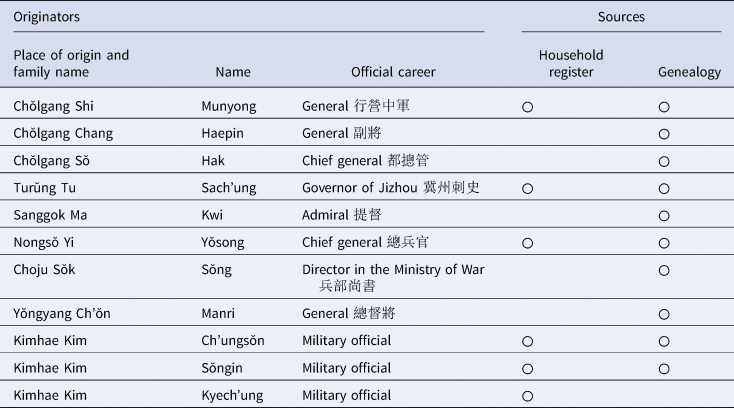
This study focuses on immigrant families that settled in Taegu and its neighboring counties. The Taegu household registers record the marriages not only of the upper class but also of the middle class and commoners, who feature less frequently in the family genealogies. The registers are especially useful for figuring out the marriage network of the Japanese families who were mostly middle class or commoners. For instance, I was able to find the records of three Japanese defectors' families in the Taegu registers. These are the families and households of Kim Ch'ungsŏn, Kim Sŏngin, and Kim Kyech'ung, who all belonged to the Kimhae Kim 金海金 clan. Unfortunately, it is not possible to discover any information or even to speculate in a meaningful way about the lives of these Japanese defectors in the years before the Imjin War, but from family records and genealogies we know that the most famous of the three defectors, Ch'ungsŏn,Footnote 31 took part in seventy-eight battles as a military official in the Chosŏn army and that after his defection he obtained a high position in the Chosŏn government.Footnote 32 The other two defectors, Sŏngin and Kyech'ung,Footnote 33 were also granted positions in the Chosŏn government following their defection from Japan (Table 1).
Chinese and Japanese immigrant families in Kyŏngsang Province

This paper will attempt to trace the lineage and describe the lives of these Chinese and Japanese immigrants and their descendants and will make use of household registers and genealogies to particularly focus on their marital relationships and social mobility. It will illustrate the major distinguishing features of immigrant families' marriage networks and explore their historical and cultural backgrounds. This study will also highlight the important role played by women in fostering divergence and social mobility within the family.
Ethnically heterogamous marriage networks
Cases in which immigrants tried to preserve their ethnic or national identity can be found throughout the records. In the premodern Korean household registers, there are many nationalized Jurchen people who continued to write their place of origin as Heilongjiang 黑龍江 for several generations after taking Korean nationality.Footnote 34 Likewise, the Chinese immigrant families descended from Ming generals used their progenitor's homeland in China as their place of origin, including Chŏlgang 浙江, Turŭng 杜陵, Nongsŏ 隴西, Sangkok 上谷, and Choju 潮州. Likewise, some of the Korean potters in Japan who were captured and brought there during the Imjin War retained their Korean identity for hundreds of years.Footnote 35
Chinese immigrant families took great pride in the fact that they originated from the great Ming dynasty and had ancestors who saved Chosŏn from the Japanese invasions. For example, the Turŭng Tu family based in the center of Taegu and the Chŏlgang Shi and Chŏlgang Sŏ families in the rural area of Sŏngju each named their village Taemyŏng-dong 大明洞, which means “village of the Great Ming”. Also, Shi Munyong, the originator of the Shi family in the Taemyŏng-dong, used to bow four times to the north (in the direction of the Ming emperor) on the first and the fifteenth days of every month while wearing Ming court dress.Footnote 36 And even in the early nineteenth century, Chinese families published a type of comprehensive genealogy which contained famous Ming Chinese immigrant families.Footnote 37
On the other hand, many immigrant families made great efforts to assimilate into Korean society. The descendants of Kim Ch'ungsŏn, for example, chose to adopt Confucianism, which formed the basis of elite culture in Chosŏn society. The first of those who gained prominence for Confucian learning in this family was Chinyŏng 振英, a grandson of Ch'ungsŏn. In 1752, Chinyŏng received an office posthumously honoring the dead from the government as a result of petitions by the Confucian communities of the county and the province.Footnote 38 This shows that the local elite communities recognized the Ch'ungsŏn's family as one of their members and that the family's efforts to assimilate into Korean elite society had been successful.
This raises the question as to whether pride in their common origins led such immigrant families to form strong marriage networks among themselves or whether this was hindered by the desire to assimilate. As mentioned above, the Turŭng Tu family settled in Taegu, so their records can be easily found in the Taegu household registers. The registers also provide information about some of the households of the sons and daughters of the Chŏlgang Shi and Nongsŏ Yi families who settled in Koryŏng and Sŏngju, close to Taegu, because they used to give their daughters in marriage to elite families in Taegu. So, in addition to the Turŭng Tu family, eleven marriages involving these Chinese families are confirmed in the Taegu household registers during the period being analyzed. To figure out their marital relations, we need to use the genealogies of some of the Chinese families who moved to the Korean Peninsula after the Imjin War: the Chŏlgang Shi, Chŏlgang Chang, Chŏlgang Sŏ, Nongsŏ Yi, and Sangkok Ma families. In the case of the Turŭng Tu family, the Taegu household registers provide a greater wealth of information than their genealogy.
I traced the marriages in five generations from the originator or the first immigrant of the family to the peninsula over a period of around 150 years.Footnote 39 There were 122 marriages involving 5 Chinese families who resided in Kyŏngsang Province, especially around Taegu. The Chinese families formed marriage relationships with 65 clans, and there was a clear preference for some clans by particular families. For example, of the 23 marriages made by the Shi family, 8 of these were made with the Sŏngju Yi 星州李 clan, and of the 15 marriages made by the Nongsŏ Yi family, 4 of these were with the Kimhae Kim clan. In the case of the 70 marriages made by the Chŏlgang Chang family, they most frequently married members of the Kyŏngju Kim 慶州金, Kyŏngju Yi 慶州李, and Kwangsan Kim 光山金 clans (5 marriages in each case). The Sŏngju Yi, Kimhae Kim, Kyŏngju Kim, Kyŏngju Yi, and Kwangsan Kim were all large clans in Kyŏngsang Province.
Within these families, I found one example of a marriage between families originating in China. This took place between the Sŏ and Sŏk families at the beginning of their period of settlement in the peninsula. It involved the daughter of Sŏ Hak 徐鶴 (in Chinese Xu he), a Ming general and the originator of the Chŏlgang Sŏ family, who married Sŏk Chaekŭm 石在錦, the son of Sŏk Sŏng, a high-ranking official who advised the Ming emperor to dispatch an army and take part in the Imjin War. After the war, Sŏk Sŏng was imprisoned and Chaekŭm fled to Chosŏn and settled in Sŏngju, close to Taegu, where he became the first immigrant and the intermediate originator of the Choju Sŏk family. His marriage with the daughter of Sŏ Hak, who resided at Sŏngju right after the Imjin War, may have helped the Sŏk family become established in Sŏngju. Though no examples of marriages of Sŏ or Sŏk families were found in the household register, their genealogies show that they had marriage networks with Korean elite society.
What is striking is that apart from the above example of the Sŏ and Sŏk families, I was unable to find any other marriages between the Chinese immigrant families in household registers and genealogies until the mid-eighteenth century. Even though these families shared a similar language and culture, fought together against the Japanese invasions, and shared a common identity as people of the great Ming dynasty, they did not intermarry with each other.Footnote 40 To understand this phenomenon, in the next section, we need to examine the cultural and historical background of Chosŏn during the period under analysis.
Before that, we will next take a look at the descendants of Japanese soldiers who defected during the Imjin War. Many Japanese defectors – including Kim Ch'ungsŏn, Kim Sŏngin, and Kim Kyech'ung mentioned earlier – served the Chosŏn government both during and after the Imjin War and were integrated into the Chosŏn army. They fought against the Manchu invasionsFootnote 41 and helped to suppress domestic rebellion in the invasions' aftermath. To reward their efforts, the Chosŏn government granted them various property and privileges, including government posts, tax exemptions, and nobi 奴婢.Footnote 42 The three defectors' families previously mentioned all settled on the southern border of Taegu.
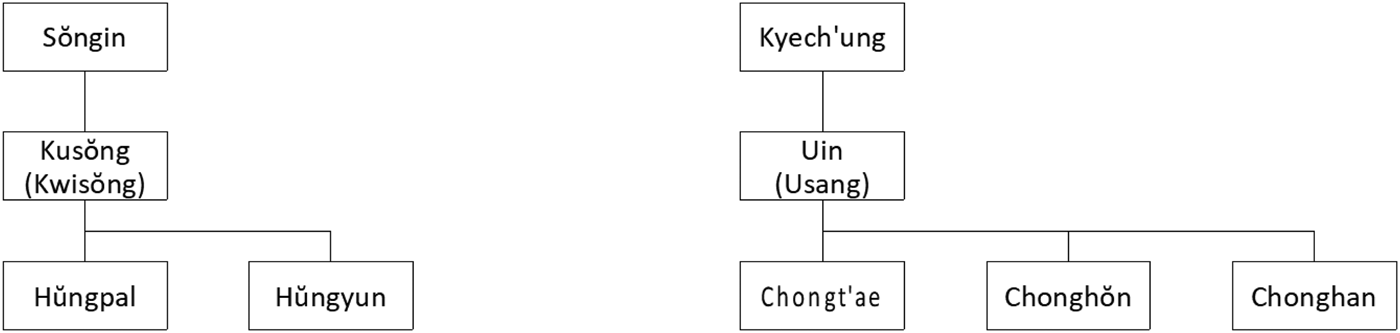
Because the household registers of this region date back to the late seventeenth century, it is possible to trace the marriage networks of these defectors and their descendants with great accuracy. In addition, the descendants of Ch'ungsŏn regularly compiled genealogies, so this study uses the genealogy of 1909 to supplement the information in the household registers (Figs. 1 and 2).Footnote 43
Family tree of Kim Ch'ungsŏn's family. * The lines in the figures indicate patrilineal male members and their father-son and sibling relationships.

Family tree of the families of Kim Sŏngin and Kim Kyech'ung.

These three Japanese defectors settled in close proximity to each other. Ch'ungsŏn settled in Urok-ri 友鹿里 Sunam-myeon 守南面, Sŏngin in Guman-ri 九萬里 Gaknam-myeon 角南面, and Kyech'ung in Nokgal-ri 彔乫里 Gaknam-myeon. Guman-ri and Nokgal-ri are located very close to one another, and Urok-ri Sunam-myeon is located about 10 km away, an easy half-day of travel. Their descendants still live in these places today.
The close relationship between these Japanese families is apparent not only in their decision to live in neighboring areas but also in their intermarriage. One prior study has argued that Japanese defectors' families married into one another after the Imjin War in order to create a strong community. This is certainly true of the Japanese families that settled in and around Taegu.
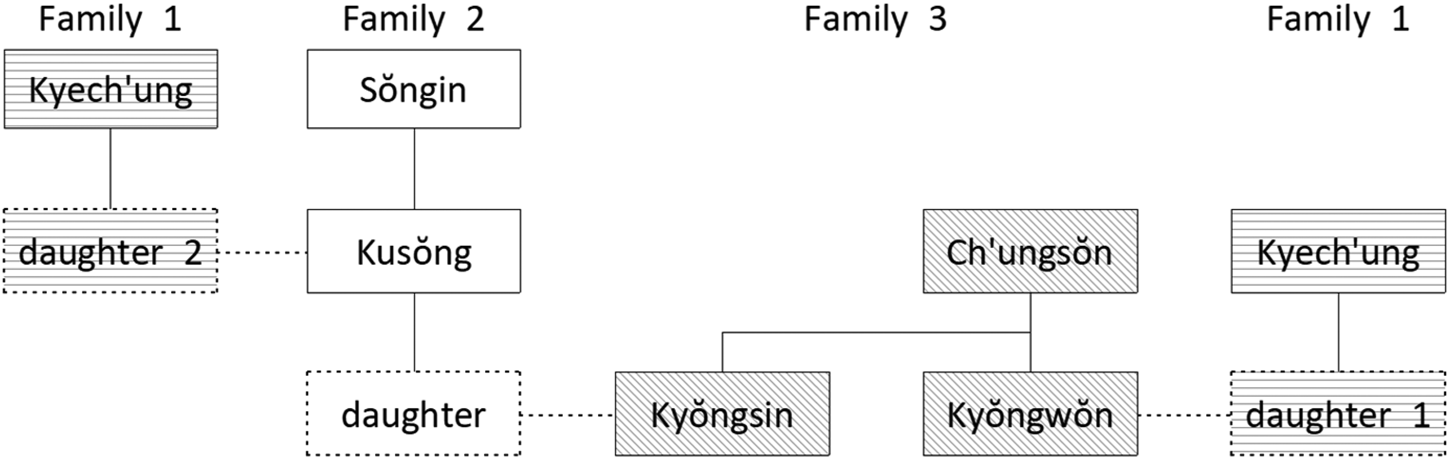
Firstly, Ch'ungsŏn, who oversaw the Japanese defectors to the Korean army, married his two sons, Kyŏngwŏn 敬元 and Kyŏngsin 敬信, to the daughter of Sŏngin and granddaughter of Kyech'ung. Secondly, Kyech'ung married his other daughter to Sŏngin's only son. As a result, these families were closely related.
However, apart from the marriages depicted in Figure 3 which all took place in the early stage of settlement, I failed to find any additional marriages between these three families in over 100 years of household registers and genealogies.
Marriage network between the Japanese families. *Dotted lines in the figure indicate women and their marriage relationships.

The male descendants of Ch'ungsŏn received 101 wives from 53 clans, according to the Taegu household registers from 1681 to 1780. They showed a preference for the women of certain clans, the most favored being the Miryang Pak 密城朴 (13 marriages), Ch'ŏngdo Kim 淸道金 (12), Kyŏngju Ch'oe 慶州崔 (6), and the Kyŏngju Yi (5) clans.Footnote 44 The sons and grandsons of Sŏngin received 36 wives from 19 clans. Of these, women from the Kimhae Kim (9), Miryang Pak (5), and Kyŏngju Yi (4) clans appeared to be favored. Kyech'ung's family married 32 times with 21 clans, most frequently receiving wives from the Kimhae Kim (8) and Miryang Pak (3) clans. Despite these clear preferences, there is no example of a specific line among these clans intermarrying more than twice.Footnote 45 This shows that they tried to make marriage alliances with as many families from the populous local clans as possible.
I examined the records of the three Japanese defectors' families to see if there were any further marriages between them in their fifth and sixth generations in the household registers between 1681 and 1780. Interestingly, of the total 169 marriages made by these three Japanese defectors' families during this period, only six were made between them, even though they shared the common bond of having risked their lives by defecting to Chosŏn during the Imjin War.
During the early stage of their settlement, it may well have been difficult for these immigrant families to communicate with native Koreans, and there would have been obvious cultural differences with Korean families. Therefore, one might assume it would be natural for some of the early settlers to intermarry, such as the examples we saw between the Sŏ and Sŏk Chinese families and between the three Japanese defectors' families in Taegu. But why did this type of intermarriage not continue beyond the initial stage of settlement? They had two options: either to create their own marriage market or to join the local elite's marriage network of Korean families. This latter option was open to them because most Chinese families belonged to the upper class from the initial time of their settlement. So, we can suppose that as they sought to integrate into the local Korean community rather than creating Chinese or Japanese diasporic communities of their own, their marital choices may have been a strategy for their settlement in a foreign country and their adoption of a new cultural context. From this point of view, the role of the Korean wife who was married to the descendants of the immigrant families was extremely important. The simplest means for immigrants and their children to access such cultural capital was by taking a Korean bride from a Korean elite family.
The next section illustrates specific cases of immigrant marriages and explains their historical circumstances in order to demonstrate how such marriages acted as a strategy to aid integration. We will also see some specific reasons why certain immigrant families chose not to intermarry.
Barriers to marriages between immigrants
In order to understand the apparent absence of a closed marriage network among immigrant families, it is necessary to understand the unique historical and cultural background of seventeenth-century Chosŏn Korea. I argue that the cultural and social differences between Chosŏn society, Ming China, and Tokugawa Japan can help to explain the various distinguishing characteristics of the heterogamous marriages displayed by immigrant families.
The first reason why these families may have sought integration rather than intermarriage was the threat of repatriation by Chinese powers. As the conflict between the Ming and the Manchu (the Jurchen 女眞) intensified, both governments began to request the repatriation of their people who had settled in the Korean Peninsula. In 1627, envoys sent by the Ming authorities repatriated fifty-eight men and five women to the Chinese mainland.Footnote 46 This was just the beginning of eighteen years of forced repatriation of Chinese from the peninsula.
Even when pressure from the Ming for the repatriation of its people receded, a new force began to make the same demands on Chosŏn: Mao Wenlong 毛文龍 and his military forces. When the Liaodong 遼東 Peninsula fell to the Manchus, the Ming general Mao led the remnants of the defeated soldiers and refugees from the region to the Korean Peninsula and stationed them on the island of Ka-do 椵島 in the Yellow Sea until 1629.Footnote 47 He extended his power by acting independently rather than following orders from the Ming or Chosŏn governments and he used to seek out and capture Ming Chinese who had settled on the Korean Peninsula.Footnote 48
Less than three decades after the Japanese invasions, the Manchu invaded Chosŏn Korea in 1627, and again in 1636–1637. The Manchu (later Qing) made several requests for the repatriation of their people;Footnote 49 however, after the second invasion, the Manchu repeatedly demanded that the Chosŏn government should repatriate not only the Jurchen, but also the Ming Chinese who had already settled in Chosŏn. This repatriation was one of the terms of surrender for Chosŏn in 1637.Footnote 50 Because of the pressure exerted by the Manchus on the Chosŏn government to fulfill its demands,Footnote 51 the number of those repatriated reached 544 by 1641.Footnote 52 This repatriation continued until 1644 when the Qing emperor announced an amnesty for the remaining Jurchen and Ming Chinese fugitives in Chosŏn.Footnote 53
For those Ming Chinese families who claimed to belong to the Ming dynasty and to be descendants of Ming generals, these demands were significant threats.Footnote 54 The Chosŏn government began to seek out Han Chinese in Kyŏnggi 京畿, Kangwŏn 江原, Hwanghae 黃海, and P'yŏngan 平安 Provinces and forcibly expelled them in response to the Qing's demands.Footnote 55 The government also searched for Han Chinese in the southern part of the Korean Peninsula in ChŏllaFootnote 56 and KyŏngsangFootnote 57 Provinces. The government even reprimanded some local governors for not finding more Ming Chinese.Footnote 58 The repatriation was conducted thoroughly to the extent that there were even some Koreans who were unjustly repatriated.Footnote 59 Even the descendants of a Ming generals who saved Chosŏn from the Japanese invasions appear to have suffered the threat of repatriation.
The case of a grandson of Yi Yŏmae 李如梅 (in Chinese Li Rumei) illustrates the situation faced by the descendants of Ming generals at this time. Yŏmae was a Ming general who took part in battles to repulse the Japanese invasions and a younger brother of Yi Yŏsong 李如松 (in Chinese Li Rusong), who was the most notable war hero among the Ming generals of the Imjin War.Footnote 60 However, Yi Sŏngryong 李成龍 (in Chinese Li Chenglong), a grandson of Yŏmae who had already settled in the peninsula,Footnote 61 was forced to hide in the countryside of Ch'ungch'ŏng 忠淸 Province to avoid being repatriated by the Qing.Footnote 62 Following his example, many Ming Chinese families tried to avoid drawing attention to themselves and made efforts to blend into Korean society to escape these threats.
A second reason for avoiding intermarriage may have been their desire to make strategic marriages that would make it easier to settle quickly on the Korean Peninsula and become part of the native Korean elite. It was difficult at this time for foreigners to become part of Korean elite society, not only because of linguistic and cultural differences but also because of differences in their economic situation.
Although these Chinese immigrants were descendants of the Ming generals who had helped defend Chosŏn, the Chosŏn government could not afford to take care of them, especially so soon after the end of the Imjin War. The annals of the Chosŏn dynasty contain an instructive example of how the descendants of the Ming military officials who fought against the Japanese invasions of Korea suffered various hardships in Korean society as they attempted to integrate during the late seventeenth century. Han Tŭngkwa 韓登科, the grandson of Han Chongkong 韓宗功 (in Chinese Han Zonggong) who had participated in the war, sent letters to King Sukjong 肅宗 in 1675 and 1681 complaining about the difficulties he was facing in trying to make a living. In response, King Sukjong provided him with food and clothing.Footnote 63
There is no reason to believe that the Chinese families who settled near Taegu did not face similar hardships. Occasionally, Chosŏn kings would award the descendants of the Ming generals various benefits to show their gratitude for the Ming dynasty's role in defending Korea. For example, King Yŏngjo 英祖 identified the descendants of Ming generals, gave them the privilege of being excluded from military service, and granted government posts to some of their capable men. However, it was not until 1705, more than a century after the Imjin War, that a Chosŏn king granted the first of these rewards (to the descendants of Yi Yŏsong) and they did not begin to significantly increase in number until the middle of the eighteenth century.Footnote 64 Rewards typically took the form of government posts granted to descendants of the Ming generals, often to the eldest son in the family or the ritual successor.Footnote 65 Despite the government's support, the situation for the descendants of Yi Yŏsong did not appear to improve substantially, as in 1788 King Chŏngjo 正祖 had to order the Ministry of Finance 戶曹 to buy a new house for Yi Yŏsong's successor, who was living in a cabin that could not protect him from the wind and rain.Footnote 66 And the unfortunate descendants of Ma Kwi, who was a less famous Ming general in the Imjin War,Footnote 67 received no benefits until much later in 1840 when the Chosŏn government first recognized their existence.Footnote 68 Although it is not possible to generalize about the situation of socio-economic hardship for Chinese immigrants based on these few cases, other sources also bear witness to their plight. For instance, Sŏng Taechung 成大中, a government official and famous writer in the late eighteenth century, described the hardships faced by Ming immigrants in his anthology Ch'ŏngsŏngjapki 靑城雜記. He describes how Chinese immigrants until the end of the Koryŏ dynasty were treated well and were accepted as members of the elite class, but that Ming immigrants experienced economic hardship and were unable to take their place in upper-class society. He cites the example of the descendants of the eight Ming scholars who followed Crown Prince Bongrimdaegun and settled in Seoul but subsequently became commoners 委巷人.Footnote 69
The practical hardships of living in a foreign country may help explain why the descendants of Ming generals favored marriages with the large kinship groups in their local region. For example, the Sŏngju Yi, Kimhae Kim, Kyŏngju Kim, Kyŏngju Yi, Kyŏngju Ch'oe, Miryang Pak, and Taegu Sŏ clans who frequently married into immigrant families were all large and populous clans that enjoyed robust economic and social bases around Taegu and Sŏngju. It is easy to see the attraction of marriages with such families for immigrant families. Fortunately for the immigrants, their prestige as descendants of Ming generals who had saved Chosŏn meant that they had something to offer in return in the marriage market. This was not the case, however, for the descendants of Japanese defectors who, because they had originally been on the side of the invaders, did not enjoy the same prestige.
A third reason why the immigrant families settled around Taegu did not favor intermarriage was differences in social status among themselves. It is useful to note the case of the Turŭng Tu family in this regard.Footnote 70 Most members of the Tu family belonged to the lower class of society, such as the nobi. In the household registers from 1681 to 1780, none of the 38 male members of the Tu family had upper-class occupations. In the registers, their occupations are recorded as belonging to this low-ranking local government office, in positions such as local headman or nobi. They were successful to a limited extent in moving up the social ladder in subsequent generations, as by the fifth generation seven out of eight wives of Tu male members belonged to the middle class. Despite this gradual rise in their social status, there was still a significant gap in status between them and the other Chinese immigrant families. As we will see later in this study, this situation was caused by an inter-class marriage in an earlier generation.
By contrast, the household registers show that most members of the Chŏlgang Shi and Nongsŏ Yi immigrant families married into elite families, in which their spouses had upper-class occupations – for example, one was a government official and another was a magistrate.Footnote 71 Because they had this option, families such as the Chŏlgang Shi and Nongsŏ Yi did not consider marriage with the Turŭng Tu family despite their shared language and culture. And because of the acute social awareness of peoples' lineage, few elite Korean families would choose to jeopardize their social status by marriage with a lower-class immigrant family such as the Turŭng Tu.
Although the Turŭng Tu family failed to create marriage alliances with other Chinese families, their marriages with middle and lower-class Koreans in the region provided them with other benefits: they were able to settle down inside the Taegu city wallsFootnote 72 and take positions at the local government offices as local headmen or as government-retained nobi as a result of marriages with local headmen families.
Social status was also a barrier for intermarriage between Japanese immigrants in their newly adopted homeland. We do not know about the military ranks held by the originators of these families when they served in the Japanese army, but we can suppose that after they switched their loyalties they were employed in gun manufacturing and military training, like many other Japanese defectors. Various historical sources indicate that Ch'ungsŏn's performance in battle had been outstanding – in fact, the records indicate that he had been renowned for his skill in battles for decades. His military success impacted the social status of his descendants for generations to come. His two sons, Kyŏngwŏn (sixty-seven years old) and Kyŏngsin (sixty-four years old) were still alive when Taegu's oldest existing household register was compiled in 1681. According to their occupational records, they held government positions; this means they were considered to be bureaucrats and part of the Yangban 兩班 elite,Footnote 73 at least for purposes of the household register.
Ch'ungsŏn's family worked steadily to improve their status and their genealogy describes their successes. For instance, Ch'ungsŏn's oldest grandson passed the military examFootnote 74 and received a government position, while his nephew, Yŏtae 汝泰, gathered his relatives and helped quell a rebellion that broke out in Kyŏngsang Province in 1728. Also, three members of Ch'ungsŏn's family married daughters of men who had passed the military exam. For those living in Taegu, passing the military exam was not an easy matter and there is no record of any other member of the other Japanese immigrant families achieving this success.
The marriage network of the Ch'ungsŏn family with members of the local elite is proof of their social success in their local region. The most notable cases are three marriages with the Taegu Sŏ family, especially with the descendants of Sŏ Sawŏn 徐思遠.Footnote 75 Sawŏn had been rewarded with the position of magistrate from the government due to his outstanding Confucian learning and had been enshrined in the Igang Private Academy 伊江書院 in Taegu after his death. We can also find some marriages with low-ranking government officials and others who had succeeded in passing lesser exams. As a result of Ch'ungsŏn's reputation and the continued efforts of his descendants, his family rose to become part of the local elite over the next 100 years. Although some of his third-generation descendants had middle-ranking military official occupations, Taegu's household registers record that all but one of the 22 grandsons of the fourth generation had occupations that would place them in the Yangban elite or the semi-elite class of “students preparing for the civil (or military) exam (幼學, 業武)”. Their attainment of elite status in local Korean society is also clearly illustrated by their marriage relationships. Nineteen out of a total of 25 wives (76 percent) of the fourth-generation male members of Ch'ungsŏn's family can be identified as belonging to the upper class as they are recorded as “氏 (lady)” in the household registers.Footnote 76 The number and proportion of wives from the upper class increased in the next generation to 28 out of a total of 34 (82 percent). By the sixth generation, all of the wives of male members of the family who appear in the 1780 register are recorded as “lady”. These figures illustrate how the upward social mobility of this family was both reflected in and reinforced by the marriage market.Footnote 77
Other Japanese families, however, failed to keep up with the Ch'ungsŏn family's rise in status. To reward the services of Sŏngin and his son, who had fought alongside Ch'ungsŏn, the Chosŏn government granted the privilege of exemption from taxation and military service. However, Tŭkch'u 得秋, the great grandson of Sŏngin, needed to petition the government because military service had been imposed on his family by the local authorities.Footnote 78 This shows how the Sŏngin family had failed to solidify their position among the elite in the local community and had fallen behind the social status achieved by the Ch'ungsŏn family.
Sŏngin's descendants show no apparent signs of decline in their occupational records in the household registers. However, we can trace with precision the way their ascent failed to keep pace with that of the Ch'ungsŏn family through their daughters' social status, because the woman's social status in the household registers mostly reflects her parental family background. Their improvement in status is shown by the fact that although all three of the fourth-generation male members married middle-class women, both of the fifth-generation members took wives from the upper class. However, the fact that all five daughters of the fifth generation were classified as middle class with the character 姓 (wife) rather than 氏 (lady) in the registers shows that they had not achieved the same level of upward social mobility as the descendants of Ch'ungsŏn.
Compared with the overall upward trend of these two Japanese defectors' families, progress for Kyech'ung's family was slow and uncertain. Kyech'ung served the Chosŏn government both during and after the Imjin War and was granted a government position. According to the household registers, however, it appears that his descendants failed to maintain their high status. Two of his three grandsons were employed as soldiers and military officials of low rank, and by the fourth and fifth generations, the registers indicate that most of his male descendants had middle and lower-class occupations. The failure of the upward social mobility of Kyech'ung's family is clearly reflected in the marriage market. Of the 11 marriages in the fourth generation, only one was a marriage with an upper-class family. And of the total seven marriages of the fifth and sixth generations recorded by 1780, only two wives came from upper-class families.
Although their initial starting point at the end of the Imjin War had been the same, by the fourth and fifth generations, a significant gap had opened up in status between these three defectors' families that reduced the likelihood of intermarriage between them. The families who had achieved a more rapid rise in social status had no reason to marry into those Japanese families below them and risk downgrading their position. This was one of the crucial reasons why the close marriage ties during the early stage of the Japanese families' settlement did not continue into subsequent generations.
The most significant cultural differences that Japanese immigrants faced in Korea arose from the role of Confucianism in Korean elite culture. Although Confucianism had not yet permeated all levels of Korean society in the seventeenth century, the Yangban elite gradually introduced Confucian family culture into wider society during this period. Therefore, the Japanese families who sought to become part of the Yangban elite needed to adapt to Confucian customs.
Kim Ch'ungsŏn and his descendants provide the best example of this process of adjusting to the Confucian norms of elite culture. After the seventeenth century, local Yangban elite families would often compile an anthology or a collection of literary works to prove their knowledge of Confucianism and provide evidence for their status as part of the Yangban elite. Although Ch'ungsŏn was a military officer in the Japanese army and would have had little knowledge of Confucianism at the time of his defection, he left behind various literary works. His seventh-generation descendant, Hancho 漢祚, collected Ch'ungsŏn's works and compiled them into an anthology in 1798. The title of this anthology, Mohadang munchip 暮夏堂文集, based on his literary pseudonym Moha (“an admirer of Confucian civilization”), was designed to display Ch'ungsŏn's admiration of Confucian culture.Footnote 79
It is likely that the early acceptance of Confucian culture in Ch'ungsŏn's family was due to his first marriage with a woman from a Korean elite family. According to the genealogy, his first wife was a daughter of Chang Ch'unchŏm, who was a magistrate of Chinju (the senior third rank).Footnote 80 She would have been responsible for helping her husband and children adapt to Korean elite culture and become proficient in the Korean language and writing in classical Chinese. Other Japanese defectors who were not successful in finding a bride from a Korean elite family received daughters from other Japanese defectors or Korean middle class military officials. As a result of their marriages in the early stage of settlement, none of the Japanese defectors' families apart from the Ch'ungsŏn family was able to compile an anthology or genealogy until the early twentieth century.Footnote 81
Korean cultural custom banned marriage between those with the same surname as per Confucian tradition. This posed another significant barrier to building strong marriage networks between Japanese families. According to Ch'ungsŏn's literary works, he was granted the surname Kimhae Kim by the king for his service during the Imjin War.Footnote 82 A similar case from the record of action 行錄 and the epigraph of the memorial tablet 墓碣銘 of SŏnginFootnote 83 shows that he received his surname and literary pseudonym from King Kwanghaegun 光海君 in 1621, not only for his victories in battles but also for improving the army's defences by pointing out mistakes and blunders made by its commander. There is no exact record of how Kyech'ung obtained his surname, but it can be assumed it was for similar service on the battlefield.
However, the crucial issue here is that Ch'ungsŏn's place of origin 本貫Footnote 84 and family name (Kimhae Kim) granted to him by the Chosŏn government were the same as those granted to Sŏngin and Kyech'ung. Therefore, all of the descendants of the three Japanese defectors share the same place of origin and family name in the household registers. At first, Sŏngin's descendants used both Andong 安東 and Ch'ŏngdo 淸道 to describe their place of origin, but this was gradually unified as Kimhae. As a result, these three families had little chance of marrying each other or other families with the Kimhae Kim surname. Indeed, the household registers until 1750 only record one marriage between the Ch'ungsŏn family and another member of the Kimhae Kim clan. Although the genealogy shows that in 1909 two wives were taken from the Kimhae Kim clan, their place of origin was changed to Ch'ŏngdo Kim to disguise the fact that these were same-surname marriages.
In summary, disparities in social status were significant barriers to marriage between immigrant families in the Korean Peninsula, and Confucian culture provided an additional reason for the early marriage network between Japanese deserters' families to come to an end. However, not all marital relations improved a family's social status, or aimed to do so; some marriages caused drastic declines in family status and long-term inequalities among family members. In the next section, we will examine various cases that show how the status of women was an important factor in determining a family's social status.
Marriage resulting in divergence within families
The role of the woman as not only the nurturer but also the educator of the child in the premodern Korean family was highly important in Korean elite society.Footnote 85 Prior studies have noted that in Qing China and Chosŏn Korean the role mothers played in the education of their children meant that the cultural capital possessed by women in elite families was a significant influence on whether their children were successful in passing the civil service exams.Footnote 86 The role of the mother was even more important in immigrant families because brides from Korean families were the main source of access to Korean language and culture.
The crucial role of women in determining the social status of her children is a unique feature of the Korean family as compared to Chinese and Japanese families. Indeed, the household registers of post-war Chosŏn Korea indicate that children's social status was, by law, determined by their mother's social status. This differs from the normal rules of family succession that were common in China and Japan during the eighteenth century. Illegitimate children born to concubinesFootnote 87 provide a notable example of how a child's status could decline as a result of the status of its mother and her position within the family.Footnote 88
During the same period in China, illegitimate sons received almost equal treatment as their legitimate siblings and did not face social discrimination. In Tokugawa 徳川 Japan, the important factor for a child was to be named as an heir, rather than their legitimacy or their mother's status. In Chosŏn society, however, illegitimate children born to a woman of lower status faced severe discrimination, both from society at large and within their own families. The chance of an illegitimate son attaining a high-ranking governmental position was negligible. By law, an illegitimate son was only able to inherit about one-tenth to one-seventh of what his legitimate half-brother might inherit.Footnote 89 In addition, illegitimate children were often not recorded in their family genealogies; on the occasions when they were recorded, it included clear references to their illegitimacy in various ways.Footnote 90
Since marriage into a lower status family could negatively influence the eventual social status of one's children, immigrant families were under pressure to adapt to the Korean hierarchical social system. Those families that did not conform to this social hierarchy in the marriage market might end up divided with children of different status because of the different status of their mothers. As an example, let us look at marriage in the Turŭng Tu family. Whereas other Chinese families ascended into the upper class of Korean society, members of the Tu family remained in the lower classes until the nineteenth century.
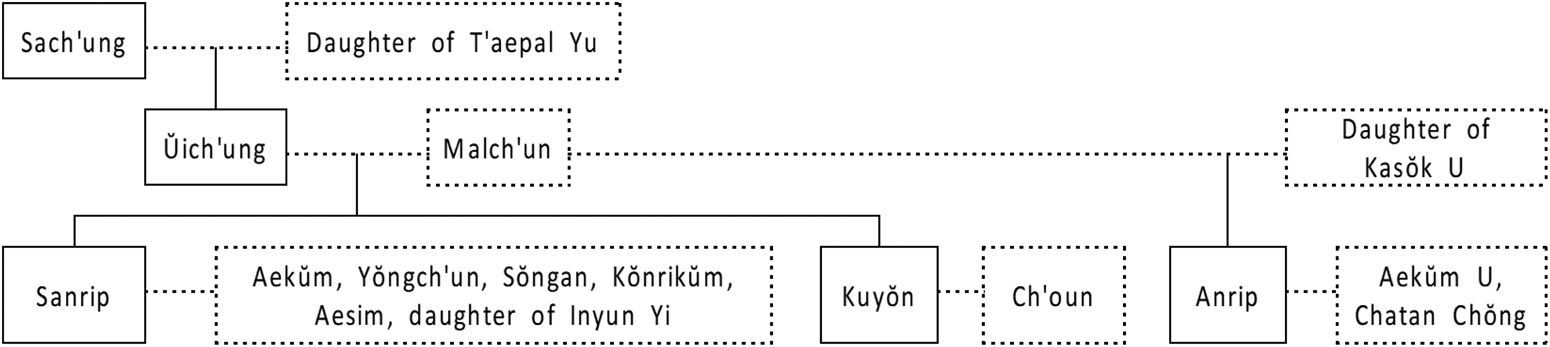
In the Taegu household registers, the Turŭng Tu family records began with the ninety-year-old Tu Ŭich'ung 杜義忠 in 1690. His father, Sach'ung, was a highly respected Ming general who took part in the Imjin War and was a famous topographer in Korean elite society after the war.Footnote 91 However, Ŭich'ung's maternal grandfather was a commoner and his mother was either a commoner or lower-class according to his ancestral records in the household register.Footnote 92 Ŭich'ung is also recorded as having a middle-class occupation in the household register. Despite his father's fame in elite society, his mother's relatively low status prevented Ŭich'ung from attaining the same level of social status as his father. His two marriages,Footnote 93 one to a commoner and one to a woman of lower class, also testify to his lack of elite status, as the wife's social status was a good indicator of her husband's status in Chosŏn society (Fig. 4).
Family tree of Tu Sach'ung's family.

As stated previously, the mother's social status determined that of her children. Differences in status between siblings according to their mothers' status occurred in Ŭich'ung's sons' generation. Ŭich'ung had three sons from two wives. His first wife, Malch'un 唜春, was a privately owned nobi and was thus of lower class than his second wife, who was probably a commoner judging by her father's occupational record. This difference between the two wives meant that Ŭich'ung's sons had different social status. Born to the lower-class mother, Sanrip 山立 and Kuyŏn 龜淵 both married nobi. The fact that the eldest son, Sanrip, was of low status is also indicated by his non-Confucian style of marriage: he had at least six partners, four of whom were nobi. By contrast, Anrip 安立, whose mother was a commoner, married twice, both times to middle-class commoners.
The marriages of Tu Yuching 有徵, a low-ranking local government functionary and a grandson of Tu Ŭich'ung, resulted in similar divergence in status within a family. Tu Yuching had two wives: Hyonyŏ 孝女 was a nobi owned by the provincial government, and Kim was a commoner “woman 召史”. Hyonyŏ gave birth to two sons, Sinhaeng 愼行 and Poksong 福松, who were also nobi of the provincial government with the same status as their mother. In contrast, Kim's son, Ch'ŏnhaeng 天行, was a local government low-ranking military official of similar rank to his father and mother. This case again clearly shows that the mother's status was crucial in Chosŏn local society.
Let us move on to the situation of the Japanese defectors' families in Taegu. As mentioned earlier, Kim Ch'ungsŏn's family was the most successful of the three Japanese families in improving its social status. However, some of the wives of Ch'ungsŏn family members slowed rather than contributed to their upward mobility.
Ch'ungsŏn's second son, Kyŏngsin, had two wives – the daughters of Yi Koro 李考老 and Kim Kusŏng 金九聲. Kim Kusŏng was the son of the Japanese defector Kim Sŏngin, and Yi Koro was also likely to have been a Japanese defector judging from his Japanese-style name. Kyŏngsin's two sons, Chinhŭng 振興 and Chinpal 振發, who were born to Yi Koro's daughter, were low-ranking military officers. However, his other three sons, who were born to Kim Kusŏng's daughter, had upper-class occupational records, such as “scholar student 幼學”, and their wives were mostly from Yangban elite families. From this, we can conclude that the daughter of Yi Koro was of lower status than the daughter of Kim Kusŏng (Fig. 5).
Family tree of Kim Kyŏngsin's family.

Some of Ch'ungsŏn's great-grandchildren had a lower status than their half-brothers due to the status of their mothers. Chinmyŏng 振鳴, Ch'ungsŏn's oldest grandson, had two wives: the “lady 氏” Yi and the daughter of Sin Chinyŏng 辛震英. Unlike the “lady” Yi's four sons, all of whom married upper-class women designated as “lady”, the youngest son born to the daughter of Sin Chinyŏng married a commoner-class woman with the mark of “woman”.Footnote 94 Over time, the youngest son's wife also achieved the title of “lady” in the household registers, but this was almost thirty years later than his siblings' wives. We can conclude that these inequalities among brothers occurred due to the difference between the social status of the “lady” Yi and the daughter of Sin Chinyŏng (Fig. 6).
Family tree of Kim Chinmyŏng's family.

In Kim Ch'ungsŏn's family, we can also find records of concubines and their lower-status illegitimate children. One of Ch'ungsŏn's grandsons, Chinki 振起, had a concubine, the “woman” Kim, who gave birth to an illegitimate son, Mongki 夢己. Mongki was one of only three men married to commoner-class women among the twenty-three brothers and cousins in the fourth generation. One of the other men who married a commoner, Yŏpyŏk 汝碧, was also an illegitimate son according to the family genealogy. In addition, Mongki was the only one of the male members of the fourth generation to have their occupation recorded as a commoner.
It is also interesting to examine the places of residence of these illegitimate sons. The Ch'ungsŏn family settled in Urok-ri, Taegu, in the early seventeenth century and most of the family members continued to live in the village for hundreds of years. The records show where seventeen of the members of the fourth generation lived; of these, it is only the illegitimate sons, Mongki and Yŏpyŏk, who did not live in Urok-ri but about two kilometers further up the mountain in a village called Paengnok-ri 白鹿里. They may have chosen to live in a different village to avoid discrimination from their legitimate brothers and cousins in the family village community. From this, we can see how the lower status in the family and society of illegitimate children is revealed not only by their marriages, but also by their occupational records and place of residence.
Finally, let us examine the marriages that brought about the divergence in Kim Sŏngin's family. Kim Hŭngyun 興胤, a grandson of Sŏngin, had one son and five daughters from three partners. His first partner was “wife” Kim, the second was a daughter of Kim Ŏkpok 金億卜, and the third was Tolrye 乭礼, a nobi. It is not clear whether Tolrye was a concubine or a wife, but her daughter as a nobi was of much lower status than her half-siblings, one of whom was a “lady” and the others middle class. Similarly, Tolrye's son-in-law is recorded as a nobi, whereas Hŭngyun's sons-in-law all belonged to the middle class.
Immigrants from outside of the Korean Peninsula needed to receive brides from Korean families who had economic, social, and cultural capital in local society, in order to adapt to life in their new homeland as quickly as possible. Most Chinese families and Kim Chungsŏn's family successfully found a bride from Korean elite families in the early stage of their settlement. It helped them to join elite society and maintain their status, even though their families did not produce any high-ranking government official or successful candidates for the civil exam for centuries after their settlement. In contrast, families who were not quickly aware of the importance of women in Korean society and social hierarchy paid the price over time, and they achieved upper class occupational records much later than immigrant families who were more successful in the early marriage market.
In Chosŏn society, the wife's social status was usually an accurate indicator of the husbands' status and the most important factor in determining their children's status. This was significantly different from Ming and Qing Chinese society, where the rigid social class system had broken down centuries previously. Unfamiliar with hierarchical Chosŏn society, Tu Sach'ung, the well-known Ming general and originator of the Tu family in Taegu, may have given too little thought to the consequences of taking a commoner wife for the social status of his descendants in their newly adopted homeland. In the final Taegu household register of 1876 in which 5,169 (56 percent of the total) of 9,198 household heads were recorded as having an upper-class occupational record, some of his descendants were still languishing as local headmen belonging to the middle class.
Conclusion
Marriage has been a significant survival strategy for individuals and families in many historical circumstances, and it was especially significant for the Chinese and Japanese immigrants who settled in the Korean peninsula after the Imjin War. This study has traced the marriages of immigrant families that are recorded in the Taegu household registers and in genealogies over a period of about 150 years to test the hypothesis that they would have intermarried to create a strong immigrant network based on shared ethnicity that would help them face the challenges of living in a foreign country. In contrast to expectations, it appears that the Chinese and Japanese immigrants who settled around Taegu rarely married each other during the period under analysis.
Instead, it appears as though the cultural and historical situation in Chosŏn Korea after the Imjin War actively prevented immigrants from forming communities with one another. Rather than coming together to form a strong immigrant community, they remained separate and faced the challenges of living in a foreign country by trying to integrate into the culture of their new homeland on their own.
One major historical reason for this was the continuous demand for repatriation of Han Chinese who had settled in the Korean peninsula by the Ming and Qing authorities and also the threat of capture by the rebel Ming general Mao Wenlong in the early seventeenth century. As a result, many Chinese families tried to avoid drawing attention to themselves and made efforts to blend into Korean society to avoid repatriation. One of the most effective means of integration was to marry into native Korean society rather than seeking to establish a distinct immigrant community.
The practical hardships of living in a foreign country also help explain why the descendants of Ming generals favored marriages with influential local clans who had long-established economic and social bases in the region rather than with immigrant families. Fortunately for most of the Chinese immigrants, their prestige as descendants of Ming generals who had saved Chosŏn during the Imjin War meant that they had something to offer in return in the marriage market.
The gap that opened up in social status among the descendants of the original immigrants was another factor responsible for preventing their intermarriage. The Turŭng Tu family experienced a dramatic fall in social status because the originator of the family married a commoner. As a result, this family was viewed unfavorably in the marriage market by both local elite families and other Chinese immigrant families, despite their shared heritage.
In the case of Japanese immigrant families, the Confucian principle that banned same-surname marriage presented a substantial obstacle to their intermarriage as the three families in the Taegu registers shared a common surname. In addition, the early success of the Kim Ch'ungsŏn family in achieving the social status of the Yangban elite meant that they were unlikely to consider marriage with other Japanese defectors' families who had not been as successful in improving their status.
But perhaps most importantly, this study contributes to the growing research that questions the established timeline for the “Confucian transformation” of the Korean family by demonstrating how the uniquely important role of women in Korean hierarchical society influenced the marriages of immigrant families. The Korean women from elite families who married into immigrant families possessed social and cultural capital that enabled immigrant families to form social networks with the elite class and gain success in the civil service examinations. Early recognition of the important role played by women and strategic marriages provided an easy route for some immigrant families to be accepted into local elite society. Families such as the Turŭng Tu, however, who failed in the first generation of immigration to take a bride from the upper class of Korean society, struggled to improve their social status in subsequent generations. The importance of women as repositories of social and cultural capital in immigrant families thus causes us to question the dual assumptions that the Korean family system was fully “Confucianized” in the seventeenth century and that women had only a subordinate position within the family structure, although it is unclear whether the importance of a woman's marital role resulted in greater status and freedom in day to day life.
What this study demonstrates is that the status of women is a vital key to understanding premodern Korean society, as it was the social status of the mother that determined the status of her children and had a long-term impact on families over many generations. The fact that the social and cultural capital of the wife was more important than shared bonds of language, culture, and ethnicity in the marriages of immigrant families after the Imjin War is a pertinent reminder of the importance of women and marriage in premodern Korean family culture.
Acknowledgements
This work received funding from the European Research Council (ERC) under the European Union's Horizon 2020 research and innovation program (No 758347).