Introduction
The plant–herbivore interactions both affect and are affected by their relationships with the third trophic level, natural enemies (predators, parasitoids, or parasites) of herbivores. Not only the interactions between plants and herbivores can have selective impact on natural enemies, but also natural enemies may exert reciprocal selective pressure on these interactions (Ode, Reference Ode2006). In multitrophic systems, lower trophic members may have evolved in such a way that to be less attractive for higher trophic levels (Price et al., Reference Price, Bouton, Gross, McPheron, Thompson and Weis1980) and in these systems, the alternate trophic levels have symbiotic relationships. For example, the natural enemies satisfy plants by reducing herbivore density and plants make herbivores more vulnerable to serve natural enemies (Ahmad et al., Reference Ahmad, Aslam and Razaq2004). Although, the role of natural enemies in reducing herbivores population has been demonstrated by many researchers, in most systems both the quantity and nutrient quality of host-plant resources are also likely to be important bottom-up factors (Nikooei et al., Reference Nikooei, Fathipour, Javaran and Soufbaf2015, Reference Nikooei, Fathipour, Javaran and Soufbaf2017; Karami et al., Reference Karami, Fathipour, Talebi and Reddy2018a, Reference Karami, Fathipour, Talebi and Reddy2018b). Both latter factors can influence herbivore populations by altering their feeding preference and performance (Waring and Cobb, Reference Waring, Cobb and Bernays1992).
The plant quality and quantity can also indirectly influence top-down factors by altering the effectiveness of herbivore natural enemies in various manners. For instance, poor food quality increases herbivore foraging behavior and exposure time to natural enemies (Slansky and Feeny, Reference Slansky and Feeny1977; Bergelson and Lawton, Reference Bergelson and Lawton1988). It has also been argued that plant-mediated reduction in larval growth can increase susceptibility of herbivorous larvae to be more attacked by natural enemies (Alipour et al., Reference Alipour, Fathipour and Farazmand2016). Decreased herbivore body size and fecundity, in result of feeding on resistant host plants, can also lead to increased performance of natural enemies (Khanamani et al., Reference Khanamani, Fathipour and Hajiqanbar2015; Alipour et al., Reference Alipour, Fathipour, Farazmand and Khanamani2019). The presence, absence, or even altered ratios of these elements in plants can also affect survival and developmental rates of natural enemies. Chen et al. (Reference Chen, Ruberson and Ni2014) demonstrated a longer developmental time (30%) in larvae of Cotesia marginiventris (Cresson) (Hym.: Braconidae) reared on Spodoptera exigua (Hübner) (Lepidoptera: Noctuidae) fed on cotton cultivars with low nitrogen content compared with those reared on S. exigua fed on high nitrogen content ones.
Although, the relationship between biological control agents and resistant host plants can be generally positive, sometimes the overall effect on pest population may be less than the sum of the effects of each factor. For instance, the inevitable intake of chemicals (e.g., cardenolides) by herbivores and subsequent uptake of compounds from the midgut, can change hemolymph composition. These compounds may simply be in transit through the gut, or sequestered and used as a defensive response in herbivores (Price et al., Reference Price, Bouton, Gross, McPheron, Thompson and Weis1980). Natural enemies feeding on these hosts may damage due to cascading allelochemical negative effects. The negative effect of the first trophic level on performance of natural enemies in a tritrophic system has been evidenced for some natural enemies like Diaeretiella rapae (McIntosh) (Hymenoptera: Braconidae) on Myzus persicae (Sulzer) (Hemiptera: Aphididae) feeding on different pepper cultivars (Ghorbanian et al., Reference Ghorbanian, Fathipour, Talebi and Reddy2019) and Phytoseiulus persimilis Athias-Henriot (Acari: Phytoseiidae) fed on Tetranychus urticae Koch (Acari: Tetranychidae) reared on greenhouse cucumber cultivars (Bahari et al., Reference Bahari, Fathipour, Talebi and Alipour2018).
Habrobracon hebetor Say (Hymenoptera: Braconidae) is one of the most important beneficial and widely used parasitoids in insect biological control programs due to its short lifespan and rapid population growth on hosts. There are many instances on the successful employment of H. hebetor against different lepidopteran species either in warehouses and production fields solely (Chen et al., Reference Chen, Zhang, Zhu and Throne2013; Saadat et al., Reference Saadat, Seraj, Goldansaz and Karimzadeh2014) or in combination with other parasitoids as a complementary biocontrol agent (Tuerxun et al., Reference Tuerxun, Guo, Akedan, Xu and J2006; Bagheri et al., Reference Bagheri, Askari Seyahooei, Fathipour, Famil, Koohpayma, Mohammadi-Rad and Parichehreh2019). The bottom-up effect of host-plant quantity and quality on the life table parameters of H. hebetor has been studied by different researchers. For instance, Kaur et al. (Reference Kaur, Kaur and Dhindsa2013) showed a significant change in fecundity and longevity of H. hebetor on S. litura (Fabricius) (Lepidoptera: Noctuidae) fed with a coumarin-incorporated diet.
In our previous study, we provided valuable information on the resistance of 24 sugar beet genotypes to S. exigua (Talaee et al., Reference Talaee, Fathipour, Talebi and Khajehali2017a). Our results unveiled existence of a diverse range of resistance, from high susceptible to resistant, among sugar beet genotypes studied (Talaee et al., Reference Talaee, Fathipour, Talebi and Khajehali2017a). As the host plant nutritional quality (Karowe and Martin, Reference Karowe and Martin1989) and secondary chemical compound composition (Barbosa et al., Reference Barbosa, Gross and Kemper1991; Price, Reference Price, Boethel and Eikenbarry1986) are among the primary factors mediating herbivore-parasitoid interactions, in the current investigation we aimed to study the bottom-up effects of various sugar beet genotypes on performance of H. hebetor in a tritrophic system consisting of sugar beet genotypes, S. exigua and H. hebetor. Different sugar beet genotypes in terms of resistance would extend our chance to gain the proper results for employing in integrated pest management programs.
Materials and methods
Host plants
Seeds of 10 sugar beet (Beta vulgaris L.) genotypes, including five cultivars (SB26, SB27, SB29, SB33, and SB34), one hybrid (7112*SB36)*Sh-1-HSF-5, and four lines (FC220, FC301, SBSI006, and HM 1339RZ) were prepared from the Sugar Beet Seed Institute, Karaj, Iran. A diverse range of resistance to S. exigua [SB26, (7112*SB36)*Sh-1-HSF-5, SB27, HM 1339RZ, SBSI006, SB29, SB34, SB33, FC220, and FC301 from high susceptible to high resistant] in the above mentioned genotypes has been evidenced by Talaee et al. (Reference Talaee, Fathipour, Talebi and Khajehali2017a). Plants were grown from the seeds in 24-cm-diameter plastic pots, each containing standard nursery mixed soil, in an insect proof greenhouse under 25 ± 1 °C, 60 ± 5% RH, and 16:8 (L: D) h photoperiod in experimental station of the Faculty of Agriculture, Isfahan University of Technology, Isfahan, Iran. The lack of infestation to other pests was confirmed by daily check. During the course of experiments, no pesticides or fertilizers were used on plants of pots. The sixth leaf growth stage (youth stage) was used for feeding assay.
Rearing Spodoptera exigua
A colony of S. exigua was established using 100 larvae collected in late May from sugar beet fields in Isfahan, Iran. The larvae were reared on lettuce (Lactuca sativa L.) (cultivar Romaine) under laboratory condition at 25 ± 1 °C, 60 ± 5% RH, and 16:8 (L: D) h photoperiod. Adults of this colony were kept in plastic containers (17 cm diameter and 16 cm height) for oviposition. A small cotton wick soaked in 10% honey solution was placed in oviposition jars for adult feeding. Before the experiments, offspring of the colony were reared separately on sugar beet genotypes (the respective genotypes tested) for two consecutive generations.
Rearing Habrobracon hebetor
To establish a laboratory colony of H. hebetor, a high number of the fifth S. exigua larvae were collected from Isfahan sugar beet fields. These larvae were kept in a growth chamber at 25 ± 1 °C, 60 ± 5% RH, and 16:8 (L: D) h photoperiod up to the end of their life cycle and finally H. hebetor wasps were harvested. To colonize H. hebetor in the laboratory condition, the last larval instars of Ephestia kuehniella Zeller (Lep.: Pyralidae) were used as an factitious host. The parasitized larvae of E. kuehniella were maintained under the same condition mentioned above. Adults of H. hebetor supplied with 20% honey solution were introduced separately to S. exigua larvae fed on the studied genotypes. They completed two consecutive generations on each genotype before experiment initiation. To do so, five last larval instars of S. exigua were placed between two net layers fastened in the open side of a glass (7.5 × 5.5 × 9.5 cm) containing a pair of H. hebetor. To increase the population density of H. hebetor wasps, the S. exigua larvae were refreshed daily.
Life history study
To study the life history traits of H. hebetor, each of newly emerged females of H. hebetor (<24 h old) on each genotype was paired with a single male harvested from the same genotype. The mated females then were allowed to parasitize S. exigua larvae (reared on the same genotype) for 24 h. Only one egg on each larva was allowed to feed and the others were removed. So the experiment was initiated with 100 eggs (100 parasitized larvae) as a cohort. The H. hebetor larvae were checked daily up to pupal stage and adult emergence or death in each stage. After adult emergence, they were sexed, coupled, and introduced to five S. exigua larvae daily. During the adult stage, daily observation was made to determine longevity, fecundity, and mortality of females and males until the death of all individuals.
Data analysis
The data of all individuals of H. hebetor parasitized S. exigua reared on the various sugar beet genotypes were analyzed based on the age-stage, two-sex life table theory (Chi and Liu, Reference Chi and Liu1985; Chi, Reference Chi1988). The adult pre-oviposition period (APOP, the duration from female adult emergence to the first oviposition) and the total pre-oviposition period (TPOP, the duration from egg to first oviposition) were calculated from the raw data of an individual female. The age-stage-specific survival rate (sxj) (the probability that a newly emerged individual will survive to age x and stage j); the age-specific survival rate (lx) (the probability of a newly laid egg survives to age x); the age-stage-specific fecundity (fxj) (the mean fecundity of females at age x); the age-specific fecundity (mx) (the mean fecundity of individuals at age x); and the population growth parameters (the intrinsic rate of increase (r); the finite rate of increase (λ) that λ = er; the net reproductive rate (R 0) the gross reproductive rate (GRR); and the mean generation time (T)) were calculated accordingly (Fathipour and Maleknia, Reference Fathipour, Maleknia and Omkar2016; Maleknia et al., Reference Maleknia, Fathipour and Soufbaf2016). The age-specific survival rate included both males and females, and was calculated as follows:
 $$l_x = \mathop \sum \limits_{\,j = 1}^k s_{xj}$$
and
 $$m_x = \displaystyle{{\mathop \sum \nolimits_{\,j = 1}^k s_{xj}f_{xj}} \over {\mathop \sum \nolimits_{\,j = 1}^k s_{xj}}}$$
where k is the number of the stages.
The intrinsic rate of increase is estimated by using an iterative bisection method from the following equation:
 $$\mathop \sum \limits_{x = 0}^\omega e^{{-}r\lpar {x + 1} \rpar }l_xm_x = 1$$
with age indexed from 0 to ω (maximum age). The net reproductive rate (R 0) is estimated (Goodman, Reference Goodman1982) as:
 $$R_0 = \mathop \sum \limits_{x = 0}^\omega \mathop \sum \limits_{\,j = 1}^k s_{xj}f_{xj}$$
The mean generation time is the time length that a population needs to increase to R 0-folds of its size as the population reaches the stable age-stage distribution and is calculated as T = ln R 0/r.
The life expectancy (exj) was calculated according to Chi and Su (Reference Chi and Su2006):
 $$e_{xy} = \mathop \sum \limits_{i = x}^n \mathop \sum \limits_{\,j = y}^m {s}^{\prime}_{ij}$$
where s′iy is the probability that individuals of age x and stage j will survive to age i and stage y and was calculated by assuming s′xj = 1.
The related software, TWOSEX-MSChart (Chi, Reference Chi2016) was used in this analysis. To ensure more precise estimates, all of the standard errors were estimated by the bootstrap technique with 100,000 bootstrap numbers and then used the paired bootstrap test to compare the differences among genotypes (Reddy and Chi, Reference Reddy and Chi2015; Bahari et al., Reference Bahari, Fathipour, Talebi and Alipour2018).
Results
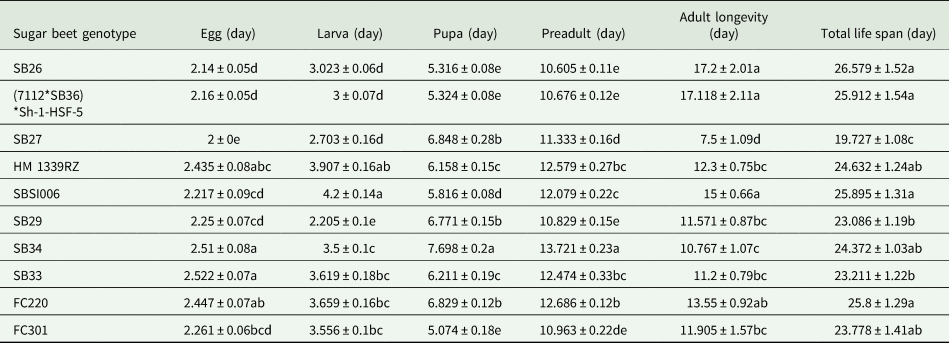
There was significant difference in developmental time and adult longevity of H. hebetor reared on S. exigua fed on various sugar beet genotypes (Paired bootstrap test, P < 0.05). The shortest pre-adult period (10.605 days) was found on SB26, followed by (7112*SB36)*Sh-1-HSF-5 (10.676 days). The longest pre-adult period of H. hebetor (13.721 days) was recorded on SB34 followed by FC220 and HM 1339RZ. The longest adult longevity and lifespan were found on SB26 followed by (7112*SB36)*Sh-1-HSF-5. However, the shortest adult longevity and lifespan occurred on SB27 (Table 1).
Mean (±SE) duration of different pre-adult stages, adult, and total life span (days) of H. hebetor on S. exigua fed on 10 sugar beet genotypes

The mean followed by the same letter in each column are not significantly different (Paired bootstrap test, P < 0.05). The order of genotypes in the table has been arranged based on their resistance to S. exigua (from susceptible to resistant) documented by Talaee et al. (Reference Talaee, Fathipour, Talebi and Khajehali2017a).
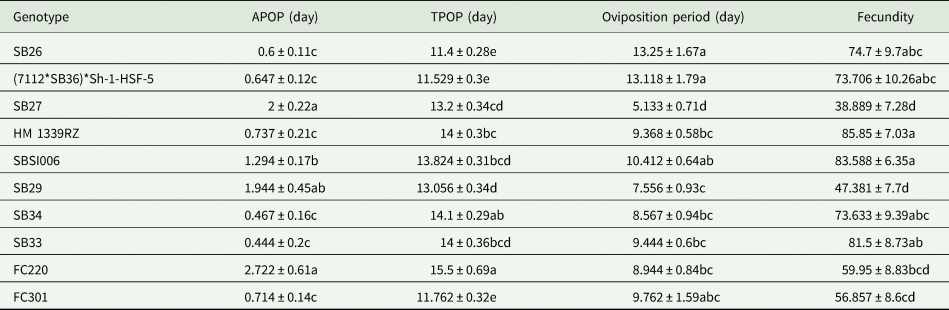
The mean APOP, TPOP, oviposition period, and fecundity of H. hebetor are shown in Table 2. The longest and shortest APOP and TPOP were observed on FC220 and (7112*SB36)*Sh-1-HSF-5 hybrid, respectively. The longest oviposition period was found on SB26 and (7112*SB36)*Sh-1-HSF-5. The highest and lowest fecundity of H. hebetor were obtained on HM 1339RZ and SB27, respectively (Table 2).
Mean (±SE) duration of APOP, TPOP, oviposition period (day), and fecundity of H. hebetor on S. exigua fed on 10 sugar beet genotypes

The mean followed by the same letter in each column are not significantly different (Paired bootstrap test, P < 0.05(. APOP: adult pre-oviposition period; TPOP: total pre-oviposition period. The order of genotypes in the table has been arranged based on their resistance to S. exigua (from susceptible to resistant) documented by Talaee et al. (Reference Talaee, Fathipour, Talebi and Khajehali2017a).
The curves of age-specific survival rate (lx) of H. hebetor fed on S. exigua reared on various sugar beet genotypes are plotted in fig. 1, showing the probability that a newborn individual will survive to age x. The age specific fecundity (mx) and age-stage specific fecundity (fxj) are shown in fig. 1. The highest convexity and concavity of lx were observed on SB34 and FC301, respectively. The survival rate of H. hebetor individuals on various sugar beet genotypes was different. While the longest survival rate (37 days) occurred on FC220 and FC301, its shortest value (27 days) was observed on SB27. The curve of age-specific fecundity of the total population (mx) (fig. 1) showed the highest mean laid eggs occurred at day 31 (13 eggs per individual per day) on FC220. The highest value of age-stage specific fecundity (fxj) of H. hebetor on SB26, SB27, SB29, SB33, SB34, (7112*SB36)*Sh-1-HSF-5, FC220, FC301, SBSI006, and HM 1339RZ was 8.75, 9.16, 7, 11.38, 12.14, 9.2, 10.5, 6.93, 10.82, and 11.42 eggs per female per day, respectively.
Age-specific survivorship (lx), age-stage specific fecundity (fxj), and age-specific fecundity (mx) of H. hebetor on the 10 sugar beet genotypes.

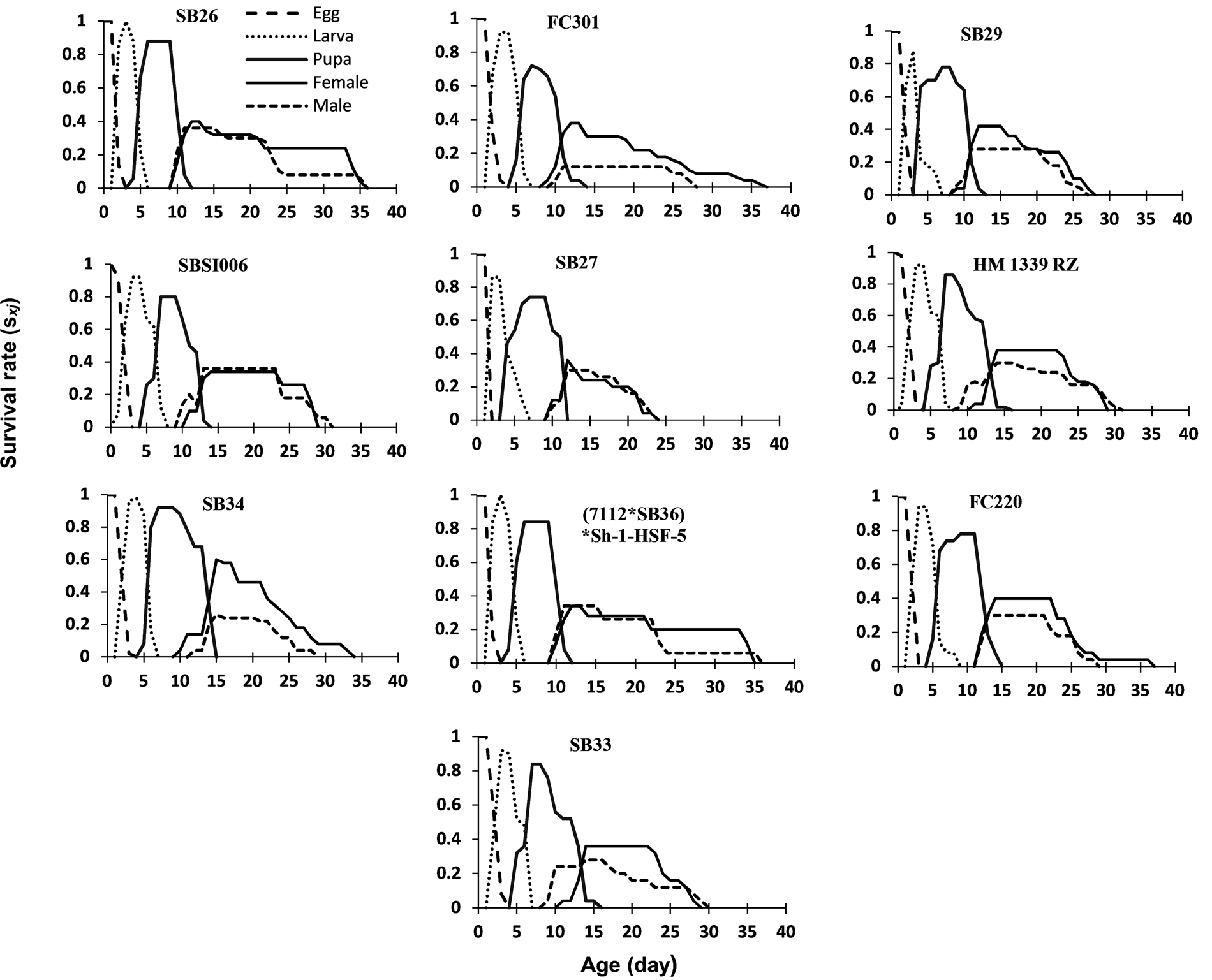
The curves of age-stage survival rate (sxj) that show the survival probability in different stages of H. hebetor fed on S. exigua on various sugar beet genotypes are plotted in fig. 2. The probability that a newborn egg survives to the adult stage was 0.14, 0.36, 0.42, 0.36, 0.6, 0.34, 0.4, 0.38, 0.34, and 0.38 for females and 0.36, 0.3, 0.28, 0.28, 0.26, 0.34, 0.3, 0.12, 0.36, and 0.3 for males of H. hebetor fed on S. exigua reared on SB26, SB27, SB29, SB33, SB34, (7112*SB36)*Sh-1-HSF-5, FC220, FC301, SBSI006, and HM 1339RZ, respectively. The highest and lowest pre-adult death rates were recorded on SB27 and SB34, respectively.
Age-stage survival rate (sxj) of H. hebetor on the 10 sugar beet genotypes.

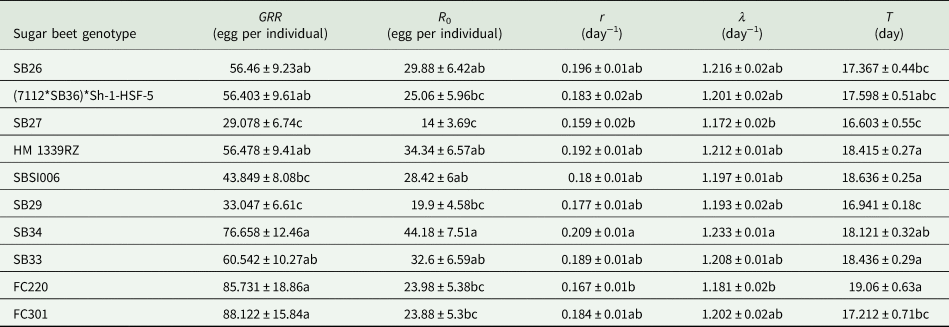
The population (life table) parameters of H. hebetor on different sugar beet genotypes are shown in Table 3. The highest intrinsic rate of increase (0.209 day−1) and the finite rate of increase (1.233 day−1) and the lowest values of these parameters (0.159 and 1.172 day−1, respectively) were observed on SB34 and SB27, respectively. The lowest R 0 and GRR (14 and 29.078 eggs per individual, respectively) and T (16.603 day) were observed on SB27. The highest value of R 0 and GRR (23.98, 85.737 eggs per individual, respectively) and T (19.06 days) was observed on FC220.
Age-stage, two-sex life table parameters of H. hebetor on S. exigua fed on 10 sugar beet genotypes

The mean followed by the same letter in each column are not significantly different (Paired bootstrap test, P < 0.05). The order of genotypes in the table has been arranged based on their resistance to S. exigua (from susceptible to resistant) documented by Talaee et al. (Reference Talaee, Fathipour, Talebi and Khajehali2017a).
Discussion
There is a highly complicated relationship between consecutive and alternate members in an ecological tritrophic system consisting of plant, herbivore, and natural enemies (Woodward, Reference Woodward and Guys2010) which needs to be identified in agroecosystems where the integrated pest control program is implemented. Although in the current study we showed that H. hebetor could parasitize S. exigua larvae on all sugar beet genotypes and complete its life cycle successfully, a high variation was found in the life table parameters of H. hebetor on these genotypes. This may result from genotype-specific chemicals cascaded up to H. hebetor via its host, S. exigua (Nikooei et al., Reference Nikooei, Fathipour, Javaran and Soufbaf2015). In the previous study (Talaee et al., Reference Talaee, Fathipour, Talebi and Khajehali2017a), we found that various sugar beet genotypes strongly affected the life table parameters of S. exigua. Accordingly, the genotypes were classified from high resistant to high susceptible based on their resistance to S. exigua. Here we also showed that these genotypes could affect H. hebetor life history traits through rendering allelochemicals via S. exigua (see Karami et al., Reference Karami, Fathipour, Talebi and Reddy2018a).
Results of the present study showed that H. hebetor had high age-stage survival rate, age-specific survival rate, and population parameters on SB34. Negative effects of this genotype on fitness of S. exigua may benefit H. hebetor to have high performance on this genotype. The adverse effects of SB34 on the life history traits of S. exigua including long pre-adult duration and low intrinsic rate of increase of S. exigua on SB34 were documented in our previous study (see Talaee et al., Reference Talaee, Fathipour, Talebi and Khajehali2017a). Synergistic interaction between plants and natural enemies in a tritrophic system has been frequently demonstrated by different researchers (see Khanamani et al., Reference Khanamani, Fathipour and Hajiqanbar2015; Alipour et al., Reference Alipour, Fathipour and Farazmand2016). On the other hand, parasitoids often have to expend high amounts of energy in the larval stages to disrupt the immune system of their herbivore hosts, resulting in increased pre-adult duration and energy deficiencies in the adult stage (Bae and Kim, Reference Bae and Kim2004). Therefore, when the plant chemicals can disrupt the herbivore immune system, they supply parasitoid larvae indirectly to keep their energy reserve necessary to disrupt the immune system of their herbivore host (Gols, Reference Gols2014). Regarding SB34, the plant chemicals may have a key role in suppressing the S. exigua immune system and increased H. hebetor performance which needs to be further investigated (Bae and Kim, Reference Bae and Kim2004; Gols, Reference Gols2014). In addition, high carbohydrate content of SB34 makes this genotype more desired to be fed by S. exigua larvae. Feedings on these larvae may help H. hebetor to compensate its lost energy (Fuchsberg et al., Reference Fuchsberg, Yong, Losey, Carter and Hoffmann2007).
The lowest values of r, λ, R 0, GRR, and T of H. hebetor on SB27 may reflect unsuitability of this genotype to be colonized by H. hebetor. Finding of Talaee et al. (Reference Talaee, Fathipour, Talebi and Khajehali2017a) showed short pre-adult duration of S. exigua on SB27 and susceptibility of this genotype. Based on the mentioned study, SB27 was also bunched with other susceptible sugar beet genotypes. Feeding on susceptible host plants with no strong immune system enables herbivores to find an opportunity to sequester harmful compounds used as a constitutive chemical defense against their natural enemies (Karimzadeh and Wright, Reference Karimzadeh and Wright2008). Higher phenol oxidase activity and stronger immune system have been reported in herbivores feeding on susceptible host plants than those feeding on resistant ones (Karimzadeh and Wright, Reference Karimzadeh and Wright2008). In SB27, it is likely low free carbohydrate content in association with high phenol oxidase activity of S. exigua resulted in less colonization of H. hebetor. The immune response of an herbivore, which can involve synthesis of antimicrobial peptides, triggering prophenoloxidase activation system (humoral responses), phagocytosis, and encapsulation (Bulet et al., Reference Bulet, Hetru, Dimarcq and Hoffmann1999; Lavine and Strand, Reference Lavine and Strand2002; Cerenius and Söderhäll, Reference Cerenius and Söderhäll2004) can be affected by host plant induced stresses, such as poor nutrition, starvation or a high level of allelochemicals (Blumberg, Reference Blumberg1997; Souissi and Le Rü, Reference Souissi and Le Rü1998; Turlings and Benrey, Reference Turlings and Benrey1998).
Results of the current study indicated that (7112*SB36)*Sh-1-HSF-5 and SB26 were highly supportive for H. hebetor colonization visualized in its shortest pre-adult development time as well as in its longest lifespan and adult longevity on these genotypes. Although, both of these genotypes were susceptible to S. exigua (Talaee et al., Reference Talaee, Fathipour, Talebi and Khajehali2017a), it seems they have benefitted from their susceptibility to S. exigua by providing pathways conducive to colonization by H. hebetor. This shows the cascading effects of food source quality on fitness of organisms at upper trophic levels.
We observed moderately longer larval and pre-adult periods of H. hebetor on FC301 when compared those on (7112*SB36)*Sh-1-HSF-5 and SB26. Talaee et al. (Reference Talaee, Fathipour, Talebi and Khajehali2017a) showed that FC301 was the most resistant genotype to S. exigua. Here, unlike what we found in (7112*SB36)*Sh-1-HSF-5 and SB26, the third trophic level was influenced negatively by cascading effects of the first trophic level. Although, developmental time of H. hebetor increased on FC301, no significant difference was found among this genotype and (7112*SB36)*Sh-1-HSF-5 and SB26 in terms of two key population parameters of H. hebetor (i.e., r and λ). This demonstrates that H. hebetor benefitted from FC301 because this genotype prolonged developmental time of S. exigua. Increased developmental time and decreased population parameters of S. exigua on FC301 (Talaee et al., Reference Talaee, Fathipour, Talebi and Khajehali2017a) allow H. hebetor to benefit from this period and parasitize more S. exigua on this genotype. The shorter lifespan of H. hebetor on FC301 compared to that on the other genotypes (except SB27 and SB33) enables this genotype to be relatively more conducive for H. hebetor colonization. Our results may further suggest that plant chemicals produced by FC301, which imposed adverse effects on S. exigua, might have been mitigated in H. hebetor through blocking or some form of detoxification. Blocking or degradation of plant toxins is a defensive strategy employed by insects to be saved from negative effects of the secondary metabolites (Opitz and Müller, Reference Opitz and Müller2009).
We found the lowest fecundity of H. hebetor on S. exigua feeding on SB29. The lowest pre-pupal and pupal weight of S. exigua has also been reported on this genotype by Talaee et al. (Reference Talaee, Fathipour, Talebi and Khajehali2017b). By these findings, it is reasonable to expect decreased fecundity of H. hebetor on genotypes mediating in decreased size of S. exigua. This inference can also be true for high fecundity of H. hebetor on (7112*SB36)*Sh-1-HSF-5 on which S. exigua produced the heaviest pre-pupae and pupae (Talaee et al., Reference Talaee, Fathipour, Talebi and Khajehali2017b). Gregarious parasitoids can optimize their reproductive potential by regulating the number of eggs on a host (clutch size) and progeny sex ratio (Yu et al., Reference Yu, Ryoo, Na and Choi2003). Although H. hebetor allocated lower fecundity on SB29, compared with the other genotypes (except SB27), its survival rate on this genotype was considerably higher than that on FC301 and SB26 which H. hebetor allocated higher fecundity. This implies that parasitoid adaptability not only depends on the host clutch size but also dramatically depends on host nutritional values or other factors involving post-ovipositional development of parasitoids (Godfray, Reference Godfray1994).
In a successful biological control program, the intrinsic rate of increase of biocontrol agents should be greater than or equal to that of their hosts under the same conditions (Kontodimas et al., Reference Kontodimas, Milonas, Stathas, Papanikolaou, Skourti and Matsinos2008). According to the current results, the only genotype on which H. hebetor showed a greater intrinsic rate of increase than S. exigua was FC301 (0.184 ± 0.01 and 0.104 ± 0.00 for H. hebetor and S. exigua, respectively). In addition, FC301 has a high potent resistance to different plant pathogens on sugar beet such as rhizomania, cercospora leaf spot, aphanomyces, and curly top virus, which can threaten sugar beet production (Panella and Lewellen, Reference Panella and Lewellen2005).
The genotype (7112*SB36)*Sh-1-HSF-5 was another host plant on which H. hebetor and S. exigua had approximately equal r values. FC301 and (7112*SB36)*Sh-1-HSF-5 characterized as resistant and susceptible genotypes, respectively, by Talaee et al. (Reference Talaee, Fathipour, Talebi and Khajehali2017a), which suggests a relatively high potential of H. hebetor for controlling S. exigua on a wide range of sugar beet genotypes from high resistant to high susceptible to S. exigua.
Conclusion
This investigation shed a light on the role of bottom-up and top-down forces on the interactive relationships in a tritrophic system consisting of sugar beet, S. exigua, and H. hebetor. It also provided valuable information regarding the effect of sugar beet genotypes in reducing the damage of S. exigua or increase the efficiency of H. hebetor in a tritrophic system. We found high performance of H. hebetor on both resistant and susceptible genotypes, suggesting a deep mutualistic interaction between the first and third trophic levels. It can extend range of sugar beet genotypes on which H. hebetor can be released in the form of inundation patterns. Our results suggest FC301 as a promising genotype to be involved in breeding research and integrated pest management programs due to a proper mutualistic relation established between the genotype and H. hebetor.
Acknowledgements
This is a part of Ph.D thesis of the second author, which was financially supported by Tarbiat Modares University.
Conflict of interest
The authors declare no conflict of interest.