Introduction
Some gastropods eat lichens, but the grazing impact depends, among other factors, on the content of lichen compounds that have a deterring effect (e.g. Zukal Reference Zukal1895; Stahl Reference Stahl1904; Lawrey Reference Lawrey1980). As lichen compounds can be non-destructively extracted from living lichens (Solhaug & Gauslaa Reference Solhaug and Gauslaa2001), their deterring effect can be quantified in experiments (Gauslaa Reference Gauslaa2005). Gastropod grazing decreases with increasing concentration of certain lichen compounds such as the stictic acid complex in Lobaria pulmonaria and Pseudocyphellaria crocata (Asplund & Gauslaa Reference Asplund and Gauslaa2008; Gauslaa Reference Gauslaa2008). This appears to be a general type of herbivore response to lichen fodder, as moth larvae (Pöykkö et al. Reference Pöykkö, Hyvärinen and Backor2005) and mammals such as bank voles (Nybakken et al. Reference Nybakken, Helmersen, Gauslaa and Selås2010) respond to lichen compounds in a similar way.
Lichen feeding snails are abundant in calcareous lichen habitats (Fröberg et al. Reference Fröberg, Baur and Baur1993; Baur et al. Reference Baur, Fröberg and Baur1995), and since they discriminate between lichen-specific levels of chemical defence, their grazing may shape the lichen vegetation on limestone. Gastropods also occur in epiphytic lichen communities (Coker Reference Coker1967; Peake & James Reference Peake and James1967), but have not been thought to influence epiphytic communities significantly. Recent evidence, however, shows that natural gastropod populations can shape epiphytic lichen communities (Asplund & Gauslaa Reference Asplund and Gauslaa2008; Gauslaa Reference Gauslaa2008; Asplund et al. Reference Asplund, Larsson, Vatne and Gauslaa2010), and this may explain why some old forest lichens are sometimes absent from old forests despite low air pollution and long ecological continuity.
Assessing gastropod abundance is not easy to do since they are mainly active at night and hide during daytime. The standard way to quantify forest gastropod abundance is to search for them in litter on the ground where they often hide during the day. The gastropod fauna sampled in this way often show high spatial variations on small scales (Solhøy et al. Reference Solhøy, Skartveit, Johannessen, Myrseth, Sivertsen, Carter, Gjerde and Baumann2002; Davies Reference Davies2008). Since the grazing damage to L. pulmonaria also varies considerably between neighbouring trees (Y. Gauslaa, personal observation), we were interested in studying the relationship between gastropod abundance and the environmental factors that might influence lichen grazing damage in a number of L. pulmonaria sites. Specifically, we studied whether simple habitat variables such as pH in the soil and tree species can explain the species richness and abundance of gastropods in L. pulmonaria habitats. We also asked to what extent the local gastropod fauna and other measured habitat variables can account for the between-tree variation in grazing traces observed in L. pulmonaria.
Materials and Methods
Fieldwork was undertaken between June 28th and August 18th 2008 in south Norway (58°07′-61°54′N, 7°12′-10°58′E) at altitudes 30–600 m a.s.l. Snails were collected by means of an established semi-quantitative method that involves collecting litter samples from the forest floor and sifting for animals (Waldén Reference Waldén1983; Gärdenfors et al. Reference Gärdenfors, Waldén and Wäreborn1995; von Proschwitz Reference von Proschwitz, Gustafsson and Ahlén1996). Only snails were included, as the sifting method used is not suitable for collecting slugs. We collected litter on the forest floor around 33 trees (Quercus spp, Acer platanoides, Ulmus glabra, Populus tremula, Sorbus aucuparia, Salix caprea) that all had L. pulmonaria thalli on the trunks. These tree sites were located in 19 localities with 1–4 tree sites studied in each. Five to seven litter samples collected < 5 m from each tree were sifted in the field in a sieve-bag with 15 mm mesh size. Sifted samples from each tree were combined and stored in 5 l bags until drying was possible. Adult specimens of Cepaea hortensis and Arianta arbustorum that were too large to pass through the sieve were hand-picked and added to the sample. As gastropods can pass to the underlying soil during long-lasting drought, no litter was sampled when too dry. After drying at 70 °C in the laboratory, the sifted litter samples weighed 156–776 g (mean 345 g) with a volume of 1·5–5·1 l (mean 3·4 l). Snails were sorted in the laboratory under a magnifying glass and a stereomicroscope (×3–12) and stored dry in glass vials. No distinction was made between dead and living specimens due to difficulties in distinguishing between them. The method was considered to miss 5–10% of juvenile snails, as well as mature individuals of the smallest species, Punctum pygmaeum, by Waldén (Reference Waldén1981), but T. Solhøy (unpublished data) only missed 0–5%. Gastropods climbing or resting on the tree trunk could not be quantified in a standardized way; however, every trunk was carefully examined in search for gastropods. These were collected and identified, but were too few to be included in any analyses. Nomenclature of gastropods follows Kerney & Cameron (Reference Kerney and Cameron1979).
All vascular plants on the ground < 5 m from each trunk were recorded since the vegetation may influence the gastropod abundance. At the lower 2 m of each trunk, percent cover was estimated for each of the following groups: L. pulmonaria, other macrolichens, crustose lichens, bryophytes and naked bark because the structure of the epiphytic vegetation may influence grazing frequency. To assess grazing damage by gastropods, the total cover of grazing traces on L. pulmonaria for each trunk was visually estimated by comparing observed grazing traces with images of specific values of cover.
Five to seven top soil samples from below the litter layer were collected around each tree for pH measurements. Before measuring pH in the combined dried soil samples for each tree, the soil was sifted through 2 mm mesh. Two replicate sub-samples of 30 ml litter from each sample were separately mixed with 50 ml distilled water in vials. The vials were shaken at room temperature over night and pH measured with a pH-meter. The mean value of the two measurements was used as one observation. Eight tree sites lacked pH data. Based on recorded vascular plants, Ellenberg's R-number (Hill et al. Reference Hill, Mountford, Roy and Bunce1999) was computed for all sites. The R-number is considered to provide an estimate of the pH in the soil. For the 25 trees with measured soil pH, there was a highly significant regression between pH and R-number (pH in soil = 2·87 + 0·365*R-number; r 2=0·481; P<0·0001), allowing soil pH to be computed for the eight trees lacking pH measurements.
Regression analyses were computed using SigmaPlot 11.0 by searching for the best subset regression for percent grazing traces in a dataset including all measured variables. As the distributions of grazing traces and number of gastropod specimens deviated from the normal distribution, they were log-transformed to satisfy the normality claim and the constant variance test of regression analyses.
Results
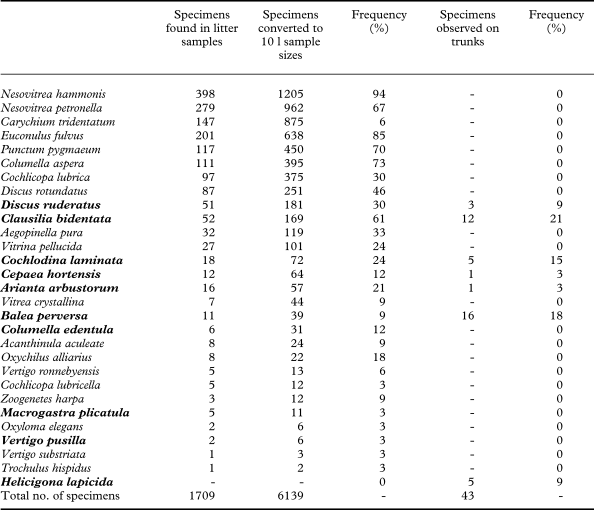
In total, 1709 individuals representing 28 snail species were found around the 33 trees harbouring L. pulmonaria thalli; one additional species was only found climbing the trees (Table 1). The number of snail species per site ranged from 2 around one P. tremula trunk to 15 around another P. tremula; the mean number was 7·6 ± 0·6 (± SE). The total number of snail specimens standardized to 10 l litter sample varied from 19 around one Quercus to 1644 around one U. glabra (total mean = 186 ± 51; median = 121; n=33). Snail abundance accounted for 56% of the variation in snail species richness in a linear regression: log(snail species number) = 0·560 + 0·365 * log(total specimen number); P < 0·0001; n=33. The snail species richness varied between trees, but did not show any clear geographic pattern. There was no significant relationship between snail species richness and altitude within the elevation range studied of 30–600 m (data not shown). The spatial variation in snail abundance was at least as large within as between localities. The eight snails represented by the highest number of specimens were exclusively found in litter samples (Table 1), which was also the case for the five most frequent species (> 66% frequency; Table 1). The snails most frequently seen climbing (Clausilia bidentata, Balea perversa and Cochlodina laminata; Table 1) were all observed while feeding on L. pulmonaria. The lichen-feeding snail Helicigona lapicida was exclusively observed climbing in the trees (Table 1). The slug Arion fuscus, not observed in the litter, was seen feeding on lichens on some trunks.
Total number of snail specimens collected from litter samples (first three columns) taken around 33 separate deciduous trees from southern Norway that had populations of the old forest lichen Lobaria pulmonaria during the summer 2008. The first column gives the number found, in the second columns these observations were converted to a 10 l litter sample size for each tree studied (330 l in total). The last two columns show the snails that were observed during the visit made during day light hours. Species in bold denote climbing and lichen-feeding snails.

The number of snail specimens and species increased with increasing pH in the litter. Both regressions were significant (P < 0·001), and pH accounted for 31% and 33% of the variation in these two gastropod variables, respectively (data not shown). Neither the snail species richness nor the species abundance showed significant differences between tree species. Most snail species were well distributed among tree species as well as among geographic districts. Among the frequent species, only Discus rotundatus and Oxychilus alliarius showed a pattern, being exclusively found in the southernmost parts (Agder-Telemark), and both mainly occurred around Quercus trunks.
The cover of grazing traces on L. pulmonaria varied substantially between trees (total range 1–35%; mean = 8·6%; median = 5%). In six trees, including all the tree species studied, the cover of grazing traces on L. pulmonaria thalli exceeded 20%, whereas 16 trees had less than 5% cover of grazing traces. Starting with all measured variables, the best subset regression for explaining the cover of grazing traces on L. pulmonaria included the abundance of snails in the litter and the cover of crustose lichens on the stem: log(grazing traces) = 0·447 + 0·360 * log(no. of snail specimens) − 0·0154 * crustose lichen cover; r 2adj = 0·291; P = 0·003; n = 33. Number of snail specimens (P = 0·039) and cover of crustose lichens (P = 0·006) also contributed significantly. Among the variables included in the total dataset were also site factors for canopy cover computed by image analysis of hemispherical photographs (e.g. Englund et al. Reference Englund, O'Brien and Clark2000). These variables (data not shown) did not significantly improve multiple regression models. The presence of climbing snail specimens alone (see Table 1) did not significantly predict the quantity of grazing marks.
Discussion
We have shown that climbing and lichen-feeding snails are not well represented in litter on the forest floor during resting periods in the daytime (Table 1). Not a single specimen of Helicigona lapicida was found in the litter samples, and for Balea perversa, a large part of the total specimen pool found was seen on trees during the daytime. There are many possible explanations for this. Some climbing snails may rest during the day in the canopy (Jaremovic & Rollo Reference Jaremovic and Rollo1979), whereas other gastropods rest buried in, for example, the soil below the litter. Our results call into question the effectiveness of traditional gastropod sampling protocols in litter to document grazing pressure in epiphytic lichen communities. If, as we suspect, gastropods play a significant role in shaping epiphytic communities (Asplund et al. Reference Asplund, Larsson, Vatne and Gauslaa2010), new methods are needed to study these poorly known lichen–gastropod interactions in tree canopies.
Previous studies have established that the lichen Lobaria pulmonaria (Gauslaa Reference Gauslaa1985) and lichen-feeding gastropods (Wäreborn Reference Wäreborn1970; Cameron Reference Cameron1973; Waldén Reference Waldén1981; Millar & Waite Reference Millar and Waite1999) favour hardwood forests growing on high pH soils. The hypothesis that this ecological situation may result in increased consumption of L. pulmonaria thalli by gastropods is supported by our results. In our study area, we found a significant relationship between snails resting in the forest litter and gastropod grazing damage on lichen thalli growing on tree trunks, which may result from similar ecological requirements for climbing and ground-dwelling gastropods. Although mature thalli of L. pulmonaria have a potential to grow despite a presence of grazing damage (Gauslaa et al. Reference Gauslaa, Holien, Ohlson and Solhøy2006), grazing can under some conditions be devastating, particularly for juvenile thalli (Asplund & Gauslaa Reference Asplund and Gauslaa2008).
In conclusion, our results suggest that gastropods can limit L. pulmonaria on calcareous soils. Thus, L. pulmonaria in our study area seems to be squeezed in between an intolerance of low bark pH that often occurs at the lower end of the soil pH gradient (Gauslaa Reference Gauslaa1985, Reference Gauslaa1995) and high grazing susceptibility at the highest soil pH ranges.
We thank James D. Lawrey, Lars Fröberg and one anonymous referee for thoughtful and constructive comments and suggestions.