Despite the long-standing recognition that work and nonwork domains can interact with each other (Binnewies et al., Reference Binnewies, Sonnentag and Mojza2009; Geurts & Demerouti, Reference Geurts, Demerouti, Schabracq, Winnubst and Cooper2002; Ilies et al., Reference Ilies, Schwind, Wagner, Johnson, DeRue and Ilgen2007; Kabanoff, Reference Kabanoff1980), as well as the early call for consistent research to “focus on how people actually balance needs, aspirations and satisfactions across life spheres” (Geurts & Demerouti, Reference Geurts, Demerouti, Schabracq, Winnubst and Cooper2002, p. 283), the study of goal self-concordance and goal attainment across work and nonwork domains is scarce and has so far only made the journey from proactive personality, through work-specific goals, to work outcomes (i.e., job performance and organizational citizenship behavior) and non-work outcomes (i.e., life satisfaction)(Greguras & Diefendorff, Reference Greguras and Diefendorff2010). By contrast, the current study explores the potential benefits of goals this time not restricted to work for employees as individuals (i.e., wellbeing), as well as for their employing organizations (i.e., in-role performance and organizational citizenship behavior) and for the environment at large (i.e., organizational citizenship behavior for the environment).
The topic of work-life blending is more relevant than ever, now that boundaries between the work and non-work domains of life become less and less discernible. In the US alone, a quantitative review estimated that every year over 120,000 deaths and five to eight percent of healthcare costs may be attributable to workplace stressors and practices (Goh et al., Reference Goh, Pfeffer and Zenios2016). Simultaneously, “bring your full self to work” has become a popular catchphrase in employer communication. But, do individuals’ goal attainment (GA) also benefit their organizations, not just their own wellbeing?
An evolving line of research with applicability in goal, work-life and pro-environmental research explores the goal self-concordance (GSC) model. Empirical studies on GSC have so far studied these dimensions as transversal sections through a person’s life domains or social roles. That is, for the work domain, the links between attaining work goals and job satisfaction have already been studied (Bono & Judge, Reference Bono and Judge2003). So were the links between personal goals and their attainment (Sheldon & Elliot, Reference Sheldon and Elliot1998), as well as between characteristics of personal goals and their corresponding level of GA (Sheldon & Kasser, Reference Sheldon and Kasser1998).
For the purpose of this study, non-restricted goals are defined to be goals that are not confined to any specific life domain or social role, therefore goals that a person selects without being asked to choose from within a specific life domain (e.g., work, school or personal) or a specific social role (e.g., parent, student, employee). Employing the principles of self-determination theory (SDT) and of the self-concordance model also derived from SDT, this study addresses the question of whether potential benefits of GSC and GA could extend not only to an individual’s wellbeing but also to the organizations in which they are active (as captured through in-role and extra-role performance outcomes and including organizational citizenship behavior as one such form of extra-role performance, one of increased interest for employees and organizations alike). To this end, we hypothesize that non-restricted goals (more specifically, their levels of self-concordance and of attainment) will have a positive impact on job performance subdimensions and on wellbeing. In exploring this hypothesis, in addition to the theoretical perspectives on self-determination and self-concordance, we build upon previous empirical results (Bono & Judge, Reference Bono and Judge2003; De Cooman et al., Reference De Cooman, Stynen, den Broeck, Sels and De Witte2013; Deci & Ryan, Reference Deci and Ryan2000, Reference Deci and Ryan2008; Greguras & Diefendorff, Reference Greguras and Diefendorff2010; Judge et al., Reference Judge, Bono, Erez and Locke2005; Sheldon & Elliot, Reference Sheldon and Elliot1998, Reference Sheldon and Elliot1999).
Self-Determination Theory applied to Goals and Work Settings
The state of science on self-determination macro-theory applied to work settings was summarized by Deci et al. (Reference Deci, Olafsen and Ryan2017) in a paper that harmonized existing SDT theories and empirical findings. Their proposed framework largely serves as the theoretical foundation of the current study. Their framework included a number of independent variables (workplace context variables such as need supporting and need thwarting, as well as individual differences variables such as causality orientations along with aspirations and goals), a number of mediators (the basic psychological needs of autonomy, competence and relatedness, as well as autonomous versus controlled motivations), and a number of outcomes (employee performance in quantitative and qualitative terms, as well as health and wellness, as reflected in aspects such as wellbeing, vitality and ill-being).
Of central importance to the above framework (and the current study) are the different types of motivation (autonomous versus controlled, with their subtypes forming an autonomy continuum) and the very different impacts they have in activating outcomes related to job performance as well as health and wellness (Deci et al., Reference Deci, Olafsen and Ryan2017; Deci & Ryan, Reference Deci and Ryan2008; Sheldon et al., Reference Sheldon, Turban, Brown, Barrick and Judge2003). Additionally, the goal contents sub-theory of SDT emphasizes the idea that, unlike intrinsic goals, extrinsic goals are linked with lower wellness and higher ill-being. The SDT literature also recognizes that apart from the goal contents (extrinsic vs. intrinsic), the motives for goal pursuit (autonomous vs. controlled) were shown to independently relate to wellbeing in at least three dedicated studies (Sheldon et al., Reference Sheldon, Ryan, Deci and Kasser2004).
While various empirical studies previously applied the SDT theory to work, sports, or education settings, the current study, is, to our knowledge, the first one to specifically test the integrative conceptual architecture proposed by Deci et al. (Reference Deci, Olafsen and Ryan2017) by considering variables from each of the model’s clusters of variables – that is, individual and contextual antecedents (work climate [WCQ] and environmental identity [EID]), both mediators (basic psychological needs’ satisfaction [BPNS] and GSC to capture the differences in autonomous versus controlled motivations), and variables from the two outcome categories (namely, well-being from the health and wellness category; in-role job performance [IRB], organizational citizenship behaviors [OCB], as well as organizational citizenship behaviors for the environment [OCBE], as outcomes from the work behaviors category). Past studies typically explored one or the other mediator (Deci et al., Reference Deci, Olafsen and Ryan2017). In the current study, we maintain both the variables related to need satisfaction (in the form of BPNS) and to motivations (in the adapted form of GSC) as mediators, while adding from the goal theory literature goal attainment as an intermediary outcome that further predicts the final outcomes.
The Self-Concordance Model as a “Varietal” of SDT
The self-concordance model (Sheldon & Elliot, Reference Sheldon and Elliot1999), a derivate of SDT, encompasses different steps that break down the advancement of a goal from the stage of being identified to being pursued (through sustained effort), to then being attained. The self-concordance theory also considers the impact GA can then have on a person’s wellbeing. The extent to which that initial goal choice is reflective of that person’s values and interests is defined as GSC and deemed to play a crucial part in the way the rest of the GA process unfolds.
The self-concordance model posits that there are different degrees to which a person feels ownership of a goal and has integrated that goal (Sheldon & Elliot, Reference Sheldon and Elliot1999). In turn, this self-concordance of goals relates to both level of effort invested in achieving the goal several weeks after and to the level of GA at end of the study (Sheldon & Elliot, Reference Sheldon and Elliot1999). Importantly, in a meta-analytical review of 11 studies, individuals with high autonomous motivations were more likely to achieve their goals or to make progress on them (Koestner et al., Reference Koestner, Otis, Powers, Pelletier and Gagnon2008). Even though GSC is operationalized as the difference between autonomous and controlled motivations and expected to even better capture the contrasting impact of these two types of motivation, several studies, some subsequent to the above mentioned meta-analysis, did not find the expected significant, positive relationship between GSC and GA (Greguras & Diefendorff, Reference Greguras and Diefendorff2010; Judge et al., Reference Judge, Bono, Erez and Locke2005; van Dierendonck, Reference van Dierendonck2015).
In terms of antecedents, the self-concordance model has been previously adapted to consider individual difference antecedents such as transformation leadership (Bono & Judge, Reference Bono and Judge2003; Greguras & Diefendorff, Reference Greguras and Diefendorff2010), proactive personality (Greguras & Diefendorff, Reference Greguras and Diefendorff2010) or core self-evaluations (Judge et al., Reference Judge, Bono, Erez and Locke2005). The following section discusses why we have chosen to employ environmental identity (EID) as a new individual difference antecedent.
Grafting Environmental Identity onto SDT and Self-Concordance
Interventions aimed at encouraging pro-environmental behaviors through the self-concordance mechanism already exist (Unsworth & McNeill, Reference Unsworth and McNeill2016), yet they do not consider some potentially valuable antecedents that the broader SDT model includes. Understanding those antecedents preceding self-concordance could help in targeting future interventions (e.g., to individuals or workplace contexts that are more likely to respond to them). A theoretical paper proposed the framing of messages aiming to encourage pro-environmental behaviors as serving intrinsic goals rather than extrinsic goals (Pelletier & Sharp, Reference Pelletier and Sharp2008) and a scale to measure motivation toward the environment has also been developed drawing on SDT (Pelletier et al., Reference Pelletier, Tuson, Green-Demers, Noels and Beaton1998). Another study highlighted the fact that, when compared to norm-based theories as well as social exchange based theories, SDT might better address the research gap of explaining the within-person variations in manifesting employee green behaviors (Norton et al., Reference Norton, Parker, Zacher and Ashkanasy2015). Nevertheless, the body of literature supporting the application of SDT in shaping pro-environmental behaviors is still sparse. Moreover, a meta-analytical review of pro-environmental behavior experiments highlighted goal setting as one of the most effective yet understudied treatments (Osbaldiston & Schott, Reference Osbaldiston and Schott2012). The current study thus also adds up to the environmental literature. By improving the understanding of pathways leading to pro-environmental behaviors manifested in the workplace, through types of goal motivations and their attainment, the current study’s results can also help in better designing future interventions on pro-environmental behaviors manifested in the workplace (organizational citizenship behaviors towards the environment [OCBE]).
The Present Study. Hypothesized Model
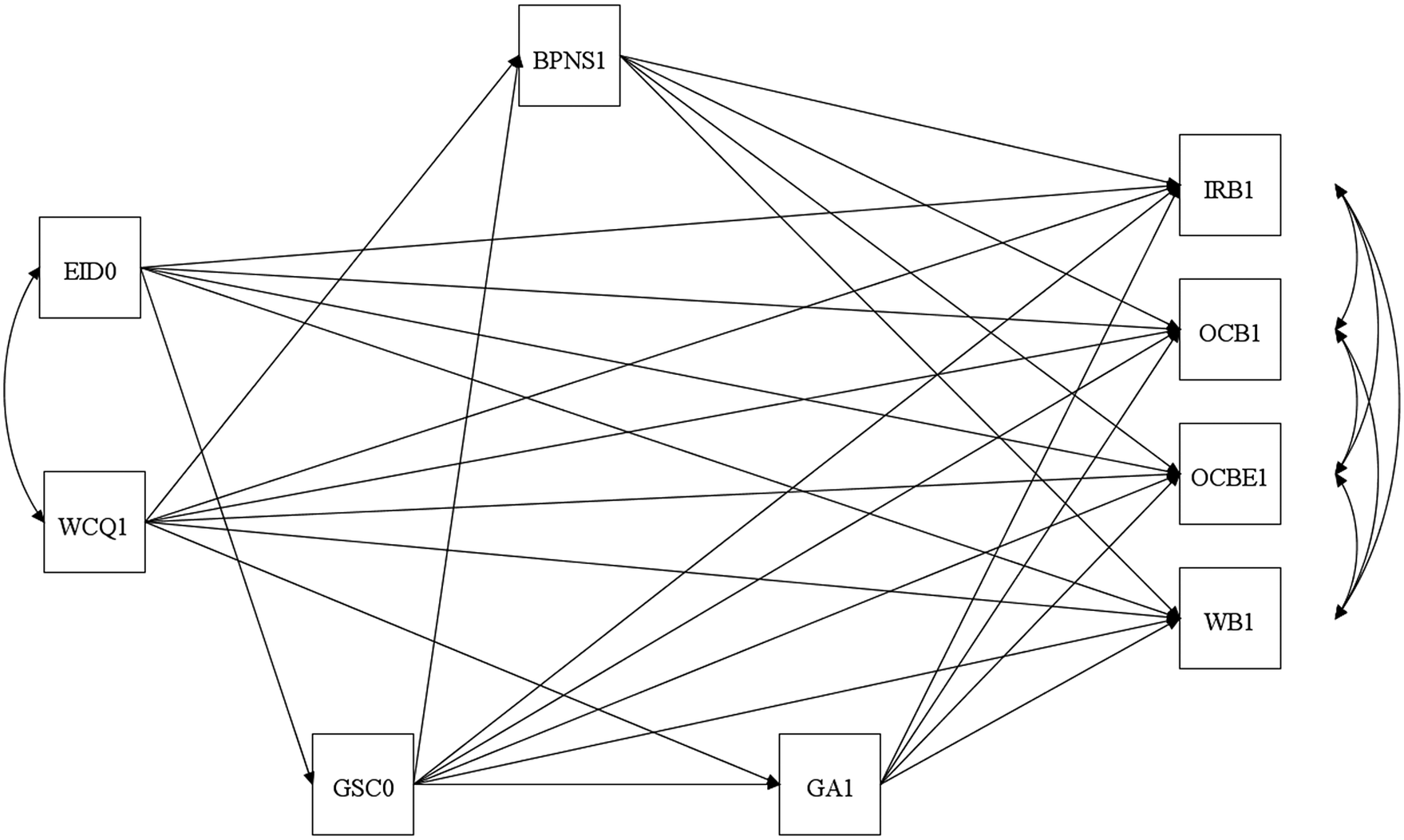
We have considered a model with the following specifications: WCQ at Time 1 and EID at Time 0 are unobserved variables; BPNS at Time 1 and GSC at Time 0 are mediators which also interact among themselves (GSC at Time 0 is an antecedent for BPNS at Time 1); GSC at Time 0 has EID at Time 0 as an antecedent; GA at Time 1 has GSC at Time 0 and WCQ at Time 1 as antecedents; the final outcomes of IRB at Time 1, OCB at Time 1, OCBE at Time 1 and Wellbeing at Time 1 are all impacted by GA at Time 1, BPNS at Time 1, WCQ at Time 1, GSC at Time 0 and EID at Time 0. All these relationships, as well as the indirect paths are shown in Figure 1.
Hypothesized Model
Note. For variables measure in the first round of data collection, the label ends in 0, for those measured in the second round of data collection, the label ends in 1. The labels’ meanings are as it follows: EID0 = environmental identity at T0; WCQ1 = work climate at T1; GSC0 = goal self-concordance at T0; BPNS1 = basic psychological needs at T1; GA1 = goal attainment at T1; IRB1 = in-role behavior at T1; OCB1 = organizational citizenship behavior at T1; OCBE1 = organizational citizenship behavior for the environment at T1; WB1 = Wellbeing at T1.

Method
Participants
Participants were recruited using Prolific (March, 2021)Footnote 1. Employing the platform’s capabilities, the following criteria were used to select participants: Age was 18 or above, work status was employed, and country of residence was the US. The sampling method was non-probabilistic and the sample is neither representative of the overall population in the US nor of the population of employees in the US. Out of the first wave group of 297 participants, 201 also provided answers to the follow up questionnaire, resulting in a retention rate of 67.68%.
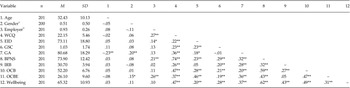
The initial sample comprised 52.86% male respondents, 46.80% female and one other participant who selected “Other/I choose not to answer”. In the second wave there were 50.75% males and 48.76% females, along with the one participant who opted for “Other/I choose not to answer”. Respondents’ ages in the initial wave of responses ranged from 18 to 68 (M = 31.95; SD = 10.20), compared to a range of 18 to 67 (M = 32.43; SD = 10.13) in the second stage. About 93.03% of the second wave participants were still with the same employer at the time when Wave 2 data have been collected. The average time to complete the questionnaire from the first stage was 16 minutes and 35 seconds, with an average compensation of GBP 4.79 per hour. The average time to complete the second stage questionnaire was 20 minutes and 35 seconds, with an average compensation of GBP 7.60 per hour. Table 1 includes descriptive statistics of the sample by demographic characteristics.
Descriptive Statistics and Pearson Correlations for Study Variables

Note. EID = environmental identity; WCQ = work climate; GSC = goal self-concordance; BPNS = basic psychological needs; GA = goal attainment; IRB = in-role behavior; OCB = organizational citizenship behavior; OCBE = organizational citizenship behavior for the environment.
a 0 = female, 1 = male.
b 0 = different employer since first data collection and 1 = same employer since first data collection.
*p < .05. **p < .01.
Following the suggestion of an anonymous reviewer, we compared the participants who took both the initial and the follow-up surveys with those who only took the initial survey, in terms of gender, age, GSC, and EID. A likelihood ratio test showed that the final sample did not significantly differ from the initial sample in regard to gender (p = .47). Independent t-tests showed that the final sample did not significantly differ from the initial sample in terms of age (p = .25), GSC (p = .99), or EID (p = .71).
Procedure
Data were collected through online questionnaires at two different points in time, approximately 90 days apart. The first round of data collection took place between November 25 and 26, 2018. The second round of data collection took place between March 3 and 8, 2019. The study received Board of Ethics approval from the authors’ university, complying with informed consent, full anonymity and opt-out rights. Specifically, participants were presented with an informed consent form and monetary compensation has been provided even to those who opted out of completing the questionnaire once they have read the informed consent or later, while filling in their responses – this was done both for ethical reasons and to ensure that the quality of the data is not negatively impacted by participants being solely motivated by financial reasons (i.e., to avoid random answers).
The Prolific (ProA) platform was chosen based on a comparative study in which ProA fared better than CrowdFlower (CF) and MTurk:
In two studies, we found that participants on both platforms were more naïve and less dishonest compared to MTurk participants. Across the three platforms, CF provided the best response rate, but CF participants failed more attention-check questions and did not reproduce known effects replicated on ProA and MTurk. Moreover, ProA participants produced data quality that was higher than CF’s and comparable to MTurk’s. ProA and CF participants were also much more diverse than participants from MTurk. (Peer et al., Reference Peer, Brandimarte, Samat and Acquisti2017, p. 153).
In addition, MTurk was shown to include more diverse participants, while being as valid as in-person data collection on campuses (Casler et al., Reference Casler, Bickel and Hackett2013).
Measures
Work climate. Work climate was measured using the six-item scale version of the homonym questionnaire (Baard et al., Reference Baard, Deci and Ryan2004). The questionnaire is commonly used in SDT-based studies, in reference to general work climate or to specific work groups (e.g., the team’s or the manager’s support of employees’ basic psychological needs, particularly that of autonomy) (Deci et al., Reference Deci, Olafsen and Ryan2017). A sample item is “My manager tries to understand how I see things before suggesting a new way to do things”. Responses were evaluated on a 5-point scale, with scores then summed for each participant. The internal reliability of the selected scale when applied to our sample was very high (α = .91).
Environmental identity. Environmental identity was measured using a 22-item scale of environmental identity (Olivos & Aragonés, Reference Olivos and Aragonés2015). Sample items are “I spend a lot of time in natural settings (woods, mountains, desert, lakes, ocean)” and “In general, being part of the natural world is an important part of my self-image”. Responses were captured on a 5-point scale. This scale also had very high internal reliability in our sample (α = .94).
Goal self-concordance. For the purpose of this study, we have employed the measurement procedure used by Bono and Judge (Reference Bono and Judge2003). Participants were first asked to enter 6 goals that they would aim to attain in the subsequent 60 days. For each of the goals they chose, the subsequent section of the questionnaire asked them to rate each of those goals on four items, using a 9-point scale. A sample item of those four goal rating items was “You choose this goal because somebody else wants you to or because the situation demands it”. The four items represented two autonomous types of motivations and two controlled types of motivations. A GSC score was calculated for each participant by subtracting the controlled items’ scores from the autonomous items’ scores, then averaging the results of the subtraction for each of the initial six goals into a single score. Unlike in the study by Bono and Judge (Reference Bono and Judge2003), selecting job-related goals was not included as a prompt, to allow participants to select non-restricted goals. We followed this procedure as it was the one first used in a work context and also in line with that of Sheldon and Elliot (Reference Sheldon and Elliot1998) in their foundational study on self-concordance, which in turn relied on the work of Emmons (Reference Emmons1986). The internal reliability of this scale was adequate (α = .73).
Goal attainment. Goal attainment was measured employing the method previously used in workplace-oriented research by Judge et al. (Reference Judge, Bono, Erez and Locke2005), drawing on the work of Sheldon and Elliot (Reference Sheldon and Elliot1999). Sample items included “I accomplished what I set out to do with this goal” and “I am happy with my progress toward attaining this goal”. Responses were collected on 5-point scale and the internal reliability of the scale was high (α = .80).
Basic psychological needs satisfaction. For the purpose of the current study a 21-item scale measuring need satisfaction at work has been selected (Deci et al., Reference Deci, Ryan, Gagné, Leone, Usunov and Kornazheva2001; Deci & Ryan, Reference Deci and Ryan2000; Ilardi et al., Reference Ilardi, Leone, Kasser and Ryan1993; Kasser et al., Reference Kasser, Davey and Ryan1992). Participants were prompted to consider their feelings towards their job during the past year or in case of tenure lower than a year, since employment. Using a 5-point scale, they rated items such as “Most days I feel a sense of accomplishment from working” or “On my job I do not get much of a chance to show how capable I am” (reversed). The three subscales corresponding to the three basic psychological needs from SDT (i.e., autonomy, competence and relatedness) have then been summed. The resulting scale’s internal reliability was high (α = .87).
In-role behavior (IRB, task performance) and extra-role behaviors (OCB, organizational citizenship behavior). IRB and OCB were measured with a 7-item and 13-item scale, respectively (Williams & Anderson, Reference Williams and Anderson1991). Sample items are “I fulfill responsibilities specified in job description” (for IRB) and “I help others who have heavy workloads” (for OCB). For both of these measures, participants were presented with 5-point scales. The reliability of the IRB scale was high (α = .82) and so was that of the OCB scale (α = .78).
Organizational citizenship behavior towards the environment (OCBE). OCBE was measured with the 9-item scale developed by Boiral and Paillé (Reference Boiral and Paillé2012). The responses were collected on a 5-point scale and examples of items include “I speak to my colleagues to help them better understand the environmental problems” and “I voluntarily carry out environmental actions and initiatives in my daily activities at work”. The internal reliability of this scale in our sample was very high (α = .94).
Wellbeing. For the purpose of the current study, we have employed an 18-item psychological wellbeing scale, that includes dimensions such as autonomy, environmental mastery, positive relations with others, self-acceptance and purpose in life (Ryff & Keyes, Reference Ryff and Keyes1995). Sample items of this scale include “When I look at the story of my life, I am pleased with how things have turned out so far” and “Maintaining close relationships has been difficult and frustrating for me” (reversed). Participants were asked to provide their ratings of all items on a 5-point scale. The reliability of the scale in our sample was high (α = .86).
Demographic variables. The demographic variables were captured in the first round of data collection and included age and gender. For the second round of data collection, the only demographic information collected was whether the participant was still working for the same organization as initially.
Data Analysis
A path analysis was conducted using MPlus 7 (Muthén & Muthén, 1998–Reference Muthén and Muthén2012) and MLR (maximum likelihood parameter estimates with standard errors and a chi-square test statistic) estimation method, in order to test the proposed model. Descriptive statistics and reliability calculations have been completed using the IBM SPSS Statistics 20 software.
Results
While the χ2 value did not clearly support whether the model does fit the data well (χ2 = 9.54, df = 4, p = .049), given that chi square values are impacted by the sample size (Bollen, Reference Bollen1990), the analysis was continued.
Moving with the analysis to fit indices, we considered the revised interpretation guidance of Hu and Bentler (Reference Hu and Bentler1999). First considering an absolute fit index, SRMR, it indicated that the model is a good approximation of the data (SRMR = .046). Next, incremental fit indices provided excellent (CFI = 0.989) and good results (TLI = 0.902) on whether the model offers an improvement over the independence model (which assumes no relationship between variables). However, the RMSEA value, RMSEA = .083; 90% CI [.005, .152]; p > .05, raises concerns regarding the model’s fit in approximating the data.
In line with an anonymous reviewer’s recommendation, we compared this model of interest with an alternative model. The model considered for comparison was a simplified version, one more closely aligned to the original SDT model – that is, GA was excluded from the model, with BPNS remaining as mediator between WCQ and the four outcome variables, and GSC remaining as mediator between EID and the four outcome variables. The initial test of model fit for this alternative model was not significant (χ2 = 16.04, df = 3, p = .925), indicating that the model might not fit the data well, yet due to its sensitivity to sample size, the analysis was continued. The absolute fit index SRMR also indicated this alternative model to be a good approximation of the data (SRMR = .063). In terms of incremental fit indices, CFI showed slightly lower yet still excellent results (CFI = 0.971). However, the Tucker-Lewis Index showed poor results (TLI = 0.741), lower than the 0.902 value previously obtained for the initial model and not supporting an acceptable fit. RMSEA value, RMSEA = .147; 90% CI [.082; .221]; p > .05, was also higher than in the initial model of interest and maintained the concerns in regard to the model’s fit in approximating the data. Overall, considering these results and its higher complexity, we concluded that the initial model of interest performed slightly better than the alternative model, indicating some support for expanding the SDT model to account for GA as intermediary outcome.
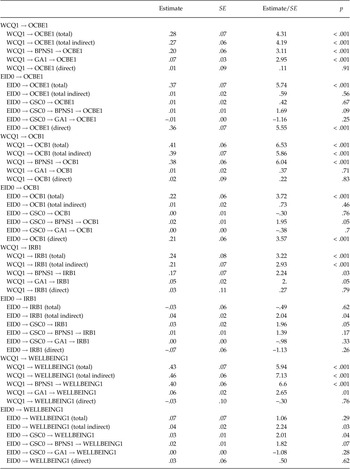
For the selected model, the standardized results of the path analysis, as detailed in Table 2, are also discussed below with focus on indirect effects.
Path Analysis: Standardized Total, Total Indirect, Specific Indirect, and Direct Effects (STDYX Standardization)

Note. EID0 = environmental identity at T0; WCQ1 = work climate at T1; GSC0 = goal self-concordance at T0; BPNS1 = basic psychological needs at T1; GA1 = goal attainment at T1; IRB1 = in-role behavior at T1; OCB1 = organizational citizenship behavior at T1; OCBE1 = organizational citizenship behavior for the environment at T1; WELLBEING1 = Wellbeing at T1.
While hypothesized to also have a direct effect on the final outcomes (IRB, OCB, OCBE and wellbeing – all at Time 1), WCQ at Time 1 only had indirect effects on all of these outcomes and significant direct effects on BPNS at Time 1 and on GA at Time 1, particularly strong in the case of BPNS at Time 1 (β = .73, p < .01). The total indirect effect of WCQ at Time 1 on IRB at Time 1 was significant (β = .21, p < .01), with the path through BPNS at Time 1 being significant (β = .17, p < .05) as well as the path through GA at Time 1 being significant (β = .21, p = .05). Similarly, the total indirect effect of WCQ at Time 1 on OCB at Time 1 was significant (β = .39, p < .01), only through the BPNS at Time 1 path (β = .38, p < .01) but not through the GA at Time 1 path. Importantly, WCQ at Time 1 also had a significant total indirect effect on OCBE at Time 1 (β = .27, p < .01), which was significant both through the BPNS at Time 1 path and the GA at Time 1 path. The total indirect effect of WCQ at Time 1 on wellbeing at Time 1 was also significant (β = .46, p < .01), both through the BPNS at Time 1 path (β = .40, p < .01) and the GA at Time 1 path (β = .06, p < .01). Taken together, these results, suggest BPNS1 as playing a more relevant role in explaining the relationship between WCQ at Time 1 and the four final outcomes (as supported by Deci et al.’s (Reference Deci, Olafsen and Ryan2017) framework of self-determination theory in the workplace) than GA at Time 1 played in explaining the same relationship. Yet it is important to note that GA at Time 1 did have significant direct effects on the final four outcomes.
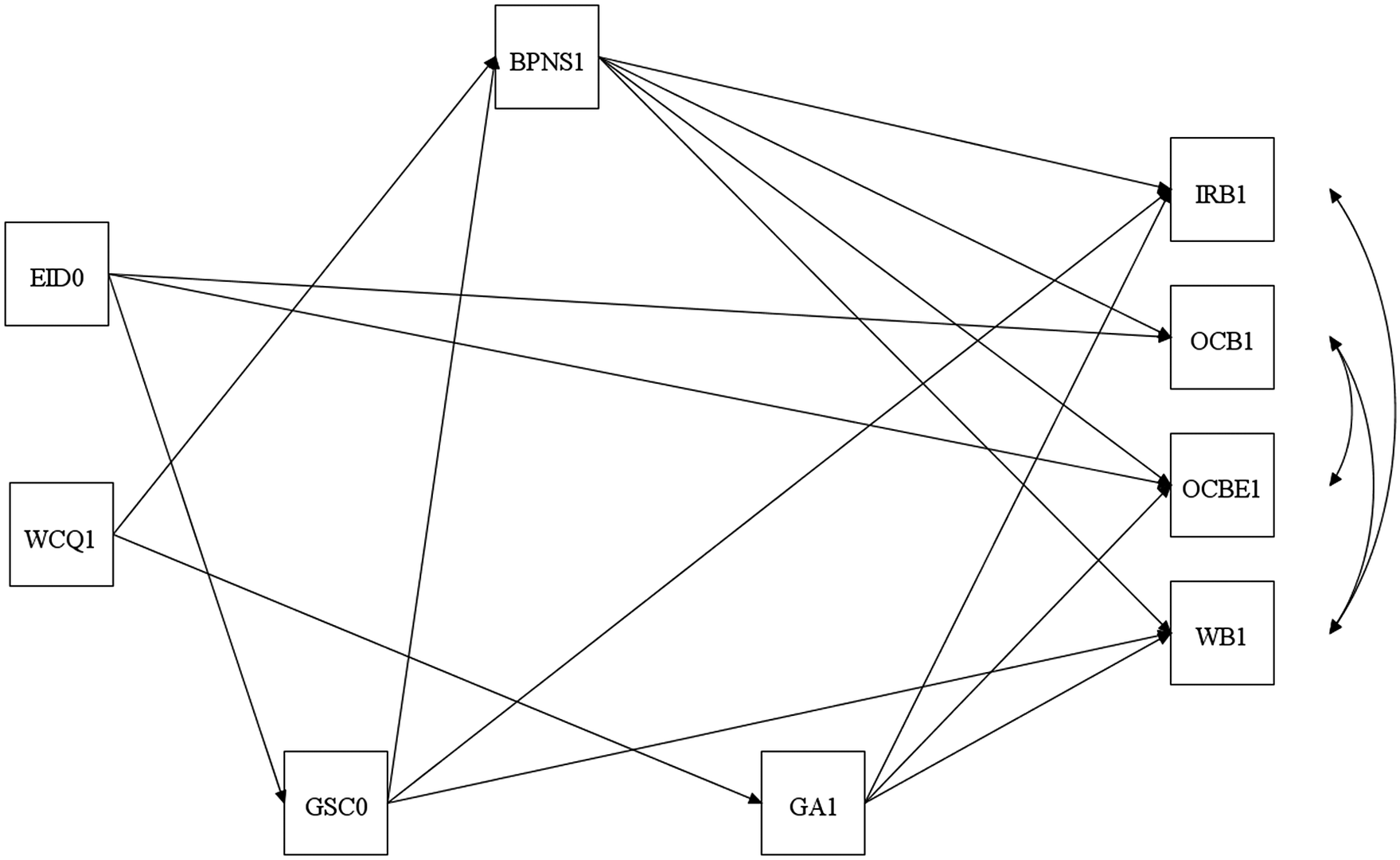
As hypothesized, EID at Time 0 had direct effects on OCB at Time 1(β = .13, p < .01), OCBE at Time 1(β = .18, p < .01) and also on GSC at Time 0 (β = .23, p < .01). Contrary to the hypothesized model, it did not significantly impact IRB at Time 1 or wellbeing at Time 1 in a direct manner. Moreover, the total indirect effect from EID at Time 0 to OCB at Time 1 and to OCBE at Time 1 was not significant through either of the paths. However, there was a significant yet too small total indirect effect of EID at Time 0 on IRB at Time 1(β = .01, p < .05), with the only significant path being the one through GSC at Time 0 (β = .01, p < .05). Similarly, the total indirect effect of EID at Time 0 on wellbeing at Time 1 was significant yet very small (β = .02, p < .05), with the path through GSC at Time 0 being once again the only significant one (β = .02, p < .05) (see Figure 2).
Confirmed Model
Note. Model fit: χ2 = 9.54, df = 4, p = .049, SRMR = .046, RMSEA = .083, 90% CI = [.005, .152], CFI = 0.989. The labels’ meanings are as it follows: EID0 = environmental identity at T0; WCQ1 = work climate at T1; GSC0 = goal self-concordance at T0; BPNS1 = basic psychological needs at T1; GA1 = goal attainment at T1; IRB1 = in-role behavior at T1; OCB1 = organizational citizenship behavior at T1; OCBE1 = organizational citizenship behavior for the environment at T1; WB1 = Wellbeing at T1.

Discussion
Among the mediators, as hypothesized, goal attainment (GA) did impact in-role behavior (IRB), organizational citizenship behaviors towards the environment (OCBE) and wellbeing. However, organizational citizenship behaviors (OCB) were not impacted by GA. This could potentially be explained from the perspective of intentionality – when asked to set goals, people might not proactively consider goals which have an impact on helping others or the organization. Another potential explanation comes from the perspective of limited resources/ego depletion theories – attaining own goal might leave fewer resources available for helping others in the organization. However, this second explanation seems to be contradicted by the existing relationships between GA and IRB, OCBE.
As hypothesized, BPNS was shown to impact all outcome variables. While GSC was hypothesized to impact BPNS, all four outcomes as well as GA, the data could only relate it to BPNS, IRB and wellbeing. Among the independent variables, for WCQ, the results do not support the manifestation of the direct impact on the four outcomes. Instead, BPNS and GA seem to mediate all the relationships between WCQ and the four outcomes. However, EID directly impacted OCB and OCBE. Moreover, EID indirectly (through GSC) impacted BPNS, IRB and wellbeing.
The current findings and the resulting model in particular can inform the SDT literature in three ways: (a) As a particular case of a more extensive SDT model, (b) as an integration of the SDT and self-concordance literature, and (c) as a nuanced exploration of whether the mediators specific to SDT also act as a mechanism in the relationship between environmental identity and employee performance outcomes.
First, in light of the good fit indices (particularly incremental fit) and the fact that the hypothesized model considered variables from each of the categories in the basic self-determination theory model in the workplace proposed by Deci et al. (Reference Deci, Olafsen and Ryan2017), the results can be interpreted as showing some support for the overarching structure of this theoretical model. In doing so the current findings also exemplify the intricate ways in which individual differences and the workplace context ultimately impact behavioral and wellbeing outcomes. For example, the effect of work climate on employee wellbeing and performance outcomes seems to depend on the satisfaction of basic psychological needs. From a practical perspective, this finding can help explain why certain interventions aimed at improving the work climate might not succeed and could potentially be improved by also intervening at the BPNS level. More broadly, the comparison of direct versus indirect effects can support human resources and management practitioners in identifying more relevant “levers” to monitor as predictors of wellbeing and employee performance outcomes. Team level action plans such as the ones used in employee engagement programs could target the “levers” the current model pinpoints as having larger effects.
Second, the current study integrated into the SDT model the advancements made in the self-concordance literature and thus added the goal attainment variable as an intermediary to wellbeing and performance outcomes. However, GA only seemed to interact with WCQ in indirectly impacting the wellbeing, IRB and OCBE outcomes (but not OCB). These paths might indicate that when selecting goals, participants chose goals relevant to their work and non-work social roles, including some which might overlap with pro-environmental behaviors (while the manifestation of OCB might be contingent on opportunity, rather than plans or goals). Notably, the relationship between GSC and GA was not supported. Though contrary to what is theoretically and empirically supported by the goal self-concordance literature, our finding is aligned to some other empirical studies on the same GSC-GA relationship (Greguras & Diefendorff, Reference Greguras and Diefendorff2010; Judge et al., Reference Judge, Bono, Erez and Locke2005; van Dierendonck, Reference van Dierendonck2015). We therefore echo the calls for further exploring this relationship and its potential moderators. In fact, some researchers have pointed towards student settings versus work settings as impacting the relationship between GSC and goal progress, performance, and wellbeing – since work settings, in contrast to learning settings, are more likely to witness the manifestation of extrinsically motivated work goals, which are achieved due to external motivators, such as the need for monetary rewards – thus contrary to what would be expected from an autonomous motivation or self-concordance perspective (van Dierendonck, Reference van Dierendonck2015).
Third, the current findings can inform interventions aimed at encouraging employees to manifest citizenship behaviors for the environment. The significant direct impact of EID on OCBE is not surprising, given the conceptual overlap between OCBE and PEB and strong theoretical and emergent empirical support of EID as predictor of PEB. The observed indirect impacts in the EID-OCBE relationship were not significant, indicating that the mechanisms through which this relationship operates are not those specific to SDT. Nevertheless, the overall results pertaining to EID indicate that it can indeed impact not only OCBE but other outcomes too. EID’s significant direct effect on OCB might signal that those with strong EID will also be more likely to manifest non-environmental citizenship behaviors at work. Furthermore, the indirect effects EID had through GSC on BPNS, IRB and wellbeing confirm the relevance of considering GSC as an intervention point, yet not necessarily for encouraging OCBE, as it was expected. Given that prior interventions aimed at encouraging specific pro-environmental behaviors by increasing GSC (Unsworth & McNeill, Reference Unsworth and McNeill2016), the current findings help set more accurate expectations in regard to the transferability of such interventions to encouraging OCBE and support the design of more targeted future interventions.
The current study’s limitations mainly come from the choice of measures and data collection methods, as well as the inherent limitations of path analysis. We discuss these limitations below, along with ways to address them and avenues for future research.
First, we acknowledge the limitations associated with our choice of measurement for GSC. Sheldon et al. (Reference Sheldon, Osin, Gordeeva, Suchkov and Sychev2017) provided a comprehensive analysis of the different measurement options and Adriasola (Reference Adriasola2014) designed a GSC measure that accounts not only for the strength of autonomous versus controlled motivations, but also for the interconnections between goals within an individual’s goal hierarchy. Their revised conceptualization also accounts for within-individual versus between-individual effects. Future studies could consider employing Adriasola’s (Reference Adriasola2014) scale, as well as other researchers’ observation that weighted scores might better capture the different proportions of intrinsic and extrinsic motivations that exist on the self-determination continuum (Ünlü, Reference Ünlü2016).
Second, task complexity could further be explored in the context of motivations for non-restricted goals, their attainment and their consequences. As referenced by Deci et al. (Reference Deci, Olafsen and Ryan2017), the meta-analytic study of Weibel et al. (Reference Weibel, Rost and Osterloh2010) showed that the relationship between extrinsic incentives and performance is dependent on the task’s complexity. Likewise, Adriasola (Reference Adriasola2014) showed that high self-concordance had the strongest impact on low prototypicality tasks. Since in the current study, the goals selected by participants were likely a mix of simple and complex tasks, this characteristic might also have impacted the study’s results. Future studies could invite participants to categorize their self-selected goals as either complex or simple.
Third, the conceptual delineation of non-restricted goals can further be improved. In introducing the concept of non-restricted goals, unlike prior studies, we did not prompt participants to select a specific category of goals (such as work, study or personal goals). By pre-selecting participants who work, we have implicitly allowed them to also include work-related goals. Future studies could better clarify the overlap as well as the differences between work, non-work and non-restricted goals (e.g., by introducing additional items inviting participants to categorize their goals as strictly work-related, strictly personal, or relevant for their work and non-work life domains).
Finally, there are limitations resulting from employing self-report data and path analysis. The main limitation of path analysis as it applied to the current study is not being able to confirm the direction of the relationships in the model. Testing for circular relationships would be particularly relevant to consider in future studies. Circular relationships have previously been considered for job satisfaction and job performance (Judge et al., Reference Judge, Thoresen, Bono and Patton2001). Relationships between goal progress and wellbeing have also been studied as bidirectional (Koestner, Reference Koestner2008).
Future directions could aim to expand the current framework to include further related aspects, such as: (a) As it pertains to GSC – how it interacts with goal conflict, ambivalence, and self-discrepancy (Kelly et al., Reference Kelly, Mansell and Wood2015) and (b) as it pertains to self-determination and self-regulations literature – strategic goal disengagement and re-engagement with an alternative goal when being faced with unattainable goals (Ntoumanis, Healy, Sedikides, Duda, et al., Reference Ntoumanis, Healy, Sedikides, Duda, Stewart, Smith and Bond2014; Ntoumanis, Healy, Sedikides, Smith, et al., Reference Ntoumanis, Healy, Sedikides, Smith and Duda2014; Shah, Reference Shah2005).
The current study aimed to explore a modified version of the basic self-determination theory model in the workplace proposed by Deci et al. (Reference Deci, Olafsen and Ryan2017). Goal attainment seems to be a valuable intermediary outcome to add to this overarching model, as it interacted with WCQ in indirectly impacting wellbeing, IRB and OCBE outcomes. Environmental identity seems to be a valuable antecedent to consider beyond its relationship with OCBE, as it also showed effects on OCB. Nevertheless, mechanisms beyond those we considered seem to explain these relationships, as these effects were direct. Though prior interventions have acted upon GSC to increase pro-environmental behaviors outside the workplace, the current results do not support the same approach in encouraging OCBE. Still, GSC does seem to be a potential intervention point in impacting BPNS, IRB and wellbeing.