INTRODUCTION
Within the infraorder Caridea, which is one of the most species-rich and diverse decapod crustacean clades (De Grave et al., Reference De Grave, Pentcheff, Ahyong, Chan, Crandall, Dworschak, Felder, Feldmann, Fransen, Goulding, Lemaitre, Low, Martin, Ng, Schweitzer, Tan, Tshudy and Wetzer2009), shrimps belonging to the family Alpheidae exhibit remarkable morphological, behavioural and ecological diversity (Bauer, Reference Bauer2004). For instance, in species belonging to the genera Alpheus Fabricius, Reference Fabricius1798 and Synalpheus Spence Bate, Reference Spence Bate1888, termed pistol or snapping shrimp, both males and females exhibit hypertrophied chelipeds that are used during intra- and inter-sexual social interactions and are capable of producing loud snapping sounds (Versluis et al., Reference Versluis, Schmitz, Von der Heydt and Lohse2000 and references therein). Similarly, members from Arete Stimpson, Reference Stimpson1860 and Athanas Leach, Reference Leach and Brewster1814, among various other genera, have adopted a symbiotic lifestyle, developing partnerships with a wide variety of sessile macroinvertebrates (Baeza, Reference Baeza, Watling and Thiel2015). Some of these symbiotic shrimps are socially monogamous (e.g. Alpheus armatus Rathbun, Reference Rathbun1901 (Knowlton, Reference Knowlton1980)) and others exhibit complex social behaviours (e.g. eusociality in Synalpheus regalis Duffy, Reference Duffy1996a (Duffy, Reference Duffy1996b)). Considering this diversity, shrimps in the family Alpheidae represent a model group to understand the adaptive significance of various evolutionary novelties. Studies on the natural history of this family are warranted to understand adaptive innovations in the marine realm.
Within the family Alpheidae, Salmoneus Holthuis, Reference Holthuis1955 is the third most species-rich genus, containing 46 extant species distributed worldwide (Anker, Reference Anker2011b; De Grave & Fransen, Reference De Grave and Fransen2011; Komai & Anker, Reference Komai and Anker2012; Anker et al., Reference Anker, Firdaus and Pratama2014). Salmoneus is also one of the smallest genera of alpheid shrimps. Most species exhibit a cryptic lifestyle, dwelling in small refuges such as cavities under rocks, crevices in coral rubble and/or burrows constructed by other crustaceans (e.g. callianassid and snapping shrimps) (Anker, Reference Anker2007, Reference Anker2010; Almeida et al., Reference Almeida, Boehs, Araújo-Silva and Bezerra2012). Their cryptic habitat, small size and the drab colouration of many members from this genus explain why their biology is poorly understood (Anker, Reference Anker2010; Anker et al., Reference Anker, Firdaus and Pratama2014). Indeed, most species are known from a single or few specimens, from their type locality or from a few localities (Anker, Reference Anker2010; Anker et al., Reference Anker, Firdaus and Pratama2014).
In this study, we are particularly interested in improving our understanding of the life history of Salmoneus carvachoi Anker, Reference Anker2007, a rare species that inhabits the western Atlantic (Yucatan Peninsula, Guadeloupe and Brazil – from Paraíba to São Paulo) (Anker, Reference Anker2007, Reference Anker2010) (Figure 1A, B). Salmoneus carvachoi occurs in the intertidal up to 22 m depth in the subtidal and is found in muddy estuaries, mangroves, mudflats and under rocks and rubble (Christoffersen, Reference Christoffersen1982, as Salmoneus ortmanni (Rankin, Reference Rankin1898); Anker, Reference Anker2007, Reference Anker2010; Almeida et al., Reference Almeida, Boehs, Araújo-Silva and Bezerra2012). Recent studies have reported that S. carvachoi inhabits burrows constructed by another alpheid shrimp, Alpheus estuariensis Christoffersen, Reference Christoffersen1984, suggesting the existence of a symbiotic relationship between these two species (Ramos-Porto et al., Reference Ramos-Porto, Viana and Lacerda1994, as Salmoneus ortmanni; Almeida et al., Reference Almeida, Boehs, Araújo-Silva and Bezerra2012). In this study, we report on the autoecology of this rare species living within intertidal burrows constructed by other crustaceans in the tropical western Atlantic.
Salmoneus carvachoi Anker, Reference Anker2007, habitus in lateral view (A), habitus in dorsal view (B), and (C) a pair of specimens of S. carvachoi (below) collected with a male–female pair of Alpheus estuariensis Christoffersen, Reference Christoffersen1984 (above) at Maraú, Bahia, Brazil. Photo credits: Jonathan A. Vera Caripe (A and B) and Alexandre Oliveira Almeida (C).

MATERIAL AND METHODS
Study area and sampling protocol
Sampling was conducted between September 2011 and October 2012 at Pontal Bay (14°48′31.1″S 39°02′08.3″W), an intertidal estuarine system formed by the rivers Cachoeira, Fundão and Santana, and bordered by the coastal city of Ilhéus, Bahia, Brazil. The intertidal is dominated by muddy sediments but there are remnant mangrove patches and sandbanks located at the lower part of the alluvial terrace (Nacif et al., Reference Nacif, Costa, Soadi, Fernandes-Filho, Ker, Costa and Moreau2003). The entire region of Pontal Bay is urbanized and somewhat impacted by domestic sewage discharged from nearby neighbourhoods (Almeida et al., Reference Almeida, Coelho, Santos and Ferraz2006; Souza et al., Reference Souza, Eça, Silva, Amorim and Lôbo2009). Specimens of Salmoneus carvachoi were captured from within the burrows of Alpheus estuariensis, Alpheus chacei Carvacho, Reference Carvacho1979 and the axianassid mud shrimp Axianassa australis Rodrigues & Shimizu, Reference Rodrigues and Shimizu1992 (Gebiidea: Axianassidae).
At the study site, three permanent transects (T1, T2 and T3 on the lower, middle and higher intertidal zones, respectively) were established parallel to the shoreline. Twenty-four meters separated transect T1 from T2 and 12 m separated transect T2 from T3. On each transect, all burrow openings observed on each of 10 randomly positioned quadrants (1 m2) within each transect were sampled during the spring tide period every month. Sampling was conducted with a handmade ‘yabbie pump’ (PVC tube, diameter = 50 mm). During sampling, the number of specimens of S. carvachoi per burrow was recorded. Individuals of S. carvachoi collected from each burrow were separated from the muddy sediments using a fine-mesh (1.8 mm) sieve, rinsed with seawater, placed into individual plastic flasks filled with seawater and transported to the laboratory for further analysis.
To describe the habitat of S. carvachoi, we recorded air temperature, salinity, rainfall and sediment grain size composition during sampling. Salinity was measured with a portable refractometer (Instrutherm). Air temperature data were obtained from the Centro de Previsão de Tempo e Estudos Climáticos, Instituto Nacional de Pesquisas Espaciais, Cptec/Inpe, Brazil (available online at www.cptec.inpe.br/). Rainfall data were obtained from the Instituto do Meio Ambiente e Recursos Hídricos do Estado da Bahia INEMA-BA (available online at http://monitoramento.inema.ba.gov.br/sistemas/planilhas/plu/). Last, to analyze sediment grain size composition, three sediment samples were obtained from three different quadrants during November 2011 and May and October 2012 (Ntotal = 9 samples). Sediment samples were extracted using the same PVC pump mentioned earlier. Each sample was transported to the laboratory and oven-dried at 60°C for at least 48 h until constant sample weight was attained. Grain size composition analyses were conducted whilst pipetting and sieving as described in Suguio (Reference Suguio1973). Biodetritic carbon was not removed during sample analyses. Different parameters describing sediment composition were calculated following the method described by Folk & Ward (Reference Folk and Ward1957).
Laboratory measurements
In the laboratory, each shrimp was anesthetized on ice, preserved in 70% ethanol, measured and sexed. The carapace length (CL) of each shrimp was measured as the distance from the tip of the rostrum to the posterior margin of the carapace. For this purpose, all shrimps were photographed in lateral view under the stereomicroscope and the CL was measured (precision = 0.01 mm) using the software ImageJ 1.45 s (Rasband, Reference Rasband2006). Next, each shrimp was sexed using the presence/absence of appendices masculinae and embryos underneath the abdomen. In caridean shrimps with separate sexes, males but not females bear appendices masculinae on the base of the endopod of the second pleopods. Furthermore, females but not males brood embryos underneath the abdomen (Bauer, Reference Bauer2004). The embryo masses of brooding shrimp were then classified into three stages of embryo development according to Mossolin et al. (Reference Mossolin, Shimizu and Bueno2006): initial stage (I): embryos with no evidence of eyes and yolk occupying 75–100% of the embryo volume; intermediate stage (II): embryos with small and elongated eyes, yolk occupying about 50–75% of the embryo volume; final stage (III): embryos with well developed eyes, yolk occupying 25–50% of the embryo volume. Logistic constraints did not permit dissecting the shrimp to observe internal sexual characters (e.g. gonads and gonoducts) because the material was preserved in alcohol, a fixative that is not ideal for proper preservation of internal organs.
Population distribution in Salmoneus carvachoi
We examined whether or not Salmoneus carvachoi live solitarily, in pairs or aggregations within burrows of their host crustaceans. For this purpose, we examined whether or not the distribution of S. carvachoi in burrows (i.e. the frequency of occurrence of burrows without shrimps and with different numbers of shrimps) differed from a random distribution. We compared the observed distribution (e.g. frequency of occurrence of hosts with one, two or more shrimps) with the truncated Poisson random distribution (Sokal & Rohlf, Reference Sokal and Rohlf1995). We employed a truncated Poisson distribution rather than the regular Poisson random because we did not record the total number of sampled burrows that did not harbour any shrimp (Plackett, Reference Placklett1953). Significant differences between observed and expected distributions were examined using a Chi-square test of goodness-of-fit (Sokal & Rohlf, Reference Sokal and Rohlf1995).
A small proportion of burrows harboured pairs of shrimps (see Results). We tested for a correlation between the CL of paired shrimps using an ordinary least squares regression and a t-test (Sokal & Rohlf, Reference Sokal and Rohlf1995).
RESULTS
Environmental data and population structure in Salmoneus carvachoi
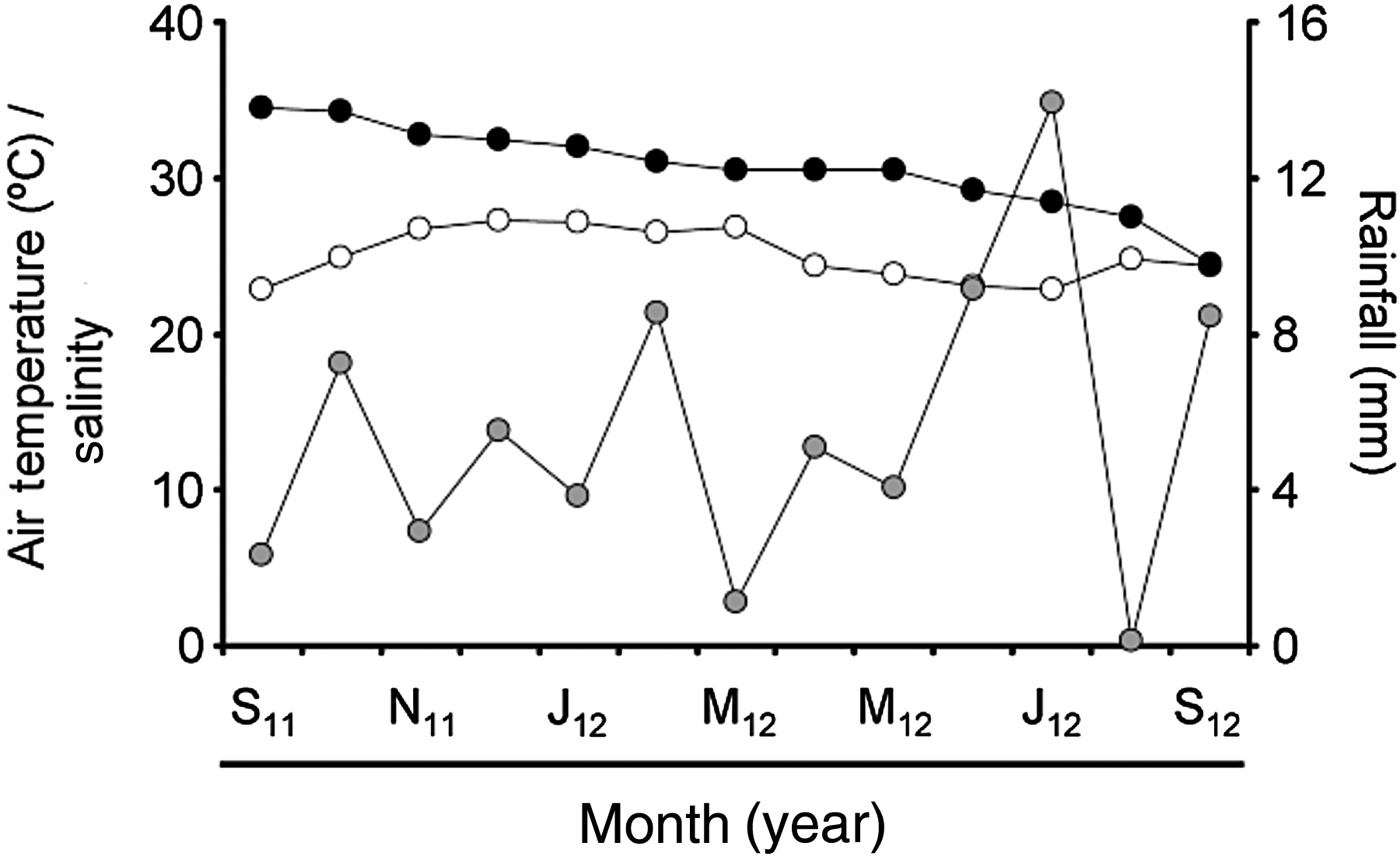
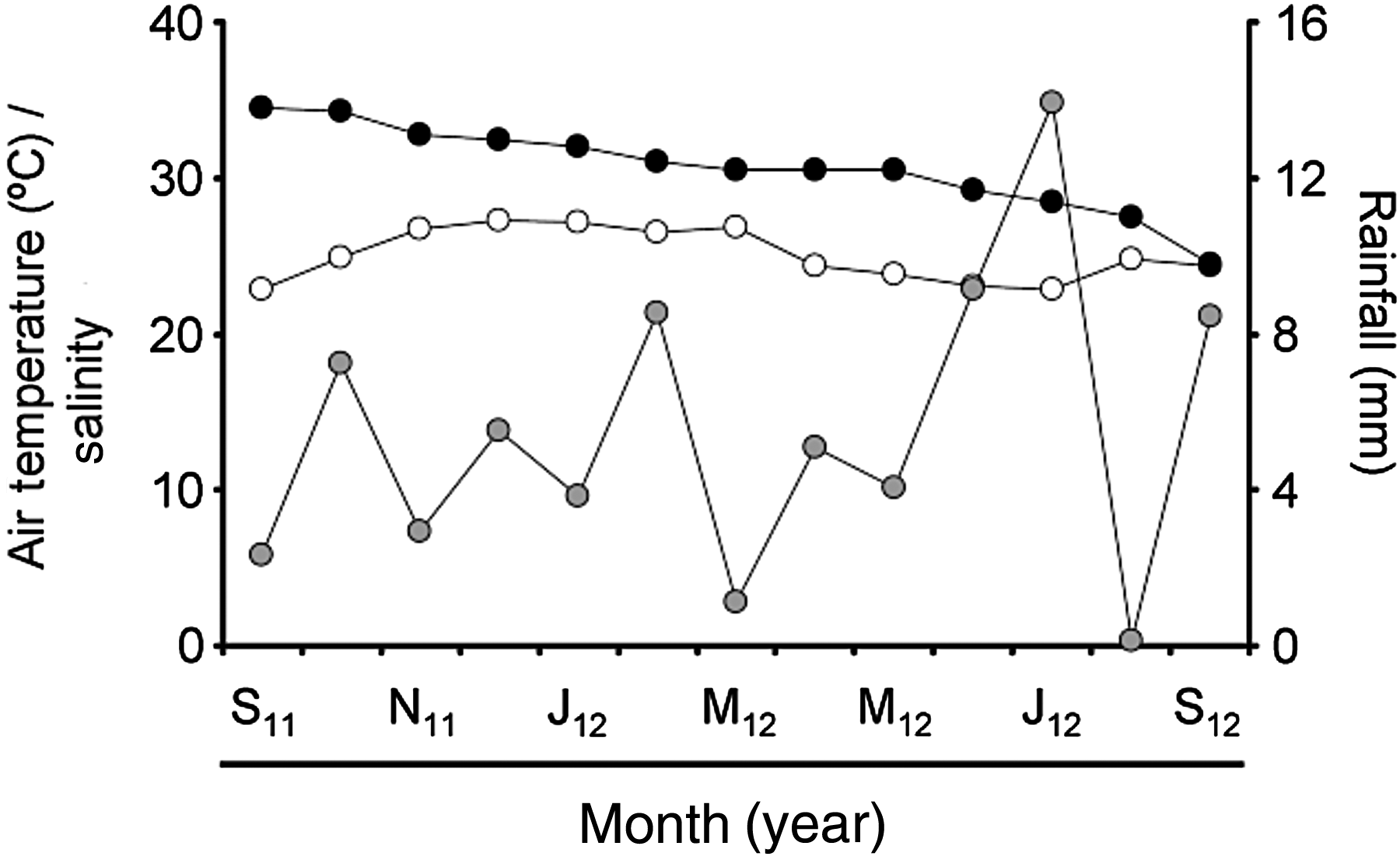
The average air temperature at the study site was 25°C ± 1.6 and varied between 22.8 (September 2011 and August 2012) and 27.3°C (January 2012). Rainfall varied from 0.1 ± 0.2 mm (September 2012) to 13.9 ± 22.0 mm (August 2012) with an average (±SD) of 5.6°C (±3.9). Average salinity was 30.6 ± 2.8 and varied from 24.5 (December 2011) to 34.2 (May 2012) (Figure 2). Last, grain size composition varied among transects: coarse silt, fine sand and very fine sand dominated transects T1, T2 and T3, respectively.
Salmoneus carvachoi Anker, Reference Anker2007, air temperature, seawater salinity, and rainfall from September 2011 to October 2012 at Pontal Bay, Ilhéus, Bahia, Brazil.
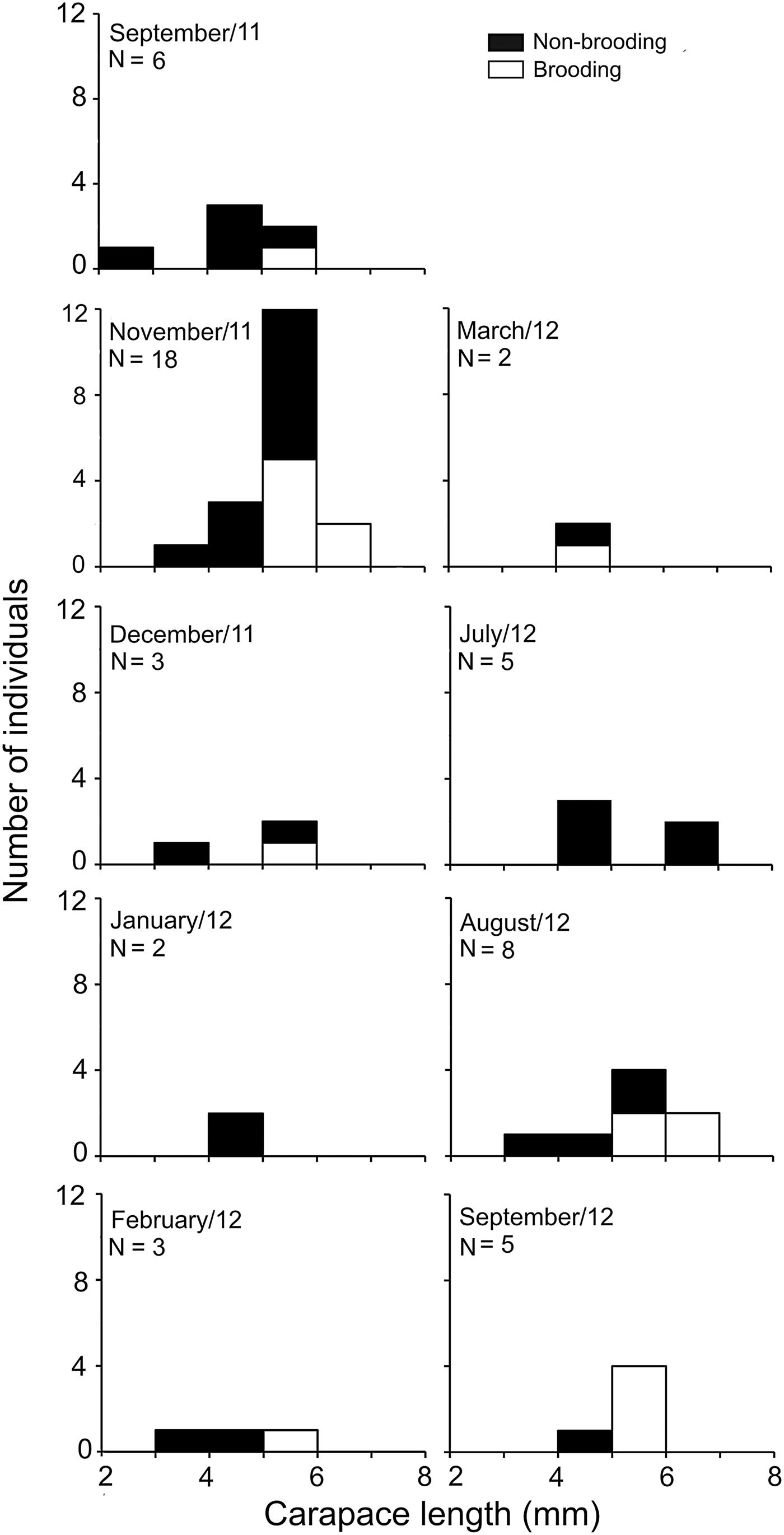
A total of 52 specimens of Salmoneus carvachoi were retrieved from burrows of Alpheus estuariensis, Alpheus chacei and Axianassa australis during the sampling period. Specimens of S. carvachoi were observed during 9 out of 13 sampling months. Shrimps were not collected during April, May, June and October 2012 (Figure 3).
Salmoneus carvachoi Anker, Reference Anker2007, monthly size–frequency distribution of brooding and non-brooding shrimps collected at Pontal Bay, Ilhéus, Bahia, Brazil (N = 52 individuals).
In S. carvachoi, CL varied between 2.8 and 6.2 mm with a mean (±SD) of 4.9 ± 0.7 mm (Figure 3). Interestingly, all shrimps collected had appendices masculinae on the endopod of the second pair of pleopods. Nineteen (36.5%) of these 52 specimens with appendices masculinae carried embryos underneath the abdomen. The CL of non-brooding shrimp varied between 2.8 and 6.1 mm (mean ± SD = 4.7 ± 0.7 mm) and that of the brooding shrimp varied from 5.0 to 6.2 mm (5.5 ± 0.3 mm).
Brooding and non-brooding shrimp were observed concomitantly in almost every month, except during January and July 2012 when only non-brooding shrimp were sampled (Figure 3). Brooding shrimp were more frequently sampled in November 2011 (N = 7). Most shrimp were collected from transect T1 during the present study (NT1 = 40, NT2 = 5, NT3 = 7).
Population distribution and sexual traits in Salmoneus carvachoi
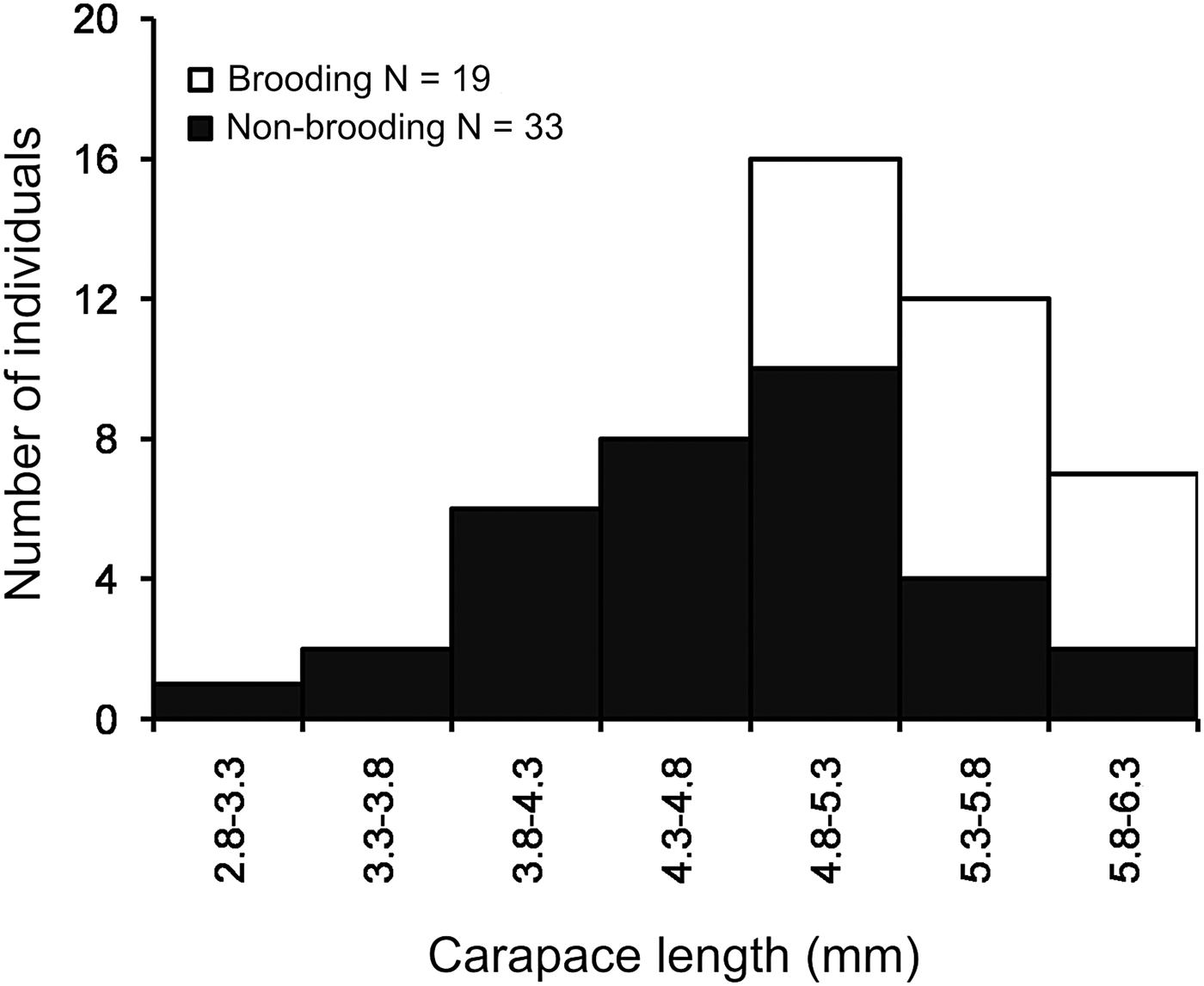
Burrows harboured only one or two shrimps (mean ± SD = 1.16 ± 0.37) and never three or more shrimps. The population distribution of Salmoneus carvachoi in burrows was significantly different from a random distribution (X 21 = 16.27, P < 0.0001). Solitary and paired shrimps were found with frequencies greater and lower than expected by chance alone, respectively. The mean (±SD) CL of non-paired shrimps (4.8 ± 0.8 mm) was not statistically different from that of paired shrimps (5.2 ± 0.4 mm) (Kruskal–Wallis test (variances were heterogeneous): S = 428.5 Z = 1.176, P = 0.2396) (Figure 4).
Salmoneus carvachoi Anker, Reference Anker2007, population distribution in burrows of snapping and mud shrimps at Pontal Bay, Ilhéus, Bahia, Brazil.
There was no correlation between the body size (CL) of shrimps found in pairs (t-test; t = 2.34, df = 1.5, P = 0.0665). Pairs of shrimp inhabiting burrows consisted of two brooding shrimps (N = 3 pairs), two non-brooding shrimps (N = 3), or one brooding and one non-brooding shrimp (N = 1). In pairs formed by two brooding shrimps, the stage of embryo development was the same in both individuals. The mean CL of pairs formed by two non-brooding shrimps and by two brooding shrimps was 4.9 ± 0.6 mm and 5.4 ± 0.3, respectively. The small sample size (N = 6) precluded a statistical comparison of the body size of paired shrimps carrying or not carrying embryos.
DISCUSSION
Specimens of Salmoneus carvachoi were observed during most of the year at the studied intertidal flats in Pontal Bay, Bahia, Brazil. Nonetheless, the abundance of this shrimp was remarkably low; the highest shrimp abundance was observed in September 2011 (N = 18). During the same study period, and using the same sampling protocol (see Costa-Souza et al., Reference Costa-Souza, Rocha, Bezerra and Almeida2014), we retrieved a total of 863 specimens of Alpheus estuariensis (Costa-Souza et al., in prep.), 135 of Axianassa australis and <10 of Alpheus chacei (Costa-Souza et al., personal observation). Thus, the density of S. carvachoi at the study site is remarkably low when compared to that of A. estuariensis. This supports the suggestion that S. carvachoi is a rare species. In the following, we discuss three aspects of the ecology of this rare shrimp that we believe deserve further attention.
Symbiosis between Salmoneus carvachoi and burrowing crustaceans
In this study, specimens of Salmoneus carvachoi were collected from burrows constructed by three different decapods: the snapping shrimps Alpheus estuariensis (Figure 1C), Alpheus chacei and the mud shrimp Axianassa australis. The association between Salmoneus carvachoi and Alpheus estuariensis has been noticed before (see Ramos-Porto et al., Reference Ramos-Porto, Viana and Lacerda1994, as Salmoneus ortmanni; Almeida et al., Reference Almeida, Boehs, Araújo-Silva and Bezerra2012). However, this study reports for the first time an association between Salmoneus carvachoi, Alpheus chacei and Axianassa australis. Salmoneus carvachoi has also been recorded under rocks laying on fine sand and muddy bottoms in the intertidal, with specimens of Alpheus estuariensis, Alpheus buckupi Almeida et al., Reference Almeida, Terossi, Araújo-Silva and Mantelatto2013 and Alpheus carlae Anker, Reference Anker2012, as well as with an unidentified gobiid fish (Almeida et al., Reference Almeida, Boehs, Araújo-Silva and Bezerra2012, Reference Almeida, Terossi, Araújo-Silva and Mantelatto2013). This wide variety of host species suggests that Salmoneus carvachoi is a generalist, establishing facultative symbiotic partnerships with larger burrowing decapods.
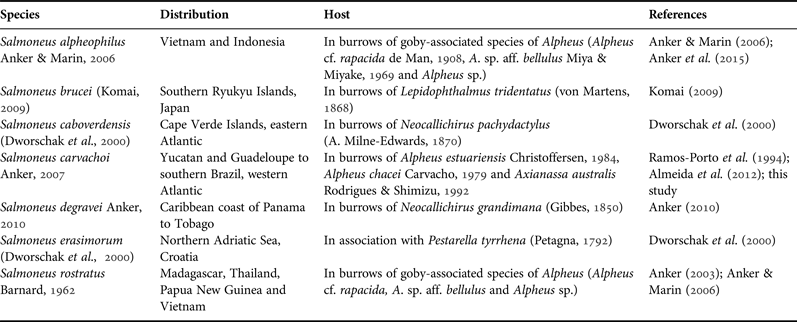
A review of the literature demonstrates that members from the genus Salmoneus often establish partnerships with larger burrowing crustaceans (Table 1). For a small species like Salmoneus carvachoi, as well as for other members from the same genus, inhabiting burrows with larger heterospecific decapods might result in net benefits, for example protection against potential predators (e.g. fish, mantis shrimp, amongst others). The large claws of snapping shrimps (notice claw size in Figure 1C) likely decrease the chances of Salmoneus carvachoi being attacked, for example by fish predators (see Baeza et al., Reference Baeza, Farías, Luppi and Spivak2010). Benefits or costs for snapping and mud shrimps resulting from the association with Salmoneus carvachoi are more difficult to foresee. Albeit our results suggest that Salmoneus carvachoi is a symbiotic species, the nature of the symbiotic partnership (e.g. mutualism, commensalism, parasitism) established between Salmoneus carvachoi (and other Salmoneus spp.) and larger burrowing crustaceans remain to be further investigated.
Species of alpheid shrimp from the genus Salmoneus Holthuis, Reference Holthuis1955 reported in association with decapod hosts (records of presumed association omitted).
Is Salmoneus carvachoi socially monogamous?
Salmoneus carvachoi either lived solitarily or in pairs but never in groups of three or more individuals within burrows of its burrowing crustacean hosts. Pairing behaviour is common in free-living and symbiotic crustaceans, including alpheid shrimps (Mathews, Reference Mathews2002a; Rahman et al., Reference Rahman, Dunham and Govind2003; Baeza, Reference Baeza2008; Marin & Mapnh, Reference Marin and Mapnh2014). Several of these pair-living species exhibit long-term monogamy; sexual partners share their dwelling for long periods of time and stay together for several reproductive cycles (Mathews, Reference Mathews2002b; Baeza, Reference Baeza2008). Interestingly, by contrast to that commonly reported for other alpheid shrimps, our data, albeit limited, suggest that S. carvachoi is not socially monogamous.
First, the fact that S. carvachoi pairs cohabited within host burrows with a frequency lower than that expected by chance alone indicates that the studied shrimp is not monogamous. This is in contrast to data reported for socially monogamous shrimps in which heterosexual pairing occurs more frequently than expected by chance alone (e.g. the palaemonid shrimp Pontonia margarita Verrill, Reference Verrill1869 (Baeza, Reference Baeza2008 and references therein)). Second, the lack of a relationship between the body sizes of the relatively few paired shrimps in the population further argues against the notion of monogamy in S. carvachoi. In crustaceans exhibiting long-term monogamy, a tight correlation between the body size of paired individuals is often observed (Baeza, Reference Baeza2008 and references therein). The absence of size-assortative pairing in S. carvachoi suggests therefore that paired shrimp do not cohabitate in burrows for long periods of time. Indeed, that shrimps inhabited burrows solitarily with a frequency greater than expected by chance alone and the absence of a correlation between the body size of paired shrimp suggest that individuals might be shifting between burrows in search of sexual partners rather frequently, as reported previously for other symbiotic crustaceans (Baeza & Thiel, Reference Baeza, Thiel, Duffy and Thiel2007 and references therein). For instance, in Inachus phalangium (Fabricius, Reference Fabricius1775), a spider crab that lives solitary among the tentacles of the anemone Anemonia sulcata (Pennant, Reference Pennant1777) in the Mediterranean, males frequently switch between host individuals in search of sexual partners (Diesel, Reference Diesel1988).
Finally, that several solitary shrimps were observed brooding embryos (N = 12 individuals) further supports the idea that individuals of S. carvachoi might be shifting between burrows in search of receptive sexual partners (see Baeza et al., Reference Baeza, Hemphill and Ritson-Williams2015). Unfortunately, our data is too limited to reveal additional details of the mating behaviour in S. carvachoi. We argue in favour of new integrative studies (e.g. field sampling, experiments, dissections) that should help reveal the mating system of this rare species.
Simultaneous hermaphroditism in Salmoneus carvachoi
The presence of appendices masculinae on the endopods of the second pleopods in all specimens analysed, including those brooding embryos, concurs with previous morphological observations in Salmoneus carvachoi and other congeneric species. In addition to Salmoneus carvachoi (Salmoneus carvachoi reported as Salmoneus ortmanni, see Christoffersen (Reference Christoffersen1982) and Ramos-Porto et al. (Reference Ramos-Porto, Viana and Lacerda1994)), the presence of both male (appendices masculinae) and female (embryos underneath the abdomen) external morphological traits in the same individual have been reported before in various other congeneric species (see Carvacho, Reference Carvacho1989; Holthuis, Reference Holthuis1990; Fransen, Reference Fransen1991; Anker & Marin, Reference Anker and Marin2006; Anker, Reference Anker2007, Reference Anker2010, Reference Anker2011a, Reference Ankerb). Importantly, three out of seven pairs of shrimps inhabiting burrows consisted of two brooding individuals. This latter observation also agrees with that observed by Anker & Marin (Reference Anker and Marin2006) in Salmoneus pusillus Anker & Marin, Reference Anker and Marin2006 and Salmoneus rostratus Barnard, Reference Barnard1962. Altogether, these data suggest that Salmoneus carvachoi is a simultaneous hermaphroditic species, a sex allocation pattern experimentally confirmed for a few other caridean shrimps (genera Lysmata Risso, Reference Risso1816, Exhippolysmata Stebbing, Reference Stebbing1915, and Parhippolyte Borradaile, Reference Borradaile and Willey1900 (Baeza, Reference Baeza2009; Braga et al., Reference Braga, López-Greco, Santos and Fransozo2009; Onaga et al., Reference Onaga, Fiedler and Baeza2012)) but also proposed before for representatives of Salmoneus (Anker, Reference Anker2011b). Unfortunately, shrimp dissections and examination of internal organs (e.g. gonads, vas deferens) were not conducted during this study because we preserved the specimens in alcohol, a fixative that does not result in proper preservation of internal shrimp morphology. In future studies, initial preservation in seawater formalin or a similar fixative is recommended before final storage in 70% alcohol to investigate internal morphology. Also, it was not possible to observe the gonopores located in the coxae of the pereopods in the preserved shrimps. In small shrimp species, such as Salmoneus carvachoi, the gonopores are extremely small and difficult to detect using light microscopy; however, scanning electron microscopy has been used to reveal them in Synalpheus spp. (Tóth & Bauer, Reference Tóth and Bauer2007) and might be used with Salmoneus in future work. Our data are limited to demonstrate simultaneous hermaphroditism in Salmoneus carvachoi. We argue in favour of additional experimental studies to verify male and female sexual functionality in this shrimp with an external simultaneously hermaphroditic phenotype.
Interestingly, in the simultaneously hermaphroditic Lysmata, Exhippolysmata and Parhippolyte, juvenile shrimps invariably mature first as functional males (male-phase individuals) before attaining the female function (i.e. ability to produce, spawn and brood embryos) and, thus, turning into functional simultaneous hermaphrodites (Bauer, Reference Bauer2000; Baeza, Reference Baeza2009). Whether or not Salmoneus carvachoi is a simultaneous hermaphrodite with an early male phase also deserves further attention. A thorough analysis, including behavioural experiments and examination of primary and secondary sexual characters in species of Salmoneus, remains a pending task.
ACKNOWLEDGEMENTS
The authors are indebted to the Fundação de Amparo à Pesquisa do Estado da Bahia (FAPESB) (APP 0035/2011) and to the Universidade Estadual de Santa Cruz (UESC) (00220.1100.1065) for financing the Project ‘Biologia e Ecologia de Camarões da Família Alpheidae (Crustacea: Decapoda: Caridea)’. To the Programa de Pós-Graduação em Zoologia of UESC for the support. A.C.C.-S. thanks the Coordenação de Aperfeiçoamento de Pessoal de Nível Superior (CAPES) for the provision of a Master's scholarship. To Patricia Santos, Guidomar Soledade, Andressa Cunha, David Weber, João Mário Macêdo, Aline Reis, Midian Salgado, Karen Martins, Yamid Mera, Milane Correa, Luciano Oliveira, Paulo Ribeiro and Ivanise Hora for their support in the field collections and to Dr Erminda Couto for her support with sediment analysis. Jonathan A. Vera Caripe kindly shared with us photographs of Salmoneus carvachoi from Venezuela. Finally, the authors are indebted to Dr Ray Bauer and one anonymous referee for the criticisms that greatly improved the manuscript. This is SMS at Fort Pierce contribution number 1010.