1. Introduction: Challenging established wisdom
Judges ad hoc are a staple of contentious proceedings before the International Court of Justice (ICJ or Court).Footnote 1 The Court hears very few cases in which no judge ad hoc sits alongside elected judges,Footnote 2 and some of the most highly reputed international law jurists have served as judges ad hoc.Footnote 3 The drafters of the Statute of the Permanent Court of International Justice (PCIJ) intended judges ad hoc to be a means of preserving the Court’s impartiality by altering its composition in individual cases.Footnote 4 Academic commentators, however, have criticized judges ad hoc widely, presuming their lack of impartiality.Footnote 5 On the basis of empirical observations, this article argues that developments since the turn of the millennium show that such criticism is now misplaced, and that the appointment of judges ad hoc in fact positively affects the Court’s impartiality, which in this article is understood to embrace both subjective lack of bias, and objective lack of appearance of bias.Footnote 6 This article does not elaborate on the notion of impartiality, which, as was recently suggested, may not be clearly defined.Footnote 7
Section 2 explores the reasons for creating the institution of judges ad hoc by reference to the drafting history of the PCIJ’s Statute. In support of the argument of this article, Section 3 discusses recent developments in the appointment of judges ad hoc: the appointment of former elected judges as judges ad hoc, the election of former judges ad hoc as titular judges, and the appointment of judges ad hoc in the current crisis of multilateralism. Section 4 concludes by suggesting how such changes have re-shaped the role of judges ad hoc at the ICJ.
2. Why judges ad hoc? The drafting history of the ICJ’s Statute
The travaux préparatoires of the Court’s Statute are instructive as to the reasons for conferring on states a right to appoint judges ad hoc.
2.1 Drafting the PCIJ’s Statute (1920–1921)
In the 1920 Advisory Committee of Jurists, tasked with preparing a draft Statute for the newly-created PCIJ, judges ad hoc, also called national judges, were the subject of lengthy discussions. The record of these discussions indicates that two main issues justifying the creation of the right to appoint judges ad hoc concerned the PCIJ’s perceived impartiality resulting from the elected judges’ nationality and equality between the parties.
The Committee’s ‘Draft of general agenda’ queried whether the states parties to a dispute should have the right to influence the composition of the bench, and whether judges should be allowed to sit in cases to which their state of nationality was a party.Footnote 8 The comments received by the Committee from states and other entities mainly suggested that nationals of a litigant state should not sit in judgment over the dispute concerned,Footnote 9 with some states even proposing that the parties should have the right freely to choose two,Footnote 10 threeFootnote 11 or fiveFootnote 12 judges to abstain from deciding their dispute. At the Sixth Session of the Committee, Mr. Adatci first proposed the creation of a right for a state ‘to appoint one of it[s] own nationals to sit as [a] judge in the case’, provided that no such a national was sitting on the Court.Footnote 13 The record of the debates indicates that the Committee was primarily concerned with avoiding inequality between litigating parties, in order to preserve the appearance of impartiality of the Court as a whole.Footnote 14
The fundamentals of the rule in Article 31 of the ICJ’s Statute first appeared as part of the Root-Phillimore plan, Article 27 of which provided that:
[i]f, on the trial of a case, there is no judge upon the Court belonging to one of the litigating States, that State shall, for the purpose of the trial, appoint a judge who shall take part in the decision of the case on a footing of absolute equality with the other judges on the Bench.
If neither of the parties in litigation before the Court had a judge, each shall appoint a judge to take part in the proceedings and the decision of the case.
If two or more of the parties are in the same interest, they shall have but one judge, to be agreed upon between them.Footnote 15
The mandatory language in this provision envisaged the appointment of judges ad hoc as an obligation rather than a right. Lord Phillimore argued that allowing states to appoint judges ad hoc would, inter alia, ‘enable the Court to understand certain questions which require highly specialised knowledge and relate to the differences between the various legal systems’.Footnote 16 While agreeing with Lord Phillimore,Footnote 17 Mr. de Lapradelle made a point about impartiality by noting that national judges would always record their disapproval of a decision against their state, which counselled for excluding the judge having the nationality of one of the parties.Footnote 18 Mr. Loder, with whom Baron DescampsFootnote 19 and Mr. de LapradelleFootnote 20 agreed, ‘was opposed to Article 27 of the Root-Phillimore plan, because [it] still involved the idea of arbitration instead of justice’, and instead suggested that the parties should appoint assessors with advisory powers.Footnote 21 Mr. Adatci and Mr. Hagerup supported Article 27 of the Root-Phillimore plan, and further proposed that judges ad hoc be chosen from the list of unsuccessful candidates submitted earlier to the Assembly and Council of the League of Nations for consideration in electing judges.Footnote 22 Both the suggestion by Mr. Loder, and the suggestion by Mr. Adatci and Mr. Hagerup, would have affected the appearance of impartiality of the PCIJ: on one hand, assessors with advisory powers would have had little impact on how cases were decided; on the other hand, choosing judges ad hoc from among unsuccessful candidates for election as titular judges would have limited the states’ choice to persons who, in principle, satisfied the requirement of impartiality under the Statute.
Article 28(2) of the Draft Scheme for the PCIJ’s Statute transmitted to the Assembly and Council of the League provided that, if no elected judge having the nationality of a litigating state would be on the Court, that state could select a judge of its nationality from among the deputy-judges, and, in the absence of any such deputy-judge, it could appoint a judge ‘preferably chosen among those persons who have been nominated as candidates by some national group in the [Permanent] Court of Arbitration’.Footnote 23 This system established a clear nationality link between the state party to a dispute appointing a judge ad hoc and the person so appointed.
Upon examination of the Committee’s Draft Scheme, Norway and Sweden suggested that the institution of judges ad hoc be eliminated entirely.Footnote 24 In his report to the Council, Mr. Bourgeois stated that ensuring the equality of the parties could be achieved ‘either by adding or by subtracting’, and suggested that ‘it appeared … unnecessary to substitute, for purely theoretical reasons, a new system for that proposed unanimously by the Hague Jurists’.Footnote 25 The Council did not change Article 28 of the Draft Scheme.Footnote 26 Throughout its proceedings, the Assembly did not change the substance of that provision,Footnote 27 which was finally adopted and became Article 31 of the PCIJ’s Statute.Footnote 28
2.2 Amending the PCIJ’s Statute (1929)
In 1929, a Committee of Jurists was established to consider possible amendments to the PCIJ’s Statute. Discussions on judges ad hoc focused on their impartialityFootnote 29 and the meaning of ‘nationality’,Footnote 30 but also on their relationship with deputy-judges.Footnote 31 The Committee, however, ‘considered that it was no part of its duty to deal with the institution of national judges, which is regarded by certain States as one of the essential principles of the organisation of the Court’.Footnote 32 Thus, the only amendment to Article 31 of the Statute was a by-product of the Committee’s proposal to eliminate the category of deputy-judges. In its 1929 Report, the Committee proposed to ‘increase the number of ordinary judges from eleven to fifteen and to omit all mention of deputy-judges’,Footnote 33 and stated that ‘[t]he disappearance of the deputy-judges naturally involves consequential amendment of various articles in the Statute in which they are mentioned’,Footnote 34 which included Article 31.
Article 31(2) of the Statute as adopted by Protocol of 14 September 1929Footnote 35 stated that:
[i]f the Court includes upon the Bench a judge of the nationality of one of the parties, the other party may choose a person to sit as judge. Such person shall be chosen preferably from among those persons who have been nominated as candidates as provided in Articles 4 and 5.Footnote 36
Following this amendment, Article 31 gave states full discretion in choosing judges ad hoc by removing the requirement that such judges be nationals of the appointing state. The record of the 1929 Committee of Jurists, however, does not express any reason for eliminating the nationality requirement, and does not seem to link this elimination to concerns relating to the PCIJ’s impartiality. The 1929 amendments entered into force on 1 February 1936.Footnote 37 The PCIJ’s practice relating to the new Article 31 was limited to four years, owing to the outbreak of the Second World War, during which time the PCIJ decided only eight cases in which judges ad hoc had been appointed.Footnote 38
2.3 Adopting the ICJ’s Statute (1944–1945)
The 1944 report of the Inter-allied Committee on the future of the PCIJ was in favour of retaining the institution of judges ad hoc for much the same reasons as the 1920 Advisory Committee of Jurists.Footnote 39 However, the report commented that:
[t]he present position of an ad hoc judge is unsatisfactory; he has no regular or permanent status as a Judge of the Court, but is there for the particular case only on the ad hoc nomination of his own country.Footnote 40
The report suggested that, in the process for electing judges:
each party to the Statute … should nominate one candidate … Candidates so nominated should, by the fact of nomination, become members (though not Judges) of the Court. As such, they would, for a period of 9 years, automatically be the national judges of their respective countries …Footnote 41
According to the report, this new system would ensure that ‘national judges would not be specially appointed for a particular case; they would have a permanent status as members of the Court’,Footnote 42 and the fact that all states would be ‘represented by someone having the status of a member of the Court would of itself give all countries a greater stake in the Court and help to promote interest in it’.Footnote 43 Although the report does not refer directly to impartiality, its writers conceivably had considered that conferring on national judges the status of members of the Court also would have affected positively the perception of the Court’s impartiality, thus incentivizing states to ‘promote interest’ in the new institution.
At the Dumbarton Oaks Conference, states spoke of judges ad hoc only in support of retaining them in the future court.Footnote 44 Subsequently, at the San Francisco Conference a UN Committee of Jurists drafted the text that became the ICJ’s Statute. The initial text,Footnote 45 the states’ comments on that textFootnote 46 and the subsequent drafts prepared by the CommitteeFootnote 47 all included a provision on the appointment of judges ad hoc. The draft provision on judges ad hoc was adopted unchanged by the relevant commissions of the San Francisco Conference,Footnote 48 and adopted as Article 31 of the ICJ’s Statute.
3. Appointment of judges ad hoc in practice
The pattern in the appointment of judges ad hoc since 1946 shows that, far from reducing the perception of the Court’s impartiality, the institution has developed in a way which increases it. This development results from certain recent trends discussed below.
3.1 Appointment of former titular judges as judges ad hoc
While appointing former elected judges as judges ad hoc is not a novelty, this practice has become more common since the turn of the millennium. The first such appointment was made in 1963, when Spain appointed former titular Judge Armand-Ugon to sit in Barcelona Traction.Footnote 49 His appointment, made 17 years after the Court’s establishment, was followed 16 years later by Libya’s appointment of the Court’s former President, Judge Jiménez de Aréchaga, in Continental Shelf (Tunisia/Libya) and, after three more years, in Continental Shelf (Libya/Malta). In the remaining 18 years until 1999, former titular Judges Ajibola, Bedjaoui, Jennings, Mbaye, Ruda, Sette-Camara, Shahabuddeen, Weeramantry and Zafrulla Khan were appointed as judges ad hoc.Footnote 50 Over 54 years, states appointed former elected judges as judges ad hoc 14 times. Since 2000,Footnote 51 however, in just 19 years, states have appointed former elected judges as judges ad hoc 22 times.Footnote 52
This increase in appointments of former titular judges cannot be attributed simply to the expansion of the Court’s docket since 2000. States filed 96 contentious cases between 1946 and 1999, and 52 such cases between 2000 and 2019. Thus, over one-third of the time, and approximately half the number of cases, former elected judges were chosen as judges ad hoc far more frequently than before. Nor could this trend necessarily stem from an increased number of judges recusing themselves from cases in which their state of nationality is a party. Since 2000, recusals by elected judges took place in six contentious cases,Footnote 53 and states appointed former titular judges as judges ad hoc in three of those cases.Footnote 54 In contentious cases before 2000, elected judges recused themselves for reasons of incompatibility on six occasions, but no judge ad hoc was appointed specifically to replace them, as none of such elected judges was a national of a litigating state.Footnote 55
As stated above, certain writers have criticized judges ad hoc for lacking impartiality, as revealed by their voting record.Footnote 56 In his 1954 report to the Institut de Droit International, Max Huber wrote that judges ad hoc are ‘contraire[s] à la conception de la magistrature telle qu’elle est conçue depuis Montesquieu’.Footnote 57 However, arguing that judges ad hoc are not impartial because of their votes seems overly simplistic. Hernández has written that consideration of instances in which judges ad hoc voted against their appointing states weakens the argument that their votes are automatically in favour of such states.Footnote 58 Nevertheless, there is more than the simple fact of how a judge ad hoc’s vote is cast. The Court’s decisions ordinarily include numerous operative paragraphs, on which separate votes are taken. It is not uncommon for judges ad hoc to vote in favour of their appointing state as to some, but not all, operative paragraphs. In the 2007 Nicaragua v. Colombia judgment, both judges ad hoc voted partly to reject and partly to uphold the preliminary objections of the respective appointing states.Footnote 59 Similarly, in the 2015 Certain Activities/Construction of a Road judgment, the judge ad hoc appointed by Nicaragua voted to find his appointing state internationally responsible for the breaches alleged by Costa Rica,Footnote 60 and the judge ad hoc appointed by Costa Rica voted to hold that his appointing state had failed to carry out an environmental impact assessment for the construction of Route 1856.Footnote 61
Moreover, for certain kinds of disputes it may be challenging to establish whether judges ad hoc vote in favour of, or against, their appointing states. For instance, delimiting maritime boundaries in the continental shelf and exclusive economic zone requires the Court, inter alia, to: identify the relevant coast; identify the relevant area; select base points; decide whether relevant circumstances exist, and their effect on a provisional equidistance line; and make a disproportionality assessment.Footnote 62 However, only one operative paragraph contains the Court’s decision on the course of the boundary.Footnote 63 It is difficult precisely to determine the degree to which judges ad hoc voting on this one operative paragraph could be considered to have voted in favour of or against their appointing states. The argument that judges ad hoc are not entirely impartial merely because of their voting record is unconvincing. Votes should be read in the context of the written and oral submissions made by the contesting states, which are set forth in the judgment, as well as the Court’s reasoning in the judgment, in order fully to evaluate whether, or the extent to which, judges ad hoc have voted in favour of, or against, their appointing states. Academic writers, however, so far have not endeavoured to do so, thereby painting a distorted picture of the performance of judges ad hoc based solely on the fact of their votes.
Conversely, it seems possible that the criticism made with respect to judges ad hoc could apply to elected judges. Judge Schwebel wrote that ‘[w]e are all prisoners of our own experience’,Footnote 64 which also extends to one’s national origin. Whether one sits as an elected judge or as a judge ad hoc, the same national subjectivities may affect a judge’s decision-making.Footnote 65 Nothing guarantees that, once elected as judges, individuals become wholly detached from their national backgrounds. Judges’ impartiality rather should be assessed based on their individual opinions, the content of which could suggest more than their mere vote. One cannot fault judges simply for voting in favour of the state of their nationality.Footnote 66
What matters in this context is the states’ perception of the Court’s impartiality. The impartiality of the Court as an institution is linked to, although not wholly dependent on, the impartiality of individual judges.Footnote 67 It might be that, for whatever reason, a certain judge is not entirely devoid of bias in a given case, in which instance the collegial character of the Court counter-balances any potential bias of an individual judge. However, because of their appointment by states, judges ad hoc are subject to heightened scrutiny in relation to the impact that their presence has on the impartiality of the Court as an institution. Greater concerns seem to exist that one judge ad hoc may negatively affect the Court’s impartiality than any of the elected judges doing so.
In this perspective, appointing former titular judges as judges ad hoc could be perceived as guaranteeing the Court’s impartiality, owing to their personal stature and professional reputation as former members of the Court. Relatedly, having been a titular judge entails knowledge of the Court’s complex deliberation processFootnote 68 and likely enhances the weight that such a judge ad hoc is able to play in that process, which may lead to judges ad hoc having greater influence in the drafting of a judgment. In a judicial organ ordinarily composed of 15 to 17 members, the ability of judges ad hoc to persuade other judges of their position, including through their standing acquired while members of the Court, is likely to be beneficial to their appointing states. The value of personal and professional relationships established between judges therefore should not be underestimated, and may play a role in the appointing state’s decision to appoint a former titular judge as judge ad hoc. The same consideration could apply to the appointment of the same individual as judge ad hoc in multiple cases.Footnote 69 In addition to benefits for appointing states, however, the fact that a judge ad hoc has been a titular judge is likely to have an indirect, though perceivable, positive effect on the impartiality of the Court as a whole.
3.2 Election of former judges ad hoc as members of the Court
Besides the appointment of former elected judges as judges ad hoc, former judges ad hoc have been elected to the Court. Hernández suggested that the progression from judge ad hoc to elected judge has been ‘relatively common throughout the history of the [Court]’.Footnote 70 However, this view does not reflect the limited number of judges ad hoc elected to the Court. Judges Spiropoulos, Morelli, Ago, de Castro, Mosler, Nagendra Singh, Evensen, and Sepúlveda-Amor sat as judges ad hoc before being elected to the Court.Footnote 71 Four current titular judges have previously served as judges ad hoc.Footnote 72
This practice could raise issues relating to the impartiality of elected judges chosen from among individuals who have been judges ad hoc. Under Article 2 of the Statute, candidates for election to the Court must be ‘independent’ and ‘of high moral character’. If one takes the view that judges ad hoc cannot be considered to be wholly impartial,Footnote 73 one could doubt whether electing judges ad hoc to the Court fulfils the requirements of the Statute. A more cautious view, however, is advisable.
It could be perceived as problematic if an individual were elected to the Court very shortly after having served as judge ad hoc, or even during the pendency of a case in which such individual had been sitting as judge ad hoc. This concern, however, does not seem to have arisen in practice. In the 2012 Nicaragua v. Colombia proceedings, the newly-elected judge, whom Nicaragua previously had appointed judge ad hoc, recused himself after Nicaragua appointed another judge ad hoc in his stead.Footnote 74 Conversely, in Navigational and Related Rights when the judge ad hoc appointed by Costa Rica was elected to the Court, Costa Rica refrained from appointing a new judge ad hoc, which resulted in the newly-elected judge continuing to sit on the case.Footnote 75 These cases suggest that it is regarded as inappropriate for a judge elected while serving as judge ad hoc to keep sitting on the Court if the appointing state chooses a new judge ad hoc. The attitude of the state party to a case, presumably linked to its perception of the Court’s impartiality, is decisive. Although, in the cases mentioned above, no state party raised impartiality issues publicly, it is plausible that the perceived impartiality of a newly-elected judge, who formerly was a judge ad hoc, was a reason for that judge to recuse himself in Nicaragua v. Colombia. Similarly, had Costa Rica appointed a new judge ad hoc in Navigational and Related Rights, the newly-elected judge would likely have followed the same course.
Other judges ad hoc were elected to the Court after the conclusion of the cases in which they had been appointed, which did not raise issues concerning their impartiality.Footnote 76 Nevertheless, doubts about one’s independence could arise if prospective candidates for election to the Court previously were appointed as judges ad hoc by their states of nationality. Theoretically, this might induce judges ad hoc to favour their state of nationality, in order to secure that state’s support for their candidacy. Although this may be correct in theory, it does not appear to have occurred in practice. In Ambatielos, Judge ad hoc Spiropoulos agreed with the majority to reject Greece’s argument that the Court had jurisdiction to decide on the merits of the Ambatielos claim.Footnote 77 Although finding for Mexico, Judge Sepúlveda-Amor joined the majority in Avena, thus raising no doubt as to his independence.Footnote 78 In Jurisdictional Immunities of the State, Judge Gaja voted to reject Italy’s counterclaim.Footnote 79
To the contrary, a state may have good reasons to appoint its potential future candidate to the Court to serve as judge ad hoc. That state can assess how somebody might perform if elected to the Court, for example, on the basis of that person’s voting record as judge ad hoc, including any eventual declaration or individual opinion. From the point of view of other states, observing the conduct of a judge ad hoc who is a potential candidate for election to the Court may be a way of assessing that person’s impartiality, which could be an element in deciding whether to support that particular candidate. Furthermore, and similar to the case of former elected judges chosen as judges ad hoc, exercising the functions of judges ad hoc allows potential candidates to become familiar with the Court’s internal working methods, and establish personal and professional relationships with current titular judges.
In many respects, the election of judges from those who have been judges ad hoc does not appear to be much different from the established practice of electing judges from among individuals who have been members of the International Law Commission (ILC) or of other international tribunals. Since 1946, 42 out of 109 elected judges, seven of whom are currently sitting on the Court,Footnote 80 have been ILC members before taking up their judicial function. Before their election to the Court, Judges Buergenthal and Cançado Trindade were judges and Presidents of the Inter-American Court of Human Rights, Judges Mosler and Waldock were judges of the European Court of Human Rights, Judge Sebutinde served on the Special Court for Sierra Leone, Judge Bennouna sat on the International Criminal Tribunal for the former Yugoslavia (ICTY), and Judge Robinson was a member both of the ICTY and of the International Criminal Tribunal for Rwanda. Whether one has been a member of the ILC, of another international tribunal, or a judge ad hoc of the Court, states can always assess how that person has exercised those functions, based on positions taken, views expressed, votes cast and opinions written. This assessment seems likely to inform a state’s decision as to whether or not to put forward one of its nationals as a candidate for election to the Court, or to support a candidate put forward by another state, with impartiality being an important criterion which states are likely to consider in making that decision.
3.3 Judges ad hoc and the crisis of multilateralism
Judges ad hoc could be linked to states’ evolving perception of the Court and its role in recent years, in which multilateral institutions and processes have been going through a time of crisis. Some examples of this crisis are the withdrawal of certain states from the Rome Statute (the International Criminal Court), the recent exit of the United Kingdom from the European Union, and the backlash against the World Trade Organization and investor-state dispute settlement.Footnote 81 Certain states recently have been implementing inward-looking policies, considering multilateralism as an obstacle to, rather than a potential instrument for, prosperity. In his 2018 address to the UN Security Council, ICJ President Yusuf stated that the Court owes its existence to multilateralism.Footnote 82 Despite the crisis of the multilateral model, the Court’s docket is the heaviest it has ever been. This could be symptomatic of the maturity of the international legal order, or conversely indicate states’ reduced readiness to settle their disputes through bilateral or multilateral non-adjudicative processes.Footnote 83 Either way, the issue is whether the current crisis of multilateralism has affected or may affect, the states’ perception of the Court, to which the appointment of judges ad hoc could be said to contribute.
The rationale for judges ad hoc has long been that national susceptibilities may alter a state’s perception of the Court’s impartiality, and therefore must be acknowledged and addressed in the settlement of disputes by the Court.Footnote 84 This rationale is even more compelling at a time when several states openly reject particular aims and methods of the multilateral international legal order. At the time when the PCIJ’s Statute was drafted, however, ensuring that states perceived the Court as impartial was necessary because no global international organization had ever existed, and states had to be persuaded to join this new organization. To the contrary, ensuring that states perceive the Court as impartial today aims to prevent states from mistrusting, and perhaps even leaving, this established multilateral dispute settlement system that exists under the auspices of the UN. Judges ad hoc could be a means of maintaining states’ confidence in the Court in a time of crisis, and especially to avoid cases of non-appearance and non-compliance with the Court’s decisions.
It has been suggested that there is a connection between appointing a judge ad hoc and compliance.Footnote 85 No state seems to have suggested openly that it would be more willing to comply with the Court’s decisions owing to the presence of a judge ad hoc appointed by it. Nonetheless, willingness to comply has been linked to the independence and impartiality of the Court.Footnote 86 From a political standpoint, the presence of judges ad hoc has the potential to be a catalyst for compliance, especially insofar as a judge ad hoc’s individual opinions reveal that the positions before the Court have been duly considered. The lack of appointment of judges ad hoc could signal, from the outset of a case, the states’ unwillingness to comply with any decision the Court may render. By not appointing a judge ad hoc while having the right to do so, states can show their intention not to engage with the judicial process before the Court. In both Fisheries Jurisdiction cases, Iceland did not appoint a judge ad hoc, and finally refused to comply with the Court’s 1974 judgments.Footnote 87 Although judges ad hoc should not be the reason for complying with the Court’s decisions, that judges ad hoc frequently sit on the Court suggests that certain states might regard their presence to have a positive effect on the Court’s impartiality and, as a result, on compliance.
The Court’s perceived impartiality is also linked to the nationality of judges ad hoc. In principle, appointing a non-national as a judge ad hoc is likely to be perceived as a guarantee of impartiality. In times when multilateralism faces a crisis, however, one may expect states to appoint their own nationals as judges ad hoc. Under the PCIJ’s Statute, judges ad hoc were required to be nationals of the appointing state, and it was only following the 1929 amendments to the Statute, and the abolition of deputy-judges, that the nationality condition was removed from Article 31.Footnote 88 Although since 1946 it has not been uncommon for non-nationals to be appointed judges ad hoc, recently the number of such appointments has increased considerably. This trend is continuing despite the crisis of multilateralism, suggesting that, in selecting judges ad hoc, states may take into account the effect that certain appointments could have on the perception of the Court in the international community.
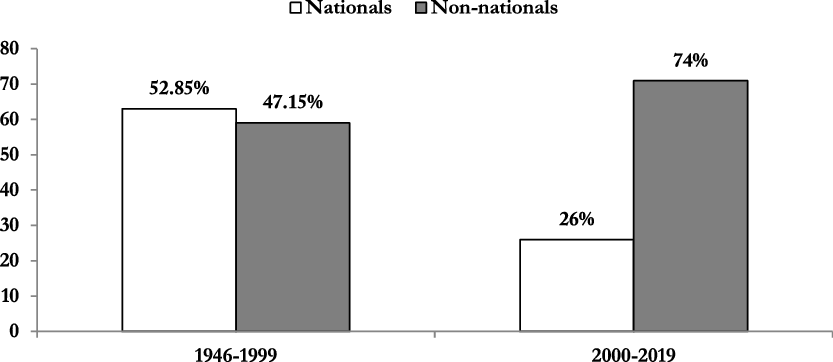
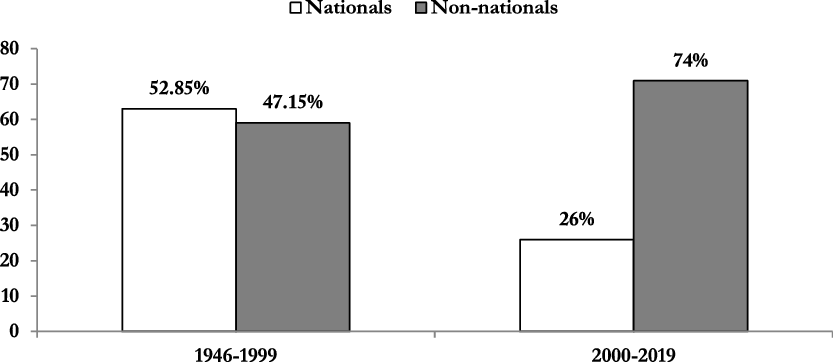
Across 96 cases until 1999, states appointed non-nationals 58 times (47.15%) and nationals 65 times (52.85%), while in the 53 cases since 2000 states chose non-nationals 74 times (74%) and nationals 26 times (26%) (see Figure 1 below).Footnote 89 There also appears to be a correlation between the increase in non-nationals appointed as judges ad hoc and the increase in former judges appointed as judges ad hoc.Footnote 90
Number of nationals and non-nationals appointed judges ad hoc across all ICJ cases.
Appointing non-nationals as judges ad hoc can also result in the Court having more than one person of the same nationality, which could affect its perceived impartiality. Since judges ad hoc technically are not ‘members’ of the Court,Footnote 91 Article 3(1) of the Statute does not apply to them. Yet, the issue is one of optics.Footnote 92 For instance, three French judges sit in a case pending between Qatar and the United Arab Emirates,Footnote 93 while two Russian judges and two United States judges sit in the case pending between Nicaragua and Colombia on the delimitation of the maritime boundary beyond 200 nautical miles from the Nicaraguan coast.Footnote 94 Parties should be deemed nonetheless to have accepted this situation if they do not object to the choice of judge ad hoc, as permitted by Article 35(3) of the Rules of Court. In any event, this can occur only when neither party is the state of which multiple judges are nationals, and no state seems to have objected to the appointment of a judge ad hoc on this ground.Footnote 95
Choosing non-nationals as judges ad hoc with increasing frequency seems inconsistent with multilateralism being in a crisis, and the same could be said for implicitly accepting that multiple judges having the same nationality may sit in a case. However, reality seems more complex. Cohen argues that ‘[c]urrent global institutions were founded against a backdrop of unipolarity, bipolarity, or even tripolarity’.Footnote 96 Limited polarity could make pursuing multilateralism easier,Footnote 97 as multipolarity would make agreement among states harder to reach, yet, if reached, that agreement would be more pluralistic than in a non-multipolar world.
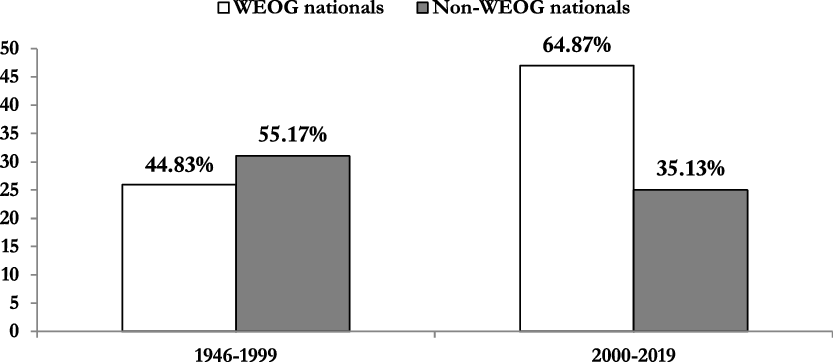
One could see the choice of non-nationals as judges ad hoc as expressing limited polarity. Since 2000, 48 non-nationals appointed as judges ad hoc have come from states of the Western European and Others Group (WEOG) (64.87%), while 26 have been nationals of other states (35.13%). Until 1999, 26 non-nationals appointed as judges ad hoc had come from WEOG states (44.83%), while 32 were nationals of other states (55.17%) (see Figure 2 below).Footnote 98
Number of non-nationals appointed judges ad hoc divided between WEOG nationals and non-WEOG nationals.
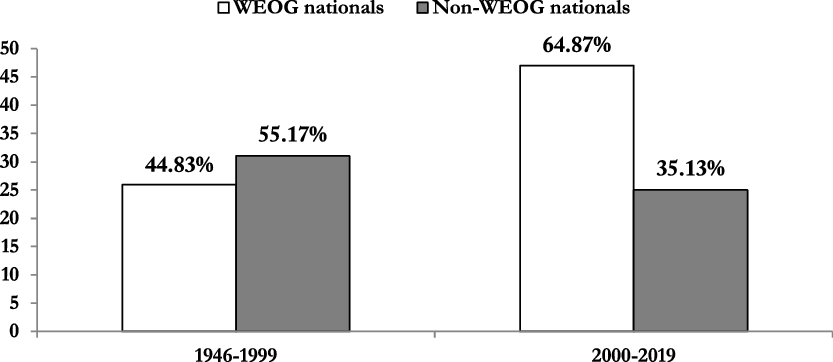
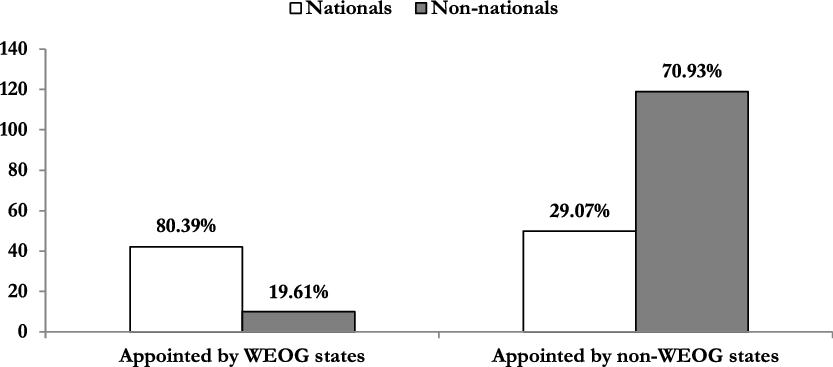
These numbers could be attributed to the multiple appointments, since 2000, of former elected judges who are nationals of WEOG states. Nonetheless, it remains that, in the twenty-first century, diversity in appointments has been more limited than before.Footnote 99 Furthermore, non-nationals are more often appointed by non-WEOG states. In the ICJ’s history, non-WEOG states appointed 122 non-nationals as judges ad hoc (70.93%), while appointing their own nationals 50 times (29.07%), whereas WEOG states have appointed 10 non-nationals (19.61%) and 41 nationals as judges ad hoc (80.39%) (see Figure 3 below).Footnote 100
Number of nationals and non-nationals appointed judges ad hoc by WEOG and non-WEOG states since 1946.
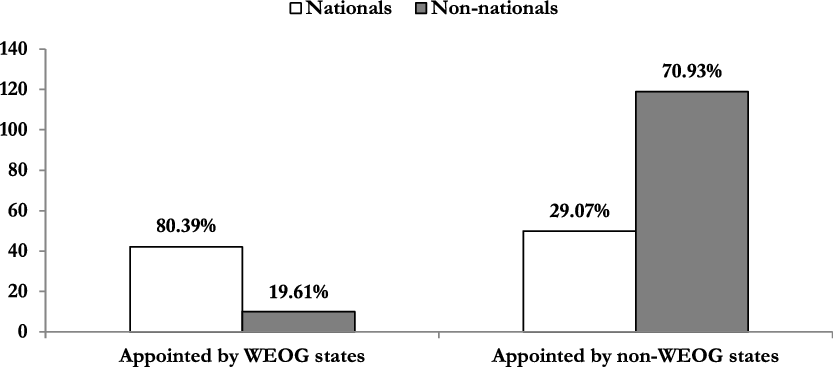
As Cohen suggested, a group of states, such as the WEOG, may look like a single pole to other states.Footnote 101 This indicates that choosing non-nationals as judges ad hoc has not promoted multipolarity, and thus, following Cohen’s analysis, might contribute to making multilateralism easier to achieve. Yet, if appointing non-nationals as judges ad hoc would promote multipolarity, it could in the future determine a more pluralistic approach to ICJ dispute settlement. The pattern of appointment of non-nationals as judges ad hoc also shows that states reportedly pursuing non-multilateral-oriented policies, such as the United States, choose their own nationals as judges ad hoc, which seems consistent with their policy orientation. The limited polarity emerging from appointments of non-nationals as judges ad hoc further suggests the existence of yet another juxtaposition of ‘global north’ and ‘global south’, with nationals of ‘global north’ states being appointed far more frequently than nationals of ‘global south’ states.
Appointing a state’s own nationals as judges ad hoc could increase multipolarity, at least in international dispute settlement. If one were to agree that pluralistic multilateralism in settling international disputes is something to strive for, it might seem desirable to reinstate a nationality requirement for judges ad hoc. Nevertheless, overcoming national particularism is a sign of maturity of the international legal order, which could strengthen pluralist multilateralism in international dispute settlement. Whoever states appoint as judges ad hoc, there will continue to be forces pulling towards enhanced multilateralism and forces pulling in the opposite direction.
4. Conclusion: The role of judges ad hoc at the ICJ
Sir Elihu Lauterpacht wrote that judges ad hoc have a special obligation to ensure that the Court fully appreciates ‘every relevant argument’ made by their appointing states, and that such arguments are reflected in an eventual individual opinion.Footnote 102 An issue could arise in cases in which only one state appoints a judge ad hoc: if the opposing party were entitled to make an appointment but did not do so, it could be considered to be at a disadvantage. This conception of the judge ad hoc’s role suggests that elected judges might not fully appreciate every relevant argument made before the Court, which would justify the presence of judges ad hoc. If one accepted this premise, the arguments of a state, the national of which is an elected judge, could possibly be appreciated less fully than those of an opposing state appointing a judge ad hoc. The Court’s complex and collegial deliberation process should ensure that, in successive rounds over several months, elected judges assess all arguments made during the written and oral proceedings, irrespective of the presence of judges ad hoc. This seems to be confirmed by the decision of certain states not to appoint judges ad hoc despite being entitled to do so, as in Cambodia v. Thailand,Footnote 103Nauru v. Australia,Footnote 104 and Botswana/Namibia.Footnote 105
In cases heard by Chambers of the Court,Footnote 106 arguably somewhat comparable to arbitration,Footnote 107 the more limited number of decision-makers suggests that judges ad hoc might be more likely actively to ensure that their appointing states’ arguments are fully considered. However, as both the Court and its Chambers must issue judgments which ‘state the reasons on which [they are] based’,Footnote 108 they have an interest in such reasons being cogent and persuasive, which also require fully addressing ‘every relevant argument’ made by the parties. Furthermore, in five of the six cases heard by Chambers to-date, one current titular judge having the nationality of one of the litigating states sat in the Chamber,Footnote 109 which meant that, in each of such cases, a judge ad hoc sat in that Chamber. However, no judge ad hoc was appointed in Elettronica Sicula (ELSI), as elected judges having the nationalities of both parties were members of the Chamber.Footnote 110
The increasingly common appointment of former titular judges as judges ad hoc suggests that states wish to select individuals who know the Court’s procedures, and have established personal and professional relationships within the Court. In the Court’s deliberation process, judges express and exchange views both orally and in writing, which makes it important for judges ad hoc, as well as elected judges, to be persuasive. In addition, judges ad hoc are chosen based on the influence which the appointing state expects them to have in the deliberations. Presumably, being authorities in their respective fields contributes to increasing this influence. In fact, with respect to appointments, practice also suggests that judges ad hoc have recently been chosen on a ratione materiae basis, irrespective of nationality. For example, states chose law of the sea specialists in Peru v. Chile and Alleged Violations of Sovereign Rights and Maritime Spaces,Footnote 111 and international humanitarian law experts in Arrest Warrant and Ukraine v. Russian Federation.Footnote 112 Similarly, a private international law authority was appointed in Belgium v. Switzerland.Footnote 113 States have appointed ITLOS judges in maritime delimitation disputes, such as Nicaragua v. Colombia and Romania v. Ukraine,Footnote 114 and re-appointed judges ad hoc who had sat on earlier maritime delimitation cases, as in Qatar v. Bahrain and Nicaragua v. Honduras.Footnote 115
The personal stature and professional reputation of judges ad hoc, especially when chosen from among former elected judges, likely contribute to enhance the perception of the Court’s impartiality. The same could be said for the choice of judges ad hoc from the ranks of experts in particular fields of international law, regardless of their nationality. Moreover, the clear pattern showing the increasingly common appointment of non-nationals as judges ad hoc heightens the appearance of impartiality of the Court as a whole. There might also be a correlation between legal counsel for a state and the judges ad hoc appointed by that state, which nonetheless appears to be speculative considering the lack of public records in this regard.
The recent practice in the appointment of judges ad hoc, especially appointment of former elected judges and the increasingly common appointments of non-nationals, suggests that the institution of judges ad hoc should not be viewed as damaging the states’ perception of the Court’s impartiality. While one could argue that, in the first few decades of the Court’s existence, the states’ choices of judges ad hoc would not have necessarily led to states perceiving the Court as being more impartial, recent developments should lead to a different conclusion. The institution of judges ad hoc has come full circle, back to the point at which it started in the early 1920s, when it was created as a means to limit the appearance that the PCIJ was less impartial owing to only one of the parties counting one member of the Court having its nationality. In this perspective, the institution of judges ad hoc seems finally to be achieving the aim for which it was created, as opposed to fulfilling the prophecies of those who, throughout the Court’s history, have been advocating its demise.
Appendix
ICJ cases in which judges ad hoc were appointed (in chronological order by date of commencement)