


%20--%3e%3c!DOCTYPE%20svg%20PUBLIC%20'-//W3C//DTD%20SVG%201.0//EN'%20'http://www.w3.org/TR/2001/REC-SVG-20010904/DTD/svg10.dtd'%3e%3csvg%20version='1.0'%20id='Layer_1'%20xmlns='http://www.w3.org/2000/svg'%20xmlns:xlink='http://www.w3.org/1999/xlink'%20x='0px'%20y='0px'%20width='64px'%20height='64px'%20viewBox='5.5%20-3.5%2064%2064'%20enable-background='new%205.5%20-3.5%2064%2064'%20xml:space='preserve'%3e%3cg%3e%3ccircle%20fill='%23FFFFFF'%20fill-opacity='0'%20cx='37.785'%20cy='28.501'%20r='28.836'/%3e%3cpath%20fill='%23595959'%20d='M37.441-3.5c8.951,0,16.572,3.125,22.857,9.372c3.008,3.009,5.295,6.448,6.857,10.314%20c1.561,3.867,2.344,7.971,2.344,12.314c0,4.381-0.773,8.486-2.314,12.313c-1.543,3.828-3.82,7.21-6.828,10.143%20c-3.123,3.085-6.666,5.448-10.629,7.086c-3.961,1.638-8.057,2.457-12.285,2.457s-8.276-0.808-12.143-2.429%20c-3.866-1.618-7.333-3.961-10.4-7.027c-3.067-3.066-5.4-6.524-7-10.372S5.5,32.767,5.5,28.5c0-4.229,0.809-8.295,2.428-12.2%20c1.619-3.905,3.972-7.4,7.057-10.486C21.08-0.394,28.565-3.5,37.441-3.5z%20M37.557,2.272c-7.314,0-13.467,2.553-18.458,7.657%20c-2.515,2.553-4.448,5.419-5.8,8.6c-1.354,3.181-2.029,6.505-2.029,9.972c0,3.429,0.675,6.734,2.029,9.913%20c1.353,3.183,3.285,6.021,5.8,8.516c2.514,2.496,5.351,4.399,8.515,5.715c3.161,1.314,6.476,1.971,9.943,1.971%20c3.428,0,6.75-0.665,9.973-1.999c3.219-1.335,6.121-3.257,8.713-5.771c4.99-4.876,7.484-10.99,7.484-18.344%20c0-3.543-0.648-6.895-1.943-10.057c-1.293-3.162-3.18-5.98-5.654-8.458C50.984,4.844,44.795,2.272,37.557,2.272z%20M37.156,23.187%20l-4.287,2.229c-0.458-0.951-1.019-1.619-1.685-2c-0.667-0.38-1.286-0.571-1.858-0.571c-2.856,0-4.286,1.885-4.286,5.657%20c0,1.714,0.362,3.084,1.085,4.113c0.724,1.029,1.791,1.544,3.201,1.544c1.867,0,3.181-0.915,3.944-2.743l3.942,2%20c-0.838,1.563-2,2.791-3.486,3.686c-1.484,0.896-3.123,1.343-4.914,1.343c-2.857,0-5.163-0.875-6.915-2.629%20c-1.752-1.752-2.628-4.19-2.628-7.313c0-3.048,0.886-5.466,2.657-7.257c1.771-1.79,4.009-2.686,6.715-2.686%20C32.604,18.558,35.441,20.101,37.156,23.187z%20M55.613,23.187l-4.229,2.229c-0.457-0.951-1.02-1.619-1.686-2%20c-0.668-0.38-1.307-0.571-1.914-0.571c-2.857,0-4.287,1.885-4.287,5.657c0,1.714,0.363,3.084,1.086,4.113%20c0.723,1.029,1.789,1.544,3.201,1.544c1.865,0,3.18-0.915,3.941-2.743l4,2c-0.875,1.563-2.057,2.791-3.541,3.686%20c-1.486,0.896-3.105,1.343-4.857,1.343c-2.896,0-5.209-0.875-6.941-2.629c-1.736-1.752-2.602-4.19-2.602-7.313%20c0-3.048,0.885-5.466,2.658-7.257c1.77-1.79,4.008-2.686,6.713-2.686C51.117,18.558,53.938,20.101,55.613,23.187z'/%3e%3c/g%3e%3c/svg%3e)
%20--%3e%3c!DOCTYPE%20svg%20PUBLIC%20'-//W3C//DTD%20SVG%201.0//EN'%20'http://www.w3.org/TR/2001/REC-SVG-20010904/DTD/svg10.dtd'%3e%3csvg%20version='1.0'%20id='Layer_1'%20xmlns='http://www.w3.org/2000/svg'%20xmlns:xlink='http://www.w3.org/1999/xlink'%20x='0px'%20y='0px'%20width='64px'%20height='64px'%20viewBox='5.5%20-3.5%2064%2064'%20enable-background='new%205.5%20-3.5%2064%2064'%20xml:space='preserve'%3e%3cg%3e%3ccircle%20fill='%23FFFFFF'%20fill-opacity='0'%20cx='37.637'%20cy='28.806'%20r='28.276'/%3e%3cg%3e%3cpath%20fill='%23595959'%20d='M37.443-3.5c8.988,0,16.57,3.085,22.742,9.257C66.393,11.967,69.5,19.548,69.5,28.5c0,8.991-3.049,16.476-9.145,22.456%20C53.879,57.319,46.242,60.5,37.443,60.5c-8.649,0-16.153-3.144-22.514-9.43C8.644,44.784,5.5,37.262,5.5,28.5%20c0-8.761,3.144-16.342,9.429-22.742C21.101-0.415,28.604-3.5,37.443-3.5z%20M37.557,2.272c-7.276,0-13.428,2.553-18.457,7.657%20c-5.22,5.334-7.829,11.525-7.829,18.572c0,7.086,2.59,13.22,7.77,18.398c5.181,5.182,11.352,7.771,18.514,7.771%20c7.123,0,13.334-2.607,18.629-7.828c5.029-4.838,7.543-10.952,7.543-18.343c0-7.276-2.553-13.465-7.656-18.571%20C50.967,4.824,44.795,2.272,37.557,2.272z%20M46.129,20.557v13.085h-3.656v15.542h-9.944V33.643h-3.656V20.557%20c0-0.572,0.2-1.057,0.599-1.457c0.401-0.399,0.887-0.6,1.457-0.6h13.144c0.533,0,1.01,0.2,1.428,0.6%20C45.918,19.5,46.129,19.986,46.129,20.557z%20M33.042,12.329c0-3.008,1.485-4.514,4.458-4.514s4.457,1.504,4.457,4.514%20c0,2.971-1.486,4.457-4.457,4.457S33.042,15.3,33.042,12.329z'/%3e%3c/g%3e%3c/g%3e%3c/svg%3e)
%20--%3e%3c!DOCTYPE%20svg%20PUBLIC%20'-//W3C//DTD%20SVG%201.0//EN'%20'http://www.w3.org/TR/2001/REC-SVG-20010904/DTD/svg10.dtd'%3e%3csvg%20version='1.0'%20id='Layer_1'%20xmlns='http://www.w3.org/2000/svg'%20xmlns:xlink='http://www.w3.org/1999/xlink'%20x='0px'%20y='0px'%20width='64px'%20height='64px'%20viewBox='5.5%20-3.5%2064%2064'%20enable-background='new%205.5%20-3.5%2064%2064'%20xml:space='preserve'%3e%3cg%3e%3ccircle%20fill='%23FFFFFF'%20fill-opacity='0'%20cx='36.924'%20cy='28.403'%20r='28.895'/%3e%3cpath%20fill='%23595959'%20d='M37.442-3.5c8.99,0,16.571,3.085,22.743,9.256C66.393,11.928,69.5,19.509,69.5,28.5c0,8.992-3.048,16.476-9.145,22.458%20C53.88,57.32,46.241,60.5,37.442,60.5c-8.686,0-16.19-3.162-22.513-9.485C8.644,44.728,5.5,37.225,5.5,28.5%20c0-8.762,3.144-16.343,9.429-22.743C21.1-0.414,28.604-3.5,37.442-3.5z%20M12.7,19.872c-0.952,2.628-1.429,5.505-1.429,8.629%20c0,7.086,2.59,13.22,7.77,18.4c5.219,5.144,11.391,7.715,18.514,7.715c7.201,0,13.409-2.608,18.63-7.829%20c1.867-1.79,3.332-3.657,4.398-5.602l-12.056-5.371c-0.421,2.02-1.439,3.667-3.057,4.942c-1.622,1.276-3.535,2.011-5.744,2.2%20v4.915h-3.714v-4.915c-3.543-0.036-6.782-1.312-9.714-3.827l4.4-4.457c2.094,1.942,4.476,2.913,7.143,2.913%20c1.104,0,2.048-0.246,2.83-0.743c0.78-0.494,1.172-1.312,1.172-2.457c0-0.801-0.287-1.448-0.858-1.943l-3.085-1.315l-3.771-1.715%20l-5.086-2.229L12.7,19.872z%20M37.557,2.214c-7.276,0-13.428,2.571-18.457,7.714c-1.258,1.258-2.439,2.686-3.543,4.287L27.786,19.7%20c0.533-1.676,1.542-3.019,3.029-4.028c1.484-1.009,3.218-1.571,5.2-1.686V9.071h3.715v4.915c2.934,0.153,5.6,1.143,8,2.971%20l-4.172,4.286c-1.793-1.257-3.619-1.885-5.486-1.885c-0.991,0-1.876,0.191-2.656,0.571c-0.781,0.381-1.172,1.029-1.172,1.943%20c0,0.267,0.095,0.533,0.285,0.8l4.057,1.83l2.8,1.257l5.144,2.285l16.397,7.314c0.535-2.248,0.801-4.533,0.801-6.857%20c0-7.353-2.552-13.543-7.656-18.573C51.005,4.785,44.831,2.214,37.557,2.214z'/%3e%3c/g%3e%3c/svg%3e)
%20--%3e%3c!DOCTYPE%20svg%20PUBLIC%20'-//W3C//DTD%20SVG%201.1//EN'%20'http://www.w3.org/Graphics/SVG/1.1/DTD/svg11.dtd'%3e%3csvg%20version='1.1'%20id='Layer_1'%20xmlns='http://www.w3.org/2000/svg'%20xmlns:xlink='http://www.w3.org/1999/xlink'%20x='0px'%20y='0px'%20width='64.000977px'%20height='64px'%20viewBox='0%200%2064.000977%2064'%20enable-background='new%200%200%2064.000977%2064'%20xml:space='preserve'%3e%3cg%3e%3ccircle%20fill='%23FFFFFF'%20fill-opacity='0'%20cx='32.064453'%20cy='31.788086'%20r='29.012695'/%3e%3cg%3e%3cpath%20fill='%23595959'%20d='M31.943848,0C40.896484,0,48.476562,3.105469,54.6875,9.314453C60.894531,15.486328,64.000977,23.045898,64.000977,32%20s-3.048828,16.457031-9.145508,22.513672C48.417969,60.837891,40.779297,64,31.942871,64%20c-8.648926,0-16.152832-3.142578-22.513672-9.429688C3.144043,48.286133,0,40.761719,0,32.000977%20c0-8.723633,3.144043-16.285156,9.429199-22.68457C15.640137,3.105469,23.14502,0,31.943848,0z%20M32.060547,5.771484%20c-7.275391,0-13.429688,2.570312-18.458496,7.714844C8.381836,18.783203,5.772949,24.954102,5.772949,32%20c0,7.125,2.589844,13.256836,7.77002,18.400391c5.181152,5.181641,11.352051,7.770508,18.515625,7.770508%20c7.123047,0,13.332031-2.608398,18.626953-7.828125C55.713867,45.466797,58.228516,39.353516,58.228516,32%20c0-7.3125-2.553711-13.484375-7.65625-18.513672C45.504883,8.341797,39.333984,5.771484,32.060547,5.771484z%20M44.117188,24.456055%20v5.485352H20.859863v-5.485352H44.117188z%20M44.117188,34.743164v5.481445H20.859863v-5.481445H44.117188z'/%3e%3c/g%3e%3c/g%3e%3c/svg%3e)
Globally, in 2020, the officially recorded remittance flows to low and middle-income countries were estimated at $540 billion and the total remittance flows, including high-income countries, were estimated at $702 billion(Reference Ratha, De and Kim1). The volume of remittances continues to be higher than the official development aid, although their level is projected to decline due to the present economic crisis in many developing nations(2). The relationship between migration and human development has been investigated in different geographical settings. At the macro-level, Giuliano and Ruiz-Arranz (2009)(Reference Giuliano and Ruiz-Arranz3) showed that remittances have a positive effect on countries’ economic growth and financial development. At the household level, existing studies showed that remittances have a positive effect on both subjective and objective well-being(Reference Szabo, Adger and Matthews4–Reference Karamba and Quiñones6).
Overall, there has been mixed evidence regarding the impact of migration and remittances on food security. While some studies(Reference Szabo, Adger and Matthews4,Reference Azzarri and Zezza5) found that a positive association existed between migration and nutritional outcomes(Reference Karamba and Quiñones6), it has been suggested that migration might negatively affect the quality of diet. Numerous studies have examined the food security status of farm households and coping strategies and the effect of off-farm work on food security(Reference Demi and Kuwornu7–10). However, to the best of the authors’ knowledge, there is no recent comprehensive country-level quantitative analysis on the associations between remittances and food security in Bangladesh. Our study aims to fill this gap by statistically analysing the most recent (2016) Household Income and Expenditure Survey data.
Examining the association between remittances and food security is particularly critical in high out-migration regions, such as South Asia. This region experiences comparatively a high level of out-migration accompanied by large remittances flows(Reference Ratha, De and Kim1). According to the most recent World Bank data(Reference Mallick and Vogt11), South Asia continued to experience considerable remittance growth despite the pandemic(Reference Mallick and Vogt11). In the current US dollar (USD) terms, in 2020, India was amongst the top five recipients of remittances. Pakistan and Bangladesh were sixth and seventh, respectively, with Bangladesh receiving USD22 billion in 2020. While the pandemic negatively affected the remittance flow in some countries, this was not the case for Bangladesh and Pakistan(Reference Mallick and Vogt11). A survey conducted by Bangladesh Bank in 2014 found that 55·6 % of remittances from expatriates were utilised to different types of expenditures (e.g. 33·6 % food and clothing, 11·5 % education and health care, 3·5 % durable goods and 7·0 % other expenses) and 44·4 % is utilised in different types of investment (e.g. 18·9 % real estate, 77·8 % small and medium enterprises and 7·7 % financial investment)(9).
In South Asian countries, the number of studies examining the link between remittance flows and food security to provide policy recommendations for development is limited. Bangladesh has a long history of migration, which has shaped and continues to shape Bangladeshi society(Reference Sepuldeva, Van Banning and van Genugten12). According to an International Organization for Migration report (2005)(Reference Sepuldeva, Van Banning and van Genugten12), 75 % population migrating from rural to urban areas is internal migration, while the remaining individuals are international migrants(Reference Sepuldeva, Van Banning and van Genugten12). In many cases, internal and international migrations are intertwined. Many international migrants, for example, had first settled in the country before venturing abroad(Reference Sepuldeva, Van Banning and van Genugten12). The majority of Bangladeshi nationals who emigrated from the country reside in Saudi Arabia and India(Reference Islam, Ali and Amin13). Only 2 % of migrants are classified as ‘professional,’ while 48 % are classified as ‘low skilled’(Reference Grosso, Mateo and Rangelov14). Remittances have played a significant role in poverty reduction, maintaining balance of payment, enriching foreign currency reserve and contributing to the Gross Domestic Product of the country(Reference Sepuldeva, Van Banning and van Genugten12).
Bangladesh is one of the top receivers of remittances from migrants globally, as attested by the contribution of remittances to the Gross Domestic Product. According to the most recent World Bank estimates, they account for equivalent to 5·8 % of the country’s Gross Domestic Product and almost 20 % of foreign exchange earnings(10). High rates of out-migration, both in terms of internal migration and emigration abroad, result from a combination of push and pull factors. These include not only economic pressures to sustain livelihoods but also environmental vulnerability, in particular in the Ganges Brahmaputra delta region. A relatively recent study by Mallick and Vogt(Reference Pérez-Escamilla15) estimates that by 2080, 28 million people will be displaced due to the consequences of sea-level rise.
Food security is an integral part of the human security framework and households’ access to food is a substantial human right(Reference Zezza, Carletto and Davis16). In Bangladesh, both the human security of farmers and the human right to food are often compromised due to a mixture of political, economic and environmental factors. The livelihoods of farmer communities are particularly threatened by natural disasters as well as in, andcreasing salinity intrusion and relatively high arsenic contamination. It has been reported that in the Patuakhali district, farmers had to resort to shifting crop production patterns in order to mitigate existing and expected food insecurity risks(Reference Azzarri17). At the same time, given the reliance of the urban poor on purchased food, potential hikes in food prices are likely to affect household food security. The exposure to food insecurity risks is not equal across different strata of society. In addition, food security is related to all of the present Sustainable Development Goals (SDG) of the United Nations 2030 agenda(18,Reference Zapata19) . In order to meet the SDG, countries must benefit from improved food security governance based on equitable and sustainable food systems. Given the above, our study aims not only to contribute to the existing body of literature but also provide policy recommendations for development of Bangladesh. Therefore, we examined the association between remittances and food security in Bangladesh, controlling for other key factors.
Conceptualising the associations between remittances and food security
We draw from the conceptual framework developed in previous studies(Reference Raihan, Khondker and Sugiyarto20,Reference Gibson, McKenzie and Stillman21) on remittances and, more broadly, the migration that can affect food security in several ways(Reference Raihan, Khondker and Sugiyarto20). We distinguish five channels through which migration can affect food security outcomes. These include the effects on: (1) income; (2) household size and composition; (3) allocation of time to paid work and household chores; (4) knowledge of care practices and (5) insurance effects. The income effect is the most intuitive as remittances, whether monetary or gifts, are likely to ease households’ financial pressures. Remittances can, however, act on food security outcomes through different pathways and have differentiated effects.
According to the FAO, food insecurity exists when ‘people lack secure access to sufficient amounts of safe and nutritious food for normal growth and development and an active and healthy life’(Reference Matthew and Walsham22). In Bangladesh, physical and financial barriers to accessing food can be exacerbated by environmental vulnerability, particularly in the coastal region. In Bangladesh, physical and financial barriers to accessing food can be exacerbated by environmental vulnerability, particularly in the coastal region.
Figure 1 summarises the relationships between remittances, household socio-economic characteristics and the four aspects of food security. Potentially, the most obvious way in which remittances can affect food security is through financial access to food. The positive effect of remittance flows on households’ income has been well established in the literature(Reference Szabo, Adger and Matthews4,Reference Azzarri and Zezza5,Reference Zapata19) . Households that receive remittances are not only able to increase their food supplies but also invest more in their health and education(Reference Rawlani and Sovacool23). A study from the Asian Development Bank(Reference Szabo, Hossain and Adger24) found that Bangladesh households that receive remittances were significantly more likely to have higher food expenditures. Typically, households with higher incomes tend to spend a smaller proportion of their overall expenditure on food, thus leaving more income for non-food consumption. It should also be noted that in addition to the direct effect on food expenditure, remittances can also indirectly influence physical access to food, as households may invest them in transportation, housing, child education and agricultural development.
Conceptual framework of the study, based on analysis in Szabo et al. (2018). Solid arrows indicate direct relationships, whereas dashed arrows indicate indirect relationships

The effect of remittances on energy intake and dietary diversity is more complex. Because households that receive remittances are expected to spend more on food, it is sensible to assume that the average energy intake of household members is going to increase. Despite the debate in the literature to date, there is evidence that remittances are primarily spent on consumption(25). By increasing income available for food consumption, remittances are likely to have a positive effect on dietary diversity. However, there is also evidence of the opposite effects. For example, a recent study from Ghana found that migration was associated with lower quality of diet related to a shift towards less nutritious food and eating outside(Reference Demi and Kuwornu7).
Although the association between remittance flows and food stability is more difficult to measure, there are empirically proved pathways(Reference Raihan, Khondker and Sugiyarto20,Reference Gibson, McKenzie and Stillman21) . These interlinkages are particularly important in a country like Bangladesh, where natural hazards are frequent, especially in coastal districts. Cyclones and floods affect the stability of food supplies not only through immediate damage of stocks and agricultural land but also by contributing to shifting population distribution and occupational structures in the study area. In the face of deteriorating environmental conditions, such as increasing soil salinity and arsenic contamination, some farmers chose emigration as a coping strategy in order to sustain their livelihoods(Reference Smith and Subandoro26). In the context of shocks caused by natural hazards, extreme weather conditions and loss of income due to creeping processes, remittances can act as a natural buffer to ensure the continuity of food supplies. The issue of food stability and resilience to shocks will become even more important, given the predicted impact of climate change in Bangladesh(Reference Rahman, Matsui and Ikemoto27,Reference Mekuria, Wubneh and Tewabe28) .
Finally, other factors and pathways affect food security, such as previously mentioned environmental dynamics and individual socio-economic characteristics. The natural environment and climate change can affect both the availability and accessibility of food and the stability of food supplies. In Bangladesh, these environmental challenges define the interconnection between wealth and location of the households. It has been previously shown that poor rural households are particularly likely to be food insecure(Reference Mekuria, Wubneh and Tewabe28), although comprehensive quantitative evidence on this specific association is scanty.
Data and methods
Data
In order to conduct statistical analyses, we make use of the 2016 Household Income and Expenditure Survey (HIES). HIES is a nationally representative survey, which has been periodically carried out by the Bangladesh Bureau of Statistics(29). The sample design involves two-stage random samplings and is based on the Integrated Multipurpose Sample design framework established for the 2001 Population and Housing Census. The Integrated Multipurpose Sample encompasses 1000 Primary Sampling Units, including 360 urban and 640 rural Primary Sampling Units.
We followed the quantitative approach developed by the International Food Policy Institute for estimating food security(Reference Filmer and Pritchett30). Regarding food availability, we used the indicator of energies consumed per capita, which is obtained by dividing the household’s energy availability by household size. We used the national cut-off point for nutritional requirements (2122 kcal/d) to classify an individual as food insecure(29,Reference Vyas and Kumaranayake31) . Financial access to food is approximated by the proportion of household-level expenditure on food. Following International Food Policy Institute’s approach, the household is classified as food insecure if it spends more than 65 % of its overall expenditure on food consumption(Reference Filmer and Pritchett30). In order to quantify diet diversity, we used a score based on the count of food groups consumed over the last 2 weeks. The specific food groups are based on the original categorisation by the Bangladesh Bureau of Statistics and include food grains, pulses, eggs, fish, meat, vegetables, milk and dairy, sweetmeat, oil and fats, fruits, drinks, sugar and molasses. Following previous literature(Reference Houweling, Kunst and Mackenbach32), households were considered food insecure if they consumed three or fewer food groups within 24 h prior to the survey.
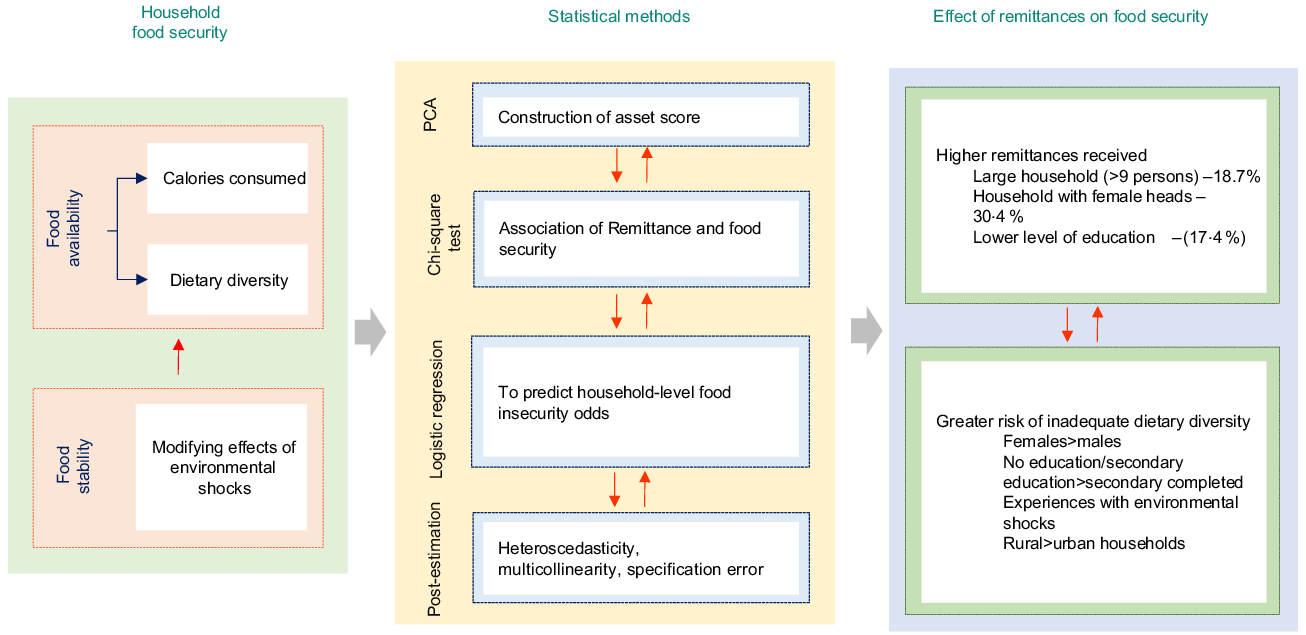
Food stability, the fourth aspect of the food security concept, is the most difficult to measure and thus rarely investigated. We, therefore, incorporated this aspect in our analysis by examining the modifying effect of environmental shocks on household food security. In addition to remittances, key explanatory variables include the receipt of remittance and socio-economic characteristics of the household. We use a binary indicator of remittances, classifying households by those who have been receiving remittances over the last 12 months and those who have not. Remittances include both monetary transfers and gifts. Another key explanatory variable is respondents’ gender; this variable will allow us to test the presupposed difference in food security between males and females. We presented analytical approach adopted in the current study in Fig. 2.
Analytical approach for assessing the association between remittances and food security

Other control variables include respondents’ educational attainment of the household head that is measured by three categories: (i) no institutional education (baseline); (ii) secondary incomplete and (iii) secondary or above(Reference Agresti33). Then, we included other characteristics of the household, that is, a dummy denoting whether household experienced environmental shocks, age of household head (categorised into four categories, <30, 30–49, 50–69 and 70 and more), household size (categorical, 1–4 persons being baseline, 5 to 8 and 9 or more). The next control variable, household wealth status, has been constructed based on total consumption expenditure, where wealth quintile is a multilevel variable (see next section), and we considered the poorest category as a baseline level. Locational variables include rural v. urban residence and geographical region (Bangladeshi divisions, where Barisal division is a baseline). Descriptive statistics of the control variables are presented in Table 1.
Background characteristics of the households

HIES 2016.
Statistical analysis
The socio-economic status of each household was assessed by asset scores based on the households’ dwelling characteristics (e.g. wall, roof and floor materials), water and sanitation facilities, utilities (e.g. gas, electricity and internet), holdings of durable goods (e.g. radio, television and almirah) and other assets (e.g. ownership of land and livestock). The asset scores were generated by employing a principal component analysis approach(Reference Scott, Hosmer and Lemeshow34). The principal component analysis is a widely used technique for dimensionality reduction and, for example, assessing socio-economic status in low-income settings(Reference Quisumbing35). The first principal component analysis was used to construct asset scores since it accounted for the highest proportion of the total variation. A higher asset score indicates that a household is more wealthy(Reference Sraboni, Malapit and Quisumbing36). By using the asset scores, households were ranked from the poorest to the richest and divided into five equal wealth quintiles.
We used χ 2 test to measure the association between receiving remittances and food-security status estimated using two different approaches (i.e. expenditure and energy-based method). We utilised a series of logistic regressions to test the hypothesis on the potential association of remittances with food security. Logistic regression is a commonly used statistical model for binary endogenous variables, i.e. when the outcome takes two values, such as 0 = ‘having insufficient energy intake’ (often denotes as a failure) and 1 = ‘having sufficient energy intake’ (success)(37,38) . The model assumes that the logit of the probability of success is a function of a linear predictor and has a standard logistic distribution. The coefficients are estimated by using the maximum likelihood method.
In the analysis, we defined two endogenous variables that measure food security; the first using expenditure on food and the other based on energy intake defined as consuming more than 2122 calories/d. Thus, in model 1, we considered ‘food security’ (inadequate dietary diversity) and, in model 2, we selected binary outcome of ‘food security (2122 calories or more)’ as the outcome variables, respectively. We used ‘receiving remittances’ (binary) as the key explanatory variable in both models. We applied sampling weights in the regression analysis. We performed post estimation test for the presence of heteroscedasticity, multicollinearity and the specification error for both regression models.
Results
Background characteristics of the households
In the analysed data set, 48·55 % of the household heads were in the age group of 30 to 49 years, and the male household head share was higher than the female (87·25 %). The education level of the household heads showed that ‘no institutional education’ (42·09 %) and ‘incomplete secondary’ (43·15 %) education status of the household heads were more common. Only 14·75 % of household heads had secondary or above complete education. Approximately 20 % of the household heads were from the Dhaka division, whereas 9 % and 6 % were from Barisal and Sylhet, respectively. It is visible that 91·15 % of household heads did not recieved any remittances (Table 1).
Remittances and food security
Descriptive statistics by food security and remittance status are summarised in Table 2. Receiving remittances was high in households with the oldest household heads (26·2%). In Bangladesh, households’ mean remittances were 12 605·9 BDT, whereas higher remittances were received in the Sylhet and Dhaka region, followed by Chittagong (Fig. 2 and figures in the supplementary material). Comparatively, only 14·7% of households with household heads aged 30 to 49 years reported received remittance, and the mean value of remittances in these households was 5899·8 BDT. Households with female heads of households were considerably more likely to receive remittances than households with a male head of household (30·4% v. 14·5%). Large households (households with nine members or more) were also more likely to receive remittance (18·7 %). In addition, receiving remittances was more common in households with higher levels of education. About 17·4 % of households with household heads who had incomplete secondary education stated that they received remittances.
Results of bivariate analysis using χ 2 test of the relationship between socio-demographic characteristics of the households, remittances and food insecurity

In terms of geographical differences, proportion of households receiving remittances was the highest in the Chittagong division (19·0 %), where the mean value of remittances was 8217·9 BDT. Comparatively, in Rajshahi and Rangpur, respectively 18·8% and 14·4% of all households reported receiving remittances. The proportion of households receiving remittances was slightly higher in urban areas (17·4 %) than in rural areas (14·5%). Based on the asset quintiles, it was observed that 14% of the poorest households received remittances, while 18·5% of the richest households received remittances. Considering the food diversity category, the proportion of households with inadequate diet diversity was higher among those households who did not receive remittances (16·5% v. 12·8%). Similarly, 17% of food-insecure households (measured by energy intake) reported receiving remittances, compared with 18·4% of food-insecure households who did not receive any remittances. Based on the results of the χ 2 tests, the association between characteristics of household and receiving remittance was statistically significant for all variables presented in Table 2.
Regression analysis
Table 3 presents the regression results with food security as the outcome variable based on dietary diversity score and energy intake. The result shows that there is a statistically significant positive relationship between receiving remittances and the likelihood of food insecurity. If a household received remittances within the last 12 months, it is significantly less likely to suffer from inadequate dietary diversity (Adj. OR = 0·769, P < 0·01) compared with households that have not received remittances. Controlling for other factors in the model, the association between receiving remittances and the probability of sufficient energy intake was not statistically significant. This might indicate that households are more likely to fulfil their basic energy intake requirements but struggle to have a sufficiently diverse diet.
Associations between remittances, food security status and socio-economic factors in Bangladesh*

* P < 0·05.
** P < 0·01.
*** P < 0·001.
It is observed that households in the highest wealth quintile have much lower odds of experiencing inadequate dietary diversity (Adj. OR = 0·125, P < 0·001) and insufficient energy intake (Adj. OR = 0·338, P < 0·001) compared with the baseline category of the lowest quintile (poorest households). The results also reveal an interesting dependency between gender and food security. Females are more likely to suffer from inadequate dietary diversity (Adj. OR = 1·531, P < 0·001) and insufficient energy intake (Adj. OR = 1·361, P < 0·001) in comparison with males. Further, the level of education has also been found to be a significant predictor of food security. More specifically, households with higher levels of education (those who completed secondary education or higher) are less likely to experience inadequate dietary diversity (Adj. OR = 0·492, P < 0·001) compared with the households with no institutional education or incomplete secondary education.
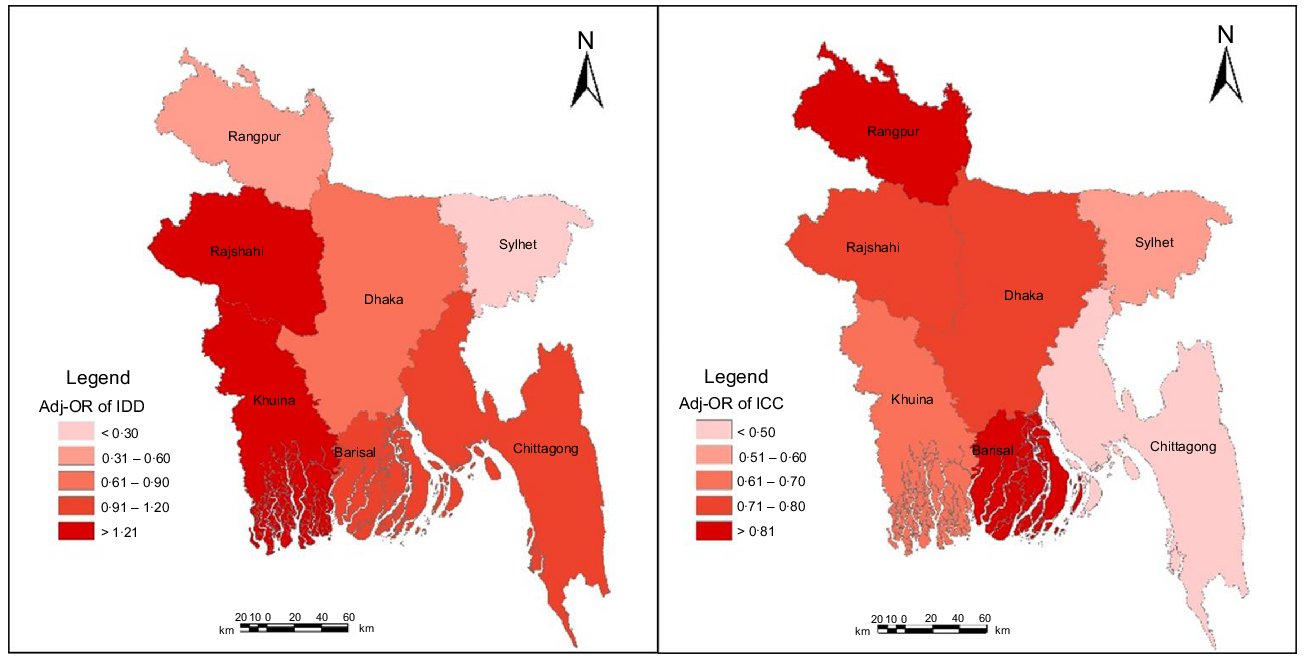
Food security varies geographically (Fig. 3 and see online supplemental Fig. 2). Compared with households located in Barisal (baseline category), households in Sylhet (Adj. OR = 0·342), Rangpur (Adj. OR = 0·451), Khulna (Adj. OR = 2·048) and Rajshahi (Adj. OR = 4·250) are less likely to suffer from inadequate dietary diversity (IDD). Households in Sylhet and Chittagong divisions are less likely to experience insufficient energy intake compared with households in the Barisal division (Adj. OR = 0·54 and Adj. OR = 0·50, respectively). The geographical variation in inadequate dietary diversity (Adj. OR) and insufficient energy intake (Adj. OR) are showing in Fig. 4. Compared with households that did not experience environmental shocks, households who have experienced such shocks are significantly more likely to be affected by food insecurity in the form of poor dietary diversity (Adj. OR = 0·767, P < 0·01). Moreover, rural households are more likely to suffer from inadequate dietary diversity (Adj. OR = 1·216, P < 0·01) and insufficient energy intake (Adj. OR = 1·106, P < 0·05) compared with urban households.
Distribution of the mean remittances received (BDT) across different geographical regions in Bangladesh

Geographical variation in inadequate dietary diversity (IDD) and insufficient energy intake (ICI) based on regression model results (Adj. OR)
Discussion
The current study considered the impact of remittances on food security in Bangladesh. The results of our analysis on the nationally representative HIES data showed that remittances have a significant positive effect on household food security in Bangladesh. The analysis further revealed that gender, education, location and wealth are all significantly associated with food security. In Bangladesh, women and girls can be exposed to higher food insecurity risks through challenges they face in terms of their access to education and employment opportunities, which restricts their economic autonomy and weakens their bargaining position within the family. Their weak bargaining position impacts households towards food insecurity(Reference Adams and Cuecuecha39). Existing research showed that this position also influences the relative empowerment of women within households(Reference Bui and Kugler40).
A study by Mallick et al. (2010) showed that poverty incidence and food consumption or expenditure among female household heads were higher than the male household head(Reference Pérez-Escamilla15). Food security is related to poverty, and the relationship between receiving remittance is more general. Therefore, programmes related to the effective utilisation of remittance income at the household level can improve a household’s overall poverty situation and result in a positive change in food security. In the long term, remittance income can be used for investments in education and women empowerment. Continued investments in schooling, particularly of women and girls, will be important to increase food security.
The current study showed that the growing remittances have important policy implications for improving and strengthening household-level food security status in Bangladesh. Increased food production does not mean food security if households do not have enough money to buy food. Therefore, the availability of remittances improves the household poverty situation. Recent evidence suggests that remittances, the portion of a migrant’s income sent back to the family members left behind, are helping to improve the livelihoods of households in many low-income countries including Bangladesh(Reference Sikder, Higgins and Ballis41,Reference Maphosa42) . The study showed that food security is also associated with geographical location and socio-economic factors. Socioeconomic factors, such as households’ wealth, can have a direct and indirect effect on household food security. In the current study, we found that receiving remittances can improve food expenditure, diversity of food and increase the consumption of food energies significantly.
Most of the people living in extreme poverty and hunger in Bangladesh have experienced positive effects of the flows of remittances, given the fragmented coverage of social protection, informality in economic activities and employment and wide gaps in public health infrastructure(Reference Gubert43). In spite of these constraints, Bangladesh made significant progress towards SDG 2 (‘end hunger, achieve food security, improved nutrition and promote sustainable agriculture’) by achieving remarkable success in food production and self-sufficient in major food production though it had a food deficit in the past. In addition, the Bangladesh government has emphasised crop diversification to ensure the higher accessibility of food to all people, particularly for the poor and vulnerable populations(Reference Edwards and Ureta44).
According to an estimation of the World Bank (2020), the international remittance inflow has already declined by US$14 billion in 2020, which constitutes around 1·75 % of Bangladesh’s Gross Domestic Product(2). Therefore, inequalities have been accentuated in the context of current economic development, and the crisis is likely to reverse years, if not decades, of gains in poverty reduction, undermining the progress made by Bangladesh towards achieving the SDG. Besides this, resilience is a major factor in ensuring sustainable agriculture and other primary activities (such as fisheries and forestry) (SDG 15, target – 15·2) for the region with significant environmental challenges with considering pandemic crisis (SDG 13, target – 13·1), which jointly ensure the progress towards food security (SDG 2), and healthy lives and well-being (SDG 3). Therefore, to undertake the progress towards SDGs 2 within the view of remittance-related policy response is necessary.
The positive impact of remittance inflows on food security makes it crucial to include remittances as essential components of food security programmes in Bangladesh. The current study provides an overview of the links between gender empowerment and food security and the importance of the SDG and their follow-up. Therefore, it contributes to the provision of evidence towards the progress towards SDG 5, which aims to ensure women’s full and effective participation and equal opportunities for leadership at all levels of decision-making in political, economic and public life (target – 5·5). Moreover, it also contributes evidence towards the design of social protection policies, with a specific focus on promoting shared responsibility (target – 5·4) and reducing all forms of discrimination against all women within the household (target – 5·1).
Remittance has differential effects on human capital improvement besides the effect on food consumption behaviour or food security. A number of papers have analysed the differential effects of remittances focusing on education, health, child labour and women empowerment(Reference Adams and Cuecuecha39–Reference Edwards and Ureta44). Using a nationally representative household survey from Ghana, Adams et al. (2013) found that households receiving internal or international remittances spend more at the margin on one important investment good (e.g. education) compared with what they would have spent without remittances, which brings support to the idea that remittances can help increase the level of investment in human capital(Reference Adams and Cuecuecha39). Bui and Kugler (2012, 4th M&D conference) looked at differential impacts when a larger fraction of remittances are received by women and improving children’s health, school attendance and a negative effect on child labour. This suggests that the identity of the receiver matters in terms of increasing human capital investments for children(Reference Bui and Kugler40).
This paper focused on quantifying the household-level associations between remittances, socio-economic factors, the occurrence of environmental shocks and food security. To the best of our knowledge, it is the only study quantifying such association at the national level in Bangladesh using the 2016 HIES data.
Although this manuscript provides significant policy recommendations for the socio-economic development of Bangladesh, it is not without limitations. First, the endogeneity problem arising from the selection into remittance receipt has not been addressed in the current study. Second, the study does not address the differential impacts of remittance receipt relative to that of emigration of household members or relatives. Third, the analysis was performed at the household level using cross-sectional data. Using panel data for the analysis may provide more insightful results and implications. Fourth, more advanced statistical modelling, including matching techniques, might be useful when aiming to examine the causal effects of remittances rather than associations using logistic regressions. Finally, the fact that the majority of household heads were females might be a result of male migration. These limitations will be key considerations in our future research agenda. Overall, further research should consider evaluative modelling techniques and temporal changes and focus more specifically on the influence of hazards and stresses on food security status considering all livelihood categories in the coastal regions in Bangladesh.
Acknowledgements
Acknowledgements: The authors would like to thank the Bangladesh Bureau of Statistics (BBS) for providing access to the Household Income Expenditure Survey 2016 data. Financial support: This research received no specific grant from any funding agency in the public, commercial or not-for-profit sectors. Authorship: S.S., S.A. and A.W. have participated in the conceptualisation, data analysis, data acquisition and drafting of the manuscript. M.P., R.I. and F.Z. contributed in data analysis and writing. J.K.M.K. edited the manuscript and reviewed critically the initial draft. All authors have seen and approved the final version. Ethics of human subject participation: This article has been prepared using secondary data (Household Income and Expenditure Survey 2016 of Bangladesh) from Bangladesh Bureau of Statistics. Thus, no ethical approval is required separately for the current study.
Conflict of interest:
There are no conflicts of interest.



 Open access

