Introduction
Solenopsis geminata (Fabricius) and some other predatory ant species can nest abundantly within fields of upland (dryland) tropical rice (Way et al., Reference Way, Javier and Heong2002). The ants may also establish nests within the fields during dryland phases between irrigated rice crops, particularly during the long fallow season of single cropped flooded rice. During flooding, the ants are largely limited to the earthen banks (bunds) used to confine water in each field. Here, the numbers of workers in S. geminata nests may exceed 500,000 per 100 m of bund (Way et al., Reference Way, Islam, Heong and Joshi1998). In continuously flooded rice fields, S. geminata can forage across a closed leaf canopy once this has overlapped the bund (Way et al., Reference Way, Islam, Heong and Joshi1998), but most only reach the peripheral 2–3 m of the crop. However, as discussed later, some farmers periodically drain cropped fields to mud level for several days, during which predatory S. geminata quickly spread across wet mud and forage on the rice plants.
This paper describes experimental studies on the behaviour and impact of S. geminata compared with that of other natural enemies, notably spiders, mostly using Nilaparvata lugens (Stäl) the brown planthopper (Bph) as a target pest species. Interactions between S. geminata and spiders are also examined in order to assess possible impairment of biological control by the diverse natural enemy community, which is potentially very important in the control of many crop pests (Sunderland et al., Reference Sunderland, Axelsen, Dromph, Freier, Hemptinne, Holst, Mols, Petersen, Powell, Ruggle, Triltsch, Winder and Powell1997) and recognized as sometimes crucial in the suppression of at least one key pest of tropical irrigated rice, notably Bph (Kenmore et al., Reference Kenmore, Carino, Perez, Dyck and Guitierrez1984; Way & Heong, Reference Way and Heong1994).
Materials and methods
Some studies on foraging behaviour of S. geminata were done on a private farm within 10 km of IRRI, where no insecticides had been used for at least ten years. Otherwise, most field experiments were at the IRRI Experimental Farm in pesticide-free areas, apart from a single pre-emergence non-insecticidal herbicide as used also on the private farm. At IRRI, transplanted rice seedlings were established using bunches (hills) of 3–5 rice seedlings reared in the nursery, which were transplanted in flooded fields 0.2 m apart. The rice cultivar was the Bph resistant IR72. This is only partly resistant because adapted strains of Bph can colonize and multiply though more slowly than on susceptible cultivars. The adapted Bph were reared in a glasshouse and then established as target pests for experimental studies in the field.
Experiments on S. geminata predation and its impact compared with that of other natural enemies, notably spiders, were done using 0.7-m diameter and 0.6-m-high transparent Mylar ring cages with two 0.2 m2 netting windows, each usually put around five rice hills artificially infested with Bph adults or 3rd–4th instar nymphs. The cages were designed to compare the impact of all predators and parasitoids including ants with that of ants only and with non-ant natural enemies, as well as with complete natural enemy exclusion. All predators and parasitoids were excluded by Mylar rings pressed into the mud around the rice hills and surmounted by sleeves of 180 μ nylon netting. All natural enemies were given access through unsleeved open top cages with the bases lifted about 0.1 m above the soil surface. Such cage frames did not impair herbivore or predator access (see table 1). The treatment for sole access of S. geminata involved sleeved cages with about six 0.1-m-wide and 5-mm-high slots cut into the sunken bases of the Mylar rings about 10 mm above the level of the mud. Such slots were quickly found by S. geminata. In the treatment with ants excluded, the non-ant predators and parasitoids were given access through the unsleeved tops of Mylar cages set into the mud. Based on total spider numbers, these selective exclusion procedures proved satisfactory. For example in one experiment (table 2), the numbers of spiders in the all predator and non-ant predator treatments in the first five days were, respectively, 8.6 and 7.4 per two cages, which did not differ significantly (P>0.05); but in the first five days their species composition was different, with 18.2% per hill Lycosa pseudoannulata (Böesenberg & Strand) of total spiders in the ant plus other predator treatment compared with 5.8% in the treatment where ‘predators only’ had access only from the cage top. Later observations showed that some L. pseudoannulata entered the ‘ant only’ exposed treatment at ground level through holes made for ant access. Other spider species, notably Atypena formosana (Oi), made up for the fewer L. pseudoannulata, but this species preys mostly on hopper nymphs whereas the latter also preys on adults (Shepard et al., Reference Shepard, Barrion and Litsinger1987). After ten days, the proportions were restored, 14.3% and 13.8%, respectively (P<0.05). Whilst this problem was mostly solved in experiments with upland rice using an amended technique (Way et al., Reference Way, Javier and Heong2002), it was unfortunate that two well-replicated experiments on wet season irrigated rice crops using the better technique were ruined by leakage from an adjoining field, and by a typhoon.
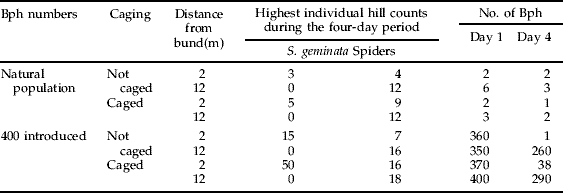
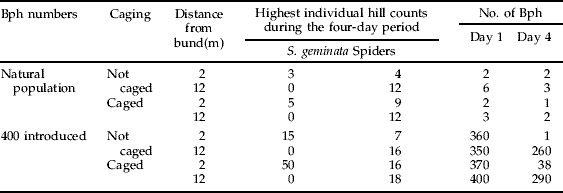
Changes in numbers of the natural population and of 400 introduced Bph per hill on five uncaged hills and on five caged hills, all given access to both S. geminata and spiders during four days when a field of IR72 rice was kept drained in rainy weather.
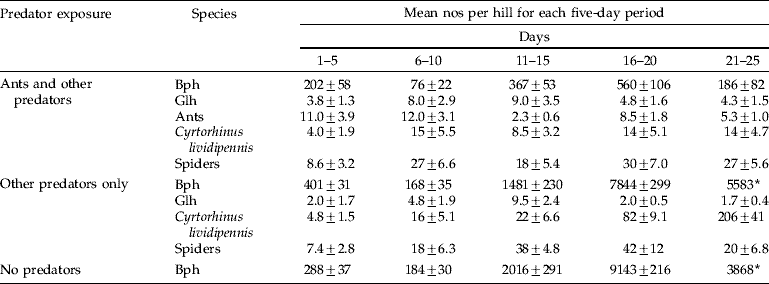
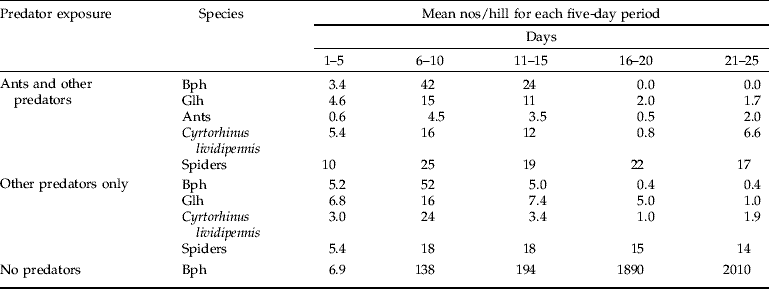
Changes in Bph numbers beginning with (a) 400 initially introduced 3rd–4th instar Bph nymphs or (b) ten gravid females and of naturally occurring Glh on groups of five caged hills given access either to S. geminata and other predators, or to other predators only, or to no predators on a wet season crop of Bph resistant IR72 rice.
(a)
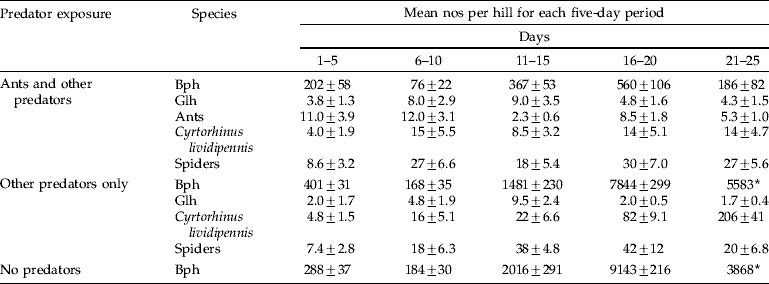
* Some plants dying – hopperburn.
(b)
The numbers of different species were counted visually on individual hills; however, when there were more than about 100 per hill, Bph numbers were estimated (Way et al., Reference Way, Islam, Heong and Joshi1998). Replicated experiments were analyzed by ANOVA and multiple comparison of means using Duncan's multiple range test. In general, numbers were no doubt greater than those recorded, partly because all individuals are difficult to find, particularly on the older larger hills, and partly because some spiders and Bph jump or drop from the plants when the plants are disturbed. Nevertheless, the direct counting method is notably more accurate than, for example, suction sampling (Islam et al., Reference Islam, Way and Heong2000) and because destructive methods such as suction sampling are useless for experiments involving sequential counts on particular plants.
The main caging experiment to compare effects of S. geminata with and without other predators comprised five replicates of five hills in a wet season crop. Changes in abundance of Bph, ants, spiders and some other predators were recorded throughout the season in one dry season crop. In this experiment, 360 hills were examined individually on a block ten hills wide and extending 36 hills long into the field from a bund. The field was periodically drained for up to four days and then re-flooded.
Results
S. geminata behaviour in periodically drained rice fields
Formation of foraging columns
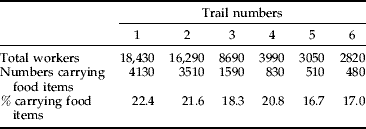
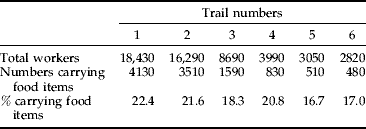
A dry season crop at the tillering stage was allowed to drain during dry sunny weather. After one day, there was still some standing water, but S. geminata workers were already forming foraging trails across the mud. Six trails from a bund length of about ten metres were marked, and the total numbers of workers and those carrying food items crossing a line at the incoming end of each trail were counted for three minutes in every 30 min period from 06.45 to 20.30 h. The total numbers of ants, based on the three-minute counts, were then estimated for the 14 h duration of the study. Those returning varied from totals of 2820 to 18,430 in different trails (table 3) though only 17–22% were carrying food items, including all or parts of hopper adults and nymphs, leaffolder larvae, dipterous detritivore larvae, larval Coleoptera and eggs and young of the golden apple snail, Pomacea canaliculata (Lamarck). As an example along one trail, 870 hoppers, including body parts and 226 snail eggs, were among the calculated 4130 food items carried in their mandibles by 18,400 returning workers during the 14 h period.
Estimated total numbers of S. geminata workers returning to nests during a 14 h period (06:30–20:30) along six trails directly after partial drainage of a dry season irrigated rice field.
Ant predation on artificial infestations of Bph
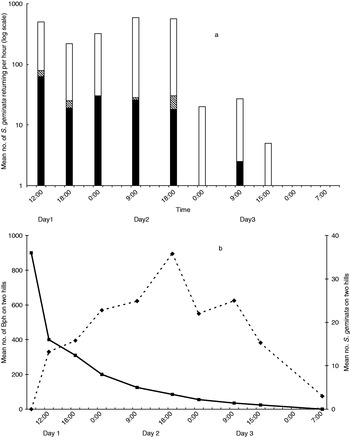
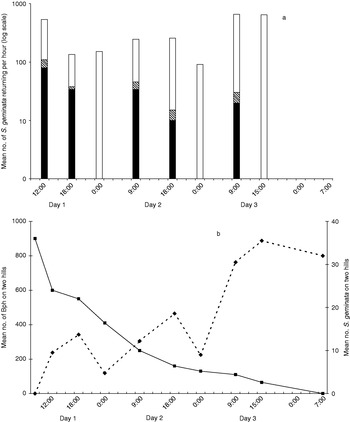
During dry weather in the wet season, two separate pairs of rice hills three metres from a bund were each infested directly after partial drainage with about 900 nymphal and adult Bph. One hour later, there was an S. geminata trail to each pair of rice hills from two separate colonies on the adjoining bund. Returning workers were recorded day and night as before although there were gaps in the records during the night of days 2–3. Ants carrying Bph or Bph parts and those carrying other items were counted, and mean numbers per hour were then estimated. Bph and S. geminata on each pair of hills were also counted or estimated separately for successive 5–7-h periods. In both pairs of hills and their associated S. geminata trails, there were initial peaks of Bph collection by about 10% of the returning workers (figs 1a and 2a). In one trail (fig. 1a), Bph collection continued overnight and into the second day when S. geminata numbers on the plants and in the trail again peaked at around midday. On day 4, no Bph were left on the plants (fig. 1b). In the second trail (fig. 2a), the ants remained active during the first night but were not carrying food items. Moreover, ant numbers peaked around midday on the 3rd day though there were few remaining Bph on the plants. A midnight record on the second night showed that both trails remained active, but neither was carrying food items (figs 1a and 2a) There was one anomaly, namely the estimated numbers of Bph prey taken along the second trail at around 0900 h on day 3 (fig. 2a); this seemed notably greater than the decrease in numbers on the corresponding hills (fig. 2b). Perhaps, ants collected Bph during the night but did not return with them until the next morning.
Predation by S. geminata from one colony on 900 Bph nymphs on two rice hills in a drained rice field. (a) calculated numbers of S. geminata workers returning per hour to the ant colony with and without transported items (□, totals;  , numbers carrying ‘other’ food items; ▪, numbers carrying Bph). (b) changes in numbers of Bph on the infested plants (–▪–, Bph; - -◆- -, S. geminate).

As in fig. 1 but using a separate S. geminata colony in the same rice field.

Estimates of total Bph and their body part numbers carried along trails to each colony during the experimental period were 1006 and 1130 compared with initial infestations of 900 Bph on the hills from which Bph were being taken.
Foraging distance
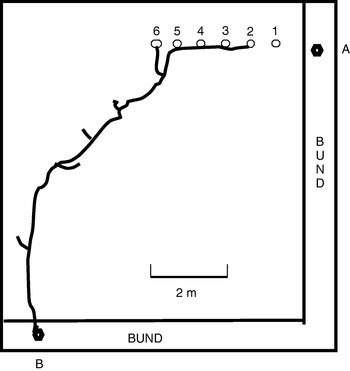
S. geminata were seen foraging up to about 20 m into a two-day drained field. That the behaviour of different competing colonies varied was demonstrated strikingly in one experiment where six hills 0.2 m apart in a row opposite S. geminata colony A (fig. 3) were each infested at 0800 h with about 200 Bph nymphs. The original objective was to determine the speed at which successive infested hills were found and the Bph removed by colony A workers. However, no foragers left colony A. Instead, at 1000 h, a trail of S. geminata to the Bph was traced >10 m back to colony B (fig. 3). At first, colony B workers removed all Bph from hills 5 and 6, but by 1700 h they had reached hills 2 to 4. On the following morning, although no trail was seen to hill 1, the numbers of Bph had fallen to seven. Seemingly, workers from one of the ant colonies had removed them. Otherwise, workers from colony B, despite the distance, monopolized hills 2–6, having inhibited foraging from colony A.
Approximate line of an S. geminata trail across mud to a nest of colony B from a row of rice hills each artificially infested with 200 Bph. Note absence of trail from nest of colony A ( , approx. line of ant trial;
 , S. geminate nest).

Use of selective exclusion techniques
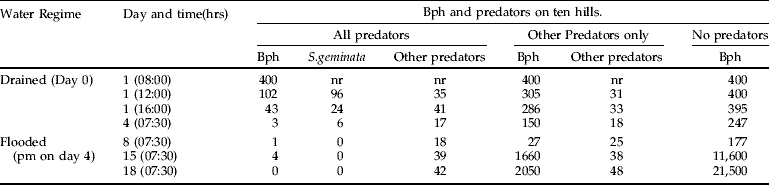
Two experiments were done to compare the roles of ants and other natural enemies, notably spiders, against Bph. Initially, in the dry season, a rice field at the tillering stage was partly drained. The soil was still very muddy when it was re-flooded four days later. Two sets of five hills, each infested with 200 3rd–4th instar Bph, were caged three metres from a bund in three conditions: to permit access of ants and other natural enemies, to exclude ants but not others, and to exclude all natural enemies. These were set up at 0700 h one day after drainage began when the ground was still very muddy with pools of water. Yet, S. geminata workers were already making trails in the field, and within about four hours were removing Bph from caged plants to which they had access, leaving only 43 after eight hours and three before the field was re-flooded on day 4 (table 4). Where only other natural enemies had access, the numbers of Bph decreased notably more slowly. Initially the predators were mainly spiders, notably Lycosa pseudoannulata and Atypena formosana, and latterly also the heteropteran bug Cyrtorhinus lividipennis Reuter and predatory Coleoptera. In these circumstances, 27 Bph became adults which reproduced causing a surge of newly hatched nymphs after 18 days when 2050 were recorded on the ten plants, contrasting with none where S. geminata had access during field drainage (table 4). However, where all natural enemies were excluded, the estimate of hatched nymphs reached >21,000 before the experiment was terminated by a typhoon. Dull weather and some rain kept the field muddy during the period of drainage, but this did not stop S. geminata devastating the Bph.
Changes in numbers of initially introduced 400 Bph on ten hills given access to S. geminata and other predators or to other predators only or with all predators excluded.
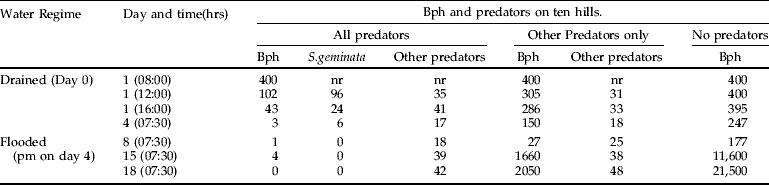
nr, not recorded.
In a wet season experiment, the same caging regimes were used with two densities of Bph, one with five sets of five caged hills initially infested with 400 3rd instar Bph nymphs and the other with ten adult gravid females, greater than the current level of natural colonization of immigrant adult Bph. Where the 400 nymphs per cage were given access to ants and other natural enemies, the numbers of Bph initially decreased but subsequently increased to up to 500 per five hills during the 25-day experiment (table 2a). In contrast, there was much egg-laying in the ‘no-ant other natural enemy’ treatment and in the no-natural enemy controls, creating a surge of newly hatched Bph nymphs. This was followed by a collapse when plants began to die of hopper burn (table 2a), despite an increase to 206 C. lividipennis per hill. However, with an initial total of ten adult female Bph, there were no differences between the two natural enemy-exposed treatments (table 2b). In these circumstances, ants were not recruited to the few Bph prey, which, however, were suppressed successfully by the other predators in the absence of ants, as were naturally occurring immigrants of the green leafhopper (Glh) Nephotettix virescens (Distant) (table 2b). This was despite periodic rainfall, which no doubt impaired the rate of predation by S. geminata on the large populations of Bph (table 2a).
The next wet season experiment was chosen to show the effect of weather conditions unfavourable to ants when much rainfall caused natural flooding such that artificial re-flooding was only needed once during the first 15 days of the experiment. S. geminata and a few Paratrechina spp. sporadically entered the crop, yet they were seemingly still sufficient to keep the Bph populations very low in circumstances where there were attractively large hopper populations. However, the inadequate sole effect of other predators on the large initial Bph populations (table 2a) must be qualified by the evidence (see Methods) that some of one important spider predator species, L. pseudoannulata, were initially excluded from the ‘non-ant open-top’ cage treatment although this species was replaced by more of the other common spiders, notably A. formosana and Tetragnatha spp. Nevertheless, it is revealing that such non-ant predators still effectively suppressed small adult Bph numbers and also immigrant N. virescens equivalent to natural numbers of incoming colonists (table 2b).
In a third wet season experiment in July, the objective was to compare the predatory contribution of S. geminata against Bph on hills two metres from the bund and near the middle of a field about 12 m from the bund. Unreplicated groups of five hills were kept either in open cages which allowed access of all predators from the ground as well as from above, or they were entirely uncaged. These were set up one day after field drainage, five including the natural immigrant Bph population and five infested with 400 3rd–4th instar Bph nymphs per hill. One day and four days after drainage (table 1), no S. geminata were recorded on hills 12 m from the bund, no doubt because frequent rainfall limited ant foraging except close to the bunds. However, at 12 m, the other predators solely prevented increase of the small natural Bph population. S. geminata were still recruited to the artificially infested hills 2 m from the bund where, together with other predators, they greatly decreased the Bph populations in both caged and uncaged conditions (table 1). However, at 12 m distance, with ants absent, the other predators alone had comparatively little effect on the large introduced Bph populations, whether caged or uncaged.
Abundance of S. geminata, spiders and other insects on hills throughout the crop season
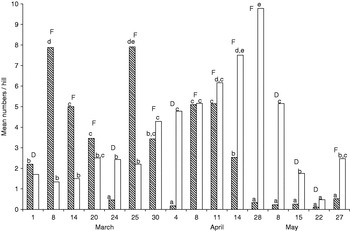
In the 360-hill dry season experiment, S. geminata moved immediately into the drained field and onto some hills on 1 March. When the field was re-flooded four days later, up to eight S. geminata were flushed from the ground per hill but did not affect spider numbers (fig. 4). Subsequently, one day after further drainage on 23 March and 3 April, fewer ants continued foraging on the hills though re-flooding (25 March and 8 April) showed that, overall, there were still many ants in the field (fig. 4). During 20 days continuous artificial flooding required for crop ripening in April, the numbers of ants stranded on hills notably decreased. Some returned to the bunds across the rice canopy, but others seemingly became dormant and twice were seen being caught by the spider L. pseudoannualata. Relatively few ants were counted foraging on the hills after drainage prior to harvesting on 22 May; also few were on the ground and stubble after harvesting, as indicated by a count made on 27 May after they had been flushed onto the stubble by temporary re-flooding (fig. 4). Further counts were made on the stubble until 16 June when, in rainy partly flooded conditions, means of only 1.4 S. geminata were stranded per hill.
Mean numbers per hill of S. geminata and spiders in a block of 360 rice hills in periodically flooded and drained conditions throughout a dry season rice crop season. F, flooded; D, drained. Histogram numbers with the same letters are not significantly different at P<0.05 (, S. geminate; □, spiders).

Regardless of drainage or flooding, spider numbers initially remained at about two per hill in March and then increased to a peak during crop ripening in April when they reached 9.8 per hill on 28 April. This increase was no doubt associated with the great increase in size of territories provided by the growing hills, which also attracted much supplementary prey other than pest species, which remained scarce. Two species of spider predominated – initially about 30% L. pseudoannulata decreasing to 10% of the total, and A. formosana rising from about 60% to over 80% at the time of peak spider numbers on 28 April. Throughout, the pest population, mainly hoppers, remained very low with Bph at 0.39 per hill on 1 March and between 0.16 and 1.91 from 8 to 28 March. Subsequently, their numbers fluctuated between zero and 0.025 per hill until 28 April, and then remained at zero.
Relationship between S. geminata and spider numbers on individual hills
The relative numbers of ants and spiders on individual hills in the 360-hills experiment (fig. 4) were analyzed in order to assess the possible impact of S. geminata on the spiders which were chosen as the natural enemies most likely to be interfered with by the ants. Overall, in March and April, the mean numbers of spiders did not differ significantly in relation to increased ant numbers (P>0.05). S. geminata were never seen attacking spiders although the latter, like the bug C. lividipennis and adult parasitoids, when confronted by an ant crawled aside or moved elsewhere on the hill.
The impact of notably more naturally recruited ants was determined on a total of 33 hills in five drained fields where 500–900 Bph were artificially established on single hills. As already described, aggressively predatory S. geminata workers were quickly recruited. Overall, on the first day, the mean numbers of 23 S. geminata and 0.4 spiders per hill contrasted with 2.2 ants and 4.8 spiders on 30 randomly examined hills not artificially infested with Bph (P<0.01). As before, spiders were not seen being attacked by the ants, and most moved away to peripheral parts of the hill and to neighbouring hills as the recruited ants arrived. Ten days later, after most ants had departed, there were 5.6 spiders per hill which had returned from adjoining hills or arrived aerially. In these circumstances, the aggression and hyperactivity of the recruited S. geminata contrasted sharply with the behaviour of wandering foragers towards individual Bph prey on naturally infested hills, which they attacked but which did not elicit ant recruitment.
Discussion
Whilst S. geminata can undoubtedly be a very effective predator against some pests in upland (dryland) rice (Way et al., Reference Way, Javier and Heong2002), its impact on irrigated rice pests must depend on conditions that enable it to forage into the crop from the very large colonies that can flourish on the bunds. Once the rice canopy is closed and in contact with the bunds, workers can forage across the foliage of flooded fields, though relatively few reach more than a few metres inwards (Way et al., Reference Way, Islam, Heong and Joshi1998; Islam et al., Reference Islam, Way and Heong2000). Otherwise, this paper shows that they can very quickly spread into fields across the wet mud at times when some farmers regularly practise periodic drainage for about three to four days before re-flooding (S. Masajo, personal communication). In these circumstances, S. geminata can forage about 20 m into a field and eliminate large populations of Bph at least 10 m from a nest. However, even in drained conditions, the impact of S. geminata is impaired directly by wet season rainfall and indirectly by the semi-flooded conditions that rainfall can create.
We recognize that our experimental caging systems to compare the relative importance of different natural enemies in a pest complex may not accurately represent reality. For example, our experiments did not always distinguish the effect of ants from the full effect of other natural enemies though they nevertheless demonstrated that S. geminata can uniquely and rapidly suppress large infestations of Bph. This contrasts with the relative inadequacy of other predators and parasitoids against such infestations. Otherwise, S. geminata made no added contribution to the vital early control of the normally few initial immigrant adult Bph and other hoppers in insecticide-untreated fields, as these were still effectively suppressed by the other natural enemies in both drained and flooded conditions. However, it is significant that abundant populations of S. geminata flourished in bunds of irrigated fields frequently sprayed with insecticides at IRRI and also in our experiments using broad spectrum cypermethrin and carbofuran (Way & Heong, in prep.). In these circumstances, natural enemies within flooded fields were killed; but, after drainage, S. geminata quickly spread into the crops killing incoming Bph and Glh when most other predatory species were still absent or sparse, apart from wind-blown spiderlings, which are too small to attack hopper pests.
As our results confirm, early season mortality of immigrant Bph is crucial because the non-ant natural enemy complex can normally prevent their multiplication to otherwise catastrophically damaging populations (table 2b). Therefore, when drainage permits S. geminata to enter a transplanted crop, it is vital that the ant should not impair the impact of early season predators. This is also important in relation to the increasingly used techniques of direct seeding rice, which must remain unflooded for about two weeks after germination. The ant's safety was demonstrated by our experiments, which showed that the normally very few S. geminata that in drained fields are regularly seen foraging on a hill do not decrease spider numbers. Exceptionally, more than about 20 S. geminata per hill were associated with many fewer spiders. This happened when ant recruits began aggressively preying on initially large populations of Bph. However, this seems irrelevant because such immediately recruited ants were highly effective against the large Bph populations which are inadequately controlled by the delayed and density responsive predators such as spiders, C. lividipennis and also parasitoids (Claridge et al., Reference Claridge, Morgan, Steenkiste, Iman and Damyanti2002). Once the ants had departed, spiders re-colonized the hills aerially and from neighbouring plants.
Although Bph was a catastrophic pest of tropical Southeast Asian rice during the 1960–1980 era of excessive insecticide usage and non-resistant rice, it can still be locally severe (Way & Heong, Reference Way and Heong1994). In these circumstances, drainage would no doubt enable the often huge bund populations of S. geminata to make a major impact based not only on the ants' immediately density dependent recruitment but also because such ants can continue predation beyond the immediate needs of a colony (Way & Khoo, Reference Way and Khoo1992). Furthermore, S. geminata prey on other pests, notably Lepidoptera including leaffolders (Way et al., Reference Way, Javier and Heong2002) and sometimes stem borers. It is also among the few natural enemies of eggs and young of the golden apple snail Pomacea canaliculata, which can be a devastating pest of newly established rice plants in Southeast Asia (Way et al., Reference Way, Islam, Heong and Joshi1998; Yusa, Reference Yusa2001). In this context, it is noteworthy that early season drainage has been recommended empirically for control of the snail. No doubt predation by S. geminata helps explain the value of such drainage.
Until recently, conventional advice has assumed that continuous flooding of irrigated rice is needed to maximize irrigated rice yields. Yet previous evidence had already shown that periodic drainage may not limit yield and indeed can favour it (Singh et al., Reference Singh, Aujla, Sandhu and Khera1996; Guerra et al., Reference Guerra, Bhuiyan, Tuong and Barker1998). Moreover, in recent years, there has been disturbing ‘yield decline’ in some continuously flooded intensive rice monocultures (Dawe et al., Reference Dawe, Dobermann, Moya, Abdulrachman, Bijay Singh, Lal, Li, Lin, Panaullah, Sariam, Singh, Swarup, Tan and Zhen2000), which despite the advent of new higher yielding cultivars has slowed overall rice yield growth in parts of tropical Asia and is confirmed by decreasing yields of the classical Green Revolution IR8 cultivar. Now, the evidence from long term experiments in Southeast Asia shows that continuous flooding is detrimental to soil fertility (Dawe et al., Reference Dawe, Dobermann, Moya, Abdulrachman, Bijay Singh, Lal, Li, Lin, Panaullah, Sariam, Singh, Swarup, Tan and Zhen2000), which can be countered by periodic drainage and lessened volume of irrigation water by as much as 40–70% in southern China, apparently without yield detriment (Guerra et al., Reference Guerra, Bhuiyan, Tuong and Barker1998). This seems crucially important not only for maintaining soil fertility but also for making better use of declining water for irrigation. Indeed, in view of the ‘looming water crisis’, ‘alternate wetting and drying’ practices may become necessary even where it might incur some yield loss (Bouman, Reference Bouman2001; Bouman et al., Reference Bouman, Lampayam and Tuong2007). The present paper shows that such practices can also confer notable biological pest control benefits from S. geminata.
Acknowledgements
We are much indebted to Mr S. Masajo for allowing us to work on his farm and for invaluable advice. We wish to express our gratitude especially to G. Javier and also to J. Angeles, D. Dizon, E.T. Rico and D. Vasquez for technical assistance, to Isobel Way for exhaustive work on the manuscript, to M.E. Cammell for illustrations, and to the IRRI Experimental Farm staff for field experiment facilities.