1. INTRODUCTION
Consistent with Gibson (Reference Gibson1979), we define affordances as relational qualities that depend on both user attributes and object attributes. When users interact with a product, they perceive a set of affordances corresponding to the actions or uses they imagine they can perform with the product. In contrast, when designers develop a product, they intend certain uses, which we define as the functions of the product. For example, any flat horizontal surface affords the placing of items on it. Such flat surfaces may exist to satisfy a closely related function; for example, bookshelves and tabletops are flat horizontal surfaces that exist for the function of supporting items. However, many such surfaces arise from other functions but still afford the placing of items on top, which may not always be desirable. For example, a flat horizontal surface may result from an enclosure but include a ventilation grill, as with some dehumidifiers, heaters, and so on. Items placed on top of such flat surfaces may degrade intended functions such as ventilation, or if on top of heaters, may constitute fire hazards. In the ideal circumstance, concordance between a product's intended and perceived use is better managed; that is, users only perceive those product uses that are desirable or possible. In addition to the potential misuse of products just described, user frustration can arise when users perceive actions that are not possible with the product.
Placing our view of affordance in the context of others' work, Gaver (Reference Gaver1991) describes product affordances as perceptible (discernable by perceptual information), hidden (indiscernable by perceptual information), and false (misconstrued by perceptual information). Verbeek (Reference Verbeek2006) states that affordances are similar to scripts (Akrich, Reference Akrich, Bijker and Law1992; Latour, Reference Latour, Bijker and Law1992) in that they exert influence on users to act in particular ways. In our framework, user-perceived affordances can be perceptible or false, depending on whether they are present in the object. We are particularly interested in false affordances, because they are significant sources of user frustration. For example, product geometry that arbitrarily prevents resting of objects on top may unnecessarily thwart a common perceived use. Figure 1 shows a nonflat top surface for a hot-drink dispensing machine. The adhesive tape holding down a container of drink stirrers demonstrates a needed affordance that is not present.
User-perceived affordance that does not exist.

We are also interested in designer-intended affordances because products that do not afford intended uses represent a failure in design. For example, Figure 2 shows a laptop computer intended to be pocketable. However, the computer's dimensions may afford less portability than was intended by the designer. We therefore became interested in studying the relationships among a product's affordances, specifically the designer's intended affordances and the user's perceived affordances.
Designer-intended affordance that does not exist. Accessed at https://www.flickr.com/photos/mushman1970/3179976258/in/photolist-61pKGV-5S4J3w-5R1d9S-5R1d6Y-5R5aH6-6zmAPA-5S4HB3-5SSH81CCBY-SA2.0

1.1. Affordance identification
Finding the affordances of a concept or an existing product can be difficult. Maier and Fadel (Reference Maier and Fadel2007) present the following four ways of generating affordances for products. Predetermination involves listing the affordances intended by the designer. Direct experimentation involves determining user-perceived affordances by performing user–prototype testing. Indirect experimentation involves asking expert designers and users to predict how products will be perceived and used in various scenarios. Automated identification involves comparison of each product feature with its known feature-affordance links in an affordance database. Much affordance-identification work can be categorized under these four types. Galvao and Sato (Reference Galvao and Sato2005) used several interview and observation-style methods (i.e., experimentation) to generate a list of affordances for a blender. Hsiao et al. (Reference Hsiao, Hsu and Lee2011) built on Galvao and Sato's work by creating an online survey system that asks participants to select affordances they felt best matched each shown component. The results were analyzed and statistically prioritized to produce a master list of affordances associated with the product, which would facilitate automated identification.
1.2. Affordance perception
Relevant to the cognitive mechanisms that lead to user perception of affordances, Gibson and Walker (Reference Gibson and Walker1984) detail how infants have an understanding of how spongy versus rigid objects should behave. Gibson et al. (Reference Gibson, Riccio, Schmuckler, Stoffregen, Rosenberg and Taormina1987) then studied how infants are able to discern the traversability of surfaces through visual and haptic exploration. Borghi and Riggio (Reference Borghi and Riggio2009) suggest that when affordances are perceived, they trigger particular motor areas of the brain associated with certain actions. Still and Dark (Reference Still and Dark2012) posit that perceived affordances result from automatic perceptual processes that developed over time through consistent interactions with the environment. Glăveanu (Reference Glăveanu2012) and Lu and Cheng (Reference Lu and Cheng2013) postulate that the perception of affordances depends on two factors: the cultural background and personal knowledge of the user (sociocultural norms); and the situation and intent of the user. Changes in either factor affect the ability of users to perceive affordances.
Related to a person's cultural background and past knowledge, sociocultural norms are usually acquired by training and demonstration. Even young children, after being shown one use of a product, tend to think of that product as being mainly for that use (Casler & Kelemen, Reference Casler and Kelemen2005). Artificial intelligence researchers have successfully demonstrated how robots can be trained to recognize affordances in objects and surfaces (Stoytchev, Reference Stoytchev2005; Hermans et al., Reference Hermans, Rehg and Bobick2013; Katz et al., Reference Katz, Venkatraman, Kazemi, Bagnell and Stentz2013). However, machine-learning methods tend to work by testing object features for basic affordances such as ability to be pushed, pulled, grasped, and so on. For product design, we are also interested in the higher level affordances that users may perceive in an object, for example, the ability to carry items and the ability to be stored in a cabinet.
2. AFFORDANCE OF ABSENCE
Following our previous study of lead users with limited resources, Old Order Mennonites (Srivastava & Shu, Reference Srivastava and Shu2013a, Reference Srivastava and Shu2013b) and Bangladeshis (Srivastava & Shu, Reference Srivastava and Shu2014), we proposed the affordance of absence as a potentially novel method to examine product affordances. We noted that an absence of material or features affects the utility of products, and these absences may be applied to improve the utility of products to better meet user needs. We identified three dimensions (one major and two minor) in which we can consider existing examples of affordance of absence: level of physical absence (major), level of user control (minor), and permanence of the absence (minor). Details and examples for each dimension follow.
2.1. Major dimension: Physical absence
We identify the major dimension for affordance of absence as related to the level at which physical absence occurs. The absence of material in a part, absence of a part in a product, and absence of a product in a system may all lead to additional utility and affordances.
2.1.1. Absence of material at the part level: AidPod
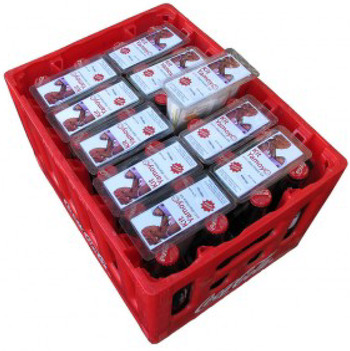
At the lowest level, the absence of material in, or the space unoccupied by, an object can itself afford uses. Simon Berry, an aid worker in Zambia in the 1980s, wanted to use Coca-Cola's distribution system to deliver essential medicines to developing countries, where Coca-Cola can sometimes be more easily accessed than clean water. ColaLife, a UK charity, has since developed the AidPod, a wedge-shaped container for medicines that fits between the necks of bottles in a standard Coca-Cola crate. Initial concepts included side pouches and tubes that replaced bottles in the crate, but because such concepts reduced the space for Coca-Cola products, they were less attractive for distributors. Berry's wife had the idea to exploit the unused space in a Coca-Cola crate, leading to the packaging configuration of the AidPod, shown in Figure 3.
AidPod (container for medicine) that exploits unused space in Coca-Cola crate. Simon Berry. Accessed at https://www.flickr.com/photos/bezznet/6247074530/CCBY-SA2.0

2.1.2. Absence of part at the product level: Tablet computers
Removal of a part or component, including those considered critical, could also add utility. Although we by no means claim that the development of tablet computers was based on the affordance-of-absence method, such devices can serve as examples of its potential. Tablet computers can be thought of as laptop computers without keyboards. Laptops existed long before tablets and provided most of the same functionality. Even so, the removal of a physical keyboard has enabled new affordances that make tablet computers more useful for certain situations. Tablet computers provide displays that can be more easily manipulated and held with a single hand, and enable simple data entry or other interactions while standing. These affordances make them suitable for a wider variety of situations than the laptop computers that predate them. In spite of reduced capabilities for data entry and other limitations relative to laptops, tablets are becoming increasingly adopted in applications such as aviation and medicine, where laptops have not been as successful. Of course, tablet computers may require features not present in the laptops that predate them, for example, touch-sensitive screens.
2.1.3. Absence of product at the system level: Mobile phones
Finally, contrary to what might be expected, utility can be added to a system by the absence of a product altogether. Mobile phones have become an intrinsic part of modern life, with users frequently checking them for news updates, e-mails, and text messages. As a result, the presence of mobile phones can be disruptive in many settings; alerts about text messages and other updates can distract those engaged in a task or a meeting. Recognizing this, mobile phone platforms by Apple Inc., Google Inc., Microsoft Corp., Blackberry Ltd., and others include “do not disturb” settings that effectively turn the phone off to stop receiving alerts. Thus, turning off mobile phones, or physically leaving them behind when going into meetings or on vacation, fulfills needs that are otherwise unmet in their presence. Specifically, workers can better focus on tasks and delay performing other nonessential tasks that compromise their mental presence. Vacationers can enjoy their holidays without being tempted to respond to messages and better achieve the purpose of physical absence from their usual environment.
2.2. Minor dimension: User control
The first minor dimension we discuss is that of user control. This dimension describes products that offer absence in manners ranging from fully user controllable to fully prescribed by the designer.
2.2.1. User-controllable absence: Cooking vessels for camping
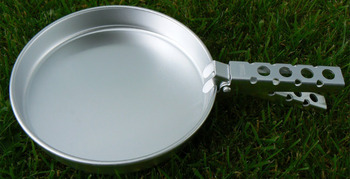
A product can enable users to make material or product components absent as required. For example, handles facilitate carrying of the objects on which they appear, and may also communicate where to lift such objects. On cooking vessels, handles allow users to manipulate and carry the vessels without burning their hands, but they also add bulk to objects and make them more difficult to store and transport. Their presence or absence, therefore, offers different benefits that are more or less important depending on the use context. Figure 4 shows a pan made for camping that features a user-removable handle to optimize product performance in multiple use contexts. Users attach handles to pots or pans to facilitate manipulation during cooking, and remove them to minimize product bulk and enable easier storage and transport.
Pan with removable handle. Accessed at https://www.flickr.com/photos/orangebrompton/1192778180/CCBY-NC-SA

2.2.2. Designer-prescribed absence: Search engines
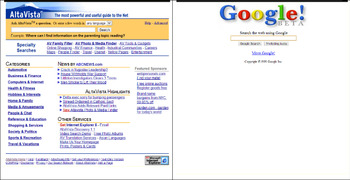
The designer can also prescribe the absence of material, components, or whole products. In the late 1990s, when many Internet search engines competed for market leadership, Google, then a newcomer, drew attention due in part to its notably sparse landing page, while other contemporary search engines tended to feature much busier landing pages. AltaVista, one of the largest search engines then, had a landing page with news updates; links to nonsearch services and sponsor websites; options for searching by category, topic, and language; and example queries to show users how to search. In contrast, as shown in Figure 5, Google's landing page contained only a text box and two buttons. The absence of distracting material increases the ability of users to quickly perform a search, fulfilling their primary goal.
AltaVista and Google landing pages from 1999. Accessed at http://web.archive.org

2.3. Minor dimension: Permanence of absence
The second minor dimension describes whether an absence of material, component, or product is permanent or temporary.
2.3.1. Permanent absence: Sloped top surfaces
The absence of an affordance can be permanent, or at least require significant effort to change. To discourage the placing of items on top, lockers, mailboxes, and garbage bins can be configured with a sloped top surface. While the top surfaces of mailboxes and garbage bins are typically less easily changed, lockers can often be procured with the sloped top as an option, as shown in Figure 6. The only function of this optional part is to prevent users from placing items that may constitute fire hazards on top of the lockers, thereby thwarting a common horizontal-flat-surface affordance. The permanence of the absence of this affordance is related to the significant effort required to change it.
Sloped top of hallway lockers. Tom Magliery. Accessed at https://www.flickr.com/photos/mag3737/7995036725CCBY-NC-SA2.0

2.3.2. Temporary absence or delayed presence
The presence of an affordance can also be purposely delayed to achieve a specific goal.
Desire paths
A compelling example that supports the temporary absence of a product or affordance involves desire paths, which refer to paths worn down by pedestrians. Urban planners have used the idea of desire paths for over a century to plan urban spaces that match citizens' needs (Myhill, Reference Myhill2004). Architect and design theorist Christopher Alexander included desire paths as one of his 253 design patterns as the best way for designing pathways (Alexander, Reference Alexander1975). By postponing the paving of paths and simply surrounding a building with a less durable material such as grass when occupants first move in, it is possible to identify the routes deemed most useful by the building's inhabitants, which can then be formally paved. Thus, the temporary absence of paved pathways allows the establishment of efficient paths that would be less likely to occur if the introduction of paved pathways were not delayed.
Optimizing tool purchases
Directly analogous to desire paths is advice from an expert on hand tools, who recommends that novice users begin with the cheapest tool kit they can buy, because they may not be familiar with the types of tasks for which they require tools. Because inexpensive tool kits tend to be of low durability, tools wear quickly from repeated use, and the tools that break correspond to those actually used. Assuming that novices use the most task-appropriate tool, the ones that break may be more worthy of replacing with higher quality versions.
2.4. Applying affordance of absence
In this section, we present proposed concepts along the major, physical dimension of affordance of absence.
2.4.1. Absence of material at the part level: Blenders
Galvao and Sato (Reference Galvao and Sato2005) identify affordances for a blender. By starting with affordance of absence at the product level, the removal of a blender may reveal increased kitchen-counter or cabinet-storage space whose value exceeds the occasional blending required. Thus, blenders and other small kitchen appliances could be improved by reducing their footprint and thus counter space occupied; consolidating kitchen appliances (e.g., combining a blender with a food processor); and improving their ease of storage in kitchen cabinets.
Assuming the necessity of the blender and each of its parts, one could better exploit the existing absence of material in parts as demonstrated by the AidPod concept. For example, one could configure the blender container, attachments, accessories, and power cord to nest optimally and reduce needed storage space and effort. In related examples, storage containers and cooking vessels often nest and reduce the space required when not in use. In addition, many clothing irons and laptop power adaptors have geometries that informally or formally afford the wrapping of the cord around them. Therefore, occasionally used and/or frequently stored and carried items could be configured to optimize their use of space, as well as their setup and storage, by exploiting absence of material at the part level.
2.4.2. Absence of part at the product level: Resilient House
A demonstration of affordance of absence at the component level is the award-winning design of the Resilient House (2013), a “disaster-resistant, environmentally responsible, and affordable single family home” for regions that encounter extreme weather and natural disasters. As shown in Figure 7, Resilient House architects, Sustainable.TO, eliminated the basement that is particularly vulnerable to flooding. The absence of a basement provides valuable new uses, such as sheltered parking and outdoor space, which are especially restricted in dense urban areas.
Resilient House. Image used with permission. Accessed at http://www.sustainable.to/index.php/projects/detail/resilient-house

2.4.3. Absence of product at the system level: Wrinkle removal
Kim et al. (Reference Kim, Hong, Kim and Noh2013) discuss the affordances of a steam iron. Applying affordance of absence to this example, one could consider either buying less wrinkle-prone material or being less concerned with such details. Barring that (e.g., for business attire when traveling), one may resort to using the steam from a shower to remove wrinkles from clothes. A frequent challenge is to find an optimal location to hang clothes for this purpose. Clothes need to be close to the source of the steam (the shower), but should not be so close that they become wet. In addition, both the front and the back sides of the garment need to be exposed simultaneously, which is not the case when hanging on most door hooks. Therefore, a potential alternative solution that is at least more portable than an actual steam iron is an artifact that would facilitate the use of steam from the shower. For example, a collapsible bracket that would enable one to hang the nonstandard, antitheft, hotel-room hangers at a distance from an existing door, wall, or rack may be appropriate.
2.5. Affordance-of-absence discussion
We now discuss some insights gained while applying affordance of absence toward a prescriptive methodology. It may be both most impactful and simplest conceptually to start by considering the absence of the overall product. This could reduce functional fixedness, or the inability of people to think of novel uses of products (Duncker, Reference Duncker1945), by clarifying how the need could otherwise be addressed. For example, the need for a stacking chair could be met by modifying products (e.g., coffee table to ottoman) that already exist in a domestic environment. When it is established that the product (e.g., a house) is required, one can next determine which parts, including those considered “critical” or at least typical (e.g., the basement), can be removed. Finally, when it is clear that each part is required (e.g., each of the blender components), one can determine how to best exploit existing or potential absences of material at the part level.
2.5.1. Relation to affordance-based design
As Burlamaqui and Dong (Reference Burlamaqui, Dong and Gero2014) state in their extensive review, the concept of affordance has two relevant features for design: to determine the kinds of utility to incorporate into products to meet user needs, and to find ways to convey that utility to the user. On the first point, there are a myriad of approaches that use the concept of affordances successfully to link user tasks or user needs to product features (Galvao & Sato, Reference Galvao and Sato2005; Maier & Fadel, Reference Maier and Fadel2006, Reference Maier and Fadel2009a, Reference Maier and Fadel2009b; Kim et al., Reference Kim, Hong, Kim and Noh2013). As a design heuristic, the affordance-of-absence method integrates well into existing approaches for changing the utility of a product to better meet user needs. After identifying the needed affordances from product users, designers could consider whether user aims can be met by exploring the major and minor dimensions of absence. Affordance of absence as a method may be especially useful in product redesign and optimization, to find ways of improving the utility of a product by removing material and/or components.
Reviewing products where affordance of absence is present also helps designers work on the secondary benefit of affordance-based design: how best to convey affordances. By seeing how users interact with products when certain features are missing, designers can infer how users perceive and understand those features. The mental exercise of considering how the removal of features may affect the user's perception of the product can be revealing for the designer. Specifically, one could explore the product's attributes more thoroughly and be open to new ideas for manifesting affordances. Designers can also consider how much control they would like the user to have over product affordances. Exploring how users are likely to perceive the affordances in a product, designers can work to increase the concordance between designer-intended and user-perceived affordances. As a method of ideation, it prompts designers to explicitly plan aspects that may be otherwise ignored or forgotten.
2.5.2. Relation to function sharing
Affordance of absence shares many virtues with function sharing. Ulrich and Seering (Reference Ulrich and Seering1990) described function sharing as a systematic method of product optimization that involves: modeling components schematically, deleting elements, determining if other elements can assume the functionality of deleted elements, and modifying the design. Ulrich and Seering recognized that simplified designs can be more efficient, cheaper to produce, and more reliable.
Affordance of absence differs from function sharing in terms of constraints. Function sharing requires the optimized product to retain the same functionality but offer improvements in cost, reliability, and efficiency. In our examples, the simplification through elimination at the part, product, or system level does necessarily retain the same functionality, but rather, products can both lose and gain utility. For example, as opposed to a typical laptop, an ultrabook computer cannot write to optical media, but it can be carried for longer periods and stored in smaller spaces. Our intent is not to optimize the design of a product solely for reliability, cost, or efficiency, but to enhance the usefulness of the product in one of many possible ways. Ulrich and Seering also recognize the need for “the detection of harmful unanticipated functions,” which is well explained using the language of affordances. Our emphasis is more on the interface between user and product than on the interface between individual product components, while function sharing schematic representations focus on the inner links between components.
3. EXTRACTING AFFORDANCES FROM DO-IT-YOURSELF POSTINGS
As previously mentioned, we developed the affordance-of-absence method as a technique for extracting affordances after studying lead users with limited resources. Continuing with our efforts to exploit lead users for affordance extraction, we studied do it-yourselfers (DIYers), specifically “IKEA hackers,” an online community who modify IKEA products and post these modifications, or hacks, on the website http://www.ikeahackers.net. In addition to repurposing existing products for reuse, IKEA hackers often customize new products to meet their specific needs. IKEA hackers are thus able to shift the level of user control, Dimension 2 of the affordance of absence, by modifying designer-prescribed affordances. We previously found that “novel” hacks, which enabled a change in use of the product, provided the most insights on affordances (Lai & Shu, Reference Lai and Shu2014).
3.1. Selecting and categorizing IKEA hacker postings
We initially studied and categorized over 200 IKEA hacks, which were selected using posting dates of July 2013 to October 2013 as a criterion to reduce selection bias. Because we are most interested in novel affordances, we sorted these hacks into categories based on likelihood to reveal new uses: change in aesthetics and change in function. Change-in-aesthetics hacks focus on modifying product appearance, while change-in-function hacks may involve breaking from the intended, designer-prescribed function to use the product in a new and potentially surprising way. Change in aesthetics retains the same basic product form and affordances, while change in function involves different affordances using the same or a different product form.
3.1.1. Change in aesthetics
Change-in-aesthetics hacks involve product alterations that primarily aim to improve product appearance for an individual. Examples vary in required effort, including painting and covering surfaces, adding or replacing dresser handles, and changing the material of tabletops. In one example, a hacker crocheted a cover for a lounge chair to delay the need to buy a new cushion, remarking on the difficulty in making a sewn cover that fits the cushion well. While change-in-aesthetics hacks rarely provide new insights on affordances, they are useful in increasing product life, because furniture is often replaced due to aesthetic needs alone.
3.1.2. Change in function
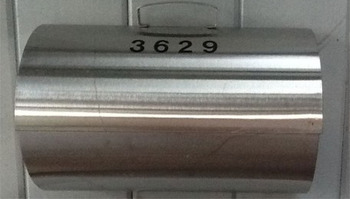
Change-in-function hacks involve product repurposing to fulfill a function that may be significantly different from the original product function. The hacker often makes use of product affordances in clever new ways. As such, we believe that this category contains the DIY cases that are more likely to reveal novel insights on affordances. For example, Figure 8 shows an inexpensive, stainless-steel breadbox repurposed into a mailbox because the hacker found existing comparable mailboxes too expensive. Figure 9 shows a crib transformed into a children's desk by removing the mattress, covering and reinforcing the crib base, and installing it at the preferred height. Figure 10 shows headboards and footboards of a bed repurposed into dog gates for a wide front hall. Another hacker made custom lampshades from inverted fruit bowls, demonstrating that even relatively simple products may have untapped affordances. Applying the insights from such hacks, designers may be able to highlight such affordances to further extend product life, by literally giving products new lives.
Mailbox repurposed from breadbox. Image used with permission. Accessed at http://www.ikeahackers.net/2013/10/ordning-stainless-steel-breadbox-to-modern-mailbox.html

Children's table repurposed from crib. Image used with permission. Accessed at http://www.ikeahackers.net/2013/10/kids-artcrafthomework-table-from-ikea-gulliver-cot.html

Dog gate repurposed from headboards and footboards. Image used with permission. Accessed at http://www.ikeahackers.net/2013/12/hemnes-dog-gate.html

3.2. IKEA hacks and affordance of absence
We now discuss the above IKEA hacks using the affordance-of-absence lens. A product in its most simplified form may be easier to modify than a more specialized product, as hackers identify and act upon affordances that aid in modification. Products with relatively simple relationships between parts may be more likely to be disassembled and reconfigured (e.g., for the crib-to-desk hack). In addition, the absence of a mattress may have allowed the DIYer to more readily recognize the crib's potential use as a desk. Rectangular furniture pieces may be easier to repurpose (e.g., in the bed-board-to-dog-gate hack). Aesthetically, rectangular drawer fronts can be more easily replaced or fitted with new knobs and handles than those with handle cutouts. Finally, the absence of a support surface/counter for the breadbox could be used to examine its potential uses in other orientations (e.g., mounted sideways on a wall instead).
3.3. DIY conclusions and next steps
We found change-in-function hacks to provide examples of both novel affordances and affordance of absence, that is, a broader set of product affordances, which led to new uses. These affordances, perceived by IKEA hackers/DIYers, can be made more salient (for a larger number of users) to guide typical users to similarly modify or reuse, personalize, and repurpose existing products. By emphasizing affordances of products that hint toward certain paths for alteration, a product's overall life could be lengthened, with implications for sustainability.
However, this work would benefit from identifying insightful IKEA hacks more effectively. Because text is often used to describe the modifications, we next describe a natural-language search approach to identify affordances, which we will then apply to IKEA hacks.
4. EXTRACTING AFFORDANCES FROM USER-GENERATED TEXT
The third method of identifying novel affordances we recently explored is to search online consumer product reviews. In this section, we outline insights gained from applying a natural-language search approach to extracting affordances from online product reviews of Canadian Tire (Chou & Shu, Reference Chou and Shu2014). Three previously identified motivations for this approach follow.
4.1. Motivation for searching online product reviews
4.1.1. Real-world context
User-generated reviews come from actual consumers using products in ways arising out of needs or desires that may not have been predicted. Change in environment and context create opportunities for interactions that may not be otherwise possible or noticed. For example, the enhanced visibility of shiny-chrome-plated over darker socket sets may become more salient when they are used and dropped in a dark work environment. It may also be possible to analyze the frequency of occurrence of particular affordance-enabled actions based on the number of reviewers mentioning them. For example, many reviewers may mention the ability to stack storage units, supporting the importance of stackability for this product.
4.1.2. Usage duration
Because affordances are manifested through interactions with a product, some affordances may not become apparent until after extended use. Those who review a product online may have had more time to use the product, and therefore reveal benefits or limitations noticed after a period of time. For example, such users are more likely to be able to report on unexpected wear and failure modes. Therefore, their comments may be more insightful than those with limited experience with a new product.
4.1.3. Volume and availability
Both retailers and consumers benefit greatly from online reviews, so there will continue to be an abundance of reviews online that are readily available, and free to access. Comparatively, product insights gathered from end users in other forms, such as surveys and focus groups, may be costly and more difficult to administer.
4.2. Initial source and challenges in natural-language search of product reviews
The retailer initially selected for the study was Canadian Tire due to the sheer volume of available reviews, as well as its diversity in product offerings. Canadian Tire is one of Canada's largest retailers, with more than 487 stores, and offers automotive, hardware, home, and sporting-good products. We created a database of Canadian Tire online reviews by scraping the source websites using Python and MySQL, which contains 60,922 reviews dating from 2007.
Natural language used in many online reviews is inherently difficult to process computationally. Review text may be informal and frequently plagued with improper grammar, spelling, punctuation usage, and slang, requiring heavy preprocessing of text before parsing algorithms can be applied. Separating affordance-containing text from nonaffordance-containing text can be seen as a classification task, which is common in natural-language processing applications. However, without labeled data, or already-classified text to train algorithms, machine-learning techniques cannot be readily applied.
4.3. Characterizing novelty
Not all reviews will contain affordance information, and those that do may be neither novel nor insightful. Chou and Shu (Reference Chou and Shu2014) attempted to address the subjective quality of “novelty” by considering the following criteria toward identifying whether an affordance was previously unknown to the designer or the user.
4.3.1. Side effect
Products include features intended to serve particular needs, but this can also result in side effects, or affordances that may not have been planned by the designer. For example, VelcroTM was intended to serve the need for quick and easy fastening and unfastening, but unfastening creates noise that is unsuitable in some situations and the surfaces with hooks often snag fabrics and trap particles. In differentiating between functions and side effects, one challenge is that the most obvious functions will not always be explicitly stated in a features list. For example, the function of Velcro is common enough knowledge that packaging for Velcro strips may not explicitly state that the product enables fastening and unfastening, but rather that the product is intended to be installed by adhesion or sewing.
4.3.2. Difference in usage context
As affordances are realized during interactions, a change in usage context or environment may reveal latent uses. However, both primarily intended and other expected usage contexts, as well as the level of departure from these contexts, are ill defined. Because products are generally unaccompanied by explicit statements of how or where they are to be used, it is difficult to objectively measure whether the usage context is “novel.” For example, while Velcro is commonly used in clothing, shoes, and personal accessories, is their use to attach curtains more novel to some than others?
4.3.3. Distance from intended function
An affordance may be more novel when it is not an obvious function of the product and cannot be inferred from the list of product features advertised or specifications on the packaging. In addition to the limitations of what are listed as product features and specifications, this criterion may be subjective, as the ability to “infer” varies between people. Continuing with the Velcro example, is the use of Velcro surfaces as lint brushes a sufficiently interesting, nonobvious function that cannot be inferred from the list of product features?
4.4. Summary of results on Canadian Tire reviews
In attempts to extract affordances from Canadian Tire reviews, taking into account lack of training data as well as inherent ambiguity in the task, two approaches appeared most promising.
4.4.1. Clustering
Exploratory clustering of review sentences using features such as frequency of particular parts of speech and purchase-related words suggests that quantifiable properties of text can be used to identify affordance-containing review text. Review sentences that did not describe affordances tended to have more pronouns, purchase-related words, and shorter length.
4.4.2. Cue phrases
Applying the second approach, the cue phrase method (Teufel & Moens, Reference Teufel and Moens1997) revealed that occurrence of certain phrases may point to affordance-containing reviews. This approach attempts to capture tone in a way that the general features used for clustering could not. In particular, potentially useful phrases identified include as opposed to, can actually, doubles as, and than usual. As opposed to hints that the product differs from other products (e.g., “This is the safest kind of shade, as opposed to the kind that clips/suctions to the window which can become airborne in a collision”). Can actually indicates unexpectedness, so if followed by an affordance, suggests it may be novel or surprising to the user (e.g., “You can actually hear the cleaner fizzing while its cleaning the Rims”). Doubles as suggests an alternative use that may or may not be intended by the designer (e.g., regarding a stepstool, “The big steps provide good-sized targets and a very stable base. Doubles as a chair in a pinch”). Finally, reviews that contain than usual note product attributes or performance that differ from those of most other similar products (e.g., “The product also attracts dust to windshield so I have to clean the inside of the windshield much more often than usual”). Each locating between 18 and 74 reviews, the above four cue phrases had between 25% and 32% precision. Precision is computed as the proportion of accurate hits, that is, the number of hits that correspond to reviews containing affordances divided by the total hits.
5. APPLYING CUE PHRASES TO IKEA HACKERS' POSTS
In our current work, we apply the cue phrase method to IKEA hackers' posts to identify hacks with potentially useful insights on affordances. We also explore the use of phrases that identify projects demonstrating the affordance of absence.
As with most blog posts, IKEA hackers' posts often rely heavily on photos. Thus, the affordances or transformations are rarely fully described in the text. Furthermore, information on original product names, materials used, and purpose of transformation appear in varying positions of each blog post, and in varying sentence structures. Sometimes, all such information must be inferred from the pictures. Nonetheless, we sought to find linkages between use of language and the affordances-enabled transformations performed.
5.1. Cue phrases for aesthetic versus functional changes
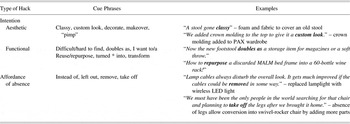
As previously mentioned, the intent of IKEA hackers varies from purely aesthetic changes to dramatic changes in function. In Table 1, we identify search phrases related to user intent. Because these phrases can be found in any part of the post, their occurrence does not guarantee that they are representative of overall intent. We found some phrases to be particularly promising, with a focus on change-in-function hacks.
Cue phrases indicating intention of hack and affordance of absence examples

Note: The asterisk (*) in search phrases indicates a wildcard search, where the * will match anything.
In particular, turn _______ into often reveals the original as well as converted products. Difficult to find often indicates a recurring motive for hacks: that the user had needs unmet by existing products. For example, the motivation behind a tabletop-to-headboard conversion is expressed as “I was looking to buy a simple headboard for a twin bed for use with a standard metal frame. However, it was difficult to find one without having to buy an entire bed and footboard.”
5.2. Cue phrases for absence
We previously outlined the concept of exploiting absence to explore affordances. In applying the cue phrase method to IKEA hackers' posts, we identified phrases leading to hacks that demonstrate affordance of absence. Such projects often excluded parts of furniture. For example, Figure 11 shows a project located using remove, where removing the middle, honeycomb layer between the top and bottom surfaces of an IKEA side-table top afforded storage of remote controls. The hack required an additional “set of 20 inch ball-bearing sliding rails” as well as two tabletops. The second tabletop was used as a cover that slides over the storage afforded by removing material from the middle of the first tabletop. Another project enabled a change in function by leaving out a vertical pegboard to convert a child's tool bench into a puppet theater stage, as described in “I constructed the bench following the instructions exactly but left out the blue peg board from the back in step 11. This small bridge part is now the front of the stage and holds the curtain and lights.”
Side table modified to store remote controls. Image used with permission. Accessed at http://www.ikeahackers.net/2012/11/remote-storage-lack-table.html

5.3. Effectiveness of cue phrases for IKEA hackers' posts
Table 1 contains sample excerpts of IKEA hackers' posts to illustrate how cue phrases can be used to identify affordances in DIY projects, under the categories of intention of hack (aesthetics or function/form) and affordance of absence.
As expected, hacks whose primary focus is aesthetic change revealed few useful affordances. For example, the cue word classy was used to identify 10 hacks, 7 of which corresponded to typical aesthetic hacks with few novel insights on affordances. In contrast, 1 hack involved converting an enclosed wall shelf intended for DVD storage into a wall-mounted computer workstation. The hacker remarked that the wall shelf's single hinged door, which opens from the top, was “really heavy duty” and “massively overbuilt,” affording its use as a work surface. Atypical of those identified by the cue phrase, for this project, classy was only used once to describe adding plastic caps to cable cutout holes as a finishing touch.
In addition, it was expected that change-in-function hacks would reveal more affordances. Using the cue phrase doubles as, all 10 corresponding hacks identified uses other than the primary one intended for the original product, again after varying degrees of effort. Figure 12 shows the use, without alteration, of a fabric remote-control holder, intended for a couch armrest, under a child's car seat to store children's art and other supplies, while also protecting the vehicle-seat material. Multiple mentions of doubles as involved the direct use or modification of storage surfaces for sitting. Other projects involved modifying furniture (e.g., beds, change-tables and cabinets) to accommodate pets (e.g., as cat housing, dog bedding, and litter-box storage). One commonly hacked product is a simple, fabric-covered, five-sided, cube-shaped footstool. One DIYer inverted this footstool and created a new top to access the newly afforded storage, reporting, “The new footstool doubles as a storage item for magazines.”
Couch-arm remote control pocket repurposed as children's in-car supply organizer. Image used with permission. Accessed at http://www.ikeahackers.net/2012/03/flort-turned-into-car-organizer-for-kids.html

Remove and left out consistently pointed to affordances arising from absence. For each phrase, only 1 of 10 corresponding hacks involved temporary absence (e.g., left out parts in early stage to allow installation of other parts). The remainder involved permanent absence, most commonly to provide or reconfigure storage space. In addition to more ambitious modifications (e.g., of the coffee table to enable storage of remote controls described above), other projects are simpler (e.g., leaving out a vertical divider to fit a stereo or television, or a horizontal divider to fit a computer tower). The products used in these hacks are often the same (e.g., basic side tables and versatile shelving units), highlighting how their simple structure and ease of leaving out provided parts might be exploited to accommodate different functional needs.
While cue phrases help expedite the process of finding useful affordance insights from online content, automating this process would be more practical for systematic searching of affordances. This will require more objective definitions of novelty, as well as of affordance itself, to facilitate labeling of data, after which we may be able to train machine-learning algorithms to perform the classification.
6. SUMMARY
In this paper, we described three methods for identifying affordances. We discussed the affordance of absence as a way to explore the relative importance of user needs and for designers to provide utility in products through the elimination of elements. We identified three dimensions of affordance of absence: level of physical absence, amount of user control, and permanence of absence. We then outlined how the affordance of absence can be applied in product design.
The next two methods involved analysis of user-generated online resources that provide information obtained from actual experiences with artifacts and products. IKEA hackers described DIY projects enabled by exploiting and modifying the affordances of IKEA products. These projects were examined using the affordance-of-absence lens. Next, we summarized a natural-language approach to extracting affordances from user-generated reviews, blogs, and other content. We described efforts to parse online product reviews, identified cue phrases that signify the intention behind DIY projects, and highlighted those that point to the usage of absence in transforming IKEA products.
We initially devised and applied these methods to identify novel affordances and better understand the concept of affordances. However, all three methods have potential to improve product design in general. The affordance-of-absence framework can be used directly in product design. Insights gathered from online product reviews can be used directly to improve the design of products. Descriptions of DIY projects not only clarify how products can be improved to better serve user needs but also identify what needs remain unmet by existing products.
L.H. Shu is a Professor of mechanical engineering at the University of Toronto. She received her SM and PhD degrees in mechanical engineering from the Massachusetts Institute of Technology. Dr. Shu is a Fellow of the CIRP (International Academy of Production Engineering) and has taken leadership roles in the Design Society and the American Society of Mechanical Engineers Design Theory and Methodology Committee.
Jayesh Srivastava is a PhD candidate in mechanical and industrial engineering at the University of Toronto, where he also received Master's and Bachelor's degrees. His research areas of focus are behavior change through design, affordance identification, and the capture of design knowledge.
Amanda Chou is an MASc candidate in mechanical and industrial engineering at the University of Toronto, where she completed her undergraduate degree in engineering science: infrastructure. Her interests are natural-language processing and its applications in product design.
Song-Liang Lai is an MASc candidate in mechanical and industrial engineering at the University of Toronto, where he also received his undergraduate degree. His research interest involves affordance extraction and application to product and process design.