Introduction
Developmental Language Disorder
Developmental Language Disorder (DLD, previously Specific Language Impairment, SLI) is a developmental disorder which affects oral language acquisition. Children with DLD show severe and persistent language impairment, mainly in the areas of phonology and morphosyntax (Jakubowicz & Tuller, Reference Jakubowicz, Tuller and Ayoun2007). However, they develop normally without showing signs of neurological damage, sensorial disabilities (such as deafness), severe cognitive impairment, and pervasive developmental disorders (Leonard, Reference Leonard1998, Reference Leonard2014). The term ‘specific’, present in the previous label ‘SLI’, referred to the fact that the impairment was claimed to be restricted to language, with many authors having described various syntactic deficits (see for instance Parisse & Maillart, Reference Parisse and Maillart2004, or Jakubowicz & Tuller, Reference Jakubowicz, Tuller and Ayoun2007, for reviews with French-speaking children). The most frequently reported deficits are found in the processing of sentences that show a non-canonical ordering (involving what is called ‘syntactic movement’), namely sentences which differ from the French/English canonical Subject–Verb–Object (SVO) word order. These deficits have been observed for different structures which all require syntactic movement and the building of a long-distance syntactic dependency: passive clauses (Marinis & Saddy, Reference Marinis and Saddy2013; Montgomery & Evans, Reference Montgomery and Evans2009; van der Lely, Reference van der Lely1996), accusative clitics (Paradis, Crago, & Genesee, Reference Paradis, Crago, Genesee, Beachley, Brown and Conlin2003; Tuller, Delage, Monjauze, Piller, & Barthez, Reference Tuller, Delage, Monjauze, Piller and Barthez2011), object relatives (Adani, Forgiarini, Guasti, & van der Lely, Reference Adani, Forgiarini, Guasti and van der Lely2014; Contemori & Garraffa, Reference Contemori and Garraffa2010; Friedmann & Novogrodsky, Reference Friedmann and Novogrodsky2004), and object questions (Jakubowicz, Reference Jakubowicz2011; Marinis & van der Lely, Reference Marinis and van der Lely2007; van der Lely, Jones, & Marshall, Reference van der Lely, Jones and Marshall2011). Children and adolescents with DLD were also observed to produce embedded clauses relatively infrequently (Prévost, Reference Prévost2009; Tuller, Henry, Sizaret, & Bathez, Reference Tuller, Henry, Sizaret and Bathez2012; Zebib, Tuller, Prévost, & Morin, Reference Zebib, Tuller, Prévost, Morin, Stavrakaki, Lalioti and Konstantinopoulou2013). This tendency differentiates their language profile from that of L2 children who display a proportion of embedded clauses similar to that of typically developing L1 children in spontaneous language (Scheidnes & Tuller, Reference Scheidnes, Tuller, Lobo and Santos2013).
The existence of such language impairment, in the presence of an intact general cognitive system, was taken to suggest that the narrowly defined language faculty is quite independent of the other cognitive systems (van der Lely & Marshall, Reference van der Lely, Marshall, Gouendouzi, Loncke and Williams2011). However, certain researchers have questioned the existence of a deficit strictly limited to language in children with DLD, claiming that these children rather show numerous deficits in other non-linguistic domains, such as general low-level problems with auditory temporal processing (Tallal, Reference Tallal1976) or other non-language impairments such as motor disorders and executive impairments (Bishop, Snowling, Thompson, Greenhalgh, & CATALISE consortium, Reference Bishop, Snowling, Thompson and Greenhalgh2016). More generally, numerous findings reported lower-than-expected performance on non-verbal cognition in school-aged children and adolescents with DLD (see Tomblin & Nippold, Reference Tomblin and Nippold2014). This is precisely one of the reasons for which the label ‘Specific Language Impairment’ has been replaced by ‘Developmental Language Disorder’ (Bishop et al., Reference Bishop, Snowling, Thompson and Greenhalgh2016). Ullman and Pierpont (Reference Ullman and Pierpont2005) assert, for example, that most individuals with DLD show an abnormal development of brain structures affecting the procedural learning system (i.e., ‘Procedural Deficit Hypothesis’). This development leads to non-language impairments in motor skills, temporal processing, and working memory (WM). WM deficits are well known in DLD, particularly the persistent difficulties in non-word repetition which are considered to be clinical markers of DLD (e.g., Gathercole & Baddeley, Reference Gathercole and Baddeley1990; Graf, Evans, & Else-Quest, Reference Graf, Evans and Else-Quest2007; Montgomery, Reference Montgomery2002; or for French: Thordardottir et al., Reference Thordardottir, Kehayia, Mazer, Lessard, Majnemer, Sutton, Trudeau and Chilingaryan2011). Other deficits have been identified through measures of digit and word spans (e.g., Archibald & Gathercole, Reference Archibald and Gathercole2006; Durrleman & Delage, Reference Durrleman and Delage2016; Hick, Botting, & Conti-Ramsden, Reference Hick, Botting and Conti-Ramsden2005) as well through complex-span tasks assessed by dual-processing paradigms (e.g., Archibald & Gathercole, Reference Archibald and Gathercole2007; Ellis Weismer, Evans, & Hesketh, Reference Ellis Weismer, Evans and Hesketh1999; Hoffman & Gillam, Reference Hoffman and Gillam2004; Lukács, Ladányi, Fazekas, & Kemény, Reference Lukács, Ladányi, Fazekas and Kemény2016; McDonald, Seidel, Hammarrlund, & Oetting, Reference McDonald, Seidel, Hammarrlund and Oetting2018; Montgomery, Reference Montgomery2000). For Archibald and Gathercole (Reference Archibald and Gathercole2006), these various deficits are substantial and generally co-occur in children with DLD, whereas visual WM appears to be less commonly affected.Footnote 1 In a more recent study, Archibald and Harder Griebeling (Reference Archibald and Harder Griebeling2016) suggest, however, that deficits displayed by children with DLD in complex-span tasks are due to their impairment in simple spans, notably in phonological storage. Indeed, they observed no difference between controls and children with DLD when the level of difficulty of the complex-span tasks was adjusted for each child's short-term memory storage capacity.
Working memory
“Working memory involves the temporary storage and manipulation of information that is assumed to be necessary for a wide range of complex cognitive activities” (Baddeley, Reference Baddeley2003, p. 189). Although it remains a subject of debate (especially by supporters of the unitary view of working memory, such as Conway & Engle, Reference Conway and Engle1994), Baddeley and Hitch's (Reference Baddeley and Hitch1974) modular tripartite working memory model is recognized as the most influential memory model in psycholinguistics. This model contains an attentional control system, the ‘central executive’, which is aided by two subordinate systems: the ‘phonological loop’ which stores acoustic and verbal information and the ‘visuospatial sketchpad’ which stores visuospatial information. In 2000, a fourth component was added to the model, the ‘episodic buffer’, which functions as an interface between both subordinate systems and the activation of information stored in long-term memory; it is also controlled by the central executive which regularly retrieves information from this buffer.
The capacity of the phonological loop is most accurately assessed by simple-span tasks (Barrouillet & Camos, Reference Barouillet, Camos and Lautrey2007). These tasks require the simple storage of verbal information (e.g., forward digit span, word and non-word repetition). The non-word repetition task appears to be the most frequently used in clinical practice as well as in research. It is considered to be “a relatively pure measure of the capacity of the component of the working memory system known as the phonological loop” (Hansson, Sahlén, & Mäki-Torkko, Reference Hansson, Sahlén and Mäki-Torkko2007, p. 310). Simple spans gradually improve with age, especially between two and nine years old, and reach adult levels by adolescence (Barouillet & Camos, Reference Barouillet, Camos and Lautrey2007). The capacities of the central executive, associated with one of the two slave subsystems, are measured with the so-called complex-span tasks, which require storage and simultaneous processing such as reading sentences, counting collections, or even solving arithmetic operations (Barouillet & Camos, Reference Barouillet, Camos and Lautrey2007). Backward digit span, listening span (Gaulin & Campbell, Reference Gaulin and Campbell1994), counting span (Case, Kurland, & Goldberg, Reference Case, Kurland and Goldberg1982), and reading span (Daneman & Carpenter, Reference Daneman and Carpenter1980) belong to this category. In these complex-span tasks, additional processing demands are combined with the capacity of remembering a list of items (see Gathercole, Pickering, Ambridge, & Wearing, Reference Gathercole, Pickering, Ambridge and Wearing2004; La Pointe & Engle, Reference La Pointe and Engle1990; Turner & Engle, Reference Turner and Engle1989). Performance improvement with age in complex spans seems to be more linear than in simple spans, which improve more rapidly initially but then level off at about the age of nine (Barrouillet & Camos, Reference Barouillet, Camos and Lautrey2007; Siegel, Reference Siegel1994). Indeed, using the backward digit span, listening span, and counting span, Gathercole et al. (Reference Gathercole, Pickering, Ambridge and Wearing2004) observed that the increase in these complex-span tasks is linear in children aged six to fourteen years and then stabilizes later, between the age of fourteen and fifteen years. This lengthy development of complex spans until the end of adolescence can be linked to late cerebral maturation, especially of regions within the frontal lobes which are involved in planning and executive functions (Collette & van der Linden, Reference Collette and van der Linden2002).
Working memory and syntax
As for the relationship between WM and language skills, many studies show a direct link between WM and lexical acquisition (see Gathercole, Service, Hitch, Adams, & Martin, Reference Gathercole, Service, Hitch, Adams and Martin1999; Leclercq & Majerus, Reference Leclercq and Majerus2010; Majerus, Poncelet, Greffe, & van der Linden, Reference Majerus, Poncelet, Greffe and van der Linden2006), and more recently a link between WM and syntactic development. In their study comparing word/non-word repetition and the production of complex sentences in spontaneous language samples, Adams and Gathercole (Reference Adams and Gathercole2000) confirm that children aged three to five with a more efficient phonological loop produced longer and more complex sentences than those with less efficient WMs. Similarly, Willis and Gathercole (Reference Willis and Gathercole2001) show that children aged four to five who displayed low phonological loop capacities (assessed via non-word repetition and forward digit span) repeated significantly fewer complex sentences compared to children showing better performance in the memory tasks. Furthermore, Poll, Miller, Mainela-Arnold, Adams, Misra, & Park (Reference Poll, Miller, Mainela-Arnold, Adams, Misra and Park2013) found that performance in listening span predicts scores of six- to thirteen-year-old children in a standardized task of sentence repetition. In younger children, Dispaldro, Deevy, Altoé, Benelli, and Leonard (Reference Dispaldro, Deevy, Altoé, Benelli and Leonard Purdue2011) also suggested that results in word repetition strongly predict grammatical abilities in children aged three to four, especially for clinical markers of DLD such as the mastery of accusative clitics.Footnote 2 For complex syntactic constructions, Bentea and Durrleman (Reference Bentea, Durrleman, Costa, Fiéis, Freitas, Lobo and Santos2014) found that WM measures (assessed by forward and backward digit span) correlated with the comprehension of object wh-questions and relative clauses in five-year-olds. In older children (aged seven to nine), this link was limited to the most complex constructions involving intervention effects in the presence of two NPs, according to Rizzi's approach to Relativized Minimality (Reference Rizzi and Belletti2002) such as “Show me the ladyi that the girl is kissing ti”, as compared to simpler constructions like “Show me whoithe girl is kissing ti”. Results obtained by Engel de Abreu, Gathercole, and Martin (Reference Engel de Abreu, Gathercole and Martin2011) are of particular interest since these authors compared the role of simple and complex spans of five-year-old children in their general language abilities. They claimed that simple spans (assessed by forward digit span and non-word repetition) are specifically linked to lexical capacities in children, whereas complex spans (assessed by backward digit span and counting recall task) are strongly linked to syntactic comprehension.Footnote 3 More specifically on syntax, Montgomery, Magimairaj, and O'Malley (Reference Montgomery, Magimairaj and O'Malley2008) compared the role of simple spans (assessed by non-word repetition) and complex spans (assessed by listening span) in the comprehension of simple and complex sentences in children aged six to twelve. These authors observed a positive correlation between the comprehension of complex sentences (including passives and pronominals/reflexives) and performance on complex spans. Moreover, regression analyses revealed that the complex spans results explain 30% of the variance in the comprehension of complex sentences. In contrast, the comprehension of simple sentences (with SVO constructions) did not correlate with any WM task.
As previously explained, verbal WM is clearly impaired in children with DLD. Among various theories suggesting the role of external factors in developing language skills, Jakubowicz (Reference Jakubowicz2011) hypothesizes that these WM weaknesses limit the ability of individuals with DLD to process complex sentences, which explains their long-lasting immature level of grammar. This hypothesis seems to be supported by Montgomery and Evans (Reference Montgomery and Evans2009), who found in children with DLD (aged six to twelve) a positive correlation between WM (assessed by a complex-span task, an adaptation of a listening span task) and the comprehension of complex sentences, such as passives and structures containing object pronouns, that required the children to compute a non-local dependency. On the other hand, simple spans (assessed by non-word repetition) were correlated to simple (SVO) sentence comprehension.Footnote 4 Similarly, Frizelle and Fletcher (Reference Frizelle and Fletcher2015) examined the contribution of different WM tasks (including simple and complex spans) in the repetition of relative clauses in 35 children with DLD aged six to seven, compared to aged-matched TD children and to language-matched ones (aged four). They found that, for children with DLD, the ability to repeat the most complex relative clauses (i.e., the bi-clausal ones) was related to verbal complex spans, and more precisely to the listening span, which was not the case for simpler relative clauses. An example of such dual propositional relatives would be, for an object condition, “The girl ate the sweets that you brought to the party”, different from simpler presentational relative clause constructions that express a single proposition such as “There is the picture that you drew on the wall last week”. The same pattern was found in DLD children for the more difficult types of relative clauses such as object, oblique, and indirect object clause types. Their processing was correlated with performance on complex spans, whereas that of simpler structures (i.e., intransitive subject relatives) was related to simple spans. Such relationships were not found in control children in which verbal simple spans (digit recall) were associated with relative clauses, regardless of complexity. This suggests that children with DLD rely on complex WM (assessed by complex-span tasks) for repeating complex syntactic structures, whereas typically developing children only rely on passive verbal storage (assessed by simple-span tasks) to repeat sentences for which they have a sufficient syntactic knowledge. Still on the subject of DLD, Robertson and Joanisse (Reference Robertson and Joanisse2010) evaluated spoken sentence comprehension, including subject and object relatives, in 14 English-speaking children with DLD (M age = 10;4) in a task in which difficulty increases with increasing working memory loads.Footnote 5 They found that children performed less accurately than age-matched controls in this task and that general performance decreased when memory load increased. Moreover, a significant correlation between non-word repetition and overall sentence comprehension was also reported in the most demanding memory-load conditions, suggesting that sentence comprehension was associated with simple storage capacity. Durrleman and Delage (Reference Durrleman and Delage2016) also found a significant positive correlation between the production of third person accusative clitics and WM measures, more precisely on backward digit span, in 22 individuals with DLD aged five to sixteen. Interestingly, this correlation was obtained after controlling for non-verbal reasoning, thus supporting the existence of a specific relationship between complex syntax and complex working memory capacities. This perspective gains further empirical support from studies by Marinis and Saddy (Reference Marinis and Saddy2013) and Weismer, Davidson, Gangopadhyay, Sindberg, Roebuck, and Kaushanskaya (Reference Weismer, Davidson, Gangopadhyay, Sindberg, Roebuck and Kaushanskaya2017). The first set of authors indeed showed a correlation between the processing of passives and working memory abilities as measured by a listening recall task in 25 children with DLD (M age = 7). Still using a complex WM task (visual N-back), Weismer and colleagues (Reference Weismer, Davidson, Gangopadhyay, Sindberg, Roebuck and Kaushanskaya2017) found that WM performance predicts results in a grammatical judgment task, including omissions of verbal inflexions in complex sentences, in 30 children with language impairment (including participants with DLD and autism spectrum disorders; M age = 9;8). Finally, in a more recent study, Montgomery, Evans, Fargo, Schwartz, and Gillam (Reference Montgomery, Evans, Fargo, Schwartz and Gillam2018) found that complex working memory (assessed by two tasks involving concurrent processing and storage) mediates complex sentence comprehension (non-canonical sentences) in 117 children with DLD aged seven to eleven, whereas for canonical structures, these children seem to depend on long-term memory language knowledge.
Syntactic complexity
The studies reviewed above show that working memory capacity and the mastery of complex syntax are linked. Jakubowicz (Reference Jakubowicz2005, Reference Jakubowicz2011; see also Jakubowicz & Strik, Reference Jakubowicz and Strik2008) attempted to quantify this so-called ‘complex syntax’ by attributing a high degree of syntactic complexity to certain grammatical structures. More precisely, she assumes that the cognitive load involved in processing complex syntax depends on the number and nature of syntactic operations necessary for sentence processing (Jakubowicz, Reference Jakubowicz2011; Jakubowicz & Tuller, Reference Jakubowicz, Tuller and Ayoun2007). Two main factors determining syntactic complexity were thus considered:
Syntactic movement: the complexity of a sentence is related to the amount of disruption to the canonical structure (SVO): the more syntactic movement a structure undergoes, the more complex it is. Jakubowicz and Strik (Reference Jakubowicz and Strik2008; see also Jakubowicz, Reference Jakubowicz2011) applied this reasoning to the production of object questions in French:Footnote 6 The less complex structures consist of questions where the object is produced in its in situ post-verbal position, without any movement (1), as compared to more complex structures like object questions containing the movement of the object (2), and to the most complex structures which are associated with subject–verb inversionFootnote 7 (3). All of these forms are grammatical in spoken French.
(1) tu pousses qui ?
‘you push who?’
(2) qui tu pousses ?
‘who you are pushing?’
(3) qui pousses-tu ?
‘who are you pushing?’
This reasoning can also explain why object relative clauses with subject–verb inversion (4), which contain two instances of syntactic movement and result in a non-canonical word order (OVS), are more complex than object relative clauses without such subject–verb inversion (5) but that also result in a non-canonical word order (OSV). The latter, in turn, are more complex than subject relative clauses (6), which respect the canonical word order (SVO).

Depth of embedding: Although embedded clauses may not necessarily involve syntactic movement, they generally involve an accumulation of syntactic operations whose number and nature vary according to the type of embedded clauses (relative, adverbial, or complement clauses): presence of a complementizer (e.g., que ‘that’), additional verbal inflection, or morphological tense/mood dependencies between main and embedded clauses (Delage, Reference Delage2008; Hamann & Tuller, Reference Hamann and Tuller2014; Hamann, Tuller, Monjauze, Delage, & Henry, Reference Hamann, Tuller, Monjauze, Delage, Henry, Caunt-Nulton, Kulatilake and Woo2007; Tuller, Delage, & Monjauze, Reference Tuller, Delage and Monjauze2006). Moreover, since each operation has a processing cost, when operations add up, complexity increases. The embedding of subordinate clauses within other embedded clauses thus increases the cost of the syntactic processing due to its deep embedding. The following examples describe the increasing complexity of utterances due to an increase of syntactic operations, including multiple embedded clauses.

Both of these syntactic aspects (movement and embedding) have been demonstrated to be relevant at a developmental level. Indeed, young TD children, as well as children with DLD, produce object questions with a wh-word in-situ more frequently than object questions containing movement of the object (Jakubowicz, Reference Jakubowicz2011). As for embedding, its complexity influences children's syntactic acquisition since complex utterances are indeed mastered later in typical development. Thus, after the age of six to seven, rather than producing new structures (for the most part mastered), children are facing a progressive increase in the complexity of produced utterances, with a deeper degree of embedding (Delage, Reference Delage2008; Delage & Tuller, Reference Delage, Tuller, Castro, Lobo, Costa and Pratas2010; Hamann & Tuller, Reference Hamann and Tuller2014). Therefore, Hass and Wepman (Reference Hass and Wepman1974), among others, underlined a significant age effect on the number of embedded clauses measured with spontaneous language samples produced by 167 English-speaking children aged three to thirteen (see also Hamann et al., Reference Hamann, Tuller, Monjauze, Delage, Henry, Caunt-Nulton, Kulatilake and Woo2007; Leadholm & Miller, Reference Leadholm and Miller1992; Loban, Reference Loban1976; Reilly, Losh, Bellugi, & Wulfeck, Reference Reilly, Losh, Bellugi and Wulfeck2004; or Soares, Reference Soares2006, who highlighted the same progression in the complexity of produced utterances with age).
Aim and prediction of the present study
Like Jakubowicz (Reference Jakubowicz2005, Reference Jakubowicz2011), we hypothesize a direct link between children's increased use of complex syntax and the maturation of their working memory capacities, with the former being predicted by WM. The syntactic complexity of certain sentences (e.g., with embedded clauses) is assumed to place a heavy load on the child's working memory capacities which are limited and still developing. Working memory capacity is expected to increase through normal maturation, thus making essential resources more available for the processing of complex structures. In atypical language acquisition, such as in DLD, limitations in working memory persist with age and should consequently impede the mastery of complex grammatical sentences (Delage & Durrleman, Reference Delage and Durrleman2018; Durrleman & Delage, Reference Durrleman and Delage2016; Jakubowicz, Reference Jakubowicz2011; Jakubowicz & Tuller, Reference Jakubowicz, Tuller and Ayoun2007). We could imagine that, like a ‘bottleneck’, working memory capacities impose limits on the processing of complex sentences. This bottleneck would limit the ability of young children and children with DLD to comprehend and produce complex sentences. When this working memory capacity increases with age, the necessary resources to process complex syntax become available.Footnote 8
The current study aims to determine whether there is a predictive relationship between WM capacities and the processing of complex syntax in DLD as well as in typical development across a wide range of ages (six to fourteen). With various tasks that assess both working memory and complex syntax, we first attempt to replicate two results previously observed: (1) syntactic abilities and WM performance increase with age in both groups; and (2) syntactic abilities and WM performance improve more slowly in children with DLD, revealing severe and persistent deficits both in syntax and WM. These two results are actually well supported by the literature (see Jakubowicz & Tuller, Reference Jakubowicz, Tuller and Ayoun2007; Montgomery, Magimairaj, & Finney, Reference Montgomery, Magimairaj and Finney2010, Montgomery et al., Reference Montgomery, Gillam and Evans2016; as well as Henry & Botting, Reference Henry and Botting2017, for reviews on these topics), but need to be confirmed in our sample. In the light of the results of previous studies (e.g., Montgomery & Evans, Reference Montgomery and Evans2009; Montgomery et al., Reference Montgomery, Magimairaj and O'Malley2008), we also expect that complex spans predict syntactic performance better than simple spans in both groups.
Until now, such a link between complex syntactic abilities and working memory in DLD has received relatively little attention (Durrleman & Delage, Reference Durrleman and Delage2016; Frizelle & Fletcher, Reference Frizelle and Fletcher2015; Marinis & Saddy, Reference Marinis and Saddy2013; Montgomery & Evans, Reference Montgomery and Evans2009; Montgomery et al., Reference Montgomery, Evans, Fargo, Schwartz and Gillam2018). However, the implications of the presence of such a relationship seem to be of the utmost importance in the understanding, as well as in the remediation, of difficulties encountered by children with DLD.
In this study, we intend to extend the previous studies on this topic by (1) broadening the type of WM tasks used (simple versus complex) and reducing the role of language in these tasks; (2) broadening the type of linguistic tasks used for syntactic assessment (e.g., production, comprehension, and repetition); (3) broadening the types of syntactic structures examined (varying in embedding and movement); and (4) testing the strength of the predictive relationship between syntactic processing and WM (rather than using a correlational approach).
1. We vary verbal working memory measures, using several tasks for both simple and complex spans. Some of these tasks do not depend upon language representations; for example, serial order reconstruction and counting span tasks. These tasks allow us to focus on WM components while neutralizing any potential influence of language. This is not the case for language-based tasks like digit span and listening span used by Montgomery and Evans (Reference Montgomery and Evans2009) and Durrleman and Delage (Reference Durrleman and Delage2016).
2. We evaluate not only the comprehension of complex utterances (as in Montgomery & Evans, Reference Montgomery and Evans2009, Montgomery et al., Reference Montgomery, Evans, Fargo, Schwartz and Gillam2018, or Marinis & Saddy, Reference Marinis and Saddy2013, for passives), the repetition of such utterances (as in Frizelle & Fletcher, Reference Frizelle and Fletcher2015), or the elicited production of a particular structure (as in Durrleman & Delage, Reference Durrleman and Delage2016, for clitics), but we assess the complex grammar in all these modalities (comprehension/repetition/production). To do this, we use, for example, elicitation tasks and analysis of spontaneous production samples which yield different yet complementary information about children's production of complement clauses (Steel, Rose, Eadie, & Thornton, Reference Steel, Rose, Eadie and Thornton2013).
3. Research on syntactic complexity has often been limited to only one aspect (such as syntactic movement, as in Durrleman & Delage, Reference Durrleman and Delage2016) or one structure (relatives, passives, or pronouns in studies such as Frizelle & Fletcher, Reference Frizelle and Fletcher2015, or Marinis & Saddy, Reference Marinis and Saddy2013). Based on a more precise definition of syntactic complexity, we include a large variety of sentences for which two factors of syntactic complexity are manipulated: the number of syntactic movement operations and the depth of embedding.
4. Most of the studies cited above have examined the links between working memory and syntax by using simple correlations, an approach which cannot provide information about the direction or causality of this relationship. That is why, in this study, we are searching for predictive links by means of regression analyses. Moreover, the only study (Frizelle & Fletcher, Reference Frizelle and Fletcher2015) that used regression analyses was restricted to one specific structure (relative clauses) in one particular modality (repetition).
Method
Participants
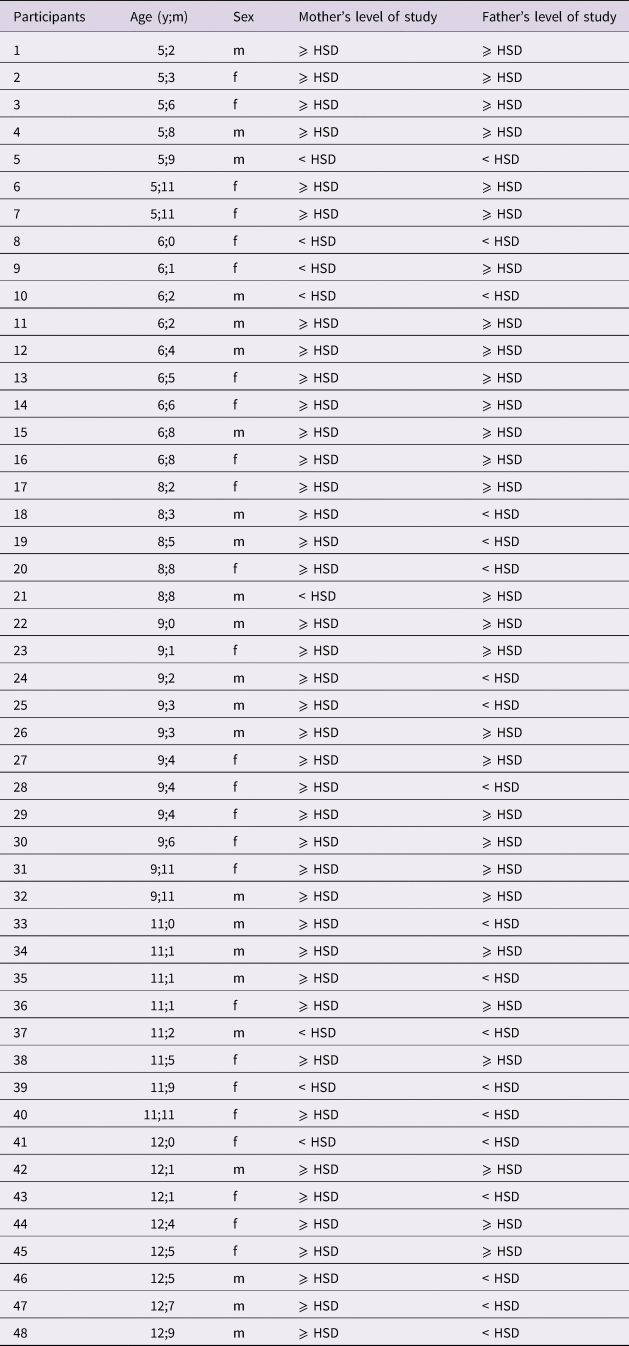
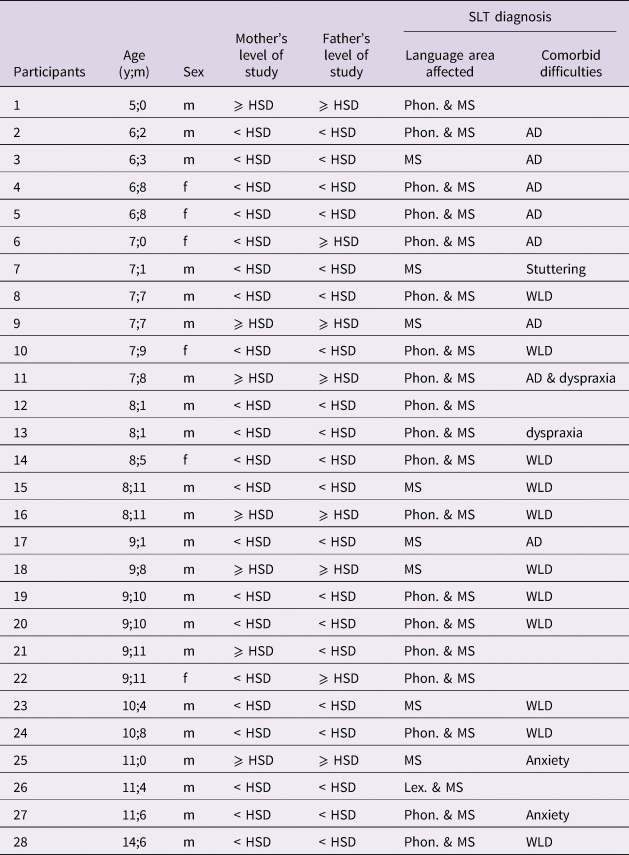
Twenty-eight children with DLD, aged 5;0 to 14;6 (M = 8;10, SD = 2;0, 22 boys, 6 girlsFootnote 9) were selected for the experiment. The majority of these participants were diagnosed by speech and language therapists working in private clinics in France or Switzerland via standardized tests classically used in clinical practice. For seven children, the diagnosis was performed in France by multi-disciplinary teams in specific centres (centres for language disorders and learning disabilities). All diagnoses of these children included syntactic deficits (with scores less than 2 standard deviations, the criterion used in Switzerland and France to diagnose DLD, CIM 10; De La Santé, Reference De La Santé1993), as evaluated by standardized batteries commonly used by language therapists, such as EXALANG 5–8 (Thibault, Helloin, & Croteau, Reference Thibault, Helloin and Croteau2010), which include both expressive and receptive assessments. Hearing status as well as articulation were checked by specialized clinicians. At the time of the study, all participants were receiving speech-and-language therapy. Performance of these children was compared with that of 48 typically developing control children aged 5;2 to 12;9 (M = 9;0, SD = 2;4, 23 boys, 25 girls), recruited from local schools, who did not present any academic or language difficulty according to their teachers and parents, and who had never received speech or language therapy. Descriptive data on participants are given in Tables 1 and 2, including age and gender of children and parents’ education level,Footnote 10 as well as, for participants with DLD, characterization of language area affected and comorbid difficulties according to their Speech and Language Therapists (SLT).
Descriptive data on control participants

Note. HSD = High-school degree.
Descriptive data on participants with DLD

Notes. HSD = High-school degree; phon. = phonology; MS = morphosyntax; Lex. = lexicon; AD = attentional difficulties; WLD = written language disorders.
All participants were strictly monolingual French-speaking, lived in the same border region (including Geneva and its Swiss and French outskirts) and performed within the normal percentile range (⩾ 10th, which corresponds to an IQ of 80) in non-verbal reasoning, assessed via Raven's Colored Progressive Matrices (Raven, Court, & Raven, Reference Raven, Court and Raven1998). Children with DLD obtained a mean score of 27.2 (SD = 5.5) and control children of 28.6 (SD = 6.2) for this non-verbal task. We ensured that the groups did not differ in chronological age (t(74) = 0.3, p = .3) or in non-verbal reasoning (t(74) = 1.0, p = .6). Approval for this study was obtained from the Ethics Committee of the Faculty of Psychology, at the University of Geneva. Parents of the participants gave informed, written consent for their children to participate in the research.
Material and procedure
All children were tested individually in the speech and language therapist's office (for children with DLD) or in school (for controls). Their answers were (digitally) recorded for subsequent transcription and coding. All testing sessions were transcribed, coded, and checked twice by two different experts.
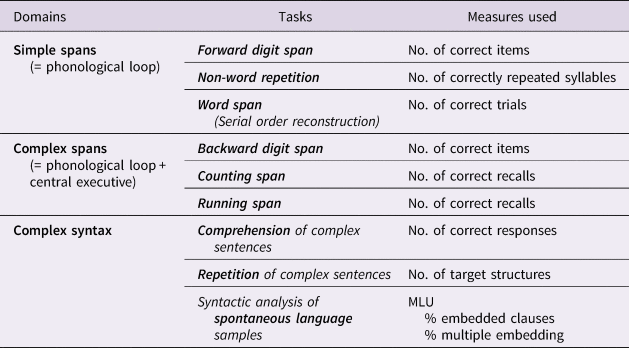
To assess working memory performance, we used three simple-span tasks (a–c) and three complex-span tasks (d–f) which involve dual-processing. When the child failed two or three times consecutively on the same task, the task was discontinued. Syntax was evaluated in three different contexts (g–i): comprehension, repetition, and spontaneous production of complex sentences. Finally, Raven's Colored Progressive Matrices (Raven et al., Reference Raven, Court and Raven1998) allowed us to assess the non-verbal reasoning ability of participants. Table 3 summarizes these different tasks and the measures we used for each of the tasks.
(a) Forward digit span (WISC IV; Wechsler, Reference Wechsler2005). This task consists of orally presenting a series of digits increasing in length from 2 to 9 to the participants, who then have to immediately repeat them aloud in the same order
(b) Non-word repetition (BELEC; Mousty, Leybaert, Alegria, Content, & Moraïs, Reference Mousty, Leybaert, Alegria, Content and Moraïs1994). This task is composed of 40 non-words increasing in length (1–5 syllables) and in phonological complexity (with Consonant–Vowel and Consonant–Vowel–Consonant structures), such as moga, juséga, kragrinblan, panilèfévu, praublifrouklébro.
(c) Word span. The ‘animal race task’ (Majerus, Reference Majerus2008; Majerus et al., Reference Majerus, Poncelet, Greffe and van der Linden2006) is a serial order reconstruction task.Footnote 11 Participants listen to a short auditory list of animal names participating in a race; the subjects are then asked to put the animals on the podium in their order of arrival.
(d) Backward digit span (WISC IV; Weschler, Reference Wechsler2005). In this task, participants are asked to repeat a series of digits in the reversed order.
(e) Counting span (Case et al., Reference Case, Kurland and Goldberg1982). In this task, the child is presented with a ring-binder with each page containing a different number of red and blue dots. The child is instructed to count and remember the number of red dots, and then, after n-pages (a number which progressively increases), he/she has to recall, in the order of presentation, the number of dots remembered for each page.
(f) Running span (Pross, Gaonac'h, & Gaux, Reference Pross, Gaonac'h and Gaux2008). This task evaluates the size of the attentional focus and involves updating WM content (without using rehearsal processes, as it is the case for subvocal repetition). The child hears a list of monosyllabic words (e.g., peau ‘skin’, fil ‘thread’, date ‘date’, peur ‘fear’, ski ‘ski’, noix ‘walnut’) without knowing how many words the list contains; he/she is then instructed to recall the last two, three, or four words listed by the experimenter.
(g) Comprehension of complex sentences (ECOSSE; Lecocq, Reference Lecocq1996, a French adaptation of the well-known TROG; Bishop, Reference Bishop1989). In this standardized task, which was reduced by half and only included complex utterances, the examiner reads a sentence referring to one of four drawings, and the participant's task is to point to the one that corresponds to the meaning of the sentence. The distracter drawings differ from the target sentence by either a lexical or grammatical element. The sentences are divided into blocks composed of gradual syntactic complexity (e.g., La vache que le chien poursuit est marron; le cercle dans lequel il y a une étoile est rouge ‘the cow that the dog is chasing is brown; the circle in which there is a star is red’).
(h) Repetition of complex sentences (Delage & Frauenfelder, Reference Delage and Frauenfelder2012). The child has to repeat sentences that include embedded clauses whose syntactic complexity varies. Two factors of syntactic complexity are manipulated: the type of relative clause (with one or two movements resulting in different word orders) and the depth of embedding (cf. Table 4).Footnote 12 The task consists of 8 control sentences (without embedding) and 16 complex sentences, all containing relative clauses. Control and complex sentences are of the same length (14 syllables per sentence). The repeated sentence is considered correct if the target structure is uttered (e.g., subject relative clause: qui pleure ‘who is crying’) with the expected embedding (here, three levels: Il pense [qu'elle dit [que le garçon déteste la fille [qui pleure]]] ‘He thinks [that she is saying [that the boy hates the girl [who is crying]]]’). We chose to use a sentence repetition task because it allows us to evaluate precisely the ability of children to produce structures in which complexity is manipulated, which is not the case for spontaneous language analysis or classical elicitation tasks.Footnote 13
Synthesis: tasks and measures

Types of complex sentences

(i) Syntactic analysis of spontaneous language samples. Spontaneous language samples are elicited during free interview contexts where 60 utterances per childFootnote 14 are analyzed. After the initial coding, all transcriptions were checked by an expert linguist who also listened to all of the corresponding audio files.Footnote 15 Our measures are (i) ‘MLU’ (total number of words / total number of sentences); (ii) rate (= proportion) of embedded clauses (number of subordinate clauses / number of verbal utterances); and (iii) rate of multiple embedding (number of subordinate clauses embedded in another subordinate clause / number of verbal utterances). Utterances are parsed using C-units, each unit corresponding to one main clause with all subordinate clauses attached to it. The following example (11) illustrates a multiple embedding produced by a control child.
(11) child (aged 12): “et puis enfin y a [PR] les animaux qui peuvent parler [SUB1] parce que dans leur réseau au départ on leur a donné [SUB2] une petite machine qui leur permet [SUB3] de parler [SUB4] [NF]”Footnote 16
‘And then lastly there are the animals who can talk because in their network they were given a little machine so that they could speak.’
Such embedded clauses may be used more or less frequently by children as a function of individual stylistic choices. To limit this variability and minimalize the diversity of conversation topics, each interview followed the same format, with specific questions about leisure activities.
Main results
Preliminary hypothesis: performance improves with age
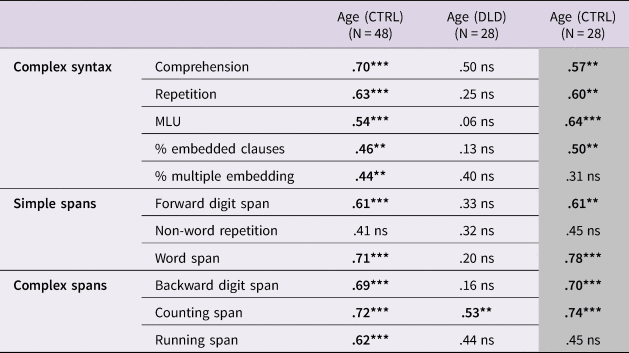
As expected, our results revealed a strong age effect for syntax and for WM in control children (CTRL), since age is significantly correlated with almost all measures of syntax and WM in this group of 48 participants (Table 5). Note that, due to multiple variables considered, we performed a Bonferroni correction (p < .0023) in dividing the critical p value by the number of comparisons being made.
Pearson correlations between measures of syntax and WM for three groups: all CTRL participants, DLD participants, and age and number-matched CTRL

Notes. ***p < .001; **p < .0023 (Bonferroni correction).
However, this age effect is largely absent in the DLD population despite the fact that the age range of this population is larger (five to fourteen years) than in the controls (five to twelve years). More precisely, although 5 out of 6 working memory measures and all language measures correlate significantly with age in control children, only one measure correlates with age in children with DLD (counting span). These results may reflect a dissociation between the normal maturation of syntax and WM in control children and a slower development observed in children with DLD in the same domains. Note, however, that the different number of participants in each group (48 for controls, 28 for DLD) makes it difficult to compare the two groups with respect to these patterns of correlations. Thus, the moderate correlations in the DLD group (for syntactic comprehension or running span for example) are not significant, whereas such levels of correlations are significant in controls due to the higher number of participants. In order to take into account this problem, we have conducted the same analyses with a subgroup of 28 control children, age-matched with DLD children (M = 8;11). Results are presented on Table 5 (in the darker tint) and display the same pattern of correlations except for two correlations that become non-significant (rate of multiple embedding and running span).
Preliminary hypothesis: controls versus DLD
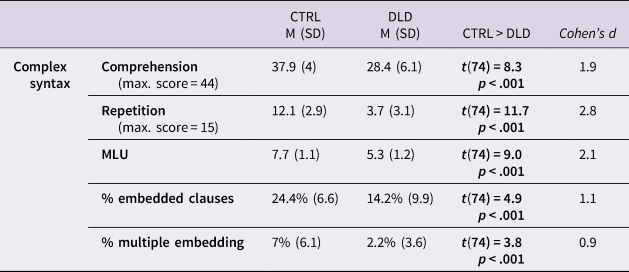
With regard to syntax, Table 6 sheds light on the severe difficulties encountered by children with DLD in this domain since they significantly differ from the control children for all the measures. We conducted other analyses which demonstrate that the difficulties encountered by these children are particularly specific to complex syntax. For instance, in spontaneous language, children with DLD produce significantly less complex sentences (i.e. utterances containing at least one embedded clause) than controls (14% versus 24%; t(74) = 5.4, p < .001, d = 1.2). At the same time, they produce as many simple sentences (without embedded clauses) as controls (60% versus 62%), revealing that children with DLD seem to avoid producing complex sentences when they can make sentences choosing their own words. The fact that children with DLD also produce more non-verbal utterances than controls (25% versus 10%; t(74) = –5.5, p < .001, d = 1.2) further supports this claim.
Controls versus DLD: complex syntax

Note. p value <.01 (Bonferroni correction).
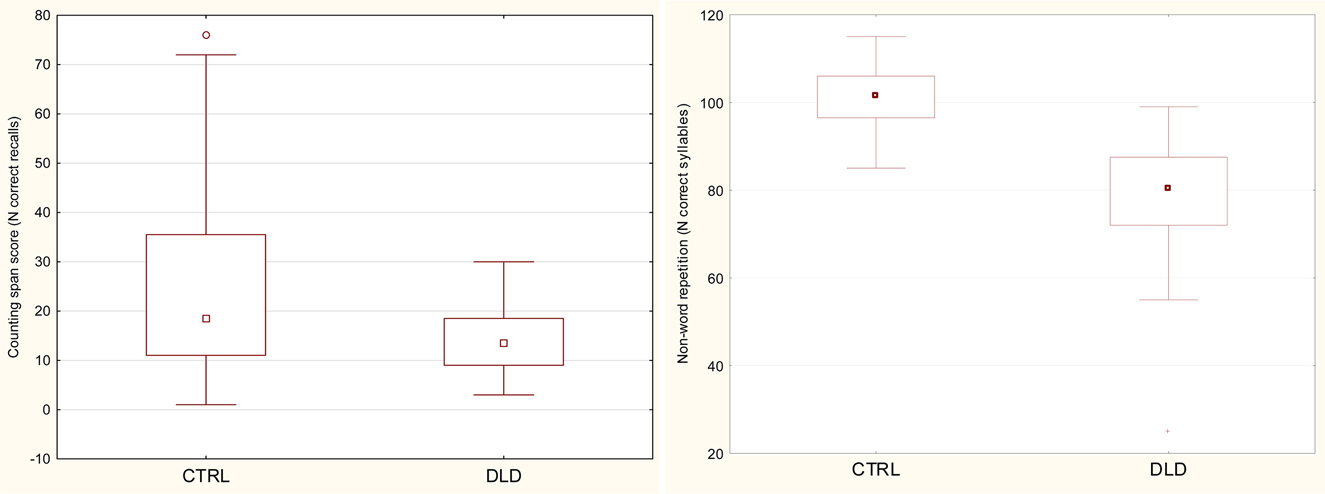
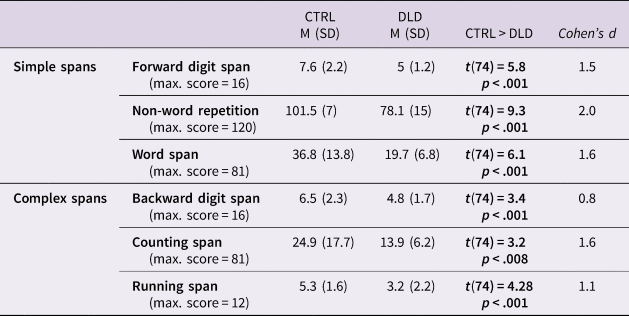
As expected, the performance of controls and that of children with DLD also differs statistically in all WM measures, with weaker scores in DLD, as shown in Table 7. Figures 1–2 show these results, with the distribution of performance in both groups, for the counting span task and the non-word repetition task.
Results for counting span and non-word repetition for controls and DLD children.

Controls versus DLD: working memory

Note. p value < .008 (Bonferroni correction).
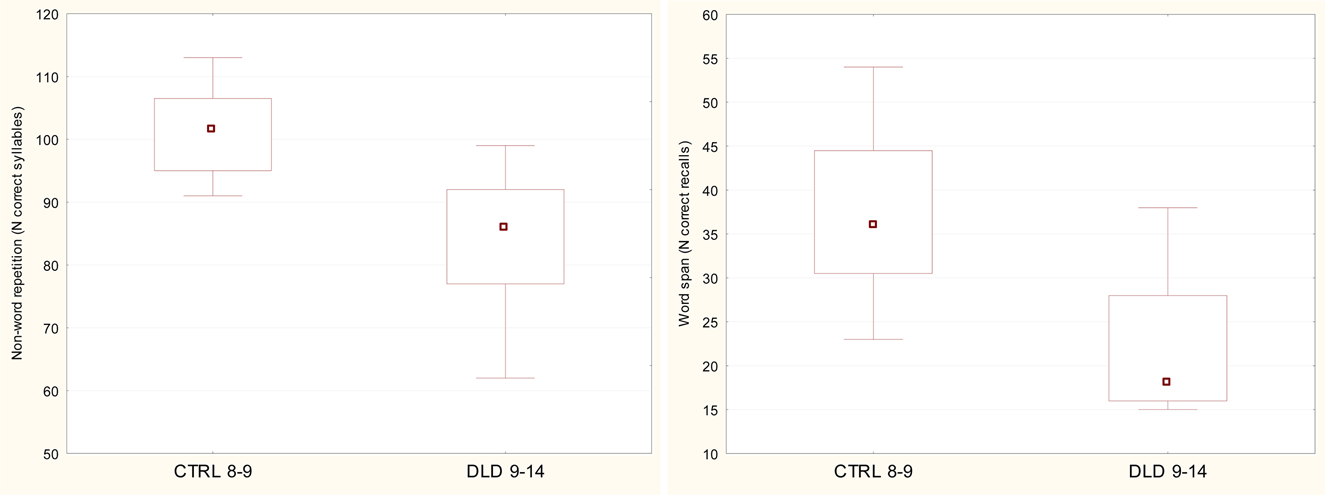
Moreover, the performance of children with DLD on some simple-span tasks remains below that of younger control children, as illustrated in Figures 3–4, which show differences between young control children aged eight to nine (M age = 8;11, N = 16) and the ‘oldest’ DLD group aged nine to fourteen (M age = 10;5, N = 14) for the tasks of non-word repetition and word span (respectively: t(28) = 5.3., p < .001, d = 1.9; t(28) = 4.8, p < .001, d = 1.8).
Results for non-word repetition and word span for a subset of the participants: young control children (aged 8–9) and oldest DLD (aged 9–14).

Main hypothesis: predictive link between working memory and complex syntax
We proceeded to multiple linear regression analyses in order to test for a predictive relationship between WM and syntax. To simplify these analyses we calculated unit-weighted standardized composite scores for simple and complex spans.Footnote 17 Since correlation matrices (see ‘Appendices 1 and 2’) point to a possible high degree of collinearity between our four predictors (age, non-verbal reasoning, simple spans, and complex spans), we calculated an index of collinearity of 19.6. This result showed a medium collinearity, as defined by condition numbers of more than 15 (Besley, Kuh, & Welsch, Reference Belsey, Kuh and Welsch1980). To deal with this collinearity in our data, we orthogonalized all our predictors to obtain variables which were no longer interdependent (Baayen, Reference Baayen2008). This enabled us to analyze each factor independently. Indeed, one part of the variance of scores in WM can be attributable to age (the older the children, the better their results). In this case, orthogonalization can remove part of the age-related variance on other predictors and can consequently reduce the interdependency between variables. The possible predictors considered were the composite scores of simple and complex spans, as well as age and non-verbal reasoning. Predicted variables were the different (continuous) measures of complex syntax. The entire set of orthogonalized predictors was entered at a single step. We ran multiple linear regression analyses on each of our five measures of syntactic complexity using the ‘lme4’ (Bates et al., Reference Bates, Maechler, Bolker, Walker, Christensen, Singmann and Grothendieck2011) and ‘languageR’ (Baayen, Reference Baayen2010) packages for R.2.11.1 software.
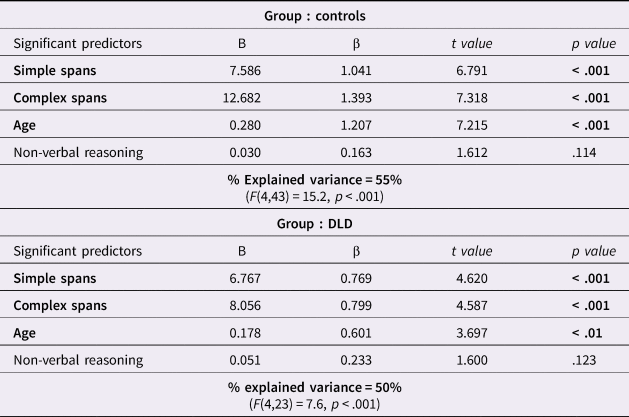
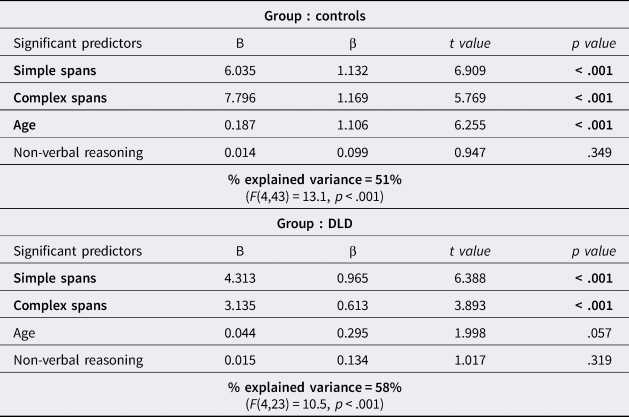
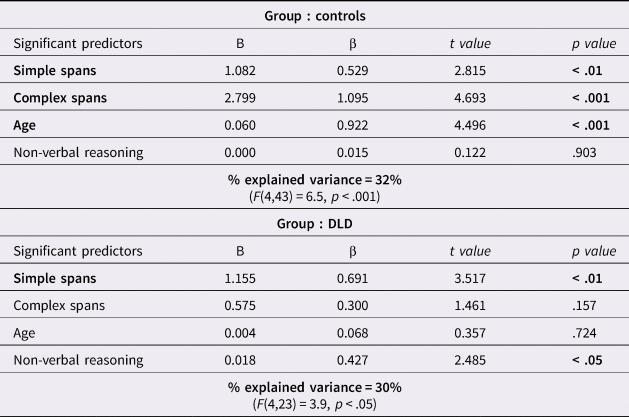
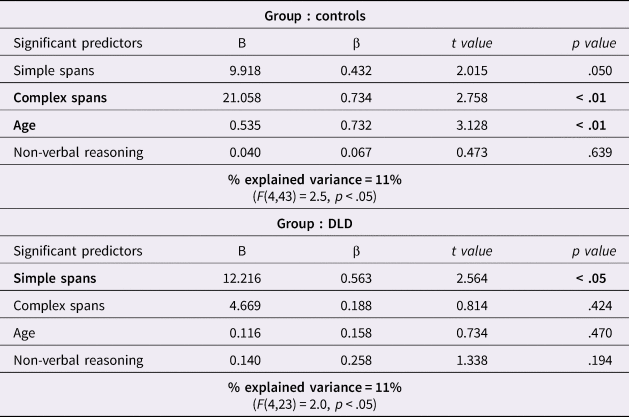
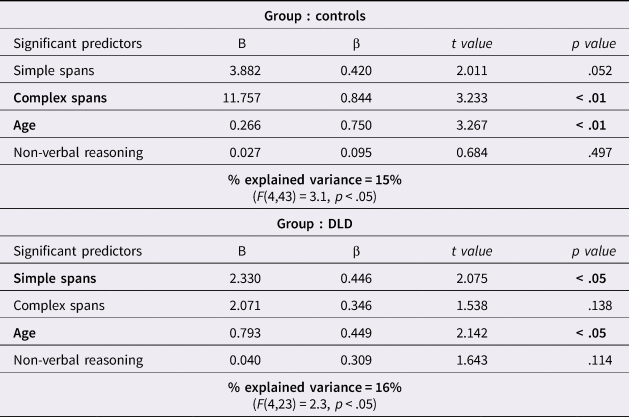
Tables 8 to 12 present the detailed results for these regression analyses conducted in controls and in children with DLD for each measure of complex syntax. For both groups, the combination of simple spans, complex spans, and age explained a significant part of the variance in the comprehension of complex sentences (55% for controls and 50% for DLD). These predictors are also of particular importance in the repetition of complex sentences, with 51% of the variance explained in control children and 58% in children with DLD. In contrast, results in both groups slightly differ when considering spontaneous language measures (Tables 10, 11, and 12). In fact, our findings revealed that complex-span tasks strongly predicted all three measures of spontaneous language in the control group, whereas this predictor does not explain the variance in spontaneous language measures in children with DLD. Interestingly, in this group simple spans are the most important predictor of complex syntax in spontaneous language production.
Regression analyses for comprehension of complex sentences

Regression analyses for repetition of complex sentences

Regression analyses for Mean Length of Utterances (MLU)

Regression analyses for rate of embedded clauses

Regression analyses for rate of multiple embedding

In the light of these results, we examined which WM tasks were the most predictive for syntactic measures in spontaneous language production. In order to do this, we repeated the same analyses, this time, however, with seven (orthogonalized) possible predictors: the six WM scores and age. Again, the results revealed different tendencies depending on the group. In control children, the counting span (= complex-span task) is the only WM task which, associated with age, significantly predicts the three syntactic measures: 25% of the variance of MLU (F(7,40) = 3.2, p < .01),Footnote 18 19% of the variance of the rate of embedded clauses (F(7,40) = 2.6, p < .05),Footnote 19 and 11% of the variance of the rate of multiple embedding (F(7,40) = 1.9, p < .05).Footnote 20 In children with DLD, however, the word span (= simple-span task) explains 35% of the variance of MLU (F(7,20) = 3.1, p < .05)Footnote 21 and 22% of the variance of the rate of embedded clauses (F(7,20) = 3.6, p < .05).Footnote 22
General discussion
First, our results confirm that WM and complex syntax capacities increase considerably with age in control children, whereas this progression seems to be slower in children with DLD. Note, however, that these differences in changes in performance over time have to be interpreted with extreme caution since only a longitudinal study, following the same children from a young age to adolescence, could confirm that, with age, the maturation timeline of WM capacities differs between the two groups. Our results also show persistent limitations in both syntax and WM in DLD, who obtained lower scores than controls, which has already been described in adolescents with DLD (Tuller et al., Reference Tuller, Henry, Sizaret and Bathez2012, for complex syntax, and Weismer, Plante, Jones, & Tomblin, Reference Weismer, Plante, Jones and Tomblin2005, for WM).
Second, we have demonstrated a close relationship between WM capacities and complex syntax, with simple and complex span explaining a significant part of the variance in the syntactic measures. These findings support Jakubowicz's (Reference Jakubowicz2011) hypothesis suggesting that (1) the progressive maturation of WM in typically developing children explains, at least in part, the increase of the mastery of complex syntax with age; and (2) the WM deficits observed in children with DLD limit their ability to process complex syntax. Nevertheless, one could venture an objection: since it is known that WM is strongly related to general IQ level (see for example Colom, Abad, Quiroga, Shih, & Flores-Mendoza, Reference Colom, Abad, Quiroga, Shih and Flores-Mendoza2008), it is perhaps general IQ level that predicts syntax development rather than WM itself. However, as already mentioned, our results cannot be explained in this way since predictors entered in regression analyses were orthogonalized in order to neutralize their reciprocal influences (and especially the influence of non-verbal reasoning on WM performance). Moreover, non-verbal reasoning capacities, entered as potential predictors, almost never appeared as a significant predictor for complex syntax performance. Since age alone cannot explain the strong predictive relationship observed between WM and syntax, these results thus argue for a specific relationship between WM and syntax.
Another observation supports this particular relationship between WM and complex syntax (and not grammar in general). In our analysis of the spontaneous language samples, we computed the proportion of complex and simple sentences. Whereas WM measures correlated with the complex syntax measures, neither simple nor complex spans did so with the proportions of simple verbal or non-verbal utterances. As a consequence, it seems that complex syntax depends specifically on the WM capacities of children, as has been demonstrated by previous studies (e.g., Frizelle & Fletcher, Reference Frizelle and Fletcher2015). Similarly, further analyses of the results from the repetition of complex sentences task show that complex spans predict children's performance on deep embedded clauses (with at least two degrees of embedding) rather than on simpler embedded clauses (with only one degree of embedding). Furthermore, subject relatives, which are simpler constructions than object relatives (since they do not involve the disruption of the canonical structure), are not predicted by WM results, in contrast to the more complex object relatives.
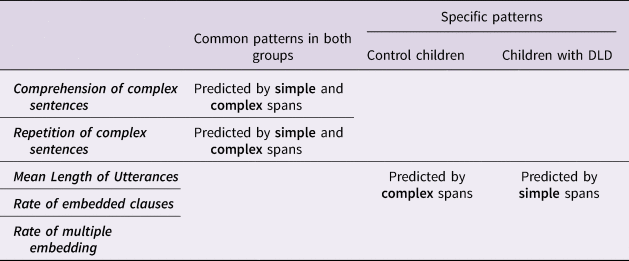
Table 13 offers a synthesis of our main results in comparing the common and specific patterns for controls and DLD children. The results showing a role of WM in syntactic performance of both populations can be understood straightforwardly for sentence comprehension and repetition since these tasks logically require the storage of the verbal material in order to respectively (1) give the right answer for comprehension or (2) recall the sentence for repetition. As for our measures of spontaneous language, the results may be surprising since it is, a priori, less obvious that producing language in a natural context requires an abundance of computational resources in terms of memory processing, particularly for children with typical language development. Yet, even in a natural context of conversation, people have to plan their utterances by remembering the topic of the conversation, taking into account the feedback of their conversation partner, preparing a response in advance, and articulating their response at the appropriate moment (Corps, Gambi, & Pickering, Reference Corps, Gambi and Pickering2018). It is, therefore, not surprising that such cognitive process tax participants’ WMs. In this case, the additional processing required by complex syntax could produce an overload in sentence production, which is consistent with the effects of complex spans observed in control children. The fact that only simple spans predict complex syntax (in spontaneous production) in children with DLD could then be explained by the fact that language production for these children is more difficult than comprehension and repetition tasks where their other (lexical and discursive) difficulties intervene less. In spontaneous production, all their language difficulties influence language processing, which could explain why even simple resource processing, such as the ability to maintain verbal material, impacts their spontaneous language production.
Synthesis of main results: common and specific patterns in the two groups

Although controls and DLD results follow the same pattern overall, with simple and complex spans explaining a large part of variance of their scores in the comprehension and repetition of complex sentences, we have identified some differences between the two groups regarding which WM tests best predict syntactic performance in spontaneous language. Indeed, complex spans, and in particular the counting span task, explain a significant part of the variance in these measures in control children, whereas simple spans, and more specifically the serial order reconstruction task, do so in children with DLD. This is of particular interest since language aspects are minimized in these specific WM tasks. In fact, in the counting span task, children need to exclusively manipulate numbers from one to nine (all numbers being monosyllabic in French) and, in the serial memory task, children only have to remember the order of animals participating in the race and not their actual names. Consequently, these tasks rely less on language representations as compared to other WM tasks, such as the listening span task in which the child needs to retain the last word of a previously heard sentence and to give a semantic judgement on the same sentence. The fact that the two tasks that depend least on language best predict performance in complex syntax supports the conclusion that WM specifically predicts complex syntax and that this link cannot be explained by inter-individual differences in language.
Why are certain aspects of complex syntax predicted by different WM tasks in controls and children with DLD? Indeed, the fact that only simple and not complex spans predict syntactic complexity measures in spontaneous language samples of children with DLD raises some questions, since previous results (such as those of Frizelle & Fletcher, Reference Frizelle and Fletcher2015) pointed to specific links between complex spans and complex syntax. One explanation for this discrepancy refers to the nature of the serial order reconstruction task, a task that was not used by Frizelle and Fletcher. In this task, only the serial order of words has to be maintained and recalled, a condition that echoes word order in sentence processing, a component that we know is particularly difficult for children with DLD, especially when sentences do not follow the canonical word order of their language (see a.o. Montgomery, Gillam, Evans, & Sergeev, Reference Montgomery, Gillam, Evans and Sergeev2017). Another explanation can be given on the basis of our data. Due to their well-known difficulties in sustained attention (see Ebert & Kohnert, Reference Ebert and Kohnert2011, for a meta-analysis), children with DLD lack the necessary processing resources to complete complex span tasks efficiently, in particular the counting span task, which has been shown to be linked to sustained attention (Magimairaj & Montgomery, Reference Magimairaj and Montgomery2013). In other words, the dual-processing involved in these tasks (which require storage and simultaneous processing) may lead to a floor effect which reduces inter-individual variability and makes it difficult to find a relation with complex syntax.Footnote 23Figure 1, which illustrated descriptive data for the counting span task, seems to support this hypothesis. Indeed, DLD performance is not only lower than that of controls, but is also more homogenous. This graph contrasts with the one describing the non-word repetition task (Figure 2), a simple-span task, for which the performance of the two groups is more similarly distributed.
Several studies support the idea that attentional difficulties in children with DLD, particularly in selective attention processing, influence their WM performance. Majerus et al. (Reference Majerus, Leclercq, Grossmann, Billard, Touzin, van der Linden and Poncelet2009) demonstrated that attentional processing explained more than 30% of the variance in verbal WM capacities, and that it acts as an essential intermediary between short-term memory and linguistics processing. Our study focused specifically on WM. However, as underlined by a large number of studies (see Henry, Messer, & Nash, Reference Henry, Messer and Nash2012), attentional deficits are recognized in DLD, 20–40% of children with language impairments having co-occurring attention-deficit hyperactivity disorder (Cardy, Tannock, Johnson, & Johnson, Reference Cardy, Tannock, Johnson and Johnson2010). In fact, attentional difficulties were observed in 8 participants, 28% of the sample, in the present study (see Table 2). However, we did not collect any data on attention skills, and thus we cannot distinguish between the role of working memory and of attention. Since attention is likely a part of working memory (see Cowan, Reference Cowan2005, or Oberauer, Reference Oberauer2013), future research should examine the role of attention in the syntactic performance of children with DLD as well.
Returning to the word span task, which tests short-term memory for serial order, we should mention that previous results showed that atypical populations, including children with dyscalculia and dyslexia, present difficulties in serial order reconstruction tasks (Attout & Majerus, Reference Attout and Majerus2015; Martinez-Perez, Majerus, Mahot, & Poncelet, Reference Martinez-Perez, Majerus, Mahot and Poncelet2012). Our study also reveals that children with DLD encountered difficulties in this task; more specifically, this task predicts a significant part of MLU and rate of embedding variance. Since during a serial order memory task children have to remember/store items they have previously heard, they need to plan the order of linguistic elements in advance when producing complex sentences. It thus seems that similar mechanisms underlie serial order memory tasks and the production of complex sentences since in both cases the linearization of verbal elements is involved. Thus, the fact that in this study children with DLD score lower in serial memory tasks could explain why this population, in particular, avoids producing complex sentences in their spontaneous language.
In sum, the results of this study show a strong predictive relationship between WM and complex syntax.Footnote 24 Even though our results should be treated with caution due to the relatively small sample of participants with DLD, they are supported by other studies that used larger cohorts (117 children with DLD in Montgomery et al., Reference Montgomery, Evans, Fargo, Schwartz and Gillam2018). We thus think that our results have clear clinical implications. Indeed, if WM limitations in children with DLD truly predict complex syntax deficits in this population, it would then be appropriate to train the WM of this population. Further studies should therefore investigate the impact of a motivated and specific WM rehabilitation programme on syntactic performance in children with DLD, a particular need which had already been formulated by Montgomery (Reference Montgomery2002): “Structuring intervention with students with DLD to include training of cognitive processes would seem to be important […] we propose that this process should consider other reliable sources of emerging evidence, particularly from psychology, to support the use of alternative treatment approaches such as memory training with students with DLD” (Montgomery et al., Reference Montgomery, Magimairaj and Finney2010, p. 88). Surprisingly, while intensive WM training programmes inundate the market (with programmes such as Cogmed: Klingberg et al., Reference Klingberg, Fernell, Olesen, Johnson, Gustafsson and Dahlstrom2005; or Jungle Memory: Alloway, Bibile, & Lau, Reference Alloway, Bibile and Lau2013), to the best of our knowledge no scientific study analyzing the effect of such training on the language of children with DLD that respects the methodological principles (such as the use of control groups) has been published. Even if prior studies, which were often conducted with typically developing participants, revealed relatively little transfer of skills (Melby-Lervåg & Hulme, Reference Melby-Lervag and Hulme2013), other studies including children with intellectual disabilities (see Danielsson, Zottarel, Palmqvist, & Lanfranchi, Reference Danielsson, Zottarel, Palmqvist and Lanfranchi2015, for a meta-analytic review) or adults with aphasia (Eom & Sung, Reference Eom and Sung2016; Zakariás, Keresztes, Marton, & Wartenburger, Reference Zakariás, Keresztes, Marton and Wartenburger2016) are clearly more promising. Finally, we believe that the results of our study could influence the conceptualization of new WM training programmes. These would differ from existing programmes which include a large proportion of visual WM tasks, such as Cogmed, by including training activities targeting specific verbal WM. More precisely, training activities would focus on the working memory aspects that have been shown to be predictive of syntactic performance, such as serial order WM in DLD. Such tailor-made WM intervention programmes could be more effective but still require further empirical support (Majerus, Reference Majerus2016). Specifically on this topic, we recently conducted such a WM training study which shows improvement of complex syntax in children with DLD, more precisely on accusative pronoun production, a clinical marker of DLD in French (Stanford, Durrleman, & Delage, Reference Stanford, Durrleman and Delagein press).
Authors’ note
The corresponding author and the co-author confirm that they do not have any conflicts of interest to declare.
Appendices
Appendix 1. Correlation matrix between potential predictors in control children

Appendix 2. Correlation matrix between potential predictors in children with DLD