Introduction
There are an estimated 35.6 million people with dementia worldwide, and this number is projected to increase to over 115 million by 2050 (Wimo and Prince, Reference Wimo and Prince2010). The prevalence of dementia in the UK is estimated at around 700,000 people, with dementia affecting one in five of the population over the age of 85 (Knapp and Prince, Reference Knapp and Prince2007). By 2051 it is estimated that there will be approximately 1.7 million people in the UK with dementia. Dementia is a progressive neurodegenerative disease which significantly reduces survival (Neale et al., Reference Neale, Brayne and Johnson2001). The end-of-life care received by this group is often poor (Sampson et al., Reference Sampson, Gould, Lee and Blanchard2006) and patients have inequitable access to palliative care services (Hanrahan and Luchins, Reference Hanrahan and Luchins1995). In part, this may be because few people with dementia have an advance care plan.
Advance care planning (ACP) is being promoted internationally as an effective strategy to improve end-of-life care for people with dementia (Alzheimer Europe, Reference Alzheimer2006; US Congress, Reference Congress1991; Department of Health, 2008). ACP is an overarching term that can be understood as a “process of discussion that usually takes place in anticipation of a future deterioration of a person's condition, between that person and a care worker” usually from a healthcare background (Henry and Seymour, Reference Henry and Seymour2007). ACP can include advance decisions to refuse treatment (ADRT), advance statements and living wills as well as legal frameworks such as lasting power of attorney (UK). A number of ACP programs have been established worldwide, notably in parts of the USA, Australia and Canada. The goals of such programs are to establish a process of communication that facilitates a person's involvement in decisions about their current and future care, and to put in place plans to ensure that these preferences can be met when a person no longer has the capacity to express their wishes (Teno, Reference Teno2010).
ACP is less advanced in Europe and the UK, perhaps due to the historically unclear legal status of advance statements in the UK compared to the USA, Canada or Australia (van der Heide et al., Reference van der Heide2003; Seymour et al., Reference Seymour, Gott, Bellamy, Ahmedzai and Clark2004). In England and Wales there is now recognition that under common law, a specific anticipatory statement (usually the advance refusal of medical treatment) has legal status. The Mental Capacity Act 2005 (Department of Consitutional Affairs, 2005) addresses this area of legislation and seeks to ensure that even those without mental capacity are enabled to make known their wishes and preferences for care and support, in anticipation that these will be carried out.
In order to develop services to enable people with dementia and their carers to plan effectively for future care, it is essential to understand what progress has been made in the field both nationally and internationally. In this paper we report the findings of a review of the international literature on ACP for people with dementia.
Study aims
We were aware that the literature was small so aimed to systematically identify and review all empirical studies on ACP for people with dementia.
Our study questions were:
1. What are the facilitators and inhibitors to ACP for people with dementia?
2. What are the key themes that emerge from the literature?
We also wished to examine what kinds of methodologies have been used and the size of the evidence base for advance care planning for people with dementia
Methods
Search strategy
The literature search was developed using PubMed (1950–2010) with searches then translated and repeated in CINAHL, AMED, PsychINFO, EMBASE and BNI (all searched until March 2010).
The term “advance care planning” was the overarching intervention heading and was searched as both free text and as a Medical Subject (MeSH) heading. The MeSH heading for this includes “advance directives” and “living wills” within the MeSH tree. Similarly, “dementia” was also entered as free text and a MeSH heading. The terms (both MeSH and free text) were combined with the “AND” operand and searched initially in the PubMed database. Searches were then translated and repeated in the other databases. The Cochrane Database, Trial Registers (Current Controlled Trials; UK-CRN; UMIN-CTR; NRRA) were searched until March 2010, Conference Papers Index and unpublished library sources (e.g. SIGLE) were also were reviewed. Experts in the field were contacted to seek their knowledge on any current studies or unpublished materials. We also hand searched reference lists in all included papers. As we believed there to be a limited evidence base, we used broad inclusion criteria.
Inclusion criteria
We included papers reporting empirical studies using any methodology that (i) were published in the English language, (ii) reported characteristics of the patient population studied, (iii) reported details about the type of ACP under investigation, (iv) provided information about the study setting, and (v) involved people with dementia (diagnosed clinically or using research criteria) or family members and professional carers of people with dementia. We excluded papers that reported reviews, opinions and comments only.
The numbers of abstracts screened, papers retrieved, studies suitable for inclusion, and excluded studies were recorded. Abstracts were independently assessed for inclusion by KHD and ELS.
Data extraction and assessment of study quality
We extracted data from all included studies using data extraction sheets developed for the study. To assess the types of methodology used in studies, we adapted the SCIE Systematic Research Review framework (Coren and Fisher, Reference Coren and Fisher2006) and guidelines (Boyle, Reference Boyle1998).
Synthesis of findings
The limited numbers of papers suitable for inclusion, the heterogeneity of the population studied with respect to stage of dementia and outcome measures used precluded us from combining data to explore whether ACP changed patient or carer outcomes. We identified key themes from the overall findings of qualitative and quantitative papers and synthesized these to produce a narrative review (Centre for Reviews and Dissemination, 2009).
Results
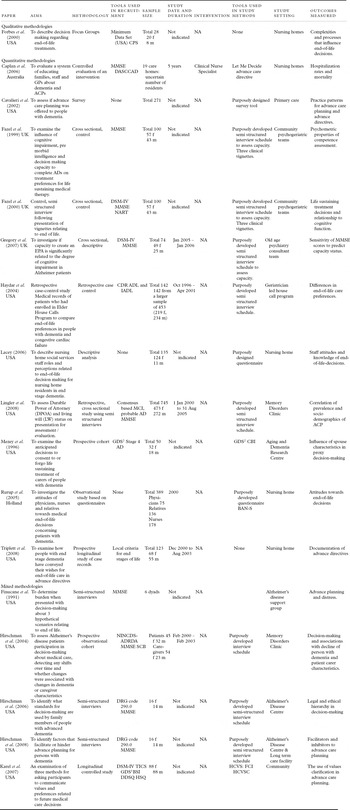
In total, 344 papers were identified. Abstracts for all retrieved citations were requested but of these a large number were unavailable, even through the British Library. These were predominantly the older literature (pre-1995). We identified 17 studies which fulfilled all inclusion criteria (Table 1). Twelve of these were conducted in North America, four in Europe and one in Australia.
Characteristics of included studies

Note: m = Male. f = Female. NA = not applicable. CPS = Cognitive Performance Scale. MMSE = Mini-Mental State Examination. ADL = Activities of Daily Living. IADL = Instrumental Activities of Daily Living. SCB = Screen for Caregiver Burden. CDR = Clinical Dementia Rating. NART = National Adult Reading Test. DRG = Diagnosis Related Group. TICS = Telephone Interview for Cognitive Status. GDS = Geriatric Depression Scale1. BSI = Brief Symptom Inventory. DDSQ = Dementia Diagnostic Screening Questionnaire. HSQ = Health Screening Questionnaire. GDS2 = Global Deterioration Scale. BI = Burden Inventory. BAN-S = Bedford Alzheimer nursing severity sub-scale. NINCDS-ADRDA = National Institute of Neurological and Communicative Disorders and Stroke – Alzheimer's Disease and Related Disorders Association criteria.
Included studies
Qualitative studies
Only one study used qualitative methods alone in which focus groups explored family decision-making processes in each of four participating care home facilities (Forbes et al., Reference Forbes, Bern-Klug and Gessert2000). Content thematic analysis was used.
Quantitative studies
Eleven studies used quantitative methods including control or comparative groups (Fazel et al., Reference Fazel, Hope and Jacoby1999; Reference Fazel, Hope and Jacoby2000; Haydar et al., Reference Haydar, Lowe, Kahveci, Weatherford and Finucane2004; Caplan et al., Reference Caplan, Meller, Squires, Chan and Willett2006), controlled evaluation (Caplan et al., Reference Caplan, Meller, Squires, Chan and Willett2006), cross-sectional study (Lingler et al., Reference Lingler2008), survey or questionnaire (Lacey, Reference Lacey2005; Rurup et al., Reference Rurup, Onwuteaka-Philipsen, Roeline, Pasman, Ribbe and van der Wal2006), prospective longitudinal study (Triplett et al., Reference Triplett2008), and prospective study using interviews (Mezey et al., Reference Mezey, Teresi, Ramsey, Mitty and Bobrowitz2000).
Mixed method studies
Five studies employed a mixed method approach (Finucane et al., Reference Finucane, Bearner, Roca and Kawas1991; Hirschman et al., Reference Hirschman, Xie, Feudtner and Karlawish2004; Reference Hirschman, Kapo and Karlawish2006; Reference Hirschman, Kapo and Karlawish2008; Karel et al., Reference Karel, Moye, Bank and Azar2007).
Demographic data
Most studies provided further descriptive data on their samples, e.g. gender (13 studies); age (14 studies); ethnicity (eight studies); education (nine studies); professional role; relationship of carer to person with dementia (five studies); level of cognitive function as indicated by tools (nine studies); Mini-Mental State Examination (MMSE), Cognitive Performance Scale (CPS).
Diagnosis and assessment of cognitive impairment and dementia
Over half of the studies used a simple clinical diagnosis of dementia (Finucane et al., Reference Finucane, Bearner, Roca and Kawas1991; Mezey et al., Reference Mezey, Teresi, Ramsey, Mitty and Bobrowitz2000; Haydar et al., Reference Haydar, Lowe, Kahveci, Weatherford and Finucane2004; Hirschman et al., Reference Hirschman, Xie, Feudtner and Karlawish2004; Reference Hirschman, Kapo and Karlawish2006; Reference Hirschman, Kapo and Karlawish2008; Caplan et al., Reference Caplan, Meller, Squires, Chan and Willett2006; Lingler et al., Reference Lingler2008; Triplett et al., Reference Triplett2008). Four studies used DSM-IV criteria (American Psychiatric Association, 1994) for diagnosing dementia (Fazel et al., Reference Fazel, Hope and Jacoby1999; Reference Fazel, Hope and Jacoby2000; Gregory et al., Reference Gregory, Roked, Jones and Patel2007; Karel et al., Reference Karel, Moye, Bank and Azar2007); two used the Diagnosis Related Group (Hirschman et al., Reference Hirschman, Kapo and Karlawish2006; Reference Hirschman, Kapo and Karlawish2008); one used the USA Minimum Data Set (Forbes et al., Reference Forbes, Bern-Klug and Gessert2000), and one the National Institute of Neurological and Communicative Disorders and Stroke – Alzheimer's Disease and Related Disorders Association criteria (NINCDS-ADRDA) (Haydar et al., Reference Haydar, Lowe, Kahveci, Weatherford and Finucane2004).
Several used a measure to assess dementia severity, most often the MMSE (Folstein et al., Reference Folstein, Folstein and McHugh1975) either as part of sample selection or in assessing outcomes.
Outcomes measured
A range of outcomes were reported. Seven studies evaluated factors that may facilitate or inhibit end-of-life care decision-making (Fazel et al., Reference Fazel, Hope and Jacoby2000; Forbes et al., Reference Forbes, Bern-Klug and Gessert2000; Hirschman et al., Reference Hirschman, Xie, Feudtner and Karlawish2004; Reference Hirschman, Kapo and Karlawish2006; Reference Hirschman, Kapo and Karlawish2008; Karel et al., Reference Karel, Moye, Bank and Azar2007; Lingler et al., Reference Lingler2008) and two studies evaluated staff attitudes in relation to end-of-life care decisions in dementia (Lacey, Reference Lacey2005; Rurup et al., Reference Rurup, Onwuteaka-Philipsen, Roeline, Pasman, Ribbe and van der Wal2006).
Three studies evaluated the psychometric properties of capacity and the use of the MMSE to predict a “cut-off range” that may indicate a point at which a person with dementia may no longer have decision-making capacity (Fazel et al., Reference Fazel, Hope and Jacoby1999; Hirschman et al., Reference Hirschman, Xie, Feudtner and Karlawish2004; Gregory et al., Reference Gregory, Roked, Jones and Patel2007).
The majority of studies purposefully developed tools for their study (Fazel et al., Reference Fazel, Hope and Jacoby1999; Reference Fazel, Hope and Jacoby2000; Cavalieri et al., Reference Cavalieri, Latif, Ciesielski, Ciervo and Forman2002; Haydar et al., Reference Haydar, Lowe, Kahveci, Weatherford and Finucane2004; Hirschman et al., Reference Hirschman, Xie, Feudtner and Karlawish2004; Reference Hirschman, Kapo and Karlawish2006; Reference Hirschman, Kapo and Karlawish2008; Lacey, Reference Lacey2005; Rurup et al., Reference Rurup, Onwuteaka-Philipsen, Roeline, Pasman, Ribbe and van der Wal2006; Gregory et al., Reference Gregory, Roked, Jones and Patel2007; Lingler et al., Reference Lingler2008); others used measures to identify perceived carer burden and distress in decision-making (Mezey et al., Reference Mezey, Teresi, Ramsey, Mitty and Bobrowitz2000), expression of healthcare values (Mezey et al., Reference Mezey, Teresi, Ramsey, Mitty and Bobrowitz2000; Karel et al., Reference Karel, Moye, Bank and Azar2007) and an ACP tool (Caplan et al., Reference Caplan, Meller, Squires, Chan and Willett2006).
Study populations
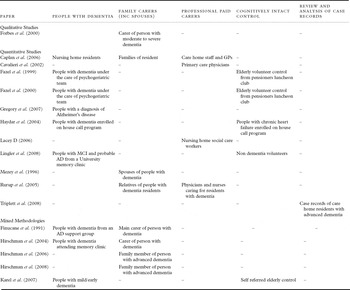
There were several key target populations (see Table 2) with nine studies directly involving people with dementia (Finucane et al., Reference Finucane, Bearner, Roca and Kawas1991; Fazel et al., Reference Fazel, Hope and Jacoby1999; Reference Fazel, Hope and Jacoby2000; Hirschman et al., Reference Hirschman, Xie, Feudtner and Karlawish2004; Caplan et al., Reference Caplan, Meller, Squires, Chan and Willett2006; Gregory et al., Reference Gregory, Roked, Jones and Patel2007; Karel et al., Reference Karel, Moye, Bank and Azar2007; Lingler et al., Reference Lingler2008; Haydar et al., Reference Haydar, Lowe, Kahveci, Weatherford and Finucane2004). Family carers were involved in almost half of the studies (Finucane et al., Reference Finucane, Bearner, Roca and Kawas1991; Forbes et al., Reference Forbes, Bern-Klug and Gessert2000; Mezey et al., Reference Mezey, Teresi, Ramsey, Mitty and Bobrowitz2000; Hirschman et al., Reference Hirschman, Xie, Feudtner and Karlawish2004; Reference Hirschman, Kapo and Karlawish2006; Reference Hirschman, Kapo and Karlawish2008; Caplan et al., Reference Caplan, Meller, Squires, Chan and Willett2006; Rurup et al., Reference Rurup, Onwuteaka-Philipsen, Roeline, Pasman, Ribbe and van der Wal2006). Professional and paid carers were the focus of four studies (Cavalieri et al., Reference Cavalieri, Latif, Ciesielski, Ciervo and Forman2002; Lacey, Reference Lacey2005; Caplan et al., Reference Caplan, Meller, Squires, Chan and Willett2006; Rurup et al., Reference Rurup, Onwuteaka-Philipsen, Roeline, Pasman, Ribbe and van der Wal2006).
Study populations

The target populations included a full range of dementia severity, from mild cognitive impairment (MCI) (Lingler et al., Reference Lingler2008) to severe and advanced or end-stage dementia (Mezey et al., Reference Mezey, Teresi, Ramsey, Mitty and Bobrowitz2000; Lacey, Reference Lacey2005; Caplan et al., Reference Caplan, Meller, Squires, Chan and Willett2006; Triplett et al., Reference Triplett2008; Hirschman et al., Reference Hirschman, Kapo and Karlawish2008).
Strengths and weaknesses of study methodologies
The heterogeneity of study methodologies precluded formal analysis; however, our data collection tool did indicate some areas of strength and weakness. Some studies were not explicit about the study date and duration (Finucane et al., Reference Finucane, Bearner, Roca and Kawas1991; Fazel et al., Reference Fazel, Hope and Jacoby1999; Reference Fazel, Hope and Jacoby2000; Forbes et al., Reference Forbes, Bern-Klug and Gessert2000; Mezey et al., Reference Mezey, Teresi, Ramsey, Mitty and Bobrowitz2000; Cavalieri et al., Reference Cavalieri, Latif, Ciesielski, Ciervo and Forman2002; Lacey, Reference Lacey2005; Hirschman et al., Reference Hirschman, Kapo and Karlawish2006; Reference Hirschman, Kapo and Karlawish2008). The detail on inclusion and exclusion criteria was variable; in some cases it was unclear which criteria had been used to diagnose dementia (Finucane et al., Reference Finucane, Bearner, Roca and Kawas1991; Haydar et al., Reference Haydar, Lowe, Kahveci, Weatherford and Finucane2004; Triplett et al., Reference Triplett2008), who had conducted each stage of the research (Hirschman et al., Reference Hirschman, Xie, Feudtner and Karlawish2004), and the reasons for attrition (Mezey et al., Reference Mezey, Teresi, Ramsey, Mitty and Bobrowitz2000; Hirschman et al., Reference Hirschman, Kapo and Karlawish2006), with none indicating any preparatory training for researchers involved.
Each study discussed the processes for ethical approval, recruitment and gaining consent. However, only six studies identified the level of cognitive function of participants or the rate of attrition (Fazel et al., Reference Fazel, Hope and Jacoby1999; Mezey et al., Reference Mezey, Teresi, Ramsey, Mitty and Bobrowitz2000; Cavalieri et al., Reference Cavalieri, Latif, Ciesielski, Ciervo and Forman2002; Lacey, Reference Lacey2005; Rurup et al., Reference Rurup, Onwuteaka-Philipsen, Roeline, Pasman, Ribbe and van der Wal2006; Hirschman et al., Reference Hirschman, Kapo and Karlawish2006; Gregory et al., Reference Gregory, Roked, Jones and Patel2007).
Findings and themes of included studies
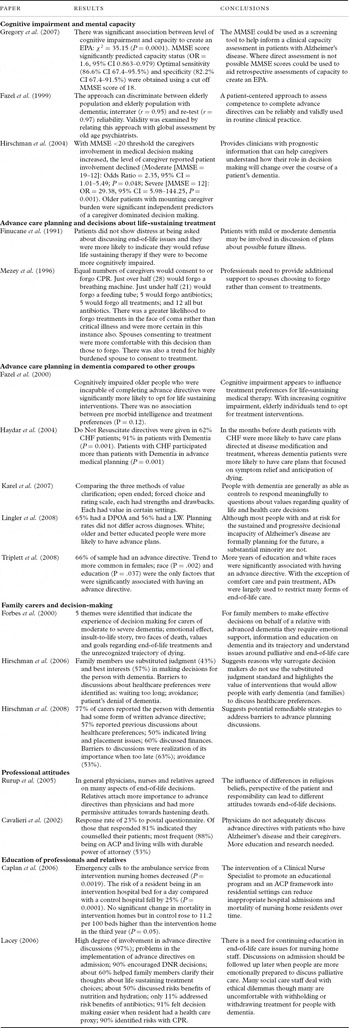
We found a number of key themes that indicate how ACP may benefit people with dementia and their carers, and the barriers and facilitators for this (these findings are presented in Table 3).
Results and main conclusions described by the main study themes

MMSE = Mini-Mental State Examination. EPA = Enduring Power of Attorney. DPOA = Durable Power of Attorney. LW = Living Will. AD = Advance Directive. CPR = Cardio Pulmonary Resuscitation. CHF = chronic heart failure. ACP = Advance Care Planning. DNR = do not resuscitate.
Cognitive impairment and mental capacity
Several studies examined cognitive impairment and mental capacity in relation to ACP or sought to determine the level of cognitive ability required to make an advanced care plan. An MMSE score of 18–20 appeared to be a consistent threshold score required to make an advanced care plan (Fazel et al., Reference Fazel, Hope and Jacoby1999; Gregory et al., Reference Gregory, Roked, Jones and Patel2007). Below this threshold, individuals appear more likely to opt for life sustaining treatments (Fazel et al., Reference Fazel, Hope and Jacoby2000).
Hirschman et al. (Reference Hirschman, Xie, Feudtner and Karlawish2004), in a prospective cohort study, found that a threshold MMSE <20 was an indicator of increased caregiver involvement in medical decision-making and a decrease in patient involvement.
Advance care planning and decisions about life sustaining treatment
Some studies sought to understand the process of ACP in dementia. Professionals and family carers may anticipate an adverse reaction to pursuing ACP with the person with dementia but this is not necessarily the case. Finucane et al. (Reference Finucane, Bearner, Roca and Kawas1991) found that the concerns of family carers were unfounded, and that the person with dementia showed no distress either before or after the discussions. This study suggests that patient and carer perspectives may differ.
Carer attitudes may influence the likelihood of people with dementia being exposed to aggressive treatments at end of life. For example, Mezey et al. (Reference Mezey, Teresi, Ramsey, Mitty and Bobrowitz2000) found that carers with a greater sense of burden were more likely to consent to life sustaining treatment. They also found that in the face of coma, carers were more likely to opt for life sustaining treatments for the person with dementia but were less sure about choices for critical illness.
Advance care planning in dementia compared to other groups
The literature revealed several differences between ACP for people with dementia and other diseases or cognitively intact controls. Fazel et al. (Reference Fazel, Hope and Jacoby2000) found that people with dementia were more likely to make decisions that were impulsive or opt for life sustaining interventions than controls, but Finucane et al. (Reference Finucane, Bearner, Roca and Kawas1991) found that people with dementia were more likely to refuse life sustaining therapy as they became more cognitively impaired.
In the USA, where advanced care plans are relatively common, there appears to be no difference in the prevalence of advanced care plans between people with dementia and people with congestive heart failure (Lingler et al., Reference Lingler2008). However, white, better educated subjects across all groups were more likely to have an advanced care plan, regardless of diagnosis (Triplett et al., Reference Triplett2008). A study of people with dementia compared to those with chronic heart failure (CHF) found that whereas patients with CHF made decisions for themselves, most of the end-of-life care planning for people with dementia was undertaken by surrogate decision-makers (Haydar et al., Reference Haydar, Lowe, Kahveci, Weatherford and Finucane2004).
Family carers and decision-making
Hirschman et al. (Reference Hirschman, Xie, Feudtner and Karlawish2004) concluded that increasing age of patients, with increasing caregiver “burden”, were significant independent predictors of caregiver-dominated decision-making. In another study, Hirschman et al. (Reference Hirschman, Kapo and Karlawish2006) used semi-structured interviews to examine caregiver decision-making based on substituted judgment and best interests standards which related to US law and ethics to guide family decision-making. Using qualitative thematic content analysis they concluded that the caregivers were more influenced by best interests of the person with dementia.
Forbes et al. (Reference Forbes, Bern-Klug and Gessert2000) found that feelings such as guilt and a sense of failure when the person with dementia was placed into long-term care, together with a lack of information on the disease and its prognosis, left family carers unprepared to make effective decisions about end-of-life care for their relative with dementia.
In a third study, Hirschman et al. (Reference Hirschman, Kapo and Karlawish2008) examined types of future planning undertaken and the experiences of family members who were decision-makers for a relative diagnosed with dementia. They reported that the majority of family carers stated the person with dementia had some form of written advance directive, with half reporting previous discussions about future preferences.
Prompts for discussions were often triggered by medical events and changes to the financial and living situation of the person with dementia. The most common reason for failure to hold such discussions was passive avoidance.
Professional attitudes
Cavalieri et al. (Reference Cavalieri, Latif, Ciesielski, Ciervo and Forman2002), in surveying community physicians, found they did not adequately prepare either the person with dementia or their carer for future care issues and related decisions, with some not engaging in ACP discussions at all. Rurup et al. (Reference Rurup, Onwuteaka-Philipsen, Roeline, Pasman, Ribbe and van der Wal2006) found that, despite agreement on many aspects of end-of-life decision-making, physicians, nurses and relatives had different views arising from religious beliefs, perspectives of the patient and care responsibilities. Where advance directives do exist, relatives often attach great importance to them and believe they have to be followed, whereas physicians know that only certain types of advance directives have any legal standing. In other situations their decisions are guided by the best interests of the patient (Rurup et al., Reference Rurup, Onwuteaka-Philipsen, Roeline, Pasman, Ribbe and van der Wal2006).
Education of professionals and relatives
We found one intervention study by Caplan et al. (Reference Caplan, Meller, Squires, Chan and Willett2006) who conducted a controlled evaluation of a system of educating nursing home residents, their families, staff and GPs about outcomes of dementia, ACP using the “Let me decide” tool (Molloy, Reference Molloy2005) and hospital in the home. This work was led by a specialist nurse providing information and education. Caplan et al. (Reference Caplan, Meller, Squires, Chan and Willett2006) found that education and ACP led to a reduction in emergency calls, decreased hospital admissions and a decrease in mortality compared with homes in the control group. Lacey (Reference Lacey2005) surveyed social care staff on their roles and perceptions of end-of-life care decision-making. She found a high degree of perceived involvement in advance directive discussions but a feeling that they were not the appropriate discipline to do this. Lacey concluded that there was a need for continuing education in end-of-life care issues for nursing home staff; although many social care staff deal with ethical dilemmas, they are uncomfortable with withholding or withdrawing treatment for people with dementia. There is a need for improved knowledge and skills (Cavalieri et al., Reference Cavalieri, Latif, Ciesielski, Ciervo and Forman2002), particularly related to discussions about withholding or withdrawing treatment (Lacey, Reference Lacey2005).
Discussion
In this review it was not possible to draw firm conclusions regarding the effectiveness of ACP as an intervention for changing outcomes of people with dementia. We found a limited literature and little clear evidence on the best way to approach ACP in people with dementia. However, several themes which revealed both barriers to and facilitators for advance care planning did emerge that are worthy of further consideration.
Cognitive impairment and mental capacity
Several studies used the MMSE to indicate a threshold for when a person has capacity to make ACP decisions (Fazel et al., Reference Fazel, Hope and Jacoby1999; Reference Fazel, Hope and Jacoby2000; Gregory et al., Reference Gregory, Roked, Jones and Patel2007). However, whilst a cognitive assessment using the MMSE may be a useful adjunct to the examination of decision-making capacity, it is not a decision tool or a substitute for asking direct questions to assess the person's understanding of making an advanced care plan. Use of an MMSE threshold is not in keeping with the principles of determining capacity enshrined in the UK Mental Capacity Act 2005 (Department of Consitutional Affairs, 2005). A presumption of capacity requires a functional approach, is decision-specific, and requires the asking of questions that are directly relevant to the decision in question. Whilst these studies have sought to clarify when this “window of opportunity” presents itself, many patients may already be too cognitively impaired at the time of presentation to services to achieve an advanced care plan (Banerjee et al., Reference Banerjee, Willis, Matthews, Contell, Chan and Murray2007).
Advance care planning in dementia compared to other groups
When considering the needs of people with dementia, it may be valuable to make comparisons with other groups of patients where the evidence base is greater. We found one study (Haydar et al., Reference Haydar, Lowe, Kahveci, Weatherford and Finucane2004) that compared dementia to another disease group, noting no difference in the prevalence of advanced care plans but differences in approaches to care. However, in keeping with similar research in general older populations, white, better educated subjects across all disease groups were more likely to have an advance care plan, regardless of diagnosis (Schmid et al., Reference Schmid, Allen, Haley and Decoster2009; Alano et al., Reference Alano2010). An inherent problem with comparative studies of other patient groups is that they will have capacity whereas most people with dementia will not.
Family carers and decision making
We found that family caregivers were unprepared for decision-making (Forbes et al., Reference Forbes, Bern-Klug and Gessert2000; Hirschman et al., Reference Hirschman, Xie, Feudtner and Karlawish2004; Reference Hirschman, Kapo and Karlawish2006; Reference Hirschman, Kapo and Karlawish2008); yet when older people with dementia are deemed no longer able to make decisions about their care and treatment, family carers are often called upon to do so. Concern for family members may be a key motivation for older people to undertake an advanced care plan (Levi et al., Reference Levi, Dellasega, Whitehead and Green2010); it may be seen as a way of reducing the burden that carers may face in having to make decisions at the end of life, but there is currently little evidence to support this. Carer decision-making may be helped by knowledge of the previous views held by the person with dementia, by clear prognostic information (van der Steen, Reference van der Steen2010), and by family support; however, the impact of this on carer decision-making about end-of-life care is largely yet to be evaluated (Livingston et al., Reference Livingston2010). The burdensome effects of the illness – such as feelings of guilt, a sense of failure when the person with dementia goes into long-term care and a lack of information on the disease trajectory and its prognosis – leaves family carers unprepared to make effective decisions on end-of-life care on behalf of their relative (Ryan and Scullion, Reference Ryan and Scullion2000; Davies and Nolan, Reference Davies and Nolan2004). Family carers require emotional support, information and education about dementia and its trajectory but this should also include a better understanding of issues around palliative and end-of-life care (Kirchhoff et al., Reference Kirchhoff, Hammes, Kehl, Briggs and Brown2010).
Professional attitudes
When considering professionals’ attitudes to ACP we found limited evidence of the timeliness and initiation of ACP discussions (Cavalieri et al., Reference Cavalieri, Latif, Ciesielski, Ciervo and Forman2002; Rurup et al., Reference Rurup, Onwuteaka-Philipsen, Roeline, Pasman, Ribbe and van der Wal2006). This reflects findings in the wider ACP literature (Horne et al., Reference Horne, Seymour and Shepherd2007; Duke and Thompson, Reference Duke and Thompson2007) and raises questions about the adequacy of professionals’ knowledge and skills in advising on issues related to developing an advanced care plan (Seymour et al., Reference Seymour, Almack and Kennedy2010). However, as with family carers, physicians and nurses may have differing perspectives towards medical decisions at the end of life. We found that whilst professionals and relatives agreed on many aspects of end-of-life decision-making, certain factors such as differences in religious beliefs and assumptions about the patient's perspective could lead to different attitudes (Rurup et al., Reference Rurup, Onwuteaka-Philipsen, Roeline, Pasman, Ribbe and van der Wal2006), which concurs with existing literature (van Wijman et al., Reference van Wijman, Rurup, Pasman, Kaspers and Onwuteaka-Philipsen2010).
Education of professionals and relatives
We found that the key professional barriers to advance care planning are a lack of knowledge of the process of ACP, failure to discuss prognostic issues of dementia with the patient and/or carer, and avoidance of such discussions at a time when the person with a diagnosis of dementia has the cognition and capacity to engage with them (Hirschman et al., Reference Hirschman, Kapo and Karlawish2006; Reference Hirschman, Kapo and Karlawish2008; Lingler et al., Reference Lingler2008). Professionals have an essential role in initiating timely and informed discussions about planning for future care with both the person with dementia and their carer. We found evidence in the review that targeted end-of-life care education and a supportive ACP program for both relatives and professionals reduces unnecessary hospital admission and reduces mortality of care home residents (Caplan et al., Reference Caplan, Meller, Squires, Chan and Willett2006). Although their findings are based on a small sample, Hirschman et al. (Reference Hirschman, Kapo and Karlawish2008) suggest that barriers to ACP discussions may be overcome by active intervention of professionals involved early on in the care of the person with dementia and in positive engagement of the family carers.
Advance care planning and decisions about life-sustaining treatment
We found that family carers were more likely to make a decision to opt for treatments rather than to forgo them (Mezey et al., Reference Mezey, Teresi, Ramsey, Mitty and Bobrowitz2000). Family carers may be divided as to whether they are motivated by what they believe the person with dementia would have wanted as against what would be in their best interests in the present circumstances (Hirschman et al., Reference Hirschman, Kapo and Karlawish2006). As well as this, family carers also may consider their own priorities and wishes for future care, and these may be influenced by the experience of caring for someone with dementia. Family carers may make negative assumptions about the quality of life of the person with dementia and these may not reflect the actual experience of that person (Hoe et al., Reference Hoe, Katona, Orrell and Livingston2007). All these factors may impact on a carer's ability to make an objective “best interests” decision on behalf of their relative (Mezey et al., Reference Mezey, Teresi, Ramsey, Mitty and Bobrowitz2000; Forbes et al., Reference Forbes, Bern-Klug and Gessert2000; Hirschman et al., Reference Hirschman, Kapo and Karlawish2006; Reference Hirschman, Kapo and Karlawish2008).
Decisions about life-sustaining treatment are often presented at times of health and social care crises and therefore at times of great stress for carers: this is a critical moment for professionals to support carers in providing information and support to make effective choices on end-of-life care issues (Mezey et al., Reference Mezey, Teresi, Ramsey, Mitty and Bobrowitz2000). Hence it may be difficult to be certain that the choices made on behalf of the person with dementia will genuinely reflect their preferences.
Limitations of this review
A significant limitation to this review is the wide variation of approaches to advance care planning. This was reflected in the range of studies reviewed in which the term “advance care planning” encompassed many differing strategies. The literature was small and study methodologies heterogeneous. Since we found only one trial it was difficult to draw any clear conclusions about the effectiveness of ACP for improving outcomes in people with dementia. We did not include papers that were not published in English so we may have missed other international studies.
Implications for clinical practice
The use of ACP is becoming more common place in many countries and is now promoted in UK government strategy and policy (Department of Health, 2008). As this review has highlighted, there are several issues to consider in ACP for people with dementia. The threshold in capacity for people with dementia to engage meaningfully in ACP would appear to be early in the disease trajectory. As the disease progresses carers become more involved in proxy decision-making but importantly require support, information and education to be able to make effective decisions (Mezey et al., Reference Mezey, Teresi, Ramsey, Mitty and Bobrowitz2000; Forbes et al., Reference Forbes, Bern-Klug and Gessert2000; Hirschman et al., Reference Hirschman, Kapo and Karlawish2008; Livingston et al., Reference Livingston2010).
The literature indicated some possible barriers and facilitators which may influence the ACP process for people with dementia. A key facilitator to ACP is a dedicated professional available to educate both families and health professionals about ACP; such a facilitator can help promote ACP development and improve outcomes (Caplan et al., Reference Caplan, Meller, Squires, Chan and Willett2006). A key barrier is the potential for proxy decision-makers to influence end-of-life care that may not reflect the wishes of the person with dementia. It is essential that, where possible, the views of people with dementia are of primary concern in the development of advance care plans; in situations where this is no longer possible, caution must be exercised when seeking preferences and wishes through a proxy informant. Professionals involved with people with dementia and their carers have a responsibility to engage in discussions about future wishes and preferences. In order to undertake this confidently, they require more education and training in the process of ACP and the various prognostic implications of dementia.
Implications for future research
Research on ACP needs to involve more people with dementia. We found few studies that directly involved people with dementia when examining the application of aspects of ACP in anticipation of future health care wishes and priorities. There was little direct evidence about the acceptability or feasibility of ACP to people with dementia.
When a person receives a diagnosis of dementia, they may become increasingly dependent upon their families to support their wishes and priorities for care. Although advance care plans may be based upon the wishes of the person with dementia, there may be times when these are in conflict with the carers’ own wishes and priorities. We found some evidence of advanced care plans reducing inappropriate hospital admissions and mortality in people with dementia (Caplan et al., Reference Caplan, Meller, Squires, Chan and Willett2006), but further longitudinal research is required to observe influences and changes to such plans over time, levels of convergence or divergence in agreement between carers and people with dementia and whether ACP actually improves end-of-life care for this group of people.
Conclusion
This review has shown that the current international evidence base for advance care planning in dementia is limited. More research is needed to understand the feasibility and acceptability of ACP for people with dementia and how this process can be implemented, supported and have a beneficial impact on outcomes.
Conflict of interest declaration
KHD is funded for doctoral studies by Dementia UK.
Description of authors' roles
KHD and ELS formulated the research questions, KHD conducted the search, KHD and ELS reviewed the papers for inclusion and analyzed the data. LJ reviewed the paper and drafted revisions to the text and presentation of the data. All authors contributed to the writing of the paper.