




No CrossRef data available.
Cost-effectiveness analysis of medical documentation alternatives
Published online by Cambridge University Press: 02 March 2005
Abstract
Objectives: The delay between patient discharge and the completion of the final discharge note have prompted hospitals to consider new information technologies. This study compared the relative cost-effectiveness of an automated medical documentation system to the current system in place at a Canadian hospital. There are significant expenditures associated with the choice of medical documentation system, yet the benefit to the patient population has not been studied.
Methods: A systematic review of the literature was carried out. Cost data for the current documentation system were obtained from the study hospital. The costs of purchasing the automated system were obtained from the manufacturer. Other resource cost implications of the automated system were estimated based on information obtained from the Centre for Applied Health Informatics at the study hospital. The outcome was determined to be the average time (days) between patient discharge and note completion. A cost-effectiveness analysis was conducted. Sensitivity analyses were used to determine the robustness of the results.
Results: The automated documentation system was associated with higher costs but better outcomes than the current system. The incremental cost-effectiveness ratio used for comparing the automated medical documentation system with the traditional system indicated that the incremental daily cost for decreasing a day in average note completion time per discharge note was 0.331 Canadian $/day over the study period (4 years).
Conclusions: Although the automated documentation system was more expensive than the current system, it also provided qualitative benefits that were not considered in the cost-effectiveness analysis.
Information
- Type
- RESEARCH REPORTS
- Information
- International Journal of Technology Assessment in Health Care , Volume 21 , Issue 1 , January 2005 , pp. 126 - 131
- Copyright
- © 2005 Cambridge University Press
Medical documentation is the main medium for communicating patient information. Efficient management of this process is essential both for costing and for quality patient care. An efficient medical documentation process ensures that every encounter with a patient is recorded in a timely manner and a record of this encounter is kept in the patient's chart. Other physicians can then review this information and use it to inform future treatment decisions (1).
Medical documentation, in its simplest form, is composed of two parts: dictation and transcription. Dictation is the process by which the physician verbally records the encounter with the patient into a storage device, such as a cassette recorder. Transcription is the process of creating a permanent written record of the patient's encounter with the physician to produce a patient record. Transcribing medical documents accurately and in a timely manner is essential for administrative and medical purposes in any hospital (2). Medical informaticians have struggled with capturing physician-generated clinical data for a quarter of a century (8). Studies have shown deficiencies in discharge summary content, accuracy, and timelines (4;7).
Sunnybrook and Women's College Health Sciences Centre (SWCHSC; Toronto, Canada) is one of Canada's largest teaching hospitals, with three campuses, over 7,700 staff and 848 beds (2001 data). At SWCHSC, the Medical Advisory Committee recently initiated an inquiry into prolonged delays associated with inpatient discharge summary completion. Using 16,295 discharge records (March 2000– June 2001), it was determined that an average of 70 days was required for note completion. For example, the mean time (in days), the standard deviation, and the coefficient of variation between patient discharge and dictation for the department of cardiology were 51.6, 62.2, and 1.2 (based on 590 notes), respectively. Transcription statistics (time between dictation and transcription) of the dictated cardiology notes were 8.2, 4.2, and 0.5, respectively. An additional 21 days was estimated for physician review regardless of department. Summing the dictation, transcription, and review times, a cardiology in-patient discharge note takes an average of 80.8 days to complete. Extreme delays in note completion have forced the hospital to adopt a policy of releasing some documents to family physicians before obtaining a final signature from the attending physician.
As transcription costs and medical documentation backlog volume rise, SWCHSC, like other hospitals (7;8), is considering automation of their medical documentation system by incorporating speech-recognition technology and electronic signatures within the hospital's clinical information architecture.
Although there have been costing studies in the literature that have focused on services provided in various hospital departments, such as pathology, radiology, and emergency rooms, there is a paucity of research addressing the automation of medical documentation for the entire hospital (5;8). There are significant expenditures associated with the choice of medical documentation system, yet the benefit to patient population has not been studied.
The length of time between patient discharge and final note completion is pertinent to patient care. The information contained in a discharge note is used by physicians in the continuum of care. If there were a delay in accessing this information because a physician's observations from a previous session had not been transcribed, then the current attending physician would be making a decision based on limited information. Thus, reducing the note completion time would positively impact patient care.
The purpose of this study was to determine whether automation of the medical documentation process for in-patient discharge notes is cost-effective when compared with the current medical documentation system, from the hospital's perspective as the purchaser of the automated system.
CURRENT SYSTEM
After an in-patient is discharged, the health records department notifies the attending physician, who then dictates observations through a dedicated telephone to create a digital voice file. This file is played in a centralized transcription area and transcribed by a professional medical transcriptionist through word processing software. Weekly notification letters are manually created and used to notify physicians of the transcribed notes requiring their signature. For every discharge note, SWCHSC creates three copies. Two of these copies are filed internally (one in Health Records and one in the attending physician's files), and the third copy is mailed to family physicians.
AUTOMATED SYSTEM
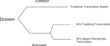
The study hospital, SWCHSC, is considering a system that incorporates speech recognition technology and electronic signatures. The proposed Continuous Speech Recognition technology, unlike past speech recognition technologies that required users to speak word-by-word, is able to recognize speech spoken at a natural speed (4). The software manufacturer estimates that 50 percent of physicians will be able to use the technology effectively. Physicians not using the technology would continue using traditional transcriptionists. A schematic representation of the automated system as described above can be found in Figure 1. Authorized health-care providers would be able to access the discharge notes on-line through clinical workstations. All signatures would be generated electronically, regardless of transcription method. The final documents would be sent by means of e-mail or e-fax to those family physicians who agreed to this distribution format. Regular mail would be used for the remainder of the family physicians. The final electronically signed document is saved in the computerized patient medical record and is considered the official patient medical document.

A schematic representation of the two medication documentation systems.
The proposed implementation plan would occur over a 2-year period in two stages. In the initial stage, 50 physicians would participate in a pilot program. If successful, the remaining 350 physicians would participate. In this study, the first phase is considered successful; therefore, the full implementation schedule was accounted for in the costing analysis.
METHODS
A systematic review of the literature was carried out. The literature was searched using MEDLINE, PUBMED, and CINAHL from 1990 to present, using the following key words: transcription, dictation, medical documentation, electronic patient record, cost-effectiveness, and computerized patient medical records. The current process was documented by interviewing staff in the Centre for Applied Health Informatics (CAHI) and the health records department at SWCHSC. The automated process was documented through interviews with the manufacturer.
Based on 16,295 records of discharge notes from Sunnybrook campus between March 13, 2000, and June 15, 2001, the mean delay time for the current medical documentation system was calculated to be 70 days. The time to produce a signed discharge note in the automated medical documentation system is expected to decrease as a result of reduced transcription times and more intense incentives for physicians to dictate and review notes in a timely manner (with an automatic reminder system). The CAHI estimates that, with the automated notification system, physicians would on average require 10 days for dictation and signature tasks. The manufacturer estimates that roughly 50 percent of the physicians would be able to use the voice recognition technology successfully. Given that only half of traditional transcription services would be required in the automated system, the average transcription time in the automated system is estimated to be 4 days, half of the current time. Therefore, the average length of time between patient discharge and final note completion is estimated to be 14 days in the automated system, which is the sum of physician time (10 days) and transcriptionist time (4 days).
The time horizon for this study was 4 years (2003 to 2006), which is the lower bound of Asset Depreciation Range (ADR) Life for computer equipment (6). The lower bound of the ADR Life was chosen because voice recognition technology is an emerging technology and is rapidly evolving (4). All amounts are expressed in 2003 Canadian dollars. It was assumed that the annual costs were incurred at the beginning of each year. Therefore, the costs of Year 1 were not discounted. Subsequent years (2004–2006) were discounted at 3 percent (3). Annual note volume, as it pertains to the outcome measure, was discounted for years 2004–2006 at 3 percent (3).
Cost Estimates
The cost categories considered for the current system were maintenance, transcription wages, notification, and distribution costs. Maintenance costs included on-going hardware costs, service contracts, and Information Technology personnel. Notification costs were based on the percentage of time (accounted for through wages) that Health Records staff spends to create notification lists and filing. Postage, photocopying, and printing costs were included in the distribution costs.
The cost categories considered for the automated system were hardware, licensing, maintenance, infrastructure, and the residual distribution and transcription costs. There were no training costs associated with the automated system because the change is considered transparent to physicians. Physicians will follow the same dictation process as in the current system and will not require training on the e-signature component of the automated system as e-signatures are used in a variety of hospital applications. The notification cost is eliminated as this function is automated under the new system. Infrastructure costs include software.
Cost-Effectiveness Analysis
A cost-effectiveness analysis was performed. This method is used when there is one unambiguous outcome from the intervention(s) and, therefore, a clear dimension along which effectiveness can be assessed (3). The relevant outcome identified in the two alternative medical documentation systems was the average length of time (delay) between patient discharge and completion of final note per discharge. CAHI staff maintains that outcomes such as accuracy level and length of transcribed note are achieved to the same extent for both systems.
To compare the cost-effectiveness of the two alternatives, the incremental cost-effectiveness ratio (ICER) was defined to be the “incremental cost per average day of delay avoided per discharge.” This measures how much more (or less) the automated medical documentation system costs to shorten the time between patient discharge and discharge note completion by 1 day, per discharge note. The annual discharge volume for 2002–2003 was 16,297. An annual 1 percent increase was assumed over the 4-year study period.
A series of one-way sensitivity analyses were conducted to test the robustness of the results. The factors varied in the sensitivity analysis were discount rate, annual note (discharge) volume, user percentage of the voice recognition system, percentage of notes requiring postage, length of the estimated delay in note completion using automated system, and the length of the study. Calculations were performed using Microsoft Excel software.
RESULTS
Base Case
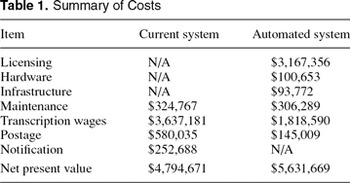
The net present value (NPV) of each cost component for each alternative (Licensing, Hardware, Infrastructure, Maintenance, Transcriptionists' wages, Postage, and Notification) was calculated over the 4-year time horizon, as shown in the rows of Table 1. The total NPV for each alternative (in Canadian [CDN] $) over the 4-year time horizon was obtained by summing all the components as shown in the final row of the table. The total NPVs for the current medical documentation system and the automated medical documentation system were $4,344,664 (CDN) and $5,519,168 (CDN), respectively.

The ICER is the ratio of the difference in NPV costs between the two documentation systems to the difference in outcomes, defined as the average time (delay) to document completion per discharge note. The total NPV cost difference between the two alternatives was $1,174,503 (CDN). Given the average note completion time of 70 days in the current documentation system, and the estimated 14 days in the automated medical documentation system, the difference in average time (delay) to document completion between the two alternatives was calculated to be 56 days. Dividing $1,174,503 (CDN) by 56 days yielded an incremental cost per day of note completion time avoided of $20,973 for all discharge notes in the hospital. Further dividing this value by the total number of discounted discharge notes over the study period, 62,378, yielded an ICER of $0.331(CDN). The ICER represents the incremental cost per average day of delay avoided per discharge.
The ICER suggests that, although the automated documentation system costs more, it improves outcomes. If the hospital is willing to spend 33.1 cents per discharge (in 2003 CDN $), the average time of note completion per discharge would be decreased on average by one day.
Sensitivity Analysis
The factors varied in the sensitivity analysis and their effects are presented below. The numbers in parentheses are the base-case value.
The discount rate (3 percent) was varied between 0 percent and 5 percent. Accordingly, the ICER changed from $0.313 to $0.343. A large portion of the costs within the automated system occurs in the first 2 years, whereas the costs of the current system are spread over all years. Consequently, the higher the discount rate, the less attractive the automated documentation system became.
The annual discharge note volume (16,297 in 2003, with an estimated 1 percent increase per year) was increased and decreased by 3 percent per year, based on CAHI estimates. The ICER varied between $0.322 and $0.341. As the note volume varies, reflecting changes in discharge volume trends, both the numerator and denominator of the ICER change. Because the number of the notes is directly linked to the postage costs of the alternatives, the distribution costs and, therefore, the NPV of both alternatives increase. However, the current system requires more postage than the automated system, resulting in a more significant increase in the NPV of the cost of the current system compared with the automated system. Consequently, the difference between the NPV of the two documentation systems (numerator of the ICER) decreases. Conversely, the denominator of the ICER increases as the number of discharges is increased. The simultaneous effect of a decrease in the numerator and increase in the denominator of the ICER would result in a lower ICER.
The percentage of physicians using the voice recognition system (50 percent) varied between 25 percent and 75 percent. The ICER varied between $0.588 and $0.075. As physician utilization increases, fewer transcriptionists are required to transcribe documents in the automated system, reducing transcription costs drastically. Once the utilization became greater than 82.3 percent, the automated system became dominant, that is, both less costly and more effective.
As the percentage of notes requiring postage in the automated system (25 percent) was varied between 0 percent and 50 percent, the ICER varied between $0.322 and $0.340. This trend is explained by lower postage and administration costs when using the e-fax capabilities of the automated documentation system. Therefore, the automated system becomes less attractive as the percentage of notes requiring postage increases.
The length of study (4 years) was varied between 2 and 6 years and had a large impact on the ICER. The ICER varied between $1.236 and $0.034. If the study was increased to greater than 6 years, the automated system would become dominant, that is, both less costly and more effective. This trend occurred due to discounting and that the majority of costs for the automated system occurred in Year 1 of the study.
DISCUSSION
This is the first cost-effectiveness analysis of automation in medical documentation for in-patient notes in an entire hospital. The base-case result was that the automated system was more expensive but also more effective than the current system.
Whereas the ICER shows the incremental cost for decreasing the note completion time by an average of 1 day, in practice, SWCHSC would not experience a single day decrease for a typical note. From the perspective of the hospital, there are only two alternatives, the current system with an average of 70 days and the automated system with an estimated of 14 days in note completion time. Furthermore, although the ICER is a per discharge note measure, it may also be used for other types of notes in the hospital such as consultation records, operative reports, and so on, and thereby increasing the system value. SWCHSC would either choose to fully implement the automated system, or maintain the current system. Although the ICER may not be intuitive to the administrative decision-maker, the measure is useful for comparisons with other capital investments with a “cost per patient per day” criterion.
There are some limitations to the study. Possible wage increases were not considered. It was assumed that the hardware and software costs as quoted by the manufacturer of the automated system would not change in the second stage of implementation (Year 2004).
There are benefits to the automated medical documentation system that could not be quantified and were not considered in our analysis. These benefits would make the automated alternative more attractive, although not necessarily less costly than the current system. The automated alternative would be able to generate status reports of all medical documentation automatically, that is, the number of documents requiring dictation, transcription, or signature, all in real time. The hospital's Medical Advisory Committee would be able to better control the medical documentation process, because automatic tracking mechanisms for the dictation, editing, and signature duties would be available. Furthermore, in the automated medical documentation plan, data would be available on a timely basis and easily accessible to support managerial decisions. More importantly, these data would be obtained from a single source.
CONCLUSION
The automated medical documentation system, although it reduces document completion time, is more costly relative to a traditional transcription–dictation system. This result was found to be sensitive to the useful length of the documentation system and the proportion of physicians able to use voice recognition technology. Moreover, certain nonquantifiable benefits of the automated medical documentation system not captured in the cost-effectiveness analysis may make the automation alternative more favorable to the hospital.
Although the results of this study are intended for the use of the Centre for Applied Health Informatics at Sunnybrook and Women's College Health Sciences Center, the results may be of interest to any similar health-care organization that is considering automation in medical documentation. Factors such as variations in clinical practice, relative costs, and population values may limit the generality of the study results. This study was conducted at a publicly funded Canadian hospital. In private health-care systems, physicians and hospital administrators may have greater incentive for faster document turn-around time, namely for billing purposes, when compared with Canada; therefore, the automated alternative may be more attractive in such settings.
CONTACT INFORMATION
Renata Kopach, BASc, MASc (kopach@mie.utoronto.ca), Somayeh Sadat, BSc, MASc (sadat@mie.utoronto.ca), Ian D. Gallaway, MEng, Graduate Student (igallawy@kpmg.ca), Department of Mechanical and Industrial Engineering, University of Toronto, 5 King's College Road, Toronto, Ontario M5S 3G8, Canada
Glen Geiger, MD, MASc, Assistant Professor (glen.geiger@sw.ca), Department of Medicine, University of Toronto, Toronto, Ontario M5S 1A1, Canada; Director of Clinical Information Systems, Department of Medicine, Sunnybrook and Women's College Health Science Centre, 2075 Bayview Avenue, Toronto, Ontario M4N 3M5, Canada
Wendy J. Ungar, MSc, PhD, Assistant Professor (wendy.ungar@sickkids.ca), Department of Health Policy, Management and Evaluation, University of Toronto, McMurrich Building, 2nd Floor, 12 Queen's Park Crescent West, Toronto, Ontario M5S 1A8, Canada; Scientist, Population Health Sciences, The Hospital for Sick Children, 555 University Avenue, Toronto, Ontario M5G 1X8, Canada
Peter C. Coyte, PhD, Professor of Health Economics (peter.coyte@utoronto.ca), Department of Health Policy, Management and Evaluation, University of Toronto, McMurrich Building, 2nd Floor, 12 Queen's Park Crescent West, Toronto, Ontario M5S 1A8, Canada
The work reported in this study was performed by Ian Gallaway, Renata Kopach, and Somayeh Sadat under the supervision of Drs. Geiger, Ungar, and Coyte. The authors are grateful to the staff of the Centre for Applied Health Informatics at Sunnybrook & Women's College Health Sciences Centre (SWCHSC) for their enormous help, especially Yaron Derman and Cathy Wong. Dr. Geiger is funded by SWCHSC Innovation Fund grant. Dr. Ungar is supported by a New Investigator Career Award from the Canadian Institutes of Health Research (CIHR). Dr. Coyte is supported by funds from the Canadian Institutes of Health Research, the Canadian Health Services Research Foundation and the Ontario Ministry of Health and Long Term Care for his Chair in Health Care Settings and Canadians. The views expressed are those of the authors and do not reflect the opinion of any institution or funding agency.
References
Ball MJ.
1995.
Healthcare information management systems: A practical guide.
2nd ed.
New York:
Springer-Verlag;
Chan SY,
Ohlmann J,
Dunbar S, et al.
2002
Operations research methods applied to workflow in a medical records department.
Health Care Manag Sci.
5:
191–
199.Google Scholar
Drummond MF.
1997.
Methods for the economic evaluation of health care programmes.
2nd ed.
New York:
Oxford University Press;
Henricks WH,
Roumina K,
Skilton BE,
Ozan DJ,
Goss GR.
2002
The utility and cost effectiveness of voice recognition technology in surgical pathology.
Mod Pathol.
15:
565–
571.Google Scholar
Leland T,
Blank AJ.
1989.
Engineering economics.
New York:
McGraw-Hill;
van Walraven C,
Laupacis A,
Seth R,
Wells G.
1999
Dictated versus database-generated discharge summaries: A randomized clinical trial.
Canad Med Assoc J.
160:
319–
326.Google Scholar
Zafar A,
Overhage JM,
McDonald CJ.
1999
Continuous speech recognition for clinicians.
J Am Med Inform Assoc.
6:
195–
204.Google Scholar
A schematic representation of the two medication documentation systems.
Summary of Costs
 You have
Access
- 5
- Cited by