Introduction
The 6 million Americans who care for family or friends with cancer are an essential component of the healthcare system (Kent et al., Reference Kent, Mollica and Buckenmaier2019). Caregivers support patients in all aspects of care and play a key role in advanced care planning (ACP) discussions. Such discussions impact critical outcomes, including prognostic awareness, psychopathology, timely hospice referrals, and the use of aggressive treatments near death (Nilsson et al., Reference Nilsson, Maciejewski and Zhang2009; Detering et al., Reference Detering, Hancock and Reade2010; Temel et al., Reference Temel, Greer and Muzikansky2010; Wright et al., Reference Wright, Mack and Kritek2010). Despite benefits, 52–79% of patients have no ACP documented before death (Connors et al., Reference Connors, Dawson and Desbiens1995; Heyland et al., Reference Heyland, Barwich and Pichora2013). Discussing ACP is difficult and made more difficult by distress (Kaplowitz et al., Reference Kaplowitz, Campo and Chiu2002; Marwit and Datson, Reference Marwit and Datson2002; Siminoff et al., Reference Siminoff, Zyzanski and Rose2008). Families often expect healthcare providers (HCPs) to initiate conversations; however, HCPs frequently avoid discussing ACP (Levin et al., Reference Levin, Moreno and Silvester2010) or delay it until it is too late (Heyland et al., Reference Heyland, Barwich and Pichora2013; You et al., Reference You, Fowler and Heyland2014).
Caregivers are uniquely positioned to broker patient–HCP communication, as they often have more accurate prognostic awareness than patients (Diamond et al., Reference Diamond, Prigerson and Correa2017) and manage a range of demanding responsibilities in decision-making, treatment, and care (AARP National Alliance for Caregiving, 2016). Assisting caregivers with communication and providing them with training to engage confidently in ACP discussions is likely more effective than HCP training alone. Interventions that address communication between patients and caregivers exist (Northouse et al., Reference Northouse, Katapodi and Song2010; Applebaum and Breitbart, Reference Applebaum and Breitbart2013), but have primarily focused on enhancing social support (Scott et al., Reference Scott, Halford and Ward2004; Northouse et al., Reference Northouse, Kershaw and Mood2005; Given et al., Reference Given, Given and Sikorskii2006; Campbell et al., Reference Campbell, Keefe and Scipio2007; Budin et al., Reference Budin, Hoskins and Haber2008; Baucom et al., Reference Baucom, Porter and Kirby2009; Lyon et al., Reference Lyon, Jacobs and Briggs2014; Bernacki et al., Reference Bernacki, Hutchings and Vick2015). To the research team's knowledge, no interventions have been studied to date addressing communication between caregivers and patients’ HCP.
Caregivers of patients with glioblastoma multiforme (GBM) and other malignant gliomas represent a group in urgent need of communication skills. These highly aggressive, devastating neurologic diseases are characterized by headaches, seizures, and deterioration of physical and cognitive function. Even with initial optimal treatment including radiation, surgery, and/or chemotherapy to reduce tumor burden, nearly all malignant gliomas recur (Wen and Kesari, Reference Wen and Kesari2008). Personality changes, mood disturbances, and cognitive limitations are unavoidable and make the provision of care particularly challenging (Salander, Reference Salander1996; Catt et al., Reference Catt, Chalmers and Fallowfield2008), requiring that caregivers quickly take over responsibility for healthcare communication. As such, optimal outcomes for patients may depend on caregivers’ ability to initiate difficult, yet necessary, ACP discussions.
To date, no intervention has specifically provided caregivers with training to improve their skills and confidence as collaborators with both patients and HCPs and, later, as healthcare proxies. The objective of this study was to develop and pilot test a brief communication training to equip caregivers of patients with malignant gliomas with the skills necessary to initiate and successfully navigate challenging ACP conversations.
Method
Development of training
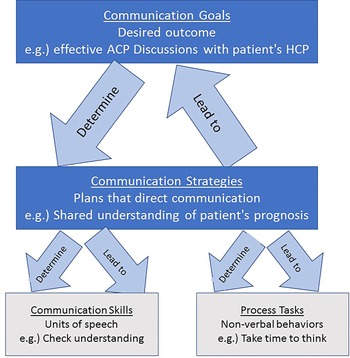
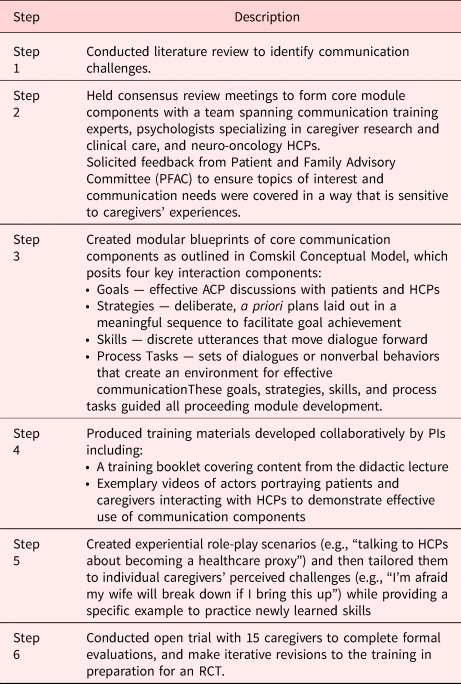
A team of psychologists and neuro-oncologists collaborated with the Memorial Sloan Kettering Cancer Center Communication Skills Training and Research Program (Comskil) to create training materials for two modules to address communication challenges identified through literature review and clinical experience of the team. The modules were established through six steps (Brown et al., Reference Brown, Bylund and Gueguen2010) outlined in Table 1 and designed after the core communication components in the Comskil Conceptual Model (Figure 1).
Core communication components in the comskil conceptual model.

Processes used to establish caregiver-specific communication modules

HCPs, healthcare professionals; ACP, advanced care planning; RCT, randomized controlled trial.
Participants
Participants were recruited through physician referral from the MSK Brain Tumor Center and were self-reported current caregivers to a patient with a malignant glioma, fluent in English and age ≥18.
Procedures and measures
Eligible and interested caregivers provided informed consent. Participants completed a demographic and pre-training questionnaire at baseline and a training evaluation one day post-training. All participants were asked if they would be willing to complete an optional 45-minute interview 2 months post-training via Webex.
-
Demographic information (Lichtenthal et al., Reference Lichtenthal, Corner and Sweeney2015). Demographic data including gender, race, ethnicity, socioeconomic status, religion, relationship to patient, and caregiving duration were assessed.
-
Comskil Pre-Training Evaluation (Brown et al., Reference Brown, Bylund and Gueguen2010; Lubrano et al., Reference Lubrano, Brown and Gueguen2010). Following standard Comskil practice, an anonymous survey was sent electronically one week pre-training which asked two questions about confidence in discussing ACP with loved ones and HCPs. Questions were rated on a five-point Likert scale, anchored at (1) “strongly disagree” and (5) “strongly agree.”
-
Comskil Module Post-Training Evaluation (Brown et al., Reference Brown, Bylund and Gueguen2010; Lubrano et al., Reference Lubrano, Brown and Gueguen2010). This anonymous form evaluated participants’ perceptions of training modules and was sent electronically one day post-training. The questions were rated on a five-point Likert scale anchored at (1) “strongly disagree” and (5) “strongly agree.”
-
Qualitative Interview. A 45-minute semi-structured interview guide evaluated participants’ reactions to the training, including the impact of training on engagement in ACP discussions, confidence in engaging in discussions, and areas of refinement.
Intervention
Originally designed to be delivered in-person prior to the COVID-19 pandemic, the Communication Training took place virtually via Zoom and included two modules: (1) ACP Discussions with your Loved One and (2) ACP Discussions with the Medical Team. Training included a 15-minute lecture and 90 min of role-play exercises where caregivers practiced skills with actors trained to portray patients and HCPs. Realistic scenarios were created and tailored to caregivers’ reported concerns, which is standard practice in Comskil (Bylund et al., Reference Bylund, Brown and Bialer2011; Kissane et al., Reference Kissane, Bylund and Banerjee2012; Pehrson et al., Reference Pehrson, Banerjee and Manna2016). For example, caregivers specified unique challenges, such as “My husband gets really angry when I try to bring this up,” and actors were coached to portray the angry husband. After role-plays, caregivers set a SMART (Doran, Reference Doran1981) (Specific, Measurable, Attainable, Relevant, and Time-bound) goal related to ACP conversations to motivate and direct behavior change (Locke and Latham, Reference Locke and Latham2006). Post-training, caregivers received example documents frequently used in carrying out ACP (e.g., DNR/DNI and healthcare proxy forms) to facilitate discussions. Two weeks post-training, study staff called caregivers to evaluate progress toward SMART goals and review skills as needed.
Analytic plan
Sample characteristics were summarized using descriptive statistics. A priori feasibility benchmarks were the ability to recruit 15 caregivers within 12 months and a training completion rate of 10 out of 15 caregivers. Measurement of acceptability was guided by the Kirkpatrick Model, which proposes four assessment levels for evaluating the impact of trainings (Kirkpatrick, Reference Kirkpatrick and Craig1967). Acceptability (Level 1) was assessed via satisfaction on the Comskil Module Evaluation Form. Results were analyzed descriptively and mean item scores ≥4 were deemed acceptable.
Interviews were audio-recorded, transcribed, and analyzed using thematic content analysis. Transcripts were reviewed independently by the coding team (Memorial Sloan Kettering Cancer Center) to identify key feedback, reach consensus on conceptual findings, and identify recurrent themes, which were then refined in a consensus meeting with the PI (Memorial Sloan Kettering Cancer Center).
Results
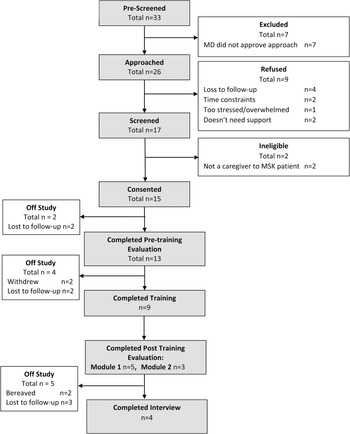
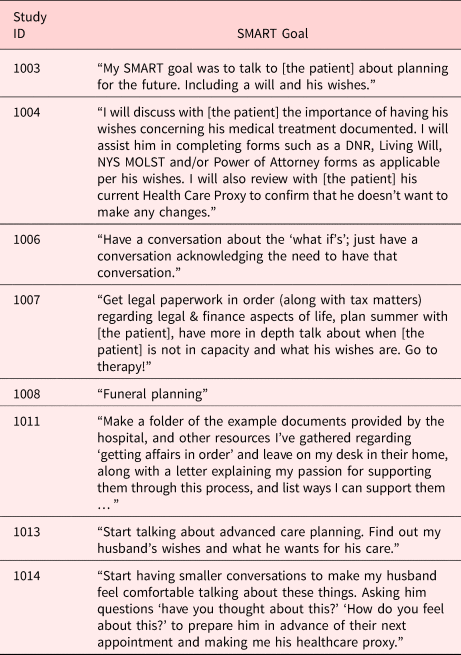
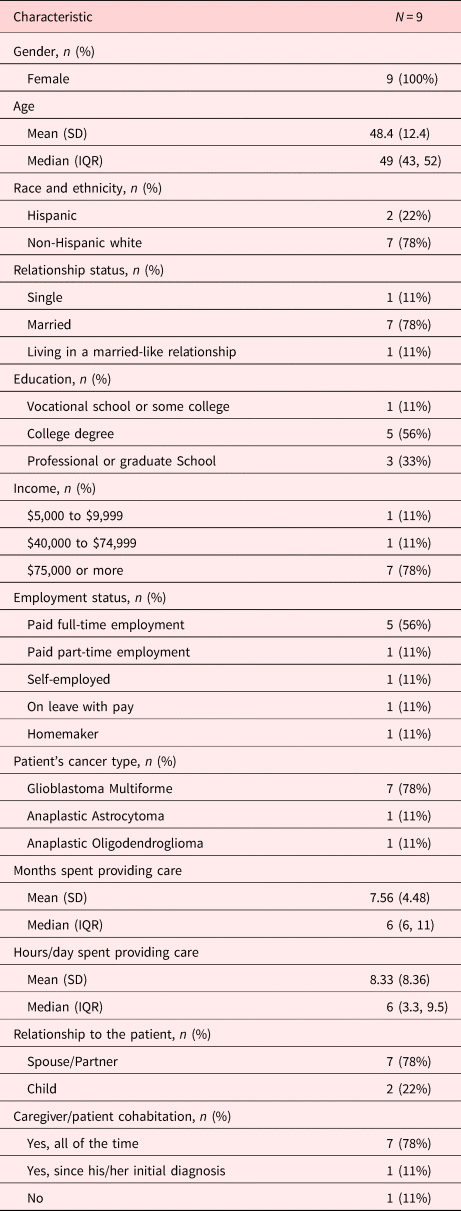
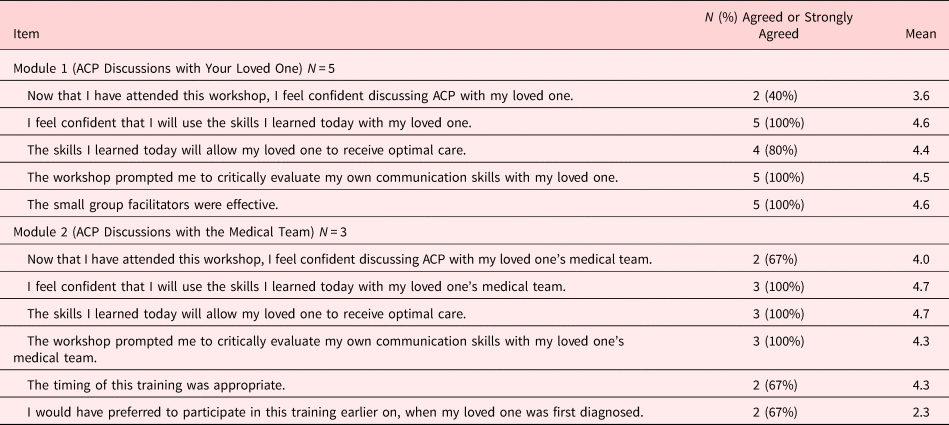
Over 12 months, 15 caregivers enrolled, 9 of whom participated in one of five trainings; 4 completed the qualitative interview (Figure 2). Of these, 8 submitted SMART goals (Table 2). Participant demographic and medical characteristics are presented in Table 3. Pre-training, 62% reported “mixed feelings” regarding confidence in discussing ACP with their loved ones (n = 8, M = 2.92), and 77% (n = 10, M = 4.0) reported confidence in discussing ACP with HCPs. Post-training, five participants completed the anonymous survey evaluating Module 1 (ACP Discussions with Your Loved One), and three for Module 2 (ACP Discussions with the Medical Team) (Table 4). Most felt confident that they would use skills learned with their loved one and HCPs and indicated that these skills would help their loved one receive optimal care. Most agreed that the timing of the training was appropriate and two shared additional feedback (i.e., one suggested setting SMART goals before concluding the training day as opposed to after, and one requested resources to help prepare for future caregiving responsibilities).
Consort diagram.

Participant specific, measurable, attainable, relevant, and time-bound (SMART) goals

Characteristics of participants who completed trainings

SD, standard deviation; IQR, interquartile range.
Module 1 (ACP Discussions with Your Loved One) and module 2 (ACP Discussions with the Medical Team) evaluation responses

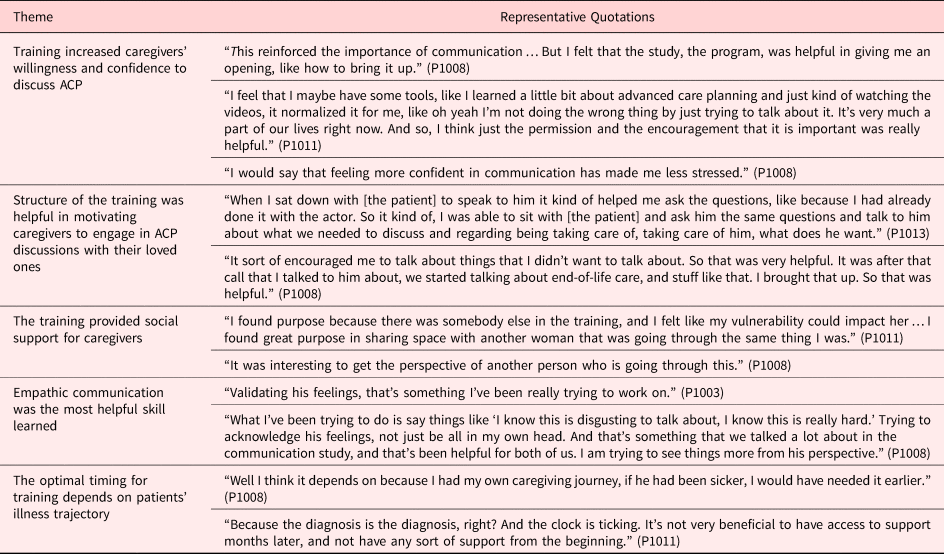
Four caregivers participated in in-depth interviews from which five key themes emerged (Table 5): (1) The training increased caregivers’ willingness and confidence to discuss ACP. (2) The structure and components (i.e., didactic presentation, role-play, and follow-up call) of the training were helpful in promoting ACP discussions. (3) The training provided social support. (4) Empathic communication was the most helpful skill learned. (5) The optimal timing for training depends on patients’ illness trajectories.
Key themes from qualitative interviews (n = 4)

ACP, advanced care planning.
Discussion
We developed a communication training for caregivers to promote ACP discussions and evaluated its feasibility and acceptability. Despite occurring during the initial year of the COVID-19 pandemic, recruitment was feasible as 15 caregivers of 33 screened enrolled in 1 year, consistent with previous studies (Diamond et al., Reference Diamond, Prigerson and Correa2017; Smith et al., Reference Smith, Martin and Chewning2018) and the investigative team's recruitment goals. Nine caregivers attended the training, a completion rate (60%) that is slightly lower than our target of 67%, though likely a reflection of the well-documented challenges caregivers face in utilizing psychosocial support in addition to the unique challenges imposed by the pandemic.
The adoption of communication skills helped caregivers feel more willing to open ACP discussions, a shift that was underscored by participants’ SMART goals (Table 2). It is unsurprising that not all participants reported overall confidence in engaging in ACP discussions with patients post-training; such discussions are emotionally difficult and, in most cases, must be repeated throughout the illness journey. In terms of the impact of training on communication with HCPs, caregivers reported confidence in engaging in such discussions and making use of the specific skills taught.
There was mixed feedback regarding timing of the training. On average, training occurred 8 months into participants’ caregiving journeys, long after patients’ initial diagnoses. It is likely that earlier delivery of the training could help caregivers navigate treatment planning in advance of being required to assume responsibility for healthcare communication. This desire to provide communication skills earlier, however, must be balanced with sensitivity to the emotional devastation of newly diagnosed families. As malignant gliomas can be aggressive, with most patients dying within 9 months of recurrence (Wen and Kesari, Reference Wen and Kesari2008), caregivers may benefit from receiving the training closer to the patient's initial diagnosis, though only after they have had time to adjust to such life-altering news.
In-depth interviews highlighted a particular benefit of training in empathic communication skills, which caregivers felt would be particularly helpful in navigating discussions with loved ones. Role-play scenarios provided the opportunity to practice these skills and verbalize specific empathic statements in advance of doing so with loved ones. Additionally, caregivers shared that participation helped them feel less isolated. While not an explicit goal of the training, the program brought caregivers together and created a sense of community among participants. This added value can be fostered in future trainings with larger groups of caregivers and follow-up sessions with continued opportunity for connection. While engaging caregivers for in-person appointments is often challenging, telemedicine removes many barriers to care (e.g., transportation, coverage for patient's care) and makes the possibility of larger groups more feasible.
Limitations and future directions
This study had several limitations. The small and sociodemographically limited sample of predominantly White, non-Hispanic, and high socioeconomic status participants limits generalizability of findings. Our data are also limited by the relatively low completion rate of post-training evaluations, which may reflect the heavy burden of caregiving for a patient with a malignant glioma. Additionally, anonymous evaluations precluded the ability to perform pre-post data analyses or associations with participant characteristics; however, it also supports validity of evaluations by reducing demand characteristics. Future trainings should evaluate the feasibility, acceptability, and efficacy of the training in larger, more diverse samples.
Our novel communication training intervention promotes ACP by equipping caregivers with vital skills to maneuver difficult, but crucial conversations. As a next step, we will evaluate the efficacy of this training through a fully powered randomized controlled trial with caregivers of patients with malignant gliomas, and then subsequently among caregivers of patients with a variety of cancers. As all caregivers can benefit from the skills taught in this training, our goal is to refine this program to be beneficial to as many caregivers as possible.
Conflicts of interest
Dr. Applebaum receives funding from Blue Note Therapeutics. Dr. Diamond discloses unpaid editorial support from Pfizer Inc and serves on an advisory board for Day One Therapeutics and Springworks Therapeutics, both outside the submitted work.
Data sharing
Participants did not agree for their data to be shared publicly. Individual requests for data sharing will need to be approved by the Memorial Sloan Kettering Cancer Center IRB.