INTRODUCTION
Morphological awareness refers to the capacity to reflect on the morphological structure of complex words or deliberately and consciously manipulate that structure in some way. Although morphological awareness has been shown to predict literacy development across languages (e.g. Deacon, Kieffer & Laroche, Reference Deacon, Kieffer and Laroche2014; Lam, Chen, Geva, Luo & Li, Reference Lam, Chen, Geva, Luo and Li2012; Schiff, Schwartz-Nahshon & Nagar, Reference Schiff, Schwartz-Nahshon and Nagar2011), very little is currently known about how it develops in any particular language, including Chinese. The primary goal of the present study was to examine the role of several factors (word semantic relatedness, phonology, and orthography) in the development of morphological awareness in school-age Mandarin-speaking Chinese children using an oral morphological judgment task. Moreover, it is at present not completely clear whether morphological awareness contributes to reading comprehension in Chinese after controlling for other reading-related variables, including phonological processing skills, character naming, and vocabulary. To address this issue, the second goal of the present study was to examine the relationship between morphological awareness, measured with the oral morphological judgment task, and reading comprehension in Chinese children across Grades 2, 4, and 6.
Morphemes and morphology in Mandarin Chinese
The central concept in morphology is the morpheme, the smallest meaningful or consistently occurring element in a language. Morphemes are understood as abstract mental categories, while their physical realizations in words or sentences are referred to as morphs. Morphemes may be instantiated in speech as one or more morphs (which are referred to as allomorphs). For instance, the Standard English morpheme marking the third person singular present indicative active {-s3SG} is represented by the default morph /z/ (as in goes), but can also occur in words as /s/ (puts) or /ɪz/ (crushes). On the other hand, the English morpheme {cat} has only a single allomorph, /kæt/. Morpheme-to-allomorph relationships are important because they determine how morphologically transparent or opaque a language is, which, in turn, may influence the development of morphological awareness in children.
There is a vast amount of variation in morphological structure across languages. Languages such as Japanese or Hungarian tend to have long multimorphemic words in which each morph roughly corresponds to a single morpheme. Others, such as Russian, feature multimorphemic words in which a single morph often represents multiple morphemes, as well as the other way around. With some exceptions, mostly due to syllable reduction, assimilation, and tone sandhi, Mandarin Chinese morphemes are represented in speech by a single morph, while the converse is not the case. Most Mandarin morphemes are monosyllabic (e.g. 山 shān ‘mountain’), but there are also morphemes consisting of more than one syllable (蚯蚓 qīuyǐn ‘earthworm’) as well as a single subsyllabic morpheme (儿 /ɻ/, ‘DIMINUTIVE’). While most Chinese characters represent a single morpheme and single syllable, there are also characters that represent homonymous morphemes (华 huá ‘Chinese’, ‘magnificent’) or submorphemic syllables (葡 pú ‘∅’) and characters that represent homographic heterophonic morphemes (少 shǎo ‘few’ or shào ‘young’). Unlike Classical Chinese, which was very strongly morphologically isolating, with most of its words being monomorphemic (Branner, Reference Branner, Garry, Galvez and Rubino2001) and also monosyllabic (Arcodia, Reference Arcodia, Montermini, Boyé and Hathout2007), contemporary Mandarin Chinese has evolved into a language with mostly disyllabic words (Lin, Reference Lin2001). Most modern Mandarin Chinese words, over 75%, are compounds (Kuo & Anderson, Reference Kuo and Anderson2006; Sun, Sun, Huang, Li & Xing, Reference Sun, Sun, Huang, Li, Xing, Luo and Yuan1996), of which more than 70% are bimorphemic (Institute of Language Teaching and Research, 1986).
The fact that Chinese morphemes do not tend to have allomorphs contributes to the formal transparency of Chinese compounds. It is occasionally remarked that there is a general tendency among Chinese compounds toward semantic transparency (e.g. Yuan & Huang, Reference Yuan and Huang1998, but see Zhou & Marslen-Wilson, Reference Zhou and Marslen-Wilson2000, for an opposing view). According to an analysis of the corpus of the Modern Chinese Dictionary (Li, Reference Li2012), 93% of Chinese compounds are semantically transparent to some degree. It bears noting, though, that both transparent (水瓶 shuǐpíng ‘water + bottle’ = ‘water bottle’) and non-transparent compounds (马上 mǎshàng ‘horse + up’ = ‘immediately’) exist. The fact that Chinese has been evolving in the direction of making its syllables ever shorter and structurally simpler has resulted in a vast number of homophones, both among morphemes and among words (e.g. 终 zhōng ‘end’ and 钟 zhōng ‘clock’; 点 diǎn ‘point’: 终点 zhōngdiǎn ‘destination’ and 钟点 zhōngdiǎn ‘clock’). In fact, 68·5% of the approximately 1,300 Mandarin syllables serve as morphs for more than one morpheme (Tang, Reference Tang1995). It is easy to see how this prevalence of homophones will inevitably lead to ambiguity in spoken word recognition and difficulty in the acquisition of literacy, countering the effect of the general lack of allomorphy.
The development of morphological awareness
Children become aware of morphological structure in the preschool years (Carlisle, Reference Carlisle and Feldman1995; Hao, Chen, Dronjic, Shu & Anderson, Reference Hao, Chen, Dronjic, Shu and Anderson2013), and this awareness significantly increases with the onset of literacy and formal education. Morphological awareness emerges gradually; the ability to identify morphemes in a word develops before the ability to reflect on the meanings of morphemes, while the ability to comment on the grammatical implications and distributional properties of morphemes emerges even later, if at all (Carlisle & Fleming, Reference Carlisle and Fleming2003; Tyler & Nagy, Reference Tyler and Nagy1989). At the present time, our understanding of the development of children's morphological awareness in Chinese is only piecemeal, mostly because past studies that have measured morphological awareness tended to include participants of a single age, and were not conducted with the development of morphological awareness in Chinese as their main focus. One early exception is Ku and Anderson's (Reference Ku and Anderson2003) cross-sectional study with multiple cohorts, which investigated the awareness of compound and derivational morphology in Chinese and American children from elementary Grade 2 to Grade 6. Ku and Anderson's participants were required to recognize the morphological structure of words and identify morpheme meanings in the written modality. The findings indicated that both Chinese and American children's morphological awareness improved considerably from Grade 2 to Grade 6.
A limitation of Ku and Anderson (Reference Ku and Anderson2003) is that the study did not examine the factors that may impact the development of morphological awareness in Chinese children. The nature of the Chinese language and orthography dictates that certain skills will be particularly valuable in identifying morphemes (Li, Anderson, Nagy & Zhang, Reference Li, Anderson, Nagy, Zhang, Li, Gaffney and Packard2002; Shu & Anderson, Reference Shu and Anderson1997; McBride-Chang, Shu, Zhou, Wat & Wagner, Reference McBride-Chang, Shu, Zhou, Wat and Wagner2003; Shu, McBride-Chang, Wu & Liu, Reference Shu, McBride-Chang, Wu and Liu2006). Due to the prevalence of homophonous morphemes, it is crucial to distinguish among various morphemes that sound the same. Moreover, because characters can be represented by different morphemes, Chinese children have to be able to identify which out of a group of homographic morphemes is present in any given word (compare this to the case of English sows meaning ‘places seeds in the soil’ versus ‘female pigs’). Additionally, two skills can be expected to further contribute to the development of morphological awareness across languages. Shared morphemes are easier to identify in pairs of words that are closely semantically related, that is, it is easier to decide whether teacher and teaching share a morpheme than whether partner and partial do (e.g. Hao, Chen, Dronjic, Shu & Anderson, Reference Hao, Chen, Dronjic, Shu and Anderson2013, for awareness; also, for on-line processing, Gonnerman, Seidenberg & Andersen, Reference Gonnerman, Seidenberg and Andersen2007). Finally, due to the pervasiveness of synonyms across languages, the ability to identify different morphemes with shared meanings (e.g. {free} and {liber} in freedom and liberty) should also contribute to overall morphological awareness.
In order to examine how morphological awareness develops in the spoken language, Hao et al. (Reference Hao, Chen, Dronjic, Shu and Anderson2013) conducted a two-experiment study with young Chinese children. The first, cross-sectional, experiment measured morphological awareness at three kindergarten levels (mean ages 3;10, 5;0, and 5;10). In the second, longitudinal experiment, two groups of children were tested twice, in the second semester of Grades 1 and 2 (mean ages 6;4 and 7;3) and again in the first semester of Grades 2 and 3 (mean ages 6;11 and 7;10). Both experiments required the children to judge whether the first homophonous syllable in orally presented disyllabic bimorphemic compounds represented the same morpheme or different morphemes (e.g. 门铃 mén líng ‘doorbell’ and 门票 mén piào ‘ticket’ share a morpheme, whereas 风扇 fēng shàn ‘fan’ and 蜂蜜 fēng mì ‘honey’ feature homophonous morphemes). Whole-compound semantic relatedness (closely vs. distantly related) was manipulated. The most notable finding was that even the youngest participants (3;0) had a rudimentary form of morphological awareness, but that awareness improved dramatically with age. Whole-word semantic relatedness was the deciding factor in the younger participants’ ability to discriminate between homophonous morphemes, indicating initial difficulty with distinguishing between word- and morpheme-level meanings. Although this distinction became more robust with age, children still had an easier time judging semantically closely related words as late as Grade 3.
Building on Hao et al. (Reference Hao, Chen, Dronjic, Shu and Anderson2013), the present study represents a further effort to understand the development of morphological awareness in Chinese children. We adopted a morphological judgment task similar to that used in Hao et al. Apart from focusing on whole-word semantic relatedness, our study also included the factors of morpheme identity (same or different morpheme), phonology (same or different), and orthography (same or different). Thus, across the different experimental conditions of the task, we examined the effects of whole-word semantic relatedness, morpheme identity, homophone, and homograph on children's performance. Furthermore, this study went beyond the age range of Hao et al. and featured participants at three mean ages, 7;3 (Grade 2), 9;4 (Grade 4), and 11;4 (Grade 6). Finally, in order to confirm the impact of word knowledge and orthography on morphological awareness, we used separate measures of character naming and vocabulary knowledge to predict children's performance on the morphological judgment task across the three grades.
Morphological awareness and reading comprehension in Chinese
The second purpose of the present study was to examine whether morphological awareness is related to reading comprehension in Chinese. Morphological awareness is known to be positively associated with such core literacy-related constructs as vocabulary, word reading, and, most relevantly for the present study, reading comprehension in languages represented with alphabetic scripts and with abjads (e.g. Arabic and Hebrew), as well as in Chinese, which has a morphosyllabic script (McBride-Chang et al., Reference McBride-Chang, Shu, Zhou, Wat and Wagner2003; Nagy, Berninger, Abbot, Vaughan & Vermeulen, Reference Nagy, Berninger, Abbott, Vaughan and Vermeulen2003; Ravid & Bar-On, Reference Ravid and Bar-On2005; Saiegh-Haddad & Geva, Reference Saiegh-Haddad and Geva2008) because it is a complex construct that draws on phonology, orthography, semantics, and syntax (Carlisle, Reference Carlisle and Feldman1995, Reference Carlisle2000; Singson, Mahony & Mann, Reference Singson, Mahony and Mann2000). This predictive ability is also long-lasting, as morphological awareness continues to improve for a long period of time (Berninger, Abbott, Nagy & Carlisle, Reference Berninger, Abbott, Nagy and Carlisle2010; Nagy, Berninger & Abbott, Reference Nagy, Berninger and Abbott2006; Nagy & Scott, Reference Nagy, Scott, Kamil, Mosenthal, Pearson and Barr2000). While the overlap of morphological awareness with other predictors of reading, especially vocabulary knowledge and word reading, means that morphological awareness may predict a relatively small amount of unique variance in reading comprehension scores, it also renders morphological awareness particularly suitable for literacy-boosting interventions (Bowers, Kirby & Deacon, Reference Bowers, Kirby and Deacon2010; Goodwin & Ahn, Reference Goodwin and Ahn2013; Nagy, Carlisle & Goodwin, Reference Nagy, Carlisle and Goodwin2013).
Morphological awareness is particularly important in reading Chinese because the Chinese script emphasizes the syllable, which is most often co-extensive with the morpheme. Moreover, due to the prevalence of homonyms in Chinese, and the fact that Chinese characters can stand for different morphemes, a successful reader must be able to identify which out of a group of homophonic or homographic morphemes is present in any given word. Reflecting the preference for compounding in the Chinese lexicon, most existing studies of morphological awareness in Chinese children have focused on compounds, and compound awareness has consistently been demonstrated to be a predictor of Chinese reading (e.g. Chen, Hao, Geva, Zhu & Shu, Reference Chen, Hao, Geva, Zhu and Shu2009; Chung & Hu, Reference Chung and Hu2007; McBride-Chang, Cheung, Chow, Chow & Choi, Reference McBride-Chang, Cheung, Chow, Chow and Choi2006; Shu et al., Reference Shu, McBride-Chang, Wu and Liu2006). Notably, a number of studies that have reported a direct contribution of morphological awareness to Chinese reading comprehension did not include word reading as a control variable. Two studies that featured word or character reading as a variable showed that morphological awareness was a predictor of word reading, which itself was then a predictor of comprehension (McBride-Chang, Shu, Ng, Meng & Penney, Reference McBride-Chang, Shu, Ng, Meng, Penney, Wagner, Muse and Tannenbaum2007; Yeung et al., Reference Yeung, Ho, Chik, Lo, Luan, Chan and Chung2011). However, Chik and colleagues (Reference Chik, Ho, Yeung, Wong, Chan, Chung and Lo2012b) found that, for normally developing children, morphological awareness (the ability to dissociate semantics from morphology when making judgments about synonymous words) and morphosyntactic awareness (the ability to supply a missing word in a sentence) were significant predictors of reading comprehension even after word reading had been accounted for.
The present study sought to clarify the relationship between morphological awareness and reading comprehension by measuring morphological awareness with the oral morphological judgment task described in the previous section. This novel task provides a comprehensive indicator of morphological awareness as it considers the effects of whole-word semantic relatedness, morpheme identity, phonology, and orthography on children's performance. With participants in Grades 2, 4, and 6, we were able to examine the relationship between morphological awareness and reading comprehension in beginning readers who are learning to read, children in the transitional stage, and children who are reading to learn. Finally, the present study included phonological awareness, rapid naming, vocabulary, and Chinese character reading as control variables in the regressions. This design enabled us to ascertain whether morphological awareness can make a unique contribution to reading comprehension after substantive controls.
METHOD
Participants
The participants were 413 children from a primary school in a working-class neighborhood in the Shanxi province in China. Specifically, the participants consisted of 130 children (59 males) in Grade 2, 135 children (79 males) in Grade 4, and 148 children (74 males) in Grade 6. Their mean ages were 7;3, 9;4, and 11;4, respectively. None of the children had a known cognitive or developmental disability. All students were native speakers of Chinese. The average level of maternal education was high school.
Measures and procedure
A battery of measures including morphological judgment, phonological awareness, rapid number naming, character naming, vocabulary knowledge, and reading comprehension were administered to the children in the fall semester. Among them, morphological judgment and reading comprehension were given to whole classes simultaneously, whereas the other measures were administered individually. All measures were administered by trained experimenters who were university students majoring in psychology or education.
Morphological judgment
The morphological judgment task was partially modeled after the task in Hao and colleagues’ (2013) study. In each item, a pair of compound words was orally presented and children were asked to judge whether the first morphemes of the two words had the same meaning. Participants were then asked to circle “yes” or “no” for each item on an answer sheet. In total, there were 32 items in the “YES” condition and 32 items in the “NO” condition, with 4 different types of items within each condition. The test items from different conditions were mixed together and presented in a randomized order. All the words were familiar to the children in the spoken language. The task was recorded by a native speaker of Mandarin and played to whole classes simultaneously. The reliability (Cronbach's α) of the task was .76. The items are presented in the ‘Appendix’.
In the “YES” condition, the items adopted a 2 (First morpheme: Same (M+) vs. Different (M–)) × 2 (Semantic Relatedness: High (S+) vs. Low (S–)) design, with eight items in each cell. In the Same Morpheme and High Semantic Relatedness items (M+S+), the two words had the same first morpheme and the words were also closely related in meaning as whole words, for instance 夜晚 yè wǎn ‘evening’ and 夜间 yè jiān ‘night’. In the Different Morpheme and High Semantic Relatedness items (M–S+), the two words had different first morphemes but they were synonyms and the words were closely related in meaning as whole words, for instance 饭店 fàn diàn ‘restaurant’ and 餐厅 cān tīng ‘dining hall’. In the Same Morpheme and Low Semantic Relatedness items (M+S–), the two words had the same first morpheme but they were distant in meaning as whole words, for instance 火箭 huǒ jiàn ‘fire + arrow’ = ‘rocket’ and 火山 huǒ shān ‘fire + mountain’ = ‘volcano’. Finally, in the Different Morpheme and Low Semantic Relatedness items (M–S–), the two words had synonymous first morphemes and were distant in meaning as whole words, for instance 乌鸦 wū yā ‘black + bird’ = ‘crow’ and 黑板 hēi bǎn ‘blackboard’. Because the task required the children to judge whether the first morpheme in each item had the same meaning, the correct answer to all four types of items described above was “yes”.
In the “NO” condition, the items adopted a 2 (Orthography: Same (O+) vs. Different (O–)) × 2 (Phonology: Same (P+) vs. Different (P–)) design, with eight items in each cell. Thus, there were four types of items in total. In the Same Orthography and Same Phonology items (O+P+), the first morphemes of the two words had the same orthographic and phonological forms but different meanings, for instance 面包 miàn bāo ‘bread’ and 面孔 miàn kǒng ‘face’. In other words, the target morphemes were homographs and homophones. In the Different Orthography and Same Phonology items (O–P+), the target morphemes were homophones but not homographs: they had different orthographic forms but the same phonological form, for instance 高兴 gāo xìng ‘happy’ and 糕点 gāo diǎn ‘cake’. In the Same Orthography and Different Phonology items (O+P–), the target morphemes were homographs, but not homophones: They had the same orthographic form but different phonological forms, for instance 大海 dà hǎi ‘sea’ and 大夫 dài fū ‘doctor’. Finally, in the Different Orthography and Different Phonology items (O–P–), the target morphemes shared neither orthographic nor phonological forms, for instance 海鲜 hǎi xiān ‘seafood’ and 答案 dá àn ‘answer’. Notably, all of the items in this condition had different meanings in the first morpheme. Therefore, the correct answer to all the items was “no”.
Semantic relatedness of whole words
A group of twenty-three psychology majors at Beijing Normal University evaluated the semantic relatedness of the 64 word pairs on a 5-point scale where 1 = extremely low semantic relatedness and 5 = extremely high semantic relatedness. For the 32 items in the “YES” condition, the average rating was 3·72 (SD = ·40) for the items of high semantic relatedness, and 1·06 (SD = ·10) for the items of low semantic relatedness. The difference between the two types of items was highly significant (F(1,22) = 1069, p < ·001, η p 2 = ·980). For the 32 items in the “NO” condition, the average rating was 1·01 (SD = ·03). It did not differ significantly from the average rating of the items in the low semantic relatedness items in the “YES” condition.
Semantic similarity of first morphemes
The semantic similarity of the first morphemes in each word pair was evaluated by nineteen graduate or undergraduate students at Beijing Normal University on a 5-point scale, where 1 = semantically very different and 5 = semantically very similar. The average rating of the items in the “YES” and “NO” conditions was 4·26 (SD = ·36) and 1·25 (SD = ·19), respectively. The difference between these two conditions was highly significant (F(1,18) = 1029, p < ·001, η p 2 = ·983).
Item familiarity
Familiarity of the words was rated by twelve teachers, with four teachers from the second, fourth, and sixth grades respectively. The items were rated on a 5-point scale, where 1 = extremely unfamiliar and 5 = extremely familiar. The average ratings of the words for the “YES” and “NO” conditions were 4·65 (SD = ·30) and 4·62 (SD = ·39), respectively. The difference between the two types of items was not significant (F(1,11) = 0·931, p = ·356). The average ratings of all words for G2, G4, and G6 were 4·43 (SD = ·44), 4·66 (SD = ·33), and 4·82 (SD = ·18), respectively. The differences among the three graders were not significant (F(2,11) = 1·365, p = ·304), suggesting that the items were highly familiar to children across all three grades.
Character familiarity
Although the task was presented orally, the orthographic form of the morpheme could affect children's judgment. Thus, the familiarity of the character that corresponds to each morpheme used in this task was also rated by the same twelve teachers on a 5-point scale, where 1 = extremely unfamiliar and 5 = extremely familiar. The average ratings of characters for “YES” responses and “NO” responses were 4·67 (SD = ·28) and 4·58 (SD = ·33), respectively. The difference between the two types of items was not significant (F(1,11) = 4·023, p = ·070). The average ratings of all characters for G2, G4, and G6 were 4·45 (SD = ·24), 4·64 (SD = ·39), and 4·79 (SD = ·19), respectively. The differences among the three grades were not significant (F(2,11) = 1·405, p = ·294). Again, the target morphemes corresponded to characters that were highly familiar to children across the three grades.
Other measures
Phonological awareness
Children's phonological awareness was tested with a phoneme deletion task. In the task, children were asked to produce a new syllable by taking away the target phoneme from a monosyllabic Chinese word. For example, children were asked to delete the /tʂh/ from the syllable /tʂha˥˥/, and the answer was /a˥˥/. After 4 practice items there were 12 test items, including 4 initial, middle, and last phoneme deletion items respectively.
Rapid automatized naming (RAN)
It was measured using the digit naming test as in previous research (e.g. Shu et al., Reference Shu, McBride-Chang, Wu and Liu2006). In this task, five digits, 1, 3, 4, 5, and 8, were repeated five times in a randomized order on a single sheet of paper. Children were asked to name the five rows of digits as accurately and rapidly as possible. Time in seconds was recorded. Each child named the list twice, and the mean score was based on the average naming time across the two trials.
Character naming
This task consisted of 150 single characters with increasing difficulty (Li, Shu, McBride-Chang, Liu & Peng, Reference Li, Shu, McBride-Chang, Liu and Peng2012). Children were asked to read from the beginning and stop when they failed to read fifteen consecutive items.
Vocabulary knowledge
A vocabulary definition task was used to assess children's vocabulary knowledge (e.g. Lei et al., Reference Lei, Pan, Liu, McBride-Chang, Li, Zhang, Chen, Tardif, Liang, Zhang and Shu2011). Children were asked to provide definitions to words that were orally presented to them by the tester. Children's responses were recorded and rated by two trained psychology students as follows: 2 points were allotted for the best answer, that is, a response that fairly completely expressed the meaning of the word, for instance, a place for cooking for the target word kitchen; 1 point was given for a response that partially explained the meaning of the word, for instance, a place at home; and 0 points were given for a totally unrelated answer, for instance, go to play for the target word kitchen. The task contained one practice item and thirty-two test items. The test items were listed in the order of increasing difficulty and testing stopped when children gave 0-point responses for five consecutive items.
Reading comprehension
The participants were asked to read one passage and answer multiple-choice or open-ended questions. There was one narrative passage, Prince Nezha Conquers the Dragon King, and eighteen multiple-choice questions for second-graders. This passage was chosen from a Chinese reading ability scale that was age appropriate for second-grade Chinese students (Mo, Reference Mo2004) and had been used by previous studies (Cheng et al., Reference Cheng, Zhang, Li, Wu, Liu, Dong, Li, Nguyen, Zheng, Zhao and Sun2016). The reliability (Cronbach's α) for the current sample was .71. Reading comprehension tests for fourth- and sixth-graders were selected from the Chinese subtest of the Progress in the International Reading Literacy Study (PIRLS) 2006. The test for Grade 4 contained the passage Dolphin Rescue (Grover & Fowler, Reference Grover and Fowler1996), seven multiple-choice questions and four open-ended questions. The test for Grade 6 comprised the passage Spacewalking (Ride & Okie, Reference Ride and Okie1991), five multiple-choice questions and ten open-ended questions. Scoring of the open-ended items followed the publicly available scoring guides. Each multiple-choice question was worth 1 point. Constructed response questions were worth 1, 2, or 3 points, depending on the depth of understanding and the extent of textual support questions required. The maximum score for Grade 4 and Grade 6 was 15 and 17, respectively. Two raters practiced scoring answers collected in a pilot study, and reached consensus on how to apply the scoring guide. Then the two raters independently scored all constructed-response items. The average inter-rater reliability of the reading comprehension measure for Grade 4 and Grade 6 was .85 and .91, respectively.
RESULTS
Table 1 shows the means and standard deviations of the items across the different conditions in the morphological judgment task. Notably, the children's performance was below chance level in all three grades when word semantic relatedness was low, regardless of whether the first morpheme was the same (ps < ·05). Their performance on the other six conditions was significantly above chance (ps < ·001). Table 2 presents the descriptive statistics for the other cognitive and reading measures given to the participants. All the measures are presented in raw scores, with the exception of rapid number naming, which was calculated in seconds. Generally speaking, performance on all the measures improved with grade level. The distribution of the phonological awareness measure was negatively skewed, while all the other variables were approximately normally distributed with no floor or ceiling effects. With respect to the regression analysis, transformation of the phonological awareness task did not lead to different results. Consequently, only results based on raw scores are reported.
Means and standard deviations (SD) of the items in the “YES” and “NO” conditions in the morphological judgment measure

note s: M+S+, Same Morpheme and High Semantic Relatedness; M+S–, Same Morpheme and Low Semantic Relatedness; M–S+, Different Morpheme and High Semantic Relatedness; M–S–, Different Morpheme and Low Semantic Relatedness; O+P+, Same Orthography and Same Phonology; O–P+, Different Orthography and Same Phonology; O+P–, Same Orthography and Different Phonology; O–P–, Different Orthography and Different Phonology.
Means and standard deviations of all measures for Grade 2, Grade 4, and Grade 6

notes: a In seconds; *** p < ·001.
Performance on the morphological judgment task
The numbers of correct responses across the four “YES” conditions were subjected to a repeated-measures analysis of variance (ANOVA) with grade level (grade: Grade 2, Grade 4, and Grade 6) as a between-subjects factor, morpheme identity (same vs. different) and word semantic relatedness (high vs. low) as within-subjects factors. We found a significant effect of grade (F(2,410) = 50·965, p < ·001, η p 2 = ·199). Performance improved with grade (all ps < ·01). Morpheme identity also had a significant effect (F(1,410) = 20·235, p < ·001, η p 2 = ·047). The correct “YES” response for the same first morpheme condition was higher than that for the different first morpheme condition. We also observed a significant main effect of word sematic relatedness (F(1,410) = 2507, p < ·001, η p 2 = ·859). Children's performance under the high semantic relatedness condition was significantly better than that under the low semantic relatedness condition.
Interestingly, several significant two-way interactions were observed. As displayed in Figure 1, the interaction between word sematic relatedness and grade was also significant (F(2,410) = 4·784, p < ·01, η p 2 = ·023). Further analysis showed that when whole-word semantic relatedness was high, the sixth-graders performed better than the fourth-graders, who, in turn, outperformed the second-graders (all ps < ·001). But under the low semantic relatedness condition, only the sixth-graders were better than the fourth-graders (p < ·001). The difference between the fourth- and second-graders was not significant (p = ·61).
Mean number of items correct as a function of grade and word semantic relatedness in the “YES” condition.

The interaction between morpheme identity and grade level was significant (F(2,410) = 10·298, p < ·001, η p 2 = ·048) (see Figure 2). The second-graders performed significantly better under the same first morpheme condition than the different first morpheme condition (F(1,410) = 30·97, p < ·001, η p 2 = ·156). The difference between these two conditions was also significant for the fourth-graders (F(1,410) = 7·35, p < ·01, η p 2 = ·051), but not for the sixth-graders (F(1,410) = 0·48, p = . 49, η p 2 = ·005). In other words, the effect of the type of the first morpheme decreased across grade levels.
Mean number of items correct as a function of grade and type of first morpheme in the “YES” condition.

Finally, the interaction between morpheme identity and word sematic relatedness was not significant (F(1,410) = 0·457, p = .499, η p 2 = ·001). The three-way interaction among morpheme identity, word sematic relatedness, and grade was not significant either (F(2,410) = 0·503, p = ·605, η p 2 = ·002).
The numbers of correct responses across the four “NO” conditions were subjected to a repeated-measures analysis of variance (ANOVA) with grade level (Grade 2, Grade 4, and Grade 6) as a between-subjects factor, orthographic form (same vs. different) and phonological form (same vs. different) as within-subjects factors.
There was a significant main effect of grade (F(2,410) = 54·444, p < ·001, η p 2 = ·210). The performance of the second-graders was lower than that of the fourth- and sixth-graders (all ps < ·001), while the difference between the fourth- and sixth-graders was not significant (p = ·43). The effect of phonological form was significant (F(1,410) = 172·312, p < ·001, η p 2 = ·296). Thus, it was harder for the children to determine that two first morphemes in a pair of words had different meanings when they shared a pronunciation. We also observed a significant main effect of orthographic form (F(1,410) = 44·188, p < ·001, η p 2 = ·097). When the first morphemes in a pair of words were represented by the same character, it was more difficult for the children to decide that the meanings of the morphemes were different.
Aside from significant main effects, all of the two-way interactions were significant. The interaction between phonological form and grade was significant (F(2,410) = 15·106, p < ·001, η p 2 = ·069) (see Figure 3). The second-graders performed significantly better when the phonological forms of the two first morphemes were different than when they were the same (F(1,410) = 137·85, p < ·001, η p 2 = ·354). Differences were also observed between the two conditions for the fourth-graders (F(1,410) = 34·47, p < ·001, η p 2 = ·281) and the sixth-graders (F(1,410) = 24·79, p < ·001, η p 2 = ·258). However, the difference was larger in the second-graders than that in the other two grades, suggesting that it was more difficult for the second-graders to determine that two first morphemes had different meanings when they shared the same pronunciation than the fourth- and sixth-graders.
Mean number of items correct as a function of grade and phonological form in the “NO” condition.

The interaction between orthography and grade was significant (F(2,410) = 21·692, p < ·001, η p 2 = ·096), as shown in Figure 4. Further analysis showed that for the second-graders, the performance was significantly better when the first morphemes were represented by a different character than when they were represented by the same character (F(1,410) = 79·46, p < ·001, η p 2 = ·288). The difference between these two conditions was also significant for the fourth-graders (F(1,410) = 4·39, p < ·05, η p 2 = ·022), but not for the sixth-graders (F(1,410) = 0·20, p = ·651, η p 2 = ·003).
Mean number of items correct as a function of grade and orthographic form in the “NO” condition.

The interaction between phonological and orthographic forms was also significant (F(1,410) = 8·667, p = .003, η p 2 = ·021). When the first morphemes had the same pronunciation, the difference between the two orthographic conditions was smaller than that when the first morphemes had different pronunciations. Finally, the three-way interaction among phonological form, orthographic form, and grade was not significant (F(2,410) = 0·570, p = .566, η p 2 = ·03).
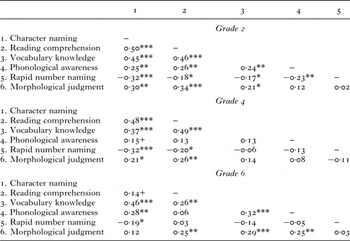
Table 3 shows the inter-correlations among all measures included in the study, for the three grade levels respectively. In Grade 2, all variables were moderately correlated with reading comprehension. In Grade 4, phonological awareness was not significantly correlated with reading comprehension, probably due to a ceiling effect on the measure. The correlations between reading comprehension and all of the other measures were significant in this grade. In Grade 6, only the vocabulary and morphological judgment measures were significantly correlated with reading comprehension. The correlation between the morphological judgment task and reading comprehension was (r = ·34, p < ·001 for Grade 2; r = ·26, p < ·01 for Grade 4; and r = ·25, p < ·01 for Grade 6).
Intercorrelations among different measurers for Grade 2, Grade 4, and Grade 6

notes: + p < .1; * p < ·05; ** p < ·01; *** p < ·001.
Predictors of performance on the morphological judgment task
To assess the contribution of character naming and vocabulary knowledge to performance on the morphological judgment task, a hierarchical regression was calculated for each group. In each of the analyses, age was entered as the first step, while character naming and vocabulary knowledge were entered together in the second step. The results are summarized in Table 4.
Unique variance (R2) in performance of Morpheme judgment explained by individual difference in Character naming and Vocabulary knowledge

notes: * p < ·05; ** p < ·01; *** p < ·001.
In Grades 2, 4, and 6, character naming and vocabulary knowledge together predicted 9%, 5%, and 8% of the morphological judgment task scores, respectively. In Grades 2 and 4, character naming was a unique predictor (t = 2·67, p < ·01 and t = 2·03, p < ·05). In Grade 6, on the other hand, vocabulary knowledge was the only unique predictor of morphological awareness (t = 3·28, p < ·01).
Predictors of reading comprehension
To assess the contribution of morphological judgment to reading comprehension across the three grade levels, a hierarchical regression was calculated for each group. In each regression analysis, children's age was entered in the first step, while character naming, vocabulary knowledge, phonological awareness, and rapid number naming were entered together in the second step, and morphological judgment was entered in the third and final step. The results for the three grades are summarized in Table 5.
Unique variance (R2) in performance of Reading comprehension explained by individual difference in Morpheme judgment

notes: * p < ·05; ** p < ·01; *** p < ·001.
In Grade 2, character naming and vocabulary knowledge were unique predictors (t = 3·38, p < ·01 and t = 3·09, p < ·01, respectively). Notably, morphological judgment, entered in the final step, predicted 3% of the unique variance (t = 2·39, p < ·05). The model explained 36% of the variance in reading comprehension. A similar pattern of results was observed in Grade 4. Character naming and vocabulary knowledge were two significant unique predictors of reading comprehension (t = 3·63, p < ·001 and t = 4·51, p < ·001, respectively). Morphological judgment still explained 2% of the unique variance when entered in the last step (t = 2·01, p < ·05). In total, the model explained 37% of the variance. In Grade 6, only vocabulary knowledge and morphological judgment were unique predictors of reading comprehension (t = 2·18, p < ·05 and t = 2·36, p < ·05, respectively), with the latter explaining 4% of the variance in the last step. The model explained 11% of the variance in reading comprehension.
DISCUSSION
Factors that influence the development of morphological awareness
Consistent with Hao and colleagues’ (2013) study, the present study demonstrated a predominant effect of word semantic relatedness on Chinese children's development of morphological awareness. As expected, in the high word semantic relatedness condition (e.g. 夜晚 yè wǎn ‘evening’ and 夜间 yè jiān ‘night’), children's performance was high and increased significantly with grade, ranging from 78% in Grade 2 to 93% in Grade 6. Thus, similarity in word meaning facilitated understanding of morpheme meaning. However, when word semantic relatedness was low (e.g. 火箭 huǒ jiàn ‘fire + arrow’ = ‘rocket’ and 火山 huǒ shān ‘fire + mountain’ = ‘volcano’), children performed below chance level in all three grades. Thus, even children in Grade 6 were not able to avoid the distraction of word meaning to focus exclusively on morpheme meaning. Although the sixth-graders performed significantly better than the second- and fourth-graders in this condition, thus providing preliminary evidence of conscious morphological decomposition, this finding must be interpreted with caution as the former group still scored significantly below chance level.
Notably, the developmental pattern observed in the present study is somewhat different from that reported by Hao and colleagues (Reference Hao, Chen, Dronjic, Shu and Anderson2013). In that study, children in the low word semantic relatedness condition performed significantly at or above chance in the early primary grades (Grades 1–3). The difference between the high and low word semantic relatedness conditions was further reduced with age and grade level. The different patterns between the two studies may result from different task demands. Hao and colleagues employed a homophone detection task in which children were asked to differentiate between word pairs that shared a morpheme. Since the target morpheme(s) in each pair always had the same pronunciation, children's performance was inflated in the “YES” condition, on both high and low word semantic relatedness items, and depressed in the “NO” condition, which consisted of fillers and was not reported in Hao and colleagues’ paper. However, the same strategy would not have worked in the present study because half of the target morphemes had different pronunciations. Thus, compared to Hao and colleagues, the present study may present a more realistic estimate of children's performance in the low whole-word semantic relatedness condition, paralleling Gonnerman and colleagues’ (2007) finding that high versus low semantic relatedness can have the effect of encouraging or discouraging the real-time identification of shared morphological constituents between words in adult morphological processing. The finding that children performed consistently below chance level in this condition suggests that they made decisions based on item properties, rather than guessing.
A novel factor that was examined in the present study was first morpheme identity (same vs. synonymous morphemes). Consistent with our expectations, children were more effective in judging that the first morphemes of a pair of words had the same meaning when they were exactly the same, for instance 夜晚 yè wǎn ‘evening’ and 夜间 yè jiān ‘night’, than when they were synonymous, for instance 饭店 fàn diàn ‘restaurant’ and 餐厅 cān tīng ‘dining hall’. This finding indicates that shared phonological and orthographic forms facilitate morphological decomposition. Importantly, a significant interaction was observed between first morpheme identity and grade level. It seems that with the increase of grade level, children were better able to focus on morpheme meaning despite different phonological and orthographic forms. By Grade 6, children performed equally well regardless of whether the first morphemes were the same or synonymous. The effects of phonological and orthographic forms on the development of morphological awareness will be discussed separately below as we look at the “NO” condition.
As mentioned earlier, Chinese is a language with extraordinarily high homophone density (e.g. Chen & Pasquarella, Reference Chen, Pasquarella, Verhoeven and Perfettiin press; Duanmu, Reference Duanmu2007). One syllable on average corresponds to five morphemes (Shu, Reference Shu2003). As such, it is challenging for Chinese children to distinguish among homophonous morphemes (Shu, Chen, Anderson, Wu & Xuan, Reference Shu, Chen, Anderson, Wu and Xuan2003). This is confirmed by children's performance on the morphological judgment task in the present study. It was easier to determine that two morphemes had different meanings when they also had different pronunciations, for instance 海鲜 hǎi xiān ‘seafood’ and 答案 dá àn ‘answer’, than when they were homophones, for instance 高兴 gāo xìng ‘happy’ and 糕点 gāo diǎn ‘cake’. Notably, the difference between the two conditions was smaller in Grades 4 and 6 than in Grade 2. In other words, homophone interference was the largest among the youngest children. Before they learn to read, children rely entirely on morpheme meaning (only deducible in context) to differentiate among homophones, which is not an easy task as their vocabulary is also limited at this time. Learning to read enables children to map morphemes onto characters. As a result, character knowledge provides additional cues for homophone differentiation, such as in the case of 高 gāo ‘lofty’ and 糕 gāo ‘pastry’. Probably due to the high homophone density, the ability to differentiate homophones develops gradually, as demonstrated by the finding that the difference between the two conditions was still significant in Grade 6.
We also examined the effect of orthography on morpheme identification in the present study. Although the morphological judgment task was presented orally, we were interested to see whether children's decisions were influenced by the orthographic forms of morphemes. As we predicted, children were more likely to judge that two morphemes had different meanings when they were represented by different characters, for instance 高兴 gāo xìng ‘happy’ and 糕点 gāo diǎn ‘cake’, than when they were homographs, for instance 面包 miàn bāo ‘bread’ and 面孔 miàn kǒng ‘face’. Moreover, the difference between the two conditions was significant in Grades 2 and 4, but not in Grade 6. These findings demonstrate that character knowledge is related to morphological development. As children become more experienced readers, they have more opportunities to encounter homographs in reading. Thus, they are better able to understand that two morphemes may have different meanings, despite sharing the same orthographic form. It seems that, by Grade 6, Chinese children have mastered the ability to differentiate homographs, at least at this frequency level.
The results of the regression predicting the performance on the morphological judgment task from character reading and vocabulary further confirm the importance of these two factors in the development of Chinese children's morphological awareness. Character reading was a significant predictor of morphological judgment in Grades 2 and 4. Learning to read helps children develop a more sophisticated understanding of the relationships among morpheme meaning, pronunciation, and its orthographic representation in print. Since morphology by its nature exists at the intersection of several language domains, that is, semantics, syntax, phonology, and orthography, it is unsurprising that increased mastery of or accessibility to one of these domains would contribute to strengthened performance on morphological tasks.
Contrary to the foregoing, performance on the vocabulary test was the only unique predictor of performance on the morphological judgment task in Grade 6. This is likely a reflection of the relative difficulty of the vocabulary task, which consisted of definitions, thus requiring considerable depth of lexical knowledge and well-developed meta-cognitive skills. The finding that character naming, an orthographic ability, was no longer predictive of morphological judgment performance in Grade 6, taken together with the fact that orthographic similarity present in the stimuli no longer played a role in the kind of morphological judgment task used in the present study, reinforces the notion that the role of orthography in Chinese children's morphological awareness diminishes at this age.
The contribution of morphological awareness to reading comprehension
As a construct, morphological awareness shares characteristics with phonological and orthographic awareness (since morphemes have an auditory and written form), syntactic awareness (the morphological structure of words is often conditioned by syntactic context), and semantic knowledge (morphemes have meanings). It is, therefore, unsurprising that morphological awareness is important for successful reading comprehension. However, due to the similarities between the constructs of morphological awareness and lexical knowledge, and the fact that morphological awareness could be seen as being subsumed within the broader construct of vocabulary knowledge, the question remained whether morphological awareness could uniquely predict reading comprehension. In the present study, performance on the morphological judgment task was associated with reading comprehension at all three ages examined. Notably, the morphological judgment task remained a unique predictor of reading comprehension after controlling for word-level skills and vocabulary knowledge, which are essential for text comprehension.
While previous studies had provided preliminary evidence for the contribution of morphological awareness to reading comprehension (Chik, et al., Reference Chik, Ho, Yeung, Chan, Chung, Luan and Lau2012a; Ku & Anderson, Reference Ku and Anderson2003; Li et al., Reference Li, Anderson, Nagy, Zhang, Li, Gaffney and Packard2002; Li & Wu, Reference Li and Wu2015; Shu et al., Reference Shu, McBride-Chang, Wu and Liu2006; Tong, McBride-Chang, Shu & Wong, Reference Tong, McBride-Chang, Shu and Wong2009; Tong, Tong, Shu, Chan & McBride-Chang, Reference Tong, Tong, Shu, Chan and McBride-Chang2014), the results were not consistent. Two studies that controlled for both word reading and vocabulary failed to detect a unique connection between morphological awareness and reading comprehension (e.g. McBride-Chang et al., Reference McBride-Chang, Shu, Ng, Meng, Penney, Wagner, Muse and Tannenbaum2007; Yeung et al., Reference Yeung, Ho, Chik, Lo, Luan, Chan and Chung2011). One study (Chik et al., Reference Chik, Ho, Yeung, Wong, Chan, Chung and Lo2012b) offered the first preliminary evidence that morphological awareness may be a direct predictor of Chinese reading comprehension. It is therefore noteworthy that, in the present study, morphological awareness explained unique variance in reading comprehension across Grades 2, 4, and 6 after controlling for both word reading skills and vocabulary. These findings expand those of previous research and underscore the critical role of morphological awareness in literacy development in Chinese children.
The reason for lack of consistency in the previous research may be that the majority of the studies used morphological awareness measures that focused on only one dimension of the construct. For example, a commonly administered morphological judgment measure requires children to identify among several words containing homophonous morphemes (e.g. 刮风 guā fēng ‘blow + wind’ = ‘windy’; 蜜蜂 mì fēng ‘honey’ + ‘bee’ = ‘bee’) the one that contains the same morpheme as the target word (风雨 fēng yǔ ‘wind + rain’ = ‘the elements’) (e.g. Li et al., Reference Li, Anderson, Nagy, Zhang, Li, Gaffney and Packard2002; McBride-Chang et al., Reference McBride-Chang, Shu, Zhou, Wat and Wagner2003). A limitation of this task is that the word containing the target morpheme tends to be semantically close to the correct answer (e.g. 刮风 –风雨); as such, the effect of word semantic relatedness is not taken into consideration. A handful of studies adopted morphological awareness measures that assessed children's ability to produce or identify homographs (Li et al., Reference Li2012; Shu et al., Reference Shu, McBride-Chang, Wu and Liu2006). These measures only target homograph awareness, but ignore other aspects such as homophone awareness. Our measure, by considering the effects of word semantic relatedness, morpheme identity, phonology, and orthography simultaneously, provides a comprehensive indicator of children's morphological awareness.
Limitations and future directions
The findings of the present study must be interpreted in light of several caveats. While the primary goal of the present study was to examine the development of morphological awareness in Chinese children, with a cross-sectional design, our results revealed age-related differences in the effects of morpheme identity, whole-word semantic relatedness, phonology, and orthography on performance in a morphological judgment task. These findings need to be confirmed with future studies that adopt a longitudinal design. Second, it bears noting that the morphological awareness measure used in the present study taps the ability to identify morphemes in a compound word, which is a single aspect of morphological awareness. Future research should examine other aspects of morphological awareness, such as awareness of the structure of morphologically complex words. Finally, because standardized reading comprehension measures were not available in Chinese, we used three age-appropriate experimental reading comprehension tests for the three different grades. While the tests demonstrated good reliabilities and reasonable correlations with other variables, test differences made it difficult to compare the relationship between morphological awareness and reading comprehension across the three grades.
Broadly speaking, it should be noted that the findings of this study are based on patterns observed in Mandarin Chinese, a language which heavily favors compounding, features very little derivation and inflection, has relatively short and morphologically simple words, and is written in a morphosyllabic script. It remains for future studies to demonstrate how the developmental trajectory of morphological awareness may differ in languages that feature more morphological complexity and that rely on other kinds of writing systems (syllabaries, abugidas, abjads, and alphabets with various degrees of orthographic depth). Also of note is that morphemes in morphologically rich languages often have multiple allomorphs, some of which may be difficult to recognize as belonging to the same morpheme (e.g. Serbo-Croatian {vod-} ‘lead, guide’ has (among others) the allomorphs vođ- and ves- in vođa ‘leader’ and prevesti ‘translate / lead across’, respectively), which contributes to the opacity of the relationships between morphologically related forms. A further complicating factor is that morphs in many languages can represent multiple morphemes simultaneously, as well as that a single morpheme can be expressed redundantly by multiple morphs in the same word form. Based on the foregoing considerations, it remains an open question whether the balance and relative importance of phonological, orthographic, and semantic factors will be different across languages when it comes to the development of morphological awareness.
CONCLUSION
The present study adds to the current understanding of the development of Chinese children's morphological awareness. We looked at children's ability to distinguish between morpheme and word meanings in Grades 2, 4, and 6 (ages 7;3, 9;4, and 11;4, respectively) and found that at the age of 11;4 children were still improving on this ability. Thus, morphological awareness stands in stark contrast to phonological awareness, which reaches ceiling in children learning to read and write much more rapidly. The investigation of the role of morpheme identity, phonology, and orthography in the development of Chinese children's morphological awareness is a further novel contribution of the present study. In terms of morpheme identity, we found that Chinese children are still experiencing difficulty in detecting synonymous morphemes at ages 7;3 and 9;4, but that they are as good at detecting synonymous morphemes in pairs of words as they are at recognizing a shared morpheme in pairs of words by age 11;4. This study has also demonstrated that the role of phonology in making morphological judgments gradually diminishes in the investigated age range, but continues to be relevant at the age of 11;4. Finally, our results indicate that by Grade 6 and the age of 11;4, children are able to perform the type of morphological awareness task we used in the present study without the interference of orthography. However, it should be noted that our results reflect the developmental patterns of morphological awareness, rather than the precise age when the effect of a certain factor emerges or disappears, as the latter may vary depending on the proficiency of the sample and the difficulty level of the task.
Overall, it is evident even from the scarce existing research on the development of morphological awareness that children's ability to focus on morphology in metalinguistic tasks while ignoring the distractions of word-level semantics, morpheme identity, morpheme type, phonology, and orthography continues to develop throughout elementary school years. As mentioned above, this stands in stark contrast with the developmental trajectory found for phonological awareness. This is not surprising, seeing as aspects of morphological competence, the type of knowledge that morphological awareness directly builds on, still continue to develop in the age range examined in the present study (Clark, Reference Clark, Bowerman and Levinson2001; Jarmulowicz & Taran, Reference Jarmulowicz and Taran2013; Tager-Flusberg & Zukowski, Reference Tager-Flusberg, Zukowski, Gleason and Ratner2009). At the same time, it is important to note that a comprehensive morphological awareness measure that takes various factors into consideration, such as the one used in the present study, makes a unique contribution to reading comprehension throughout the elementary school years after substantive controls.
APPENDIX A
Items in the “yes” condition:
Same Morpheme and High Semantic Relatedness (M+S+)
外语-外文, 天气-天空, 节省-节约, 夜晚-夜间, 月亮-月球, 秋季-秋天, 乡村-乡下, 草地-草坪
Different Morpheme and High Semantic Relatedness (M–S+)
饭店-餐厅, 乘船-坐车, 口腔-嘴巴, 青草-绿叶, 烧鸡-烤鸭, 小孩-幼儿, 足底-脚趾, 切开-割断
Same Morpheme and Low Semantic Relatedness (M+S–)
白发-白鸽, 绿洲-绿豆, 新闻-新年, 手语-手绢, 红灯-红旗, 话题-话筒, 黄豆-黄金, 火箭-火山
Different Morpheme and Low Semantic Relatedness (M–S–)
乌鸦-黑板, 停车-止痛, 等人-待业, 双手-对联, 好人-优美, 寒冬-冷饮, 小狗-微笑, 明天-下回
Items in the “no” condition:
Same Orthography and Same Phonology (O+P+)
面包-面孔, 开关-开水, 表面-表哥, 明年-明星, 快餐-快乐, 值钱-值班, 分开-分数, 安装-安静
Different Orthography and Same Phonology (O–P+)
高兴-糕点, 保温-宝石, 变化-辫子, 比较-笔记, 兵器-冰雹, 明亮-名字, 羊肉-阳台, 蜂蜜-风雨
Same Orthography and Different Phonology (O+P–)
大海-大夫, 调查-调皮, 空调-空白, 好看-好奇, 少年-少数, 种类-种植, 长城-长官, 假期-假货
Different Orthography and Different Phonology (O–P–)
海鲜-答案, 书名-班车, 乌龟-晚会, 白云-炮兵, 滑冰-考试, 真情-角落, 梦乡-毛巾, 电脑-黄花