I. INTRODUCTION
Typical industrial methods of generating molecular hydrogen (H2) rely on high temperature cracking of hydrocarbon fuels, as in steam reforming, with corresponding energy and CO2 costs. Photocatalytic materials have emerged as potential solutions to this problem. Reference Walsh, Ahn, Shet, Huda, Deutsch, Wang, Turner, Wei, Yana and Al-Jassima1 The efficiency of a semiconductor photocatalyst in converting incident light into mobile charge carriers depends on several factors. Firstly, photocarrier production is maximized when the band gap is approximately the same as the energy of the peak number of incident photons, i.e., visible light at energy 2.5 eV—which corresponds to approximately 496 nm wave length, in visible range near the blue–green. Secondly, it is important to separate the exciton pair so as to prevent charge recombination. This is achieved by modifying the electronic band structure so as to increase the zone-centre/edge dispersion (or difference) of the highest occupied (HOMO) or lowest unoccupied (LUMO) states. Greater dispersions reduce the effective mass and thus maximize charge mobility. In particular, TiO2 is the most studied material, both theoretically and experimentally, since its discovery as a photocatalyst. Reference Fujishima and Honda2,Reference Linsebigler, Lu and Yates3 Unfortunately, unmodified TiO2 has a too wide band gap (around 3.1 eV for rutile Reference Tang, Levy, Berger and Schmid4 and 3.3 eV for anatase Reference Tang, Schmid, Lévy and Burri5 ) for visible light photo-catalysis. Therefore, it is highly desirable to lower the band gap from 3.1 eV to around 2.5 eV so as to render photo-catalysis more efficient. Doping with N has been considered (both theoretically and experimentally) as a potential solution. Reference Batzill, Morales and Diebold6,Reference Asahi, Morikawa, Ohwaki, Aoki and Taga7 Recently, a new oxynitride film was obtained through ordinary techniques and consists of a Cmcm group Ti3−δO4N based on N-substitution into the orthorhombic phase of α-Ti3O5 structure. This was reported as the first anionic substitution-based Ti oxynitride in this phase Reference Hyett, Green and Parkin8 and showed higher photocatalytic activity than TiO2. The photocatalytic ability was determined using stearic acid degradation tests with light of wave length 254 nm.
At the theoretical point of view, ab initio simulations, mainly through density functional theory (DFT), Reference Hohenberg and Kohn9,Reference Kohn and Sham10 with exchange-correlation energy functional described within the local density approximation (LDA) or the generalized gradient approximation (GGA), can provide important insights toward a better understanding of photocatalytic mechanism. Reference Wang, Tafen, Lewis, Hong, Manivannan, Zhi, Li and Wu11 However, in many cases, such mechanisms involve dopants, impurities, and defects which make simulations much more demanding due to the need for large super-cells so as to approach experimental concentrations. Reference Onida, Reining and Rubio12 Furthermore, DFT provides an incorrect description of the band gap and excited states. Reference Fiolhais, Nogueira and Marques13 More accurate methods of calculating excited states are currently limited to small systems. Reference Foulkes, Mitas, Needs and Rajagopal14,Reference Onida, Reining and Rubio12 Recently, we have shown that the self-energy correction of band gaps in the LDA–1/2 technique has proven very reliable for the calculation of large systems of the same type, e.g., N-doped rutile TiO2. Reference Ribeiro15,Reference Ribeiro and Shevlin16 We believe that we could succeed now on the characterization of a new system, namely the Cmcm Ti3−δO4N.
II. CALCULATION METHODS AND MODELS
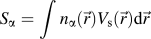
I used the LDA–1/2 technique to calculate the final electronic structures. This takes into consideration of the anion self-energy, in which one proves that
 ${S_\alpha } = \int {{n_\alpha }\left( {\vec r} \right){V_{\rm{s}}}} \left( {\vec r} \right){\rm{d}}\vec r$
, where both V
S, the atomic self-energy potential, and
 ${n_\alpha }\left( {\vec r} \right)$
, the electronic density, belong to the one-particle Kohn–Sham state α. It is possible to show, using Janak's theorem
Reference Janak17
and Slater's half-occupation scheme
Reference Slater and Johnson18
that
 ${V_{\rm{s}}} \cong V\left( {0,r} \right) - V\left( { - {1 \mathord{\left{\vphantom {1 2}} \right\kern-\nulldelimiterspace} /2},r} \right)$
, the difference between the all-electron potentials of the neutral atom and the half-ionized atom. The important detail is that this self-energy potential has a long-range Coulomb tail that strikes through neighboring sites.
Reference Mauro Ribeiro, Fonseca and Ferreira19
To avoid that, V
S needs to be cut by multiplying it by a function whose range is such that the resulting fundamental band gap of the material is at an extreme. Usually, LDA (or GGA) within DFT underestimates the band gaps in semiconductors, so the extreme chosen is a peak. The corrected eigen-values e
α are then obtained from the solution of the usual Kohn–Sham equation with the pseudo-potentials to which we add
 $V_{\rm{s}}^{{\rm{cut}}}$
at each atomic site. The method has been shown to predict band gaps and band offsets with high accuracy,
Reference Ribeiro and Shevlin16,Reference Mauro Ribeiro, Fonseca and Ferreira19–Reference Ribeiro, Fonseca, Sadowski and Ramprasad22
being regarded as a quasi-particle approximation theory. The advantage of the LDA–1/2 technique, specially for the type of system studied in this work, is that the computational cost is similar to that of usual DFT/LDA, making it possible to build large super-cells with hundreds (or even thousands) of atoms, depending on the DFT code used.
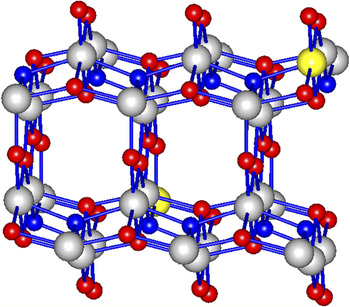
This work was performed using the SIESTA code. Reference Soler, Artacho, Gale, García, Junquera, Ordejón and Sánchez-Portal23 All relaxations were done with the LDA pseudo-potentials, with Ceperley–Alder Reference Ceperley and Alder24 treatment for the exchange and correlation energies. The Ti pseudo-potentials were constructed as [Ar]3d 24s 2, without nonlinear core correction or Ti(3p) electrons as part of the valence. The Brillouin zone was sampled using a 2 × 2 × 2 Monkhorst–Pack scheme Reference Monkhorst and Pack25 for all Ti3−δO4N calculations. The basis set used was the double-zeta plus polarization, with energy shift of 0.02 eV. As the LDA–1/2 technique cannot be used to relax systems, I used experimental values for lattice constants. Our primary Cmcm Ti3−δO4N cell has experimental lattice vectors of 3.80 Å × 9.65 Å × 9.87 Å (very close to the 3.84 Å × 9.85 Å × 10.04 Å lattice parameters as found by relaxation within LDA). A larger 96-atom cell considered for defect calculations consists of a 3 × 1 × 1 Cmcm primary cell. In this particular case, no oxygen or nitrogen atom was removed. Following the experiment, Reference Hyett, Green and Parkin8 I removed a single Ti1 and/or Ti2 atom (see Fig. 1 for details). Here, I labeled the Ti1 and Ti2 as titanium atoms with one or two nitrogen neighbors, respectively. Ti1 and Ti2 occupy Wyckoff positions 4c and 8f, respectively. Let me label Ti ab the defective system, being “a” and “b” the number of Ti1 and Ti2 vacancies, respectively. In this notation, Ti00 is the nonvacant system (perfect Ti3O4N). My procedure was to relax all model structures and compare their electronic structures regarding the Ti10, Ti20, Ti01, Ti02, and Ti11 vacancies. Two Ti vacancies represent 5.6% of Ti positions. I compared the band structures of the Ti3O5 anosovite phase, as well as Ti3O5N. I found a band gap of 2.61 eV within LDA–1/2 for Ti3O5, and 2.75 eV for Ti3O5N, both in gamma point.
“Ball and stick” model structure for the (3 × 1 × 1) Cmcm Ti3O4N. Blue balls for N, red for O, and gray for Ti. Yellow balls represent the positions from where Ti atoms were removed, in each case (see text for details).

A few more words about the LDA–1/2 procedure: just the oxygen and nitrogen p-orbitals self-energies were considered. This is because the technique is based on the electronic states with high self-energies near the band gap, and the self-energy is higher for highly localized states. In most cases, as is the case of Ti3−δO4N material, just the anion is important, because it constitutes the valence band edge, and it is far more localized than the conduction band (CB) edge, which has a negligible self-energy. The O(p) and N(p) self-energy potential tails were cut at 2.9 atomic units. This is necessary to avoid the self-energy function to invade other atom's sites, an effect that would happen upon summation in the infinite crystal. In this work, I have considered non-spin-polarized systems, which is a good approximation, since I did not find any considerable difference in total energy while testing with the spin-polarized case for the smallest super-cell.
III. RESULTS AND DISCUSSION
Table I shows a comparison among calculated and experimental bond lengths. As the LDA–1/2 technique works fine for experimental lattice parameters, I have maintained the cell vectors as found experimentally and relaxed the atomic positions only. Results from Table I show a good agreement in bond lengths, and we can expect a good agreement in bond angles, as a consequence, as lattice vectors were frozen at the experimental values. This runs in favor of our model structure.
Comparison of experimental and calculated (average) bond lengths for different chemical environments. I followed Ref. Reference Hyett, Green and Parkin8 and label O1 and O2 the oxygen atoms with 4 and 3 titanium neighboring atoms, respectively. First column shows the central atom. The lines match the first neighbor atom, if applicable. The experimental values Reference Hyett, Green and Parkin8 are presented in square brackets, for comparison.

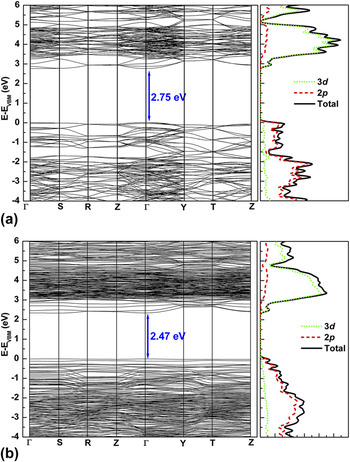
Analyzing the band structures and projected density of states (PDOS) gives us insights to better understand the effects of vacancies. Figure 2 gives us a wider view of the states around the band edges. It shows the combined electronic structure representations (band structure and PDOS) for both Ti00 and Ti11 cases with band gaps of 2.75 and 2.47 eV, respectively. Valence band is mainly composed of N and O p-states, while CB is mainly of Ti d-states. The Ti00 case (top) is free of defects and shows less localized valence states. On the other hand, when analyzing Ti11 case, we find the CB states lowering the band gap edge with the appearance of localized defect states. Valence band states are more localized than in Ti00 case, which means that photo-holes are more mobile when Ti vacancies are produced. A N(2p) localized level appears at 0.45 eV above the top of valence band, while one Ti(3d-4s) electron needs to be accommodated at the bottom of CB, thus pinning the Fermi level, as we will conclude from next results. Previous results using the same methodology in similar systems showed that the method provides excellent band gaps for the TiO2 system (rutile and anatase), as well as for the N-doped rutile TiO2 (Ref. Reference Ribeiro and Shevlin16) and its defect state position.
Combined band structure (left) and PDOS plots (right) for the (a) nondefective and (b) Ti-vacant Ti3O4N, both calculated using LDA–1/2. The defective case is a 96-atom super-cell in which both Ti1 and Ti2 atoms were removed, cell was relaxed again, and electronic structure was then calculated using LDA–1/2.

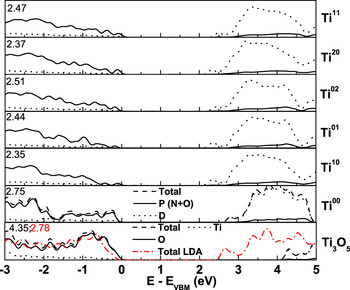
Figure 3 shows the PDOS results for the various cases analyzed, namely no defects (Ti00), one defect (Ti01, Ti10), and two defects (Ti20, Ti02 and Ti11). Experimentally, we know there are both types of Ti vacancies so I will put emphasis in Ti11 case. Our model structures result in the Fermi level always on bottom of the CB, and large gaps below it, what can be explained if we remember that Ti3O5, with no vacancies, has an excess of electrons shared in chemical bonds, as Ti3O6 is charge neutral (composite is stoichiometric). If we take off one O atom, we must have Ti vacancies or O interstitials to balance electronic charges taking part of chemical bonds. In this work—and following the experimental results of Hyett et al. Reference Hyett, Green and Parkin8 —we deal only with Ti vacancies. Ti has oxidation states +3 or +4, and O has oxidation states −2 or −1, depending on the chemical environment. Supposing we have Ti+3 and O−2, we get 3(+3) + 5(–2) = −1 electron in Ti3O5 system. In this case, an excess of electrons in chemical bonds, as in negatively doped semiconductor. Substituting one O for one N does not change the situation, as the N would be in anion position, with oxidation state −3. Ti3O5 has a monoclinic structure at room temperature, being the orthorhombic phase unstable. So, Ti vacancies would partially explain the instability. But Ti3−δO4N with Ti vacancies is still with Fermi level in CB meaning that there is excess of electrons in chemical bonds. Ti3O5 is a Magnéli phase, Reference Åsbrink and Magnéli26 with both Ti3+ and Ti4+ species. Therefore, two 3+ ions and one 4+ ion will guarantee charge neutrality. However, in our case, imposing a background net charge of +4 for the Ti3O4N (as is the case for Ti3O6) primary cell [32 atoms, being 12Ti, 16O and 4N, or 4(Ti3O4N)] brings the Fermi level to the middle of band gap. Therefore, the nondefective 3 × 1 × 1 super-cell of Ti3O4N net charge needs to be +12 so that the system is charge neutral (regarding chemical bonds). If we try to explain in terms of integer oxidation numbers, this result implies that the Ti oxidation number is +4: in the 3 × 1 × 1 Ti3O4N super-cell, we have 36Ti, 48O, and 12N. This gives 36 × (+4) + 48 × (−2) + 12 × (−3) = +12. This also implies that, for the defective super-cell in which two Ti were removed, the net charge involved in chemical bonds would be 34 × (+4) + 48 × (−2) + 12 × (−3) = +4. These impositions to the system net charge bring the Fermi energy back to the middle of the band gap in both cases (nondefective and defective model structures). Mulliken population analysis shows that Ti atoms gain 1.03 electrons (on average), while oxygen and nitrogen loose 0.65 and 0.48 electrons, respectively, for the nondefective (Ti00) case. Situation changes little when going to the defective (Ti11) case: Ti's now gain 1.05 electrons (average), while O and N loose 0.64 and 0.43 electrons, respectively (1.13, 0.62 and 0.41, respectively, if we impose the +4 net charge to the Ti3O4N system, to maintain charge neutrality). Band gaps were calculated for each system, namely Ti00, Ti10, Ti01, Ti20, Ti02, and Ti11, with results in the range of 2.35–2.75 eV (see Fig. 3). Hyett et al. obtained 2.6(1) eV for the band gap of the Ti3−δO4N system by the Tauc method. Reference Hyett, Green and Parkin27
(Projected) Density of states for the various defective structures, calculated using LDA–1/2. There is a balance of the band gap caused by, on one hand, the Ti vacancies; on the other hand, the band gap depends on the amount of charge in the system, which pins the Fermi level to the CB. Experimental band gap is 2.6(1) eV. Reference Hyett, Green and Parkin8 Band gaps at the upper left corner in each case. Energy reference at the top of valence band. LDA band gap (red/dash–dot curve) is 2.78 eV.

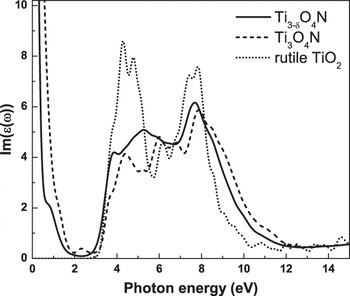
Optical calculations were done for the Ti3−δO4N system using 1320 bands and a mesh of 5 × 5 × 5 points for the integration across the Brillouin zone. Results are shown in Fig. 4, with Ti3O4N and rutile TiO2 results as well, for comparison. We can see that there is a high infrared-damping region below 1.0 eV which drops considerably as the photon energy approaches the band gap region around 2 eV, and the material presents high transmittance around visible region from 2 to 3 eV. A minimum in Im [ε(ω)] appears at 2.32 eV for Ti3−δO4N, which corresponds to a wave length of 534 nm and is in tune with the transmission spectrum determined experimentally for the same system in Ref. Reference Hyett, Green and Parkin27, in which the authors find a peak at 2.41 eV (515 nm). As for the Ti3O4N spectrum, there is a significant increase in optical damping at the infrared region with slightly higher damping at the band gap energy as well. Rutile TiO2 spectrum is shown for comparison, which is in agreement with other state-of-art theoretical results obtained by solving the Bethe–Salpeter equations, Reference Landmann, Rauls and Schmidt28 which take into account the electron–hole interactions, and are also consistent with the high transmission at the infrared region found experimentally. Reference Hyett, Green and Parkin27
Imaginary part of dielectric function, calculated with LDA–1/2 for both the nondefective Cmcm Ti3O4N system (dashed line) and the Ti-vacant Cmcm Ti3−δO4N system, as described in text for case Ti11 (solid line). Rutile TiO2 result (dotted line) was included for a convenient comparison.

Total energy calculations were performed for the Ti11 case. I considered a first approximation in which atomic positions in super-cell were not allowed to relax. The total energy difference, in this case, was E (Ti1) − E (Ti2) = −121.1 meV. This is against our intuition that nature would require less energy to take off an atom in a higher symmetry site (in this case, Ti2), as it, in principle, would cause less distortion. Allowing the super-cell to relax does not help, and energy difference becomes E (Ti1) − E (Ti2) = −108.9 meV, smaller, but still considerable. Both total energy calculations endorse the experimental findings of Hyett et al., Reference Hyett, Green and Parkin8 with Ti 4c sites less occupied than Ti 8f sites [0.933(6) and 0.958(5) fractional occupancies, respectively].
IV. CONCLUSIONS
In summary, I performed simulations on the oxynitride Ti3−δO4N, which has shown experimentally to be more photocatalytic than TiO2. Electronic structure calculations revealed that the energy of Ti3−δO4N structures endorse the experimental findings, with Ti 4c sites less occupied than Ti 8f sites. Results indicate the presence of defect p-levels instead of band gap narrowing due to hybridization of orbitals. There is modification at the CB and at the valence band as well, due to high concentration of defects (Ti vacancies) and nitrogen, with Fermi level at the bottom of CB, implying that Ti d-states become occupied. Rebalancing the charge in chemical bonds brings Fermi level back to the middle of band gap and restores the LUMO. I found that the LUMO state has a larger dispersion than the HOMO state, implying that in Ti3−δO4N photoelectrons are mobile while photo-holes are pinned. Optical calculations are also in agreement with experiments, showing a massive dumping of the electromagnetic radiation at infrared regions, while the minimum dumping was determined to be at wavelengths around 534 nm. Band gaps were determined theoretically to be around 2.5 eV for all defective super-cells, very close to the experimental value of 2.6(1) eV found experimentally.