Participation in decision-making, defined as “the involvement employees have in decisions” (Monge & Miller, Reference Monge and Miller1988), has long captured the attention of management scholars. As an important motivational property of jobs, participation in decision-making has been found to bring positive consequences on a range of individual, group, and organizational outcomes (Morgeson & Campion, Reference Morgeson and Campion2003; Parker & Wall, Reference Parker and Wall1998; Wall, Clegg, Davies, Kemp, & Mueller, Reference Wall, Clegg, Davies, Kemp and Mueller1987). Specifically, a sizeable group of empirical studies has found participation in decision-making to be positively associated with job satisfaction (e.g., Driscoll, Reference Driscoll1978; Pearson & Duffy, Reference Pearson and Duffy1999; Sagie, Zaidman, Amichai-Hamburger, Te’eni, & Schwartz, Reference Sagie, Zaidman, Amichai-Hamburger, Te’eni and Schwartz2002; Scott-Ladd, Travaglione, & Marshall, Reference Scott-Ladd, Travaglione and Marshall2006; Witt, Andrews, & Kacmar, Reference Witt, Andrews and Kacmar2000).
To date, several perspectives have been applied to better understand the association between participation in decision-making and job satisfaction. Drawing from the knowledge exchange perspective, scholars find that participation enhances knowledge transfer and learning, which in turn promotes specific outcomes (Sagie et al., Reference Sagie, Zaidman, Amichai-Hamburger, Te’eni and Schwartz2002; West, Reference West2002). Following the motivation perspective, Somech (Reference Somech2010) regards participation as a motivational variable, which can lead to greater attainments of high-order needs such as self-expression, respect, interdependence and equality, and in turn elevate morale and satisfaction. Following a procedural justice perspective, Roberson, Moye, and Locke (Reference Roberson, Moye and Locke1999) report that participation in decision-making leads to a higher level of procedural justice perceptions, and thus higher job satisfaction. In addition, the job characteristic perspective suggests that participation in decision-making induces the mediating effect of critical psychological states (i.e., experienced meaningfulness, knowledge of results), and thus more job satisfaction (Humphrey, Nahrgang, & Morgeson, Reference Humphrey, Nahrgang and Morgeson2007; Scott-Ladd et al., Reference Scott-Ladd, Travaglione and Marshall2006).
Although these perspectives provide diverse views, they ignore that participation can promote the communication openness through interpersonal communication, and thereby improve job satisfaction. As indicated by previous research, experiencing openness in communication adds to employees’ feelings of job satisfaction (Burke & Wilcox, Reference Burke and Wilcox1969a). Managers often consider open communication as an instrument for catering to individual needs (Smidts, Pruyn, & van Riel, Reference Smidts, Pruyn and van Riel2001). However, the potential impact of participation in decision-making on communication openness and its subsequent impact on job satisfaction has not been explored.
In this study, our objective is to explain the association between participation in decision-making and job satisfaction based on a communication perspective. Participation in decision-making gives employees the benefit of developing their own social capital, and can be beneficial to their communication with supervisors and coworkers in formal or informal situations (Russ, Reference Russ2013). Additionally, research has also uncovered that a high quality of communication openness has the capacity to stimulate job satisfaction (Burke & Wilcox, Reference Burke and Wilcox1969a; Trombetta & Rogers, Reference Trombetta and Rogers1988). Thus, based on the theory and research, this study proposes that communication openness has high potential for explaining the linkage between participation in decision-making and job satisfaction.
Furthermore, in order to acquire a deeper insight into the participation––job satisfaction relationship, this study also endeavors to identify a key boundary condition of our suggested effect. Social capital researchers have claimed that the great access to information is a key contextual moderator in social capital literatures (Seibert, Kraimer, & Liden, Reference Seibert, Kraimer and Liden2001). The information adequacy of an organization can directly affect the likelihood of employees’ access to information (Rosenfeld, Richman, & May, Reference Rosenfeld, Richman and May2004). In essence, we test the moderating effect of information adequacy, namely, that participation in decision-making brings more communication openness in environments with better information adequacy.
In the following sections, we first develop the relationship between participation in decision-making and communication openness based on social capital theory. Second, we investigate the relationship between communication openness and job satisfaction, further developing a mediation assumption that links participation in decision-making and job satisfaction via communication openness. Third, we argue that the proposed consequence is stronger in environments with high levels of information adequacy. The research model is depicted in Figure 1. Fourth, we test the research model using data of 184 employees from four enterprises in China. We conclude by describing the theoretical and practical contributions of our research to the participation in decision-making, communication, and job satisfaction literatures.
Research Model.

Definition of participation in decision-making and communication openness
Participation in decision-making refers to the influence sharing between hierarchical superiors and their subordinates (Locke & Schweiger, Reference Locke and Schweiger1979; Monge & Miller, Reference Monge and Miller1988). Previous studies have outlined an important division of participation in decision-making, dividing the phenomenon into direct and indirect participations. Direct participation in decision-making is defined as the direct involvement of individuals in the organization’s decision-making and problem solving, for example by the establishment of problem-solving teams. Indirect participation involves several employees who are selected by a union as delegates, and these delegates will be called upon to vote for solutions through democratic decision-making (vanYperen, Berg, & Willering, Reference vanYperen, van der Berg and Willering1999).
In addition to the direct/indirect dimension, participation in decision-making can also be divided into formal and informal styles. Formal participation occurs under the official decision-making system, and is set up by the organization or group. Informal participation is mainly for informal occasions, in which employees are not granted formal rights and responsibilities (Cotton, Vollrath, Froggatt, Lengnick-Hall, & Jennings, Reference Cotton, Vollrath, Froggatt, Lengnick-Hall and Jennings1988; Dachler & Wilpert, Reference Dachler and Wilpert1978; Stashevsky & Elizur, Reference Stashevsky and Elizur2000). Participation in decision-making also can be divided into short-term versus long-term, according to the duration of participation (Cotton et al., Reference Cotton, Vollrath, Froggatt, Lengnick-Hall and Jennings1988). Although participation in decision-making has many different types of categories, the present research considers a broadly defined participation concept––one that reflects joint decision-making among more than one person (usually a job incumbent and a supervisor) (Evans & Fischer, Reference Evans and Fischer1992; Wagner & Gooding, Reference Wagner and Gooding1987). This view is consistent with the opinion of Latham, Winters, and Locke (Reference Latham, Winters and Locke1994) that employees who participate in decision-making will result in better performance than in the case of no participation.
Participation in decision-making is distinct from job autonomy, which is generally defined as the amount of freedom a worker has to schedule work and determine the process of carrying out the work (Hackman & Oldham, Reference Hackman and Oldham1976). Participation and job autonomy both have been linked to decision-making. Spector (Reference Spector1986) find that the correlation of participation and job satisfaction is similar to the relation between autonomy and job satisfaction. However, participation is distinct from autonomy in that the former one emphasizes joint decision-making among several persons while the latter refers to one person to make his/her own decision (Evans & Fischer, Reference Evans and Fischer1992). Therefore, participation in decision-making has an element of interpersonal communication, which is absent in the concept of autonomy. As for such unique characteristic of participation, we seek to explore the relationship between participation in decision-making and job satisfaction from the perspective of communication, and study the mediating role of communication openness.
Communication openness is defined as the ease of individuals talking to each other within the organization, and the degree of understanding gained during communication with other team members (Ayoko, Reference Ayoko2007). It involves the transfer of information among group members. Redding (Reference Redding1992) divided it into two dimensions, message sending and message receiving. Other scholars have proposed that communication openness includes upward, downward, and parallel communication. Upward communication is the flow of information from subordinates to supervisors, downward communication is from supervisors to subordinates, and parallel communication is between coworkers. Communication openness also involves work-related information and non-work-related topics (Rogers, Reference Rogers1987). Non-work-related topics include personal thoughts, new ideas and suggestions. Thus, communication openness can further be divided into six dimensions: upward job-related, upward non-job-related, downward job-related, downward non-job-related, parallel job-related and parallel non-job-related communication openness (Trombetta & Rogers, Reference Trombetta and Rogers1988).
Participation in decision-making and communication openness
We argue that participation in decision-making enhances communication openness based on the social capital theory. Social capital is defined as the ability that organizations have of creating, maintaining, and using relationships to achieve desirable organizational goals (Poertes, Reference Poertes1998). Communication openness, or the free flow of work-related communication, is one type of social capital (Merlo, Bell, Mengüç, & Whitwell, Reference Merlo, Bell, Mengüç and Whitwell2006). According to the social capital theory, communication openness can be determined by four factors––access to the parties of information communication, anticipation of value in the information communication, motivation to exchange information or communication and the capability of communication (Nahapiet & Ghoshal, Reference Nahapiet and Ghoshal1998; Seibert et al., Reference Seibert, Kraimer and Liden2001). We argue below that participation in decision-making has direct implications for the development of communication openness.
First, participation in decision-making signals supervisors’ trust in employees, and it also signals a long-term perspective of the employment relationship (Jia, Shaw, Tsui, & Park, Reference Jia, Shaw, Tsui and Park2014). Thus, participative employees are persuaded that they have long-term work in the organization, which allows them greater access to the information exchange with coworkers and supervisors (Abu Bakar, Dilbeck, & McCroskey, Reference Abu Bakar, Dilbeck and McCroskey2010). Participation in decision-making increases the communication between employees and supervisors (van der Westhuizen, Pacheco, & Webber, Reference van der Westhuizen, Pacheco and Webber2012), and among coworkers. Thus, we state that participation in decision-making is beneficial for the communication openness because of the first factor –– access to the parties of information communication.
Second, participation in decision-making increases employees’ work influence through giving employees the right to speak out their opinions freely (Zhang & Bartol, Reference Zhang and Bartol2010). Such perspective means that participation in decision-making allows employees to contribute to organization and promotes the anticipation of value in the information communication, and thus boosts the communication openness. Accordingly, participation in decision-making will promote the communication openness as for it enhances the anticipation of value in communication, which is the second factor for social capital development.
Third, when employees are involved in the decision-making process of the organization, supervisors may adopt some good suggestions or ideas made by their employees. Such a situation provides employees with opportunities for both advancement and promotion, which enhance their motivation to exchange work-related information with others (Appelbaum et al., Reference Appelbaum, Louis, Makarenko, Saluja, Meleshko and Kulbashian2013). In this context, the participatory employees are likely to communicate more openly with others.
Finally, as a method of developmental inducement, participation in decision-making is beneficial for employees’ development of skills. From the perspective of employees, participation in decision-making provides the opportunity to work with and learn from more advanced employees or supervisors (Thompson & Kahnweiler, Reference Thompson and Kahnweiler2002). In the long-term, employees will increase their capacity to establish and develop relationship networks. Participation in decision-making can thus increase employees’ capability to communicate. In turn, their social capital, especially communication openness, will increase.
Previous studies on participation have shown that participation in decision-making enriches the information flow in organization (Anderson & McDaniel Jr, Reference Anderson and McDaniel1999), and thus the communication turns to be more open and transparent (Scott-Ladd et al., Reference Scott-Ladd, Travaglione and Marshall2006). Smylie, Lazarus, and Brownlee-Conyers (Reference Smylie, Lazarus and Brownlee-Conyers1996) also examine that participative processes can engage teachers in the types of open and collaborative interactions conducive to learning and change. To summarize, we expect that the relationship between participation in decision-making and communication openness is positive. Thus, we propose:
Hypothesis 1: The relationship between participation in decision-making and communication openness is positive.
Communication openness and job satisfaction
Research has shown that communication behavior alone accounts for more than 60 percent of the variance in employee job satisfaction (Cheng & Coyte, Reference Cheng and Coyte2014). Thus, it is anticipated that communication openness will boost employees’ job satisfaction. Social capital theory indicates that social capital influences organizational outcome for two distinct themes. One is increasing the efficiency of action, and the other is encouraging cooperative behavior (Nahapiet & Ghoshal, Reference Nahapiet and Ghoshal1998). Based on the social capital theory, we expect a positive relationship between communication openness and job satisfaction for several reasons. First, open communication increases communication between supervisors and employees, and improves the efficiency through minimizing redundancy (Burt, Reference Burt2009). For example, in an organization with open communication, employees are able to comment on the organization’s systems, and express their own opinions to their supervisors in formal or informal situations. Such efficiency in communicating with supervisors is beneficial for job satisfaction. Leadership researchers have stated that free communication with leaders can contribute to the employee satisfaction (Kim & Brymer, Reference Kim and Brymer2011). Accordingly, communication openness is beneficial for employees’ job satisfaction.
Second, communication openness encourages the cooperative behaviors within organizations that are associated with knowledge sharing between employees (Correia, Stokic, & Faltus, Reference Correia, Stokic and Faltus2014). Open communication facilitates the transfer of knowledge, skills, and informal messages within the organization. With communication openness, employees may feel that they are part of the organization as a whole. Such cooperative and supportive work environments will contribute to their job satisfaction (Nahrgang, Morgeson, & Hofmann, Reference Nahrgang, Morgeson and Hofmann2011).
Furthermore, communication openness, as one style of positive organizational climate, allows employees to express their dissatisfaction or displeasure without fear of punishment or misunderstanding, which can increase their psychological security (Eisenberg & Witten, Reference Eisenberg and Witten1987). Psychological safety is a significant factor in employees’ job satisfaction (Siu, Phillips, & Leung, Reference Siu, Phillips and Leung2004). For instance, a good organizational climate is positively related to job satisfaction for Chinese white-collar and blue-collar workers (Siu, Cooper, & Donald, Reference Siu, Cooper and Donald1997; Siu, Donald, & Cooper, Reference Siu, Cooper and Donald1997). Other empirical evidence also indicates that communication openness is positively related to job satisfaction (Burke & Wilcox, Reference Burke and Wilcox1969b). Thus, we predict:
Hypothesis 2: Communication openness is positively related to job satisfaction.
Empirical evidence claims that higher level of decision-making latitude is associated with a greater sense of job satisfaction (Evans et al., Reference Evans, Huxley, Gately, Webber, Mears, Pajak and Katona2005; Sagie et al., Reference Sagie, Zaidman, Amichai-Hamburger, Te’eni and Schwartz2002; Witt et al., Reference Witt, Andrews and Kacmar2000). A meta-analysis conducted by Miller and Monge (Reference Miller and Monge1986) also concludes that participation in decision-making is positively associated with job satisfaction. Thus, it is logical to believe that participation in decision-making is beneficial for employees’ job satisfaction because it encourages communication openness in the organization through the increase of access, communication capability, anticipation of value, and motivation to communicate openly with other members of the organization. Based on the above reasoning, we propose that participation in decision-making has a positive association with job satisfaction via the mediation effect of communication openness. As such, we propose:
Hypothesis 3: The relationship between participation in decision-making and job satisfaction is mediated by communication openness.
The moderating effect of information adequacy
Information adequacy is defined as the amount of information related to the organization that employees are provided with (Rosenfeld et al., Reference Rosenfeld, Richman and May2004). In other words, it refers to the amount of information available to employees within the organization. The most direct determinant of information adequacy is the type and amount of information received by organization members (Zhu, May, & Rosenfeld, 2004). Social capital theory assumes that access to information is essential to the motivation induced by social capital variables (Seibert et al., Reference Seibert, Kraimer and Liden2001). By extension, the relationship between participation in decision-making and communication openness should be strengthened when information is adequate. We expect that participation in decision-making is more likely to be positively related to communication openness under high information adequacy than under low information adequacy for the following reasons.
First, an adequate information environment provides a variety of information for employees. When information adequacy is high, employees can get useful information rapidly and accurately (Spiker & Daniels, Reference Spiker and Daniels1981). They can therefore know more about their coworkers and supervisors thanks to this convenience. Such opportunity is beneficial for participative employees to get access to the parties of communication, and result in higher communication openness.
Then, an adequate information environment provides employees more resources and support that help them to come up with more solutions in the process of organizational decision-making (Brisman, Reference Brisman2013). In other words, it allows employees to have a higher possibility of solving the problem, and therefore contributing to the organization. Such possibility increases employees’ control over certain job (Thoits, Reference Thoits1994). Research has discovered that increased control over the work environment motivates workers to try out and master tasks (Fried & Ferris, Reference Fried and Ferris1987; Morgeson & Campion, Reference Morgeson and Campion2003; Morgeson, Delaney-Klinger, & Hemingway, Reference Morgeson, Delaney-Klinger and Hemingway2005), rather than giving up. For these reasons, the sense that problems can be solved increases the tendency of employees who participate in the decision-making process to enhance the value anticipation in communication, and promote their communication openness. As a consequence, employees under adequate information environment are more likely to perceive communication openness when participating in decision-making.
Furthermore, providing adequate information gives employees the opportunity to develop trust for supervisor (Thomas, Zolin, & Hartman, Reference Thomas, Zolin and Hartman2009), and thus gives them more possibility to be promoted in the career development. Accordingly, when participating in the decision-making, people with adequate information will be more likely to be promoted. Such opportunity enhances their motivation to communicate, and promotes the participants’ communication openness as a result.
Finally, adequate information stimulates employees’ proactive learning orientation (Edmondson, Reference Edmondson1999), which is beneficial for improving their communication capacity. Thus, employees who participate in decision-making under adequate information environment will be more easily to enhance their communication capability, and more likely to promote communication openness.
All these reasons suggest that participation in decision-making will be more positively related to communication openness when there is higher information adequacy. Thus, we propose the following:
Hypothesis 4: The relationship between participation in decision-making and communication openness is moderated by information adequacy such that the positive relationship will be stronger when information adequacy is high.
Overall, we propose that participation in decision-making can enhance the communication openness in organization and then promote employees’ job satisfaction. We suggest that the mediating effect is more prominent for those with higher information adequacy. Our proposed model represents a first-stage moderated mediation framework of the relationships between participation in decision-making, communication openness, information adequacy, and job satisfaction. We expect to observe the benefits of participation in decision-making in terms of communication openness and job satisfaction only under high information adequacy. Stated formally:
Hypothesis 5: The strength of the mediated relationship between participation in decision-making and job satisfaction (through communication openness) depends on information adequacy; the indirect and total effect of participation in decision-making on job satisfaction will be stronger when information adequacy is high.
Method
Participants
We collected our data from four manufacturing companies in northeastern China. These four enterprises are all in the machine manufacturing industry, and specialize in producing aircraft engines, automobile engines, tires and household appliances respectively. They are mostly similar in that they are all state-owned enterprises that adopt similar performance evaluation criteria and management systems. Fifty individuals were selected randomly from each company to participate in our survey. The participation of employees and supervisors was voluntary. Paper questionnaires were distributed to the employees through human resource management departments. At the same time, employees were informed that their responses would be strictly confidential. During sample selection, researchers tried to clarify the purpose and significance of the survey to guarantee the authenticity. The participants were informed that their names should not appear anywhere on the data collection instruments to ensure anonymity. Additionally, all the questionnaires were administered to the participants simultaneously. When completed, employees returned the questionnaire in a sealed envelope to researchers directly and anonymously, with no handing over from the manager and supervisor. Two hundred questionnaires were given out to the employees. The total number of valid return was 184, and the valid usable return rate was 92%.
Responses indicated that 62.5% of the respondents were male, and 37.5% were female; 82.4% were under 30 years old, of whom 62.7% were between 25 and 30 years old (M = 1.98 and SD = 0.64); 68.1% of respondents had less than 7 years of job experience; 68.5% had a bachelor’s degree or higher qualification. As for the distribution of job position, 77.3% of respondents were employees, and 22.7% were managers.
Measurement
In order to ensure the accuracy of the questionnaire, we adopted a double translation procedure (Brislin, Reference Brislin1980). A bilingual professor translated the original version of the questionnaire into Chinese and another professor and two PhD Candidates (all bilingual) translated the Chinese back into English. After the translation, we invited two employees to check whether the items were clear and accurate. Finally, we established the scales that include participation in decision-making, communication openness, information adequacy, job satisfaction and the control variables.
Participation in decision-making
Participation in decision-making was measured according to the questionnaire developed by Trombetta and Rogers (Reference Trombetta and Rogers1988), which includes items such as “supervisor allows me to express my opinions beyond his/her requirement,” “my supervisor delegates some work decisions to me,” and “my supervisor often asks me about suggestions for certain work”. Responses were recoded using a 5-point scale (1 = strongly disagree, 5 = strongly agree).
Communication openness
Communication openness was assessed according to the 13-item scale developed by Rogers (Reference Rogers1987). The measure uses a 5-point rating scale (1 = strongly disagree, 5 = strongly agree) and includes three types of communication openness: upward communication from subordinate to superior, downward communication from supervisor to subordinate and parallel communication between coworkers. The previous scale includes 13 items and the Cronbach’s α was 0.87. Our study focuses on the upward communication from subordinate to supervisor. Thus, we modified the scale, and the final scale included “when I communicate with my superior, I have the chance to speak out my own opinions,” “I will ask for the superior’s opinion proactively,” and “I will talk with my superior about the things I am interested in.”
Information adequacy
Information adequacy was measured according to the scale developed by Zhu et al. (Reference Zhu, May and Rosenfeld2004). Participants were asked to rate on a 5-point scale (1 = very little, 5 = a great deal) the amount of information they received on the issues such as “how well I am doing my job,” “organizational policies,” “pay and benefits,” “promotion and advancement opportunities,” and “specific problems faced by management.”
Job satisfaction
Job satisfaction was measured according to the 5-item scale developed by Bono and Judge (Reference Bono and Judge2003). The sample items were “I am satisfied with the job I am doing,” “Most days I am enthusiastic about my work” and “I find real enjoyment in my work” (1 = strongly disagree, 5 = strongly agree).
Control variables
Prior research and the industry context suggest the importance of controlling for several factors. First, we controlled for gender, which has previously been found to be the strongest demographic predictor of job satisfaction (Hodson, Reference Hodson1989). We measured gender as 0 “male” or 1 “female”. Then we controlled age and education because there is evidence that these two variables can influence job satisfaction (Spector, Reference Spector1997; Wright & Bonett, Reference Wright and Bonett2007). We asked employees to fill out their age (1 = under 25 years old, 2 = age 25–30, 3 = age 31–40, 4 = age 41–50, 5 = more than 50 years old). Education was coded into four categories (1 = high school graduated and below, 2 = bachelor’s degree, 3 = master’s degree, 4 = doctoral degree). In addition, we controlled for job position. Job position was included because it may influence how employees interact with each other in the organization, particularly in terms of influence accorded (Fiske, Reference Fiske2010), which is potentially relevant to both job satisfaction and communication openness. Position was also coded into four categories (1 = general worker, 2 = director level, 3 = minister level, 4 = deputy or above). In order to explore whether supervisors and employees differ, we recoded the dummy variable of “Position” from 4 categories into 2 categories: employee = 0; manager (including ‘”director level”, “minister level” and “deputy or above”) = 1.
Results
Descriptive statistics, validity, and reliability
Cronbach’s α was calculated to test the reliability of each part of the scale. Coefficient alpha reliability of participation in decision-making was .74, communication openness was .80, information adequacy was .75, and the Cronbach’s α of job satisfaction was .78. All values were above .70, indicating good reliability for our constructs.
We conducted confirmatory factor analysis (CFA) on the above four measures to examine their construct validity. The statistics showed acceptable fit of the hypothesized four-factor measurement model (consisting of participation in decision-making, communication openness, information adequacy, and job satisfaction) model (CFI = .91, GFI = .90, RMSEA = .09, χ2 = 140.29, p < .001, df = 56).
We compared this four-factor model to several alternative models using χ2 difference tests. χ2 difference tests showed that the four-factor model was significantly better than a single-factor model combing all the items into one overall factor (Δχ2 = 160.1, df = 7, p < .01). Fit of this one factor model was χ2 = 300.39, df = 63, CFI = .74, GFI = .78, RMSEA = .14. The four-factor model was better than a two-factor model in which collapsing participation in decision-making, information adequacy, communication openness into one overall factor (Δχ2 = 93.95, df = 5, p < .01). Fit of this two-factor model was χ2 = 234.24, df = 61, CFI = .81, GFI = .38; RMSEA = .12. Moreover, the four-factor model was better than a three-factor model in which collapsing participation in decision-making and information adequacy items on one factor (Δχ2 = 77.73, df = 3, p < .01). Fit of this three-factor model was χ2 = 218.02, df = 59, CFI = .82, GFI = .83, RMSEA = .12. Finally, the four-factor model was also a better fit to another three factor model combining participation in decision-making and communication openness items into the overall factor (Δχ2 = 49.08, df = 3, p < .01). Fit of this three-factor model was χ2 = 189.37, df = 59, CFI = .86, GFI = .86, RMSEA = .11. The findings revealed a better fit for the postulated four-factor research model.
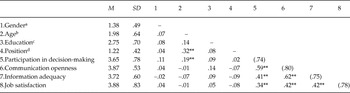
Table 1 shows the means, standard deviations, and correlation coefficients of variables and reliabilities of the constructs. The results indicated that participation in decision-making was positively correlated with communication openness (r = .59, p < .01). Communication openness was positively correlated with job satisfaction (r = .42, p < .01). Thus, these results provided initial support for Hypothesis 1 and Hypothesis 2. Participation in decision-making was also positively correlated with job satisfaction (r = .34, p < .01).
Descriptive statistics, correlations, and reliabilities

Note: n = 184. Cronbach’s alpha values are in parentheses. aGender: “0 = male, 1 = female”; bAge: “1 = under 25 years old, 2 = age 25–30, 3 = age 31–40, 4 = age 41–50, 5 = more than 50 years old”; cEducation: “1 = high school graduated, 2 = university graduated, 3 = master’s degree, 4 = doctor’s degree”; dPosition: “0 = employee, 1 = manager”; *p < .05, **p < .01.
Hypotheses Tests
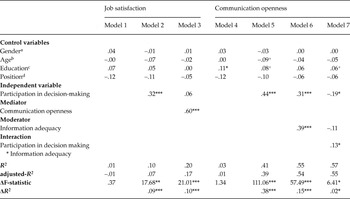
We adopted hierarchical regression analysis to test Hypotheses 1–4. As shown in Table 2, the regression results are clustered in the table by the dependent variable, so that the first half of the table is about job satisfaction and the second part is about communication openness. Hypothesis 1, which predicted a positive relationship between participation in decision-making and communication openness, was supported (β = .44, p < .001, Model 5 in Table 2). Hypothesis 2, which predicted a positive relationship between communication openness and job satisfaction, was also supported (β = .60, p < .001, Model 3 in Table 2).
Summary of regression analysis results

Note: n = 184. aGender: “0 = male, 1 = female”; bAge: “1 = under 25 years old, 2 = age 25–30, 3 = age 31–40, 4 = age 41–50, 5 = more than 50 years old”; cEducation: “1 = high school graduated, 2 = university graduated, 3 = master’s degree, 4 = doctor’s degree”; dPosition: “0 = employee, 1 = manager”; † p < .1, *p < .05, **p < .01, ***p < .001.
Hypothesis 3, which predicted that communication openness would mediate the relationship between participation in decision-making and job satisfaction, was also supported, as the relationship between participation in decision-making and job satisfaction became non-significant when communication openness was included in the regression model (β = .06, n.s., Model 3 in Table 2), and explained an additional 10% of the variance.
Table 2 also shows the results of the moderated hierarchical regression analyses for Hypothesis 4. The control variables were entered into the first step of the regression equation (Model 4 in Table 2). In the second step (Model 5 in Table 2), we added the independent variable into the regression equation based on the first step. In the third step (Model 6 in Table 2), we added the moderating variable into the regression. In the fourth step (Model 7 in Table 2), we introduced the interaction of independent variable and moderating variable into the regression based on the third step. As shown in step 4, the interaction of participation in decision-making and information adequacy was positively and significantly related to communication openness (β = .13, p < .05, Model 7 in Table 2), explaining an additional 2% of the variance.
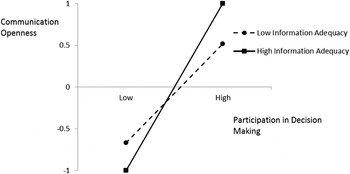
The plot of the moderating effect of information adequacy on the relationship between participation in decision-making and communication openness is presented in Figure 2. The figure shows that the form of these interactions corroborates the predicted patterns, that is, the link between participation in decision-making and communication openness being more pronounced under conditions of high information adequacy (M + 1 SD) than under conditions of low information adequacy (M − 1 SD). Hence, Hypothesis 4 was supported.
The Moderating Effect of Information Adequacy on the Relationship between Participation in Decision-making and Communication Openness.

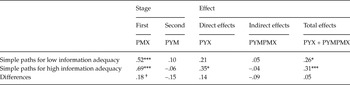
Hypothesis 5 predicts that information adequacy moderates the participation in decision-making—communication openness—job satisfaction mediating linkage. To test this hypothesis, we adopted Edwards and Lambert (Reference Edwards and Lambert2007) General Path Analytic Framework. We described the direct, indirect, and total effects of expected contributions on job satisfaction at different levels of information adequacy using path analysis conventions. Table 3 shows the results of the path analysis.
Path analytic results—direct, indirect, and total effects of participation in decision-making on job satisfaction (via communication openness) at low and high levels of information adequacy—hypothesis 5

Notes: n = 184. PMX = path from X (participation in decision-making) to M (communication openness). PYM = path from M to Y (job satisfaction). PYX = path from X to Y. † p < .1. *p < .05. ***p < .001.
The results summarized in Table 3 showed that information adequacy would not moderate the indirect effect of participation in decision-making on job satisfaction, as the size of the difference in the indirect effect was –.09, using the bootstrap estimates excluding zero. Thus, Hypothesis 5 was not supported. In particular, the results in table 3 supported a first-stage moderating effect (Δβ = .18, p < .1), suggesting that participation in decision-making interacted with information adequacy to influence communication openness, which, in turn, influenced job satisfaction. The result provides further support for Hypothesis 4. Finally, information adequacy did not moderate the effect of communication openness on job satisfaction (Δβ = –.15, n.s.), nor did it moderate the direct effect of participation in decision-making on job satisfaction (Δβ = .14, n.s.).
Supplementary analysis
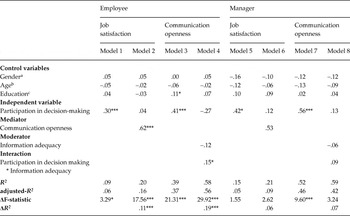
We divided the sample into managers and employees and tested the research model with employees and managers respectively. Table 4 shows the results of regression analysis of the manager and employee sample.
Supplementary analysis results

Note: aGender: “0 = male, 1 = female”; bAge: “1 = under 25 years old, 2 = age 25–30, 3 = age 31–40, 4 = age 41–50, 5 = more than 50 years old”; cEducation: “1 = high school graduated, 2 = university graduated, 3 = master’s degree, 4 = doctor’s degree”; + p < .1, *p < .05, ***p < .001.
As shown in Table 4, for employee sample, the results supported all our hypotheses in the primary analyses. As for the manager sample, results did not support the mediating role of communication openness, nor the moderating effect of information adequacy. Thus, the sample of employees fits our research model, while managers are not suitable for our research model. That is to say, employees with high information adequacy are more likely to perceive communication openness and job satisfaction than their low information adequacy counterparts when participated in decision-making process, however, managers will not show such a tendency.
The distinction may be attributable to the obligations of manager. Managers have the communication-based responsibilities such as maintaining adequate information flowing and maintaining openness (Seeger & Ulmer, Reference Seeger and Ulmer2003). Thus, communication openness and information adequacy will not contribute to the increase in their job satisfaction. All in all, our research model would be more appropriate for employees, and our future research can establish a more complete model according to managers’ job characteristic.
Discussion
The present study seeks to develop a research structure to link participation in decision-making to job satisfaction via the mediating mechanism of communication openness based on the social capital theory. We further argue that the advantages of higher levels of participation in decision-making are better realized in organizations that are characterized by high information adequacy. The results support the hypotheses that participation in decision-making predicts communication openness, and communication openness, in turn, is related to job satisfaction. Regression analyses demonstrate that communication openness mediates the relationship between participation in decision-making and job satisfaction, and the information adequacy moderates the relation between participation in decision-making and communication openness. However, the results fail to support the hypothesis of the moderated mediation framework.
The results obtained in this study are in line with previous studies that show participation in decision-making has been linked theoretically to job satisfaction (Coch & French Jr, Reference Coch and French1948), and our result is consistent with the meta-analysis result of Miller and Monge (Reference Miller and Monge1986) that participation has a mean correlation of .34 with job satisfaction. However, attempting to find positive relationship between participation and job satisfaction have not all met with success (Lischeron & Wall, Reference Lischeron and Wall1975). Previous research results suggest that the relationship between participation in decision-making and job satisfaction is more complex than originally thought of as direct positive correlation. As mentioned earlier, previous studies have put forward perspectives of knowledge exchange, motivation, and procedural justice to theorize different reasons for why employees are more satisfied when participate in the decision-making process. We raise a different perspective of communication to investigate the mechanism process of participation in decision-making. Furthermore, our study supports the finding of Jackson’s (Reference Jackson1983) study that participation in decision-making increases work communication. However, we fail to verify the moderated mediation model, in spite of the fact that the pattern of results are in the predicted direction.
Our research results have a number of theoretical implications. First, by establishing the mediating role of communication openness in participation in decision-making––job satisfaction relationship, this research offers new and useful insights into understanding of the processes through which participation in decision-making affects job satisfaction. This extension is meaningful because it suggests that participation in decision-making offers employees more opportunities to communicate with supervisors and coworkers. Those opportunities and their psychology feelings together increase their perceived communication openness, and thus enhance their job satisfaction. Although previous studies examined several perspectives of the participation in decision-making––job satisfaction relationship, they ignored the unique element of interpersonal communication behind participation in decision-making. This communication openness perspective offers a different framework from previous perspectives.
In addition, this study contributes to the communication openness literatures by adding to our understanding of the factors that are important for communication openness. Previous studies of communication openness are mostly limited to communication literatures (Ayoko, Reference Ayoko2007; Le Mare & Audet, Reference Le Mare and Audet2011). By adopting the view of social capital theory, we have demonstrated that the opportunity to participate in decision-making is important for the communication openness employees perceive. We combine the social capital and communication perspectives by integrating organizational communication openness, organizational information and participation in decision-making. This approach provides a deeper understanding of the role of participation in decision-making. These findings are important in that although considerable research studied participation in decision-making, the importance has not been empirically tested in the context of open communication.
Finally, our study extends participation in decision-making research by identifying the contextual influences of information adequacy on communication openness. Based on social capital theory, we find a moderating effect of information adequacy on the relationship between participation in decision-making and communication openness. The result is consistent with previous finding that the relationship between participation and outcome variable is moderated by situational variables (Wagner & Gooding, Reference Wagner and Gooding1987). Furthermore, we establish a moderated mediation model of the relationships between participation in decision-making, communication openness, information adequacy, and job satisfaction. Although the moderate mediation model is not supported empirically, it nevertheless reconfirms the moderating role of information adequacy.
Our study provides practical implications for managers and organizations. First, our findings show that participation in decision-making is beneficial for employees and organizations because employees who participate in the decision-making are likely to perceive high communication openness and are more likely to be satisfied with their job. A direct approach is to increase the opportunities of participating in decision-making. For example, enterprise leaders can set up project teams and decision panels to increase opportunities to participate in decision-making. In addition, to ensure employees’ job satisfaction, organization managers need to pay attention to the open communication in work group, such as encouraging employees to use face-to-face discussion to solve problems (Ardichvili, Page, & Wentling, Reference Ardichvili, Page and Wentling2003), promoting communication and cooperation among colleagues (LePine & van Dyne, Reference LePine and van Dyne2001). Finally, managers should also ensure the richness of information in organizations, such that employees can obtain the information they want at any time. For example, managers and organizations should advocate establishing “information releasing column” and encouraging information flow.
There are some limitations of our research. First, because employees provided the ratings of all measures in this study, concerns about common-method bias could be raised. Harmon’s one-factor test (Podsakoff, MacKenzie, Lee, & Podsakoff, Reference Podsakoff, MacKenzie, Lee and Podsakoff2003) was taken to examine the effect of common method variance in the present data set, and the result revealed that it did not seriously undermine the validity of the findings. Nevertheless, future research should attempt to obtain data from different sources to further reduce common-method bias and allow for stronger inferences about causality. Second, the data are cross-sectional, which leaves the possibility that the causal relationships we are inferring may be opposite in direction to those we have proposed. Although the present finding is consistent with previous evidence that find participation in decision-making to be associated with subsequent perceptions and behaviors (Anderson & McDaniel Jr, Reference Anderson and McDaniel1999; Scott-Ladd et al., Reference Scott-Ladd, Travaglione and Marshall2006; Smylie et al., Reference Smylie, Lazarus and Brownlee-Conyers1996), we cannot rule out the alternative possibility that communication openness influences participation. As such, longitudinal studies that test our theoretical model would be of value.
In addition, we argue that information adequacy provides employees more resources and support that help employees to come up with more solutions, and such possibility enhances the expected value of participation. However, it is also in the case for some people that adequate resources make them believe the problem can be solved without him/her, and thus reduce their desire to participate or communicate with others. For example, the result may differ according to the different personality features. Positive people may believe it a good thing and lead to the positive outcomes, while negative people may think it reversely. As for such difference, participation in decision-making may influence job satisfaction in positive or negative patterns. Future studies are needed to explore other possible contextual conditions for the participation––job satisfaction relationship. As a final note, we constructed the theoretical model by establishing a communication structure, but we did not test other communication variables apart from communication openness. Future studies could explore other aspects of communication.
In conclusion, based on social capital theory, this study offers a new account to explain why and when participation in decision-making can influence job satisfaction. Our study contributes by offering a communication structural view linking participation in decision-making to communication openness and job satisfaction, and exploring the moderating effect of information adequacy. We thereby contribute to a more comprehensive understanding of participation in decision-making as it affects organizational communication openness, and the conditions that engender the best outcomes for employees and organizations.
This research was supported by National Natural Science Foundation of China (71472054).