1. Introduction
The commercialization of GMO crops is regulated by national regulations which comprise regulatory approval for importing or cultivation, labelling policy, and traceability, all of which vary considerably among countries (Gruère, Reference Gruère2006; Davison, Reference Davison2010; Wohlers, Reference Wohlers2010; Viju et al., Reference Viju, Yeung and Kerr2011; Vigani and Olper, Reference Vigani and Olper2013). This large regulatory heterogeneity, especially as related to varied timings of approvals for commercial use such as feed and/or food or for cultivation, has created a situation known as asynchronous approval (AA), which means that the approval of a new GMO eventFootnote 1 does not occur simultaneously across countries. A similar situation known as ‘asymmetric foreign approval’ occurs when the biotech crop developer does not seek regulatory approval for his products in other importing countries because the crop is suitable to be marketed only in a domestic market (Stein and Rodríguez-Cerezo, Reference Stein and Rodríguez-Cerezo2010). Under these two circumstances, a new biotech crop might be cultivated and marketed for food and feed in one or more countries but remain unauthorized in the other countries (Kalaitzandonakes, Reference Kalaitzandonakes2011).
Since 2000, an increasing number of new GMO events have been authorized for import or cultivation worldwide. In 2013, maize presented 115 approved events, followed by cotton with 34 events and soybean with 20 approved events (ISAAA, 2013). Approval processes are not synchronized across countries and the perfect segregation of approved and unapproved GMO crops cannot be consistently achieved, which means that the probable outcome is that GMO approved events in one country might be found in other markets, thus creating low level presence (LLP),Footnote 2 which is likely to pose trade risks for the marketing of GMOs and may have considerable impact on producers, agribusiness firms, and consumers.
The trade disruptions that could be experienced by an importing country depend on the extent of the asynchronicity between a particular importing country and its trade partners as well as on the restrictiveness of the national GMO regulations. Even though some authors have addressed the economic impact of AA (Philippidis, Reference Philippidis2010; Pérez-Domínguez and Jongeneel, Reference Pérez-Domínguez and Jongeneel2010; Henseler et al., Reference Henseler, Piot-Lepetit, Rerrari, Gonzalez Mellado, Banse, Grethe, Parisi and Hélaine2013; Kalaitzandonakes et al., Reference Kalaitzandonakes, Kaufman and Miller2014; Carter and Smith, Reference Carter and Smith2007; Li et al., Reference Li, Wailes, McKenzie and Thomsen2010; Ryan and Smyth, Reference Ryan and Smyth2012), there is a lack of literature on the quantitative assessment of the extent of AA itself and its potential for trade disruption. In this paper, we fill this gap by measuring the extent of AA across countries and its changes over time. We assess the asymmetry in the authorizations of new GMO events and evaluate the relative strictness of the authorizations of 41 importing and exporting countries considering the regulatory approval developments between 2000 and 2013 with respect to cotton, maize, and soybean. Taking advantage of a relatively new but growing literature regarding regulatory heterogeneity indicators across countries (Kox and Lejour, Reference Kox and Lejour2005; Winchester et al., Reference Winchester, Rau, Goetz, Larue, Otsuki, Shutes, Wieck, Burnquist, Pinto de Souza and de Faria2012; Drogué and DeMaria, Reference Drogué and DeMaria2012; Burnquist et al., Reference Burnquist, Souza, Faria, Rau and Shutes2012; Vigani et al., Reference Vigani, Raimondi and Olper2012, Li and Beghin, Reference Li and Beghin2014), we apply the heterogeneity index of trade (HIT) developed by Rau et al. (Reference Rau, Shutes and Schlueter2010) to assess the extent of (dis-)similarity or AA across countries. The directional heterogeneity index (DHIT) developed by Burnquist et al. (Reference Burnquist, Souza, Faria, Rau and Shutes2012) is used to assess the regulatory approval stringency between importing and exporting countries. Apart from the asynchronicity measured through the indices, we also carry out a statistical cluster analysis based on other dimensions of GMO regulations to categorize the countries according to the state of their national regulatory GMO frameworks. The potential for trade frictions due to incidents related to the LLP of GMO events in imports depends not only on the importer indices values but also on the development stage of the regulatory framework. Therefore, by combining the indices values with divergent country cluster, we aim to identify the potential for trade frictions.
Accordingly, the paper contributes to the understanding of how the accelerated participation of new countries in regulatory approval for new GMO events created a trading environment characterized by AA and how the major exporters and importers addressed this situation to avoid a substantial impact on trade. In addition, we provide new quantitative information that allows for a comparison among 41 countries, which may prove beneficial for policy makers, and that also serves as input for further research of econometric trade flow analyses or the simulation of economic impacts.
This paper is organized as follows. Section 2 presents a conceptual framework based on a literature review. Section 3 presents the data and the strategy to calculate the indices. Section 4 provides both aggregated indices results and disaggregated results for the main importing and exporting countries. Section 5 presents the main conclusions of the study.
2. Approval of new GMO events: regulatory process and implications for trade
2.1 Divergence among national regulatory approval process
The approval of a new GMO event is the essential criterion for its introduction into the domestic market (Vigani and Olper, Reference Vigani and Olper2013), and, consequently, the approval is a direct measure that affects market access (Gruère, Reference Gruère2006). The market approval may occur independent of the approval for cultivation.
As regulatory reviews and approvals for the cultivation and marketing of GMO events are country-specific, there is significant heterogeneity across countries. More stringent regulations will generally require more costly approval and compliance procedures, and might also have a more important trade effect (Gruère, Reference Gruère2006; Kalaitzandonakes, Reference Kalaitzandonakes2011; Vigani and Olper, Reference Vigani and Olper2013). For instance, in some countries, such as China, Russia, Taiwan, and the Philippines, any request for import approval of commodities with a GMO event can begin only after the event has been approved in the exporting country. This results in an AA situation. Another substantial divergence across countries is the requirement for the GMO renewal of approval in which some countries (i.e., China, the EU, and Russia) issue import certificates for a GMO event with a validity period that may be for a period of any defined duration (e.g., three, five, or ten years). A failure in the renewal process of an expired certificate may also create an AA situation.
These disparities in the regulatory approval process, including the discrepancies in the amount of time required to complete it, which can be quite long for some countries, arise in the literature as the main drivers of AA across countries (Kalaitzandonakes, Reference Kalaitzandonakes2011; Stein and Rodriguez-Cerezo, Reference Stein and Rodríguez-Cerezo2010; Demek and Perry, Reference Demeke and Perry2013).
McDougall (Reference McDougall2011) showed that the longest phase in the development of a new GMO event is the regulatory science, registration, and regulatory affair, and the time associated with this phase is increasing from a mean of 3.7 years prior to 2002 to 5.5 years in 2011.
While conventional commodities that are on the market do not go through an approval process, exported GMO food is subject to specific import approval procedures or to complete bans in some countries. This is especially true for countries that have already implemented a comprehensive GMO regulatory framework, as have many developed countries (e.g., the United States, EU, Japan) and some developing ones (e.g., Argentina, Brazil, China). However, there is a large heterogeneity with respect to the development stages of a regulatory framework across countries (Gruère, Reference Gruère2006), and many countries are either without regulations or are in the process of implementing GMO regulations (e.g., Bangladesh and Thailand). While the countries with well-definedFootnote 3 regulations have approved the commercialization of GMO events in their territories, countries without approval and marketing regulations have become more dissimilar in terms of approved events over time, although for these countries non-approval is not translated into import bans as the majority of them have been trading genetically modified commodities, or products derived thereof, with no specific regulatory requirements (Gruère, Reference Gruère2011). The AA potential implications for international trade depend widely on the development stages of a regulatory framework.
2.2 Implications for trade
AA might become a particularly difficult problem for broadly traded commodities, such as cotton, maize, and soybean, when the segregation of authorized and unauthorized GMO events is not feasible or is too costly. In this situation, the commodity trade system would inevitably lead to a LLP, and the bilateral trade between two countries might be disrupted (Kalaitzandonakes, Reference Kalaitzandonakes2011). However, the likely impact of a LLP on trade depends to a large extent on the restrictiveness of the national LLP policies set by the importing country to address the incidence of unauthorized biotech events, as well as the technical capacity for testing for imported agricultural commodities to detect for LLP. Countries have different strategies regarding how to address LLP issues. These strategies vary from zero-tolerance and ‘technical zero’ policies to a no LLP policy. The literature has shown that a combination of AA and a zero-tolerance policy, which states that any imported food or feed material cannot contain even trace amounts of GMO substances that have not been approved in the country, may disrupt the trade of relevant commodities (Kalaitzandonakes et al., Reference Kalaitzandonakes, Kaufman and Miller2014).
Currently, many importing countries, such as China, the EU, and Japan, enforce the zero-tolerance policy. However, there are two other policy categories. These include the low percentage threshold policy enforced by Russia, South Korea, and Switzerland and the case-by-case policy, which is enforced in the United States, whereby the regulatory agencies conduct risk assessments for the GMO material and take appropriate measures (FAO, 2014). Gruère (Reference Gruère2011) found that, ceteris paribus, there is a greater chance that a shipment will be rejected at a low tolerance level than at a high one.
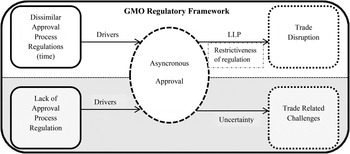
Figure 1 shows the importance of the GMO regulatory framework as the main source of AA and the main determinant of trade disruption. We separated Figure 1 into two parts to highlight the different implications for international trade when considering the environment of a dissimilar regulatory approval process and the complete lack of GMO regulation.
GMO regulatory approval process and potential for trade disruption

In the white part, above the dashed line in Figure 1, we present the situation of those countries with well-defined regulations, expertise on biosafety issues, and GMO detection facilities. Under this circumstance, the large heterogeneity in the approval process across countries drives AA, yet the restrictiveness of the requirements related to the importation of non-approved GMO event, such as the LLP policy in the importing country, drives the potential impact on trade.
In the grey part of Figure 1, the lack of approval process drives AA across countries, and providing there is no or only limited GMO regulatory requirements related to the importation of non-approved GMO events, the implication for bilateral trade is uncertain. Under this circumstance, non-approval may be not directly translated into import bans. According to Gruère (Reference Gruère2011), many developing countries are in the process of developing their GMO regulations, although most have continued to accept the presence of unauthorized GMO events in import shipments. Nonetheless, considering the uncertain environment, some trade-related challenges may arise at any time as these countries may decide to enforce a comprehensive biosafety regulation with import authorization procedures for GMO events or decide to conduct rigorous tests and monitoring of GMO crops at the port of entry.
3. Methodological approach
3.1 Clustering of national regulatory GMO frameworks
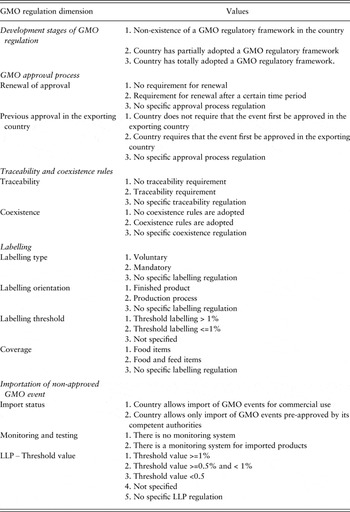
As shown in Figure 1, the trade disruption that may arise from the AA depends on the development stages of the GMO regulatory framework as well as on its restrictiveness. We conducted a statistical cluster analysis to identify groups of countries according to their current GMO regulatory frameworks composed of five dimensions each derived from a number of separate variables, as presented in Table 1. All the variables/aspects are treated as nominal ones, so the values they assume represent distinct categories rather than a rank. We used an agglomerative hierarchical cluster analysis based on between-group linkage methods, and we applied the squared Euclidean distance as the similarity measure. The cluster analysis was performed using the software SPSS.
Different national GMO regulation aspects

Source: Own compilation.
The first four dimensions of GMO regulation (development stages of GMO regulation, approval process, traceability and coexistence rules, and labelling) are widely acknowledged as being directly related to trade and have been addressed by several researchers (Gruère and Rao, Reference Gruère and Rao2007; Gruère, Reference Gruère2011; Vigani and Olper, Reference Vigani and Olper2013). Furthermore, we added a fifth dimension encompassing the restrictions regarding the importation of non-approved GMO events.
The development stages of GMO regulation is the main dimension to be considered as it separates countries with well-defined regulations from countries with a lack of regulations, and all other characteristics are dependent on the stage of development. We classified this dimension into three distinct categories, as shown in Table 1. Regarding the approval process, we considered three variables/aspects – renewal of approval and previous approval in the exporting countryFootnote 4 – that may vary considerably across countries and may add to uncertainties and delay in the market or, consequently, may result in a situation of AA. With respect to traceability and coexistence rules, we considered only the existence or non-existence of these requirements. We followed Gruère and Rao (Reference Gruère and Rao2007) to define the four variables/aspects to be considered in the labelling dimension. These are labelling type, labelling orientation, labelling threshold, and coverage. Finally, three aspects directly related to the restrictions regarding the importation of a non-approved GMO event are import status, monitoring and testing capacity, and the LLP-threshold. These three factors encompass government agencies and public and private laboratories to test and detect GMOs, while the central issue surrounding AA is the LLP-threshold value set by the importing country.
3.2 Indices of dissimilarity regarding regulatory approval of GMO events
In a second step, we focus on the quantitative measure of AA of GMO events. The heterogeneity index of trade (HIT), developed by Rau et al. (Reference Rau, Shutes and Schlueter2010), is defined on a bilateral basis by comparing standards and regulations set by an importing and an exporting country. As such, the HIT index is suitable to measure the extent of AA between two countries. Following Wieck and Dashja (Reference Wieck and Dashja2014), we propose a ranking score for the approval status, which ranges from one (the most restrictive approval status) to four (the least restrictive status).Footnote
5
Thus, define
 ${x_{k{m_{(kt)}}}}$
as the approval status for a GMO event m, for product k in a given year t, the ordinal variable assumes the scores as follows:
-
 ${x_{k{m_{(kt)}}}}$
= 1 if the GMO event is not approved for any use;
-
${x_{k{m_{(kt)}}}}$
= 2 if the GMO event is approved only for feed;
-
${x_{k{m_{(kt)}}}}$
= 3 if the GMO event is approved only for food;
-
${x_{k{m_{(kt)}}}}$
= 4 if the GMO event is approved for food and feed.


Let
 ${x_{ik{m_{(kt)}}}}$
be the rank of the approval status for a GMO event in the exporting country i; let
 ${x_{jk{m_{(kt)}}}}$
be the importing country j approval status for the same event, product, and year. Denote
 ${M_{(kt)}}$
as the total number of GMO events for each product k in a given year t, and
 $\max ({x_{k{m_{(kt)}}}})$
and
 $\min ({x_{k{m_{(kt)}}}})$
as the maximum and minimum value of the approval status for each product k and event m taken over the entire data set.
Based on the Gower index of (dis-)similarity, the HIT index between importing country j and exporting country i at point t for a given product k is defined as follows:
 $$\eqalign{HI{T_{\,jikt}} = \displaystyle{1 \over {{M_{(kt)}}}}\sum\limits_{{m_{(kt)}} = 1}^{{M_{(kt)}}} {DS_{\,jik{m_{(kt)}}}^{HIT}}}$$
where
 $DS_{jik{m_{(kt)}}}^{HIT} $
is the dissimilarity measure for each GMO event m, and it is calculated as defined in equation (2):
 $$\eqalign{DS_{\,jik{m_{(kt)}}}^{HIT} = \displaystyle{{\left \vert {x{}_{ik{m_{(kt)}}} - {x_{\,jk{m_{(kt)}}}}} \right \vert} \over {\max ({x_{k{m_{(kt)}}}}) - \min ({x_{k{m_{(kt)}}}})}}}$$
We carried out sensitivity analyses regarding the ranking score chosen for the approval status by considering two more alternatives. Firstly, the approval status is treated as an ordinal variable assuming three different scores and, secondly, as a binary variable.Footnote 6 In addition, it is worth noting that import approval is the type of approval relevant in our paper since we have defined our indices from the perspective of the importing country and we are interested in differences that may impact on trade. If we consider EU as the importer, for instance, few cultivation approvals have been delivered, so far. However, a significant number of GMO events has been approved for importing into the EU. By taking EU as the exporter and other countries as importers, it is understood that the mere fact of importing a particular GMO crop/event poses a risk of mixing GMO and no GMO crops. EU, therefore, might not be free of that GMO event any longer.
The HIT index ranges between [0,1] and increases with differences in the approval status. For HIT = 0, there is no difference in the approval status at point t between the importing and exporting country, but as the index approaches the unit value (HIT = 1), this regulatory difference increases. By averaging the sum of dissimilarity scores of each GMO event by the total number of GMO events, the index becomes invariant to the regulation intensity, which is an important property since the number of GMO events varies depending on the product and year.
Burnquist et al. (Reference Burnquist, Souza, Faria, Rau and Shutes2012) extended the HIT index to a directional heterogeneity index (DHIT), which is pertinent for evaluating differences in regulatory heterogeneity when the relative strictness of requirements between importer and exporter is relevant for the objective of the analysis. To evaluate the impact of regulatory dissimilarity upon trade, it is important to focus only on those aspects of regulatory heterogeneity where the importing country is stricter than the exporting country as this may involve compliance costs for exporting firms. The DHIT is one way to express the stringency of the regulatory dissimilarity.Footnote 7 Similar to the formulation indicated in equation (1), the DHIT index is calculated as follows:
 $$\eqalign{DHI{T_{\,jikt}} = \displaystyle{1 \over {{M_{(kt)}}}}\sum\limits_{{m_{(kt)}} = 1}^{{M_{(kt)}}} {DS_{\,jik{m_{(kt)}}}^{DHIT}} whenDS_{\,jik{m_{(kt)}}}^{DHIT} \ge 0}$$
However, this calculation involves a pre-selection of the dissimilarity measure to express only the relatively more stringent measures directed to exporters. For that purpose, the dissimilarity measure for the DHIT is calculated as:
 $$\eqalign{DS_{\,jik{m_{(kt)}}}^{DHIT} = \displaystyle{{x{}_{ik{m_{(kt)}}} - {x_{\,jk{m_{(kt)}}}}} \over {\max ({x_{k{m_{(kt)}}}}) - \min ({x_{k{m_{(kt)}}}})}}}$$
The calculated values of the DS are selected to compose the DHIT index following specific procedures. A positive value for the dissimilarity measure
 $DS_{jik{m_{(kt)}}}^{DHIT} $
> 0 indicates that the approval status of the importing country j are stricter for an event m than those of the exporting country i. In this case, this is an indication that the exporting country might have to make adjustments to comply with the requirements. Consequently, these are the values that are included in the DHIT calculation. All negative dissimilarity measures,
 $DS_{jik{m_{(kt)}}}^{DHIT} $
< 0, are not included in the DHIT calculation because these values suggest that the approval status introduced by the importing country j for an event m are the same or are less restrictive than those of the exporting country i. Non-established GMO regulations are considered in our indices as the most restrictive approval status since the majority of the countries that lack GMO regulations do not approve GMO events.
If there is a specific GMO event that is approved for both commercial uses (food and feed) in the exporting country, but it has not yet been approved in the importing country, the exporters might have problems exporting to this specific country. Accordingly, this dissimilarity is taken into account in the index calculation by equation (4). On the other hand, if the importing country has already approved the event for both commercial uses (food and feed) and the exporting country has not, we are faced with a dissimilarity that is captured by the HIT, but not by the DHIT.
The DHIT index also ranges between [0,1], where values close to zero suggest lower stringency with respect to importer requirements. Values close to one indicate that requirements enforced by the importers are relatively more stringent than those of the exporting countries.
Compared to its initial versions, we have extended both indices with a time dimension to consider dynamic developments over time. In addition, we have adopted the simplest approach regarding the weighting of different events in that all GMO events have the same weight (and importance) in the index calculation.
An important issue considered in our index calculation is the proximity of the respective GMO event to the market (Stein and Rodríguez-Cerezo, Reference Stein and Rodríguez-Cerezo2010). Following these authors, we have considered two groups of GMO events: (1) all GMO events that comprise the events authorized in at least one country, and which are either commercialized or not yet commercialized, but whose commercialization depends only on the decision of the developer and (2) a commercial event, which is a sub-group of 1 and which comprises only the GMO events currently marketed in at least one country.
In the HIT index calculation, both groups of events are considered, as the aim is to verify where countries stand in terms of their regulatory approaches towards authorized GMO events. However, in the DHIT calculation, only those events that are currently marketed in at least one country worldwide are included, because the aim is to measure AA that might cause trade friction due to commercialized GMO events.
3.3 Data
We built a data set that takes into account information on 185 authorized GMO eventsFootnote 8 for cotton, maize, and soybean, and information about the actual regulatory framework for 41 countries.Footnote 9 We selected the countries according to their share in the international tradeFootnote 10 of cotton, maize, and soybean and their regulatory approval status considering all countries that have already granted regulatory approvals for at least one biotech crop for food and/or feed uses.
Information regarding the national GMO regulation aspects ruling GMO cultivation and commercialization is provided by the Foreign Agricultural Service (FAS) of the United States Department of Agriculture (USDA) through the Global Agriculture Information Network (GAIN) reports on biotechnology (USDA/FAS, 2013). Summary statistics regarding the five dimensions of national GMO regulations can be found in Table 1A in Web appendix.
The main data sources are the ISAAA/GM Approval Database (ISAAA, 2013) and the CERA GM Crop Database (CERA, 2012), which provide approval process information regarding GMO events that are identified by their names and codes. A summary of regulatory approval is provided for each event with information on the countries that have already authorized the event, the first year of approval, and the type of approval (food, feed, or cultivation). Information about events currently marketed in at least one country worldwide is provided by the Biotechnology Industry Organization through the Biotradestatus website database (BIO, 2013).
As the ISAAA/GM Approval Database contains the first year of approval for each event and country, we built a dynamic data set that contains the status for the stock of approved GMO events for each country over the period 2000–2013. Based on the market status for each event in 2013 (event is commercialized or not) and knowing the first year of approval worldwide, we categories an event as either commercialized for the period 2000 and 2007 or not commercialized. We assume a seven-year interval as sufficient for assessing the changes in the stock of events over time and for obtaining the results for the years 2000, 2007, and 2013. An overview on the stock of approved GMO events and on commercialized events can be found in Table 2A in the Web appendix.
4. Results and discussion
4.1 Regulatory differences across countries
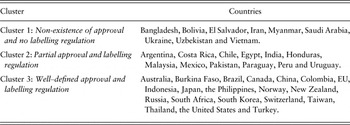
By considering the national GMO regulation in Table 1 and based on the dendrogram and the proximity matrix, the cluster analysis separates the countries into three groups presented in Table 2.
Country clusters by national GMO regulation aspects

Note: Saudi Arabia has already adopted GMO regulations. A country is included in cluster 1 if it allows for the importing of unprocessed and processed agricultural products as long as they are approved in the country of origin for human or animal consumption or planting. The cluster analysis classifies Turkey in cluster 1 because it only approves events for feed (approval status equal 2). When this variable is taken out of the analysis, Turkey is classified in cluster 3, independent of the method applied. Considering that Turkey has already adopted a comprehensive GMO regulation, we kept it in cluster 3.
Source: Own compilation.
There are two entirely distinct clusters (1 and 3) and the potential trade disruption through AA is quite dissimilar for each. First, cluster 3 – well-defined approval and labelling regulation – is composed of countries that have already adopted extensive regulations that include a regulatory framework both for approving GMO events and labelling policies for marketing GMO products.Footnote 11 All countries in cluster 3, except for Burkina Faso, have a strict import policy, allowing only the importing of GMO events pre-approved by their competent authorities. These countries also have laboratory facilities and skilled staff to conduct effective GMO monitoring and testing for imported GMO products. In addition, the majority of these countries have strict LLP policies that range from zero-tolerance and ‘technical zero’ tolerance (Brazil, Canada, China, EU, Japan, and Turkey) to low threshold tolerance (0.5%) (South Korea and Switzerland). Considering the restrictiveness of the policy designed to deal with GMO crops, the AA is likely to disrupt trade in countries of cluster 3.
Second, cluster 1 – non-existence of approval and no labelling regulation – includes mainly those countries where neither the regulatory framework for approval process nor the labelling policies have been adopted. Although these countries are in different stages of development of their GMO regulations, they have not been consistently moving towards the enforcement of GMO regulations.Footnote 12 Despite having no regulations for approving GMO events, the majority of these countries allow for the importing of GMO agricultural products for commercial use and there is no monitoring system for GMO crops.Footnote 13 Regarding LLP policies, none of the countries in this cluster enforces any specified threshold for unapproved GMO events. Considering the lack of regulations and the low stringency regarding the importation of GMO products, AA is not likely to disrupt trade in countries of cluster 1 in the short-term; however, asynchronicity might create some challenges to international trade in the future in the instance of the establishment of restrictive case-by-case GMO authorizations.
Finally, cluster 2 – partial approval and labelling regulation – is composed of countries that have already approved a regulatory framework for approving GMO events (Argentina, Mexico, Costa Rica, India, Honduras, Malaysia, Mexico, Pakistan, and Uruguay) as well as countries whose current regulatory framework is, as yet, incomplete (Peru, Egypt, Paraguay). Furthermore, these countries have not made any decisions regarding packaged food or feed originating from GMO crops. In other words, they have not established regulations on labelling.Footnote 14 Some of the countries allow for the importing of GMO agricultural products for commercial use, and they do not monitor or test for GMO products. With respect to LLP policies, these countries do not specify any threshold value for unauthorized GMOs. Given these characteristics, the relation between AA and disruption in trade is difficult to predict.
4.2 The extent of asynchronous approval and potential for trade disruption
While the HIT index measures the dissimilarity in the approval status for a pair of countries for each GMO event and thus indicates the extent of the AA across countries, the DHIT index provides information about the potential trade friction that might arise from the AA whether a specific GMO event is approved for commercial use in the exporting country but not in the importing country. We calculated 29,520Footnote 15 country pair scores for HIT and DHIT, and we analysed them using both descriptive statistics and frequency analyses. For major importing and exporting countries selected according to their shares in global imports and exports of cotton, maize, and soybean, we also display HIT and DHIT scores.Footnote 16 We emphasize the analysis of these countries, as the pattern of AA may determine the possible impact on international trade.
We systemized the country pair scores for the HIT and DHIT into five categories (from no differences to very large differences) based on whether regulatory differences in the approval status exist so that AA (HIT) and AA that might disrupt trade (DHIT) could be observed. A HIT score of, for example, 0.07 between Australia and Argentina for cotton in the year 2000 (Table 4A) indicates that across all GMO events registered for cotton in our database for that year, only small differences in approval status between the country pair existed. Hence, only a small degree of AA is detected. Our indices are robust to the sensitivity analyses regarding the ranking score as shown by the high correlation between them in Web appendix (Table 3A).
4.2.1 Regulatory approval: dissimilarity across countries considering all GMO events
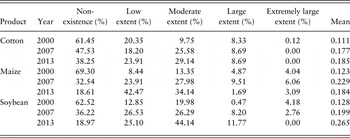
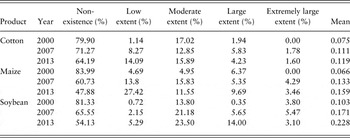
Several interesting patterns emerge from Table 3, which shows the mean for the HIT index by product and year and the percentage of total country pairs categorized according to AA levels by product and year. First, the index has changed over time, as evidenced by the mean, thus denoting the dynamics behind the approval process of GMO events. Also it is noted that the increasing value of the mean indicates a diverging regulatory path between the pair of countries over time. Second, in 2000, only a few countries had introduced GMO regulations. Furthermore, the cultivation and even the commercial use of GMO crops were not allowed in the majority of these countries. Consequently, they were more similar in terms of approved events, and thus, the means assumed low values, not higher than 0.128 (soybean). However, the maximum HIT reached a peak in 2000. This is because the leading countries in the adoption of biotechnology, such as the United States and Canada, were completely dissimilar from other countries. As other major players introduced their GMO regulations and started approving GMO events, the dissimilarities between the United States and these countries decreased; however, the dissimilarities for the entire sample increased, as shown by the mean. Cotton has the least volatile average HIT for the entire period, while in 2013 soybean is the product with the highest AA level followed by cotton and maize.
Regulatory dissimilarity across countries and extent of AA – all GMO events (mean HIT, and percentage of HIT index in categories)

Note: Non-existence: HIT = 0; Low extent: 0 < HIT ⩽ 0.2; Moderate extent: 0.2 < HIT/DHIT ⩽ 0.5; Large extent: 0.5 < HIT/DHIT ⩽ 0.8; Extremely large extent: 0.8 < HIT/DHIT ⩽ 1.
Source: Own calculation.
The percentage of country pairs presenting a non-existence of AA for cotton, maize, and soybean declined steadily over the period, thereby indicating a consistent increase in the asynchronicity across countries, especially for maize and soybean. In 2000, more than 60% of the country pairs presented HIT values equal to zero for the three products, while in 2013 this percentage was only 18.6% and 19% for maize and soybeans, respectively. On the other hand, the number of country pairs exhibiting an extremely high extent of AA diminished over the study period as a consequence of the reduction in the dissimilarities between the United States and other countries that approved GMO regulations, such as Japan in 2001, the EU in 2003, and Brazil and Mexico in 2005. Regarding the current AA situation, Table 3 shows that the scores for the majority of country pairs with respect to AA are either low or moderate in 2013; however, some extremely high asynchronicity exists in some country pairs, especially for maize.
Table 4A (Web appendix) presents the HIT index results for country pairs taking into consideration the major players in international trade. The result is a symmetric matrix, which means, for instance, that the difference between Argentina and Brazil is the same as that between Brazil and Argentina. The majority of country pairs presented HIT values (for the three products) higher than the average HIT (Table 3), indicating that AA among the major players is higher than it is for the whole country set. However, the HIT results for the major players provide similar qualitative findings as those obtained with our whole country set. It is noted that the HIT index increased for the majority of country pairs, which means that the main importing and exporting countries have become more dissimilar in terms of their approval status for GMO events over time. A different pattern can be observed for the United States and Canada as a steady decrease in their index value for the study period is evidenced.
Focusing on the current AA situation in the year 2013 for cotton and maize, we find that Japan and the United States are the most dissimilar countries when compared with their counterparts. Japan–Taiwan is the most dissimilar pair for cotton (0.72), while for maize the most dissimilar pair is Japan–China (0.77). However, the situation is different for soybean, where, apart from the United States and Japan, other pairs, such as Canada–Argentina (0.55) and Mexico–Canada (0.55), are found to be the most asynchronous. On the other hand, Argentina–Brazil is the most similar pair both for maize and soybean, and China–Taiwan is the most similar pair for cotton.
The increasing asymmetry for the majority of countries (as shown by the mean, by the low percentage of country pairs presenting non-existence of AA in 2013, and by the HIT values displayed in Table 4A) reveals that AA is now a widespread phenomenon occurring in many country pairs. In other words, AA is no longer restricted to countries in North America as it was in 2000. Accordingly, it can be concluded that the countries experienced a diverging regulatory path between 2000 and 2013 and became progressively less synchronized regarding their GMO approval status, resulting in potential trade friction.
4.2.2 Importing countries with more stringent regulatory approval: commercial events
Although the AA has increased over time, it might not be a risk to international trade if importing countries are less restrictive than exporting ones. Thus, the stringency of the GMO approval status of the importing country is an important aspect. It can be measured by the DHIT index. Table 4 shows the mean and the percentage of total country pairs in each level of AA that might disrupt trade by product and selected years
Extent of AA in countries with more stringent import approval – only commercial GMO events (mean DHIT and percentage of DHIT index in categories)

Note: Non-existence: HIT = 0; Low extent: 0 < HIT ⩽ 0.2; Moderate extent: 0.2 < HIT/DHIT ⩽ 0.5; Large extent: 0.5 < HIT/DHIT ⩽ 0.8; Extremely large extent: 0.8 < HIT/DHIT ⩽ 1.
Source: Own calculation.
The increasing value of the mean suggests that, on average, countries become more dissimilar with respect to their GMO approval status for the three products. The findings are qualitatively similar to the pattern verified for the HIT (Table 4A). That is, the percentage of country pairs presenting the non-existence of AA that might disrupt trade declined steadily over the period, and the substantial reduction is verified for maize and soybean. However, it is noted that the percentage of the non-existence of AA that might disrupt trade is considerably higher than the HIT percentage. With respect to the current situation in 2013, we observe that for a substantial percentage of country pairs, the importing country is equal to or less stringent than the exporting country. The percentage ranged from 47.8% for maize to 64% for cotton. The DHIT index also indicates that there is an increasing number of country pairs presenting with extremely high extents of AA that might disrupt trade, particularly for soybean, which means that some importing countries are becoming increasingly more stringent than exporting countries. Overall, it seems that the world is still characterized by a non-existence of AA that might disrupt trade, which indicates that the majority of countries are somehow synchronizing their approval status for commercial events over time.
Table 5A (Web appendix) shows the results of the DHIT index for country pairs while taking into consideration the major players in international trade in cotton, maize, and soybeans. The exporting countries are shown in the columns and the importing countries are displayed in the rows.
Although the HIT value has risen for the major players, thus indicating an increasing AA over time, the same pattern is not observable for the DHIT. Considering only commercial events, the results indicate that the main exporting countries (Argentina, Australia, Brazil, Canada, and the United States) have synchronized their approved events with the main importing countries (China, the EU, Japan, Mexico, and Taiwan) over time, especially for maize and soybean. The case of soybean is emblematic of this synchronicity given that, in 2013, the exporting countries are found to be perfectly synchronized with China and the EU, indicating that these importing countries are not more stringent in their approval status of GMO events. The evolution of the DHIT index for the major players may reveal the strategy of these countries, especially exporting countries, to address AA and reduce trade frictions by selecting GMO events to be commercialized only when the loss of sensitive import markets is not a serious threat, as already shown by Berwald et al. (Reference Berwald, Carter and Gruère2006).
The findings that consider only the major players combined with the results from the whole country set allow us to conclude that the high percentage of country pairs presenting the non-existence of AA, which might disrupt trade, is the result of the synchronization among the most important importing and exporting countries, while the increasing percentage of country pairs presenting extremely high AA is the result of the lack of GMO regulations in some countries.
Despite the movement towards a more synchronized approval status as a whole, some asymmetries arise from more stringent regulations in the importing country. With respect to cotton and maize, we observe that Brazil moved in the opposite direction from the other major exporters, as noted by its increasing DHIT value with respect to the importing countries China, the EU, Mexico, and Taiwan. The science-based approval system adopted in Brazil in 2005 has facilitated the fast approval of new GMO events in the country. A huge increase in the number of approved events, especially for cotton between 2007 and 2013, may explain the asymmetry between the importers and Brazil.
Some potential for trade disruption is emphasized by the highest DHIT value for cotton in the Brazil–Taiwan (0.47) country pair. With respect to maize, the highest DHIT value is for the United States–Australia (0.61) pair followed by the United States–Mexico (0.34) pair, and the United States–Taiwan and the United States–EU (0.32) pairs.
4.2.3 AA and potential for trade disruptions
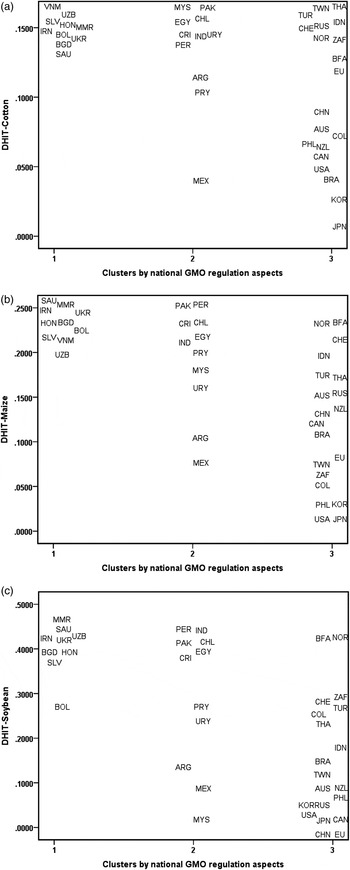
By combining the stringency of the GMO approval status of the importing country, measured by the DHIT with the country clusters by national GMO regulatory aspects, we aim to identify those countries that are more likely to face incidents related to low level presence, which arises from the AA of GMO events. To evaluate the 41 countries, we calculated the average DHIT value considering each country as an importer and all others as exporters in the year 2013. In Figure 2, the DHIT is measured along the vertical axis while the GMO regulatory framework is considered along the horizontal axis throughout the clusters. Starting from the origin, the stages of the development of GMO regulations increase from cluster 1 (non-existence of approval, no labelling regulation) to cluster 3 (well-defined approval and labelling regulation).
Relation between regulatory difference and DHIT: (a) cotton; (b) maize, (c) soybean

The top right corner of Figure 2 represents the area with a higher potential for LLP incidents and trade disruptions as it simultaneously represents a high DHIT value and well-defined regulations with strict import status and LLP policies. The top left corner of Figure 2 is the region of uncertainty and trade challenges as it represents a high DHIT value but a lack of GMO regulations. The top central region of Figure 2 is the most difficult area for predicting trade disruption. Finally, toward the bottom of Figure 2, the potential for LLP incidents and trade disruption is reduced.
Examining the countries plotted in Figure 2, a similar pattern is observed for the countries in cluster 1 (the top left corner), that is these countries present the highest DHIT index value for the three products. Although, in the short term, this asynchronicity is not likely to create incidents related to LLP, as there is no restriction concerning the importation of GMO products, the high AA presented by these countries might create trade challenges at the moment they decide to move towards tight GMO regulations with a case-by-case import authorization process.
A changing pattern is observed for cluster 3 as the countries considerably change their position depending on the product being analysed. Nevertheless, some countries, such as Japan and South Korea, are consistently in the bottom right of Figure 2, indicating that they are synchronized with their partners, while others (such as Norway and Burkina Faso) are systematically in the top right corner, indicating higher potential for trade disruption. However, while Norway already conducts compulsory testing by authorities to monitor and detect the presence of GMO events, Burkina Faso is in the process of identifying laboratories to monitor GMO events and training staff to test for GM products (FAS, 2013c). Furthermore, Switzerland, Turkey, and Thailand are consistently found in the area with a higher potential for LLP incidents for the three products.Footnote 17 However, Thailand allows the importation of transgenic plants for processed foods, soybean, and corn feed, thus reducing potential frictions (FAS, 2013d).
Figure 2(c) shows that more countries are located at the bottom compared with Figures 2 (a) and (b), thus indicating less probability of LLP incidents for soybean. Furthermore, nine countries (Canada, China, European Union, Japan, Malaysia, South Korea, Russia, the Philippines, and the United States) are perfectly synchronized in terms of commercialized events for soybean as they present a DHTI value equal to zero. Considering the small number of currently commercialized GMO events for soybean and the fact that a few countries dominate international trade for this commodity, it is easier to coordinate the approval of the events in the main importing countries or to adopt the strategy to wait for the approval from the main importing countries. With respect to maize and cotton, for which there are more commercialized GMO events and for which international trade is not heavily concentrated in a few countries, international coordination is not easily achievable.
5. Conclusion
Using two dissimilarity indices and drawing on a comprehensive database, we measure both the extent of the AA in the authorization of GMO events and the differences in stringency between importing and exporting countries with respect to cotton, maize, and soybean for the period 2000–2013. With an increase of approved GMO events for maize from 12 to 115 and for cotton from 14 to 34, we observe a rather dynamic development in the approval of GMO events between 2000 and 2013. However, the regulatory frameworks of countries to address these new technologies move at different paces that results in a situation that is characterized by AA processes and potential trade-related compliance and deflection issues.
Using the regulatory dissimilarity index HIT and focusing on all GMO events, an increase in the regulatory dissimilarity across country pairs is observed, thus indicating that the countries have become more dissimilar in terms of their approval status for GMO events over time. The approval status for GMO events differs considerably across countries, especially for maize and soybean markets, which suggests a relatively weak synchronization of GMO approval events among countries and the existence of AA. Furthermore, the increasing asymmetry combined with greater harmonization of countries toward the United States and Canada reveals that AA is now a widespread phenomenon occurring in many country pairs and that, accordingly, it is not restricted to countries in North America.
However, when we consider the stringency between importing and exporting countries and focus only on commercialized events, AA that might disrupt trade is considerably lower for the major leaders in trade, thus indicating that they have synchronized their approval status for the GMO over time. This result indicates that the exporter may act strategically and wait for the approval process in the main importing markets before launching the event in the market. A different path is observed for countries in their initial stage of the GMO regulatory framework. As they have not yet established their legal and technical apparatuses to approve new GMO events, a widening gap between the major leaders and these countries is found in 2013.
Despite the observed synchronicity between the main importers and exporters, when we examine the maize market we observe a potential for trade disruption mainly regarding the bilateral trade between the United States and its partners – China, Mexico, and the EU. In addition, considering the three products, Norway seems to be the country with the highest potential for LLP incidents and trade disruption, followed by Switzerland, Turkey, and Thailand. Japan and South Korea are less likely to have trade frictions through LLP incidents.
The increasing AA across countries leads to two policy considerations. First, as there is no guarantee that the sensitive export markets will continue to influence the release of GMO events in the near future, it is essential that the main importing and exporting countries actively pursue the harmonization of national authorization processes and LLP policies of GMO events to address the asymmetry. Second, it may be challenging for less developed and developing countries to establish and enforce their regulatory frameworks, which means that collaborative actions and the exchange of information is essential for reducing the gap between these countries and the leading countries.
Supplementary material
To view supplementary material for this article, please visit http://dx.doi.org/10.1017/S1474745615000336.