1. Introduction
My concern is […] how Cognitive Grammar and discourse might be brought together, as a matter of principle. I would be very pleased if this were the catalyst for scholars with the proper expertise to investigate their relationship more systematically. (Langacker, Reference Langacker2001, p. 144)
1.1. at the tourist-information office: sketching the object of analysis
On a quiet evening in spring, the following transaction took place between the female service agent (Off) and a male customer (T) in a tourist-information office in Switzerland. The service provider is a native-speaker of Swiss German. This is reflected in turn (2) where she greets the tourist in the local dialect by saying Gueten Oobe (‘good evening’). In her subsequent turns, she switches to English to accommodate to the British tourist. The officer’s competence in English is solid but clearly non-native. T is one of three English-speaking business travelers who are looking for accommodation.Footnote 1
Extract 1: booking accommodation
1 T Hello
2 Off Gueten Oobe [greeting in local dialect: ‘good evening’]
3 T I - do you speak English?
4 Off Yes
5 T We’re looking for three single rooms for tonight please?
6 Off uh hum
7 T for one night
8 Off for one night … and what would you like to have?
9 T erm three or four star?
10 Off three or four star, it will be LITTLE bit difficult.
11 T Right?
12 Off Just a minute. Takes a while [starts typing into computer]
13 T OK
14 Off And somewhere in the city yeah, not outside? … IN the city.
15 T erm in the city preferably yeah.
… … continued
Extract 1 constitutes one token from 100 front-desk tourist-information transactions audio-recorded and transcribed in 2006. Following Heritage (2005, p. 106), the transaction can be described as an institutionalized conversation, i.e., a speech genre with stable discursive norms that impose constraints on allowable speech turns, lexical choice, syntax, and speech style (see also Drew & Heritage, Reference Drew and Heritage1992a). The interaction thus depends on the presence of specific linguistic structures (highlighted in bold type) that are associated with the practice of booking a hotel room. The purpose of the conversation can be easily reconstructed when reading these phrases.
Although dealing with the same service, Extract 1 is noticeably different from Extract 2. This interaction took place at the very same tourist-information office one week later. However, at that time, the host city was completely booked out due to a major sports event and a huge international trade fair. Off is the same service agent as in Extract 1, whereas T is an English supporter of a British football team that played an international match against the local team in the evening.Footnote 2
Extract 2: booking accommodation with a difference
1 T Hi, I’m erm what is the cheapest room tonight? Do you have much accommodation?
2 Off Well the cheapest one is somewhere outside because there is no room available. [slightly annoyed tone of voice]
3 T Outside as in … outside the city you mean?
4 Off No [laughs] outside of the rooms … outside … there is no hotel available … we have only … maybe you get an accommodation at the YMCA.
5 T Yeah, or a youth hostel?
6 Off Or the youth hostel but I’m afraid it’s booked.
… … continued
The most striking difference between the two conversations concerns the use and meaning of outside. The officer answers the tourist’s request for a cheap room by suggesting the cheapest one is somewhere outside (2). In (3) the tourist interprets this answer according to its most salient meaning in the booking-a-hotel-room context: Outside as in … outside the city you mean? Note that his interpretation corresponds exactly to the one in turns (14) and (15) in Extract 1. The officer, however, ascribes a completely different situated meaning to outside; to tease the tourist ironically, she proposes that he sleeps in the street.
The officer’s spontaneous and non-conventional behavior exemplifies the central tenet of conversation analysis (CA), that talk-in-interaction is locally and opportunistically managed (Drew, Reference Drew, Fitch and Sanders2005, p. 94). According to this assumption, both meaning and context emerge from an interactional process of turn-by-turn negotiation (Sacks, Schegloff, & Jefferson, Reference Sacks, Schegloff and Jefferson1974). In line with this view, Clark (1996, p. 351) claims: “Conversations aren’t planned as such. They emerge from the participants’ attempts to do what they want to do […] The result is often a conversation that looks orderly even though each step of the way was achieved locally and opportunistically.” This strong emphasis on the interactional management of meaning, however, seems to contradict the more conventional and institutionalized character of Extract 1. In contrast to the idea of local management, the notions of speech genre or speech activity – most prominent in the ethnography of communication (EoC) – entail that many conversations indeed follow an institutionalized procedure. Therefore, they are prestructured and subject to conventional expectations of form and interpretation (Heritage, Reference Heritage, Fitch and Sanders2005, p. 104). This discrepancy between the more dynamic and situated view of interactional discourse advocated by CA and the more stable and convention-oriented view adopted by EoC also remains unresolved in Clark’s theory. Namely, with reference to Levinson’s (Reference Levinson1979, Reference Levinson, Drew and Heritage1992) notion of activity type, Clark describes linguistic practices as “goal-defined, socially-constituted, bounded, events with constraints on participants, setting, and so on, but above all on the allowable contributions” (Clark, Reference Clark1996, p. 30, emphasis added). The discrepancy between Extract 1 and 2 centered around the different readings of the spatial adverb outside is theoretically interesting because it encapsulates this fundamental dilemma in discourse analysis. How can the empirical fact that meaning is locally and interactionally managed be reconciled with the empirical fact that conversations are subject to genres or activity-types that impose overarching expectations of allowable contributions and corresponding inferences?
1.2. the aim of the paper
Engaging with the data from the two extracts, this theoretical paper is an attempt to approach the discourse-analytical challenge from the perspectives of cognitive linguistics and grounded cognition. Interestingly, the alternative models of language that are offered in the field of cognitive linguistics also seem to be caught in the central dilemma of bridging its dynamic, context-specific, and situationally managed dimensions with the more conventional and stable symbolization practices of a given language community. For instance, while mental space theory and blending theory model the dynamic construal processes of on-line meaning generation (see Fauconnier, Reference Fauconnier1997; Fauconnier & Turner Reference Fauconnier and Turner1998, Reference Fauconnier and Turner2002) and thus seem to be compatible with CA (Oakley & Hougaard, Reference Oakley and Hougaard2008), more traditional, grammatically oriented approaches such as cognitive grammar (Langacker, Reference Langacker1987, Reference Langacker1991) or construction-grammar (Croft, Reference Croft2001; Goldberg, Reference Goldberg1995; Östman & Fried, Reference Östman and Fried2005) attempt to model the symbolic nature of grammatical patterns in terms of the relatively stable conceptualizations that are associated with linguistic forms. The latter approaches position themselves as usage-based, i.e., they claim that symbolic associations between form and meaning are derived from concrete instances of language use. Therefore, these models should be more compatible with genre-analytical models of discourse.
Most importantly, Langacker (Reference Langacker2001, Reference Langacker2008) has proposed the current-discourse-space (CDS) model as a framework to approach the management of meaning through discourse. In this paper I would like to take up Langacker’s offer in the above vignette and investigate the interface between cognitive linguistics and discourse analysis in further depth. I will argue that the usage-based conception of language advocated by Langacker’s CDS model offers an epistemological escape route from our discourse-analytical dilemma. Based on the assumption that conventional linguistic knowledge – including the knowledge of discursive expectations – is derived from concrete usage events, the model can account for both context-specific conceptualization practices that are locally managed as well as the more conventional procedural and conceptual states that are associated with a given speech-activity type.
To ground Langacker’s framework in the recent and vibrant psychological paradigm of grounded cognition, I will further attempt to integrate the CDS model with the psychological model of situated conceptualization proposed by Barsalou (Reference Barsalou2003, Reference Barsalou, Cohen and Lefebvre2005, Reference Barsalou2010). By combining Langacker’s and Barsalou’s heuristics, the paper sketches a grounded socio-cognitive description of meaning construction in context that combines (i) the situated conversational management of meaning negotiation with (ii) the analysis of the discursive knowledge and the communicative competence that underlies speech-activity types.
To develop this model, the paper is structured as follows. In the next section, I will shortly outline Levinson’s (Reference Levinson2006) tripartite view of discourse as a starting point to make a case for an integrative socio-cognitive model of discourse engagement. Relative to Levinson’s blueprint, the central tenets of CA and EoC are sketched and contrasted. On the basis of this comparison, I will argue for the central importance of a cognitive perspective on discourse for integrating the dynamic social-interactional view of CA with the more stable social-institutional view of EoC. This integrative framework is then established by discussing Langacker’s CDS model against the tenets of CA and EoC (Section 3) and by integrating it with Barsalou’s theory of situated conceptualization (Section 4). To illustrate the model, Extract 2 will then be analyzed by means of this integrative approach in Section 5.
2. Towards an integrative socio-cognitive framework of discourse analysis
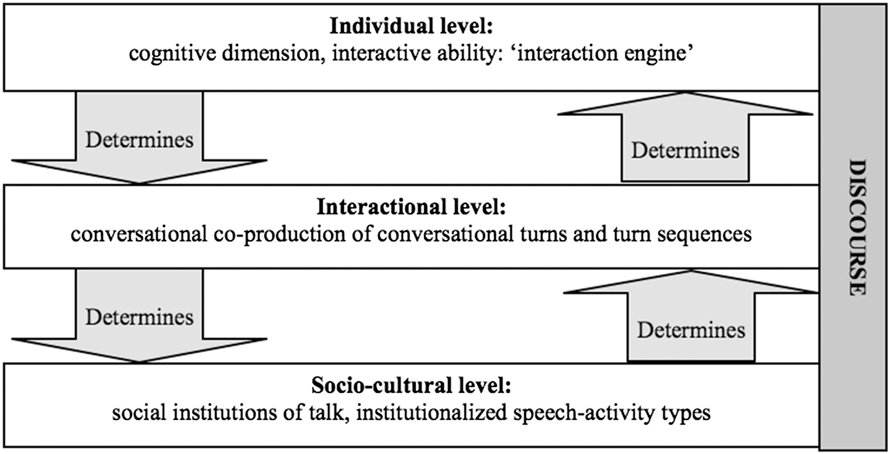
Levinson (2006, p. 91) suggests analyzing discursive practices along “three distinct ontological levels involved in the conduct of communicative interaction”. The three levels are illustrated in Figure 1. The first level, termed ‘individual level’, captures the cognitive predispositions, representations, and processes that make it possible for a human being to engage in language-based social interactions. Levinson (p. 87) calls this set of cognitive skills the ‘interaction engine’. The ‘interactional level’ constitutes the second dimension. It involves the emergent structures of conversational behavior: co-produced conversational turns and interactional sequences. Finally, the third or ‘socio-cultural level’ comprises institutionalized linguistic practices or speech activity types such as our tourist-information transactions.
Levinson’s three-level model of discourse.

In what follows, I will flesh out this blueprint for an integrative socio-cognitive analysis of discourse by discussing the interactional and the socio-cultural levels against the major tenets of CA and EoC, respectively.
The interactional level in the model captures the CA focus on the local and interactional management of discourse. CA centrally postulates that the meaning of any given utterance is only determined by how two (or more) interactional partners jointly relate to the discursive context of what was said before and what they expect to be said after. This situated nature of conversational management is revealed with regard to three intertwined levels of analysis: (i) the specific turn design, (ii) the sequential positioning of turns, and (iii) the overall sequence organization of a conversation (see Drew, Reference Drew, Fitch and Sanders2005, p. 79; Heritage, Reference Heritage, Fitch and Sanders2005, p. 105).
Turn design plays a central role for managing the construction of meaning in a conversation (Drew, Reference Drew, Fitch and Sanders2005, pp. 82–86). The design of a turn is reflected by its turn construction units, i.e., the set of linguistic units, including the hesitations, pauses, false starts, and self-repairs from which a turn is constituted (p. 80). With regard to the local and interactional nature of meaning-generation, these latter characteristics of speech turns are of particular interest to CA because they reflect the speaker’s efforts in designing the turn for the reception by his/her communicative partner. For instance, turn (3) in Extract 1 features a false start and a self-repair: I - do you speak English? Instead of continuing the turn with the personal pronoun I, the tourist first asks the officer to switch to English. CA is centrally interested in such features of recipient design, which reveal that the speaker preconceives the recipient’s potential understanding and therefore adapts the construction of his/her turns to the interactional management of the conversation (p. 89). Methodologically, conversation analysts are therefore interested in re-establishing the motivation for such unexpected features of the specific local design of a given turn.
The local management of conversational work also becomes apparent in the sequential positioning of turns (Heritage, Reference Heritage, Wetherell, Taylor and Yates2001, p. 52). This concept captures the conversational phenomenon that the construction of turns directly reflects their position in the conversational sequence of utterances. Every turn orients to the previous turn and triggers a projection of a relevant next turn. This, for instance, is reflected in turn (8). When the service agent repeats for one night, she orients back to the tourist’s answer in (7), but when she continues with and what would you like to have?, she further invites the tourist to provide the corresponding information and projects his turn (9) as a relevant next move in the sequence of conversational actions. Therefore, the sequential positioning of turns shows that individual utterances cannot be analyzed in isolation. Rather, they constitute local steps in the interactors’ production of the dynamically emerging conversation. Thus, rather than regarding conversations as following a pre-established order, CA conceives the structure and meaning of turns as the emergent products of the interactors’ joint and local management of conversational sequences. Conversation analysts regard these conversational and interactional skills as essential for the communicative partners’ communicative competence and their mutual recognition as accountable social agents (Garfinkel, Reference Garfinkel1967).
The socio-cultural level in Levinson’s framework is fully compatible with the view of discourse advocated by the EoC. According to this approach, social practices such as classroom teaching, dinner conversations, wedding ceremonies, story-telling, and so forth are considered the most important determinants of corresponding linguistic behavior or ways of speaking (Philipsen & Coutu, Reference Philipsen, Coutu, Fitch and Sanders2005, p. 355). As outlined in the ‘Introduction’, such institutionalized practices impose structural constraints on turn design, sequential positioning, and sequence organization as captured by Levinson’s notion of activity types:
I take the notion of activity type to refer to a fuzzy category whose focal members are goal-defined, socially constituted, bounded, events with constraints on participants, setting, and so on, but above all on the kinds of allowable contributions. Paradigm examples would be teaching, a job interview, a jural interrogation, a football game, a task in a workshop, a dinner party, and so on. (Levinson, Reference Levinson, Drew and Heritage1992, p. 69)
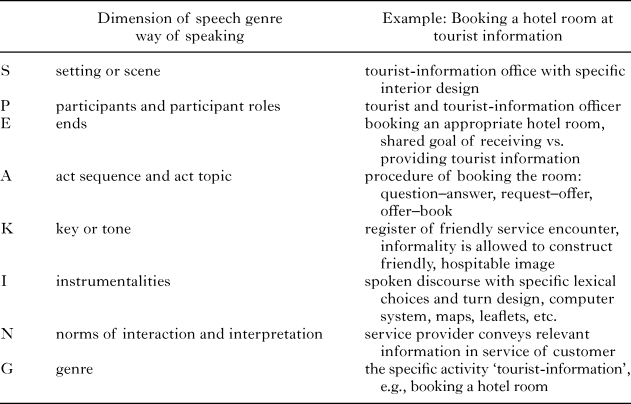
The formal constraints imposed by activity types are associated with activity-specific inferential procedures. Unlike in CA, ways of speaking and activity types are not primarily conceived as talk-in-interaction. Rather, the EoC shifts its scope of analysis beyond the interactional management of ‘what is said’ to scrutinize the institutionalized and presupposed knowledge associated with speech events (Hymes, Reference Hymes, Gumperz and Hymes1972, p. 39). This knowledge is described in terms of the communicative competence that a member of a given speech community must acquire to speak and interact appropriately in a given social situation (Lillis, Reference Lillis and Brown2006, p. 669). Hymes (Reference Hymes, Gumperz and Hymes1972) developed the SPEAKING-model to capture both the linguistic, communicative, and social dimensions of different ways of speaking as well as the corresponding knowledge that speakers must possess to successfully manage a given speech activity. The SPEAKING acronym works as a mnemonic device to describe the variables that shape alternative speech events. In Table 1, these variables are applied to our tourist-information examples, which reflect one way of speaking at a tourist-information office.
Tourist-information as a way of speaking analyzed according to Hymes’ SPEAKING-grid
With regard to the linguistic and interactional dimensions of ways of speaking, the notions of ‘act sequence/topic’, ‘instrumentalities’, and ‘key/tone’ are of special interest. The notion of instrumentalities points to the particular language or language varieties used and the mode of communication: spoken, written, or computer-mediated language (Lillis, Reference Lillis and Brown2006, p. 668). Hence, it is important to emphasize that EoC does not merely restrict its focus to linguistic signs, but it is also interested in the question of how these signs are intertwined with other symbolic practices such as reading a map or using a computer booking system in the case of tourism-information. Instrumentalities are recruited to perform a number of linguistic acts that characterize the given speech event: “the linguistic code is displaced by the speech act as the focus of attention” (Hymes, Reference Hymes, Gumperz and Hymes1964, p. 13). These acts are performed through specific utterances such as requests, greetings, etc. The presence of expected act sequences and act topics transcends the CA focus on the local management of turns and turn sequences to highlight the conventionalized arrangement of turn sequences in the given transaction. But rather than being universal linguistic moves, these act-utterances must be performed with activity-specific keys. The speech community expects utterances to reflect the particular manner, tone, and spirit that is seen as the accepted norm of a given speech event.
Although speech genres are conventionalized, they can often reflect variability and change, as reflected in Extract 2. This variability is also addressed by Bhatia:
Most often it [a genre] is highly structured and conventionalized with constraints on allowable contributions in terms of their intent, positioning, form and functional value. These constraints, however, are often exploited by the expert members of the discourse community to achieve private intentions within the framework of socially recognized purpose(s). (Bhatia, Reference Bhatia1993, p. 13)
In line with this observation (see also Bhatia, Reference Bhatia2004, Reference Bhatia2008), Blum-Kulka (2005, pp. 285–290) shows that the very specific and emergent needs of the participants very often interfere with discursive conventions. Her alternative concept of discursive events therefore describes genres as “local, activity type embedded solutions to communicative problems” (p. 289):
The notion of discursive events is based on the assumption that a communicative theory of genre needs to take into account the systematic, locally, and sequentially accomplished interaction among four major parameters: the nature of the activity type, shifts in framing, keyings, and rekeyings in the talk, the generic resources drawn on by the participants and the thematic frame of the talk. (Blum-Kulka, Reference Blum-Kulka, Fitch and Sanders2005, p. 290; emphasis in original)
Blum-Kulka thus follows the EoC approach to speech genres but pays closer attention to the situated nature of the communicative practices performed by the interacting language users. Following this model, the external, social-institutional framing of an event is achieved through activity types. Keying points to the complex interactional practice of signaling this activity through linguistic (or other communicative) elements. Thereby, the generic resources involve the “culturally conventionalized discursive ways of achieving communicative ends” (Blum-Kulka, Reference Blum-Kulka, Fitch and Sanders2005, p. 291). Hence, this dimension refers to the routinized linguistic realizations of specific activities. Thematic frames define the “conversational world” of the discourse, i.e., what the discourse event is about semantically (p. 292). Along these parameters, her definition tries to reconcile the conventionalized nature of speech genres with the considerable formal and semantic variability that emerges when activity types are implemented in concrete instances of language use. Behavioral variability reflects the participants’ local and context-specific fine-tuning, as well as their strategic adaptations of the speech activity to their private needs. Blum-Kulka’s model can therefore be interpreted as an approach to bridge the discourse-analytical dilemma sketched in the ‘Introduction’. Note that a similarly integrative view is also reflected in the recent and comprehensive socio-pragmatic approach to discourse by Bhatia (2008, p. 171).
It is therefore important to emphasize that the three levels in Levinson’s framework must be seen as interdependent and co-determinant; they cannot be reduced or conflated (Levinson, Reference Levinson2006, p. 91). The individual level of cognitive predisposition determines whether a language user can take part in social interactions or not. The ways in which people then conduct their conversations on the interactional level also determines what becomes institutionalized as a speech genre or activity type in a specific community of practice. However, the presence of these institutionalized practices itself exerts a strong influence back on how people structure their conversations by obeying the communicative norms that are associated with the activity types. To become communicatively competent social agents, individuals therefore have to adapt their cognitive level of interactional skill to these social-normative constraints on conversational conduct. Along these lines, Levinson’s three-level model can serve as a theoretical starting point to overcome the discourse-analytical dilemma of local and opportunistic interactional conduct with institutionalized discursive expectations. Thereby, the cognitive dimension of interactional ability seems to play the quintessential role for such an integration. This view is also centrally advocated by Langacker:
Conversation is constructed by sentient creatures who apprehend the expressions produced and are constantly engaged in assessing the knowledge and conscious state of their interlocutors. Though flexibly employed (like any others), the conventional units invoked are learned by individuals as entrenched patterns of neural and neurally directed activity. It is true that language is grounded in social interaction. But it is equally true that social interaction is grounded in cognition. (Langacker, Reference Langacker2008, pp. 479–480)
Since discursive behavior is mediated by the communicative competence as well as the strategic considerations of individual agents, bridging the conventional with the situation-specific pares down to the cognitive challenge of performing the local planning of interactional moves against the background of the presupposed knowledge of norm-abiding communicative conduct. We therefore need a socio-cognitive model of discourse that is able to account for the corresponding cognitive processes and representations. Cognitive linguistics, in general, and Langacker’s current-discourse-space-model, in particular, offer promising theoretical foundations for establishing such an integrative account.
3. Entering cognition: embodiment, linguistic competence, and Langacker’s CDS model
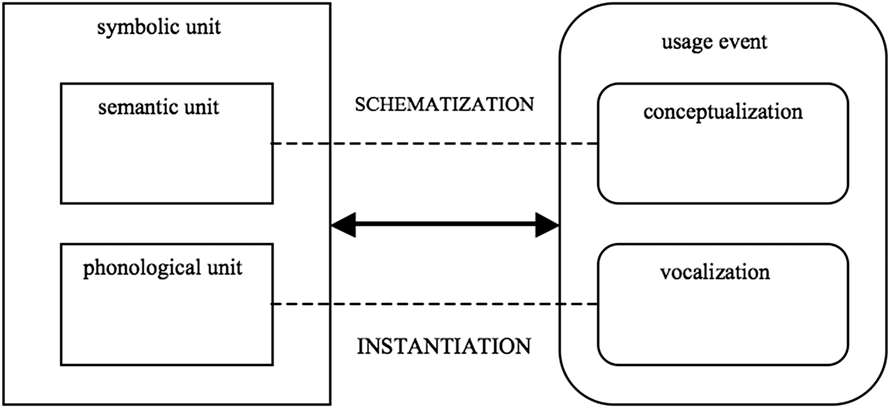
The central epistemological tenet of cognitive linguistics is that any form of knowledge is embodied. The notion of embodiment defines cognition as being deeply intertwined with the cognizers’ physical and social world of experience (Lakoff, Reference Lakoff1987, p. 266). Embodied cognizers derive their mental representations from their interaction and engagement with their physical, social, and cultural worlds of experience. Following the embodiment hypothesis, Langacker (1987, p. 77) describes linguistic competence – involving both lexical and grammatical knowledge – as usage-based (see also Langacker, Reference Langacker2008, p. 220). As illustrated in Figure 2, linguistic knowledge is conceived as a pool of symbolic associations of form and meaning that are derived from concrete usage events, i.e., rich, complex, and fully contextualized instances of language use. In such usage events, cognizers associate concrete conceptualizations with actual vocalizations. A symbolic unit, as stored in the cognitive grammar of a given language user, is the memorized association between this conceptualization and the vocalization that is mentally represented through a process of schematization.
Usage-based model of symbolic knowledge (adapted from Langacker, Reference Langacker1987, p. 77).
Although called ‘usage-based’ this early cognitive-linguistic account of linguistic knowledge is not satisfactory from a discourse-analytical perspective because the model radically simplifies the scope of linguistic experience. As advocated by CA and EoC, human agents primarily engage with their world of experience through cultural practices that are created through social interaction and that are mediated by the instrumentalities of language, artifacts, and media (see also Hutchins, Reference Hutchins1995; Wertsch, Reference Wertsch, Bechtel and Graham1998). Following Levinson’s tripartite model of discourse (see above), the cognitive representation of linguistic competence must therefore be adapted to managing interactions relative to the conventional knowledge of socially accepted ways of speaking (see Bhatia, Reference Bhatia2008, pp. 163–164).
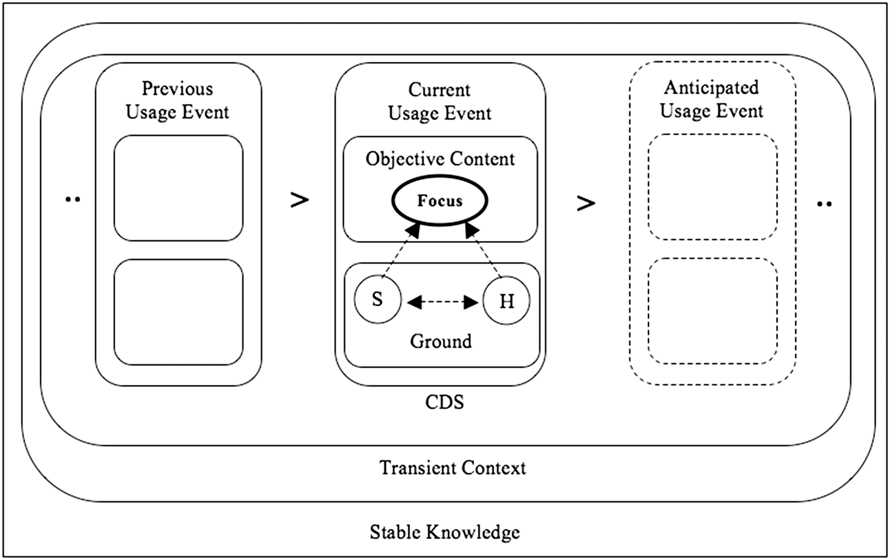
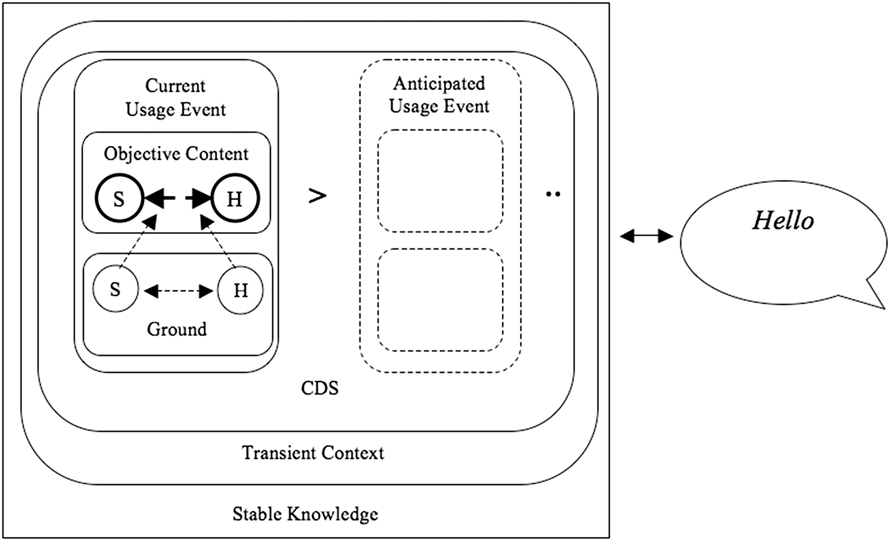
To incorporate his usage-based view of language into a more comprehensive theory of the human world of linguistic experience, and to make it more compatible with discourse-analytical approaches, Langacker (Reference Langacker2001) has proposed the more elaborate current discourse space model. A more recent and updated version of this model is published in Langacker (2008, Ch. 13). Rather than merely modeling a dyadic relationship between the linguistic cognizer and some general world of experience, the CDS model describes the usage context more elaborately as a relationship between two communicative partners (S) and (H) and their mutual apprehension of their immediate world of discursive experience termed the current discourse space (see Figure 3):
The CDS is defined as the mental space comprising those elements and relations construed as being shared by the speaker and hearer as a basis for communication at a given moment in the flow of discourse. The ground and the CDS are among the cognitive domains capable of being evoked as the conceptual base for the meanings of linguistic elements. (Langacker, Reference Langacker2001, p. 144, italics in the original)
Modeling the cognitive correlates of managing discursive steps, the current discourse space includes “the interlocutors’ apprehension of their interactive circumstances and the very discourse they are engaged in” (Langacker, Reference Langacker2001, p. 144).
Langacker’s CDS model (slightly adapted from Langacker, Reference Langacker2008, p. 466).
In line with CA, the CDS can be regarded as a model of the cognitive representations underlying the local management of a conversational turn. This local management is captured in the center of the model. In accord with the ideas of turn design and sequential positioning, what happens in the interactors’ center of attention orients to what happened previously in their conversation and projects what is expected to come afterwards. Langacker (2008, p. 466) calls this the ‘prospective’ and the ‘retrospective’ orientation of a linguistic expression. In the CDS model these steps are sketched by the empty boxes to the left and right of the central turn. Moreover, the model highlights that the rich and context-specific meaning that is activated, locally managed, and negotiated by the interlocutors is embedded in a transient context. This idea is compatible with the dynamic and sequentially developing notion of context advocated by CA.
To manage and understand a given turn, the speaker (S) and the hearer (H) have to engage in joint orientation towards a referential entity that is in their mutual focus of attention. Employing this visual metaphor of the joint ‘viewing arrangement’, Langacker (2008, p. 467) thus regards S and H as engaging in a mutual outlook at a referential entity that, in most cases, consists of a shared conceptualization:
[…] they manage to coordinate this action [the speech turn] on the same conceived entity. Of course, […] we […] have a limited visual field, taking in only so much of the world at any given instant. Analogously, we have a limited ‘conceptual field’, delimiting how much we can conceptualize or hold in mind at any given instant. (Langacker, Reference Langacker2001, p. 144)
The restricted attentional frame that is shared by the interlocutors is metaphorically defined as their viewing frame. Note that this notion of ‘frame’ is conceptually distinct from Blum-Kulka’s idea of thematic frame introduced above. While the former captures the interlocutors’ joint focus of attention within a given usage event, the latter is more broadly conceived as the topic of a given interaction. The management of linguistic units relative to the current discourse space consists in modifying the joint scope of attention relative to the viewing frame by putting conceptual entities in focus, while defocusing others: “The immediate scope of our conception at any one moment is limited to what appears in this frame, and the focus of attention – what an expression profiles, (i.e. designates) is included in that scope” (Langacker, Reference Langacker2001, p. 145, italics in the original). In other words, the function of verbal and non-verbal cues is to direct the communicative partners’ joint attention to the conceptualization that is to be placed in focus within their viewing frame; or as Langacker (2008, p. 460, emphasis in the original) states: “From an interactive perspective, linguistic structures are usefully thought of as instructions issued by the speaker for the addressee (Harder, Reference Harder1996).” By mutually exchanging, interactively negotiating, and coordinating such instructions to modify the CDS, the communicative partners can dynamically construe complex structures of meaning.
By choosing appropriate cues, and by manipulating the formal design of utterances, any element in the CDS can be raised to the interlocutors’ focus of joint attention. Thereby the CDS model accounts for the fact that speakers can employ various semiotic resources to direct the hearers’ attention to multiple dimensions of information management. By extending the basic association between vocalizations (segmental, linguistic content) and conceptualizations (objective content) in a given usage event (see Figure 2), the CDS model further includes the discursive dimension of information structure (emphasis, discourse topic, and new vs. old information) and speech management (turn-taking, floor-holding, etc.) as dimensions of conceptualization. Moreover, it incorporates gestures and intonation as part of the multiple vocalization channels (Langacker, Reference Langacker2001, p. 146; see also Langacker, Reference Langacker2008, pp. 461–462). In other words, interlocutors can depend on complex semiotic tools to couple multimodal signaling practices with multi-functional conceptualization processes. This extension of the usage-based approach to integrate the discursive tools and processes of information management provides fruitful anchor points for an integration of cognitive linguistics with CA and EoC. The extension of the formal side of communicative units to involve gestures and intonation is compatible with the CA emphasis on turn design. It also allows the analyst to specify the multimodal instrumentalities or generic resources that speakers employ for their keying of a given speech or text genre. This makes it further possible to link the CDS-model to Bhatia’s (2008, p. 164) idea that the conventional linguistic practices centered about alternative genres only develop and gain their meanings within complex social and professional practices that go well beyond the language-centered idea of encoding information. Nevertheless, Langacker rightly claims that
[t]o the extent that they are standard in a speech community, discourse genres are characterized by conventional linguistic units. In principle, their CG [Cognitive Grammar] description is comparable to that of other aspects of language structure. Our knowledge of a given genre consists in a set of schemas abstracted from encountered instances. (Langacker, Reference Langacker2008, p. 478)
In Figure 3, this entrenched and stable knowledge of genre-specific conventions is depicted by the rectangular box. To illustrate the communicative competence that is rooted in associations between linguistic units and the discursive steps that are managed by them, we can analyze greeting rituals as cognitively entrenched and socio-culturally shared speech genres. The instrumentalities employed to coordinate the initial stage of social encounters consist in conventionalized associations of linguistic cues, gestures, body positions, and intonation contours with particular act sequences to manage the culture-specific ways of greeting. On the basis of these associations, the speaker can key or trigger a specific conceptual or transactional state in the speech activity (Langacker, Reference Langacker2008, pp. 475–476). For example, we can analyze the greeting formula Hello (see turn 1 in Extract 1) in terms of the CDS model. This is illustrated in Figure 4. The activity of greeting the communicative partner and establishing contact with him/her at the beginning of a conversation constitutes the meaning that Hello brings to the interactors’ joint focus of attention. Note, however, that my figure radically simplifies the representation of the formal element – here hello – in Langacker’s CDS model.
Hello in the CDS model.
For a communicatively competent speaker to know the meaning of Hello means to know at which sequential stage of a speech activity he/she can use this signal to prospectively establish contact with another interlocutor in order to construe an interpersonal relationship in a conventionally accepted way (see also Langacker, Reference Langacker2008, p. 486). The CDS model thus serves as a complex framework to model the cognitive representations and expectations that underlie a speaker’s communicative competence. In line with the usage-based and embodied character of the CDS model, this competence is seen as derived from various instances of employing this knowledge in concrete locally and interactionally managed instances of language use. Based on the assumption that conventional linguistic knowledge, including the knowledge of discursive expectations, is derived from actual language use, the CDS model can account for both context-specific conceptualization practices that are locally managed as well as the more conventional procedural and conceptual states that are associated with a given speech-activity type. This makes it possible to bridge the discourse-analytical heuristics of CA and EoC. To elaborate on this potential integration, it is necessary to further scrutinize the relationship between the entrenched representation of discursive knowledge and its transient, local, and situated implementation in concrete instances of language use. By rooting any form of knowledge in perceptually grounded and embodied experience, Barsalou’s theory of conceptualization offers a fruitful framework for integrating the dynamic and the stable components of meaning-generation relative to the CDS model.
4. Situated conceptualization through speech activities
Barsalou’s (Reference Barsalou, Cohen and Lefebvre2005) model of situated conceptualization is centrally focused on the question of how conceptual representations emerge as dynamic and situation-specific mental products that are, however, grounded in the entrenched and memorized distillate of previously evoked mental experiences. This framework of knowledge representation is embedded in the more general research paradigm of grounded cognition (Barsalou, Reference Barsalou2010). Since the epistemological tenets of this theory of mind and knowledge are largely congruous with the usage-based view of language, the model of situated conceptualization offers a fruitful cognitive psychological framework to theorize the relationship between entrenched and conventionalized communicative knowledge and the recruitment of this knowledge in locally managed instances of conversational interaction.
Barsalou’s model accounts for the situated and embodied nature of conceptual representations (Barsalou, Reference Barsalou1999, Reference Barsalou2003, Reference Barsalou, Cohen and Lefebvre2005; Barsalou & Prinz, Reference Barsalou, Prinz, Ward, Smith and Vaid1997). He conceives concepts as dynamic entities that are derived from direct perceptual experience. When activating a concept in a specific situation, cognizers re-enact these perceptual experiences in the form of situated conceptualizations. To account for the human ability to construct complex situated conceptualizations, Barsalou’s model is based on two central notions: simulators and simulations. If you imagine the situation of greeting somebody by saying Hello in your mind’s eye, you probably activate a fairly rich and multimodal representation of meeting another person in a specific situation (see Decety & Grèzes, Reference Decety and Grèzes2006). This multimodal mental representation constitutes what Barsalou (2005, p. 625) calls a ‘simulation’. A simulation represents one specific, but mentally represented instance of a concept that a cognizer can place in his/her focus of attention by the mental re-enactment of previous perceptual experiences. Thus, “[a] concept is the ability to simulate a kind of thing perceptually” (Barsalou, Reference Barsalou1999, p. 604). Depending on the situation, concept-simulations vary. When conceptualizing how you greet another person in a business meeting, you are likely to generate a simulation that is noticeably different from greeting your relatives in a family situation. Accordingly, Barsalou claims that we do not possess fixed and abstract conceptual categories. Rather, we possess the ability to dynamically generate situated concept-simulations that allow us to understand the world of experience relative to its situational demands.
The ability to generate multimodal simulations as re-enacted perceptual states is captured by the notion of simulator (Barsalou, Reference Barsalou, Cohen and Lefebvre2005, p. 624). The simulator is a generative mechanism that comprises perceptual symbols, i.e., visual, auditory, tactile, olfactory, or proprioceptive features that a cognizer has derived from his/her concrete and dynamic interaction with the world of experience (Barsalou, Reference Barsalou1999, p. 578). To illustrate the content of a simulator, Barsalou uses the example of the cat-category:
Consider the simulator for the category of [CATS]. Across learning, visual information about how cats look becomes integrated in the simulator, along with auditory information about how they sound, somatosensory information about how they feel, motor programs for interacting with them, emotional responses to experiencing them, and so forth. The result is a distributed system throughout the brain’s feature and association areas that accumulates conceptual content for the category. (Barsalou, Reference Barsalou, Cohen and Lefebvre2005, p. 624)
In other words, the simulator consists of schematic perceptual content that is coherently integrated into an assembly of features. The simulator structures the content of perceptual symbols by means of a frame structure that organizes the pool of alternative perceptual symbols into a feature pattern (Barsalou, Reference Barsalou, Cohen and Lefebvre2005, p. 623). Note that this notion of frame again differs from Blum-Kulka’s and Langacker’s uses of the term. Within Barsalou’s model a frame is to be seen as a “structured mental representation of a conceptual category” (Kövecses, Reference Kövecses2006, p. 94), rather than an unstructured conglomerate or list of its defining features. The frame operates on the neuronal level, i.e., it functions as an association area that links input from the specialized visual, sensory, motor, olfactory, and auditory brain systems. Based on concrete embodied experience, a simulator develops for any component of experience that is subject to repeated attention: “When attention focuses repeatedly on a type of object in experience, such as for [CATS], a simulator develops for it. Analogously, if attention focuses on a type of action ([BRUSHING]) or on a type of introspection ([HAPPINESS]), simulators develop to represent them as well” (Barsalou, Reference Barsalou, Cohen and Lefebvre2005, p. 625). Thus, simulators can develop for all sorts of knowledge: objects, properties, settings, events, actions, and introspections, as well as speech activities. On the basis of simulators and the potential simulations evoked through them, cognizers become able to mentally enact complex situated conceptualizations. A situated conceptualization is “a multimodal simulation that supports one specific course of situated action with a category instance” (p. 620). In other words, it is a rich and contextualized representation of an experiential scenario.
In what follows, I will employ this account of perceptually grounded and situated conceptual knowledge to establish a link to Langacker’s CDS model and the interactional data presented in Section 1.1. This integration is appropriate because Langacker himself points to the central role of simulation in linguistic comprehension:
Activating appropriate images – simulating the experiences they represent – is a nontrivial aspect of apprehending […] expressions […] The basic point […] is that simulation […] occurs to some degree in virtually all expressions. (Langacker, Reference Langacker2008, p. 536)
Moreover, the role of simulation in understanding language has been convincingly argued for by other researchers working in the field of grounded cognition (see, e.g., Pecher & Zwaan, Reference Pecher and Zwaan2005; Zwaan, Reference Zwaan and Ross2004).
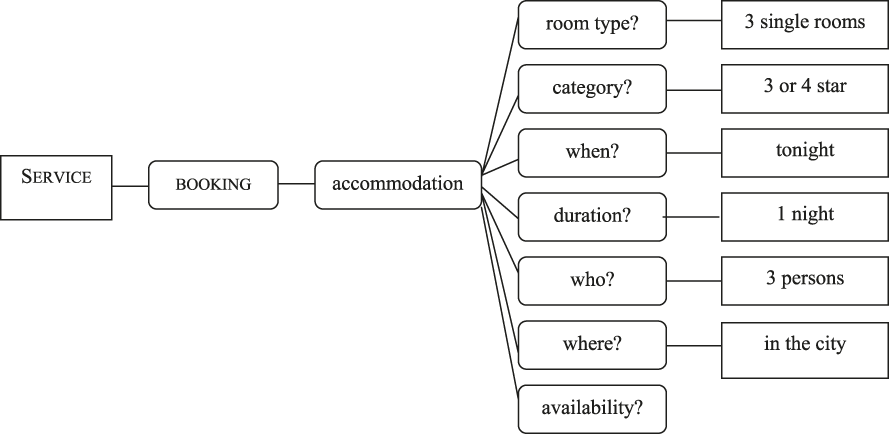
In terms of Barsalou’s model, the socio-cognitive challenge that the service agent and the tourists face in Extracts 1 and 2 pares down to a joint conceptualization task. They have to develop a shared situated conceptualization of the booking-category. In the case of Extract 1, such a situated conceptualization comprises the informational dimensions outlined in Figure 5. The figure depicts a nested frame-structure that patterns specific informational units (potential perceptual symbols) into a coherent conceptualization of booking a hotel room (see Barsalou, 1991). Without claiming that this schematic representation is fully congruent with the rich, actual mental representations evoked by the information-officer and the tourist, it nevertheless captures the informational dimensions that they have to manage in their interaction.
Situated conceptualization of booking a hotel room in Extract 1.
To begin with, neither the tourist-information officer nor the tourists have a clear concept of what the service encounter will be about. Hence, they cannot merely activate this mental representation to conduct the information transfer and exchange. Rather, the mutual engagement of the interactors in the booking-a-hotel-room activity is essentially motivated by their need to inter-adapt their cognitive worlds in order to develop a shared situated conceptualization of the booking-category. The officer acts as an expert; she knows about the service categories and most of their instances. But she does not know what the tourists actually want, i.e., what their concrete service needs are. The tourists, on the other hand, know about their goals. However, it is not clear to them what the actual service options include. The solution to this joint conceptualization problem is to develop the service need as common ground (Clark, Reference Clark1996, Ch. 4), i.e., as a mutually shared situated conceptualization. Thus, cognitively speaking, the transaction constitutes an interactive, socially distributed problem-solving process.
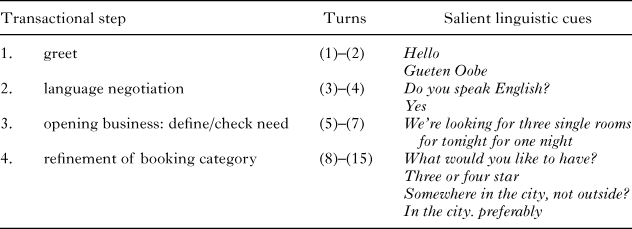
To manage the evocation of the situated conceptualization in a communicatively competent way, the interlocutors depend on each other’s conversational turns as well as their knowledge of the speech-activity type ‘booking a hotel room’. Hence, the conversational implementation of this speech genre constitutes the prime means to manage the construction of their joint conceptualization process by concretizing the hotel-room category step-by-step. As highlighted in Table 1, every speech genre is organized into conventionalized act sequences that must be implemented by the communicative partners (see also Langacker, Reference Langacker2008, pp. 480–481). This is indeed true for the information services in my dataset as I was able to learn from an interview conducted with the Information Services Manager responsible for the tourist-information office. The manager stated that the interactions with the tourists have to follow a clearly defined service chain that consists of the following transactional steps: ‘establish eye contact > greet > check need > provide information > say goodbye’. These discursive steps are implemented for the cognitive purpose of fleshing out the frame-structure depicted in Figure 5. Compatible steps are also reflected in Extract 1, as illustrated in Table 2. The table further lists the salient linguistic cues that are used by the interactors to implement the given act sequence.
Transactional steps and salient linguistic cues in Extract 1
It is important to emphasize that the professional practice conducted by the officer and the tourist is of course multimodal and involves many cues and instrumentalities other than language. For instance, as the service chain indicates, the officers are required to first establish visual contact with the customers. To do so, they have to depend on non-verbal signals such as facial expression and gestures. Moreover, as can be seen in turn (12) in Extract 1, the service practice is also significantly supported by information that is retrieved from an on-line hotel-booking system. The problem-solving process thus becomes distributed between the interlocutors’ minds and other sources of information that add content to the interactive conceptualization process (see Hutchins, Reference Hutchins1995). For the sake of argumentative transparency, I am not further investigating the contribution of the non-verbal cues and the other media employed to channel information. This, however, should not imply that they do not play an important role in the discursive organization of the joint hotel-booking practice. Interesting multimodal analyses of workplace discourse that are compatible with the view proposed here are offered in Filliettaz and Bronckart (Reference Filliettaz and Bronckart2005) and Mondada (Reference Mondada2006).
When comparing this information with the representation of the informational structure in Figure 5, we see that the transaction is so organized as to fill in the informational gaps in the interactors’ shared conceptualization of the booking need step-by-step. In Langacker’s terms, each transactional step shifts the interactors’ focus of joint attention to another informational dimension in their joint development of the situated conceptualization of the booking category. To know how to book a hotel room by engaging in a corresponding tourist-information practice means to know which linguistic cues can be used to coordinate which conceptualization steps in order to arrive at an appropriate situated conceptualization that represents the desired booking category as common ground between the service agent and the customer. In other words, the interactors’ stable knowledge of expected utterances and act sequences in combination with their conventional interpretation provide the basis for the discursive construction of their shared situated conceptualization of the service category. These theoretical considerations invite an integration of Barsalou’s theory of situated conceptualization with Langacker’s CDS model.
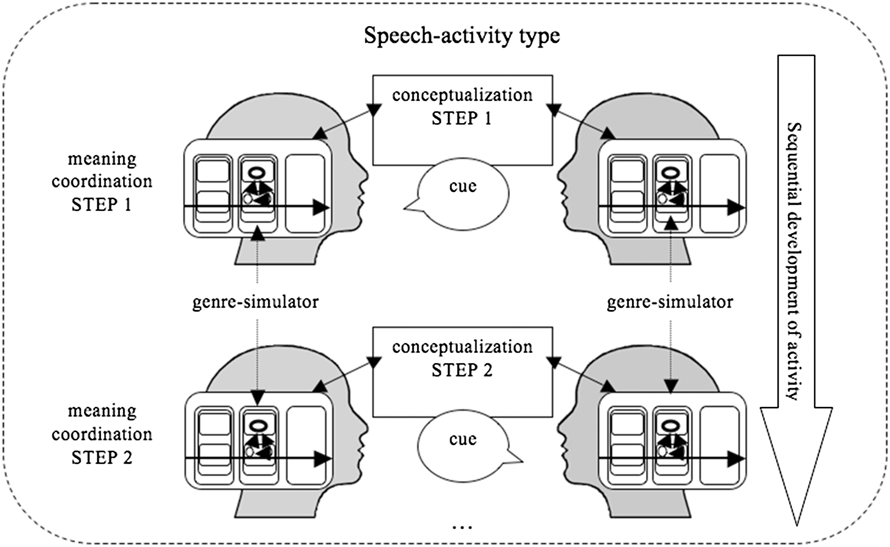
Due to their usage-based grounding, linguistic symbols provide an extremely powerful cultural technology to conventionally simulate and manipulate concrete facets of experience in their very absence (Langacker, Reference Langacker2008, p. 535). When hearing the word hello we can automatically simulate an imagined greeting-scene between some addressor and an addressee. We can thus combine Barsalou’s account of situated conceptualization with the view of communicative competence proposed by Langacker’s CDS model. Above, we have argued that a word such as hello functions as a communicative cue to place the construction of an interpersonal relationship in the focus of the speaker’s and hearer’s joint viewing frame at the beginning of a conversation. In Barsalou’s terms, when using the word Hello, the speaker invites the hearer to construct a situated conceptualization of their interpersonal relationship at the beginning of their interaction. Put differently, to know the meaning and appropriate use of hello means to have established a simulator that controls the potential conceptual content that we have learnt to associate with this word through our linguistic experience. Thus, hello must be coupled with a simulator that comprises all the perceptual symbols that have become associated with the word’s semantic potential. In a given usage context, the hello-simulator makes it possible to re-enact this meaning potential, i.e., it allows the speaker and hearer to construe a situated conceptualization of their interpersonal relationship at the beginning of their mutual engagement in a conventionally accepted way, as illustrated in Figure 6 (see also Langlotz, Reference Langlotz2015, p. 184).
Triggering situated conceptualizations by words.
Linguistic cues ‘invite’ the interlocutors to simulate situated conceptualizations in accord with their meaning potential:
Once simulators for words become linked to simulators for concepts, they can control simulations. On recognizing a word, the cognitive system activates the simulator for the associated concept to simulate a possible referent. On parsing the sentences in text, surface syntax provides instructions for building perceptual simulations. (Barsalou, Reference Barsalou1999, p. 592)
In accordance with Barsalou’s theory of grounded conceptualization and the cognitive-linguistic theory of the usage-based nature of language, the simulators for linguistic knowledge must be seen as embodied (see Evans & Green, Reference Evans and Green2006, pp. 163–165); they are derived from experiencing the world through culture-specific discursive practices. The simulators for the culture-specific conceptual knowledge must be coupled with the conventional linguistic knowledge that is employed in a given speech community to find orientation in, control, and manage these social practices. Following Clark (1996, p. 64), linguistic constructions thus work as coordination devices that mediate the alignment of conceptualizations in joint practices for the construction of common ground. In other words, the simulators of these experiences must be structurally coupled with the linguistic features, structures, and processes that recur in them and are used to coordinate the interactors’ conceptual states for the purpose of managing joint practices such as the tourist-information transaction (see also Langlotz, Reference Langlotz2015, pp. 183–188). By combining Barsalou’s model of situated conceptualization with the CDS model, we can therefore claim that the discursive expectations that underlie speech genres are mentally represented in the form of what I would like to call genre-simulators. I conceive them as abstract mental representations of discursive conventions that have been digested from concrete instances of discursive engagement. More specifically, genre-simulators consist of the discursive correlates of perceptual symbols, i.e., complex arrangements of discursive cues such as lexical choices, turn design, turn-taking, and the sequential order of turns that are conventionally associated with a specific speech-activity type. By evoking (some of) these cues in a given conversation (such as the cues listed in Table 2), the communicative partners can detect the “unique fingerprint” (Drew & Heritage, Reference Drew, Heritage, Drew and Heritage1992b, p. 26) of the activity-type that they are currently performing. By orienting to these signals, they can activate the genre-simulators in order to control and mutually implement an institutionalized speech-activity type in the given context.
Since different social encounters, such as the tourist-information transaction, create different discursive expectations, i.e., the presence of different linguistic cues and corresponding conceptualizations, the coupling of linguistic cues with communicative moves differs from practice to practice. Hence, specific institutional contexts prime the cognizers for activating conventional simulators and cues rather than unexpected ones (Bless, Fiedler, & Strack, Reference Bless, Fiedler and Strack2004, pp. 39–42). Put differently, speech-activity types create a conventional symbolic environment for scaffolding processes of joint meaning coordination (see Langlotz, Reference Langlotz2015, Ch. 5.6). With regard to Barsalou’s model of conceptualization it can therefore be claimed that institutionalized conversational expectations are effected by the entrenched association of linguistic cues and moves with genre-simulators for activity types. As illustrated in Figure 7, the conversational management of information in the tourist-information exchange is driven by a genre-simulator that mediates the discursive states in the interaction by simulating relevant conceptualizations for activity-specific meaning-coordination (also reconsider Figure 5 and Table 2; see also Langlotz, Reference Langlotz2015, p. 187).
Speech-activity types and genre-simulators.
We can now use this socio-cognitive framework to refer back to the discourse-analytical dimensions tackled by CA and EoC. The notion of ‘genre-simulator’ revisits the conventionalized knowledge of speech-activity types as modeled by the EoC in a format that is compatible with the embodied view of cognition advocated by cognitive linguistics. Relative to Levinson’s three-level model of discourse, the genre-simulator constitutes the interaction engine that is necessary to implement social institutions of talk in a conventionally accepted way. The outcome of this implementation, however, can only be locally managed on the interactional level by fine-tuning the joint conceptualization steps through turn design and sequential positioning. In this sense, all the cues from Extract 1 that I have not listed in Table 2 reflect the interactors’ joint efforts of inter-adapting their situated conceptualization of the booking need in a mutually shared way.
Any context-specific instantiation of a genre-simulator can also be subject to the strategic manipulation of the discursive environment by the interactors. In order to implement a speech-activity type to become a speech-activity token, the communicative partners must manage the conversational steps locally and opportunistically to fine-tune and align their current understanding of their joint practice. This also allows them to depart from the discursive norms and negotiate the meaning of specific linguistic cues such as outside in Extract 2. However, such local manipulations can only occur against the background of the interactors’ mutual discursive expectations of what is to occur next in their interaction. Such expectations can only be formed relative to the stable knowledge of discursive conventions (as advocated by genre analysis) that are stored in the genre-simulators. In order to substantiate and illustrate this claim, I will analyze Extract 2 on the basis of this socio-cognitive theory of discourse management.
5. Socio-cognitive analysis of Extract 2Footnote 3
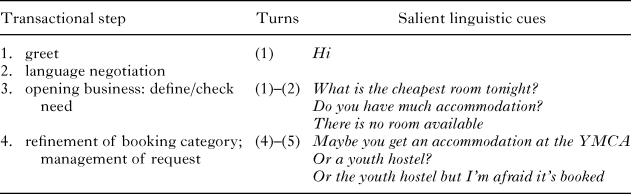
Communicatively significant departures from transactional routine illustrate the situated management of speech-activity simulations relative to genre-simulators. This is reflected in Extract 2. Since this transaction is also concerned with booking a hotel room, we can analyze it according to the same transactional steps as Extract 1. This is depicted in Table 3, which is organized by analogy with Table 2.
Transactional steps and salient linguistic cues in Extract 2
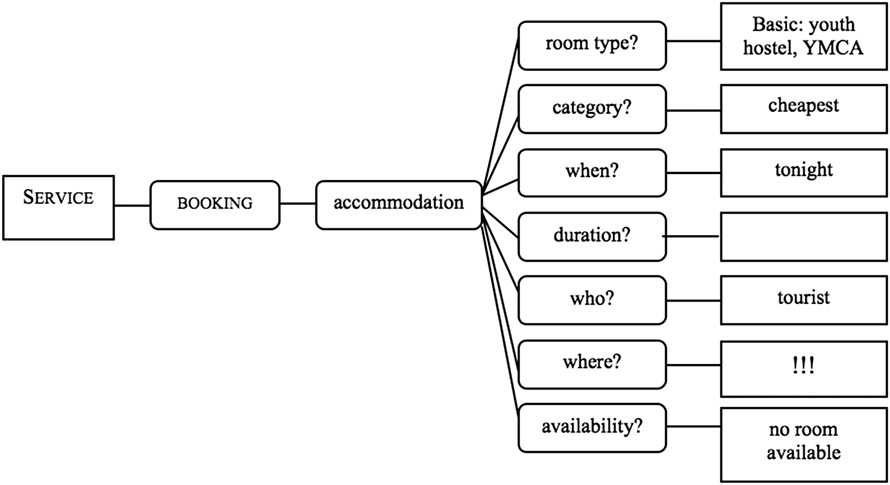
These dimensions also map onto the frame structure that underlies the communicative partners’ situated conceptualization of the booking category. By analogy with Figure 5, this is illustrated in Figure 8. Like Extract 1, Extract 2 is so organized as to place different informational substructures into the focus of the interlocutors’ joint attention. Note that Extract 1 and 2 differ in terms of what precise substructures they put into the joint focus of attention of the two communicative partners at the specific stages of their transactional engagement. This points to the interactors’ local and situated management of the booking-a-hotel-room activity. The situated implementation of the activity-type is also reflected in the highly reduced greeting sequence as well as the absence of the phase of language negotiation, which cannot be regarded as a necessary and obligatory transactional step to guarantee the success of the tourist-information practice.
Situated conceptualization of booking a hotel room in Extract 2.
To represent the dimensions of meaning-generation in Extract 2, Figure 8, however, is not sufficient. More precisely, as sketched in the ‘Introduction’, the officer deviates from the normative construal of somewhere outside in turn (2). By doing so, she departs from the joint book-a-hotel-room-simulation to trigger another speech-activity type: ironic teasing, as reflected in Table 4. While such norm departures are not frequent in my dataset, they illustrate the interactional competence of human cognizers to adapt the immediate world of experience to their own purposes by means of creative linguistic strategies.
Teasing sequence in Extract 2
This embedded communicate sequence must be understood relative to the context of the fully booked city as well as the high level of stress that the information-officer had to cope with due to the great many tourists that frequented the information-office with similarly ‘impossible’ requests. To vent her stress, the officer exploits the meaning of outside for a sarcastic quip directed against the tourist. More specifically, by departing from the transactional norm of the booking-a-hotel-room activity, she proposes to the tourist to ‘sleep outside, in the street’ when wishing to find ‘a cheap room’. In other words, she uses outside as a cue to activate a different concept-simulator in order to evoke a simulation of the tourist sleeping in the street.
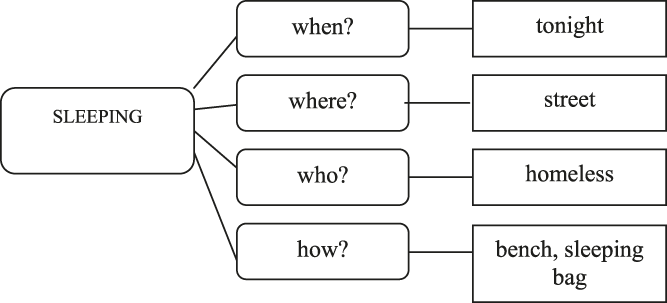
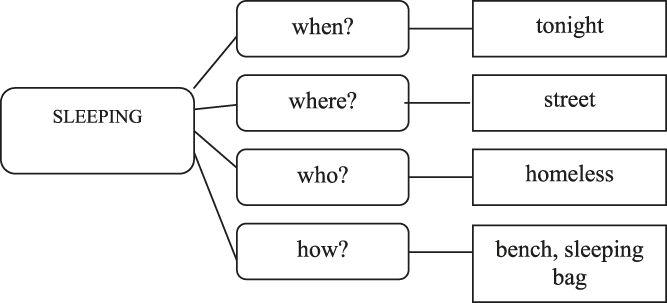
This sleeping-outdoors simulation entails a number of associations and inferences that clearly go beyond the interpretative scope of the booking-a-hotel-room activity. For example, people who sleep in the street are usually homeless and poor and cannot possibly afford a hotel room. Hence, the semantic indeterminacy of outside gives the information-officer the opportunity to locally evaluate the tourist’s request as being overrated and to momentarily re-negotiate the relationship between the tourist and herself (see Langlotz, Reference Langlotz2015, p. 4). Against the simulation of ‘sleeping in the street’ the tourist’s booking request is revealed as being absurd. Moreover, the situated conceptualization of the tourist having to spend the night outside like a poor homeless person allows the officer to momentarily escape from her activity-specific participant role. Instead of being a mere service provider who has to cater for the tourists’ requests, even the impossible ones, she can momentarily empower herself over the overly demanding customer. Against the imagination of the tourist as a poor homeless person, she is in a far more comfortable position. The departure from the booking-a-hotel-room activity by means of the sleep-outdoors-simulation creates a conversational niche for her to locally and opportunistically cope with the stressful situation (see Figure 9).
Sleeping outdoors simulation.
Interestingly, the tourist does not seem to understand the officer’s ironic quip. By asking Outside as in … outside the city you mean? in turn (3), he interprets outside according to its more conventional value relative to the institutionalized genre-simulation of booking a hotel room (see turns (14) and (15) in Extract 1). In other words, the tourist does not seem to be able to activate the simulation of having to sleep in the street because the interpretation of the symbolic environment on the basis of the conventional genre-simulator constrains his interpretative options. In this sense, Extract 2 nicely illustrates my theoretical argument that the local and interactional management of speech turns can only unfold against the background of the communicative norms associated with a given speech-activity type. The example provides strong evidence in support of the EoC claim that speech genres provide the central cultural tool to organize human life in a socially meaningful way. Accordingly, it is the tourist’s normative orientation which leads to his misunderstanding of the officer’s communicative intention. This causes her to repeat her sarcastic proposal in turn (4): No [ laughs] outside of the rooms … outside … there is no hotel available. When she realizes that the tourist does not follow her joke, however, she returns back to business and continues to manage her turns according to the transactional norm of the speech genre, as illustrated in Table 3.
The officer’s creative deviation from the transactional norm is also interesting with regard to Langacker’s idea of the speaker’s and hearer’s joint viewing frame and attentional focus. As reflected by the tourist’s reaction to the officer’s teasing in turn (3), the two interactional partners momentarily lose their common ground. Their outlook to the focus in the viewing frame becomes misaligned because they generate discrepant situated conceptualizations relative to the linguistic cue outside. Instead of functioning as a conventional coordination device, the word becomes a powerful semiotic ‘weapon’ for the officer to momentarily place the tourist in an awkward situation. This misalignment of the interactors’ mutual outlook to the viewing frame reflects their momentary social misalignment on the level of the local, interactional management of their conversation. This substantiates the CA claim that socially accountable agents are expected to design their conversational contributions in a way that allows the communicative partners to share the sequential management and development of the conversation with them.
6. Conclusion
This paper has pursued the aim of sketching a cognitive-linguistic model of meaning-construction in interactional discourse that makes it possible to account for both the situated, local, and opportunistic management of meaning in conversations with an analysis of the discursive knowledge and communicative competence that underlies institutionalized speech-activity types. The theoretical motivation for such an integrative socio-cognitive model of discourse resides in the discourse-analytical challenge of bridging the discrepant research foci and analytical heuristics offered by CA and EoC. My model proposes to theorize the cognitive dimensions that underlie a corresponding interaction engine, following Levinson (Reference Levinson2006), by integrating Langacker’s CDS model with Barsalou’s theory of situated conceptualization. Along these lines, my analysis of the two extracts from the tourist-information context has suggested that – as advocated by CA – the interactors can influence their speech-activity simulations in order to negotiate the process of meaning-generation by locally managing the state of the CDS via minute discursive signals. However, this local negotiation of meaning is only possible against the background of the interactors’ mutual assumption of the speech-activity type that they are currently performing. As advocated by EoC, these assumptions can only be formed relative to the stable knowledge of discursive conventions that is stored in speech-activity simulators. But through the strategic manipulation of the symbolic environment that is evoked via the discursive cues, speakers can also depart from a given speech-activity simulation. By evoking cues that deviate from the conventionally expected state of the CDS, speakers can provoke their communicative partners to simulate a conceptualization in the current discourse space that departs from the conventional genre-simulation. In doing so, they can invite their partners to engage with a different speech activity, such as teasing. Thus, by locally managing the state of the CDS via creative discursive signals, the interactors can influence their speech-activity simulations in order to negotiate the process of meaning-generation (as advocated by CA). However, this local negotiation of meaning is only possible against the background of the interlocutors’ assumption of the speech-activity that they are currently performing. These assumptions can only be formed relative to the stable knowledge of discursive conventions (as advocated by EoC) and the corresponding symbolic associations that are stored in the genre-simulators.