Introduction
In the business literature corporate culture is widely believed to be linked to employee and organisational performance (Deal & Kennedy, Reference Deal and Kennedy1982; Wilderom, Glunk, & Maslowski, Reference Wilderom, Glunk and Maslowski2000; Melé, Reference Melé2003) and business success (Glisson & James, Reference Glisson and James2002). Culture can be defined in many ways. The definition by Schwartz and Davis (Reference Schwartz and Davis1981: 33) – ‘a pattern of beliefs and expectations shared by the organisation's members’ – is relevant to our study because it suggests cultural influences on individual, and group behaviours can be identified and evaluated through careful analysis of an organisation's human fabric. Schein (Reference Schein2009: 19) concurs with this ‘pattern’ view, and argues: ‘Organisational culture in particular matters because cultural elements determine strategy, goals and modes of operating’. In the service sector culture is also seen as a key mechanism for ‘social control’ of group members’ actions (Chatman & Jehn, Reference Chatman and Jehn1994: 524). Outcomes in service businesses are more directly linked to employee behaviour than in manufacturing environments where outcomes are likely to be influenced by factors such as technology and work design (Schneider & Bowen, Reference Schneider and Bowen1995; Zerbe, Dobni, & Harel, Reference Zerbe, Dobni and Harel1998). It could be argued, then, that culture is likely to be a particularly important driver of performance in organisations offering professional and business services (i.e., knowledge-intensive firms) because the perceived quality and value of these complex services depends on intensive provider-customer interactions. Indeed, the service-dominant logic propounded by Vargo and Lusch (Reference Vargo and Lusch2004) suggests that service value is co-created by providers and consumers working in a harmonious relationship.
A service culture places a high priority on providing high quality service to both internal and external customers (Curtis & Upchurch, Reference Curtis and Upchurch2008). Schneider and Bowen (Reference Schneider and Bowen1995) characterise organisations as having a positive or weak passion for service, with passionate firms often being high performers. By contrast, weaker organisations have cultures that lack a customer focus and are characterised by unsupportive policies, procedures and management that make it difficult for customer contact staff to carry out their jobs. The culture of a service organisation manifests itself in the encounter between the employee and customer, with the customer experiencing the same culture that the employee experiences (Schneider & Bowen, Reference Schneider and Bowen1995).
Values are important in organisational culture because they ‘act as guides to human action’ (Stackman, Pinder, & Connor, Reference Stackman, Pinder and Connor2000: 38), with a strong culture being one where the values are ‘widely shared and strongly held’ by organisational members (Chatman & Jehn, Reference Chatman and Jehn1994: 524). Some of the values associated with a high quality service culture include innovation, joy, respect, teamwork, social profit, integrity and excellence (Skalen & Strandvik, Reference Skalen and Strandvik2005).
Much of the empirical research into the culture–performance relationship has been quantitative in nature, using standardised value frameworks to represent or profile the cultural traits and characteristics of organisations. However, concerns have been raised about the use of a priori measures that fail to reflect changing business environments and country sample differences (Chatman, Reference Chatman1991; Sarros, Gray, Densten, & Cooper, Reference Sarros, Gray, Densten and Cooper2005). Also, an over-reliance on quantitative data, although enabling inferences to be drawn about relationships, may not add much depth to our understanding of a very complex construct. For a comprehensive discussion see the work of Rousseau (Reference Rousseau1990a: 153–192).
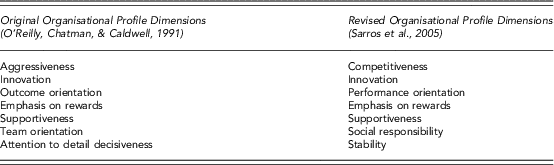
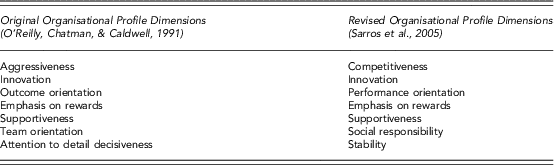
In recognition of these concerns, we set two main aims for this study. The first was to identify whether the dimensions of culture in high-performing professional and business service providers in New Zealand were consistent with those proposed by Sarros et al. (Reference Sarros, Gray, Densten and Cooper2005) in the Australian context. Sarros et al. modified the original Organisational Culture Profile (OCP) instrument developed by O'Reilly, Chatman, and Caldwell (Reference O'Reilly, Chatman and Caldwell1991) by substituting more respondent-friendly Likert-type scale questions for the original prompts used in the rather cumbersome Q-sort methodology. This made the instrument more useful for large samples. Psychometric testing using a large sample of Australian firms resulted in the original 48 items being reduced to 28 and the original eight dimensions reduced to seven (see Table 1).
Organisational profile dimensions
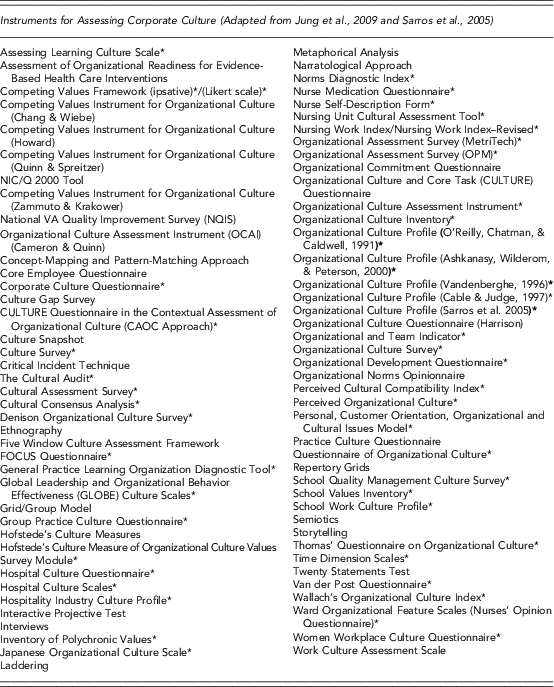
The OCP is one of 70 quantitative and qualitative instruments for exploring organisational culture identified in a wide ranging review of the literature dating back to 1954 by Jung et al. (Reference Jung, Scott, Davies, Bower, Whalley, McNally and Mannion2009). The OCP instrument has been used in a modified form in several studies (see Appendix 1) and is one of 48 identified by Jung et al. that are subject to psychometric testing. Jung et al. conclude that the most appropriate instrument for assessing corporate culture is dependent on the context, underlying aims, questions and resources available for a particular study. Sarros et al. argue that their version of the OCP is appropriate for the Australian business context because it incorporates the fundamental dimensions of organisational culture as indicated by the extant literature, it is based on an instrument that has been shown to be adaptable to different country situations, including Australia, and it demonstrates high levels of reliability and validity. There has been no comparable instrument developed for the New Zealand corporate context. However, because of the country's proximity to Australia and the close economic ties between the two nations we considered it appropriate to use the Sarros et al. dimensions as an initial guide to explore the links between organisational culture and performance in New Zealand professional and business service firms, or in other words, knowledge-intensive service firms. (There is considerable debate in the literature as to whether professional service firms are, or are not, knowledge-intensive firms, this paper adopts the popular view that the two terms are interchangeable; for further discussion see von Nordenflycht, Reference von Nordenflycht2010).
Knowledge-intensive firms have been commonly characterised by their well-educated and skilled workforces that operate mainly in an intellectual capacity (Alvesson, Reference Alvesson1993). As such, they can be loosely defined as ‘organizations that offer to market the use of fairly sophisticated knowledge or knowledge-based products’ (Alvesson, Reference Alvesson2004: 17). Blackler (Reference Blackler1995) adds that through the leveraging of their highly qualified staff, such firms are able to ‘trade in knowledge itself’ (p. 1022). Hence, the knowledge generated by, and within, the firm becomes part of the production process. Subsequently, Alvesson (Reference Alvesson2004) extends his definition by stating that the term can be broadly understood to be ‘large firms employing substantial numbers of people working with complex tasks that call for autonomy and the use of judgement, possibly rendering traditional forms of control inadequate or only partly relevant’ (p. 2).
It is in the area of control where the distinctive culture of knowledge-intensive firms becomes interesting. Robertson and Swan (Reference Robertson and Swan2003), investigating culture and ambiguity within a top-performing knowledge-intensive consulting firm, found that the existing strong culture reinforced norms of behaviour that celebrated the firm's ambiguous nature. Employees were, to an extent, willing participants in their own control as their behaviour reinforced and perpetuated the firm's cultural ambiguity, for each employee cognitively rationalised the ‘imposed’ controls on their autonomy.
An alternative perspective was offered by Karreman and Alvesson (Reference Karreman and Alvesson2004) who investigated the extensive human resource management (HRM) systems and procedures in place in another top-performing knowledge-intensive consulting firm with an acknowledged ‘strong and intense culture’ (p. 156). They found that the high degree of structural control (the HRM policies and strategies) in place tended to inhibit normative behaviour in employees to the extent that such technocratic forms of control were ‘re-interpreted and re-enacted’ (p. 170). Subsequently, they argued that the ‘bureaucratic practices are kept because of their links to the organisational culture – to heritage and tradition’ (p. 170). As such, new forms of control centered on socio-ideology – employee social and career positioning, ‘subordination and obedience, loyalty and commitment’ (p. 171) – were introduced over time. Both forms of control were identified to be informing each other, rather than the new supplanting the old. This seems to support Alvesson's (Reference Alvesson2004) assertion that traditional forms of control are potentially ‘inadequate or only partly relevant’ (p. 2) within such knowledge-intensive firms.
This relationship between an organisation's culture and its HRM practices is largely considered to hinge around managerial assumptions. Specifically, Aycan, Kanungo, and Sinha, suggest managerial assumptions ‘about employee nature and behavior’ serve to underpin an organisation's ‘internal work culture’, while their assumptions about ‘employee needs, wishes, and capabilities’ are key to determining how HRM is practised or used within the organisation (Reference Aycan, Kanungo and Sinha1999: 505). This leads to our second aim, which was to investigate whether the cultural profiles that emerged within our group of knowledge-intensive service firms were translatable into specific HRM policies, strategies and workplace practices, and whether these would then be found to positively influence the behaviours of managers and frontline staff.
Dimensions of Organisational Culture
Organisational culture refers to the way ‘things are done’ in an organisation (Glisson & James, Reference Glisson and James2002: 769). Where the culture has both intensity (i.e., the ‘amount of approval/disapproval attached to an expectation’) and consensus (i.e., the degree to which the norm is shared), then it can be considered strong (O'Reilly, Reference O'Reilly1989: 13). A strong culture is thought to have the potential to guide and influence employee behaviour and impact on organisational performance. Support for this antecedent relationship comes from research, which links an organisation's culture and a host of worker attitudes, including loyalty, satisfaction, trust (Ashforth & Mael, Reference Ashforth and Mael1989), retention (Sheridan, Reference Sheridan1992) and organisational commitment (Rashid, Sambasivan, & Johari, Reference Rashid, Sambasivan and Johari2003). It should be noted, however, that even if an organisation has a strong culture, it does not necessarily transpire that positive attitudinal outcomes are the result (O'Reilly, Reference O'Reilly1989). For example, bureaucratic cultures can negatively impact on worker commitment (Mathew & Ogbonna, Reference Mathew and Ogbonna2009). Strong cultures may be more resistant to organisational change as core values and associated behaviours are deeply ingrained (Sorensen, Reference Sorensen2002).
The importance of a strong culture has gained momentum among members of the business community since Peters and Waterman (Reference Peters and Waterman1982) suggested a strong culture could be linked to organisational effectiveness and success (Sackmann, Reference Sackmann2011). Positive performance outcomes, it is believed, result from organisation members sharing the same values and goals. So, assuming the organisational culture is one that fosters high performance, this ‘internal consistency in goals and behaviours’ should influence employee effort (Sorensen, Reference Sorensen2002: 70). Nonetheless, it must be noted that such influences may lead to ‘group-think’ due to a lack of internal critique of the organisation's culture. Subsequently, a strong culture could also inhibit diversity through a focus on conformity to organisational norms and means.
Sorensen identifies three explanations for the performance benefits of strong cultures. First, ‘widespread endorsement of organisational values and norms facilitates social control within the firm’ (Reference Sorensen2002: 73). As a result, ‘there is broad agreement that certain behaviours are more appropriate than others’ (Sorensen, Reference Sorensen2002: 73), and subsequently, violation of the norms are both easily detectable and able to be corrected (by fellow employees) faster. However, due to the ambiguous nature of ‘culture’ this view of it being a form of social control has been contested (see for instance Martin, Reference Martin1992). Second, Sorensen states that ‘with clarity about corporate goals and practices, employees face less uncertainty about the proper course of action when faced with unexpected situations and can react appropriately’ (Reference Sorensen2002: 73). Thus, strong cultures are more adaptable in the face of uncertainty. Finally, Sorensen found that ‘strong cultures can enhance employees’ motivation and performance because they perceive that their actions are freely chosen’ (Reference Sorensen2002: 73). This finding must be viewed with some caution, however, as Van Maanen found contradictory evidence in his study of Disneyland (Van Maanen, Reference Van Maanen1991).
Overall, Sorensen (Reference Sorensen2002) cautions that, although organisations with strong cultures may excel at incremental change and may have better performance outcomes in relatively stable environments, they may also struggle to adapt in more volatile environments where greater levels of organisational learning and more radical changes are required. This is in line with the theory of dynamic capabilities, which posits that the sources and methods of wealth creation and capture (i.e., competitive resources) need to be constantly adapted and upgraded in environments with high levels of technological turbulence (Teece, Pisano, & Shuen, Reference Teece, Pisano and Shuen1997).
Despite these contingencies, a significant amount of research supports the link between organisational culture and firm performance. See, for example, the comprehensive reviews by Siehl and Martin (Reference Siehl and Martin1990: 254) of studies into links between culture and financial performance, and by Wilderom, Glunk, and Maslowski (Reference Wilderom, Glunk and Maslowski2000: 198–199) who looked at culture as a predictor of performance. A number of studies have specifically examined the culture performance link in the service sector (e.g., Schneider & Bowen, Reference Schneider and Bowen1985; Schneider, White, & Paul, Reference Schneider, White and Paul1998; Borucki & Burke, Reference Borucki and Burke1999; Schneider & White, Reference Schneider and White2004), with culture identified as a critical determinant of the service-orientated behaviour of frontline employees and the satisfaction of customers (Schneider & Bowen, Reference Schneider and Bowen1995).
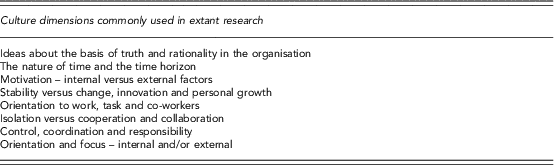
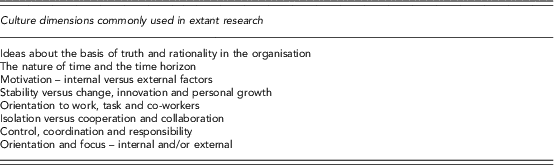
Our study seeks to identify cultural characteristics and associated HRM practices of high performing knowledge-intensive service firms, in order to gain a greater understanding of the mechanisms underlying their culture–performance relationship. So, we now introduce some key cultural dimensions and discuss our approach to assessing them. In a comprehensive review of the empirical organisational culture literature, Detert, Schroeder, and Mauriel (Reference Detert, Schroeder and Maurial2000) developed an explanatory framework that summarises the eight main dimensions explored in such research (see Table 2). It is worth noting that there can be some overlap between these dimensions (e.g., there could be some common values and behaviours linked to motivation, collaboration and innovation) and that individual studies often focus on a limited number of these dimensions.
Dimensions of organisational culture (Detert, Schroeder, & Mauriel, Reference Detert, Schroeder and Maurial2000)
Jung et al. (Reference Jung, Scott, Davies, Bower, Whalley, McNally and Mannion2009) note that organisational culture researchers tend to develop either dimensional or typological models. While dimensional studies have the advantage of focusing on specific variables of interest such as values, innovation or job satisfaction, the authors warn that typological approaches risk stereotyping organisations and producing moral judgements about them (e.g., by categorising organisations as ‘tricksters’ or ‘jesters’).
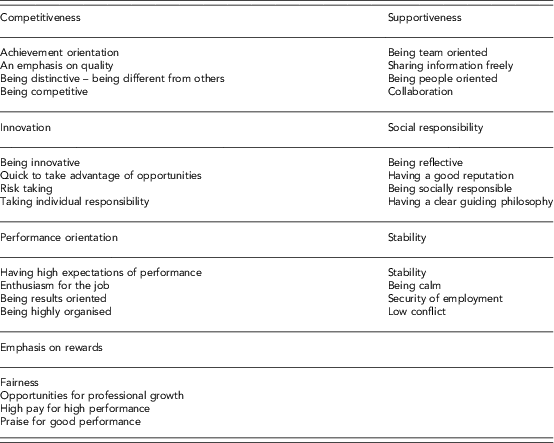
Sarros et al. (Reference Sarros, Gray, Densten and Cooper2005) developed a seven factor model of organisational culture in their revised version of the OCP instrument initially developed by O'Reilly, Chatman, and Caldwell (Reference O'Reilly, Chatman and Caldwell1991). Each of these dimensions is characterised by a series of values and norms (see Table 3). Many of the dimensions identified by Detert, Schroeder, and Mauriel (Reference Detert, Schroeder and Maurial2000) in their review of the organisational culture literature (see Table 2) also appear to be addressed in both the original and revised OCP instruments (see Appendix 1). Drawing on the empirical studies of Sarros et al. (Reference Sarros, Gray, Densten and Cooper2005), O'Reilly, Chatman, and Caldwell (Reference O'Reilly, Chatman and Caldwell1991) and the original work of O'Reilly (Reference O'Reilly1989), the main characteristics of the seven dimensions of organisational culture identified in the revised OCP instrument are now discussed.
Revised OCP (Sarros et al., Reference Sarros, Gray, Densten and Cooper2005)

OCP = Organisational Culture Profile.
The first dimension of the Sarros et al. (Reference Sarros, Gray, Densten and Cooper2005) model is competitiveness; this is found in cultures that emphasise achievement, quality and distinctiveness. It could be expected that competitiveness would also be linked to innovation and the third dimension in the revised OCP instrument, performance orientation. The second dimension, innovation, involves opportunistic and creative behaviour, risk taking and taking responsibility for one's actions. According to O'Reilly (Reference O'Reilly1989: 15), risk taking norms might also include the freedom to try things and fail, acceptance of mistakes, allowing discussion of ‘dumb’ ideas, no punishments for failure, challenging the status quo, forgetting the past, focusing on the long term, expectation that innovation is part of your job, positive attitudes about change and a drive for continual improvement.
The third dimension is performance orientation, which suggests high expectations of superior results, performance, enthusiasm and organisation. This, in turn, links logically with the fourth dimension, emphasis on rewards, which encompasses fairness, opportunities for professional growth, and praise and high wages for good performance. Associated norms might also include the celebration of accomplishments, suggestions being implemented and encouragement (O'Reilly, Reference O'Reilly1989: 15). The fifth dimension, supportiveness, could perhaps be more appropriately labelled co-operation (using the terminology of Detert, Schroeder, & Mauriel, Reference Detert, Schroeder and Maurial2000) as this includes both team and people orientations, as well as sharing information freely and encouraging collaboration. Associated norms might also include effective listening, open access, moving people around, encouraging lateral thinking, accepting criticism and a willingness to consult others (O'Reilly, Reference O'Reilly1989: 15). Social responsibility, the sixth dimension, is encapsulated in cultures where the promotion of socially responsible behaviour is also linked to reflection, a concern for corporate reputation, and a clear guiding philosophy. The final dimension, stability, reflects calmness, security of employment and low levels of conflict.
Sarros et al. (Reference Sarros, Gray, Densten and Cooper2005) have argued, based on prior factor analyses of the structure of descriptors used to characterise each of these cultural dimensions, that there may be a discernible pattern of relationships, with organisations being either externally and organisationally-oriented (focusing mainly on competitiveness and social responsibility) or internally and individually-oriented (focusing more on supportiveness, stability, emphasis on rewards, performance orientation and innovation). However, research into the corporate reputation and branding practices of service organisations in New Zealand suggests that top performing firms often have cultures that combine external and internal orientations by not only focusing on the needs of customers and/or local communities, but by also countering competitive threats and improving stakeholder relationships through effective service delivery processes, innovation and training which, in turn, may help to boost perceptions of trustworthiness, reliability and associated service quality (Gray, Reference Gray2006).
This leads to three research questions:
1. To what extent do the seven dimensions of organisational culture identified by Sarros et al. (Reference Sarros, Gray, Densten and Cooper2005) in the Australian context – competitiveness, innovation, performance orientation, emphasis on rewards, supportiveness, social responsibility and stability – help explain the cultures of successful professional, business and tourism service providers (i.e., knowledge-intensive firms) in New Zealand?Footnote 1
2. To what extent do other important dimensions emerge from the analysis?
3. To what extent are the values and norms we identify within these cultural dimensions incorporated into HRM practices, which are generally perceived to have potential to positively influence the behaviours of managers and frontline staff?
Study Design
Our research employs a qualitative approach. There has been a trend since the 1980s towards the use of quantitative approaches to assess organisational culture (Jung et al., Reference Jung, Scott, Davies, Bower, Whalley, McNally and Mannion2009), and while there may be some benefits in trying to quantify the strength of culture–performance relationships, there is also merit in adopting qualitative techniques that add depth to our understanding of this relationship. Indeed, Rousseau, in her comprehensive review and critique on assessing organisational culture, offers strong support for a more pluralistic approach:
Quantitative assessment offers opportunity for inter-organisational comparisons to assess often-assumed relations between culture and organization success, strategy, and goals. Qualitative research can explore the meanings behind the patterns … Failure to apply a variety of methods to assessing culture limits our understanding of it. (Rousseau, Reference Rousseau1990a: 185–186).
Jung et al. (Reference Jung, Scott, Davies, Bower, Whalley, McNally and Mannion2009), in their comprehensive review of the instruments used to assess organisational culture, add that qualitative approaches such as participant observation, interviews, discussions and documentary evidence allow for the meaningful examination of underlying values, beliefs and assumptions, as well as providing a rich account of the cultural dynamics and complexity within an organisation (p. 1092).
We used in-depth interviews with multiple informants in eight sample firms to explore whether culturally-sanctioned organisational behaviours – in particular HRM practices – may be linked to superior financial performance. Initially, the seven key dimensions of culture in the Sarros et al. modified version of the OCP, which is a profiling tool used to characterise an organisation's culture across multiple categories of norms, behaviours and values or beliefs (Ashkanasy, Wilderom, & Peterson, Reference Ashkanasy, Wilderom and Peterson2000: 35), provided an organising framework for our analysis. According to Ashkanasy, Wilderom, and Peterson (Reference Ashkanasy, Wilderom and Peterson2000), three categories of profiling surveys have been identified in the literature: descriptive, fit and effectiveness. Descriptive approaches are concerned with identifying cultural characteristics; fit profiles assess the degree of congruence between an organisation and its members; and effectiveness profiles are concerned with identification of performance drivers. This study is concerned with the latter.
Sample
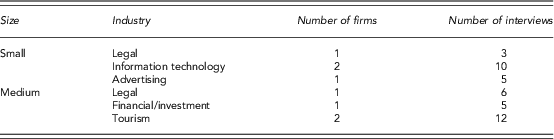
Our data are drawn from 41 interviews conducted with senior and middle managers and frontline employees in eight providers of professional, business and tourism (i.e., knowledge-intensive) services based in New Zealand. The service sector is fast becoming an increasingly important source of job creation and national wealth, and the ability to compete effectively in domestic and international markets is critical for continued growth (Gray, Reference Gray2006).
An initial survey of ~350 New Zealand service firms was conducted in 1999 to assess links between marketing and management practices and a broad array of performance measures. Four years later, 50 firms that had been identified as high performers across three dimensions – financial, customer and brand performance relative to their nearest competitor (see Appendix 2) – were contacted again (i.e., 2003/2004) to ascertain whether they were still successful and also if they were willing to participate in a qualitative study of their corporate cultures. A total of 32 firms agreed to take part in the subsequent phase. A further follow-up questionnaire was administered in 2007 to ascertain whether the performance of these 32 exemplar firms – based on their profitability and profitability growth over the previous 3 years when compared with their major competitors – had varied since the in-depth interviews had been conducted in 2003/2004. Consequently, three groups emerged: those who had experienced improved performance, those who had experienced steady performance and those who had experienced lower performance.
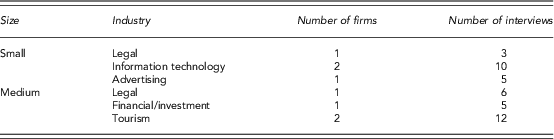
Subsequently, our analysis in this paper comprises a sample of eight firms, which were identified (a) as having the highest levels of profitability and profitability growth (due to improved performance) and (b) that were small to medium in size. We focus on this subset of firms because we want to ascertain if certain cultural characteristics are stable across a sample of high performers but also, and we believe more importantly, because while most firms in New Zealand fall into the small to medium-sized enterprises category, there is a paucity of research on them. Indeed, with regards the latter, 97% of New Zealand businesses employ 19 or fewer full-time equivalent staff. The sample demographics of the present study are presented in Table 4. The number of employees ranged from 5 to 49 for the small firms and 50–80 for the medium firms.
Sample demographics
Data collection
Face to face semi-structured interviews were conducted with managers and frontline employees in each of the eight sample firms to ensure a consistent view. The approach is consistent with previous research that posits that culture influences behaviour at the individual level which, in turn, influences performance outcomes (see, e.g., Zerbe et al., Reference Zerbe, Dobni and Harel1998; Sarros et al., Reference Sarros, Gray, Densten and Cooper2005). All questions were open-ended and were designed to allow respondents to describe their own thoughts and observations about their organisation. For instance, interviewees were asked to ‘think of the firm as a person – how would you describe its personality?’, and ‘what are the important values, beliefs, attitudes and behaviours that your firm promotes among managers and staff?’. The dimensional data obtained from respondents were unprompted, with no specific reference to the dimensions identified by Sarros et al. (Reference Sarros, Gray, Densten and Cooper2005). Each interview, which took between 1 and 2 hr, was taped and transcribed, with one of the two interviewers taking notes to verify transcriptions.
Data analysis
A thematic coding approach was adopted to sort those responses that were similar to the 28 different cultural characteristics that represent the seven cultural dimensions identified by Sarros et al. (Reference Sarros, Gray, Densten and Cooper2005): competitiveness, innovation, performance orientation, emphasis on rewards, supportiveness, social responsibility and stability. Provision was also made to code data under ‘other dimensions’ that fell outside the OCP model that had been modified by Sarros et al. for the Australian context. To enhance external validity, we used a team approach to analyse interview data (Ferlie, Fitzgerald, Wood, & Hawkins, Reference Ferlie, Fitzgerald, Wood and Hawkins2005; Teo, Lakhani, Brown, & Malmi, Reference Teo, Lakhani, Brown and Malmi2008). This saw data thematically coded by two researchers working independently (initially by one researcher and then by a second researcher several months later). Where inconsistency was evident, a panel comprising three academic researchers reviewed data and, through discussion, reached agreement on interpretation. This effectively improved the inter-coder reliability from ~85% to 100%.
Results
The results suggest that six of the seven key factors identified in Australian firms by Sarros et al. (Reference Sarros, Gray, Densten and Cooper2005) – competitiveness, innovation, performance orientation, emphasis on rewards, supportiveness and social responsibility – may also provide a useful framework for investigating cultural drivers in New Zealand professional, business and tourism service providers. The only exception appears to be stability, which (unlike the Australian experience) does not appear to be an important factor in the current New Zealand study. We also made provision for ‘other dimensions’ that fall outside the modified OCP model, however, few other cultural drivers of performance appear to be present in our sample firms.
Although earlier studies have linked the need for a stable work environment (which in this study reflects calmness, security of employment and low levels of conflict) to organisational aims as diverse as innovation (Martins & Terblanche, Reference Martins and Terblanche2003) and cost reduction (Schuler & Jackson, Reference Schuler and Jackson1987), it could be that in our context this is a necessary precondition for successful customer service that is taken for granted by managers and frontline staff. As Meyer and Allen (Reference Meyer and Allen1991: 70) note, ‘following the hygiene/motivator distinction made by Herzberg (Reference Herzberg1966), we observed that work experience variables could be divided roughly into two categories: those that satisfied employees need to feel comfortable in the organization, both physically and psychologically, and those that contributed to employees’ feelings of competence in the work role’.
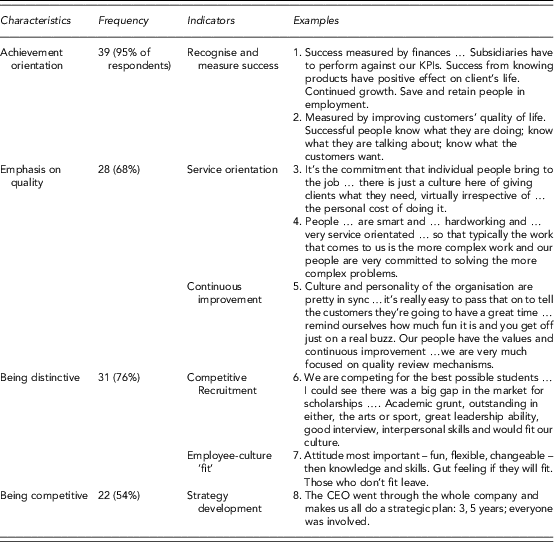
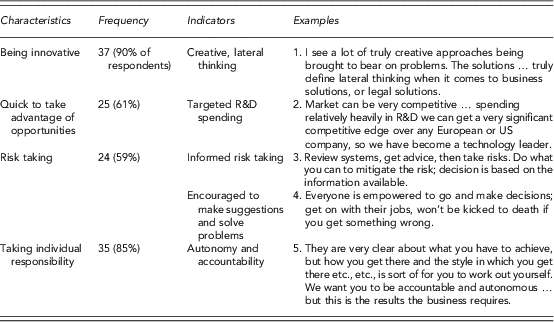
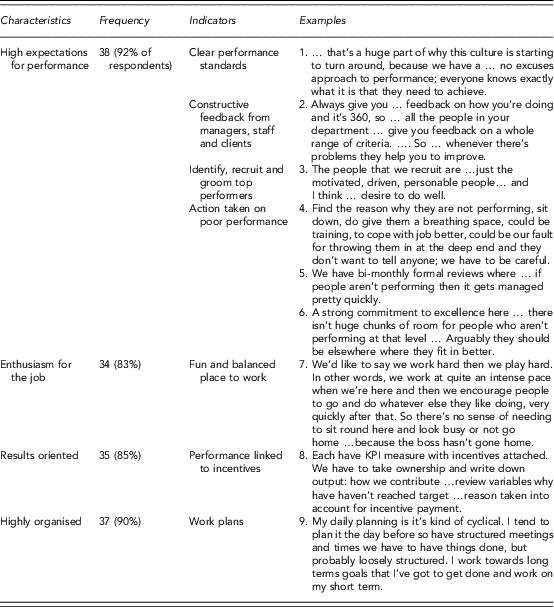
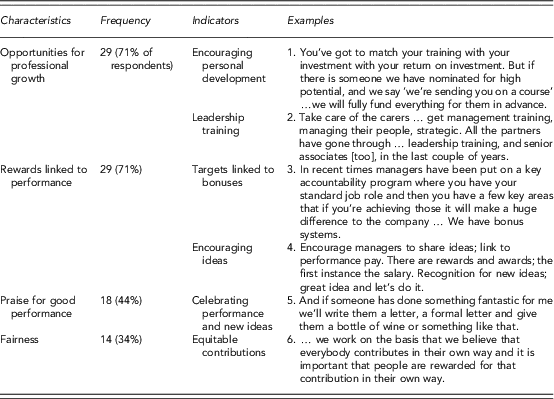
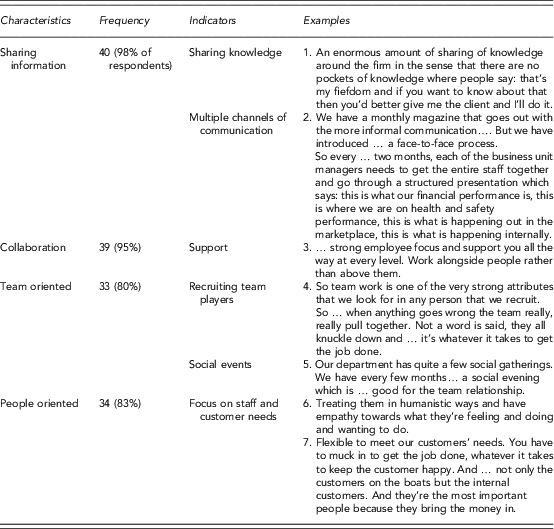
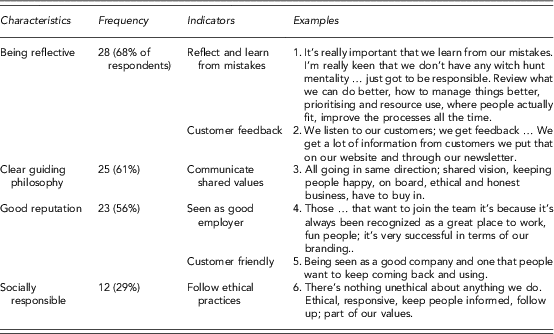
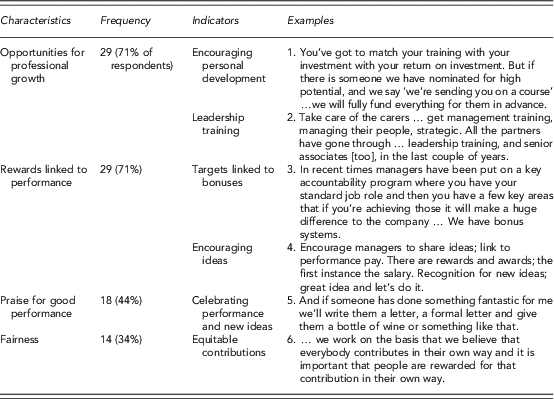
In this section, we discuss how the other six key cultural dimensions identified in our study translate into practice in the sample firms. In particular, we focus on how associated HRM practices are perceived to help improve service performance. Tables 5–10 show the proportions of participants who identified particular cultural characteristics as important features in their organisation, along with representative quotations that provide insight into these characteristics.
Competitiveness
Innovation
Performance orientation
Emphasis on rewards
Supportiveness
Social responsibility
Competitiveness
Successful service providers appear to compete primarily through attracting, training and retaining the best staff (Table 5, quotes 2, 3, 6 and 7) and aspire to provide superior customer service (quotes 3, 4 and 5). Success is measured using an array of financial indicators (Siehl & Martin, Reference Siehl and Martin1990) as well as customer and staff satisfaction measures (quote 1). Indeed, it seemed that firms tried to achieve a balance between continual improvement of service quality with a concern for employee welfare, development and enjoyment (quote 5). Firms usually plan to stay competitive (quote 8), although there was an even split between those that use formal or informal methods and those that use a top-down approach or wider consultation with staff in strategy development.
A humanistic HRM philosophy (Fombrun, Tichy, & Devanna, Reference Fombrun, Tichy and Devanna1984) is in evidence. With the focus on best practices in HRM, evident by the recruitment of excellent staff (quote 6), matching applicants with the corporate culture and strategic goals of the organisation (quote 7), providing appropriate incentives and rewards, and encouraging a balanced approach to work and personal life (quote 5). The findings support previous research that links effective staff recruitment and development strategies with firm success (Schneider & Bowen, Reference Schneider and Bowen1995; Pfeffer, Reference Pfeffer1998; Browning, Edgar, Gray, & Garret, Reference Browning, Edgar, Gray and Garret2009). The results also imply that customers will pick up cues to an organisation's culture through encounters with frontline employees (Schneider & Bowen, Reference Schneider and Bowen1985, Reference Schneider and Bowen1993, Reference Schneider and Bowen1995; Schneider et al., Reference Schneider, White and Paul1998).
Innovation
Being creative, thinking laterally, and investing in targeted research and development help firms to adapt to changing market conditions and stay competitive (see Table 6, quotes 1 and 2). The work tends to be knowledge-intensive, thus competitive advantage comes from people who think outside of the square and provide superior service. This study therefore supports the findings of Robertson and Swan (Reference Robertson and Swan2003) where thinking outside of the square equated to an autonomous and highly successful workforce. Consequently, Frenkel, Korczynski, Shire and Tam (Reference Frenkel, Korczynski, Shire and Tam1999) maintain that knowledge workers in service organisations engage in more complex problem solving and customisation to satisfy the needs of their customers.
All of which leads us to how competitive advantage was sustained. Quotes 3 and 4 indicate that participants took informed risks; therefore, the organisational climate indicates support for innovative behaviour, rather than punishment. In contrast, Rousseau (Reference Rousseau1990b: 458–459) found security-oriented behaviours, which might have adverse consequences such as failure or punishment, to be negatively related to performance.
The firms in our study strive to create flexible work environments, which empower individuals to make innovative suggestions and to solve problems with a reasonable degree of autonomy and discretion (quotes 4, 5 and 6). These features have been seen to improve job satisfaction, willingness to adapt to the particular service demands (Chebat & Kollias, Reference Chebat and Kollias2000), and boost motivation and performance (Pfeffer, Reference Pfeffer1994).
Performance orientation
From an HRM perspective, there appear to be a number of overlaps between the various dimensions of organisational culture in the Sarros et al. (Reference Sarros, Gray, Densten and Cooper2005) model. The most obvious relate to culturally-reinforced strategies and tactics to encourage service enterprises to achieve long-term success through improved competitiveness, innovation and the setting and achievement of high performance targets. Most of the firms in our study not only set high standards but also provide staff with constructive feedback (Table 7, quotes 1 and 2). High performing individuals are actively recruited or identified within the organisation, with processes to review progress and develop capabilities (quotes 3 and 5). Recruiting people who fit the culture of the organisation is mentioned in the contexts of staff performance (quote 6) and firm competitiveness (quote 5); while a low tolerance for poor performance is balanced by a commitment to assist underperformers to improve (quote 4).
Encouraging high levels of enthusiasm, as well as a sense of fun, assists socialisation (Plester & Sayers, Reference Plester and Sayers2007) and motivation (quote 7), while initiatives such as linking pay to performance, goal setting and monitoring help keep performance on track (quotes 8 and 9).
Emphasis on rewards
Respondents mentioned opportunities for personal and professional growth as often as financial bonuses as rewards for good performance. Previous research suggests that rewarding staff with training and development may have a more positive influence on service-oriented behaviour than financial rewards (Browning, Reference Browning2006). Consequently, there was evidence that personal growth was seen as a way to challenge and stretch employees and to develop managers through leadership training and mentoring (Table 8, quotes 1 and 2). Training and development is seen as a form of developmental reward (Shields, Reference Shields2008). These employees were ‘rewarded’ extrinsically with extra training, which would see the recipient and their employer benefit, the latter through the display of a higher standard of service-orientated behaviour. Consequently, by combining elements of a learning culture and a performance orientation, these organisations evaluated the training process to ensure a return on investment. Some firms offered training opportunities to all staff; others limited them to ‘top’ performers. Likewise, some fostered personal growth in a broad sense, whereas others confined development to job-related skills.
Target setting appears to be an important mechanism to link personal achievements to financial bonuses (quote 3). To encourage innovation, idea generation was also linked to rewards (quote 4). It was acknowledged that praise is also an important motivator (quote 5) but, like fair and equitable rewards (quote 6), was mentioned by fewer participants. Linking reward systems to performance is an important feature of strategic HRM (Huselid, Reference Huselid1995) and, when coupled with a managed turnover approach, encourages staff to perform or leave (Dreher & Dougherty, Reference Dreher and Dougherty2002).
Supportiveness
The findings support our earlier view that perhaps this dimension should be renamed co-operation or collaboration (Detert, Schroeder, & Mauriel, Reference Detert, Schroeder and Maurial2000). The high performing service firms in this study tend to have a strong team orientation that includes hiring strong team players (Table 9, quote 4) and forging strong collaborative bonds (quote 3). Social activities help to strengthen team relationships (quote 5). Information is shared widely (quote 1) using a variety of media (quotes 2–4). This helps these firms to maintain a strong focus on both internal and external customer needs (quotes 6 and 7). Employees feel valued and trusted and are supported in their work (quotes 3, 4 and 7), which suggests that underlying values of ‘belonging, trust and participation’ (Patterson, West, Lawthom, & Nickell, Reference Patterson, West, Lawthom and Nickell1997: 9) are emphasised. There are also strong indications of empathy and caring (quote 6), which are features of a humanistic and egalitarian culture (Pfeffer, Reference Pfeffer1994).
Social responsibility
It is worth noting in this study the evident overlap between competitiveness and social responsibility. Firms can tend to focus on competitiveness over social responsibility particularly when they have a short term focus. Reputation is a feature that arguably straddles the two; it can be classified as a means of competitive advantage as well as an outcome of socially responsible practice (Table 10, quotes 4 and 5). Reputation is an outcome that emerges from stakeholders’ judgments about a firm's past social and economic actions and achievements (Wartick, Reference Wartick1992; Helm, Reference Helm2005). Two contrasting views help explain an organisation's decision to behave in a socially responsible manner. The first is instrumentalism. This view suggests ‘that certain outcomes will obtain [sic] if certain behaviors are adopted’ (Jones & Wicks, Reference Jones and Wicks1999: 208). A normative view, on the other hand, sees stakeholders as ‘ends’ in themselves, with decisions about socially responsible behaviour likely to be motivated more by moral rather than pragmatic reasons (Jones & Wicks, Reference Jones and Wicks1999: 209). Taking the instrumentalist perspective, we interpret our data as possibly suggestive that reputation, along with being an outcome of corporate social responsibility, may also play an influential role as an input into future strategic decision-making (e.g., a firm with a good reputation may be motivated to take actions to protect it). From this perspective, reputation may be viewed as anticipated corporate conduct (Helm & Gray, Reference Helm and Gray2009). The process of developing and enhancing reputational assets may also be linked to organisational learning (Wick & Leon, Reference Wick and Leon1995), with past experiences informing the development of strategies and competencies to maintain ethical and moral positioning and subsequent competitive advantage. Our results support those of an earlier study of the corporate branding and reputation practices of New Zealand service providers that showed top performing firms focus on both service quality and community support initiatives (Gray, Reference Gray2006). Other practices related to social responsibility include a clear cognisance of ethical issues and health and safety factors. These seem to have been widely transmitted throughout the workforces, indicating that a clear guiding philosophy has been established (Table 10, quotes 3 and 6).
Organisational processes and outcomes, from personnel training to marketing initiatives, were also subject to review and revision (Table 10, quotes 1 and 2). Customer and supplier feedback was widely sought to inform and improve processes and performance. Schneider and Bowen (Reference Schneider and Bowen1995) propose that harnessing both customer and employee knowledge is essential to the development and maintenance of a service culture. This reflexivity encourages firms to embrace continual improvement, ‘rapidly creating and refining the capabilities needed for future success’ (Wick & Leon, Reference Wick and Leon1995: 299). For the knowledge-intensive firms in our sample this is very important, as future success is determined by the ability to deliver high quality services.
Other dimensions
There appears to be little support for stability, the seventh dimension in the Sarros et al. (Reference Sarros, Gray, Densten and Cooper2005) model of organisational culture, with very few respondents referring to this issue. The main elements of this dimension are posited as being calm, security of employment, limited staff turnover and low conflict. While the high performing firms that make up our sample are keen to nurture and keep top performers, there is also an acknowledgement that good professionals are mobile. A shift from contractual to permanent contracts was mentioned by only one firm (in the tourism sector). Being calm was not mentioned at all; in fact, most firms appeared to be energetic, creative and innovative, suggesting that a certain level of ‘creative conflict’ might be beneficial in this context. This finding supports Robertson and Swan (Reference Robertson and Swan2003), who identified that where ‘creative conflict’ was encouraged top-achievers were found to extend themselves, and thus the firm gained competitive advantage through ‘elite’ staff. An informant in one organisation reported increased (creative or constructive) conflict arising from respecting each others’ opinions and perspectives: ‘We argue and fight, no hierarchy, respect each other's opinions’. As mentioned earlier, it could be that stability in this context is seen more as a hygiene factor than a motivator. It may also be that the four dimensions we assessed were not broad enough to capture this concept sufficiently, a limitation that could be addressed in future research.
Few ‘other dimensions’ were evident in our analysis. In fact, most of the common dimensions of organisational culture utilised in previous studies (see Table 2) reviewed by Detert, Schroeder, and Mauriel (Reference Detert, Schroeder and Maurial2000) appear to be incorporated in the six dimensions of the Sarros et al. (Reference Sarros, Gray, Densten and Cooper2005) version of the OCP model discussed above.
Conclusions
Earlier we outlined three guiding research questions: the extent to which the seven traditional dimensions of culture identified by Sarros et al. (Reference Sarros, Gray, Densten and Cooper2005) in the Australian context help explain the cultures of successful professional, business and tourism service providers in New Zealand; to what extent other important dimensions emerge emerged from the analysis; and to what extent were these cultural dimensions incorporated into HRM practices that were perceived as positively influencing the behaviours of managers and frontline staff.
The answers to the first two questions are fairly straightforward. In terms of the first question, while only six of the seven dimensions – competitiveness, innovation, performance orientation, emphasis on rewards, supportiveness and social responsibility – appear to feature in our sample firms, the results nevertheless suggest that the quantitative OCP instrument adapted by Sarros et al. (Reference Sarros, Gray, Densten and Cooper2005) provides a useful lens for helping to guide the interpretation of data in qualitative studies. Further, the model appears to be applicable to high performing providers of professional, business and tourism services (i.e., knowledge-intensive firms) in New Zealand as well as the broader sample of firms used to develop the instrument in the Australian context. Future research might ascertain whether the modified OCP instrument has even broader application in other industry and country-market contexts. Although the seventh dimension, stability, was not evident among the organisations in our study, this could be because we have focused on the cultures of highly competitive, innovative and growth-oriented small to medium-sized enterprises that are operating in a fairly turbulent economic environment. A similar finding was identified by Robertson and Swan (Reference Robertson and Swan2003), though their knowledge-intensive firm was deemed ‘large’ by comparison. Staff accepted the turbulence as part of the normal operating environment of the firm. It may also be unsurprising that no other important dimensions emerged, given that most, if not all of the dimensions commonly studied in previous organisational culture studies (see Detert, Schroeder, & Mauriel, Reference Detert, Schroeder and Maurial2000) appear to be incorporated in the modified OCP model.
Our analysis also provides insights that help answer the third research question. It may be that managers and employees are widely aware of the relationship between their organisation's culture and its HRM and other management and marketing practices. In our study, we did not ask our interviewees specifically about HRM practices; rather we asked about their firm's culture. However, the responses tentatively suggest that HRM practices appear to be largely responsible for supporting and reinforcing the values embedded within organisational cultures, though no explicit evidence was gathered of each firm's actual policies (i.e., specific HRM documentation).
It is possible to discern that participants in our sample firms appear to acknowledge two main assumptions about existence by combining both pragmatic and rational approaches to the basis of knowledge and truth (Detert, Schroeder, & Mauriel, Reference Detert, Schroeder and Maurial2000). The pragmatic assumptions appear to be linked to values and norms related to the importance of customers and staff, a service quality orientation, innovation, a balanced lifestyle and social responsibility. The rational assumptions appear to be linked to values and norms associated with performance measurement and rewards, service quality measurement and competitive strategy and performance. In turn, these values and norms could be argued to be the basis of a variety of strategic HRM and relationship management practices that were alluded to by respondents, such as careful recruitment practices, empowerment of employees via training, and social and corporate responsibility. Subsequently, we see this as an area ripe for future research.
Our study provides an important contribution to the research into how corporate culture is potentially operationalised in small and medium-sized service enterprises. For example, our findings appear to support previous studies that indicate professional and knowledge-intensive service providers tend to favour cultural values and high performance work systems that support employee discretion and flexibility to meet the specific demands of each customer (Horwitz & Neville, Reference Horwitz and Neville1996; Frenkel et al., Reference Frenkel, Korczynski, Shire and Tam1999; Boxall, Reference Boxall2003). Our results also support the argument that performance outcomes reflect the extent to which an organisation is able to develop a coherent and cohesive fit between its sector, strategy, culture and HRM practices (Dreher & Dougherty, Reference Dreher and Dougherty2002). The importance of understanding of how recruitment, training and rewards help to develop and sustain a service culture is also apparent (Ostrom et al., Reference Ostrom, Bitner, Brown, Burkhard, Burkhard, Goul and Rabinovich2010). Our research supports the contention that service organisations are both people-oriented and outcome-oriented (Chatman & Jehn, Reference Chatman and Jehn1994). Overall, our research indicates how organisational culture may contribute to an array of strategic HRM practices (Pfeffer, Reference Pfeffer1994; Horwitz & Neville, Reference Horwitz and Neville1996) in knowledge-intensive firms.
Our findings also have some useful implications for managers wishing to develop and foster high-performance service cultures. A strong humanistic focus, supported by HRM practices such as teamwork, participation, and feedback, builds trust, job interest and customer focus among employees. It is essential that managers provide staff with the support they need to do their jobs well, such as ongoing professional development, and develop a work environment that encourages autonomy, risk-taking and flexibility to allow creativity and innovation to emerge.
Limitations and Future Research Suggestions
The strength of our study is that it provides rich insights into the nature of a high-performance knowledge-intensive service culture, based on the reasonably consistent views of 41 stakeholders across eight successful small and medium-sized service providers. Interviewees were not prompted to discuss specific cultural attributes; instead, we allowed people to tell their story. We initially analysed the culture profiles using the revised OCP model (Sarros et al., Reference Sarros, Gray, Densten and Cooper2005) as a lens.
A limitation of the research was that it did not include low performing firms. Our study focuses on the highest performing small to medium-sized enterprises among a larger sample of 32 sample firms (80% of whom would fall into the ‘outstanding’ or ‘above average’ categories based on profitability and profitability growth compared with their nearest competitors in the past 3 years). Gray (Reference Gray2010) points out that studies into best practices – and benchmarking research in general – can show that poorer performing firms appear to adopt similar management and marketing practices to those of better performing competitors. The differences usually relate to commitment, resources and sophistication (i.e., how well practices are implemented, rather than number of practices). The links between organisational culture, business strategies, practices and performance will remain blurred unless in-depth interviews, case studies, or other qualitative and quantitative inquiries are undertaken to compare the cultures and practices of better and poorly performing firms to identify the key sources of advantage (Browning et al., Reference Browning, Edgar, Gray and Garret2009). For example, while our research does not shed much light on the concept of stability, we consider this to be an area ripe for further study as work in this area (see Svyantek & DesShon, Reference Svyantek and DeShon1993; Fiol, Reference Fiol2001) suggests stability and innovation share complementarities that have the potential to benefit organisational functioning. Future research could also include poorly performing firms to identify the cultural characteristics and HRM and relationship management policies and practices that are most clearly linked to improved competitiveness and performance.
Comparing the cultures and practices of larger and smaller firms within different industry sectors, as well as those with domestic and international orientations, could also provide additional insights. We also focus on providers of professional, business and tourism services. Using a broader array of industries in future research may also be instructive. Finally, as mentioned earlier it is difficult to discern the deepest levels of culture using conventional interview or observational methods. Future studies could seek to probe underlying assumptions about existence using projective and/or laddering techniques.
Acknowledgements
The authors would like the thank the reviewers for their helpful comments.
Placing the OCP in the Wider Cultural Research Context
Appendix 2 Initial Performance Measures Used in the 1999 Study
Financial performance
Profitability compared with our nearest competitor is…
Total revenue compared with our nearest competitor is…
Over the last 3 years the change in our profitability compared with our nearest competitor is…
Customer performance
Customer satisfaction compared with our nearest competitor is…
Customer loyalty compared with our nearest competitor is…
Brand performance
Brand awareness compared with our nearest competitor is…
Brand equity compared with our nearest competitor is…
Note: All questions were rated on a 1–5 scale, with 1 = ‘much higher’ and 5 = ‘much lower’.