Introduction
Behavioral and psychological symptoms of dementia (BPSD) have a point-prevalence of 50–75% in Alzheimer's disease (AD) and affect almost 100% of patients over a five-year follow-up (Lyketsos et al., Reference Lyketsos, Lopez, Jones, Fitzpatrick, Breitner and DeKosky2002). BPSD often arise from the interaction between neurological damage, the patient's general health status, psychological and relational background, and the care environment (Cummings and Back, Reference Cummings and Back1998). These symptoms often increase patient suffering, caregiver burden, risk of hospitalization and institutionalization, and costs of care (Black and Almeida, Reference Black and Almeida2004).
Psycho-pharmacological therapies aimed at symptom reduction have limited efficacy and their use has been associated with an increased risk of adverse events and mortality (Ballard et al., 2009). Therefore, psychosocial and environmental approaches to BPSD have received increasing attention in recent years, although scientific data supporting these kind of interventions are still limited and sometimes inconsistent (O'Connor et al., Reference O'Connor, Ames, Gardner and King2009a). Some of the non-pharmacological approaches to dementia are based on the hypothesis that, in spite of the cognitive deficit, the emotional content of experiences is spared. Therefore, a psychosocial stimulation based on relational activities which are relevant to the patient, as is the case of interaction with pets, can be expected to modify emotional status, even in severe dementia.
The use of animals for health purposes was introduced in the USA in 1953 (Levinson and Mallon, Reference Levinson, Mallon and Levinson1997). At present, treatments involving interaction with animals embrace both “Animal-Assisted Therapy” (AAT), which has specific therapeutic purposes in the context of an individualized care plan, and “Animal-Assisted Activity” (AAA), which, as tested in this specific study, is aimed at improving the patient's quality of life in a broader sense. Small-sized non-randomized studies carried out in recent years suggest that these interventions may be beneficial both for subjects affected by dementia and for their caregivers. In particular, effects have been observed on agitation, social behaviors and nutritional status. In addition, the presence of pets in health care structures has been associated with a positive emotional involvement of the whole community, including staff (Churchill et al., Reference Churchill, Safaoui, McCabe and Baun1999; Greer et al., Reference Greer, Pustay, Zaun and Coppens2001; Kanamori et al., Reference Kanamori2001; Edwards and Beck, Reference Edwards and Beck2002; McCabe et al., Reference McCabe, Baun, Speich and Agrawal2002; Richeson, Reference Richeson2003). In particular, beneficial effects of dog contact include pleasant tactile stimulation, companionship and non-verbal communication, which is potentially more friendly and non-judgmental than those of the best-intentioned caregivers (Perkins et al., Reference Perkins, Bartlett, Travers and Rand2008). Such intervention is deemed as promising, even if available data are still limited (Filan and Llewellyn-Jones, Reference Filan and Llewellyn-Jones2006) and in a recent review by O'Connor and colleagues (Reference O'Connor, Ames, Gardner and King2009a; Reference O'Connor, Ames, Gardner and King2009b) no research on AAT or AAA was included, because none of the studies reached the qualitative standards required by the authors. Moreover, the positive effects are usually observed during the experimental session or in the immediately subsequent period, but such effects do not appear to last over time (Richeson, Reference Richeson2003).
The aim of the present exploratory study was to evaluate the effects of AAA with dogs for older patients affected by dementia in an Alzheimer Day Care Center (ADCC), in comparison both with an active control condition (plush dogs) and with usual ADCC activities. Outcomes included cognition, mood, agitation and BPSD. We also assessed observed emotional status and motor behavior both during sessions and after three hours.
Methods
Subjects enrolled in the study were ten elderly patients with AD according to NINCDS-ADRDA criteria, who attended the specialized ADCC “Luigi Amaducci” in Sesto Fiorentino (Florence) at least three times per week. ADCC is designed and the staff specifically trained to assist patients with dementia. A multi-professional team, including a neurologist, nurses and a physiotherapist, is responsible for implementing individual care plans. Exclusion criteria were: being bedridden, being allergic to animals, having a functional deficit in the upper limbs, refusal to interact with animals, and refusal to participate in the study on the part of the patient or his/her legal representative.
The present exploratory study has a controlled, nonrandomized, repeated measures design. The study time-schedule was divided into three periods: two weeks’ pre-intervention (usual day care activity, UDC), three weeks’ control activity (CA), three weeks’ AAA. Each patient underwent a cognitive, behavioral and psychological assessment before CA (t0), at the end of CA before AAA (t1), and at the end of AAA (t2). In addition, emotional status, agitation and behavior were evaluated during all the three phases of the study by direct twice-a-week observations, each of them lasting 10 consecutive minutes, carried out both in the morning (during CA and AAA periods these observations were performed during the experimental sessions) and in the early afternoon (3 hours after the end of intervention).
Both AAA and CA were provided to the whole group for approximately 100 minutes three times a week, from 10am to about 12 noon. Each session, guided by the same AAA experienced operator (FM), included a few minutes to introduce the dog/plush-dog to the patient and about 10 minutes of interaction for each participant. Each participant, according to his/her cognitive and functional capacity, was invited to perform an established sequence of actions with the dog (or the plush), including talking, stroking, playing, feeding, brushing and taking for a short walk.
The AAA operator and the two dogs used for the intervention (one 15-month-old male poodle, and one 3-year-old unsterilized female golden retriever) are part of the Association Antropozoa, which is highly experienced in AAA and AAT. The dogs are specifically trained as co-therapists and undergo regular veterinary controls, according to guidelines of the US Center of Disease Control. Operators involved in the study have received a specific education and have accumulated many years of experience in the field, according to guidelines of the Delta Society.
Three kinds of assessments, performed by different and independent raters, blinded to each-other were performed:
1. Cognitive, functional, behavioral and psychological assessment, performed by two physicians (a geriatrician (AMM) and a neurologist (CP)), including Mini-Mental State Examination (MMSE; Folstein et al., Reference Folstein, Folstein and McHugh1975), Severe Impairment Battery (SIB; Saxton et al., Reference Saxton, McGoingle-Gibson, Swihart, Miller and Boller1990), Activities of Daily Living (ADL; Katz et al., Reference Katz, Ford, Moskowitz, Jackson and Jaffe1963), Cohen Mansfield Agitation Inventory (CMAI; Cohen-Mansfield, Reference Cohen-Mansfield1986), Neuropsychiatric Inventory (NPI; Cummings et al., Reference Cummings, Mega, Gray, Rosenberg-Thompson, Carusi and Gornbein1994), Cornell Scale for Depression in Dementia (CSDD; Alexopoulos et al., Reference Alexopoulos, Abrams, Young and Shamoian1988).
2. Direct observation of the emotional status, performed by a psychologist (GL) with Observed Emotion Rating Scale (OERS; Lawton et al., Reference Lawton, van Haitsma and Klapper1996), which is validated in dementia patients and assesses outward manifestations of the emotional status. Behavioral expressions of five primary emotions (pleasure, anger, anxiety/fear, sadness, general alertness) are rated in frequency during a 10-minute observation period on a 5-point scale (from 1 = never to 5 = more than 5 minutes).
3. Direct observation of agitation and motor behavior, performed by a social educator (DB) with:
• Agitated Behavior Mapping Instrument (ABMI; Cohen-Mansfield and Libin, Reference Cohen-Mansfield and Libin2004), a validated scale for observation and measurement of agitation. Thirteen agitated behaviors are recorded during a 10-minute observation.
• Motor Behavior Observation Form (MoBOF), created by the present authors after qualitative analysis of direct observations of AAA recorded by social educators with semi-structured work-sheets during a preliminary phase of the study. It rates the frequency of four principal types of motor activities: “motion” (including lower and upper limb movements and walking), “vocal expression” (including words and moans), “attraction towards the environment” (including touch, finalized actions, approaching, turning the gaze around, calling, making questions/comments), “repulsion towards the environment” (including leaving and activity refusal). Each single behavior was rated on a 4-item scale during a 10-minute observation period, (0 = never; 1 = rarely (1–2 times); 2 = frequently (3 times or more); 3 = almost always), obtaining four scores (range: 0–12 for motion; 0–6 for vocal expression; 0–21 for attraction towards the environment; 0–9 for repulsion towards the environment).
Pharmacological therapy, with special regard to psychoactive drugs, remained unchanged during the study period, if allowed by clinical status. Non-pharmacological treatment included in UDC, such as physiotherapy, group gym, occupational activities (e.g. cooking, simple gardening), informal cognitive stimulation (e.g. reading newspapers, board games, drawing), was continued across CA and AAA periods.
Informed consent to participate in the study was acquired from all participants and their proxies, as appropriate.
Continuous variables are expressed as mean ± standard deviation (range). OERS, ABMI and MoBOF were treated as continuous variables, since the mean of the observations performed during each of the three study periods (UDC, CA and AAA) was calculated for every patient. Comparisons between the three observation periods (t0, t1 and t2 for clinical assessment; UDC, CA and AAA for direct observations) were performed by repeated measures ANOVA with polynomial analysis of contrasts for trend assessment. Post-hoc analysis according to the Bonferroni method was performed to compare different intervention periods. When significant differences were observed between CA and AAA in post-hoc analysis, a confirmatory non-parametric analysis with Wilcoxon signed-rank test was also performed. The significance level was set at p < 0.05. Data were analyzed with SPSS 17.0.1.
Results
The sample included ten subjects, four females and six males, with an average age of 79 years ± SD 6 years (range 69–85). The mean MMSE score was 3.3 ± 5.5 (0–16), consistent with a severe cognitive impairment; SIB was 21.0 ± 31.6 (0–99) and number of preserved ADL was 1.7 ± 0.9 (0–3).
No statistically significant change was observed across time for SIB (t0 21.0 ± 31.6; t1 18.9 ± 29.3; t2 21.1 ± 32.7). A trend for a decrease of CSDD was observed after AAA (t0 10.6 ± 5.9 (3–21), t1 10.6 ± 5.9, t2 8.7 ± 5.2, p for trend = 0.035), although the difference between observations was not significant in post-hoc analysis. No significant change in NPI total score was observed (t0 22.2 ± 10.0 (10–39); t1 21.4 ± 11.5; t2 21.3 ± 10.3). With regard to single NPI items, a significant decrease was observed for anxiety (t0 2.9 ± 2.5 (0–8); t1 3.1 ± 2.3; t2 1.5 ± 2.7; p for trend = 0.039), with a significant difference between t1 and t2 in post-hoc analysis (p = 0.04) (Figure 1), confirmed by non-parametric analysis (p = 0.027). A decrease over time in the CMAI score did not reach statistical significance (t0 61.2 ± 21.1 (33–95); t1 55.9 ± 23.9; t2 51.2 ± 22.3; p for trend = 0.068).
NPI anxiety item score change across time (t0 = before CA, t1 = after CA, t2 = after AAA). (CA = Control Activity, AAA = Animal-Assisted Activity). Bars represent SD.

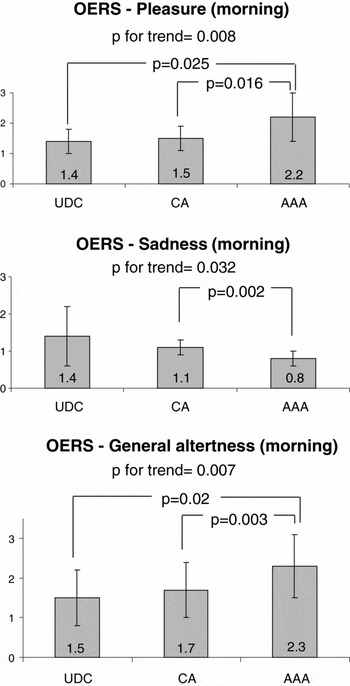
In direct morning observations of emotional status with OERS (baseline range: 1.0–2.0 for “pleasure”; 1.0–2.5 for “anger”; 1.0–1.5 for “fear”; 1.0–3.25 for “sadness”; 1.0–4.25 for “general alertness”), a significant increase of pleasure and general alertness was noticed during AAA sessions compared both with UDC (p = 0.025 for pleasure, p = 0.02 for general alertness) and with CA (p = 0.016 for pleasure and p = 0.003 for general alertness). Moreover, in the comparison between CA and AAA, a significant decrease in sadness (p = 0.002) was observed (Figure 2). Previous changes were confirmed in non-parametric analysis (p = 0.012 for pleasure and general alertness, p = 0.01 for sadness). “Anger” and “anxiety/fear” items of OERS were unchanged across observation periods (data not shown). With regard to the emotional status during the afternoon, OERS “sadness” significantly decreased during AAA compared with CA (p = 0.002; p = 0.007 in non-parametric analysis) (Figure 3). Other afternoon OERS scores were substantially unchanged across the three study periods (data not shown).
OERS morning assessment: levels of “pleasure”, “sadness” and “general alertness” during the three study periods (UDC = Usual Day Care; CA = Control Activity; AAA = Animal-Assisted Activity). Bars represent SD.

OERS afternoon assessment: levels of “sadness” during the three study periods (UDC = Usual Day Care; CA = Control Activity, AAA = Animal-Assisted Activity). Bars represent SD.

With regard to ABMI (baseline range 0–8.0), no significant changes were apparent in the observations carried out during both the morning (UDC 3.6 ± 3.0; CA 2.4 ± 2.1; AAA 2.5 ± 2.5; p for trend = 0.133) and the afternoon (UDC 3.8 ± 3.9; CA 2.7 ± 2.5; AAA 2.5 ± 2.6; p for trend = 0.078).
The assessment of motor activity in the morning by MoBOF (baseline range: 1.0–3.5 for “motion”; 0–3.5 for “vocal expression”; 1.5–4.25 for “attraction to the environment”; 0–0.25 for “repulsion towards the environment”) has shown an increase across the study period for motion (UDC 2.3 ± 0.8; CA 2.4 ± 1.3; AAA 3.1 ± 0.7; p for trend = 0.017), vocal expression (UDC 1.4 ± 1.1; CA 2.4 ± 0.6; AAA 2.4 ± 0.5; p for trend = 0.002) and attraction to the environment (UDC 2.5 ± 1.0; CA 2.3 ± 0.9; AAA 4.0 ± 1.3; p for trend = 0.014). In post-hoc analysis, attraction to the environment increased during AAA compared both with CA (p = 0.006) and with UDC (p = 0.042); “motion” during AAA was marginally greater compared with UDC (p = 0.05), but did not differ significantly with CA; “vocal expression” increased equally during AAA and CA compared with UDC (p = 0.006 for AAA, p = 0.013 for CA). Increase in attraction to the environment from CA to UDC was confirmed in non-parametric analysis (p = 0.009). No difference was observed over time for “repulsion towards the environment” during morning observation and for all items in the MoBOF afternoon assessment (data not shown).
Discussion
This study supports the hypothesis that the interaction between humans and dogs may significantly modify the emotional status of older patients with dementia, reducing anxiety and sadness and increasing positive emotions such as pleasure and general alertness. Moreover, motor activity increased due to an increased attraction towards the environment. It can be argued that these results are a specific effect of AAA rather than an unspecific consequence of social stimulation, since we observed a significant difference with CA, which involved plush dogs with the same AAA operator. This is in agreement with results from Greers et al. (Reference Greer, Pustay, Zaun and Coppens2001), who showed that cats were more effective than toys in increasing social behavior during AAA sessions and immediately afterwards in a small group of dementia patients.
To our knowledge this is the first study to assess observed emotional status of dementia patients during AAA sessions with a validated instrument, such as the OERS. We observed an increase in positive emotions, such as pleasure and general alertness (indicating interest in the surrounding environment) and a reduction in sadness. In addition, observed sadness was lower in the afternoon, several hours after the end of the session, with the AAA compared with the CA period. This suggests that the effect of the intervention on the emotional status persists during the day, beyond the limited time of the activity.
However, the clinical assessment of mood with CSDD did not confirm a significant reduction of depressive symptoms after the AAA intervention, although a decreasing trend was observed over time. This result is consistent with data reported in a different setting by Motomura et al. (Reference Motomura and Ohyama2004), who did not find a significant effect on mood in a small sample of Japanese dementia patients in a nursing home. We can speculate that the effect of AAA on emotional status is not sufficient by itself to produce a clinically relevant improvement in mood, which can be detected by rating scales. However we cannot rule out a possible adjuvant effect of this approach for depression treatment in dementia.
The global number of behavioral and psychological symptoms, measured by the NPI total score, was not affected. As many heterogeneous symptoms are included in the NPI total score, we analyzed changes of single items, observing a significant decrease of anxiety during AAA compared with the CA period. This is in agreement with results from Kanamori et al. (Reference Kanamori2001), who documented a significant improvement in the anxiety subscore of the Behavioral Pathology in Alzheimer's Disease (BEHAVE-AD) after three months of AAT in seven Japanese dementia patients in day care.
Unlike the decrease in global agitated behaviors reported by other authors (Churcill et al., Reference Churchill, Safaoui, McCabe and Baun1999; Richeson, Reference Richeson2003; Sellers, Reference Sellers2005), the reduction of agitation after AAA, both observed and staff-assessed, did not reach statistical significance. Yet the cited studies used agitation as an inclusion criterion, while in the present study patients with no agitated behavior were also enrolled. Therefore the present result should probably be confirmed in a larger sample of unselected long-term care patients. Moreover, no cognitive modification was observed, in agreement with other studies (Richeson, Reference Richeson2003; Kanamori et al., Reference Kanamori2001).
Finally, these preliminary results suggest a role of AAA in encouraging motor activity of subjects with severe dementia, as an increased attraction towards the environment was shown specifically during the AAA. This is in agreement with other studies, which observed an increase in social behaviors, including smiles, gazes, touch, verbalization (Kongable et al., Reference Kongable, Buckwalter and Stolley1989; Churchill et al., Reference Churchill, Safaoui, McCabe and Baun1999; Greer et al., Reference Greer, Pustay, Zaun and Coppens2001; Richeson, Reference Richeson2003; Sellers, Reference Sellers2005). No study has previously focused specifically on the potential of AAA for increasing engagement in motor activity. If confirmed in larger controlled studies, this finding might be remarkable for this category of patients, who have only limited, if any, participation in motor rehabilitation or physical activity programs. As physical activity has been proven to reduce the functional decline in patients with severe dementia (Rolland et al., Reference Rolland2007), AAA might be a potential aid also to improve the global health status of those subjects.
This study has some strengths. A control condition with plush dogs was included, to rule out the expected unspecific effect of social contact. Second, emotional status was rated both during AAA sessions and after a few hours, to assess the persistence of variations over time. Finally, affect observation was performed independently from the clinical assessment of mood status and agitation, so that the observed results were not biased by clinical judgment.
The present study also has clear limitations. First, as the sequence of interventions was not randomized, the observed results might partly be due to a carry-over effect of the sequence CA-AAA. However this hypothesis seems unlikely, as changes observed during and after the CA period were minimal. Second, assessments were not blinded to experimental intervention; on the other hand, in regard to direct observations (OERS, ABMI and MoBOF), for which raters are required to watch the activity sessions, blinding is clearly inapplicable. A further study limitation is the small sample size. This is due to the nature of AAA, which is difficult to carry out with large groups of subjects, because of the necessary one-to-one interaction between patient and animal and the complex organizational needs. Finally, the instrument used to assess motor activities was constructed according to qualitative observations performed in a different sample of subjects during a preliminary phase of the study; yet it did not receive a formal validation, and therefore results should be replicated after the validation of this instrument or a similar one.
The wide range of assessment instruments used in this exploratory research enables us to identify possible effects of AAA in severe dementia, which had not been clearly defined up to now. Based on the present findings, we argue that a larger randomized controlled trial of AAA for older subjects affected by dementia in long-term care settings deserves to be designed, with its outcomes including depression, anxiety, agitated behaviors and physical performance.
Conflict of interest
None.
Description of authors' roles
EM participated in the study design, analyzed the data and wrote the paper. AR participated in the study design and wrote the paper. AMM participated in the study design, carried out the clinical assessment and wrote the paper. GL carried out the emotion assessment and wrote the paper. FM participated in the study design and carried out the interventions. CP carried out clinical assessment and revised the paper. DB carried out behavioral assessment and analyzed the data. AP participated in the study design. GM and NM participated in the study design and revised the paper.
Acknowledgments
The study was supported by the municipality of Sesto Fiorentino (Florence) and carried out in cooperation with “Elleuno” Cooperative.