Introduction
Over the last few decades, Mars has been the primary subject of many ongoing space missions led by several space programs, in search of water traces and forms of life. Indeed, the idea that Mars may be the first extraterrestrial body to give evidence of life beyond Earth is currently widespread.
On the one hand, since chemical conditions on both Mars and Earth were very similar in their early stages of evolution, the origin of life may have occurred separately on both planets. On the other hand, Martian and Earth organisms may have had a common origin, that is the interplanetary transfer of life among the terrestrial planets (Horneck et al., Reference Horneck, Bücker and Reitz1994; Davies, Reference Davies, Bock and Goode1996; Nicholson et al., Reference Nicholson, Munakata, Horneck, Melosh and Setlow2000).
The possibility that life might have reached Earth's atmosphere inside micrometeoroids was the basic idea of several works of the present authors (Micca Longo and Longo, Reference Micca Longo and Longo2017, Reference Micca Longo and Longo2018, Reference Micca Longo and Longo2020, Reference Micca Longo, Longo, Vukotic, Seckbach and Gordon2021; Micca Longo et al., Reference Micca Longo, Piccinni and Longo2019b). In the present work, we want to extend this idea to Mars and to the atmospheric entry of ‘white soft minerals’ (WSMs) micrometeoroids (Micca Longo et al., Reference Micca Longo, D'Elia, Fonti, Longo, Mancarella and Orofino2019a) into its atmosphere.
Micrometeors are sub-millimetre dust particles that represent most of the minor bodies population in the inner Solar System (Grün et al., Reference Grün, Zook, Fechtig and Giese1985). They are among the most primitive objects in Space, therefore they might provide important answers to the understanding of the early Solar System chemistry (Kerridge and Matthews, Reference Kerridge and Matthews1988; Flynn et al., Reference Flynn, Keller, Feser, Wirick and Jacobsen2003).
Amino acids, carbonyl groups, and polycyclic aromatic hydrocarbons have actually been found in micrometeorites (Clemett et al., Reference Clemett, Chillier, Gillette, Zare, Maurette, Engrand and Kurat1998; Flynn et al., Reference Flynn, Keller, Feser, Wirick and Jacobsen2003; Matrajt et al., Reference Matrajt, Caro, Dartois, d'Hendecourt, Deboffle and Borg2005). Recent studies focus on the possible survival of organic compounds during the atmospheric entry of interplanetary dust particles and micrometeoroids (Glavin and Bada, Reference Glavin and Bada2001; Matrajt et al., Reference Matrajt, Brownlee, Sadilek and Kruse2006; Canepa, Reference Canepa2020): these works investigate the sublimation of amino acids from micrometeorites at high temperature, in order to simulate the flash-heating associated to the atmospheric entry and determine the temperature limit granted to amino acid survival during the micrometeoroids' atmospheric entry.
Micrometeorites are possibly more abundant on Mars than on Earth, because of its lower gravitational acceleration (3.7 m s−2, compared to 9.8 m s−2), its smaller radius (3389.5 km of Mars, compared to 6371 km of the Earth) and its lower escape velocity (on Mars, it is ~5 km s−1, compared with 11.2 km s−1 of the Earth): indeed, Mars is maybe the most promising site in the solar system for the survival of micrometeorites (Flynn and McKay, Reference Flynn and McKay1988, Reference Flynn and McKay1990). The total mass of material reaching the planet's surface depends on the fraction of micrometeorites that survive atmospheric entry. Interesting models of micrometeoroids entering Mars atmosphere have been recently developed (Tomkins et al., Reference Tomkins, Genge, Tait, Alkemade, Langendam, Perry and Wilson2019; Wilson et al., Reference Wilson, Genge, Krzesińska and Tomkins2019): their results suggest that a higher rate of micrograins survive the falling on Mars, therefore they should be more abundant on its surface. Moreover, these particles might provide an important source of nutrients for the emergence of life, since they have temperatures below the maximum hydrocarbon sublimation temperature on Mars.
The innovation of the present work lies in the consideration of a new class of minerals of the micrometeoroids entering the Martian atmosphere: the ‘white soft minerals’ micrometeoroids. This class of minerals has been introduced and largely discussed by the present authors (Micca Longo et al., Reference Micca Longo, D'Elia, Fonti, Longo, Mancarella and Orofino2019a; Micca Longo and Longo, Reference Micca Longo, Longo, Vukotic, Seckbach and Gordon2021): it is transversal to usual mineralogical and analytical classifications and includes minerals such as magnesite, calcite, dolomite, siderite, anhydrite, gypsum, bassanite.
These minerals are increasingly being found in astrobiologically interesting systems, especially on Mars. As confirmed by several Martian missions, Mars surface hosts a great number and a considerable diversity of carbonate-bearing rocks (Fe- and/or Ca- and/or Mg-rich carbonates) (Ehlmann et al., Reference Ehlmann, Mustard, Murchie, Poulet, Bishop, Brown, Calvin, Clark, Des Marais, Milliken, Roach, Roush, Swayze and Wray2008; Boynton et al., Reference Boynton, Ming, Kounaves, Young, Arvidson, Hecht, Hoffman, Niles, Hamara, Quinn, Smith, Sutter, Catling and Morris2009; Palomba et al., Reference Palomba, Zinzi, Cloutis, d'Amore, Grassi and Maturilli2009; Wray et al., Reference Wray, Murchie, Bishop, Ehlmann, Milliken, Wilhelm, Seelos and Chojnacki2016). Moreover, calcium/magnesium carbonates have been detected in SNC (shergottites, nakhlites and chassagnites) Martian meteorites: ALH 84001 (McKay et al., Reference McKay, Gibson, Thomas-Keprta, Vali, Romanek, Clemett, Chillier, Maechling and Zare1996; Borg et al., Reference Borg, Connelly, Nyquist, Shih, Wiesmann and Reese1999; Thomas-Keprta et al., Reference Thomas-Keprta, Clemett, Mckay, Gibson and Wentworth2009); EETA 7901 (Gooding et al., Reference Gooding, Wentworth and Zolensky1988); Nakhla (Gooding et al., Reference Gooding, Wentworth and Zolensky1991); Lafayette (Treiman et al., Reference Treiman, Barrett and Gooding1993); Chassigny (Wentworth and Gooding, Reference Wentworth and Gooding1994).
Calcium sulphate was identified on Mars surface (Gendrin et al., Reference Gendrin, Mangold, Bibring, Langevin, Gondet, Poulet, Bonello, Quantin, Mustard, Arvidson and Lemouélic2005; Langevin et al., Reference Langevin, Poulet, Bibring and Gondet2005); probable calcium sulphate veins were detected in Martian Endeavour Crater, a large ancient impact crater (Squyres et al., Reference Squyres, Arvidson, Bell, Calef, Clark, Cohen, Crumpler, de Souza, Farrand, Gellert, Grant, Herkenhoff, Hurowitz, Johnson, Jolliff, Knoll, Li, McLennan, Ming, Mittlefehldt, Parker, Paulsen, Rice, Ruff, Schröder, Yen and Zacny2012), and in Martian Gale Crater (McLennan et al., Reference McLennan, Anderson, Bell, Bridges, Calef, Campbell, Clark, Clegg, Conrad, Cousin, Des Marais, Dromart, Dyar, Edgar, Ehlmann, Fabre, Forni, Gasnault, Gellert, Gordon, Grant, Grotzinger, Gupta, Herkenhoff, Hurowitz, King, Le Mouélic, Leshin, Léveillé, Lewis, Mangold, Maurice, Ming, Morris, Nachon, Newsom, Ollila, Perrett, Rice, Schmidt, Schwenzer, Stack, Stolper, Sumner, Treiman, VanBommel, Vaniman, Vasavada, Wiens and Yingst2014; Nachon et al., Reference Nachon, Clegg, Mangold, Schröder, Kah, Dromart, Ollila, Johnson, Oehler, Bridges, Le Mouélic, Forni, Wiens, Anderson, Blaney, Bell, Clark, Cousin, Dyar, Ehlmann, Fabre, Gasnault, Grotzinger, Lasue, Lewin, Léveillé, McLennan, Maurice, Meslin, Rapin, Rice, Squyres, Stack, Sumner, Vaniman and Wellington2014). Calcium sulphate grains (possibly, gypsum or bassanite), derived from preterrestrial aqueous alteration, were identified in SNC Martian meteorites EETA 79001 (Gooding et al., Reference Gooding, Wentworth and Zolensky1988), Nakhla (Gooding et al., Reference Gooding, Wentworth and Zolensky1991), Lafayette (Treiman et al., Reference Treiman, Barrett and Gooding1993) and Chassigny (Wentworth and Gooding, Reference Wentworth and Gooding1994).
These discoveries may help understand the past aqueous activity on Mars and, consequently, the presence of an ancient environment and potentially habitable conditions adequate to support life forms.
Although organic molecules are often associated with evaporitic materials, only recently a planetological interest in the detection of organic compounds in carbonate and sulphate minerals has arisen. It is clear that many recent works underlined the importance of carbonates and sulphates in the context of astrobiology, but these mineral phases have never been recognized as a unitary subject. Therefore, WSMs may represent an important topic for studies in planetology and astrobiology.
In this work, entry scenarios of carbonate (magnesite MgCO3, calcite CaCO3) and sulphate (anhydrite CaSO4) micrometeoroids into Mars atmosphere will be presented.
Entry model
The theoretical entry model is based on the one for the Earth, carefully described in our previous papers (Micca Longo and Longo, Reference Micca Longo and Longo2017, Reference Micca Longo and Longo2018, Reference Micca Longo and Longo2020, Reference Micca Longo, Longo, Vukotic, Seckbach and Gordon2021; Micca Longo et al., Reference Micca Longo, Piccinni and Longo2019b): it includes the effect of Martian gravity, drag forces, Mars's curvature, deceleration, mass loss, thermochemistry, stoichiometry.
With this in mind, we have developed a model based on an ideal solid mixture: this is highly questionable, but allows an initial evaluation of the behaviour of the grains. The present model makes the following assumptions:
• grains of pure magnesite/calcite/anhydrite enter the atmosphere: we neglect the possibility that the grain might be instead a solid heterogeneous mixture;
• Langmuir's law is assumed to be valid: the vapour pressure is calculated with the thermodynamic data of the components involved;
• the grain temperature is uniform and is, at all times, given by the stationary energy balance;
• the vapour pressure of the solid mixture follows Raoult's law;
• we neglect any kinetic barriers of the separation of the volatile oxide from the solid material; in particular, there is no limit for the diffusion of the volatile oxide in the grain;
• the loss of mass and evaporation can continue until the complete stoichiometric conversion into a refractory oxide;
• simple physical extrapolations, based on the hypothesis that, at the relatively high energy involved, the interactions can be considered binary between single atoms neglecting the binding energy, are used to evaluate the efficiency of converting kinetic energy into heat (see equation (3));
• since the micrometre size of the micrometeoroid is much smaller than the mean free path of the atmospheric molecules, free molecular flow regime occurs: the incident molecules directly interact with the micrograin surface, therefore fluid dynamics can be neglected;
• WSMs in meteorites and micrometeorites represent a small part of the total volume: here we are considering a crude model of a monomineralic micrometeoroid in order to evaluate its behaviour when entering the atmosphere;
• our model also assumes that the molar fraction of the solid components during the decomposition process is uniform in any point of the grain
With all these limitations, the present model nevertheless constitutes a first starting point, that allows us to compare the chemical-physical behaviour of WSMs in the form of micro grains entering the Martian atmosphere rather than the terrestrial one.
Under the hypothesis of our model, the radiative and evaporative energy losses are given by (Love and Brownlee, Reference Love and Brownlee1991):

where r is the micrometeoroid radius, T is the temperature, ɛ is the body emissivity (here, we assume ɛ = 1), σ is the Stefan–Boltzmann constant, Hv is the latent heat of vaporization, C is a constant (C = 4.377 × 10⁻⁵ in cgs units), pv is the equilibrium vapour pressure of the solid mixture and m mol is the molecular weight of the evaporated molecule. All evaporation is assumed to take place in a vacuum.
The heating rate is given by:

v is the grain entry speed and ρatm is the atmospheric density. κ′ is the heat transfer coefficient in a collision between two atoms belonging to the atmospheric molecule and the crystal lattice (Öpik, Reference Öpik1958):

where $\tilde{m} = {\rm \gamma }/A_t$ and At is the average atomic weight of the chemical species in the lattice. In Öpik (Reference Öpik1958), the numerical value γ = 14.5 accounts for the chemical composition of the present atmosphere of the Earth (~ 80% of N2 and ~ 20% of O2). In this paper, we are considering Mars atmosphere as entirely composed of CO2, therefore here γ = 14.7. κ′ values are summarized in Table 1:
κ′ values of the Martian atmospheric component

Concerning WSMs, a decomposition model was built up, based on a well-mixed and ideal solid mixture (Micca Longo and Longo, Reference Micca Longo and Longo2017, Reference Micca Longo and Longo2018, Reference Micca Longo and Longo2020, Reference Micca Longo, Longo, Vukotic, Seckbach and Gordon2021; Micca Longo et al., Reference Micca Longo, D'Elia, Fonti, Longo, Mancarella and Orofino2019a, Reference Micca Longo, Piccinni and Longo2019b). As mentioned above, the material is assumed to be porous enough to allow the CO2 diffusion and chemical mixing, leaving behind the non-volatile metal oxide. The decomposition model is based on several assumptions: (a) the Langmuir law, to calculate the evaporation rate, per unit time and area, in terms of the vapour pressure of the solid mixture carbonate/oxide (or sulphate/oxide) (Bisceglia et al., Reference Bisceglia, Micca Longo and Longo2017); (b) the Raoult's law, to estimate the vapour pressure of the solid mixture; (c) the uniform grain temperature; (d) the use of the parameter χ, to evaluate the carbonate/sulphate fraction mole fraction during the atmospheric entry:

where m 0 represents the mass of the object when it is totally composed by carbonate, and m min is the minimum mass in which all carbonate is turned into oxide.
Due to the low entry speed, we only consider thermal evaporation as mass loss mechanism.
As previously demonstrated in the case of the Earth's atmosphere (Micca Longo and Longo, Reference Micca Longo and Longo2020), the detailed profile of a high atmosphere profile is not an important parameter; therefore, an isothermal atmospheric model is considered in the present case of study, and it is totally composed of carbon dioxide. Under such a hypothesis, the atmospheric density profile is given by the exponential expression:

d is the height, h 0 is the atmospheric scale height (~ 10.8 km), A is the zero-level density which is calculated assuming a pressure of p = 636 Pa on the Martian surface. h 0 is calculated by means of the following expression:

where R is the ideal gas constant, T is the temperature, g is the gravitational acceleration and M is the molecular mass of the atmosphere (CO2, in this case).
The model has been implemented as a native Fortran code. Grain chemical compositions, their diameters, entry speeds (not less than the Mars's escape velocity ~5 km s−1) and entry angles (0° is the vertical downward fall) are free parameters.
Results
Several entry scenarios concerning carbonate and sulphate micrometeoroids will be presented in this section.
All simulations begin at the height of 160 km and stop when the micrograin becomes subsonic. Micrometeoroids are treated as homogeneous, isothermal spheres (Micca Longo et al., Reference Micca Longo, Piccinni and Longo2019b), with a constant density of 3 gr cm−3. The entry velocities are set to 5.6 and 10 km s−1 (Tomkins et al., Reference Tomkins, Genge, Tait, Alkemade, Langendam, Perry and Wilson2019). The micrograin diameter dm is set to 50 μm. As to the entry angles, 0° indicates vertical downward fall.
Thermal histories regarding micrograins' atmospheric entry will allow us to focus on their thermal behaviour, peak temperature and chemical decomposition.
MgCO3 micrometeoroids
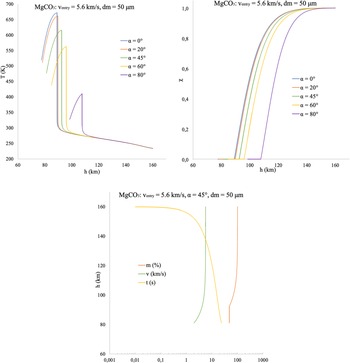
Figure 1 shows some entry scenarios, and the corresponding carbonate fraction during the descent, as a function of the height h, of a magnesite micrograin entering the Mars atmosphere with a speed of 5.6 km s−1.
Entry scenarios and the corresponding carbonate fraction of a MgCO3 micrograin with an entry velocity $v_{{\rm entry}} = 5.6\;{\rm km}\;{\rm s}^{ \hbox{-} 1}$ . α is the entry angle, dm is the grain diameter. Some cinematic quantities (mass m, velocity v, time t) are provided in the case of a specific scenario.

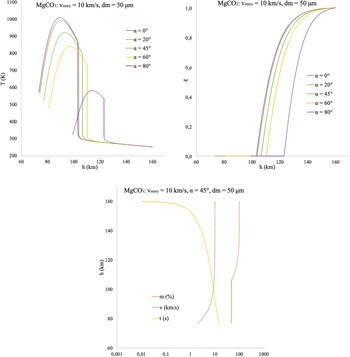
The 10 km s−1 entry speed case of study is illustrated in Fig. 2.
Entry scenarios and the corresponding carbonate fraction of a MgCO3 micrograin with an entry velocity $v_{{\rm entry}} = 10\;{\rm km}\;{\rm s}^{ \hbox{-} 1}$ . α is the entry angle, dm is the grain diameter. Some cinematic quantities (mass m, velocity v, time t) are provided in the case of a specific scenario.

CaCO3 micrometeoroids
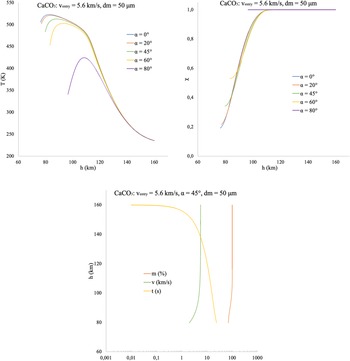
A thermal history, carbonate fraction and kinematic information of a calcite micrometeoroid entering the Mars atmosphere with an entry speed of 5.6 km s−1, as a function of the height h, can be found in Fig. 3.
Entry scenarios and the corresponding carbonate fraction of a CaCO3 micrograin with an entry velocity $v_{{\rm entry}} = 5.6\;{\rm km}\;{\rm s}^{ \hbox{-} 1}$ . α is the entry angle, dm is the grain diameter. Some cinematic quantities (mass m, velocity v, time t) are provided in the case of a specific scenario.

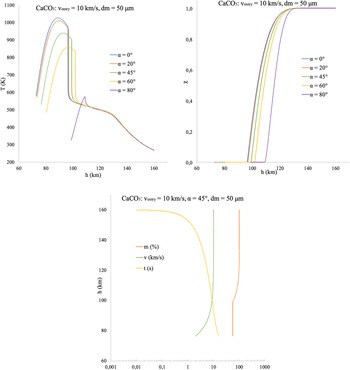
Figure 4 shows some entering scenarios corresponding to a CaCO3 micrometeoroid with an entry speed of 10 km s−1.
Entry scenarios and the corresponding carbonate fraction of a CaCO3 micrograin with an entry velocity $v_{{\rm entry}} = 10\;{\rm km}\;{\rm s}^{ \hbox{-} 1}$ . α is the entry angle, dm is the grain diameter. Some cinematic quantities (mass m, velocity v, time t) are provided in the case of a specific scenario.

CaSO4 micrometeoroids
The case of an anhydrite micrograin descent into the Mars atmosphere with an entry velocity of 5.6 km s−1 is shown in Fig. 5. Here, no plots concerning the sulphate fraction χ is provided, since it equals 1 in all entry scenarios.
Entry scenarios of a CaSO4 micrograin with an entry velocity $v = 5.6\;{\rm km}\;{\rm s}^{ \hbox{-} 1}$ . α is the entry angle, dm is the grain diameter. In all entry scenarios, the sulphate fraction ${\rm \chi }_{{\rm CaS}{\rm O}_4} = 1$
 . Some cinematic quantities (mass m, velocity v, time t) are provided in the case of a specific scenario.

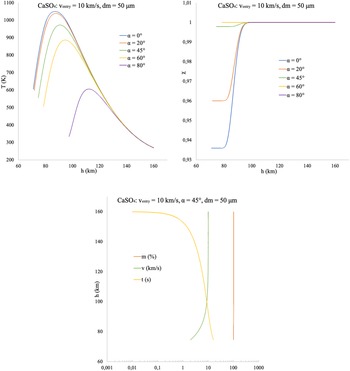
The 10 km s−1 entry speed case of study is shown in Fig. 6.
Entry scenarios and the corresponding carbonate fraction of a CaSO4 micrograin with an entry velocity $v = 10\;{\rm km}\;{\rm s}^{ \hbox{-} 1}$ . α is the entry angle, dm is the grain diameter. Some cinematic quantities (mass m, velocity v, time t) are provided in the case of a specific scenario.

Discussion
Starting from the plots in the previous section, it is interesting to provide a sort of comparative analysis with our aforementioned works concerning the Earth's atmospheric entry (Micca Longo and Longo, Reference Micca Longo, Longo, Vukotic, Seckbach and Gordon2021). The Martinan lower gravity and its lower radius of course have an important impact on the thermal histories of the WSM micrograins. Atmospheric entry heating is less significant on Mars compared to Earth, especially thanks to the lower entry velocities that Mars allows. Even in the magnesite case of study (Figs. 1 and 2), where no carbonate fraction is able to survive the entry, the peak temperatures are much lower than the ones reached in the Earth atmosphere. Recent experiments demonstrate that organic substances survive the atmospheric heating pulse (Glavin and Bada, Reference Glavin and Bada2001; Matrajt et al., Reference Matrajt, Brownlee, Sadilek and Kruse2006), therefore these lower temperatures during the Martian atmosphere entry might represent a crucial point as to the delivery of organic matter.
The 10 km s−1 entry speed case of study is more similar to the atmospheric entries in Earth's atmosphere, where all carbonate fractions go to zero and only anhydrite survives under certain entry conditions.
Important remarks come from the analysis of the contribution to the energy losses P out during the Martian entry with $v_{{\rm entry}} = 5.6\;{\rm km}\;{\rm s}^{ \hbox{-} 1}$ , in Fig. 7.
Radiative and evaporative energy loss contributions during the atmospheric entry of a MgCO3 (top left), CaCO3 (top right), and CaSO4 (bottom) micrometeoroid. v entry is the entry velocity, α is the entry angle, dm is the grain diameter.

As already demonstrated in our previous work (Micca Longo and Longo, Reference Micca Longo and Longo2020), the overall thickness of the atmosphere, and the various details of its structure, apart from the chemical composition, are not essential in determining the entrance scenario. Consequently, the main factor is the entry speed (together with the entry angle): in the case of the Earth, it cannot be less than 11.2 km s−1, while in the case of Mars, due to the reduced escape speed, an entry at 5.6 km s−1 is realistic. This means that, for the same composition and size of the grain, the dissipated kinetic energy is about a quarter of the one in the case of the Earth. This means reduced thermal stress.
In our previous works (Micca Longo and Longo, Reference Micca Longo, Longo, Vukotic, Seckbach and Gordon2021), we showed that some WSMs are able to dissipate a significant part of the kinetic energy through the process of chemical decomposition, thus heating up less during their passage through the atmosphere. In the case of an entry into the Martian atmosphere, the fraction of energy that can be dissipated by chemical decomposition is more important than for the Earth, due to the lower entry speed. This is clearly shown in Fig. 7, in the case of a Martian entry scenario of a calcium carbonate grain at 5.6 km s−1. Correspondingly, as shown in Fig. 3, the temperature of the grain is always contained to very modest values, as the cooling is both radiative and evaporative (even lower than anhydrite), and a significant fraction of calcium carbonate can survive during the passage through the atmosphere.
In the case of the anhydrite grain (Figs. 5 and 6), a substantial (and even total) carbonate sulphate fraction is able to survive the atmospheric entry: in this case, all the thermal dissipation occurs radiatively and the material does not decompose, as shown in Fig. 7.
Therefore, calcite and anhydrite are promising materials from an astrobiology point of view, as a great amount of CaCO3 and CaSO4 can survive the entry with partial (or even any) evaporation.
In light of these considerations, it can be assumed that in a panspermia scenario, or even a weaker scenario of transfer of organic molecules from the outer solar system to the Earth, Mars might have been an excellent intermediate reservoir due to its particular characteristics. Another conclusion comes from the fact that our calculations show that the anhydride is able to reach the soil without significant chemical modification. This suggests that not all the calcium sulphate eventually found on Mars is necessarily of indigenous origin.
Conclusions
In this work, the WSMs' entry model, already developed in the case of Earth's atmosphere and of hypothetical primordial terrestrial atmospheres, has been applied to the case of Mars. For these minerals, the great capacity of Mars as a potential collector is confirmed, especially due to the lower entry speed. Calcite and anhydrite are found to be the most promising materials in the light of organic matter delivery, as a great amount of CaCO3 and CaSO4 can survive the entry only partially decomposed. In the Martian atmosphere, calcium carbonate in the form of micrometeorite exhibits excellent chemical energy dissipation capacity during the entire entry process.
In light of these considerations, it can be assumed that, in a panspermia scenario or a weaker scenario of transfer of organic molecules from the outer solar system to the Earth, Mars might have been an excellent intermediate reservoir due to its peculiar characteristics.
Of course, due to the complexity of the chemical and physical processes involved, these results must be considered preliminary. The long list of assumptions on which our model relies is a caveat, in this respect. In particular, recent studies performed in collaboration with spectroscopists and recently published (Micca Longo et al., Reference Micca Longo, D'Elia, Fonti, Longo, Mancarella and Orofino2019a) suggest that the decomposition of WSMs is much slower than predicted by the present model due to kinetic factors. A future model should incorporate these observations, and presumably would make more volatile minerals, particularly magnesite, more promising.