There has been considerable research on the language development of internationally adopted (IA) children in recent years (e.g., Glennen & Masters, Reference Glennen and Masters2002; Krakow & Roberts, Reference Krakow and Roberts2003; Roberts, Pollock, & Krakow, Reference Roberts, Pollock and Krakow2005; Tan & Yang, Reference Tan and Yang2005). Much of this research has sought to examine the extent to which IA children are at risk for difficulties or even impairment in their new language or, conversely, to what extent and when their development of the new language resembles that of children raised with their birth parents. Much research on this subject indicates that IA children adjust remarkably well to their new homes and languages (e.g., Krakow & Roberts, Reference Krakow and Roberts2003). More specifically, within 24 to 36 months postadoption, many IA children score within the normal range on standardized tests or parent checklists (e.g., Glennen & Masters, Reference Glennen and Masters2002). Generally speaking, IA children who are older at the time of adoption make faster initial progress acquiring the adopted language than children adopted at younger ages, but the latter are more likely to close the gap with their nonadopted peers and to do so faster (e.g., Glennen, Reference Glennen2005; Krakow, Tao, & Roberts, Reference Krakow, Tao and Roberts2005). Length of exposure to the new language is also a significant factor, confounded in many studies with age at adoption; specifically, progress toward standardized norms is usually better the longer exposure to the adopted language, as one would expect (Snedeker, Geren, & Shafto, Reference Snedeker, Geren and Shafto2007). In addition, country of origin has been shown to be associated with differential outcomes. IA children from China exhibit especially positive outcomes, whereas children from other countries often fare less well for a number of reasons, including poor institutional and/or preadoption parental care. At the same time, there appears to be greater individual variation among IA children than among nonadopted children, and some studies suggest that there might be a subgroup of approximately 20% who exhibit significant language delays/difficulties (Roberts et al., Reference Roberts, Pollock and Krakow2005) or receive speech and language pathology services (Miller & Hendrie, Reference Miller and Hendrie2000; Tan, Dedrick, & Marfo, Reference Tan, Dedrick and Marfo2007).
There is relatively little empirical data on the early communication skills of IA children postadoption and, of particular importance for the present study, on how adoptive mothers interact with their children and how this might influence their children's later language development. Glennen (Reference Glennen2007) conducted a study of 18-month-old IA children from Eastern Europe and found that, within 2 to 3 months postadoption, most performed in the low average to mild delay range on the Behavior Sample of the Communication and Symbolic Behavior Scales—Developmental Profile (CSBS–DP; Wetherby & Prizant, Reference Wetherby and Prizant2002), which assesses primarily prelinguistic abilities, including joint attention (JA) skills. She also found that the prelinguistic language abilities of these newly adopted children were good predictors of their later language outcomes at 24 months. Hwa-Froelich and Matsuoh (Reference Hwa-Froelich and Matsuoh2008) assessed the vocabulary, gestural, social, communicative, and symbolic behavior of four girls adopted from China when they were between 12 and 36 months of age. They found that, 6 months postadoption, three of the children scored in the average range on the communication, social, and symbolic behavior scales of the CSBS-DP when compared to a group of nonadopted English-speaking children as well as when compared to children adopted from Eastern Europe. These results suggest that children adopted from China can develop prelinguistic communicative abilities in their new language quite rapidly. However, as Hwa-Froelich and Matsuoh (Reference Hwa-Froelich and Matsuoh2008) note, the sample size was small and some children had siblings whereas others did not, which might have influenced their results.
To our knowledge, only one study involving IA children from China has specifically and directly examined JA abilities, one of the aims of the present study. JA is defined as a shared experience about an object or event with another person (Ninio & Snow, Reference Ninio and Snow1996; Schaife & Bruner, Reference Schaife and Bruner1975). Lejeune (Reference Lejeune2007) found that IA children's ability to respond to JA initiated by their caregivers when they were between 12 and 34 months was not a significant predictor of vocabulary production, assessed at the same age using the MacArthur Communicative Development Inventory (MCDI) when age and cognitive ability were controlled for. However, Lejeune assessed JA with an examiner and not the child's caregiver and, thus, we do not know what would have happened between the children and their primary caregivers. Furthermore, JA has been shown to have much less influence on lexical development by the end of the second year (e.g., Morales et al., Reference Morales, Mundy, Delgado, Yale, Messinger and Neal2000), and some children in Lejeune's study were around this age or older when they were assessed. Finally, the IA children in LeJeune's study were from different countries, and differences in the effects of preadoption childcare might have masked or confounded the effects of JA in these children's language development. In the present study, JA was examined when the children were 15 months of age and the IA children were all from the same country, namely, China.
We examined JA in adopted children and their mothers in the present study because it has been argued that the emergence of JA in typically developing children is a major milestone in early communicative and language development, at least in children raised in mainstream North American families where dyadic interactions between mothers and children are common, which is a point we return to later (Bruner, Reference Bruner1975; Tomasello & Todd, Reference Tomasello and Todd1983). The first episodes of JA usually occur around 9 months of age in typically developing children, as they begin to master abilities that underpin JA, such as responding to parents, instigating object-directed gaze, and pointing (Carpenter, Nagell, & Tomasello, Reference Carpenter, Nagel and Tomassello1998). Episodes of JA become more frequent between 15 and 18 months (Carpenter et al., Reference Carpenter, Nagel and Tomassello1998). JA has been of interest among language researchers because time spent in JA and certain forms of JA have been found to be positively linked to early vocabulary growth (e.g., Tomasello & Farrar, Reference Tomasello and Farrar1986; Tomasello & Todd, Reference Tomasello and Todd1983). In a large study of 160 children, Watt, Wetherby, and Shumway (Reference Watt, Wetherby and Shumway2006) found that the number of JA episodes at 14 months contributed uniquely to the children's expressive language outcomes at 33 months (i.e., spontaneous utterances, specific vocal/verbal responses to vocabulary). Similarly, Rudd, Cain, and Saxon (Reference Rudd, Cain and Saxon2008) found that vocabulary scores on the MCDI of children attending low-quality childcare centers increased in response to longer and more frequent episodes of JA with daycare educators following training designed to increase the workers’ use of JA and the quality of their JA strategies. Studies of the effects of JA on subsequent child language development have examined relatively short-term effects, and thus the long-term effects of JA have been largely undocumented. It is clear that, although JA may play an important part in early language development, it should be regarded as only one factor that might influence subsequent development.
It has also been reported, again in studies conducted in families living in Western cultures, that mothers’ use of certain attention regulation strategies during JA appear to be particularly influential in the early language development of typically developing children. A distinction is made between “following strategies” and “redirecting strategies.” The former refers to instances when the mother's response to the child's utterance refers to an object or event that is already in the child's focus of attention. In contrast, in the “redirecting strategy,” the mother's response redirects the child's attention to an object or event that it outside his/her current focus of attention. It has been found that children learn new words more easily when caregivers use them in reference to objects that the children are already attending to (i.e., in response to the following strategy), in comparison to objects that are outside the child's current focus of attention (i.e., in response to the redirecting strategy). For example, Oshima-Takane and Oram (Reference Oshima-Takane and Oram2002) found a significant positive correlation between mothers’ use of following strategies during episodes of JA at 21 months of age and their children's receptive vocabulary at 36 months of age (see also Baldwin, Reference Baldwin1991; Oshima-Takane & Oram, Reference Oshima-Takane and Oram2002; Tomasello & Farrar, Reference Tomasello and Farrar1986). In contrast, mothers’ use of “redirecting strategies” has been found to be associated with relatively slower rates of lexical development (Tomasello & Farrar, Reference Tomasello and Farrar1986).
However, the evidence reviewed to this point has been based on studies of JA and mother's attention regulation strategies in middle-class families in Western cultural settings, as noted previously. Akhtar (Reference Akhtar, Homer and Tamis-LeMonda2005) has argued that there may be differences in the prevalence of mothers’ use of specific attention regulation strategies (following vs redirecting strategies) in different cultural settings and has questioned whether JA is necessary for early vocabulary learning in all contexts. The following strategy, which is common and often associated with vocabulary development in typically developing children in Western families, is not so prevalent or influential in other cultural settings. For example, Vigil (Reference Vigil2002) found that native-born British mothers tended to follow their children's attention during dyadic interactions, whereas Chinese-speaking immigrant mothers living in Britain tended to redirect their children's attention at 9 and 12 months of age. She also found that there was no significant difference in vocabulary development between the two groups at 18 months, arguing that the use of both types of strategy was effective. In a study of Mexican immigrant and US-born families, Vigil, Tyler, and Ross (Reference Vigil, Tyler and Ross2006) found that Mexican-immigrant children tended to acquire more words in response to redirecting parental styles than in response to following strategies, whereas American-born children tended to learn more words than the Mexican-immigrant children in response to following strategies. Yet other studies suggest that JA and parental use of specific strategies are not related to language outcomes in the same way in children with special needs and in typically developing children, even in families in Western cultural settings. Harris, Kasari, and Sigman (Reference Harris, Kasari and Sigman1996) found that frequency of JA was negatively correlated with language abilities of children suffering from William Syndrome raised in the United States States. In brief, evidence suggests that the relationship between specific kinds of maternal attention regulation strategies and vocabulary development varies depending on the developmental/health status of the child and may not be necessary or sufficient to promote vocabulary development in children raised in all cultural settings (for a review of this research, see Akhtar & Gernsbacher, Reference Akhtar and Gernsbacher2007).
The present study was carried out on IA children from China living in families where their adoptive parents, like other parents from Western cultural backgrounds, are likely to engage their children in dyadic interactions that entail JA. However, IA children from China might be expected to be at risk for developing JA skills because most IA children are raised in orphanages for several months. Because of frequent changes in caregivers and low caregiver–child ratios, children raised in institutions are often deprived of consistent and lasting interpersonal relationships and might not have the chance to develop stable attachment to a caregiver (Gunnar, Bruce, & Grotevant, Reference Gunnar, Bruce and Grotevant2000). Impoverished language input as well as social, cognitive, and physical stimulation are also possible areas of privation for children raised in institutions (Gunnar et al., Reference Gunnar, Bruce and Grotevant2000). Although there are undoubtedly important differences among institutions in the quality and nature of the care children receive and the extent of deprivation (Gunnar et al., Reference Gunnar, Bruce and Grotevant2000), studies have established a relationship between the length of time spent in an orphanage and the extent of delay or impairment in cognitive, behavioral, social, and attachment abilities of IA children (e.g., Chisholm, Carter, Ames, & Morison, Reference Chisholm, Carter, Ames and Morison1995; Glennen & Masters, Reference Glennen and Masters2002; Miller & Henrie, Reference Miller and Hendrie2000). All of these factors could be associated with reduced JA abilities among IA children.
In support of this possibility, Flanagan, Coppa, Riggs, and Alario (Reference Flanagan, Coppa, Riggs and Alario1994) found that teenage mothers’ sensitivity to their children's social cues and the contingent quality of their responses during free-play interactions with their infants (aged 9 to 11 months) correlated significantly with the number of JA acts the infants engaged in while interacting with an examiner. As well, Goldsmith and Rogoff (Reference Goldsmith and Rogoff1997) found that 18- to 30-month-old children of mothers with dysphoric symptoms (i.e., feelings of hopelessness) spent significantly less time in JA compared to children of mothers without dysphoric symptomatology. IA children raised in orphanages may not receive the responsive childrearing that is thought to underpin the development of JA abilities and, therefore, may demonstrate less JA upon adoption than children raised by their birth parents. In addition, IA children experience significant sociocultural change and face a unique language learning experience—they learn a “second first language” as exposure to their first language is abruptly stopped (De Geer, Reference De Geer1992). Thus, international adoption constitutes a natural experiment for studying the development of JA and its relationship to language development in infants who experience relatively nonresponsive childrearing and significant sociocultural and linguistic change during infancy, the period when JA abilities typically develop.
Examining JA and language development in IA children is of additional interest because adoptive mothers are faced with the unusual challenge of communicating with children whose linguistic skills are not commensurate with their age and general cognitive development. As a result, they might play a more active role in promoting JA and, in turn, language development when interacting with their children when compared to birth mothers with children of the same age. Studies involving children whose language development is slow or delayed, such as children with chronic otitis media (Yont, Snow, & Vernon-Feagans, Reference Yont, Snow and Vernon-Feagans2003) and children with developmental disorders (Mahoney, Fors, & Wood, Reference Mahoney, Fors and Wood1990), have found that mothers of these children direct their child's attention significantly more often than mothers of typically developing children. By inference, following attention regulation strategies that researchers have found to correlate with vocabulary development in typically developing infants in North America might not be the preferred nor most effective strategy for adoptive mothers of IA children because, as noted, IA children may have poorly developed JA skills making it difficult for them to establish JA with their adoptive mothers and for their mothers to establish JA with them. Adoptive mothers might, thus, be prone to use redirecting strategies with their newly adopted children in order to establish JA and, in turn, to accelerate their lexical development. It might also be expected that adoptive mothers’ general language use would differ from that of birth mothers in that the former might be expected to talk more, repeat more, and use more gestures, as they might with a younger child whose language is less well developed. Mothers raising their biological children have been found to adapt their communicative behaviors to their child's level of development (Bakeman & Adamson, Reference Bakeman and Adamson1984).
In summary, the goal of the current study was to examine patterns of communication between IA children from China and their adoptive mothers and the relationships between adoptive mothers’ general language use and their use of following versus redirecting strategies and their children's later vocabulary development. Three specific questions motivated the study: (a) Are IA children from China delayed in acquiring the ability to engage in JA? (b) Do adoptive mothers interact differently with their children compared to birth mothers and, in particular, are they prone to using more redirecting strategies and talking more with their children? (c) Is adoptive mothers’ use of redirecting attention regulation strategies correlated with their children's later vocabulary development?
METHOD
Participants
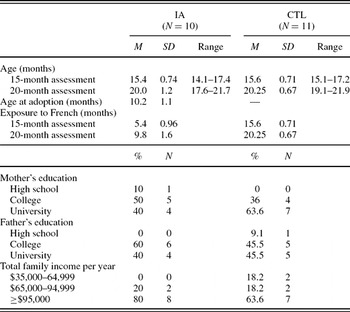
Two groups of children and mothers participated: 10 children adopted from China and their French-speaking adoptive mothers and 11 monolingual French-speaking, nonadopted children and their French-speaking birth mothers. The IA children were 15.4 months of age on average (range = 14.1–17.4, SD = 0.74) at the time of the first session and 20.0 months of age (range = 17.6–21.7, SD = 1.2) at the time of the second session. The average age at adoption of the IA children was 10.2 months (range = 9.0–13.3, SD = 1.2), and the average number of months of exposure to French at the first session was 5.4 months (range = 4.0–7.6, SD = 0.96) and 9.8 months (range = 7.1–12.1, SD = 1.6) at the second session. All participants were girls because the majority of IA children from China in Quebec are female. All IA children lived in orphanages for the entire period prior to adoption, except for one child who spent 7 months in a foster family before spending 2.5 months in an orphanage. Detailed demographic information of the participants is presented in Table 1. The IA children were recruited with the assistance of two adoption agencies in Montreal. The agencies sent letters to French-speaking parents who had recently adopted a child from China. In order to be included, the child had to be the first child of the family and between 9 and 13 months at the time of adoption; this restriction was important in order to limit variability in the time IA children spent in an orphanage and in their exposure to their new language. Information regarding parental education and income was collected during a semistructured interview during the first session with the IA parents.
Demographic data on the adopted and control groups at initial and follow-up assessments

Note: IA, internationally adopted children; CTL, control children.
The control group (CTL) consisted of 11 nonadopted children who were 15.6 months of age on average (range = 15.1–17.2, SD = 0.71) at the time of the first session and 20.3 months of age (range = 19.1–21.9, SD = 0.67) at the second session. The CTL children were recruited through ads in a local newspaper as well as through daycare centres. The following exclusionary criteria were used to select the CTL children: (a) no siblings; (b) no psychiatric or neurological problems; (c) no premature birth; (d) no major health problems, past or present; (e) no serious motor or behavior problems; and (f) no or minimal exposure (25% of the time maximum) to a language other than French. Information about the exclusionary criteria, the sex, and age of the children as well as level of parental education and family income was collected from the parents during an initial phone call to our laboratory.
The IA and CTL children were matched for age (within a 1.5-month interval), sex, and familial socioeconomic status (SES). It was important to control for SES because it has been found that the SES of adoptive parents tends to be higher than that of the general population (e.g., Tan & Yang, Reference Tan and Yang2005) and that SES has a significant influence on the language development of children (e.g., Arriaga, Fenson, Cronan, & Pethick, Reference Arriaga, Fenson, Cronan and Pethick1998). For example, Arriaga et al. (Reference Arriaga, Fenson, Cronan and Pethick1998) found that 80% of children from families with a relatively low income performed below the 50th percentile on the MCDI. Only firstborn children were included in the present study because birth order has been found to have an effect on expressive vocabulary, as measured by the MCDI, with first-born children scoring significantly higher than later born children between 17 and 19 months of age (Westerlund & Lagerberg, Reference Westerlund and Lagerberg2008). Oshima-Takane and Robbins (Reference Oshima-Takane and Robbins2003) found that the linguistic environment of first-born children is significantly different from that of second-born children.
There was no significant difference in age between the IA and CTL groups at the initial assessment, t (19) = −0.140, p = .89 (two tailed) or at the follow-up assessment, t (19) = −0.570, p = .58 (two tailed). Chi-square tests indicated that there were no significant differences between the groups with respect to number of years of education of mothers, χ2 (2, N = 21) = 1.89, p = 0.39, or fathers, χ2 (2, N = 21) = 1.16, p = .56, or for family income, χ2 (2, N = 21) = 2.02, p = .36. Information about SES can be found in Table 1.
Information regarding the children's past and current general health and development was collected during the semistructured interview during the first visit and again at the second visit. The IA and CTL children were comparable with respect to the frequency of past general health and developmental problems (i.e., problems present before the second assessment), with 11 instances of problems reported for the IA children and 12 instances for the CTL children. However, the kind of health problems was different, with more CTL children having ear infections or other ear-related problems in comparison to the IA children who had more weight or height problems as well as more emotional problems (e.g., anxiety, attachment difficulties). Concerning their medical and developmental status at 20 months, the IA children had a slightly higher incidence of problems (four instances) compared to the CTL children (one instance). Several IA children (71%; n = 5) had overcome their weight and height problems at 20 months, but 20% (n = 2) of the IA children continued to be below the 10th percentile with respect to weight and height. One IA child had a mild developmental delay and one had an ear infection or ear-related problem. For the CTL group, one child had feeding difficulties at 20 months.
The mothers of both groups were asked to judge the general health of their child. At 20 months, 80% (n = 8) of the IA mothers reported that they considered their child's general health excellent and 20% (n = 2) answered very good. For the CTL mothers, 55% (n = 6) judged their child's general health as excellent, 36% (n = 4) judged it as very good, and 9% (n = 1) judged it as good.
Procedure
Each session took place in the participants’ homes to ensure that the children were at ease and to increase the ecological validity of our findings. Carpenter et al. (Reference Carpenter, Nagel and Tomassello1998) suggest that findings from studies on JA and language development conducted in laboratories may not generalize as well as studies conducted in the home. This may be even truer for IA children for whom visiting a laboratory and meeting strangers in an unfamiliar context shortly after adoption might be unsettling. During the initial session, the objectives and procedure of the study were explained to mothers and questions were answered by the examiner, the first author, a licensed psychologist, or a trained research assistant. Mothers were then asked to read and sign a consent form. This was followed by a semistructured interview during which mothers completed the Developmental Questionnaire with the assistance of the examiner. The questionnaire asked about the child's development, past and current health problems, and medical conditions before and after adoption (for IA children only). Questions about each parent's education and occupation, combined family income, and the composition of the family were also included. The mothers also completed the Language Environment Questionnaire in which they were asked to estimate the amount of French, English, or any other languages the child had been exposed to. They had to estimate the frequency of language experiences in and outside the family and in a variety of situations (e.g., TV, radio). After completing these questionnaires, mothers were instructed to interact with their child as they normally would with the toys that they usually played with. They were instructed to stay in a specific delimited area as much as possible during the session in order to ensure that the mother and child could be video/audio-recorded simultaneously. The play session lasted exactly 30 min. During the follow-up session, information from the Developmental Questionnaire and the Language Environment Questionnaire was updated and mothers were instructed to play with their child as they normally would. The duration of the interaction was 30 min but was not analyzed in the present study.
Vocabulary development was assessed using the French version of the MCDI. The Mots et Gestes form was used at 15 months (words and gestures; Trudeau, Frank, & Poulin-Dubois, Reference Trudeau, Frank and Poulin-Dubois1997) and the Mots et Énoncés form was used at 20 months (words and sentences; Frank, Poulin-Dubois, & Trudeau, Reference Frank, Poulin-Dubois and Trudeau1997). The MCDI is a parent report measure that is widely used to assess the vocabulary knowledge of young children. Each child's mother was asked to fill out the MCDI the day of the initial visit or the day after and to complete MCDIs every month thereafter. However, only the MCDIs completed at 15 and 20 months were analyzed for the current study. At 15 months, the number of words understood and produced by the child as well as the communicative and symbolic gestures the child had tried or completed were the dependent variables extracted from the MCDI. The early gestures score included information about early communicative gestures such as pointing and engaging in games and routines. The late gestures score included information about the ability of the child to perform or try to perform certain actions involving objects, to engage in pretend play, and to imitate or to try to imitate the actions of an adult. The Mots et Énoncés form of the French version of the MCDI was used to assess the number of words produced by the children and their ability to combine words at 20 months of age; these were used as indices of expressive language ability. We were unable to assess words understood at 20 months because this is not included in the MCDI for this age group.
Coding procedure
The videotaped sessions at the initial assessment (at 15 months) and at the follow-up assessment (at 20 months) were transcribed according to the CHAT format developed by the Child Language Data Exchange System (MacWhinney & Snow, Reference MacWhinney and Snow1990). The coders were trained with coded transcripts and videos from the Oshima-Takane and Oram's study (Reference Oshima-Takane and Oram2002) and the coding manual created by Oshima-Takane, Oram, Albanese, and Browning (Reference Oshima-Takane, Oram, Alabanese and Browning1994) was used to develop the coding scheme and to guide our coding of the transcripts. Twenty minutes of the free-play interaction of the initial sessions between the children and their mothers were coded, beginning after the first 5 min of each recording. The first 5 min were not analyzed in order to give the children and their mothers time to become comfortable and to ignore the camera and examiner. The last 5 min were not analyzed. The videotaped sessions of the follow-up assessment are not analyzed in the current paper. Caregiver utterances were coded for episodes of JA following Tomasello and Todd's (Reference Tomasello and Todd1983) guidelines: (a) JA episodes begin with one person initiating interaction with the other; (b) both individuals visually focus on a single object or activity for at least 3 s (they can look away shortly during a long interaction); and (c) to show that the child is aware of the interaction, at some point during the episode, each child must direct some behavior toward the caregiver, particularly looking at her face. The caregivers’ utterances inside JA episodes were classified as following (i.e., attending to an object or activity that the child is already attending to), redirecting successfully (i.e., redirecting with success the child's attention toward an object or action that she was not attending to, whether she already knew the name of the object or not), or redirecting unsuccessfully the child's attentional focus (i.e., trying to redirect the child's attention but failing to do so). The decision to distinguish successful and unsuccessful redirecting strategies was based on Shimpi and Huttenlocher's (Reference Shimpi and Huttenlocher2007) findings that successfully redirecting a child's attention to an object being labeled was positively linked to vocabulary development, whereas redirecting unsuccessfully was negatively correlated with vocabulary development. Each maternal utterance was classified as being accompanied by gestures (e.g., pointing, tapping, outlining, presenting an object) or not. Twenty percent of the transcripts were recoded entirely by a second coder in order to assess coding reliability. The percentage of agreement was between 90.4% and 98.3%.
RESULTS
Communication patterns and lexical development
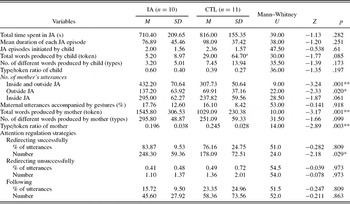
Because most of the coded variables were not normally distributed and the sample sizes were small, the two groups were compared using nonparametric analysis. Mann–Whitney tests and Spearman correlations were used to examine the presence of a significant difference between groups and the relationships between variables, respectively. A p value of <.05 was considered statistically significant. Table 2 summarizes average raw scores and statistical results for the behaviors that were coded from the transcripts of the play sessions at 15 months.
Means (SD) of variables computed during the 20-min interactions between mothers and children at 15 months

Note: IA, internationally adopted children; CTL, control children; JA, joint attention.
aThere was an outlier in the control group who produced 223 tokens but had several repetitions.
*p < .05. **p < .01.
Time in joint attention and child-initiated joint attention episodes
There was no significant difference between the IA and CTL groups with respect to total time spent in JA, calculated in seconds, when the children were 15 months (Mann–Whitney U = 39.0, z = −1.23, p = .282). However, there was considerably more variance in the results of the IA children. Forty percent (n = 4) of the IA children spent less than 600 s in JA, whereas no CTL child spent so little time in JA; another 40% (n = 4) of IA children spent between 601 and 850 seconds in JA compared to 63.6% (n = 7) of CTL children; and only 20% (n = 2) of the IA children spent more than 850 s in JA compared to 36.4% (n = 4) of the CTL children. There was no significant difference between the groups with respect to the mean length of each JA episode (Mann–Whitney U = 38, z = −1.20, p = .251). Again, there was more variation for the IA children with 30% (n = 3) of the IA children spending less than 42 s in JA, on average, whereas none of the CTL children had an average length of episode that was so short. Finally, the IA children initiated the same number of JA episodes as the CTL children (Mann–Whitney U = 47.5, z = −0.538, p = .605).
Vocabulary development and communicative gestures
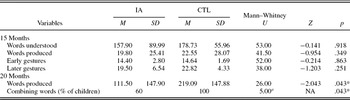
Table 3 summarizes the results from the MCDI at 15 and 20 months. There was no significant difference between the groups with respect to number of words understood or number of words produced at 15 months. Moreover, both groups were quite similar with respect to the number of communicative gestures they tried or completed. At 20 months, the IA children produced significantly fewer words compared to the CTL children (Mann–Whitney U = 26.00, z = −2.043, p = .043). Chi-square tests indicated further that there were significantly fewer IA children (60%) combining words at 20 months than CTL children (100%), χ2 (1, N = 20) = 5.00, p = .043. As shown in Table 4, the number of words that the IA children produced at 15 months correlated significantly with vocabulary size at 20 months (r = .79, p = .003). Furthermore, the number of words understood at 15 months by IA children correlated significantly with the number of words produced at 20 months (r = .66, p = .020).
Results on the MacArthur Communicative Development Inventory at 15 and 20 months

Note: IA, internationally adopted children (n = 10); CTL, control children (n = 11); NA, not available.
a Pearson chi-square.
* p < .05.
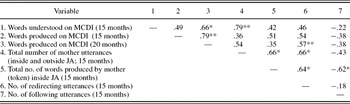
Correlations between adopted children's vocabulary scores and their mothers’ attention regulation strategies and language use (n = 10)

Note: The values are Spearman correlations. MCDI, MacArthur Communicative Development Inventory; JA, joint attention.
* p < .05. **p < .01
Children's language use during play sessions
There was no significant difference between the total number of word tokens (Mann–Whitney U = 30.0, z = −1.77, p = .085) or word types (Mann–Whitney U = 35.5, z = −1.39, p = .173) produced by the IA and CTL groups during the play sessions at 15 months (see Table 2). Nor was there a significant difference between the type/token ratios of the IA and CTL groups (Mann–Whitney U = 36.0, z = −1.35, p = .197) based on language use during the sessions at 15 months. However, the means suggest that there was a tendency for the CTL children to talk more and to use a wider range of words during the play sessions than the IA children. Details of these results are presented in Table 2.
Mothers' language use
Results concerning mothers’ language use are presented in Table 2. The total number of utterances (inside and outside JA episodes combined) produced by IA mothers was significantly higher than the number of utterances produced by the CTL mothers (Mann–Whitney U = 9.0, z = −3.24, p = .001). The total number of utterances produced by IA mothers outside JA episodes was also significantly higher (Mann–Whitney U = 22.0, z = −2.33, p = .020) compared to that of the CTL mothers. There was no significant difference between groups with respect to number of mothers’ utterances inside JA episodes (Mann–Whitney U = 28.5, z = −1.87, p = .061), and there was no significant difference between groups for percentage of mothers’ utterances accompanied by gestures (Mann–Whitney U = 53.0, z = −1.41, p = .918). The total number of words (i.e., tokens) produced (inside and outside JA episodes combined) was significantly higher for the IA mothers than for the CTL mothers (Mann–Whitney U = 10.0, z = −3.17, p = .001). The type/token ratio was significantly smaller for the IA mothers compared to the CTL mothers (Mann–Whitney U = 14.0, z = −2.89, p = .003). However, there was no significant difference between groups with respect to the number of different words (i.e., types) the mothers produced (Mann–Whitney U = 31.50, z = −1.66, p = .099), suggesting that the IA mothers were using more repetitions.
Mothers' attention regulation strategies
Results concerning mothers’ attention regulation strategies are presented in Table 2. There was no significant difference between the IA and CTL mothers with respect to percentage of utterances that redirected successfully (Mann–Whitney U = 51.00, z = −0.282, p = .809), redirected unsuccessfully (Mann–Whitney U = 54.50, z = −0.039, p = .973), or followed the child's attention (Mann–Whitney U = 51.50, z = −0.247, p = .809). However, IA mothers used a significantly larger number of utterances redirecting the child's attention successfully (Mann–Whitney U = 24.0, z = −2.18, p = .029). Thus, the sheer number of utterances that redirected the child's attention was significantly higher for the IA mothers compared to the CTL mothers, but the proportion of redirecting utterances was the same. There was no difference in number of mothers’ utterances redirecting the child's attention unsuccessfully (Mann–Whitney U = 54.0, z = −0.078, p = .973) or following the child's attentional focus (Mann–Whitney U = 52.0, z = −0.211, p = .863). The average number of utterances redirecting the child's attention unsuccessfully was very low in both groups: 1.10 for the IA dyads (representing 0.41% of the mother's utterances) and 1.36 (representing 0.49% of the mother's utterances) for the CTL dyads. Therefore, the number of utterances redirecting successfully and unsuccessfully were merged to form one category—redirecting utterances, for further analysis. The difference between the average number of redirecting utterances (combining redirecting successfully and unsuccessfully) remained significant between groups (Mann–Whitney U = 24.0, z = −2.18, p = .029).
Mothers' use of gestures
As shown in Table 2, the percentage of maternal utterances accompanied by gestures was similar for the groups and was relatively low, 17.76% and 16.10% for the IA and CTL mothers, respectively. We also calculated the number of utterances redirecting the child's attentional focus and the number of utterances following the child's attention focus that were accompanied by gestures. A Mann–Whitney test of the number of utterances redirecting the child's attentional focus with gestures revealed that there was no significant difference between the IA (M = 39.00, range = 22.57–55.43, SD = 22.97) and CTL mothers (M = 31.55, range = 18.06–45.03, SD = 20.07), Mann–Whitney U = 45.0, z = −0.705, p = .512; nor was there a significant difference between the groups with respect to the number of utterances following the child's attentional focus that were accompanied by gestures (IA mothers: M = 5.40, range = 1.16–9.64, SD = 5.93; CTL mothers: M = 8.00, range = 2.95–13.05, SD = 7.51), Mann–Whitney U = 44.0, z = −0.790, p = .468. This result suggests that CTL and adoptive mothers were similar with respect to their use of gestures and how they combined them with different types of attention regulation strategies.
Correlation between maternal attention regulation strategies, input, and vocabulary development
In order to examine the relationships between the adoptive mothers’ attention regulation strategies and their verbal input, on the one hand, and IA children's vocabulary development, on the other hand, Spearman correlations were calculated (see Table 4). The number of utterances by the adoptive mothers that redirected the IA child's attention during the interaction at 15 months was significantly and quite strongly correlated with expressive vocabulary at 20 months (r = .57, p = .042). The total number of mother's utterances (inside and outside JA episodes) during the interaction at 15 months correlated strongly with the number of words understood at 15 months (r = .79, p = .003). The number of words the IA children understood (r = .66, p = .020) and produced at 15 months (r = .79, p = .003) correlated strongly with the number of words they produced at 20 months. The total number of mother's utterances (inside and outside JA episodes) during the interaction at 15 months correlated significantly with the number of redirecting utterances (r = .66, p = .019); but there was no significant correlation between total number of mothers’ utterances at 15 months and number of words IA children produced at 20 months or between total number of words produced by mothers at 15 months and IA children's productive vocabulary at 20 months.
Exposure to French, age at adoption, and vocabulary results
In order to investigate other factors that might have influenced the vocabulary outcomes of the IA children, we correlated number of months of exposure to French and age at adoption with vocabulary scores at 15 and 20 months. There were no significant correlations between age at adoption and number of words understood at 15 months or with the number of words produced at 15 or at 20 months (as measured by the MCDI). None of the correlations between number of months of exposure to French and vocabulary (i.e., number of words understood at 15 months, number of words produced at 15 or 20 months) was significant. The lack of significant correlations might be related to small variability in terms of age at adoption (range = 9–13 months).
DISCUSSION
The present research sought to answer three questions: (a) Are IA children from China delayed in acquiring the ability to engage in JA? (b) Do adoptive mothers interact differently with their children when compared to birth mothers and, in particular, are they prone to use more redirecting attention regulation strategies? (c) Are the interaction and JA strategies of adoptive mothers related to their children's later vocabulary development?
In response to the first question concerning JA abilities of the IA children, our results suggest that the 15-month-old IA children were similar to the CTL children in many ways even though the former had been in their new families and had been exposed to French for only about 5 months, on average. More specifically, the IA children initiated JA episodes with the same frequency as the CTL children; they spent the same amount of time in JA as the CTL children; and the number of communicative gestures they tried or completed, measured by the MCDI, was equivalent between groups. In these respects, and contrary to our expectations, the IA children's ability to acquire early communication-related skills was not delayed significantly when compared to the CTL children. These results are consistent with those of Hwa-Froelich and Matsuoh (Reference Hwa-Froelich and Matsuoh2008), who found that most of their sample, although quite small, scored within the normal range with respect to communication, social, and symbolic behaviors 6 months postadoption. In contrast, Glennen (Reference Glennen2005) found that 50% of her sample of adoptees from Eastern Europe would qualify for early intervention based on their low scores on the CSBS-DP. However, there was considerable range in the age of adoption of the children in Glennen's study (11–23 months) in comparison with our sample. At the same time, the IA children in the present study exhibited considerably more variability in the amount of time they spent in JA than did the CTL children and, as well, there was a higher proportion of IA children (40%) who spent very little time in JA (less than 600 s) compared to the CTL children, none of whom spent so little time in JA episodes. It is possible that some of these numeric differences would become significant with larger samples.
We also found that, even though the 15-month-old IA children had had 8–11 months less exposure to French than the CTL children, they understood and produced the same number of words as the CTL children, according to parental reports. This suggests that the IA children, who were cognitively more mature when they were first exposed to French than the CTL children when they were first exposed to French, did not need extensive exposure to begin learning words in French (see also Pollock, Reference Pollock2005). In contrast, the vocabulary scores of the IA children were significantly behind those of the CTL children at age 20 months, and significantly fewer IA children combined words (see also Tang & Yang, Reference Tan and Yang2005). Although there is no definitive explanation for this shift in results, it could reflect the nature of the early words that children typically learn. More specifically, to the extent that the words that children are first exposed to are words for sounds, social expressions, and social games, they may be simple, high frequency, and phonologically simply. Consequently, they may be relatively easy to learn in comparison to later learned words.Footnote 1 More detailed analysis of the early words that IA children are exposed to and learn would be required to examine this possibility. An alternative explanation of these results might lie in the trajectory of lexical development that typically developing children exhibit. Nonadopted children typically produce their first words around 1 year of age and then go through a vocabulary growth spurt beginning around 18 months of age (Benedict, Reference Benedict1979). The vocabulary growth spurt may be delayed or protracted in IA children because of their lack of exposure to French during the first year of life. Thus, although IA children may be ready to produce their first words in their new language within a few months of adoption (initial assessment of our study), they may experience a relatively slow rate of lexical development subsequently in comparison to nonadopted children of the same age and familial SES, due to their lack of exposure to French prior to adoption. Catching up to the CTL children may be even more challenging for the IA children if one considers that the rate of vocabulary growth of the CTL children may well have been accelerated because these children were being raised in relatively high socioeconomic families (Hoff, Reference Hoff2006). Finally, it could also be that differences in the health status of the IA and CTL children at 20 months, although modest, and the nature of their early health problems could account for the differential rates of early lexical development reported here.
Our second question was whether adoptive mothers interact differently with their children when compared to birth mothers. There was evidence of significant differences. The adoptive mothers talked significantly more with their children than did the CTL mothers: when talk inside and outside of JA episodes was combined and also when only talk outside of JA episodes was considered. The type/token ratio of the adoptive mothers was smaller than that of the CTL mothers. This result could be misleading if it were interpreted as a sign that the IA mothers exhibited less lexical diversity in their interactions with their children compared to the CTL mothers. The number of different words (types) used by the IA and CTL mothers was similar. It was the total number of words (tokens) that differed. Thus, the type/token results indicate that the adoptive mothers were using more repetitions compared to the CTL mothers. Research has found that repetitions usually decrease as children get older (Kavanaugh & Jirkovsky, Reference Kavanaugh and Jirkovsky1982), presumably as children's language skills mature and they require fewer repetitions from caregivers. Our data do not allow us to attribute the IA mothers’ language use to their children's language level because the number of words understood and produced was similar for the two groups. However, it is possible that the adoptive mothers adapted their language in these ways because their children had been exposed to French for only a few months and they were seeking to extend their language exposure. It is also possible that repetitions served to establish and/or maintain JA. In our informal observations of the interactions between the adoptive mothers and their children, we noted that repetitions were mostly used to encourage JA; for example, adoptive mothers would often repeat what they had said because the child was not paying attention the first time. That the adoptive mothers were actively seeking to get and maintain their children's attention is evident in the finding that they used redirecting attentional regulation strategies significantly more frequently than the CTL mothers. This result is in line with studies with children with special needs (Mahoney et al., Reference Mahoney, Fors and Wood1990; Yont et al., Reference Yont, Snow and Vernon-Feagans2003).
The third question was whether the interaction strategies of adoptive mothers related to their children's later vocabulary development. There was evidence that they were. Of particular significance, the adoptive mothers’ use of redirecting strategies at 15 months was significantly and positively correlated with their children's subsequent expressive vocabulary at 20 months. This finding is not consistent with most studies of typically developing children raised by their birth mothers in Western cultural settings which have reported negative correlations between the use of redirecting strategies and subsequent expressive vocabulary (Baldwin, Reference Baldwin1991; Tomasello & Farrar, Reference Tomasello and Farrar1986; although see Barnes, Gutfreund, Satterly, & Wells, Reference Barnes, Gutfreund, Satterly and Wells1983, for divergent results). However, our findings are consistent with Shimpi and Huttenlocher (Reference Shimpi and Huttenlocher2007), who found that use of a lead-in style, which they defined as parental references to objects that were not in the child's ongoing focus of visual focus, was positively correlated with the children's vocabulary and with Masur, Flynn, and Eichorst (Reference Masur, Flynn and Eichorst2005), who found that certain types of directive strategies and, in particular supportive directives (which they defined as utterances that attempted to extend a child's activity in contrast to intrusive directives that disrupt the child's current activity), correlated positively with children's lexical development. The use of redirecting attentional strategies may be a way for adoptive mothers to encourage JA and may explain why there were no significant differences in IA and CTL children's level of engagement in JA (i.e., time spent in JA). The present findings also corroborate other researchers who suggest that there is not an ideal maternal attention regulation style, but that the style that correlates with lexical development varies according to the type of learner and the context of learning (Akhtar, Reference Akhtar, Homer and Tamis-LeMonda2005; Vigil, Reference Vigil2002; Vigil et al., Reference Vigil, Tyler and Ross2006). For adoptive mothers, redirecting their children's attention might be an effective way to foster social–cognition skills and early vocabulary development.
The amount of maternal input (inside and outside JA episodes) during sessions when the children were 15 months of age was significantly related to the IA children's receptive vocabulary at the same age. This relationship was very strong; 62% of the variance in the number of words understood by the IA children could be explained by variance in total number of mothers’ utterances. This suggests, in turn, that the amount of input addressed to IA children plays an important role in the development of their early receptive vocabulary. However, it is possible that the direction of causality is the reverse: IA children with well-developed receptive skills might have elicited more talk from their mothers. Experimental methodologies would be needed to better understand this mutually driven process (Shimpi & Huttenlocher, Reference Shimpi and Huttenlocher2007). Our findings suggest that it is not only mothers’ talk inside JA episodes that plays a role in the development of receptive vocabulary at 15 months, but also mothers’ talk outside JA (see also Floor & Akhtar, Reference Floor and Akhtar2006; Tomasello & Farrar, Reference Tomasello and Farrar1986; Trautman & Rollins, Reference Trautman and Rollins2006). In contrast, when predictors of the IA children's expressive vocabulary development at 20 months of age were examined, neither total number of maternal utterances (inside and outside of JA) nor total number of words mothers used with their children at 15 months was significantly related to their children's vocabulary at 20 months, although the correlations were positive. Thus, IA mothers’ use of redirecting utterances at 15 months had a more significant relationship with their children's subsequent expressive vocabulary growth than did the volume of maternal input earlier on. These results suggest that quantity of maternal input at 15 months might be particularly important to foster early lexical comprehension, whereas redirecting the IA child's attention at 15 months might play a more important role in later expressive vocabulary development at 20 months of age.
There are, of course, limitations to the present study. One concerns the direction of the causal relations inferred by our discussion of these results. The use of certain attention regulation strategies may foster language development, but the opposite could also be true: children with more advanced language and communicative abilities might encourage parents to use certain strategies. However, this possibility does not seem plausible because research has shown that parents tend to use redirecting strategies with children who present developmental delays (Mahoney et al., Reference Mahoney, Fors and Wood1990) or with children who tend to be passive (Prizant, Wetherby, & Roberts, Reference Prizant, Wetherby, Roberts and Zeanah1993) and not with children who are developmentally advanced. With a larger sample, partial correlations could be done in which vocabulary at 15 months could be partialled out. Another limitation is sample size; the small sample size limits the generalizability of our findings and may account for the lack of statistical significance in some cases. For example, when differences between the two groups of children with respect to their engagement in JA at 15 months were examined, there were no statistically significant differences, although numerically the IA children tended to spend less time in JA compared to the CTL children. Because this study involved a specific group of adopted children (girls adopted from China between 9 and 13 months), additional studies involving groups that differ in term of age at adoption, country of origin, and sex are needed to generalize the results of the present study to other populations. Considering input and the type of interactions that IA children have with their mothers is an important start but is limited. Paternal input could also have an important influence on IA children's language development and needs to be considered in future research. We are in the process of analyzing data on the communication patterns of IA children and their fathers. Moreover, although JA may play an important part in early language development, and especially vocabulary development in both IA and nonadopted children, it is but one factor that must be considered when formulating a comprehensive understanding of children's language development as well as individual variation in development.
ACKNOWLEDGMENTS
This research was supported by a grant to Fred Genesee from the Social Sciences and Humanities Research Council of Canada and scholarships to Karine Gauthier from the Natural Sciences and Engineering Research Council of Canada (NSERC), the Fonds de la recherche en santé du Québec (FRSQ), and the Centre for Research on Language, Mind and Brain. We express our thanks to Yuriko Oshima-Takane for her help in the design of this study. We thank the children and parents who participated as well as Elisa-Maude McConnell and Valérie Sami for their help with data collection and transcription.