Emotions are broad phenomena related to a comprehensive psychological process integrating affective, cognitive, psychological motivation, and expressive factors (Scherer, Reference Scherer, Scherer and Ekman1984). Students in academic settings are likely to experience emotions when involved in academic activities such as learning or tasks whose outcomes are assessed by standardised criteria. For instance, when a student knows that failing to pass an exam means retaking it, by investing more time and effort a few months later, he/she may experience test anxiety or hopelessness, which can potentially lead to avoiding challenging tasks (Elliot & McGregor, Reference Elliot and McGregor1999). Many researchers have attempted to conceptualise and integrate academic emotions within the school context (Schutz & Lanehart, Reference Schutz and Lanehart2002) because of its close connectedness with learning and teaching processes. Students with test anxiety may experience increased heart rate or sweating, or an impulse to avoid the test. Academic emotions might be a critical factor affecting academic learning, achievement, personality development, and health (Efklides & Volet, Reference Efklides and Volet2005; Linnenbrink, Reference Linnenbrink2006; Linnenbrink-Garcia & Pekrun, Reference Linnenbrink-Garcia and Pekrun2011; Schutz & Lanehart, Reference Schutz and Lanehart2002; Schutz & Pekrun, Reference Schutz and Pekrun2007). This is consistent with the social psychological approach that emphasises a vital role of emotion; that is, high levels of anxiety and arousal interfere with cognitive performance (Cadinu, Maass, Rosabianca, & Kiesner, Reference Cadinu, Maass, Rosabianca and Kiesner2005; see Hill & Wigfield, Reference Hill and Wigfield1984, for an overview). In this respect, counsellors and psychologists whose clients are students should pay attention to dealing with the academic emotions of students.
Until 1998, however, there was little research on academic emotion except for a study on test anxiety (Zeidner, Reference Zeidner1998). More researchers have since investigated the role of academic emotion in learning processes (deMarrais & Tisdale, Reference deMarrais and Tisdale2002; Linnenbrink & Pintrich, Reference Linnenbrink and Pintrich2002; Pekrun, Goetz, Titz, & Perry, Reference Pekrun, Goetz, Titz and Perry2002; Schutz & DeCuir, Reference Schutz and DeCuir2002; Turner, Husman, & Schallert, Reference Turner, Husman and Schallert2002). Schutz and Lanehart (Reference Schutz and Lanehart2002) insisted that emotions are integral components in educational settings and that one can improve teaching, motivation, and learning by understanding the nature of emotions within the school context. Pekrun (Reference Pekrun2006) closely examined academic emotions by adapting Russell’s idea, and specified and visualised academic emotions with two axes of activation (i.e., high vs. low arousal) and valence (i.e., positive and negative emotions). The extent of activation and positive–negative valence in emotion results in a 2-by-2 taxonomy of four categories. High arousal (activation) positive emotions include enjoyment, hope, and gratitude, while high arousal negative emotions include anxiety, anger, frustration, and hatred. Low arousal positive emotions include relaxation, relief, and contentment, while low arousal negative emotions include hopelessness, disappointment, and boredom. For academic activities, emotions diverge into activity-related emotions such as enjoyment and boredom during learning and outcome-related emotions such as pride, anxiety, shame, and hatred.
To clearly understand academic hatred, which is used synonymously to mean hatred of academic work in the present study, as a component of negative academic emotion, we refer to hate as an emotion. Hate is an interpersonal emotion (Shaver, Schwartz, Kirson, & O’Connor, Reference Shaver, Schwartz, Kirson and O’Connor1987); that is, hate between people can be analogous to academic hatred between students and the object of academic work. There is disagreement on the construct of hate, as several psychologists have found it difficult to define hate. For instance, Shaver et al. (Reference Shaver, Schwartz, Kirson and O’Connor1987) described hate as an anger-related emotion; for Smith-Lovin (Reference Smith-Lovin, Cook, Fine and House1995), it is a low-intensity sentiment characterised by low tolerance to disliking someone; and Oatley and Jenkins (Reference Oatley and Jenkins1996) considered it a disgust-related rather than anger-related emotion, differentiated by avoiding someone towards whom one experiences hate. With these approaches, academic hatred can be defined as disliking academic work or avoiding it. Because academic work accompanies adolescent students into adulthood, investigating academic hatred is warranted to help students adaptively sustain their academic work. To date, research on anxiety, shame, and pride has been conducted (Zeidner, Reference Zeidner, Schutz and Pekrun2007) compared to only a few studies on academic hatred. Hence, we aimed to investigate longitudinal change in academic hatred and its related variables to understand the nature of academic hatred more comprehensively.
Pekrun (Reference Pekrun2006) noted that emotions are bound to be context-free, but subcategories of emotions are context-specific, depending on culture, gender, and the individual. This implies that the dimension, intensity, and frequency of emotions can be divergent within a certain sociocultural context and an individual’s characteristics. Examining the cultural characteristics of Korean education is necessary to investigate the correlates of academic emotion. Markus and Kitayama (Reference Markus and Kitayama1991) addressed the distinctiveness between Eastern and Western cultures as that between an interdependent and independent self respectively. They described an interdependent self as being connected with its social context, wherein an individual values relationships with ingroup members, and an independent self as being separated from its social context, wherein an individual focuses on expressing the unique self. In interdependent self-schema, individuals interact with the surroundings and are encouraged to fit in with others, which requires perspective-taking, mind-reading, and considering the ingroup as a reference. Interdependent selves are considered a representative feature of Eastern cultures such as Korea and China. For instance, Kitayama, Karasawa, Curhan, Ryff, and Markus (Reference Kitayama, Karasawa, Curhan, Ryff and Markus2010) found that the extent of relational strain and effect of relational harmony on psychological happiness was higher among Japanese than English participants. Thus, teachers at school and parents at home are important social agents as significant others for Korean adolescents. Their expectations and how they encourage adolescent students have a strong impact on academic emotions (Goetz, Pekrun, Hall, & Haag, Reference Goetz, Pekrun, Hall and Haag2006). Additionally, East Asian education cultures highlight successful achievement in college entrance examinations for entering high-ranked universities, which is considered a shortcut towards higher social status and a privileged workplace (Bong, Kim, Shin, Lee, & Lee, Reference Bong, Kim, Shin, Lee and Lee2008; Song, Bong, Lee, & Kim, Reference Song, Bong, Lee and Kim2015). Most parents and teachers who value entering into top-tier Korean universities tend to pressure adolescents to show higher academic achievement, which harms their experience of positive academic emotions. Academic pressure from teachers and parents negatively affects learning domains such as intrinsic motivation and academic engagement and achievement (Song et al., Reference Song, Bong, Lee and Kim2015; Wang & Eccles, Reference Wang and Eccles2012; Wentzel, Reference Wentzel1998). Conversely, parental and teacher supports have a positive role in academic experiences, including academic emotions, stress, and school adjustment (Goetz et al., Reference Goetz, Pekrun, Hall and Haag2006; Malecki & Demaray, Reference Malecki and Demaray2003). Specifically, parental and teacher autonomy support enhances adolescents’ perception of control for their academic work, leading to experiencing fewer negative academic emotions (Perkun, Reference Pekrun and Heckhausen2000). Considering the education fever for higher social status in Korea and the cultural background of interdependent self-schema, parents and teachers play a critical role in adolescents’ process of appraising their achievements and experiencing emotions in academic work. Thus, we examined autonomy support and academic pressure from teachers and parents to investigate their longitudinal effects on academic hatred.
Pekrun (Reference Pekrun2006) suggested that individual factors such as temperament and gender should be considered as antecedents when studying academic emotions. For instance, individuals with test anxiety are likely to experience anxiety when confronted with situations where one is assessed and evaluated (Zeidner, Reference Zeidner1998). Pekrun (Reference Pekrun and Heckhausen2000) explained the process of an individual’s emotional development by using the social-cognitive model, where environmental factors as antecedents are involved in cognitive appraisal in interaction with intrapersonal factors such as self-concept or academic goal orientation, which consequently contribute to developing academic emotions. Intrapersonal emotional states may interfere in the cognitive appraisal process. For example, anxiety and depression may increase test- or evaluation-related worries, thereby encroaching on working memory processes (Owens, Stevenson, Hadwin, & Norgate, Reference Owens, Stevenson, Hadwin and Norgate2012). Thus, we included test anxiety and depression as intrapersonal factors affecting longitudinal change in academic hatred while examining environmental factors including parental and teacher supports and pressures simultaneously.
Pekrun (Reference Pekrun2006) focused on contextual factors to clarify academic emotions. Applied to a school context, differences in contextual factors exist in each class. That is, the extent of teacher autonomy support differs in each class, which implies a different level of effect on academic hatred. Consequently, for instance, there may be similar and different extents of teacher autonomy support at the individual and class levels respectively. Thus, to capture the trajectory of academic hatred and subsequently investigate the predictors and correlates of such change, we should consider the heterogeneity of the individual and class levels, and level-specific variables that can explain the trajectory of academic hatred over time. This requires a multilevel modelling approach to identify variances both at the individual and class levels, thereby disentangling level-specific effects that influence the trajectory at either level (Li et al., Reference Li, Fisher, Bauman, Ory, Chodzko-Zajko, Harmer and Cleveland2005).
Through a multilevel approach, the current study attempted to address the trajectory as well as predictors of the trajectory of academic hatred both at the individual and class levels. Specifically, using multilevel modelling analysis, we examined sociocultural factors as predictors, including interpersonal variables (i.e., teacher autonomy support/academic pressure, parental autonomy support/academic pressure) and intrapersonal variables (i.e., depression, test anxiety) of academic hatred at the individual and class levels: gender and socioeconomic status (SES) at the individual level and school type at the class level (i.e., co-education school, single-gender school).
Methods
Participants and procedures
Participants included adolescents in the final year of high school from eight schools that included an academic track in which students are expected to be mainly involved in academic activities. Participation occurred with guidance from teachers, and the survey was answered four times across 7 months: T1 = July 2015, T2 = October 2015, T3 = November 2015, and T4 = February 2016. Antecedents including gender, school type (i.e., co-ed, single-gender), SES, parental/teacher academic pressure, parental/teacher autonomy support, depression, and test anxiety were measured at T1. The numbers of respondents in each wave were: T1 = 934 (398 boys, 43%), T2 = 956 (409 boys, 43%), T3 = 893 (386 boys, 43%), T4 = 436 (183 boys, 42%). This study was approved by the Institutional Review Board at a university in South Korea.
Measures
Academic hatred
We employed the Korean Academic Burnout Inventory (KABI; Lee, Lee, & Lee, Reference Lee, Lee and Lee2009). Based on the Maslach Burnout Scale-Student Survey (MBI-SS; Schaufeli, Martinez, Pinto, Salanova, & Bakker, Reference Schaufeli, Martinez, Pinto, Salanova and Bakker2002), it is a validated academic burnout measure that has been used across Europe and Asia (Hu & Schaufeli, Reference Hu and Schaufeli2009; Schaufeli et al., Reference Schaufeli, Martinez, Pinto, Salanova and Bakker2002; Zhang, Gan, & Zhang, Reference Zhang, Gan and Zhang2005) and consists of three dimensions: exhaustion, cynicism, and inefficacy. In Lee et al.’s (Reference Lee, Lee and Lee2009) validation study, two components, antipathy and anxiety, were added to capture academic burnout among Korean students. The five items for antipathy include: ‘I hate to study’, ‘I am irritated with studying’, ‘I hate a world that focuses only on studying’, ‘I want to live in a world without studying’, and ‘I hate a world that only prioritises studying’. These items correspond to and were used for assessing academic hatred, because despite being important, no direct measures have been developed. The items are rated on a 5-point Likert-type scale from 1 (strongly disagree) to 5 (strongly agree). The reliability for the four measurement waves was satisfactory: .92, .93, .93, and .91 for T1, T2, T3, and T4 respectively.
Teacher academic pressure
We used the scale measuring teacher achievement pressure in the Korean Educational Longitudinal Study (KELS, Reference Kim, Kim, Kang, Kim, Shin, Park and Min2005), which is conducted by the Korean Educational Development Institute annually from elementary to high school. It comprises six items on a 5-point Likert-type scale (e.g., ‘My teacher emphasises high academic achievement in regular examinations’). The reliability for teacher pressure was .71 in a previous study (Jeong, Reference Jeong2015) and .83 in this study.
Parental academic pressure
We employed the six-item scale developed and validated by Bong and her colleagues (Reference Bong, Kim, Reeve, Lim, Lee, Ahn and Woo2012), which reflects Korean educational culture. It measures students’ perceptions of how much their parents value academic achievement for their academic work on a 7-point Likert-type scale (e.g., ‘My parents always focus on my academic work’). The reliability in the original study was .83 (Bong et al., Reference Bong, Kim, Reeve, Lim, Lee, Ahn and Woo2012) and .91 in this study.
Parental autonomy support and teacher autonomy support
We used a modified version (Moon, Reference Moon2006) of the scale initially adapted by Hardre and Reeve (Reference Hardre and Reeve2003). Adolescents are asked how they perceive parental and teacher autonomy support on a 5-point Likert-type scale: eight items for parental autonomy support (e.g., ‘My parents provided me with choices and options’) and six items for teacher autonomy support (e.g., ‘My teachers convey their confidence in my ability to become what I want to become’). The reliability in this study was .917 for parental autonomy support and .925 for teacher autonomy support, similar to the original study, where the values were .87 and .88 respectively.
Depression
We employed the Korean-validated version (Cho & Kim, Reference Cho and Kim1993) of the CES-D (Center for Epidemiological Studies Depression scale; Radloff, Reference Radloff1977). It comprises 20 items for six components: depressed mood, feelings of guilt and worthlessness, feelings of helplessness and hopelessness, psychomotor retardation, loss of appetite, and sleep disturbance. The items ask how often symptoms were experienced within the last week, with responses ranging from 0 (rarely or none of the time) to 3 (most or all the time). The reliability in the original study was .85 (Hann, Winter, & Jacobsen, Reference Hann, Winter and Jacobsen1999) and .92 in this study.
Test anxiety
We used the Korean Test Anxiety Inventory (K-TAI; Hwang, Reference Hwang1997), a modified version of the Test Anxiety Inventory (TAI; Spielberger et al., Reference Spielberger, Gonzalez, Taylor, Anton, Algaze, Ross and Westberry1980). It consists of 20 items on a 5-point Likert-type scale from 1 (strongly disagree) to 5 (strongly agree) divided into three dimensions: Cognitive worry (eight items; e.g., ‘During examinations, I get so nervous that I forget facts I really know’); Emotionality (eight items; e.g., ‘I feel very nervous about it although I’m well prepared for the test’); and the remainder are indistinguishable factors that include components of worry or emotionality (eight items; e.g., ‘During a test, I feel my heart pounding and dry mouth’). The reliability in the study by Spielberger et al. (Reference Spielberger, Gonzalez, Taylor, Anton, Algaze, Ross and Westberry1980) was .80, .87 in that by Hwang (Reference Hwang1997), and .95 in this study.
Demographic variables
Gender was included at the within level; male was coded as 0 and female as 1. For school type, single-gender school was coded as 0 and co-education school as 1. Schools with lower SES, where students were subsidised for free meals by the government, were coded as 1 and the rest as 0. School information was obtained from the Ministry of Education of Korea (www.schoolinfo.go.kr).
Results
Latent growth model of academic hatred
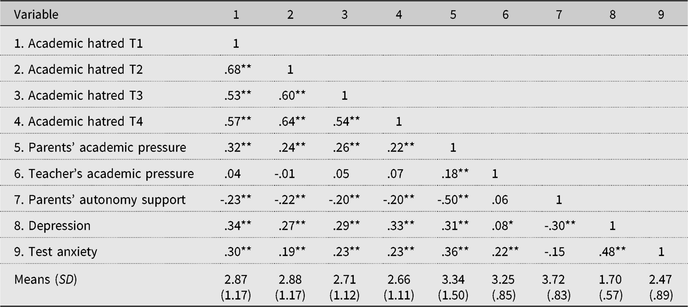
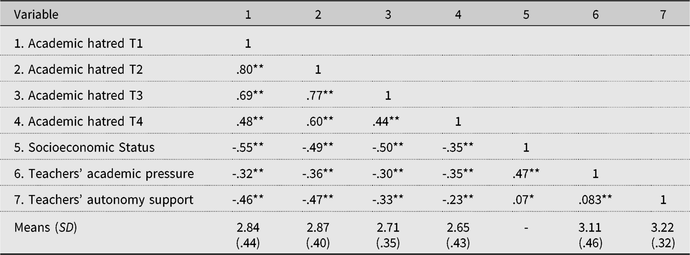
Correlation tables and descriptive statistics are presented in Tables 1 and 2. The model fit the data well, χ2 = 47.29, df = 5, p < .001, comparitive fit index (CFI) = .97, Tucker Lewis index (TLI) = .96, root mean square error of approximation (RMSEA) = .09, standardised root mean square residual (SRMR) = .05. Results showed a significant mean for the academic hatred intercept (β = 2.87, t = 77.78, p < .001) and slope (β = -.03, t = -4.57, p < .001). Significant variance was found among the academic hatred intercept (β = .98, t = 14.14, p < .001) and the slope (β = .01, t = 2.88, p < .01).
Multilevel latent growth model of academic hatred: unconditional model
The model fit the data well, χ2 = 86.57, df =15, p < .001, CFI = .95, TLI = .96, RMSEA = .07, SRMR (within) = .04, SRMR (between) = .05. The mean intercept and mean slope were significant (respectively, β = 2.87, t = 43.27, p < .001; β = -.03, t = -3.30, p < .01). Additionally, significant variances were found for the intercept and slope (respectively, β =.12, t = 4.36, p < .001; β =.001, t = 2.30, p < .05). At the within level, intercept variance was significant (β =.79, t = 15.58, p < .001), whereas slope variance was not (β = .002, t = .97, p = .33). This indicated that the classes differed in their academic hatred baseline levels and change over time; however, students were found to differ only from the initial value and not from the change. The intraclass correlations (ICCs) of the observed variable for academic hatred at each time point were .10, .07, .05, and .07 at baseline, 3 months, 4 months, and 7 months respectively. Generally, ICCs in cross-sectional research range from .05–.20 (Peugh, Reference Peugh2010), and values between .05–.75 indicate a moderate level of ICCs (Koo & Li, Reference Koo and Li2016). These results allowed us to conduct multilevel analysis with the data. Moreover, for ICCs in the longitudinal analysis, 13.5% and 33.33% of the variance in initial academic hatred and change over time respectively were because of systematic differences resulting from between-class differences, whereas the rest resulted from between students.
Multilevel latent growth model of academic hatred: conditional model
The final model (see Figure 1) fit the data well, χ2 = 132.39, df = 35, p < .001, CFI = .94, TLI = .90, RMSEA = .06, SRMR (within) = .02, SRMR (between) = .01. At the individual level (within level), gender (female), parents’ academic pressure, depression, and test anxiety were associated with a higher initial value of academic hatred. Individual change (decrease) in academic hatred was negatively predicted by gender and test anxiety. Moreover, parents’ academic pressure showed marginal significance for academic hatred. Teacher’s academic pressure and parents’ autonomy support did not have significant effects on students’ academic hatred. At the class level (between level), lower SES and higher teacher’s autonomy support were associated with a lower initial value of academic hatred. Changes (decrease) in academic hatred were positively predicted by teacher’s autonomy support. The school type and mean of teacher’s academic pressure did not significantly relate to academic hatred.
Final multilevel latent growth model. Unstandardised estimates.

Discussion
We introduce the concept of ‘academic hatred’ as a unique characteristic of Korean students for the first time and analyse the development of academic hatred at the individual and class levels. The results showed that the influence of individual and contextual factors on students’ academic hatred had different mechanisms at different levels; risk factors (e.g., parent academic pressure, depression, and test anxiety) exacerbated academic hatred at the individual (within) level, and protective factors (e.g., teacher’s autonomy support) mitigated it at the class (between) level.
First, as protective factors, higher levels of teacher’s autonomy support related to a lower baseline of academic hatred and a faster decrease in academic hatred. Conversely, parents’ autonomy support had no effect on their children’s academic hatred. Because ‘autonomy’ is in contrast to ‘control’, this suggests that the Korean government should overhaul their traditional authoritarian and controlling educational system to alleviate students’ academic hatred and protect against negative academic emotions. Despite little research on academic hatred, previous studies show that teacher’s autonomy support affects students’ academic performance and psychological status. Teachers who provide autonomy support facilitate congruence between students’ self-determined inner motivations and their classroom activity (Reeve, Jang, Carrell, Jeon, & Barch, Reference Reeve, Jang, Carrell, Jeon and Barch2004). This contrasts with the finding that controlling teachers hinder reciprocal interaction between these processes and offer extrinsic incentives and bypass students’ inner motivations (Black & Deci, Reference Black and Deci2000; Reeve et al., Reference Reeve, Jang, Carrell, Jeon and Barch2004; Reeve, Nix, & Hamm, Reference Reeve, Nix and Hamm2003). According to control-value theory (Pekrun, Reference Pekrun2006), cognitive appraisal of the academic environment induces academic emotions, and during that process, control possibilities (i.e., sense of subjective control over learning activities and results; e.g., ‘I will succeed if I keep studying’) and values (i.e., subjective values for learning activities and outcomes; e.g., perceived value of importance of success) play an important role. Therefore, our results suggest that schools and teachers should provide students the right to academic decisions to help avoid academic hatred. Currently, the ‘Free Semester System (no testing semester)’ in Korea, which has been in effect since 2013, is an educational policy towards this goal.
Second, as risk factors, high levels of parents’ academic pressure, depression, and test anxiety were related with higher academic hatred. Academic hatred decreased marginally in students with higher test anxiety. This implies that besides the need to create a protective educational environment at the class level, preventive and therapeutic intervention is required at the individual level. As mentioned above, in control-value theory (Pekrun, Reference Pekrun2006), the cognitive process of individual appraisal is the core cause of academic emotion. Although there are few previous studies on academic hatred and cognitive processes, depression was significantly associated with cognitive distortion (Beck, Rush, Shaw, & Emery, Reference Beck, Rush, Shaw and Emery1979), and test anxiety showed significant correlations with maladaptive cognitive emotional regulation strategies (Hong & Choi, Reference Hong and Choi2017). Furthermore, cognitive processes (e.g., appraisal, coping) and emotional status (e.g., anxiety, depression) are emphasised as key to stress (Derogatis & Coons, Reference Derogatis, Coons, Goldberger and Breznitz1993). Accordingly, students who suffer from depression and test anxiety may be more likely to experience negative academic emotions such as academic hatred because of cognitive distortion or negative individual appraisals. The effect of depression on academic hatred among individuals in particular was the largest, followed by test anxiety. Therefore, students with high academic hatred may be at suicide risk, as mental health problems (e.g., depression, anxiety, hostility, obsessive-compulsiveness) are closely related to suicidal ideation among Korean adolescents (Kim & Kim, Reference Kim and Kim2013). Furthermore, the suicide rate of Korean students is the highest globally, which is attributable to parental academic pressure (Pellissier, Reference Pellissier2010) — a risk factor for academic hatred. That is, Korean students who mainly perform academic work with external motivations (Bong et al., Reference Bong, Kim, Shin, Lee and Lee2008; Kim, Park, & Koo, Reference Kim, Park and Koo2004), are afraid that their parents will be disappointed because of poor academic achievement and that others will underestimate them through harsh social comparisons. These situations could contribute to students’ negative and distorted self-appraisal, causing hostility and hatred towards their studies. Therefore, school counsellors and psychologists should establish intervention plans for each of the stages (i.e., context of academic hatred, academic hatred itself, and the academic achievement process) by examining students’ distorted cognitive appraisal. Thus, preventing persistent automatic thinking about academic hostility or academic hatred, which may be caused by chronic cognitive distortions, is necessary.
Third, socioeconomic status (SES) was strongly related to academic hatred. Academic hatred was higher in the high-SES than the low-SES group. This is noteworthy considering the Korean context where academic success is considered a route for upward social mobility (Bong et al., Reference Bong, Kim, Shin, Lee and Lee2008). It is possible to conjecture that low-SES groups are more likely to aspire to academic success to increase their social status and that their academic hatred may increase because of limitations and failures, in terms of context or abilities, during that process. However, the contrary result showed a pattern similar to the relationship between parents’ socioeconomic status and academic achievement in previous studies (Hyun & Kim, Reference Hyun and Kim2015; Kim, Reference Kim2005). Moreover, it indirectly supports the result of the Programme for International Student Assessment (PISA), wherein Korean students’ negative attitudes towards study were higher compared to those of other countries despite their higher academic achievement (Song, Im, Choi, Park, & Son, Reference Song, Im, Choi, Park and Son2013). Comprehensively, the study results have considerable implications for school psychologists and counsellors. Professionals who work in schools located in high-SES areas should provide intensive group or individual interventions to reduce students’ academic stress, improve their mental health and relationships with parents, and mitigate their academic hatred. It is reasonable to assume that relatively wealthy students who can receive significant educational support such as private tutoring would suffer more from academic pressure or parental expectations. Furthermore, teachers, school counsellors, and administrators should not disregard the low academic hatred among low-SES groups. The results imply that low-SES students are already alienated from academic competition and lack academic expectations or educational support from their parents and teachers. Additionally, as some Korean researchers have indicated (Kim & Baek, Reference Kim and Baek2011; Yang & Kim, Reference Yang and Kim2003), this may suggest that Korean society has become rigid and characterised by the polarisation of social strata. That is, it might be difficult for low-SES groups to enter upper-class circles by self-acquired academic ability in Korean society. Therefore, educational, psychological, and counselling experts should focus on other academic hatred-related issues (e.g., inefficacy, low self-esteem, and low motivation or amotivation) that such students might face. Furthermore, the Korean government needs to pursue continuous educational policy changes for the underprivileged, such as No Child Left Behind (NCLB) in the United States, to resolve educational polarisation and establish educational safety nets. Finally, gender-related interventions should be considered because, despite the relatively weak effect size, female students had higher academic hatred and its decrease with time was slower.
This study had some limitations. First, academic hatred was measured as a dimension of academic burnout in the KABI. As academic hatred has been identified as a unique academic emotion among Korean students, it is necessary to develop and use more sophisticated and independent psychological scales. Second, academic hatred was measured from immediately before the Su-Neung to immediately before high school graduation. After completing the Su-Neung, the most important task for Korean school students, academic hatred predictably decreased in students as they were more relaxed psychologically. Thus, future studies should measure academic hatred during a continuous study period and explore the factors that affect increases in academic hatred among Korean students as well as explore interactions between the individual and class levels for more meaningful results.
Within-Level Correlations, Means, and Standard Deviations

Note: **p < .01, *p < .05. Correlations and means (SD) were calculated in SPSS 21.0 because Mplus could not show the means at the individual level.
Between-Level Correlations, Means, and Standard Deviations

Note: **p < .01, *p < .05
Author ORCIDs
Sang Min Lee 0000-0001-6148-772X
Financial Support
This work was supported by the 2018 Research Grant in College of Education at the Korea University.
Conflicts of Interest
None.