Introduction
Ever since Peter Hall’s (Reference Hall1993) seminal work, the concept of ‘policy paradigm’ has become central to studies of fundamental or major policy change.Footnote 1 The notion of policy paradigm rests on the assumption that policies are guided by sets of beliefs and assumptions, which determine the identification of relevant problems and feasible solutions (cf. Hall, Reference Hall1993: 279; Carson et al., Reference Carson, Burns and Calvo2009: 17; Skogstad and Schmidt, Reference Skogstad and Schmidt2011: 6). Since policy paradigms define both the desirable and the possible in policy-making, changes in paradigm will lead to fundamental changes in policies. The converse also holds true: fundamental policy change will only take place if the underlying policy paradigm changes (Hall, Reference Hall1993: 279–280).
In Hall’s study, this was illustrated by the shift from a Keynesian paradigm, which focused on full employment through government intervention in the economy, to a monetarist paradigm, which stressed price stability through monetary instruments. This change was ushered in by the fact that economic developments during the 1970s, which combined high inflation with unemployment, could no longer be explained by Keynesian theory, which had always emphasized the trade-off between inflation and unemployment (Hall, Reference Hall1993: 284–285, see also Hay, Reference Hay2001). As a result policy-makers were led to search for new approaches, which seemed better able to make sense of current economic developments. Once they adopted that perspective, all taken-for-granted certainties of economic policy started to shift and so did economic policies themselves.
Work since Hall has focused on the conditions under which paradigm change takes place. In this literature, one stream builds on the notion that paradigm change is a relatively sudden and radical phenomenon, in which one paradigm is replaced fully by another one (Baumgartner and Jones, Reference Baumgartner and Jones1993; Hall, Reference Hall1993; Hay, Reference Hay2001; Jones and Baumgartner, Reference Jones and Baumgartner2005; Sabatier and Weible, Reference Sabatier and Weible2007). Another approach has maintained that paradigm change can also (or, in fact, is most likely to) take place much more gradually and incrementally, with some elements of existing paradigms being modified while other elements remain in place (Coleman et al., Reference Coleman, Skogstad and Atkinson1996; Peters et al., Reference Peters, Pierre and King2005; Cashore and Howlett, Reference Cashore and Howlett2007; Howlett, Reference Howlett2009; Mahoney and Thelen, Reference Mahoney and Thelen2010).
Preceding the debate on radical vs. incremental paradigm change is the question to what extent policies are actually underpinned by a (more or less coherent) paradigm. Arguably, in many cases policies are formed much more pragmatically or may simply be the outcome of power struggles between actors, without much of a coherent paradigm to speak of. According to Hall (Reference Hall1993: 291), policy paradigms are particularly likely to be established in areas of technical policy-making that are administered by a stable policy community of experts. In other areas, policies will be guided by a looser ‘web of ideas’. Others have questioned on a more fundamental level whether policy paradigms are as structured and/or as consequential for policy-making as Hall claimed (Cashore and Howlett, Reference Cashore and Howlett2007; Carstensen, Reference Carstensen2011).
Arguably, the debates on the dynamics of paradigm change and the existence of policy paradigms in the first place are closely connected, as they are both determined by the conception of (the role of ideas in) policy-making. If policy-making is seen as strongly determined by ideational perspectives, more or less coherent policy paradigms are likely to arise and change between one paradigm and another is likely to be radical. By contrast, if policy-making is seen as a process of combining different ideas and interests, policy paradigms will be little more than loose networks of partially unrelated ideas and change may occur in shades within this hybrid belief system.
Both the existence of policy paradigms and change in them are empirical questions, the answers to which may differ between policies and institutional contexts. The European Union (EU) presents an interesting political system in this regard. On the one hand, the EU is characterized by a large number of veto players with often strongly diverging interests, and power politics between member states, which makes it an unlikely candidate for paradigmatic policy-making. On the other hand, the existence of policy paradigms and change in them has been documented for a range of policies.
This paper analyses the existence of and change in policy paradigms in one area of EU policy-making: the Stability and Growth Pact (SGP), which underpins the Euro. This is an area that is close to the one which Hall identified as being guided by a strong policy paradigm at the domestic level. One may expect that these paradigms also carry over to the European level. At the same time, policy-making around the SGP is characterized by high stakes and widely diverging interests between member states, making it a prime example of high politics within the EU. This would lead one to expect hybrid and pragmatic compromises rather than policies made from a single, clear paradigm. The central question of this paper, therefore, is whether a policy paradigm has been established in this area despite its political and institutional context.
In the next section, we discuss in greater detail the concept of policy paradigm and the conditions under which one is likely to be established and changed. Subsequently, we introduce the background to the SGP and the methods we use to study policy paradigms and paradigm change. Subsequently, we present our empirical analysis. Finally, we draw a number of conclusions.
Two perspectives on the role of policy paradigms
The concept of ‘policy paradigm’ denotes ‘a framework of ideas and standards that specifies not only the goals of policy and the kind of instruments that can be used to attain them, but also the very nature of the problems they are meant to be addressing’ (Hall, Reference Hall1993: 279). What this concept does is to highlight the importance and centrality of cognitive and ideational factors in policy-making. The central assumption behind the notion of policy paradigm is that policy-makers can only conceive of issues through a specific lens, which structures and gives meaning to reality. Within that paradigm, some facts become more salient and some forms of evidence more compelling than others. A paradigm is not a ‘neutral’ perspective on reality nor a ‘random’ collection of facts, but a highly structured and selective one, which highlights some facts and possible lines of action to the exclusion of others. Moreover, paradigms are mutually incompatible (‘incommensurable’), in the sense that facts and evidence that are relevant in one paradigm are irrelevant in another. For that reason, they cannot be combined: it is either this paradigm or that one, not both. This closely follows Kuhn’s (Reference Kuhn1996 [1962]) use of the term ‘paradigm’ in the history of (natural) science, from which the term was borrowed.
The notion of policy paradigm stands in contrast with two other perspectives on policy-making. First, it takes issue with approaches that assume more or less comprehensive rationality on the part of policy-makers. Policy-makers cannot assess all relevant facts and weigh all potential objectives, because the paradigm they hold determines which facts and objectives they focus on. Second, it also stands in contrast with incrementalist notions of bounded rationality. Although incrementalism also stresses the cognitive limitations on human information processing (Lindblom, Reference Lindblom1959, Reference Lindblom1979), it does not assume that policy-makers work from a more or less coherent and stable set of assumptions. Policy-makers will only consider a limited set of options, which are close to existing policies, but this is driven by practical experience and an inability to predict the consequences of radical departures from the status quo. Although incrementalism, too, rejects the assumption of comprehensive rationality, it does not assume the existence of a specific set of (theoretical) assumptions on the part of policy-makers (i.e. a policy paradigm).
The concept of policy paradigm, therefore, presents a specific perspective on policy-making in the face of cognitive limitations, which has two distinct implications for understanding policy processes. This understanding is shared by other theories of the policy process, including the advocacy coalition framework, which assumes more or less stable and integrated ‘core beliefs’ in an advocacy coalition’s belief system (Sabatier and Weible, Reference Sabatier and Weible2007), and punctuated equilibrium theory, which assumes that actors within a policy subsystem have a shared understanding of their issue area (Baumgartner and Jones, Reference Baumgartner and Jones1993; True et al., Reference True, Jones and Baumgartner2007).
First, it implies a considerable degree of stability in policies. This stability is caused by the fact that (1) policies are largely determined by the underlying policy paradigm and (2) policy paradigms are stable. The stability of policy paradigms stems from the fact that they are not simply depictions of reality but structure reality. Facts or observations that do not conform to an established paradigm will therefore be ignored or reinterpreted, so as to fit the paradigm. Moreover, since competing paradigms are incommensurable, policy-makers cannot simultaneously consider reality from different paradigms, but are tied to one paradigm. As a result, policy change will normally only take place within an established policy paradigm, affecting relatively minor details but not the core of the policy.
Second, the notion of policy paradigm implies that fundamental policy change, if it takes place, will be relatively sudden and radical. This implication flows from the fact that policy paradigms are coherent sets of assumptions. Because of this coherence, changes in one element of the paradigm are likely to lead to shifts in other elements, too. One cannot simply take an assumption from a paradigm and replace it with an assumption from a rivalling paradigm without creating inconsistencies. Since the notion of policy paradigm assumes that policy-makers will work on the basis of a specific, more or less integrated paradigm, which is incommensurable with other paradigms, they face the choice between either sticking to the old paradigm or shifting completely to a new one. This choice is not made in a piecemeal or incremental way but will tend to be radical: the old paradigm is held on to as long as possible, but when it becomes untenable it will be replaced in its entirety by a new paradigm (Jones and Baumgartner, Reference Jones and Baumgartner2005). This process of change is normally driven by the occurrence of ‘anomalies’, facts that contradict the existing paradigm and cannot easily be explained away by it (Hall, Reference Hall1993: 280). For some time, these anomalies may exist alongside the paradigm, but when their cumulative importance becomes too large to ignore, actors may reconsider the validity of the old paradigm and start to search for a new one that is better able to cope with them.
The perspective on stability and change in the literature on policy paradigms is, therefore, closely related to the conceptualization of policy paradigm as a coherent and stable set of assumptions that guides policy-makers in formulating and deciding on policies. This stands in contrast with approaches that take a different perspective on ideational factors in policy-making. One alternative approach challenges the concept of human perception and decision-making underlying the concept of policy paradigm. As Carstensen (Reference Carstensen2011) has argued, against ‘paradigm man’ one can posit the ‘bricoleur’, who does not operate on the basis of a coherent set of assumptions but on the basis of loosely coupled networks of ideas. These ideas form a set of resources that actors may draw upon in constructing reality. They may be combined and recombined with each other and other ideas in different ways, depending on the situation, leading to all kinds of hybrids between ‘pure’ paradigms. Moreover, political actors may use ideas strategically, to appeal to others in the political system, and thereby devise pragmatic ad-hoc constructs to justify pre-existing ideas and demands. In this perspective, belief systems are much less coherent and more malleable and thus do not strongly predetermine policies. The same set of beliefs may be compatible with multiple policies and the same policy may be compatible with multiple sets of beliefs. Because of this, change from one set of beliefs to another need not be radical, but may unfold in an incremental way, as elements within a belief system are reordered, added to, or partially replaced by other elements (cf. Mahoney and Thelen, Reference Mahoney and Thelen2010: 16–17; Skogstad and Schmidt, Reference Skogstad and Schmidt2011: 12–13).
Policy paradigms are social phenomena, which operate in and are constructed by not just individual policy-makers but also groups of policy-makers. The key point about the notion of policy paradigm is that policy-makers in a given political system, at a given point in time, share a certain number of (key) assumptions about policy-making. Even if multiple paradigms exist alongside each other (held by competing advocacy coalitions, to use Sabatier’s terminology), one paradigm will normally be dominant.
The existence and importance of policy paradigms in a given policy area is therefore mediated by social and political factors. Socially, policy paradigms are reinforced if pressure to conform to the dominant paradigm is higher. In addition, political institutions often make it difficult to change the status quo (Jones et al., Reference Jones, Sulkin and Larsen2003), as change requires the consent of multiple actors, which operate as ‘veto players’ within the policy-making process (Tsebelis, Reference Tsebelis2002).
Following this line of reasoning, change in the dominant paradigm is unlikely to take place within an established policy community. It will only take place if the set of policy-makers that support an existing paradigm is replaced by a new set of policy-makers, as either a new generation of actors enters the issue area or policy-making authority is transferred from one set of actors to another. This is the dynamic behind Baumgartner and Jones’ (Reference Baumgartner and Jones1993) punctuated equilibrium theory, in which radical policy change takes place when a dominant policy community is replaced by another one as a result of the intervention of higher-level political actors. It is also the mechanism behind major policy change in the advocacy coalition framework, in which a dominant advocacy coalition is replaced by another one because of changes in contextual factors around the issue area (Sabatier and Weible, Reference Sabatier and Weible2007).
An alternative view on policy-making stresses the negotiated and fluid character of policy-making, which is characterized by compromises between actors with competing interests and world views rather than the wholesale replacement of policy subsystems or advocacy coalitions by their rivals (Mahoney and Thelen, Reference Mahoney and Thelen2010: 7–10). If negotiation and compromise are taken as the central elements of policy-making processes, policies are less likely to be based on one integrated paradigm. Even if individual actors, or groups of actors involved in policy-making, operate on the basis of specific paradigms, the policies coming out of the policy-making process will not reflect one of these paradigms but a combination of them. Moreover, shifts in policies need not involve the replacement of one paradigm by another but are more likely to reflect shifting power balances between different actors involved in decision-making.
We are therefore confronted with two perspectives on the role of paradigms in policy-making. According to one perspective, policy paradigms largely determine the policy approach that is chosen. This leads to stability and sudden, radical change when one paradigm is replaced by another. According to the other perspective, policy-making is underpinned by a much looser and more negotiated set of ideas. As a result, policies are more fluid and may change incrementally as ideas, and links between ideas, shift over time.
The validity of each of these perspectives is likely to depend on the context within which policies are made. As policy processes and their contexts vary, the importance and coherence of policy paradigms may also vary. Three sets of factors, which tie in with the social and political factors discussed above, are likely to be relevant here:
-
∙ A dominant policy paradigm is more likely to be established if policies are made in a closed policy community. In such a closed policy community, the social pressures to conform to a dominant paradigm will be stronger, and alternative views will enter the debate less easily. By contrast, if policies are discussed in more open networks of actors or come more frequently under scrutiny by high-level policy-makers, a stable and coherent policy paradigm is less likely to form.
-
∙ A single policy paradigm is less likely to prevail if the actors in the policy process have strongly opposing views or interests regarding the policy at stake and attach greater importance to the policy. In that case, they are likely to fight more vigorously for their cause. By contrast, if actors share a clear interest, they are more likely to converge upon and defend one set of policies with its associated policy paradigm.
-
∙ If the policy process includes more veto players, it is less likely that one single policy paradigm will prevail (cf. Skogstad, Reference Skogstad2011b: 247). In that case, multiple actors need to share the same policy paradigm for that paradigm to be established. If the policy process includes only a limited number of veto players (or just one veto player), this is more likely to happen.
The Stability and Growth Pact
The role of policy paradigms within the EU is unclear. On the one hand, a number of authors have identified paradigms in EU policy-making (Garzon, Reference Garzon2006; Carson et al., Reference Carson, Burns and Calvo2009; Princen, Reference Princen2010; Skogstad, Reference Skogstad2011a). The existence of policy paradigms in the EU may be facilitated by the large role of technocratic policy-making in several policy areas, coupled with the strong functional differentiation between policy areas and the institutions making the policies. On the other hand, the large number of veto players in EU decision-making, coupled with the existence of different national approaches to issues, makes the establishment of policy paradigms less likely.
Among EU policies, the SGP is an interesting case for studying paradigm formation and change. The SGP was adopted in 1997 as part of the process leading up to the introduction of the Euro as a common currency in the Eurozone, forming the budgetary complement to the strict ECB independence and mandate which constitutes the monetary dimension of European Monetary Union (EMU). It contains two basic elements: (1) a set of budgetary rules that states in the Eurozone have to comply with and (2) a governance mechanism for enforcing these rules.
Potentially, the SGP is a good candidate for the establishment of a strong policy paradigm, for two reasons. First, the SGP largely covers the same issues that Hall focused on in his study of macro-economic policy in the United Kingdom and the literature has identified clear and strong policy paradigms at the domestic level. One may assume that these paradigms also affect thinking at the EU-level. In fact, according to McNamara (Reference McNamara1998: 3–6), the rise of a shared, strong policy paradigm stressing price stability and austerity among European governments was an important driver behind the introduction of the Euro.
Second, in contrast to the issues of ECB independence and centrality of the goal of price stability, which were agreed upon early in the Maastricht negotiations and remained largely uncontested until the Euro-crisis, the SGP has been controversial from its inception. During its existence, the SGP has encountered a number of crises that had the potential to undermine its foundations. These crises offer fertile ground for exploring the impact of external changes and anomalies on the thinking behind the SGP. Having said that, in contrast to the monetary dimension of EMU, which is the exclusive domain of the ECB, the SGP also presents a hard case for the establishment of a policy paradigm. The main reason for this is that policy- and decision-making on the SGP has mostly been a matter of high politics, with strong involvement of the heads of government of the member states. In this process, financial and monetary policy elites were often sidelined by actors taking a geopolitical perspective on the necessity and design of the common currency. Moreover, the stakes in this debate have always been high, economically as well as politically, while national perspectives on the Euro have diverged widely.
In the run-up to the establishment of the Euro, these perspectives came together in two opposing positions (one can perhaps say: ‘paradigms’) on the proper form of monetary and economic integration: Ordoliberalism and Keynesianism. Within European Studies, this divide is often perceived as highly relevant for understanding the incomplete or ‘irrational’ design of the EMU and the SGP (Dyson and Featherstone, Reference Dyson and Featherstone1999; Dullien and Guerot, Reference Dullien and Guerot2012; Hall, Reference Hall2012; Blyth, Reference Blyth2013a; Siems and Schnyder, Reference Siems and Schnyder2014; Bulmer, Reference Bulmer2014; Van Esch, Reference Van Esch2014).
The Ordoliberal paradigm, which was advocated by the German financial elite and government, is characterized first and foremost by a belief in the primacy of price stability (‘sound money’), which is the guiding principle by which all other policy measures are assessed. Crucially, in the eyes of Ordoliberals there is no trade-off between price stability on the one hand, and employment and economic growth on the other. To ensure price stability, European economic and monetary unification must meet two requirements: (1) member states must adopt stringent budgetary and fiscal policies and denounce monetary financing, and (2) sound and credible monetary policy making is ensured through the independence of the European central bank and expert decision-making (Dyson and Featherstone, Reference Dyson and Featherstone1999; Allen, Reference Allen2004; Dullien and Guerot, Reference Dullien and Guerot2012; Bulmer, Reference Bulmer2014).
Ordoliberal thought was often complemented by the so-called ‘Krönungs’ thesis, which argued that a monetary union could only work if it was preceded by a high degree of economic integration and convergence. In the absence of such integration, monetary union would be destabilized by differences in economic growth, inflation and, generally, ‘competitiveness’ between countries. While Ordoliberalism also adheres to supply-side economics, it is distinguished from the Neo-liberal ideas prevalent in Anglo-Saxon countries by the belief that a limited measure of state intervention is needed to provide a stable legal and social order, and thus stresses the need for regulation (Allen, Reference Allen2004; Siems and Schnyder, Reference Siems and Schnyder2013; Bulmer, Reference Bulmer2014). However, it combines this with a focus on personal responsibility and the need to prevent negative incentives and moral hazard, thereby staying clear from the interventionist tendencies displayed by the Keynesian school of thought.
In the Keynesian ideal-type, price stability is not regarded as the central economic goal and a trade-off is believed to exist between economic growth and employment on the one hand, and price stability on the other. It relies predominantly on demand-side economics and advocates economic stimulation – as opposed to stringent budgetary policy – as a means towards increasing demand and growth and reducing wage and price pressures as well as unemployment. As their major concern is with economic instability and the resulting need for anti-cyclical policy making, Keynesianism advocates strong state intervention (Hall, Reference Hall1993; Allen, Reference Allen2004). However, since flexibility is needed to adjust economic policy to the economic conditions at hand, and achieve market equilibrium, it is less concerned with the stringency and uniformity of rules or the moral hazard that may result from economic intervention. Keynesian thinking, which in the history of EMU was typically displayed by French politicians, is associated with the so-called ‘Lokomotiv’-thesis, which argued that monetary integration could move forward prior to the completion of the economic union. It assumed that economic convergence would grow out of the existence of a common currency.
In the decades before the introduction of the Euro, this controversy was repeatedly played out among the main actors at the European political stage. In the Maastricht Treaty of 1992, which included the decision to introduce the Euro, the ‘Lokomotiv’ perspective had eventually gained the upper hand. Although the Treaty included economic criteria for member states to join the Euro, these criteria allowed for a great deal of interpretative space and enforcement mechanisms were weak. The SGP was an attempt by the German financial-economic elite to remedy these weaknesses by imposing a stricter set of rules. This resulted in the SGP, which was meant to specify further the criteria and procedures for excessive deficits and economic convergence (Segers and Van Esch, Reference Segers and Van Esch2007).
The clash between these different perspectives, and the high political level at which decisions were taken, is likely to have led to power-based bargains and compromises without a clear underlying policy paradigm. Moreover, it would lead one to expect incremental and ‘unorthodox’ adjustments to the SGP in response to the two crises that it faced, rather than a radical change in approach.
The SGP, therefore, offers an interesting case for studying paradigm establishment and change. If, despite the political and institutional context in which it unfolded, the SGP is underpinned by a clear policy paradigm, it attests to the strength of paradigmatic thinking in this policy area. If, by contrast, the SGP is based on a loose combination of ideas from different paradigms, it reveals some of the limitations to the establishment of policy paradigms.
Methodology
Causal maps
Causal mapping is one of the best developed and systematic methods for studying the beliefs of actors and has been successfully applied in political science, social psychology and organizational studies (Axelrod, Reference Axelrod1976; Bougon et al., 1977; Young and Schafer, Reference Young and Schafer1998; Curseu et al., Reference Curseu, Schalk and Schruijer2010; Van Esch, Reference Van Esch2012, Reference Van Esch2014). In political and social psychology and organizational science, this technique is known as cognitive mapping.
It enables the systematic qualitative and quantitative comparison of ideas and beliefs embedded in public assertions and documents. As we will show below, causal mapping also provides a valuable method to study the presence of paradigmatic thinking in policy-making as well as paradigm shifts.
In order to create a causal map, all causal and utility relationships alluded to are derived from a text. Causal statements are of the form that ‘A caused B’, ‘B was the result/consequence of A’, or equivalent formulas. Utility statements are statements to the effect that something is ‘good’, ‘in someone’s interest’, ‘in the general benefit’ and are used to determine whether a concept is valued positively or negatively. To make comparison possible, a standardization of concepts is subsequently achieved by grouping words with similar meanings into overarching, merged concepts. The causal and utility relationships are transformed into a graphic map in which the standardized concepts are depicted as points and the relations between these concepts as arrows. To facilitate this process, causal mapping software Worldview and Gephi are used (Young and Schafer, Reference Young and Schafer1998).
In causal mapping, the relative strength of policy beliefs is determined by establishing both the relative saliency (S) – the frequency with which they are mentioned – and the centrality (C) of concepts – the number of dyads they are part of. In addition, the level of goal orientation (GO) of concepts can be determined (Hart, Reference Hart1977; cf. Bougon et al., Reference Bougon and Binkhorst1977; Van Esch, Reference Van Esch2013). This measure is built on the premise that the more relations feed into a concept, the more it is seen as a goal rather than an instrument. Consequently, the measure supplies an inductive method of distinguishing between beliefs at different levels of abstraction, like instrumental vs. principled beliefs.Footnote 2
In analysing the documents, we focused on the economic paradigm behind the SGP, contrasting Keynesian and Ordoliberal approaches. Documents on the SGP also contain statements that are unrelated to either Keynesian or Ordoliberal thought. Although these statements form part of the overall thinking behind the SGP, they will not be included in our analysis, for two reasons. First, the formation of and change in economic paradigms forms the core of the literature on domestic policy paradigms (Hall, Reference Hall1993; Hay, Reference Hay2001). Second, it has been argued that the establishment of a shared economic paradigm was a strong driver of the EMU (McNamara, Reference McNamara1998). Hence, the focus on economic paradigms behind the SGP offers the most fruitful avenue for a comparison with the literature on domestic paradigms.
We perform a number of analyses. To begin with, we determine the extent to which a document scores as being more Ordoliberal or Keynesian by calculating the aggregated saliency of the concepts associated with the Ordoliberal and Keynesian paradigms and calculating the percentage of the total causal map they entail (Van Esch, Reference Van Esch2014).Footnote 3 This analysis is done at the level of concepts and does not reveal the inherent causal and normative logic embedded in the causal map. In addition, therefore, a qualitative analysis of the causal map is performed to determine the extent to which the logic embedded in the map can be characterized as typically Ordoliberal or Keynesian. This not only reveals whether thinking behind the SGP is indeed paradigmatic, but a comparison of these measures at different points in time may also reveal changes in paradigm.
Selection of documents
Our ambition is to analyse the existence of and change in policy paradigms behind the SGP. To this end, we have made causal maps of the policy beliefs underlying the SGP at three crucial moments in the SGP’s development:
-
∙ the establishment of the SGP;
-
∙ the 2003 compliance crisis and subsequent reform of the SGP;
-
∙ the sovereign debt crisis and related reform.
A central methodological problem is where to find the beliefs behind ‘the policy’. Final decisions and formal legislation do not lend themselves to this, since they normally do not contain an extensive argument behind the adopted policies but simply state what those policies entail. Participants in decision-making processes do explain why certain measures have been adopted, but their accounts are likely to reflect and serve their own specific political objectives.
Among available materials, European Commission documents arguably come the closest to stating the overall theory behind EU policies. Of course, the Commission may itself take a specific position in a policy debate and manoeuvre strategically in order to obtain a desired outcome. In the end, however, if the Commission is to be successful, it has to find some kind of ‘greatest common denominator’ among the ideas and interests of those making the final decisions. We may therefore expect Commission documents to approximate this ‘greatest common denominator’, which reflects the overall assumptions and ideas behind a policy.
For that reason, we have analysed Commission documents for each of the three episodes mentioned above:
-
∙ The explanatory memorandum with the Commission proposal for a Council Regulation on ‘the strengthening of the surveillance and coordination of budgetary positions’ (which was to become one of the Regulations adopted as part of the SGP in 1997) (European Commission, 1996).
-
∙ The Commission Communication on ‘strengthening economic governance and clarifying the implementation of the Stability and Growth Pact’, published in response to the 2003/2004 SGP crisis (European Commission, 2004).
-
∙ The Commission Communication on ‘reinforcing economic policy coordination’, which was part of the lead-up to the so-called ‘six pack’ of measures adopted to strengthen the SGP in 2010 (European Commission, 2010).
These documents are representative of the thinking around the SGP in each of these periods, and are therefore a good indication of the beliefs underlying the SGP throughout its existence.
Mapping policy paradigms around the SGP
The central theme of all examined Commission documents is that of budgetary discipline and public debt. In general terms, each document gives an outline of a set of measures proposed to stimulate the member states to stick to the targets for budgetary deficits and public debt outlined in the Maastricht Treaty. The documents do, however, differ in terms of how closely they may be associated with the Ordoliberal and Keynesian economic paradigm.
The 1996 document
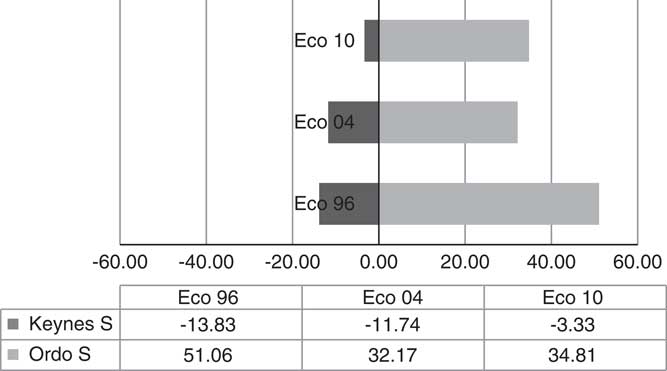
The map of the 1996 memorandum, which was issued shortly before the introduction of the SGP, shows a distinct resemblance to a strict Ordoliberal position in terms of the stringent adherence to budgetary discipline that is advocated. The quantitative analysis shows that in terms of concepts, the causal map is strongly Ordoliberal in character (see Figure 1). In terms of aggregate saliency, Ordoliberal concepts make up 51 vs. 13.8% for Keynesian concepts.
Salience of paradigmatic concepts in the three documents.

A more ambivalent picture emerges from the qualitative analysis of the inherent logic of the map. On the one hand, the map shows that the Commission voices some distinctly Ordoliberal concerns and uses Ordoliberal argumentation. First, the Commission is very concerned with budgetary debt and deficit: ‘budgetary deficit’ is the most salient concept in the map (S=11) and like all other concepts referring to poor public finances it is deemed highly undesirable by the Commission. Moreover, in accordance with the Ordoliberal paradigm, budgetary deficits are perceived as a threat to price stability. In accordance with this, the Commission advocates establishing clear, strong rules and regulations to temper governmental debt and deficits, such as sanctions, dissuasive rules and the acceleration of the Excessive Deficit Procedure (EDP). In the mind of the Commission, the introduction of sanctions within the budgetary framework of the EMU also serves the credibility of the SGP. In addition to this set of repressive measures, the Commission also proposes an entire set of ‘soft’ powers to stimulate sound public finances, like establishing an early warning system, multilateral surveillance and the obligation for states to publish their stability plans. Every one of these more or less stringent instruments is evaluated positively in the document.
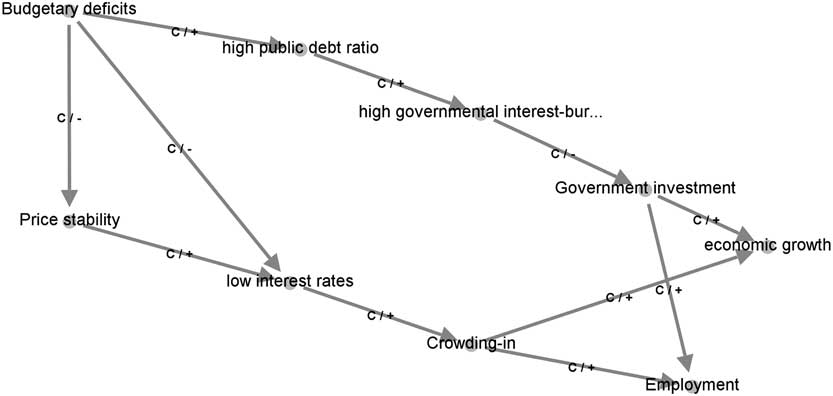
On the other hand, several elements within the map are not consistent with the Ordoliberal paradigm. First, the concept of price stability is of only minor importance in the Commission’s mind (S=2) and not nearly as salient as one would expect within the Ordoliberal paradigm. Moreover, in contrast to the ideal-type argumentation, price stability is not identified as the ultimate goal of the map, but as a means to other ends (GO=0). It is seen to promote a reduction in interest rates, which would stimulate crowding-in, which in turn would promote economic growth and employment. In addition, government debt and deficits are expected to raise governmental interest burdens, thereby inhibiting government investments and thus hampering employment and economic growth. This is illustrated in Figure 2, which presents the part of the 1996 causal map around the concept of price stability.
Keynesian strand in the causal map of the 1996 document.

Both lines of reasoning are at odds with the Ordoliberal ideal-type. In fact, the argumentation provided in the memorandum is a textbook example of the Keynesian plea to stimulate investment and consumption through a more lenient monetary policy, in order to stimulate the Keynesian ultimate goals of growth and employment.Footnote 4 In the eyes of a true Ordoliberal, low interest-rates could lead to increased lending and liquidity and ultimately endanger price stability. Finally, in comparison with the Ordoliberal ideal type, the Commission relies heavily on less stringent, more political instruments, political will and commitment, and the soft instruments outlined above. Moreover, at this moment in time, the Commission is still univocally positive about allowing the Council some discretion in its decision-making and to differentiate measures among countries. So while the document is highly Ordoliberal in terms of concept saliency and shows distinct Ordoliberal argumentation, in terms of the underlying logic, it is partly at odds with the Ordoliberal paradigm.
The 2004 document
In several ways the picture emanating from the map of the 2004 Communication is similar to the 1996 memorandum. First, the quantitative analysis shows that, in comparison with 1996, references to both ideal-typical Ordoliberal and Keynesian concepts have declined (making up 32.2 and 11.7% of the entire map, respectively). This means that overall, the map is now 2.7 times more Ordoliberal than Keynesian (compared with 3.7 times in 1996).
The qualitative analysis again portrays a more ambivalent picture. On the one hand, the entire 2004 document is geared towards ensuring a more effective and credible SGP and increased compliance with the SGP (eight of the 21 pure goal concepts refer to such concerns). Moreover, while in this Communication references to the central Ordoliberal goal of price stability are again few and far between (S=1), it does feature as an ultimate goal in the 2004 map. Finally, in terms of instruments, many of the measures proposed in 1996 reappear in the 2004 communication: for instance, establishing sound medium term budgetary objectives, fiscal and economic surveillance and clear procedures and rules. However, in comparison, it generally speaks out for more ‘clarification’ rather than ‘reinforcement’ of the rules and procedures and stresses the need for more stringent timing of procedures. This suggests that budgetary discipline has evolved from (largely) an instrument to a goal in itself.
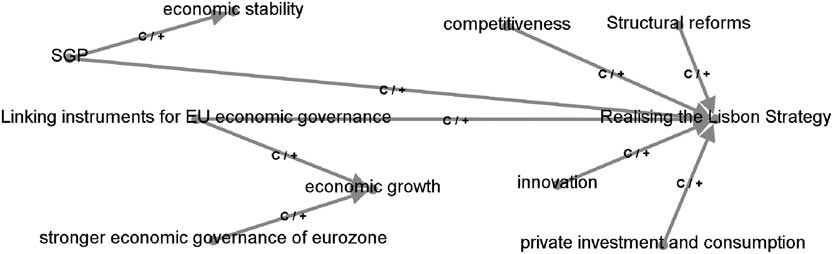
On the other hand, again some clear Keynesian lines of argumentation pop up in the Communication. First, the goal of the realization of the Lisbon Strategy features very prominently in the causal map (S=6). This strategy, with its emphasis on governmental stimulation and economic growth, is a distinctly Keynesian concept and constitutes a hub of Keynesian logic embedded in the map (see Figure 3). Not only are the SGP and the further integration of economic instruments causally linked to promoting this strategy, but competitiveness, innovation, structural reforms and private investment and consumption also feature as determinants of the success of the Lisbon strategy. Such demand-side logic and the gearing of SGP and European economic governance towards economic growth is closely related to the Keynesian paradigm and is reminiscent of some of the Keynesian logic in the 1996 document. In addition, the goal of economic growth has remained a consistent element in the Commission’s thinking throughout the years (S=2).
Keynesian strand in the causal map of the 2004 document.

Finally, the approach to promoting fiscal discipline has become even more flexible. Differentiation of policies among countries has become the most prominent instrument (S=10) and a whole new set of soft-power instruments is introduced which a true Ordoliberal would be highly sceptical about: peer pressure and review (S=8, S=1), transparency (S=8), accountability (S=4) and providing information (S=3). This reflects the political realities of the day, defined by the French and German resistance against the imposition of sanctions after their breach of the SGP criteria. In sum, this portrays a picture of a policy document that is highly Ordoliberal in terms of goals but ambiguous in the proposed means to that end.
The 2010 document
Despite the outbreak of the Euro-crisis in late 2009, the map of the 2010 Commission Communication is again similar to both the 1996 memorandum and the 2004 Communication, but more univocally Ordoliberal. First, the quantitative analysis shows that the overall decline of Keynesian concepts over the years has continued, as they now make up only 3.33% of total map saliency (see Figure 1). Since, at the same time, references to ideal-typical Ordoliberal concepts have slightly increased, the 2010 map is now 10.4 times more Ordoliberal than Keynesian (compared with 3.7 times in 1996 and 2.7 in 2004). In terms of concept saliency, the 2010 document is thus the most Ordoliberal one studied in this paper.
More than the previous documents, which were concerned predominantly with proposing new policies, the 2010 Communication is a sense-making document, trying to identify the nature and causes of the crises that the EU has faced since 2008. With regard to the Euro-crisis, the Commission identifies three major causes that forebode well for its proposals to deal with the crisis: the absence of reliable statistics, the lack of fiscal discipline (both S=4) and especially the existence of pan-EU macro-economic imbalances (S=15). In addition, European integration in various forms is identified as the major safeguard against the outbreak of crises.
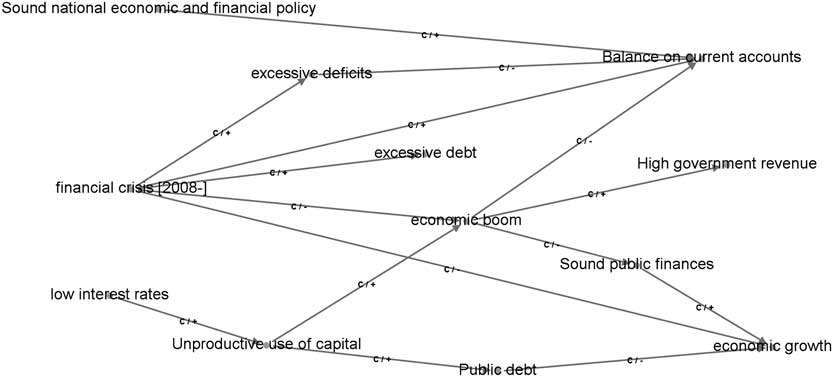
In terms of the proposals that emerge from this diagnosis, and in accordance with the quantitative analysis, the 2010 Communication is more univocally Ordoliberal than the earlier documents. This is predominantly due to the clearer and less ambiguously fiscal reasoning underlying the document. Concepts referring to the need for fiscal discipline, such as ‘sound public finances’ (S=18), ‘compliance with SGP norms’ (S=10) and ‘additional preventive mechanisms’ (S=8) belong to the most salient concepts in the map and are all valued positively. Excessive deficits (S=2) and debt (two concepts, with aggregate S=7) are deemed to disrupt economic growth (S=4), Eurozone resilience (S=3) and the current account balance (S=4). Moreover, in direct contrast with the reasoning in the 1996 document, in 2010 the Commission has adopted the Ordoliberal line of reasoning, that low interest rates form a considerable risk for sound public finances: as low interest rates foster unproductive use of capital, public debt may increase (see Figure 4). In addition, the Commission goes on to argue that fiscal stringency actually fosters economic growth thereby denouncing the Keynesian belief that austerity is detrimental to growth. Finally, Keynesian fiscal measures, some of which were previously supported by the Commission, are largely absent from the map, less salient or considered to bring along high costs (bail-outs of banks). Only the fiscal support packages (S=3) introduced to help member-states in trouble meet with the Commission’s approval and are considered to have stimulated the stability of the Eurozone (S=3). However, the Commission feels such support should be conditional to be effective. All in all, in line with the Commission’s diagnosis of the Euro-crisis as a sovereign debt crisis, her fiscal beliefs have become more univocally Ordoliberal.
Ordoliberal strand in the causal map of the 2010 document.

Moreover, in comparison with 2004, the instruments proposed by the Commission to stimulate fiscal discipline have become more stringent. Some hard power instruments to punish non-compliance with the SGP, included in the 1996 document, make their come-back in the proposals to introduce additional corrective mechanisms (S=4), acceleration of the EDP (S=3), sanctions (S=2) and enforcement (S=1). Soft instruments like peer reviews (S=1) all but disappear from the proposals, as do calls for flexibilization of rules. In addition, in line with the identification of macro-economic imbalances as the dominant cause of the Euro-crisis, there is an enormous increase in references to the need for more European economic surveillance in comparison with the earlier documents. The Commission identifies no fewer than five different forms of economic surveillance with a combined saliency of 19, which are all evaluated positively and geared towards reducing differences in fiscal discipline, competitiveness and member states’ economic fundamentals in general. Differentiation of policies across countries is no longer considered an option. Again this reflects a more Ordoliberal perspective.
Only one aspect of the map raises doubts about the Ordoliberal orthodoxy in the 2010 document: the total absence of the monetary part of this paradigm, as nowhere in the document does the Commission even mention the core Ordoliberal goal of price stability. Moreover, no mention is made of the issue of the independence of the European Central Bank, its role in the solution of the crisis or the related issue of confidence. This may be an implicit but strong indication that the Commission abides strictly to the separation of powers between the political–fiscal and technocratic-monetary dimension of EMU as advocated by Ordoliberals. However, it may also be an indication of adherence to only half of the paradigm.
Conclusions
In this paper, we have explored the existence of and change in policy paradigms behind the EU’s SGP, covering documents from 1996, 2004 and 2010. The analysis shows a mix of Keynesian and Ordoliberal ideas in which the Ordoliberal paradigm is dominant. This dominance varies over time and seems to hold trend with the major policy discussions of the day. Initially, the thinking in the documents represented a mix between the two paradigms with a strong emphasis on Ordoliberalism, which became less prevalent in 2004 and increased in strength again during the Euro-crisis. The 2010 document shows a much clearer focus on Ordoliberalism. The process we observe is, therefore, not so much one of paradigm change but of a varying dominance of one paradigm within a mix of paradigms.
All in all, then, the thinking behind the SGP seems to be characterized by hybrids between the two paradigms rather than the use of one unambiguous paradigm. This may be a result of the compromises that had to be struck between very different traditions of economic governance in the different member states of the Eurozone. Whereas some member states, such as Germany and the Netherlands, have promoted a strict Ordoliberal approach, other states, such as France and Italy, have leaned more towards a Keynesian approach. The concerns of both strands of thought are included in the belief system that underlies the documents.
Comparing the documents, two types of change can be identified. First, the 2004 and 2010 documents include concepts that are absent from the other documents. These concepts reflect the particular circumstances in which the documents were written. For instance, one of the most prominent concepts in the 2004 document is the ‘economic rationale’ of rules, which was another way of saying that the SGP’s deficit and debt rules should not be applied too strictly and does not appear in the 1996 and 2004 documents. Likewise, ‘peer pressure’ is an often-used concept in this document but does not appear in either the 1996 or 2010 document. The 2010 document scores highly on a number of concepts that directly reflect the financial crisis, like ‘macro-economic imbalances’ and ‘preventive mechanisms’ to tackle economic problems before they lead to a crisis. Both of these concepts do not appear in the 1996 and 2004 documents. As a second type of change, the documents vary in terms of the emphasis placed on specific concepts and lines of argument, even if those concepts and lines of argument can also be found in the other documents. For instance, the concept of ‘differentiation between countries’ (another way of saying that the SGP rules should not be uniformly enforced in all Euro countries) already appeared in the 1996 document, but only once, whereas it is the most prominent concept in the 2004 document. The importance of ‘sound public finances’ is professed in all three documents but becomes the single most prominent concept in 2010. This type of change is more a matter of shifting emphases than of entirely new ways of thinking, which results in gradual shifts.
On the basis of this analysis, two important points can be made about the role of policy paradigms. To begin with, the thinking behind the SGP shows that viable mixes between policy paradigms can exist, in different forms and with different emphases. This does not lead to inconsistencies, as each of the three documents presents an internally coherent argument. This casts doubt on a central tenet of the paradigm concept, that is, that paradigms are incommensurable. Apparently, even in the well-established case of macro-economic policy-making, all kinds of shades between idealtypical policy paradigms are feasible without undermining the internal consistency of the argument. This is likely to be the case in many policy areas. This has important implications for processes of policy change, since the idea that paradigm change occurs rapidly is closely linked to the presumed incommensurability of paradigms, which forces political actors to choose between competing paradigms. If paradigms are not incommensurable, gradual change is at least a plausible option and probably a likely one.
Furthermore, the existence of a policy paradigm appears to be a matter of degree: the 2010 document reflects much more closely one established policy paradigm (Ordoliberalism) than the other two documents. Hence, belief systems behind policies may be more or less paradigmatic, and the level of ‘paradigmaticness’ (to use a term that cries out for a less awkward substitute) may vary over time. For theories of policy paradigms and paradigm change, this raises important conceptual and theoretical issues. If paradigm change is seen as a distinct process, which involves qualitatively different dynamics than other types of policy change, it should be possible to make a clear distinction between paradigms and non-paradigmatic elements of a policy. Our findings raise doubt about the possibility of doing just that.
The combination of the ‘commensurability’ of Ordoliberal and Keynesian ideas, and the pattern of stability and change uncovered in our analysis, fits neither the traditional model of incommensurable paradigms, nor the bricolage model very well. On the one hand, the European Commission is clearly able to combine ideas belonging to both paradigms into one consistent set of policy proposals, which lends support to the bricolage model. On the other hand, the thinking in the documents is consistently predicated on a strong Ordoliberal foundation. The fact that this remains the case over the course of 13 politically turbulent years does not fit well with a ‘pick and choose’ bricolage model but suggests the importance of paradigmatic frameworks.
We can make sense of these mixed results by conceiving of the change we have identified in terms of a ‘moving paradigmatic core’. Essentially, the European Commission’s ideas remain highly Ordoliberal, but it is flexible in terms of how much and what part of the Ordoliberal idealtype is included and what elements are adopted from the Keynesian paradigm. Our case therefore shows a degree of ‘bricolage’, but within a stable set of preconceived ideas.
This conceptualization may also help to make sense of the paradox in Peter Hall’s explanation of paradigm change, as identified by Mark Blyth (Reference Blyth2013b). According to Blyth, Hall’s account oscillates between a focus on (exogenous) facts and the (endogenous) competition for authority between contrasting paradigms as the driving force behind paradigm change. In the case of the SGP, we can see a response to ‘outside’ events but within a paradigmatic framework. This reveals creative attempts to accommodate these events within a set of paradigmatic ideas, thereby ‘endogenizing’ the exogenous. This is the dynamic that drives paradigmatic change around the SGP.
Acknowledgements
The authors would like to thank Marcello Carammia, Christoffer Green-Pedersen, Rik de Ruiter, Thomas Schillemans, Wouter Spekkink and Fréderic Varone, as well as two anonymous referees for EPSR, for their valuable comments. Of course, the usual disclaimer applies.