Introduction
The excretion of purine derivatives (PD: allantoin, uric acid, xanthine and hypoxanthine) in urine reflects the duodenal flow of their precursors, purine bases (PB: adenine and guanine) (Chen et al., Reference Chen, Hovell, Ørskov and Brown1990; Balcells et al., Reference Balcells, Guada, Castrillo and Gasa1991). Furthermore, in ruminants, the PB in duodenal digesta are mostly of microbial origin (McAllan and Smith, Reference McAllan and Smith1973) and, thus, urinary PD excretion has been used to predict microbial mass flowing out of the rumen (Balcells et al., Reference Balcells, Fondevila, Guada, Castrillo and Surra1993; Pérez et al., Reference Pérez, Rodríguez, González, Balcells and Guada1996). However, the relationship between duodenal absorption (exogenous PB) and the urinary excretion of PD is biased by the presence of endogenous PD in urine that are synthesised within the animal.
Ruminant species differ in their PB metabolism; unlike sheep and goats, cattle (European and zebu) do not recycle exogenous PB. Cattle also have greater endogenous excretion of PD in the urine (Verbic et al., Reference Verbic, Chen, MacLeod and Ørkov1990). In addition, the physiological and nutritional status, e.g. lactation, of animals can affect the metabolism of PB (Balcells et al., Reference Balcells, Vicente, Orellana-Boero, Martin Orúe and González-Ronquillo2004). The recovery of duodenal PB and endogenous excretion have been investigated in non-lactating goats (Belenguer et al., Reference Belenguer, Yáñez, Balcells, Ozdemir Baber and González-Ronquillo2002) but not in lactating animals. The aim of this study was to define the response model between the duodenal absorption of PB and their urinary excretion as PD in dairy goats. To that end, the endogenous contribution to urinary PD was determined using the 15N-labelling procedure (Pérez et al., Reference Pérez, Balcells, Cebrian and Martín-Orúe1998) and the urinary recovery of duodenal PB was defined using intra-duodenal infusion of RNA–PB. The usefulness of milk PD as a predictor of duodenal PB flow was also examined.
Material and methods
Animals and diets
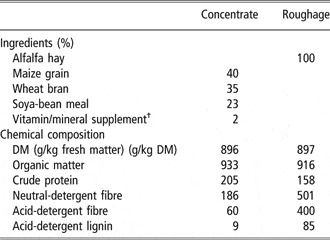
Five multiparous Granadina goats (initial weight 38.6 ± 2.78 kg live weight (LW)) fitted with a simple T-shaped duodenal catheter (Kehr T-tube, 8 mm external diameter Silkolatex® Willy Rüsch AG, Kermen/Germany) were held indoors in metabolism cages. They were fed ad libitum a mixed diet of alfalfa hay and concentrate (75 : 25) (Table 1). Each day, food was divided and offered in eight equal fractions and residues were removed and weighed. Animals had free access to drinking water and were hand milked manually at 0800 and 1700 h daily.
Ingredients and chemical composition of the roughage and concentrate supplied to Granadina dairy goats

Abbreviation is: DM = dry matter.
†Declared composition: Ca: 155, Mg: 97, P: 97, S: 28, Mn: 3, Fe: 2.7 (g/kg DM); I: 76, Co: 14, Se: 6 (μg/kg DM); vitamin A: 400 000, D3: 80 000, A: 150 (IU/kg DM).
Animals were handled following the criteria of the European Union for care and use of laboratory animals in research, and the Ethics Committee for Animal Research of Zaragoza University approved the experimental protocol.
Experimental procedure
The experiment was divided into two phases. In the first and second phase, respectively, three (37.4 ± 4.34 kg LW) and two (40.4 ± 2.23 kg LW) lactating goats were used. The first phase included 7 days for dietary changeover and 31 days for experimental measurements. The urinary recovery of PD from duodenal PB (day 8 to day 32) and endogenous excretion (day 35 to day 38) was measured. On day 38, goats were sacrificed and samples of tissues and digesta (abomasum and duodenum) were collected. In the second phase (32 days : 7 days for dietary adaptation and 25 days for experimental measurements) only the urinary recovery of PD from duodenal PB infusion was measured.
Urinary recovery of duodenal PB
The recovery of duodenal PB as urinary PD was determined after the peak of lactation, which was assumed to be reached by day 21 after parturition. In order to modify the duodenal flow of PB, four doses, administered at random, of RNA from Torula yeast (Sigma Co. St Louis, MO, USA) were continuously infused into the duodenum during four successive 5-day periods, allowing two days for treatment changeover. The RNA solution (1.1 mmol PB per g RNA) was prepared by diluting yeast doses in 500 ml of alkalinised water (pH 10 to 12 using 1 mol/l NaOH) at 40°C. Once the yeast was dissolved, the solution was neutralised with 1 mol/l HCl. The solution was infused continuously into the duodenum for 12 h (0800 to 2000 h) at a flow rate of 0.7 ml/min using a peristaltic pump (Minipuls-2 HP 18 Gilson; Villers le Bel, France). The infused doses were calculated to increase two- (phase 1: 0, 6, 12 and 18 g RNA per day) or threefold (phase 2: 0, 12, 24 and 36 g RNA per day) the theoretical basal flow. Baseline duodenal flow of PB was estimated assuming 11 g microbial protein per MJ FME (Agricultural and Food Research Council, 1993) and 1.2 mmol PB per g microbial nitrogen (N) (Balcells et al., Reference Balcells, Guada, Peiró and Parker1992).
Urine was collected daily during the last 3 days of each infusion period in 50 ml of a H2SO4 solution (10% v/v; final pH was kept <3). Daily samples were pooled within each individual, the weight and specific gravity were recorded and two sub-samples (50 ml) were collected and stored at −20°C.
Endogenous measurements
The endogenous fraction was estimated using the enrichment ratio between abomasal PB (obtained by sacrifice on day 38) and urinary PD. Abomasal PB were labelled by adding inorganic 15N to the concentrate (eight doses per day). The isotope was supplied as ammonium sulphate (15NH4)2SO4, 10 at% 15N ISOTEC, Inc. USA) to provide 80 mg 15N per day on 3 days (day 35 to day 38). After the start of isotope administration (0 h), urine was collected every 12 h following the protocol described by Pérez et al. (Reference Pérez, Balcells, Cebrian and Martín-Orúe1998). Once the collection of urine ended, animals were anaesthetised and the digestive tract was removed, sectioned (rumen–reticulum, abomasum and duodenum) and sampled along with several other tissues (liver and muscle). Finally, the goats were slaughtered by bleeding.
Analytical procedures
To determine the dry matter and organic matter, the samples were dried to constant weight at 105°C, and to ash at 550°C for 8 h. Total N content was determined using the Kjeldahl Method, with Se as the catalyst. PD and creatinine in urine were determined using HPLC (Balcells et al., Reference Balcells, Guada, Peiró and Parker1992). PB were analysed in the digesta after perchloric acid hydrolysis following the procedure of Martín Orúe et al. (Reference Martín Orúe, Balcells, Guada and Castrillo1995). The isotope enrichment of 15N in PB and allantoin was determined using a mass spectrometer (VG PRIM II; IRMS connected in series to a DUMASstyle N analyser EA 1108,Carlo Erba, Milan, Italy). Urinary allantoin-N was isolated after its conversion to allantoic acid by alkali hydrolysis using ion-exchange chromatography following Pérez et al. (Reference Pérez, Balcells, Cebrian and Martín-Orúe1998). The PB–N for isotope analysis was extracted by specific precipitation with Ag ions following Aharoni and Tagari (Reference Aharoni and Tagari1991).
Calculations and statistical analysis
To estimate the time required for the equilibrium of labelled purine compounds in the urine, the 15N-allantoin abundance time course was monitored. After the start of isotope ingestion, urine samples were collected over time. A steady state was assumed to be achieved when the 15N abundance in urinary allantoin reached the maximum (plateau) value in a mono-exponential graphical plot (Y = a + b(1 − e−kt), where Y is 15N abundance (at%), a is the basal 15N abundance at time 0, (a + b) is the asymptotic or plateau value and t is time after the start of isotope ingestion.
The contribution to urinary PD from endogenous sources was calculated at steady-state conditions as follows:

The 15N enrichment (at% excess) of urinary PD was obtained by subtracting the background abundance (at%) of the urinary PD recorded before the administration of 15N. Abomasal PB were obtained by sacrifice; therefore, background samples were unavailable, and the natural abundance of abomasal PB was taken from Askar et al. (Reference Askar, Guada, Balcells, de Vega and Castrillo2005). In the calculation, it was assumed that at short time intervals, the enrichment of endogenous sources would be negligible (Pérez et al., Reference Pérez, Balcells, Cebrian and Martín-Orúe1998).
The effect of duodenal infusion on the urinary excretion of PD was assessed using the following model:

analysing animal effect (A) and level of PB infusion (L). The model was unbalanced; therefore, to equilibrate the error term, the harmonic (Steel and Torrie, Reference Steel and Torrie1960) mean was estimated. Calculations were performed using Statistical Analysis Systems Institute (2000).
Results
Throughout the experiment, the goats remained in good health and no unusual behaviours were observed in response to the administration of the isotope or the infusion protocol. Even though the experimental procedures were identical in the two phases, the animals used in phase 2 (goats 4 and 5) had higher feed intake and milk production, but lower weight loss, than did the animals in phase 1 (goats 1, 2 and 3) (Table 2).
Feed intake and milk yield in Granadina dairy goats with one kid and fed a mixed diet ad libitum

Excretion of PD in response to the supply of duodenal PB
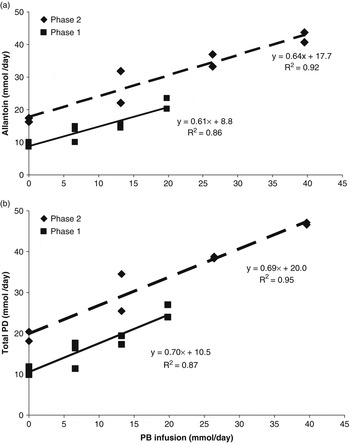
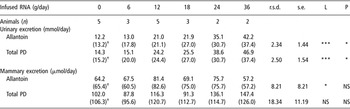
Figure 1 shows the relationship between the duodenal infusion of PB and the urinary excretion of PD in terms of either allantoin or total PD for both phases. Allantoin was the main PD in urine (up to 0.85) and its variation in urine samples mostly explained the response of total PD to the duodenal infusion of PB (P < 0.001; Table 3). In addition, allantoin precursors varied significantly with PB supply, although more irregularly: from 0.046 to 0.054, 0.048 to 0.031 and 0.042 to 0.013 from the basal to the top level of RNA infusion for uric acid, hypoxanthine and xanthine, respectively) (Table 3). The recovery of duodenal PB in urine was similar in both phases, in terms of allantoin (0.61 ± 0.08 and 0.64 ± 0.078) and total PD (0.70 ± 0.094 and 0.69 ± 0.067 in phase 1 and 2, respectively); however, the equation intercepts were lower in phase 1 (8.77 and 17.7 for allantoin and total PD, respectively) than they were in phase 2 (10.6 and 19.9).
Mean daily excretion of (a) allantoin and (b) total purine derivatives (PD: allantoin, uric acid, xanthine plus hypoxanthine) and the input of purine bases in two phases: 1 (three goats) and 2 (two goats).

Effect of level of RNA infusion (L) into the duodenum and the experimental phase (P) on the excretion of allantoin and total purine derivatives in urine (mmol/day) and milk (μmol/day) in Granadina dairy goats

Abbreviations are: PD = purine derivatives; NS = not significant.
†Estimated harmonic mean for an unequal number of replicates in each treatment.*P<0.05; ***P<0.001.
Some PD were excreted in milk, mostly as allantoin, but also as its precursors (hypoxanthine, xanthine and uric acid). The total PD concentrations in goat milk were almost constant (110.9 ± 12.13 μmol/l), with allantoin the most abundant (0.40 to 0.76), followed by uric acid (0.15 to 0.38) and hypoxanthine (0.14 to 0.23). Xanthine was not detected in milk samples. The mean excretion rate of milk PD ranged from 87.7 to 147.4 μmol/day and, on average, it was less than 0.01 of the total excretion (urine plus milk). The proportional contribution decreased from 0.0071 to 0.0031 as the PB infusion increased. Milk PD excretion was not correlated with duodenal PB flow or milk yield.
Endogenous excretion of PD
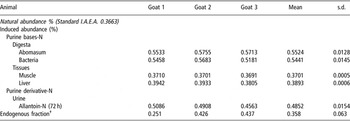
After 72 h of isotope administration, the abundances of PB–N in abomasal digesta were similar to those found in ruminal bacteria (P < 0.05; Table 4), which confirmed that most of the PB in the abomasum were of microbial origin. The abundances 15N (at%) in the liver and muscle were 0.3893 ± 0.044 and 0.3701 ± 0.005, respectively (Table 4).
Isotopic abundance (at%) in purine bases isolated from abomasal digesta, rumen bacteria and tissues (liver and muscle), and in allantoin extracted from urine in lactating Granadina dairy goats after 72 h of (15NH)2S04 administration. Estimated contribution of the endogenous fraction to total purine derivative excretion is also presented

†Endogenous fraction = 1 − [urinary PD 15N at% excess/duodenal PB 15N at% excess].
Assuming the natural abundance of allantoin-N (0.3712) determined by Pérez et al. (Reference Pérez, Balcells, Cebrian and Martín-Orúe1998) and for purine bases-N the value (0.3670) reported by Askar et al. (Reference Askar, Guada, Balcells, de Vega and Castrillo2005).
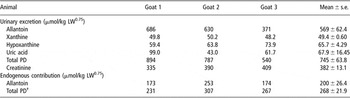
After inorganic 15N was added to the diet, isotopic abundance in urinary allantoin increased rapidly during the first 48 h and slowly, thereafter. A steady state was reached by 66 h. A mono-exponential model was fitted to the data and a Student’s t-test was used to confirm whether the theoretical value at plateau (0.517 ± 0.026 at%) differed significantly from the abundance at 72 h (0.498 ± 0.015 at%). The latter was used to estimate the urinary endogenous contribution to urinary PD, which was 0.386 ± 0.070 (Table 4) and the endogenous losses of allantoin was 200.4 ± 26.38 μmol/kg LW0.75. Total endogenous losses of PD (268.5 ± 21.98 μmol/kg LW0.75) were calculated assuming that the isotopic enrichments in allantoin precursors (i.e. xanthine, hypoxanthine and uric acid) were similar to that in the end product of purine metabolism (allantoin) (Table 5).
Urinary excretion (μmol/kg metabolic weight (LW0.75)) of purine derivatives and creatinine, and the estimated endogenous excretion of allantoin and total purine derivatives in the urine of Granadina dairy goats

Abbreviations are: LW = live weight; PD = purine derivatives.
†Endogenous excretion of total PD was calculated assuming that precursor enrichment of the end product (allantoin) should be similar to its precursors (other PD).
Discussion
In previous experience in our laboratory Granadina goats showed problems after surgery (Belenguer et al., Reference Belenguer, Yáñez, Balcells, Ozdemir Baber and González-Ronquillo2002); therefore, in the present assay, a simple infusion catheter was placed into the proximal duodenum, rather than using cannulated animals. Nevertheless, the dry matter intake recorded in our study was lower and more variable than expected. The animals were identically treated; thus, the high degree of individual variation must be due to uneven adaptation by the goats to the experimental protocol and, therefore, that result must be treated with caution.
Scharrer et al. (Reference Scharrer, Raab and Amann1981) and Martin Orúe (Reference Martín Orúe1998) demonstrated in vitro and in vivo, respectively, that the intestinal PB absorption may become saturated. This problem could be particularly important when using lactating animals and increasing doses of yeast RNA. For that reason, in phase 1, the RNA doses were designed to reach about two times the theoretical duodenal flow of PB; however, the initial data (phase 1) showed no irregularities in the PB recovery ratio, and the relationship between duodenal input and urinary output was linear. In the second phase, RNA doses were increased to obtain a wider range of responses and closer to the natural PB flow in Granadina goats under normal milk production conditions.
Endogenous contribution to urinary PD
The isotopic (15N) dilution of urinary PD in relation to duodenal PB confirmed an endogenous fraction in the urinary excretion (Table 4), which has been observed in non-isotopic studies of goats (Lindberg, Reference Lindberg1989; Belenguer et al., Reference Belenguer, Yáñez, Balcells, Ozdemir Baber and González-Ronquillo2002), other ruminants (Balcells et al., Reference Balcells, Guada, Castrillo and Gasa1991; Orellana-Boero et al., Reference Orellana-Boero, Balcells, Martín-Orúe, Liang and Guada2001; Guerouali et al., Reference Guerouali, El-Gass, Balcells, Belenguer and Nolan2004) and non-ruminant species (Martín Orúe et al., Reference Martín Orúe, Balcells, Guada and Castrillo1995; Balcells et al., Reference Balcells, Ganuza, Pérez, Martín-Orúe and González-Ronquillo1998). Differences in estimates of the endogenous fraction may partly reflect the different experimental techniques adopted. Lindberg (Reference Lindberg1991) estimated the endogenous fraction in milk-fed goat kids (242 μmol/kg LW0.75), and Belenguer et al. (Reference Belenguer, Yáñez, Balcells, Ozdemir Baber and González-Ronquillo2002) did so by using fasted goats (202.2 μmol/kg LW0.75). However, those and other procedures, such as intragastric nutrition (Ørskov et al., Reference Ørskov, Grubb, Wenham and Corrigal1979) or duodenal digesta draining (Balcells et al., Reference Balcells, Guada, Castrillo and Gasa1991), are too aggressive to use with lactating animals.
Initially proposed to be applied in sheep (Pérez et al., Reference Pérez, Balcells, Cebrian and Martín-Orúe1998), the method based on the urinary dilution of labelled exogenous purines allows determination of the endogenous component of the urinary PD without having any adverse physiological effect on the animals. Using that method in sheep, the above authors obtained an endogenous excretion of 115.2 μmol/kg LW0.75, which was in the range (92 to 150 μmol/kg LW0.75) reported by non-isotopic studies based on intragastric or digesta draining methods (Ørskov et al., Reference Ørskov, Grubb, Wenham and Corrigal1979; Giesecke et al., Reference Giesecke, Stangassinger and Tiemeyer1984; Chen et al., Reference Chen, Hovell, Ørskov and Brown1990; Balcells et al., Reference Balcells, Guada, Castrillo and Gasa1991). Furthermore, the technique has been used in lactating cows (González-Ronquillo et al., Reference González-Ronquillo, Balcells, Belenguer, Castrillo and Mota2004), showing that recycling of exogenous PB into the tissues by the salvage mechanism was negligible (Chen et al., Reference Chen, Hovell, Ørskov and Brown1990). The endogenous contribution to urinary excretion in lactating goats has not been reported.
Like sheep, goats exhibited low tissue xanthine-oxidase activity (Belenguer et al., Reference Belenguer, Yáñez, Balcells, Ozdemir Baber and González-Ronquillo2002), which suggests a significant salvage of exogenous PD. That salvage pathway implies isotope enrichment of tissue PD, which might have affected our results, but it should be a time-dependent function. We felt that 48 h were needed to obtain a homogeneous distribution of the isotope in the rumen (Broderick and Merchen, Reference Broderick and Merchen1992) and that an additional 24 h had to elapse before the 15N enrichment in urinary PD reached a plateau following duodenal absorption (Chen et al., Reference Chen, Hovell, Ørskov and Brown1990; Balcells et al., Reference Balcells, Guada, Castrillo and Gasa1991). Therefore, 72 h should be sufficient to reach the isotope equilibrium without significant labelling of endogenous purines (Pérez et al., Reference Pérez, Balcells, Cebrian and Martín-Orúe1998).
After 72 h of isotope administration, the enrichment in tissue (liver and muscle) PB confirmed the capacity of goats to recycle exogenous (digestive) purines. In liver tissue, PB became significantly enriched (0.0011 of the PB–N enrichment registered in duodenal digesta) and, thus, liver PB enrichment is an index of the maximum potential error considering the high metabolic activity in liver; however, muscular PB indicated a lower level of isotope incorporation (0.016 of digesta PB–N enrichment). If muscle constitutes a higher proportion of the total body PB pool, we can assume that the contribution of isotopes from endogenous sources to urinary PD would be similar to the muscle enrichment (1.6 at% excess) and, thus, the error would be negligible.
Our study suggests that physiological status had a significant effect on the contribution of endogenous PD to urinary losses because the value in lactating goats (268 μmol/kg LW0.75) was higher than in goats fed at the maintenance level (202.2 μmol/kg LW0.75; Belenguer et al., Reference Belenguer, Yáñez, Balcells, Ozdemir Baber and González-Ronquillo2002). Differences in endogenous PD excretion between physiological status in goats confirmed previous results in cattle (Balcells et al., 2004), which emphasise the need to consider the physiological phase effect in the design of response models of the duodenal input and urinary output of purine compounds.
Duodenal input and urinary output
In conventional studies, milk yield and urinary PD excretion were positively correlated. Increases in rumen microbial yield implied an increase in the nutrient supply to the host animal and, consequently, an increase in milk yield (González-Ronquillo et al., Reference González-Ronquillo, Balcells, Belenguer, Castrillo and Mota2004). The duodenal infusion of RNA allowed us to break down the correlation between milk yield and duodenal PB flow and to have a precise estimation of the variation in the duodenal PB flow.
The relationship between duodenal PB input and urinary PD output in goats is similar to that in sheep (Belenguer et al., Reference Belenguer, Yáñez, Balcells, Ozdemir Baber and González-Ronquillo2002). Moreover, in our study, the significant concentrations of salvageable PD (hypoxanthine plus xanthine) in urine (Table 5) and the enrichment in tissue-PB (Table 4) confirmed that in goats, as in sheep, exogenous PB might be recycled and contribute to the biochemical feedback in the ‘de novo’ synthesis. If that is true, exogenous PD would be recovered in the urine only when intestinal absorption exceeds basal excretion.
Once exogenous PB absorption fully replaces the ‘de novo’ synthesis process, the recovery of duodenal purines as urinary PD would be proportional to the ratio between renal and non-renal losses (e.g. salivary and mammary) (Chen et al., Reference Chen, Hovell, Ørskov and Brown1990; Balcells et al., Reference Balcells, Guada, Castrillo and Gasa1991).
In our study, the urinary excretion of PD (745 μmol/kg LW0.75) in the absence of a supply of duodenal RNA was greater than the endogenous losses (268 μmol/kg LW0.75) and thus urinary recovery of PD should be constant and proportional to the exogenous supply. Effectively the relationship between the daily excretion of PD (y, mmol/day) and the duodenal supply of PB (x, mmol/day) was linear (Figure 1) and the addition of a quadratic component in the calculations did not improve significantly the amount of variation explained by the model.
A linear response between duodenal input and urinary output has been observed in other ruminant, including dry goats (Belenguer et al., Reference Belenguer, Yáñez, Balcells, Ozdemir Baber and González-Ronquillo2002), sheep (Balcells et al., Reference Balcells, Guada, Castrillo and Gasa1991), steers (Orellana-Boero et al., Reference Orellana-Boero, Balcells, Martín-Orúe, Liang and Guada2001) and milking cows (González-Ronquillo et al., Reference González-Ronquillo, Balcells, Belenguer, Castrillo and Mota2004).
The urinary recovery of PD in lactating goats was in the range observed in cattle 0.75 to 0.8 (Orellana-Boero et al., Reference Orellana-Boero, Balcells, Martín-Orúe, Liang and Guada2001; Verbic et al., Reference Verbic, Chen, MacLeod and Ørkov1990) sheep, (0.7 to 0.8; Balcells et al., Reference Balcells, Guada, Castrillo and Gasa1991; Chen et al., Reference Chen, Hovell, Ørskov and Brown1990) and camels (0.72; Guerouali et al., Reference Guerouali, El-Gass, Balcells, Belenguer and Nolan2004), but was higher than the recovery in buffaloes (0.11, Pimpa et al., Reference Pimpa, Liang, Balcells, Jelan and Abdullah2003).
The recoveries that we observed in lactating goats were similar to those observed in dry goats (0.74; Belenguer et al., Reference Belenguer, Yáñez, Balcells, Ozdemir Baber and González-Ronquillo2002); thus, the metabolic changes during lactation do not affect the metabolism of exogenous PB, and consequently our results suggest that in goats a common coefficient could be used regardless of the individual’s physiological state.
Unlike in goats, in cattle, lactation affects the recovery of duodenal PB. During peak lactation, the recovery ratio was significantly lower than it was in late lactation (0.44 v. 0.74, respectively; González-Ronquillo et al., Reference González-Ronquillo, Balcells, Belenguer, Castrillo and Mota2004).
Mammary excretion of PD
In Granadina goats, the contribution of milk PD to total excretion (0.003 to 0.01) was less than that in ewes (0.022; Martín Orúe et al., Reference Martín Orúe, Dapoza, Balcells and Castrillo1996) and cows (0.016 and 0.034 in early and late lactation, respectively; González-Ronquillo et al., Reference González-Ronquillo, Balcells, Belenguer, Castrillo and Mota2004), and the PD profile in milk differed from that in urine. Differences in the PD profiles of milk and urine were explained previously in dairy ewes (Martín Orúe et al., Reference Martín Orúe, Dapoza, Balcells and Castrillo1996) and cows (González-Ronquillo et al., Reference González-Ronquillo, Balcells, Belenguer, Castrillo and Mota2004). The absence of uricase and high xanthine oxidase activity in milk and mammary glands (Martín Orúe et al., Reference Martín Orúe, Dapoza, Balcells and Castrillo1996) caused a proportional increase in the uric acid concentration as an end product of PB metabolism in milk.
In goats, the duodenal infusion of PB did not affect PD excretion through milk, which is similar to the results observed in lactating cows when a similar experimental protocol was used (González-Ronquillo et al., Reference González-Ronquillo, Balcells, Belenguer, Castrillo and Mota2004) and lactating ewes (Martín Orúe et al., Reference Martín Orúe, Dapoza, Balcells and Castrillo1996), in which duodenal flow was modified by increasing the dietary supply of rumen by-pass PB. The results of our study, however, contrast with the significant correlation observed in conventional dairy cows, where increases in organic matter intake and microbial production resulted in parallel increases in milk production and allantoin excretion (Gonda and Lindberg, Reference Gonda and Lindberg1997). In that case, it is not possible to determine whether increases in the mammary excretion of PD are positively correlated with duodenal flow of PB, or rather due to an increase in milk yield.
Implications
This study defined the positive linear relationship between the duodenal input of PB and urinary output of PD compounds in lactating goats. Lactating animals exhibited a higher level of endogenous losses than did non-lactating goats fed at maintenance, although variation in urinary recovery between mid-lactation and maintenance feeding was not detected. Excretion of PD in milk was not a suitable predictor of duodenal flow in Granadina goats.
Acknowledgements
This work has been supported by the project AGL2001-0941-CO2-02 and was part of a coordinated programme of research under the sponsorship of the International Atomic Energy Agency. For isotope analysis thanks are extended to R. Redondo, Faculty of Science, U.A.M.