INTRODUCTION
The Early Iron Age was represented by the Hallstatt culture (800–450 BC), which spread over a wide territory of Western and Central Europe and extended into northern Italy and the northwestern Balkans (Collins 2013). Increasing social differentiation led to an early urbanization (van der Vaart-Verschoof and Schumann Reference van der Vaart-Verschoof and Schumann2017).
Western Hungary, so-called Transdanubia, had been part of the Eastern group of the Hallstatt culture, with the Danube as its border in the East (Jerem Reference Jerem2003). The diverse geographical landscape ambience has strongly affected the Early Iron Age network of settlements in Transdanubia. The Early Iron Age aristocracy was living in fortified settlements built mostly on hilltops and they continued basically a Late Bronze Age tradition, as has been documented in excavations made in Sopron-Várhely (Nováki Reference Nováki1955; Jerem Reference Jerem1980; Patek Reference Patek1982), Pécs-Jakabhegy (Maráz Reference Maráz1979), Süttő (Vadász Reference Vadász1983), Smolenice-Molpír (Dušek and Dušek Reference Dušek and Dušek1984), Velem-Szentvid (Fekete Reference Fekete1985), Százhalombatta (Holport Reference Holport1996; Czajlik et al. Reference Czajlik, Holl, Nemeth, Gabriella Puszta and Vicze2016) and many others. These settlements constituted core centers even in the Early Iron Age, sustaining intense trade relations toward the South and South-East Alps region, as well as the Mediterranean (Fekete Reference Fekete1985; Patek Reference Patek1993). The aristocracy built rich grave constructions under large tumuli (Ďurkovič et al. Reference Ďurkovič, Jerem, Molnár and Tankó2018). These tumuli graves often had a timber-lined chamber and grave goods set in and around the room (Makarová Reference Makarová2013). All over the neighboring lowland hinterland, there were identified smaller settlements belonging to communities of common people. The location of the open country settlements was mostly dependent on their access to natural resources. Such settlement discoveries are known from Sopron-Krautacker (Jerem Reference Jerem1986), Győr-Ménfőcsanak (Ďurkovič Reference Ďurkovič2014), Balatonboglár (Horváth Reference Horváth2014) with the respective cemeteries, like those in Halimba (Lengyel Reference Lengyel1959), Nagydém, Süttő (Czajlik et al. Reference Czajlik, Novimszki-Groma and Horváth2015). Such cemeteries are usually much more modest in design, poorer in attachments, and generally strictly separated from aristocratic graves. The current stage of research does not allow yet to delineate the exact and direct linkage between the fortified hilltop and the lowland settlements. The process and shaping of the Hallstatt culture needs further research (Nebelsick Reference Nebelsick1994). However, dating and periodization of the Early Iron Age settlements in the Eastern part of the Hallstatt culture has many disputable issues (Ďurkovič Reference Ďurkovič2017). The reliable chronological constraints on the relative timing of Transdanubian Early Iron Age sites of similar age would be a key requirement in assessing the environmental and social events that can be reconstructed from the archeological material.
Radiocarbon (14C) dating in this period, however, is a well-known challenge due to a plateau feature characterizing the calibration curve resulting almost constant 14C ages between ∼800 to ∼400 BC (Friedrich and Hennig Reference Friedrich and Hennig1996; Pichler et al. Reference Pichler, Nicolussi and Thurner2011; Jacobson et al. Reference Jacobsson, Hamilton, Cook, Crone, Dunbar, Kinch, Naysmith, Tripney and Xu2018). 14C dating of a single sample from a period of time that coincides with a plateau may lead to similar 14C ages applying to a wide range of calendar dates sometimes greater than a couple of centuries, creating imprecision, ambiguity for archaeological dating (Hajdas Reference Hajdas2009; Manning et al. Reference Manning, Birch, Conger and Sanft2020). Development of yearly-resolved 14C datasets for certain parts of this challenging period in order to improve the calibration accuracy is an on-going effort (Jacobson et al. Reference Jacobsson, Hamilton, Cook, Crone, Dunbar, Kinch, Naysmith, Tripney and Xu2018; Jull et al. Reference Jull, Panyushkina, Miyake, Masuda, Nakamura, Mitsutani, Lange, Cruz, Baisan, Janovics, Varga and Molnár2018; Fahrni et al. Reference Fahrni, Southon, Fuller, Park, Friedrich, Muscheler, Wacker and Taylor2020).
Beside the archaeological interest there are other peculiarities increasing the interest of 14C analysis of the Hallstatt Period. High-resolution 14C datasets revealed the fine structure of the Hallstatt plateau and showed strongly decreasing atmospheric 14C levels at 2625 BP and the subsequent production event at 2610/2609 BP (Fahrni et al. Reference Fahrni, Southon, Fuller, Park, Friedrich, Muscheler, Wacker and Taylor2020). Evaluating sub-annual resolution for 10Be and and 36Cl data from ice cores suggested that the increased production rate at the 2610/2609 BP event had a solar origin (O’Hare et al. Reference O’Hare, Mekhaldi, Adolphi, Raisbeck, Aldahan, Anderberg, Beer, Christl, Fahrni, Synal, Park, Possnert, Southon, Bard and Muscheler2019). Due to these features, additional tree-ring data sets from which additional yearly-resolved 14C data can be fitted to the period of the Hallstatt plateau are particularly valuable.
TUMULI IN THE ERESZTVÉNYI FOREST—ARCHAEOLOGICAL CONTEXT AND SIGNIFICANCE OF THE REMAINS
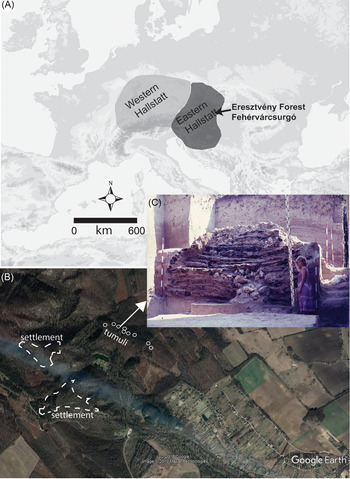
A field of tumuli in the Eresztvényi Forest near to Fehérvárcsurgó (Figure 1) has been known since the 19th century. Some of the grave mounds were disturbed by illegal excavations. Very likely the hill site of Kisvárhegy represents the settlement belonging to these burial mounds (Jungbert Reference Jungbert1991), which are separated from each other by the Gaja stream (Figure 1). Preliminary analysis of the archaeological discoveries from Fehérvárcsurgó show as being dated to the HC2 period (700–600 BC) an era with relative intense peopling of Transdanubia (Jungbert Reference Jungbert1991). At the final stage of the era, the whole region shows a sudden decrease in habitation, probably as a consequence of external attacks or partial abandon of the territory. Anyhow, the unbroken continuity of peopling in the final phase of the Hallstatt era is evident, but the intensity of documented findings is diverse in each region.
Location of the Iron Age site (Eresztvényi Forest, Fehérvárcsurgó, Hungary): (A) reconstructed geographical range of the Hallstatt culture; (B) location of the study site outline of the Iron Age hilltop settlement excavated south-west of the Gaja stream (dashed line) and location of grave tombs excavated to the east (white circles) of the Gaja stream on a satellite image (image source: Google Earth 2020); C: the excavated Tumulus No. 1. with the wooden grave structure.
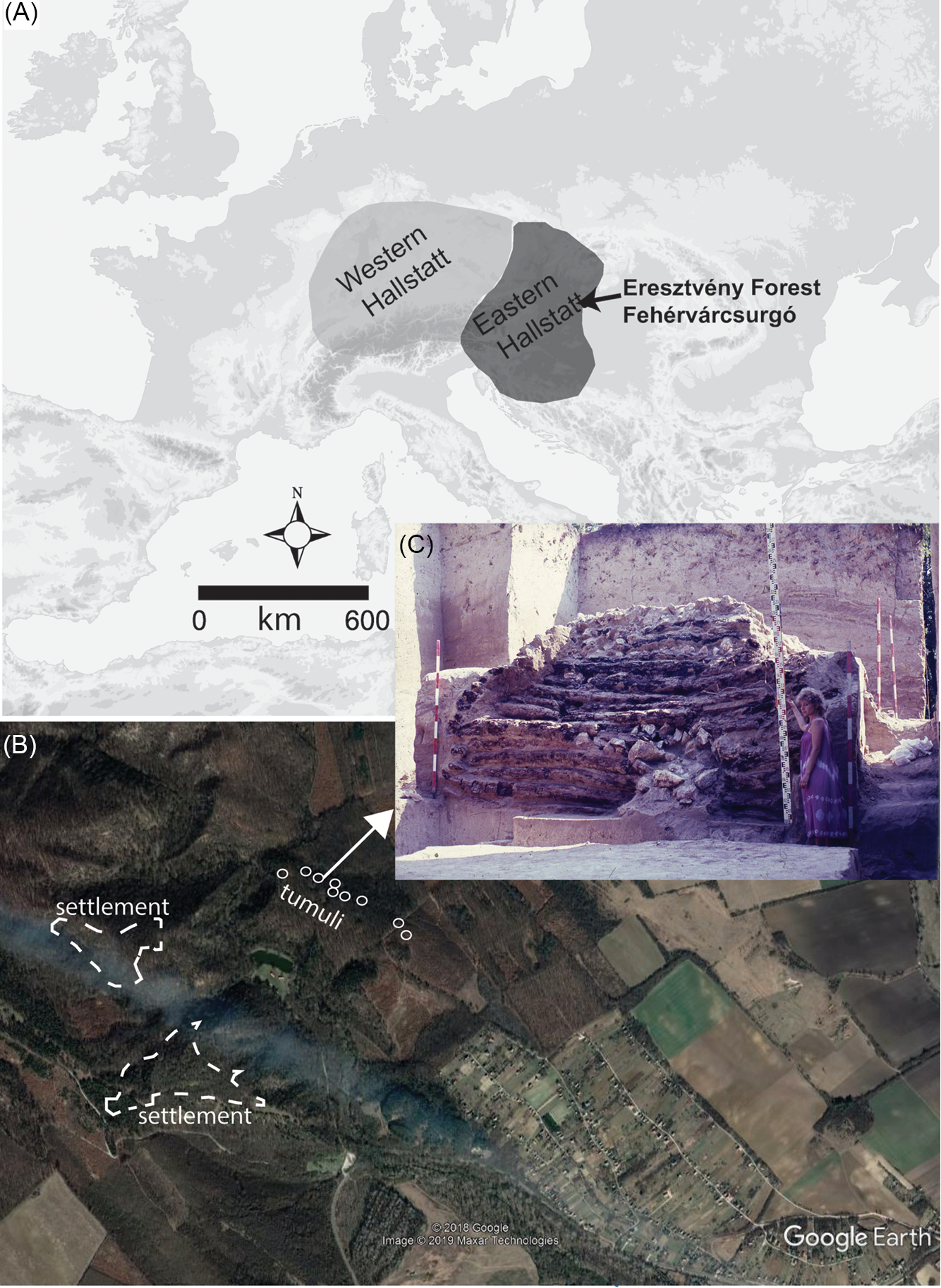
The archaeological excavation of two almost undisturbed tumuli (Nos. 1 and 4) and a third one in a large part disturbed grave (No. 3) took place between 1983 and 1986, in order to prevent further illegal digging (Kovács et al. Reference Kovács and Jungbert1984). The inner grave construction of Tumulus No. 1 was built from logs and covered with stones and earth. The well preserved wood structure of Tumulus No. 1 is quite rare across this region in the Hallstatt period (Makarová Reference Makarová2013). The significance of the site is further amplified by making possible to reconstitute basic funeral rite elements of the era (Jerem and Mester Reference Jerem and Mester2008).
As elements of the exclusive incinerating rite, the annexed funeral accessories were dispersed on the floor of the chamber, and the ashes deposed in urns. When terminating the burial construction of wood and stone was erected the tumulus itself of several meters high from local earth (Jungbert Reference Jungbert1991). The rich attachments, like specially decorated ritual and also common use pottery, iron axe and sword, bronze needles, pendants, harness and trappings, and a bronze bowl suggest that a distinguished warrior was buried in Tumulus No. 1. Tumulus No. 4 was much smaller. Its tomb was built entirely of stone and contained a relevant number of pots, lids, small bowls, cups and bronze beading. The significance of the site is further emphasized by the archaeobotanical material placed to the grave as sacrificial donations. A special finding was the beverage residue found in a ceramic pot from the Tumulus No. 1, which could be the earliest known wine residue in Central Europe (Gyulai Reference Gyulai2012).
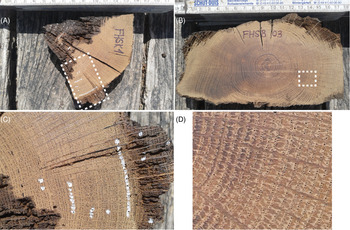
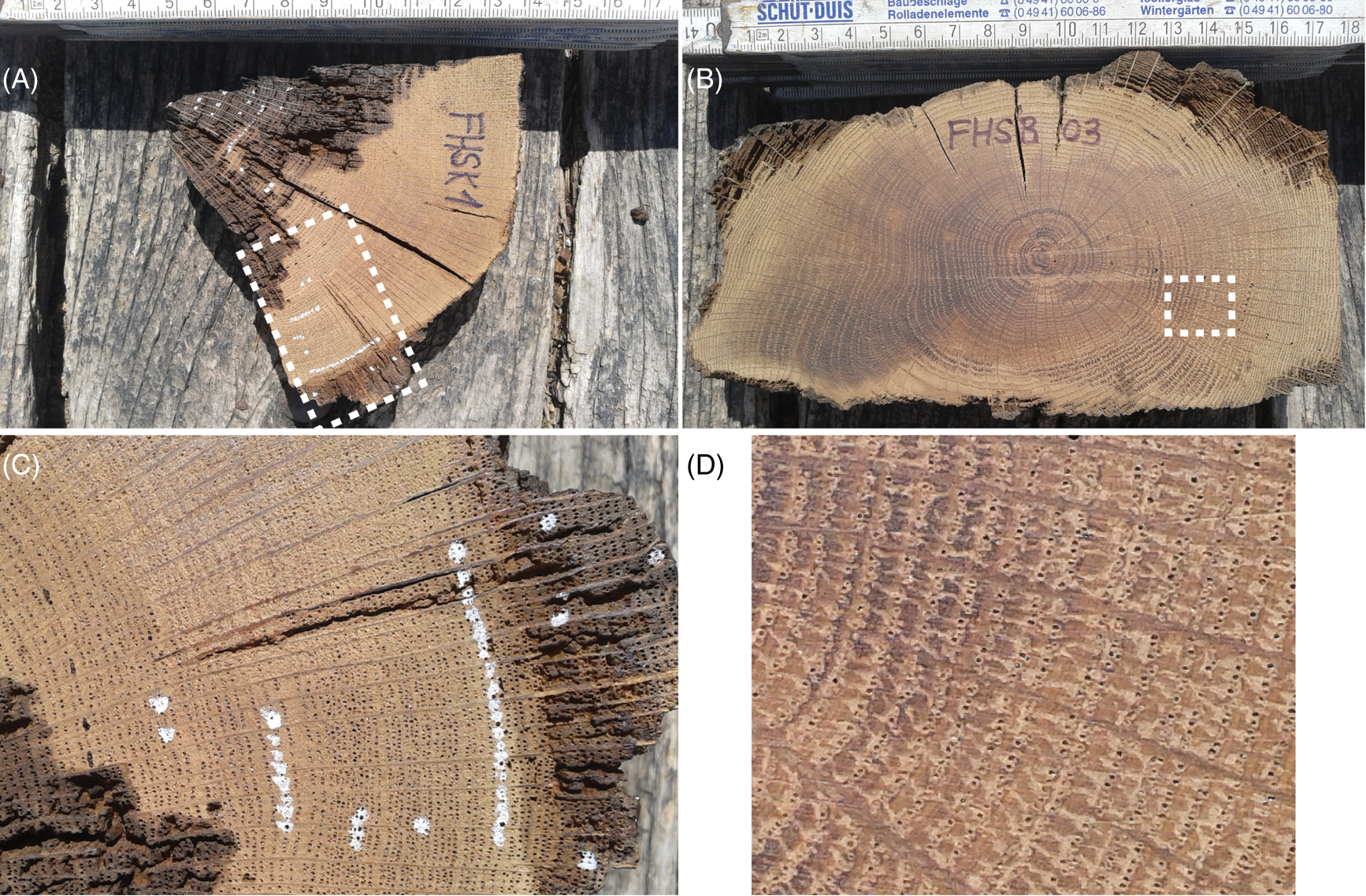
A large amount of wood was recovered from Tumulus No. 1 and a preliminary dendrochronological analysis has been performed already in the mid-1990s. Four wood panels were sampled, three of which came from the inside cover of the tomb and one from the outside structure of the tomb. According to a brief report ring width data sets of the oak samples from its inner cover could be synchronized (Grynaeus Reference Grynaeus1997). However, the dendroarchaeological investigation could only clarify the relative chronology of the samples and crucial details of the tree-ring analysis are not known from the available brief report published 25 years ago (Grynaeus Reference Grynaeus1997). In addition, since the research has halted, other scientific dating methods have not been used to improve the age determination of the site. To clarify these issues, the wood material conserved at the Szent István Király Museum (Székesfehérvár) was resampled in 2019 (Figure 2), and tree ring studies were supplemented with 14C dating. The main aim of the work is using a combination of these scientific dating methods to provide a numerical estimate of the age of the archaeological site/material, which will be an important information for the forthcoming publications assessing the archaeological remains from Fehérvárcsurgó, Eresztvényi Forest.
Examples of the polished transects of the dendroarchaeological samples from Tumulus No. 1 Eresztvényi Forest (Fehérvárcsurgó, Hungary). View of the entire cross section of a sample from the inner (A) and outer (B) wooden structure. Parts (C) and (D) are close-up views of the surface indicated by the dashed rectangle in the upper image.
MATERIAL AND METHODS
Tumulus No. 1 and the Dendroarchaeological Material
The excavation of the burial mound of Tumulus No. 1 found a double-walled chamber built in a blockhouse style. An inner log cabin construction was erected from finely finished timbers on all sides with corner joints, standing on the prehistoric ground level of the site and having a side length of about 3–3.5 m. The inner vertical chamber’s wall was 0.50–0.70 m high. In this box were ritually placed the burial objects and human and animal funerary ashes. Afterwards, the top of the chamber was horizontally covered by wooden planks. This inner chamber was surrounded by an outer log “cabin” with a side length of 4–4.5 m. This was built from unworked round logs with corner joints. The vertical log wall changed direction and shape after about 1 m forming a truncated pyramid-like shape with a ∼2 m2 opening on the top. The whole interior space between the two constructions was filled up with the remains of the funeral pyre, boulders and soil. As a last act, the mound was covered with layers of soil up to a total height of 4.5–5 m.
Former xylotomical evaluations on the archaeological wood remains identified Quercus petraea (Grynaeus Reference Grynaeus1997) and Quercus cerris (É. Petres, personal communication). Urea formaldehyde prepolymer (Conner Reference Conner1996) was used to conserve the dendroarchaeological material after excavation. This did not affect the dendrochronological examination of the samples at all but caused problems in 14C analyses in certain cases.
Dendrochronology
Five disk samples were collected from the preserved beams of Tumulus No. 1 and used for dendrochronological analysis. Three samples (FHSB01, FHSB02, FHSB03) and two samples (FHSK01, FHSK02) were originated from the inner and outer wooden structure, respectively. Surfaces of the sawn cross sections were sanded with successively finer wood abrasives to expose ring details to the cellular level (Stokes and Smiley Reference Stokes and Smiley1968). Measurements of the annual growth width, with 0.01 mm accuracy, was done using a LINTAB system and TSAP Win 4.68 software (Rinn Reference Rinn2005). Annual growth widths were measured at least along two radii in each sample and the series were synchronized and averaged. Visual and statistical methods were used to synchronize these individual mean curves. Standard dendrochronological statistics such as percentage of agreement (GLK%, Eckstein and Bauch Reference Eckstein and Bauch1969; Buras and Wilmking Reference Buras and Wilmking2015) and modified t value (tBP, Baillie and Pilcher Reference Baillie and Pilcher1973) were used to evaluate crossdating results.
Radiocarbon Analysis
Five small blocks, containing 4–7 annual increments, were detached from three disks with the best-preserved physical quality of the timber (Table 1). At the sample selection, the covered span was maximized in order to decrease the probable adverse effects in the wiggle matching results due to some small offset between the 14C levels to the calibration dataset over its duration (Galimberti et al. Reference Galimberti, Bronk Ramsey and Manning2004) however we had to consider the physical condition of the wood.
The results of the 14C analysis and modelled calendar date of the terminal ring of FHS-EIA; the Early Iron age floating oak ringwidth chronology of Tumulus No. 1 (Eresztvényi Forest, Fehérvárcsurgó, Hungary). The unmodelled age range shows the simple calibration, while the modelled one represents the estimated age obtained by wiggle-matching calibration. Calibrated ages are reported with 95.4% (2σ) probability. A: individual agreement percent of the OxCal wiggle-match model

a Individual laboratory code of the ICER Centre (Debrecen, ATOMKI) radiocarbon lab (Molnár et al. Reference Molnár, Rinyu, Janovics, Major and Veres2012).
b Calculated from the CO2 produced from the material retained after cellulose preparation.
As a first step the surface layer most affected by conservation chemicals was mechanically removed, and then subsamples were taken from the inner parts of the samples for 14C analysis. It should be noted that blocks FHSK01-a and FHSB03-a contained the cleaned surface and a few rings directly below it, while the others could be detached from deeper inside of the timber. The α-cellulose was separated (Molnár et al. Reference Molnár, Janovics, Major, Orsovszki and Jull2013a) and measured targets were prepared from the material remained after the cellulose separation using sealed-tube graphitization method (Rinyu et al. Reference Rinyu, Molnár, Major, Nagy, Veres, Kimák, Wacker and Synal2013). 14C analysis was performed at the ICER Centre (Debrecen, ATOMKI) using the EnvironMICADAS facility (Molnár et al. Reference Molnár, Rinyu, Veres, Seiler, Wacker and Synal2013b). The wiggle-matching technique was employed in the calibration of 14C results obtained from dendrochronologically cross-dated tree-ring sequences using the D_Sequence function of the OxCal v.4.4.2. program (Bronk Ramsey Reference Bronk Ramsey2009) in conjunction with the Northern Hemisphere IntCal20 dataset (Reimer et al. Reference Reimer, Austin, Bard, Bayliss and Bronk Ramsey2020).
RESULTS AND DISCUSSION
Based on the characteristic anatomical features of the timber, such as ring porous structure and wide rays (Figure 2C, D) the wood belongs to Quercus sp. (Schoch et al. Reference Schoch, Heller, Schweingruber and Kienast2004). This result agrees with previous xylotomy observations (Grynaeus Reference Grynaeus1997; É. Petres, personal communication). Although oaks are the main species today in the forest of the wider surroundings of Fehérvárcsurgó, they do not create monospecific stands, but are instead typically associated with other species (e.g., hornbeam, ash, elm), and it can be assumed that this was also the case in the Iron Age. The associated species have also been identified as well as the oaks in the timber assemblage of a contemporary wooden structures in Ukraine (Chochorowski et al. Reference Chochorowski, Krąpiec, Skoryj and Skrypkin2014). Other species were found beside oak also among the timber of the fortifications of the hillforts of Svržno and Štítary in western Bohemia dated to the Hallstatt period (Pokorný Reference Pokorný2004). However, exclusively oak species were identified in the timber material of cremation burials of another Transdanubian Iron Age tumuli site at Érd-Százhalombatta, too (Morgós et al. Reference Morgós, Holport, Lukács, Gelesz and Poroszlai2006). These suggest that people of the Northeast Pannonian group of the Eastern Hallstatt Culture selected the oaks for their burial construction and it can be assumed that the associated species could be used as firewood. The results of a detailed anthracological analyses of a burial ground used from the Neolithic until the Iron Age in northern Germany can support this assumption. The overall spectrum of wood species representing the typical species composition of mixed oak forests was found in the charcoal assemblage dated to the Iron Age, however, sorting the charcoal material according to the archeological context showed that only oak was used for grave constructions and the associated species were used as firewood (Jansen et al. Reference Jansen, Mischka and Nelle2013).
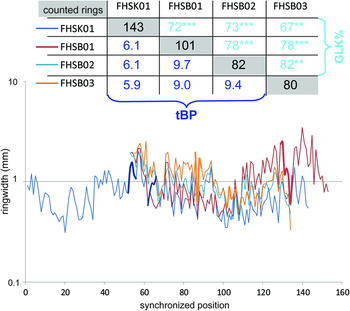
Counted rings in the samples ranged from 49 to 143. The tree-ring width sequences of the four longest records were successfully synchronized, defining a 153-yr-long floating chronology (Figure 3). The achieved mean ringwidth chronology is coded as FHS-EIA referring to the site code and the abbreviated period. The smaller sample from the outer cover (FHSK02) was the one whose annual ring width data could not be reliably synchronized. For this strongly degraded sample the annual ring widths could only be measured in three non-overlapping short sections (having fewer than 20 rings in each) and these short series could not be fitted to the patterns of the data sets of the longer records with a sufficient certainty, so these small fragments of the FHSK02 were not used in further evaluation. The excellent cross-dating statistics of the four longer records (Figure 3) suggest that the trees used for the construction lived very near to each other.
Synchronized tree-ring width series of four oak samples form Tumulus No. 1 of the Iron Age site (Eresztvényi Forest, Fehérvárcsurgó, Hungary). Sections plotted with thicker lines marks the sections removed for 14C analysis. Basic synchronization statistics are shown in the inset table. The lengths of the series are given with a gray background along the diagonal, whereas percentage of agreement (GLK%, Eckstein and Bauch Reference Eckstein and Bauch1969) and t BP (Baille and Pilcher Reference Baillie and Pilcher1973) are shown above and below the diagonal, respectively. The significance of the GLK% is marked as **: p<0.05; ***: p<0.001. Sample codes with FHSB and FHSK show samples taken from the inner and outer beam structure of the grave.

The carbon yield from FHSK01-a (65.4%, Table 1) was well above the maximum expectable carbon yield (44.4%) estimated from the molar mass of carbon (M Carbon = 12.01 g/mol) and the molar mass of cellulose (M cellulose = 162.14 g/mol) suggesting additional carbon contribution. The 14C age obtained from this sample was much older than the others most strikingly if compared to FHSK01-b which was removed from the same disk just ∼10 annual increments preceding the tree rings belonging to FHSK01-a (Table 1). The carbon yield of FHSB03-a was not as anomalous, though the second highest value in the set (Table 1), but the age was also older than the rest of the dataset and similarly in a contrast to the other dated increments of the same disk (FHSB03-b).
These two samples produced much older apparent 14C ages, compared to the others, contradicting with the robust dendrochronological synchronization results, and were detached from the vicinity of the resin-hardened original surface. The unexpectedly old 14C age likely points to a contamination from old carbon which can be originated from the residue from the synthetic resin used for conservation of the archaeological wood. Indeed, the significantly higher carbon yield seen for FHSK01-a and the accompanied strikingly older 14C age (Table 1) supports this explanation. However, the 14C ages obtained from the samples removed apart from the resin-treated surface (FHSK01-b, FHSB03-b, FHSB01) were consistent both with the expected archaeological period and the relative position of the corresponding tree-ring blocks. These samples were used in a wiggle-matching procedure to get a calibrated date for the floating oak chronology from this Early Iron Age grave construction (Table 1; Figure 4).
Visualization of the wiggle-matching modeling of the 14C ages obtained from the dendroarchaeological material building the floating oak chronology from Eresztvényi Forest (Fehérvárcsurgó, Hungary). Probability distribution of the single calibration (light gray) and wiggle matching modeling (dark gray) are shown.

The agreement index (A), which shows how the distributions obtained for the individual samples fit the model, is relatively low in one case (41.5%) but exceeds the critical level of 60% in the other cases (Table 1) and this is also true for the combined index calculated for the whole model (Acomb = 61%). The obtained calibrated age range of the last extant ring of FHS-EIA is 747–707 BC (Table 1). Sapwood was not observed on the samples; so assuming a minimum of 12 missing saprings, taking into account the usual range of sapwood rings determined for oaks younger than 150 years in modern forests of Hungary (17 +2/-5, Grynaeus Reference Grynaeus2002), the earliest possible felling dates of the trees used in Tumulus No. 1 was between 735 and 695 BC.
The archaeological relative chronology determination of Tumulus No.1 (HC2, Jungbert et al. Reference Jungbert1991) is in full accordance with the rating of similar archaeological discoveries in the area (e.g., Százhalombatta Holport et al. Reference Holport1999). However, the obtained chronological constrains on the probable range of the earliest possible felling date of the trees used for the construction of Tumulus No. 1 just marginally matches HC2 instead cover the preceding HC1 phase (Metzner-Nebelsick Reference Metzner-Nebelsick2017). Anyhow, this is a slight but remarkable discrepancy compared to the archaeological determination of the horizon of the tumuli of Eresztvény Forest (Jungbert et al. Reference Jungbert1991) and constituting an important starting point for further research and refinement in measurement, observation, and interpretation.
The 153-yr-old floating oak ringwidth chronology from Tumulus No.1 (FHS-EIA) was compared with oak ringwidth chronologies available from the corresponding period from the Czech lands (Kolár et al. Reference Kolář, Kyncl and Rybníček2012; Prokop et al. Reference Prokop, Kolář, Kyncl and Rybníček2017), Bavaria situated northwest of Transdanubia and from the subfossil driftwood of the Sava river (Pearson et al. Reference Pearson, Ważny, Kuniholm, Botić, Durman and Seufer2014) situating south from Transdanubia. However, no reliable synchronicity was found with these data (Michal Rybnicek, personal communication; Franz Herzig, personal communication; Charlotte Pearson, personal communication). Consequently, the achieved FHS-EIA will serve as a reference chronology for the (late Bronze Age) early Iron Age dendroarchaeological material of the Transdanubian region of the Eastern Hallstatt Culture which seems to be situating outside of the dendrozone of the above mentioned existing reference oak chronologies of East Central Europe. The most promising target for this endeavor is the rich dendroarcheological material of the above mentioned Iron Age tumuli near to Százhalombatta (Holport Reference Holport1999) because their conserved timber (Morgós et al. Reference Morgós, Holport, Lukács, Gelesz and Poroszlai2006) is still waiting for a systematic dendrochronological analysis.
CONCLUSIONS
A 153-yr-long ringwidth chronology, FHS-EIA, was established from four oak samples of an Early Iron Age burial mound excavated in the Eresztvényi Forest (Fehérvárcsurgó, Hungary). 14C ages, consistent with the dendrochronologically synchronized position of the analyzed tree rings agreed with the archaeological period identified based on the archaeological findings. The earliest possible felling date of the trees used in the construction could be between 735 and 695 BC based on the wiggle-matching calibration results and the sapwood correction. FHS-EIA is the first 14C-dated floating tree-ring width chronology from the Early Iron Age in Hungary which will be a valuable reference in future dendrochronological studies on wood samples from other archaeological sites along the eastern border of the Hallstatt Culture (e.g., Százhalombatta).
This result inevitably places the tumulus burials at Eresztvény Forest to a chronological context to evaluate their connection within the eastern Hallstatt culture and adjacent areas. The chronological constraints on the earliest possible felling date of the trees used in the Tumulus No.1 will apparently make possible a more precise determination of the findings from Fehérvárcsurgó, moreover they will allow a comprehensive and accurate reconsidered phase of the Early Iron age chronological horizon in Transdanubia. The independent confirmation of the archeological age classification, beside the exact dating of the archeological site, will be crucial also for the exploration of environmental historical evaluation of the plant macro-remains, food and beverage residues excavated in Eresztvény Forest.
ACKNOWLEDGMENTS
The research was supported by the European Union and the State of Hungary, co-financed by the European Regional Development Fund in the project of GINOP-2.3.2.-15-2016-00009 “ICER” and LP2012-27/2012. This is contribution No. 76. of 2 ka Palæoclimatology Research Group and and No. 34 of the Budapest Tree-Ring Laboratory.