Obesity and type 2 diabetes are common, multifactorial conditions for which susceptibility is determined by the joint actions of genetic and environmental factors. The prevalence of obesity and type 2 diabetes is increasing worldwide at an alarming rate, and both traits are associated with increased morbidity and mortality (Refs Reference Flegal1, Reference Ogden2, Reference Jee3, Reference Narayan4). By current estimates, nearly 70% of adults in the USA and more than 60% in the UK are overweight; half of these are obese (Ref. 5). The dramatic increase in the prevalence of obesity and type 2 diabetes over the past two decades is most likely due to changes in diet and physical activity (Ref. Reference Hill6). However, it is well recognised that hereditary influences also contribute significantly to the susceptibility to obesity and diabetes.
The genetic contribution to obesity and diabetes has been established through family, twin and adoption studies (Refs Reference Maes, Neale and Eaves7, Reference Stunkard, Foch and Hrubec8, Reference Stunkard9, Reference Permutt, Wasson and Cox10). Twin studies have shown that genetic factors explain 40–80% of the variance in body mass index (BMI) and in risk of obesity (Refs Reference Allison11, Reference Herskind12), while lower heritabilities have been reported for family (20–50%) (Refs Reference Luke13, Reference Rice14) and adoption (20–60%) (Ref. Reference Stunkard9) studies. The higher concordance of type 2 diabetes in monozygotic twins (50–70%) compared with dizygotic twins (20–37%) provides evidence of a genetic contribution to this condition (Refs Reference Kaprio15, Reference Newman16, Reference Poulsen17). Further evidence of a genetic component comes from studies on family history of type 2 diabetes. While the lifetime risk of developing type 2 diabetes is 7% in the general population, this risk is four- to sixfold higher (30–40%) in individuals who had one parent with type 2 diabetes and tenfold (70%) if both parents had diabetes (Ref. Reference Köbberling, Tillil, Köbberling and Tattersall18).
Despite intensive efforts to identify genetic variants predisposing to obesity and type 2 diabetes using a candidate gene approach and genome-wide linkage studies, progress until recently has been slow and success limited. However, the availability of genome-wide association studies through the advancements of the International HapMap Project and the Human Genome Project and through high-throughput genotyping has accelerated the potential to identify genetic variants influencing common traits and diseases.
This review discusses recent advances in the field of genetics of common obesity and diabetes with an emphasis on established loci identified through candidate gene and genome-wide approaches. We address how lifestyle factors such as diet and physical activity can influence the genetic susceptibility to obesity and diabetes. Finally, we discuss the impact of validated obesity and diabetes loci on public health and insights from the novel loci on pathophysiology, and conclude with various approaches that may lead to the discovery of more susceptibility loci.
Common obesity
Candidate gene studies
The number of candidate gene association studies (Box 1) has grown exponentially over the past 15 years. The latest update of the Human Obesity Gene Map reports 127 candidate genes associated with obesity traits as of October 2005 (Ref. Reference Rankinen19). These genes were chosen as candidates based on their role in metabolic pathways and on evidence from animal studies, monogenic forms of obesity and genetic association studies (Ref. Reference Rankinen19). However, findings for 12 genes alone were replicated in ten or more studies: ADIPOQ (adiponectin), ADRB2 (adrenergic β2 receptor), ADRB3 (adrenergic β3 receptor), GNB3 [guanine-nucleotide-binding protein (G protein), β polypeptide 3], HTR2C [5-hydroxytryptamine (serotonin) receptor 2C], NR3C1 (nuclear receptor subfamily 3, group C, member 1), LEP (leptin), LEPR (leptin receptor), PPARG (peroxisome proliferator-activated receptor γ), and UCP1, UCP2 and UCP3 (uncoupling proteins 1, 2 and 3) (Ref. Reference Rankinen19). Despite this substantial number of replications, many other studies have shown no or even opposite association, and thus the overall conclusion for most of these genes remains ambiguous.
Box 1. Candidate gene approach
The candidate gene approach, used since the early 1990s, is a hypothesis-driven approach that relies on current understanding of the biology and pathophysiology of the disease. Candidate genes are generally genes with a known or presumed biological function directly or indirectly regulating the development of the trait under study. The candidacy of a gene for obesity and diabetes is based on the following sources: animal models using gene knockout and transgenic approaches; cellular model systems showing their role in metabolic pathways involved in glucose metabolism; and linkage and positional cloning studies using extreme cases (e.g. patients with morbid obesity or severe insulin resistance) and their families. The concept of this approach is to find an association between a variant within or near the candidate gene and a trait of interest (such as obesity/diabetes). Candidate gene studies need to be on a large-scale (such as meta-analysis) and well powered for detecting the expected small effects of genetic variants involved in common traits and diseases (Ref. Reference Tabor, Risch and Myers118).
The limited success of the candidate gene approach can mainly be ascribed to small sample sizes that are insufficiently powered to identify the modest effects that are expected for common obesity. However, recent years have seen an increase in the number of studies that have tested for associations in larger populations and more often the initiative has been taken to meta-analyse all available published (and unpublished) results. Such large-scale studies have shown robust associations with obesity and related traits for variants in the MC4R (melanocortin 4 receptor), ADRB3, PCSK1 (prohormone convertase 1/3), BDNF (brain-derived neurotrophic factor) and CNR1 (endocannabinoid receptor 1) genes.
Melanocortin 4 receptor gene
MC4R plays an important role in the regulation of food intake and energy homeostasis (Ref. Reference Huszar20). Nearly 5% of severely obese children carry pathogenic mutations in the MC4R gene (Ref. Reference Farooqi21). However, its role as a susceptibility gene for common obesity was unclear until large-scale studies more firmly established its contribution. Two common MC4R variants (V103I and I251L), which result in a nonsynonymous change with potential functional implications (Ref. Reference Xiang22), have been studied most frequently. Yet, only one large-scale population-based study (N = 7937) showed a significant protective effect of the I103 allele (frequency: ~3.6%) on obesity risk (Ref. Reference Heid23). Subsequently, three large-scale meta-analyses confirmed that carriers of the I103 allele have a 20% lower risk of obesity than V103V homozygotes (Refs Reference Geller24, Reference Young25, Reference Stutzmann26). In addition, a meta-analysis of data on the I251L MC4R variant provided strong evidence for a protective effect, with a nearly 50% reduced risk of obesity for carriers of the L251 allele (frequency: 0.41–1.21%) (Ref. Reference Stutzmann26).
Adrenergic β3 receptor gene
ADRB3 is a strong candidate for obesity given its involvement in the regulation of lipolysis and thermogenesis. The W64R ADRB3 variant was one of the first genetic variants for which association with obesity was reported (Refs Reference Clement27, Reference Widen28, Reference Walston29). In vitro experiments in rodent and human cell lines showed that the variant (R64) form of ADRB3 had a reduced ability to stimulate adenylate cyclase activity compared with wild-type (W64) ADRB3 (Ref. Reference Pietri-Rouxel30). Also, lipolysis in human adipocytes was lower in cells with the R64 variant compared with cells with wild-type ADRB3 (Ref. Reference Umekawa31). Many studies that followed the initial publications and aimed to replicate the association between the W64R polymorphism and BMI reported inconsistent conclusions. Subsequently, a meta- analysis combining data of 44 833 individuals found significant association of the W64R variant with BMI in East Asians, with carriers of the R64 allele (frequency: ~7.5%) having a 0.24 kg/m2 higher BMI compared with noncarriers (Ref. Reference Kurokawa32). However, no association was observed in Caucasians.
Prohormone convertase 1/3 gene
The PCSK1 gene encodes a neuroendocrine convertase that converts prohormones into hormones involved in energy metabolism regulation. Rare PCSK1 mutations have been found to cause monogenic obesity (Ref. Reference Jackson33). A large-scale study of 13 659 individuals of European ancestry established a role for PCSK1 variants in common obesity as two common PCSK1 nonsynonymous variants – N221D (located in the catalytic domain of prohormone convertase 1/3) and the Q665E–S690T pair – were consistently associated with obesity risk in adults and children (Ref. Reference Benzinou34). Each additional minor allele (frequency: 4–7%) of the N221D variant increased the risk of obesity 1.34-fold, while each additional minor allele (frequency: 25–30%) of the Q665E–S690T pair increased the risk 1.22-fold. Functional characterisation of these variants showed a significant impairment of the N221D-mutant PC1/3 protein catalytic activity, but no functional role for the Q665E–S690T amino acid substitutions.
Brain-derived neurotrophic factor gene
Studies in mice have demonstrated that BDNF is involved in eating behaviour, body weight regulation and hyperactivity (Refs Reference Kernie, Liebl and Parada35, Reference Rios36). Rare BDNF mutations have been shown to cause severe obesity and hyperphagia (Ref. Reference Gray37). A large-scale study, comprising a population-based sample of 10 109 women, showed that individuals homozygous for the M66 allele (frequency: ~20%) of the V66M variant have a significantly lower BMI (−0.76 kg/m2) than carriers of the V66 allele (Ref. Reference Shugart38). In addition, genome-wide association studies have confirmed the association of the BDNF variant with BMI (Ref. Reference Thorleifsson39).
Endocannabinoid receptor 1 gene
CNR1 has been implicated in human obesity because of its physiological role in the regulation of energy metabolism and food intake. A study on 5750 individuals showed that the CNR1 variant rs806381 (frequency: ~33%), increased the risk of obesity in European children [odds ratio (OR) = 1.39, P = 3 × 10⁻⁵] and adults (OR = 1.31, P = 6 × 10⁻⁴) (Ref. Reference Benzinou40).
Other large-scale studies
A few well-powered large-scale studies have also shown that certain associations are truly negative. The ENPP1 (ectoenzyme nucleotide pyrophosphate/phosphodiesterase) variant K121Q (frequency: ~13.5–16.1%) was investigated for its role in the development of obesity in four studies with each more than 5000 participants, with a combined sample size of 27 781 individuals, but no association with obesity-related traits was found (Refs Reference Meyre41, Reference Weedon42, Reference Lyon43, Reference Grarup44). Likewise, the association between the –174G>C IL6 (interleukin 6) variant and obesity was questioned by a meta-analysis combining data from 25 populations (N = 26 944), but again no association with obesity risk was observed, despite the large sample size (Ref. Reference Qi45). In a large meta-analysis, the E27Q and the R16G polymorphisms of the ADRB2 gene were examined for their association with obesity in 10 404 and 4328 individuals, respectively (Ref. Reference Jalba, Rhoads and Demissie46). The E27 allele was found to be a significant risk factor for obesity in Asians, Pacific Islanders and American Indians (frequency: 6–20%), but not in Europeans (frequency: 44–78%). However, the R16 allele (frequency: ~51–85%) was not associated with obesity in any of the different ethnic populations. Although it might be too early to completely rule out the involvement of ENPP1, IL6 and ADRB2 in obesity, it would take more and even larger studies and meta-analyses to reverse current observations. For other candidate genes reported in the Human Obesity Gene Map (Ref. Reference Rankinen19), further studies will be required to confirm or refute their role in obesity susceptibility.
In summary, the past 15 years of candidate gene studies have started to succeed only recently. By means of large-scale studies and meta-analyses, at least five variants in four candidate genes have been found to be robustly associated with obesity traits.
Genome-wide linkage studies
Results of the first genome-wide linkage scan (Box 2) on body fat percentage were published in 1997 (Ref. Reference Norman47). Since then, the number of studies and quantitative trait loci (QTLs) have grown exponentially. The latest Human Obesity Gene map (Ref. Reference Rankinen19) reported more than 250 QTLs distributed across the genome from more than 60 genome-wide linkage scans, of which 15 QTLs have been replicated in at least three studies. Nevertheless, none of these loci could be fine-mapped sufficiently to pinpoint the variants that likely underlie the linkage signal. A meta-analysis of 37 genome-wide linkage studies with data on more than 31 000 individuals from 10 000 families of European origin was unable to locate a single obesity locus with convincing evidence, despite sufficient power to identify small effects (Ref. Reference Saunders48). So far, genome-wide linkage has not been a successful approach to identify loci for common obesity.
Box 2. Genome-wide approaches
Genome-wide approaches are hypothesis-generating and screen the whole genome with the aim of identifying new, unanticipated genetic variants associated with the complex traits or diseases such as obesity and diabetes.
Genome-wide linkage approach
The genome-wide linkage approach, used since the mid-1990s, requires no knowledge and/or judgement of the ‘biologically plausible’ genetic candidates and tests whether certain chromosomal regions across the genome cosegregate with a trait or disease of interest from one generation to the next. It requires populations of related individuals such as siblings, nuclear families, or extended pedigrees, and this limits it from achieving large sample sizes. Genome-wide linkage can only identify broad chromosomal regions that harbour hundreds of genes and it is often impossible to pinpoint which variant is causing the linkage with the disease (Ref. Reference Norman47).
Genome-wide association approach
The genome-wide association approach, which was initiated in 2005, also examines the entire genome with no prior assumptions and aims to identify previously unsuspected genetic loci associated with a disease or trait of interest. It does not rely on familial relatedness and can therefore achieve larger sample sizes than typical family-based linkage studies. This approach screens the whole genome at higher resolution levels than genome-wide linkage studies and thus is able to narrow down the associated locus more accurately (Refs Reference Frayling119, Reference McCarthy and Zeggini120). Two major advances have set the stage for genome-wide association studies: (1) the recent advancements in the International HapMap Project (Ref. 121) and the completion of the Human Genome Project; and (2) the substantial progress in high-throughput genotyping, which has made it possible to genotype more than one million genetic variants in a single analysis. Together, these breakthroughs have enabled production of single-nucleotide polymorphism (SNP) chips that can capture more than 80% of the common genetic variation reported in the HapMap (Ref. Reference Magi122).
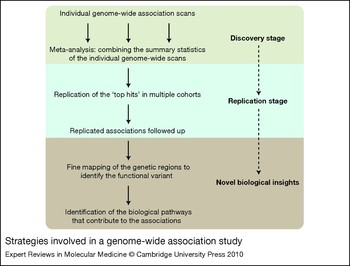
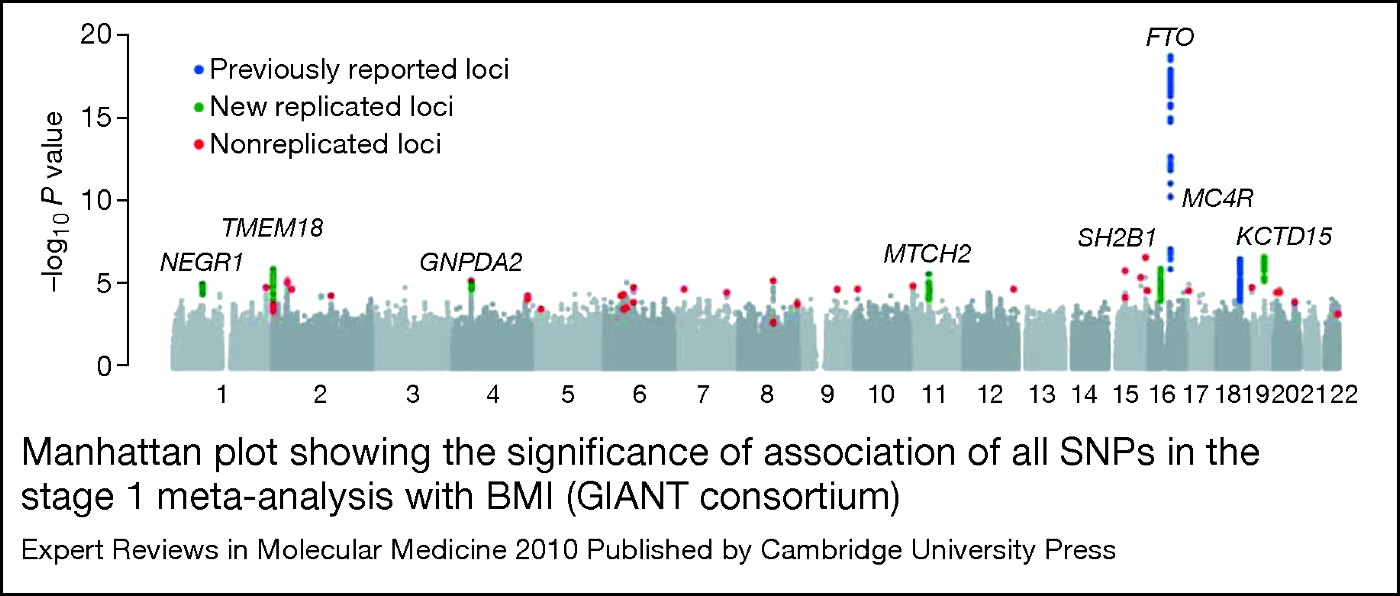
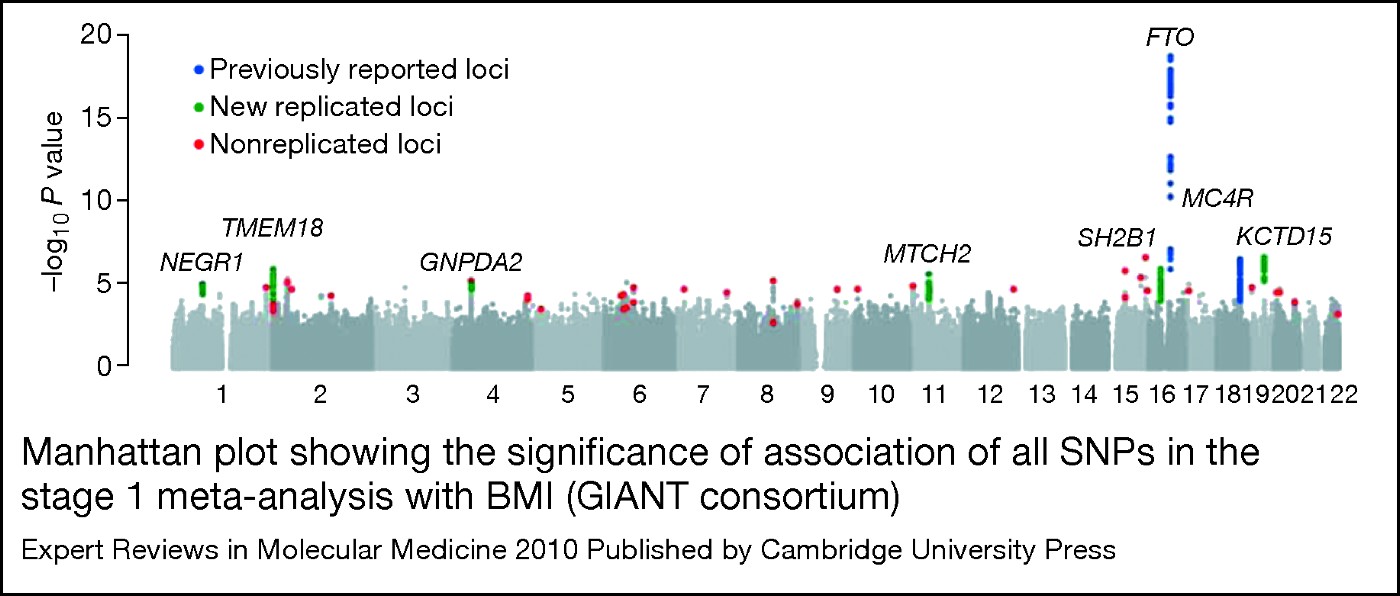
Genome-wide association studies typically comprise two or more stages: a discovery stage, followed by at least one replication stage. The discovery stage involves high-density genotyping of hundreds of thousands of genetic variants across the genome. Each variant is tested for association with a trait or disease of interest and results are often summarised in a Manhattan plot (Fig. 2). Studies with large sample sizes at this stage tend to be more successful as they are better powered to identify associations of small effect size. Although initial genome-wide association studies used more liberal P-values for significance threshold, the currently accepted genome-wide significance threshold is P < 5.0 × 10⁻⁸ (Ref. Reference de Bakker123). Associations that meet this genome-wide significance threshold are taken forward for replication to validate the initial observation in the replication stage. Only variants of loci for which the association observed at the discovery stage is confirmed at the replication stage are considered ‘true hits’. Moreover, replication is more important than the discovery significance threshold, and if replicated in multiple cohorts it is still a valid finding.
Genome-wide association studies
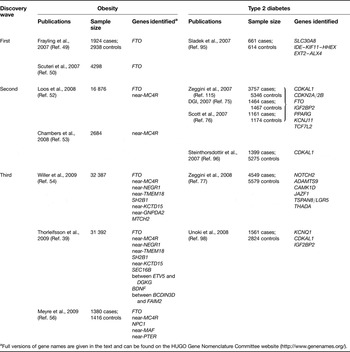
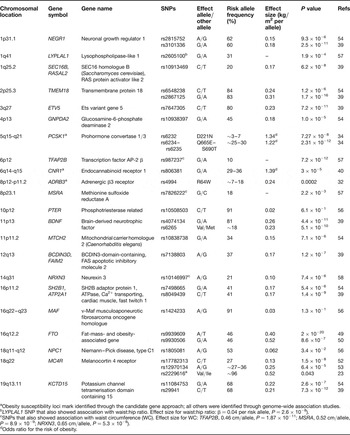
The genome-wide linkage approach has now been replaced by genome-wide association as the hypothesis-generating approach for common diseases (Fig. 1). This is because the latter has become more cost effective, has much greater resolution, and does not require related individuals (whose recruitment is often a laborious task that limits sample size and thus power). So far, three waves of large-scale high-density genome-wide association scans (Box 2) have already led to a series of discoveries in the field of obesity genetics (Table 1).
Strategies involved in a genome-wide association study. Genome-wide association studies comprise two or more stages: a discovery stage, followed by at least one replication stage. The discovery stage involves high-density genotyping of hundreds of thousands of genetic variants across the genome; each variant is tested for association with a trait of interest and results are often summarised. Associations that meet the genome-wide significance threshold are taken forward for replication to validate the initial observation in the replication stage. Only variants of loci for which the association observed at the discovery stage is confirmed at the replication stage are considered ‘true hits’. These ‘true hits’ are further followed up in molecular and physiological studies to determine the mechanisms through which these loci confer the disease susceptibility.

Three waves of discoveries through large-scale high-density genome-wide association studies for obesity and type 2 diabetes

aFull versions of gene names are given in the text and can be found on the HUGO Gene Nomenclature Committee website (http://www.genenames.org/).
First wave
The first wave, in 2007, comprised two high-density genome-wide association studies. Each confirmed FTO (fat-mass- and obesity-associated gene) as the first gene incontrovertibly associated with common obesity and related traits. The first study was a genome-wide association scan for type 2 diabetes in which variants in the first intron of the FTO gene showed a highly significant association with type 2 diabetes mediated through BMI (Ref. Reference Frayling49). Subsequently, the association with BMI and obesity was unequivocally replicated in 13 cohorts comprising more than 38 000 individuals. The second study (Ref. Reference Scuteri50) was the first large-scale high-density genome-wide association study of BMI, conducted in more than 4000 Sardinians. In the initial analyses, variants in the FTO and PFKP (platelet-type phosphofructokinase) genes showed the strongest association, but only those in FTO were significantly replicated in European Americans and Hispanic Americans. A third study published at the same time as the first two studies identified FTO while testing for population stratification (Ref. Reference Dina51). Each risk allele increased BMI by 0.10–0.13 standard deviation (equivalent to about 0.40–0.66 kg/m2) and the risks increased by 1.18-fold and 1.32-fold for overweight and obesity, respectively. Taken together, homozygotes for the risk allele weighed about 3 kg more and had a 1.67-fold increased risk for obesity than those who did not inherit a risk allele (Refs Reference Frayling49, Reference Scuteri50). The frequency of the FTO risk genotypes is high in populations of European descent; 63% carry at least one risk allele and 16% are homozygous. Although the population attributable risk for overweight (~13%) and obesity (~20%) is high, the FTO locus explains only <1% of the variation in BMI (Ref. Reference Frayling49).
Second wave
As part of the second wave of discoveries, individual genome-wide association studies were combined through collaborative efforts in order to increase sample size and thus power to identify more common variants with small effects. The GIANT (Genomic Investigation of Anthropometric Traits) consortium is such an international collaborative initiative that brings together research groups focusing on anthropometric traits from across Europe and the USA. Data from seven genome-wide association scans for BMI (N = 16 876) were combined in their first meta-analysis (Ref. Reference Loos52). Despite a quadrupling increase in sample size compared with the first wave, only FTO and one new locus [188 kb downstream of MC4R (‘near-MC4R’)], out of ten loci that were taken forward for replication, were unequivocally confirmed. The near-MC4R locus was identified in another study in 2684 Asian Indians, and confirmed in 11 955 individuals of Asian Indian and European ancestry (Ref. Reference Chambers53). The effect size was the same in both ethnic groups but the frequency of the risk allele in Asian Indians (36%) was greater than in white Europeans (27%), which might explain why this locus could be identified with a relatively small sample of Asian Indians in the discovery stage.
Third wave
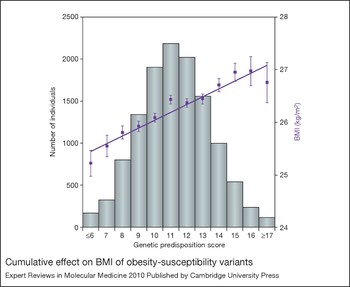
In the third wave of discoveries, the sample size was increased to 32 387 adults of European ancestry from 15 cohorts (GIANT consortium) (Ref. Reference Willer54) (Fig. 2). Of the 35 loci identified in the first stage of the genome-wide scan, eight loci were firmly replicated in an independent series of 59 082 individuals. These include the previously established FTO and near-MC4R loci and six new loci: near-NEGR1 (neuronal growth regulator 1), near-TMEM18 (transmembrane protein 18), in SH2B1 (SH2B adaptor protein 1), near-KCTD15 (potassium channel tetramerisation domain containing 15), near-GNPDA2 (glucosamine-6-phosphate deaminase 2), and in MTCH2 (mitochondrial carrier homologue 2). In parallel to these analyses, deCODE Genetics performed a meta-analysis of four genome-wide association studies for BMI, including 34 416 individuals comprising Europeans and African Americans (Ref. Reference Thorleifsson39). A total of 43 single-nucleotide polymorphisms (SNPs) in 19 chromosomal regions were taken forward for replication in 5586 Danish individuals and for confirmation in discovery stage data of the GIANT consortium. Besides the FTO and near-MC4R loci, eight additional loci reached genome-wide significance. Of these, four loci (near-NEGR1, near-TMEM18, in SH2B1, near-KCTD15) had also been identified by the GIANT consortium, whereas four loci were novel: SEC16B (SEC16 homologue B), between ETV5 (Ets variant gene 5) and DGKG (diacylglycerol kinase), in BDNF, and between BCDIN3D (BCDIN3-domain-containing) and FAIM2 (FAS apoptotic inhibitory molecule 2). Variation in BAT2 (HLA-B-associated transcript 2) was associated with weight, but not BMI, suggesting that this locus might contribute to overall size rather than adiposity. A recent study that genotyped the 12 obesity-susceptibility variants identified by the GIANT consortium and deCODE Genetics group in 20 431 individuals of a population-based study of white Europeans showed that these loci had a cumulative effect on BMI, with each additional risk-allele increasing BMI by 0.149 units, or weight by 444 g (Ref. Reference Li55) (Fig. 3). Nevertheless, together these 12 obesity-susceptibility loci explained less than 1% of the variation in BMI and had only limited predictive value of obesity.
Manhattan plot showing the significance of association of all SNPs in the stage 1 meta-analysis with BMI (GIANT consortium). Single-nucleotide polymorphisms (SNPs) are plotted on the x-axis according to their position on each chromosome, and association with body mass index (BMI) is indicated on the y-axis (as –log10P value). SNPs previously reported to show association with BMI are shown in blue, signals examined but not confirmed in stage 2 samples are shown in red, and the six new regions described in this article are highlighted in green. Adapted from Ref. Reference Willer54, with permission from Macmillan Publishers Ltd: Nature Genetics © 2009 (http://www.nature.com/ng/index.html).
Cumulative effect on BMI of obesity-susceptibility variants. The distribution of the genetic predisposition score and cumulative effects of the risk alleles from the 12 variants on body mass index [BMI; mean (± SE) values] are shown (N = 12 201). Each additional risk allele is associated with an increase in 0.149 BMI units, or 444 g in weight. Adapted from Ref. Reference Li55, with permission from the American Society for Nutrition (© 2010 American Society for Clinical Nutrition).

While the studies by the GIANT consortium and deCODE Genetics focused on BMI as the main outcome, genome-wide association studies exploring the association with other obesity-related traits have successfully led to the discovery of seven additional loci. One study examined association with the risk of early-onset and morbid adult obesity in 1380 cases and 1416 controls (Ref. Reference Meyre56). Of the 38 loci showing association, three new loci – NPC1 (Niemann–Pick disease, type C1), near-MAF (v-Maf musculoaponeurotic fibrosarcoma oncogene homologue) and near-PTER (phosphotriesterase related) – in addition to FTO and near-MC4R were identified and firmly replicated in 14 186 adults and children. A study involving a meta-analysis of 16 genome-wide association studies (N = 38 580) from the GIANT consortium and a follow-up in 70 689 individuals for adult waist circumference and waist:hip ratio discovered two novel loci – TFAP2B (transcription factor AP-2 β) and MSRA (methionine sulfoxide reductase A) – associated with waist circumference and one locus – LYPLAL1 (lysophospholipase-like 1) – associated with waist:hip ratio only in women (Ref. Reference Lindgren57). Another two-stage genome-wide association analysis for waist circumference (Ref. Reference Heard-Costa58) from the CHARGE (Cohorts for Heart and Aging Research in Genomic Epidemiology) consortium identified a novel locus – NRXN3 (neurexin 3) – in addition to FTO and MC4R based on 31 373 individuals of Caucasian descent from eight cohort studies in the stage 1 and 38 641 individuals in the stage 2 analysis.
The discovery of these loci has initiated a series of experiments to explore the pathophysiological mechanisms and pathways that underlie obesity development, in particular for the FTO gene. FTO encodes a Fe(II)- and 2-oxoglutarate-dependent oxygenase putatively involved in DNA demethylation (Refs Reference Gerken59, Reference Sanchez-Pulido and Andrade-Navarro60). Studies in rodents indicated that Fto mRNA is most abundant in the hypothalamic nuclei, which govern energy balance (Ref. Reference Fredriksson61). Another study has shown that loss of Fto in mice leads to a significant reduction in adipose tissue and lean body mass, which was found to develop as a consequence of increased energy expenditure despite decreased spontaneous locomotor activity and relative hyperphagia (Ref. Reference Fischer62). The FTO protein shows wide expression patterns in peripheral as well as central tissues with a high expression in the brain (Refs Reference Gerken59, Reference Fredriksson61, Reference Stratigopoulos63). A study in healthy women demonstrated that FTO mRNA in adipose tissue increases with BMI, and carriers of the risk allele had reduced lipolytic activity, independent of BMI (Ref. Reference Wahlen, Sjolin and Hoffstedt64). For other loci, except SH2B1 (Ref. Reference Ren65), BDNF (Ref. Reference Nakagawa66) and MC4R (Ref. Reference Farooqi21), the physiological role in relation to obesity risk is not or poorly understood.
In summary, the three waves of high-density multistage genome-wide association scans have so far identified 19 novel loci convincingly associated with obesity traits (Table 2), hence proving this approach more productive than any of the other gene-discovery methods previously used for common traits. To date, of all identified loci, the genetic variation in FTO has still the largest effect on obesity susceptibility.
Obesity-susceptibility loci identified through candidate gene and genome-wide association studies

aObesity susceptibility loci mark identified through the candidate gene approach; all others were identified through genome-wide association studies.
bLYPLAL1 SNP that also showed association with waist:hip ratio. Effect size for waist:hip ratio: β = 0.04 per risk allele, P = 2.6 × 10⁻⁸).
cSNPs that also showed association with waist circumference (WC). Effect size for WC: TFAP2B, 0.46 cm/allele, P = 1.87 × 10⁻¹¹; MSRA, 0.52 cm/allele, P = 8.9 × 10⁻⁹; NRXN3, 0.65 cm/allele, P = 5.3 × 10⁻⁸).
dOdds ratio for the risk of obesity.
Obesity-susceptibility loci and risk of type 2 diabetes
As indicated above, the FTO locus was first identified through a genome-wide association study for type 2 diabetes (Ref. Reference Frayling49). However, after adjusting for BMI, the association between FTO and type 2 diabetes was completely abolished, suggesting that BMI mediated the association and that there was no residual contribution of the FTO locus to the risk of type 2 diabetes. Of the recently identified obesity-susceptibility loci, the TMEM18, GNPDA2, NEGR1, ETV5–DGKG and BCDIN3D–FAIM2 loci also showed some evidence of association with type 2 diabetes (Refs Reference Thorleifsson39, Reference Willer54, Reference Lindgren57). Consistent with the observation for the FTO locus, the associations between these obesity-susceptibility loci and type 2 diabetes seemed to be mediated through their association with BMI (Ref. Reference Thorleifsson39), except for the BCDIN3D–FAIM2 locus. In the latter case, the association remained significant even after adjusting for BMI, suggesting that this locus might have independent effects on the risk of obesity and type 2 diabetes (Ref. Reference Thorleifsson39).
The absence of association between the other established obesity-susceptibility variants and type 2 diabetes could be due to the small effect sizes on BMI and obesity such that power is insufficient to observe association with obesity-related traits and diseases. Alternatively, the lack of association might be due to the underlying biology – that is, these loci may be obesity-specific without further implications on health and thus predispose to a ‘healthy obese’ subpopulation. However, larger studies will be required to provide sufficient power to disentangle this triangular relationship between loci, obesity and type 2 diabetes risk.
Type 2 diabetes
Candidate gene studies
Candidate genes for type 2 diabetes are chosen based on their role in monogenic forms of diabetes, pancreatic β-cell function, insulin action and glucose metabolism, or other metabolic conditions that increase risk of type 2 diabetes. So far, more than 60 candidate genes for type 2 diabetes have been studied in various populations worldwide (Refs Reference Barroso67, Reference Gaulton68). However, most of the studies have lacked thoroughness and sensitivity, as they had typically poor coverage of genetic variations in a gene and were often performed in small samples, resulting in lack of replication of the weak associations detected. In this part of the review, we focus on the candidate genes for which the results are most convincing and the sample sizes are large. These genes include PPARG, KCNJ11 (potassium inwardly rectifying channel, subfamily J, member 11), WFS1 (Wolfram syndrome 1), HNF1B (HNF1 homeobox B) and IRS1 (insulin receptor substrate 1).
Peroxisome proliferator-activated receptor γ gene
The PPARG gene is a strong candidate for type 2 diabetes because the nuclear receptor it encodes is a molecular target for thiazolidinedione compounds, which are a class of insulin-sensitising drugs used in the treatment of type 2 diabetes. A P12A change in PPARG was the first genetic variant to be convincingly implicated in type 2 diabetes. A study in a Finnish population and a second-generation Japanese cohort (Ref. Reference Deeb69) showed that homozygotes for the P12 allele had a 4.35-times higher risk for developing type 2 diabetes compared with those who do not carry this allele (P = 0.028). Subsequent small studies were not able to replicate this initial finding. However, a meta-analysis combining the results from 16 studies published before 2000 confirmed the association of P12A variant (frequency: 15%) with type 2 diabetes (Ref. Reference Altshuler70). Another meta-analysis combining data from 57 studies (N = 32 000) further confirmed the association of P12A with greater insulin sensitivity (standardised effect size 0.227, P = 0.0067) (Ref. Reference Tönjes71).
Potassium inwardly rectifying channel, subfamily J, member 11 gene
The KCNJ11 gene, which is implicated in the regulation of glucose-induced insulin secretion, is another candidate for type 2 diabetes. The SNP E23K of KCNJ11 has been shown to influence individual predisposition to type 2 diabetes. Although initial smaller studies failed to replicate the association of E23K (frequency: 35%) with type 2 diabetes, large-scale studies and meta-analyses have consistently associated the lysine variant with type 2 diabetes, showing carriers have a 1.15-times higher risk for developing type 2 diabetes compared with those who do not carry this variant (Refs Reference Gloyn72, 73, Reference Van Dam74). Individuals carrying the K23 risk allele exhibit impaired insulin secretion (Ref. Reference Florez73). Genome-wide association studies have further confirmed the association of PPARG and KCNJ11 variants with type 2 diabetes (Refs Reference Saxena75, Reference Scott76, Reference Zeggini77).
Wolfram syndrome 1 gene
WFS1 encodes wolframin, an integral, endoglycosidase H-sensitive membrane glycoprotein that localises primarily in the endoplasmic reticulum. Deficiency of wolframin in humans and mice results in pancreatic β-cell loss (Refs Reference Riggs78, Reference Yamada79), suggesting that WFS1 is essential for survival and function of pancreatic β-cells. The first evidence that WFS1 polymorphism might influence susceptibility to type 2 diabetes was provided by a family-based association study (Ref. Reference Minton80). A study on 1536 SNPs in 84 candidate genes showed that only the WFS1 gene variation was associated with type 2 diabetes, which was replicated in 9533 cases and 11 389 controls (Ref. Reference Sandhu81). A recent meta-analysis of 11 studies, comprising 12 979 cases and 14 937 controls, further confirmed the association between the WFS1 variant rs10010131 (frequency: 60%) and type 2 diabetes (Ref. Reference Franks82).
HNF1 homeobox B gene
HNF1B is a transcription factor implicated in pancreatic islet development and function. The SNP rs757210 in intron 2 of the HNF1B gene (previously called TCF2) was found to be significantly associated with type 2 diabetes in a study comprising 4206 cases and controls from Sweden, Finland and Canada (Ref. Reference Winckler83). This association was replicated in an independent sample of 5891 unrelated cases and controls and 500 families from the UK. A genome-wide association study comprising 33 023 individuals (9936 cases and 23 087 controls) also confirmed the association of another HNF1B variant (rs7501939; frequency: 40–80%) with type 2 diabetes (Ref. Reference Gudmundsson84).
Insulin receptor substrate 1
Tissue-specific knockout mice studies have shown that IRS1 is an essential component of insulin action in skeletal muscle, adipose tissue and pancreatic β-cells (Ref. Reference Nandi85). The common IRS1 G972R polymorphism is among the most extensively studied genetic variants in relation to type 2 diabetes. Although the first study reported an association between the G972R variant and type 2 diabetes (Ref. Reference Almind86), subsequent studies showed inconsistent association. However, a recent genome-wide association study has shown that a variant (rs2943641) located adjacent to the IRS1 gene is strongly associated with type 2 diabetes (OR = 1.19, P = 9.3 × 10⁻¹²) (Ref. Reference Rung87). In addition, the C allele of rs2943641 was associated with insulin resistance, hyperinsulinaemia, reduced basal levels of IRS1 protein and decreased insulin induction of IRS1-associated phosphoinositide 3-kinase activity in human skeletal muscle biopsies.
In summary, large-scale studies and meta-analyses have identified five candidate genes to be robustly associated with type 2 diabetes traits.
Genome-wide linkage studies
More than 20 genome-wide linkage scans (Box 2) for type 2 diabetes have provided suggestive evidence for many loci across the whole genome (Refs Reference Huang, Cheng and Ji88, Reference Guan89). However, only one study has successfully pinpointed the gene underlying linkage with type 2 diabetes, which led to the discovery of the TCF7L2 (transcription factor 7-like 2) gene on chromosome 10 (Ref. Reference Grant90). The initial study reported evidence of linkage at chr10q in an Icelandic population, which was followed up by a fine-mapping approach using a high density of microsatellite markers across a 10.5 Mb region (Ref. Reference Reynisdottir91). This approach localised the variants associated with increased risk of type 2 diabetes to an intron in the TCF7L2 gene. These associations were further replicated in two independent populations from the USA and Denmark (Ref. Reference Grant90). The overall effect of the TCF7L2 variant was considerable, with each additional risk allele increasing the odds of type 2 diabetes 1.5-fold (P = 10−18) (Ref. Reference Grant90).
TCF7L2 (also known as TCF-4) is a transcription factor and forms part of the WNT signalling pathway, acting as a nuclear receptor for CTNNBL1 (catenin, β-like 1) (Refs Reference Florez92, Reference Jin and Liu93). The evidence implicating variants within TCF7L2 in type 2 diabetes susceptibility has instigated efforts to understand the mechanisms involved. It has been shown that the alteration of TCF7L2 expression or function disrupts pancreatic islet function, possibly through dysregulation of proglucagon gene expression, leading to reduced insulin secretion and enhanced risk of type 2 diabetes (Ref. Reference Lyssenko94).
Of all the genetic variants associated with type 2 diabetes so far, genetic variation in the TCF7L2 gene has still the largest effect on type 2 diabetes susceptibility.
Genome-wide association studies
During the past few years, genome-wide association studies (Fig. 1) have identified several novel loci showing robust associations with type 2 diabetes. Similar to obesity, genetics of type 2 diabetes has seen three waves of large-scale high-density genome-wide association studies in the past three years (Table 1). The three waves comprise six genome-wide association scans in white European (Refs Reference Saxena75, Reference Scott76, Reference Zeggini77, Reference Sladek95, Reference Steinthorsdottir96, 97) and one from East Asian (Ref. Reference Unoki98) descent.
First wave
The first wave of discoveries began with a relatively small genome-wide association study, comprising 661 cases and 614 controls from France, that identified three novel loci (Ref. Reference Sladek95). These loci include a nonsynonymous polymorphism, R325W (rs13266634), in SLC30A8 [solute carrier family 30 (zinc transporter), member 8], which is expressed exclusively in insulin-producing β-cells, and two loci that contain genes potentially involved in β-cell development or function: IDE–KIF11–HHEX (insulin-degrading enzyme, kinesin family member 11 and haematopoietically expressed homeobox) and EXT2–ALX4 [exostoses (multiple) 2 and ALX homeobox 4].
Second wave
The second wave of discoveries comprised three further scans performed by the Wellcome Trust Case Control Consortium (WTCCC), Diabetes Genetics Initiative (DGI) and Finland-United States Investigation of NIDDM Genetics (FUSION) (Refs Reference Saxena75, Reference Scott76, 97). These scans led to the discovery of the CDKAL1 (CDK5 regulatory subunit associated protein 1-like 1) locus. In addition, further collaborations and replication studies identified CDKN2A/2B (cyclin-dependent kinase inhibitor 2A/2B), FTO and IGF2BP2 (insulin-like growth factor 2 mRNA binding protein 2), as well as other previously reported loci such as PPARG, KCNJ11 and TCF7L2. Another genome-wide association study, which was conducted in 1399 cases and 5275 controls from Iceland, identified an intronic variant (rs7756992) in the CDKAL1 gene as a novel type 2 diabetes locus (Ref. Reference Steinthorsdottir96). This study also showed that the insulin response for homozygotes was approximately 20% lower than for heterozygotes or noncarriers, suggesting that this variant confers risk of type 2 diabetes through reduced insulin secretion.
Third wave
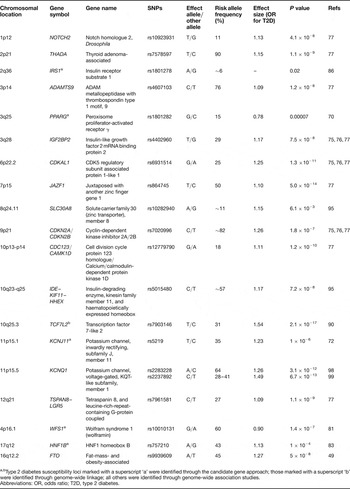
The third wave of discoveries was a result of a large-scale collaborative meta-analysis of genome-wide association scans for type 2 diabetes performed by the Diabetes Genetics Replication And Meta-analysis (DIAGRAM) consortium (Ref. Reference Zeggini77). The consortium meta-analysed genome-wide association results of the previously published WTCCC, DGI and FUSION scans, which includes 4549 cases and 5579 controls. In the discovery stage, the association of 69 variants reached a significance of P < 10−4. These variants were taken forward for an initial round of replication in 22 426 individuals. Of the 69 variants of the discovery stage, 11 reached the significance threshold in the initial replication. Further replication of these 11 variants in an additional 57 366 individuals showed that six variants reached a P-value of 5 × 10⁻⁸ for the association with type 2 diabetes. The six variants include in or near NOTCH2 (Notch homologue 2, Drosophila), ADAMTS9 (ADAM metallopeptidase with thrombospondin type I motif 9), CAMK1D (calcium/calmodulin-dependent protein kinase 1D), JAZF1 (juxtaposed with another zinc finger gene 1), TSPAN8–LGR5 (tetraspanin 8, and leucine-rich-repeat-containing G-protein coupled) and THADA (thyroid adenoma-associated) (Table 3). Furthermore, two genome-wide association studies in the Japanese population (Refs Reference Unoki98, Reference Yasuda99) comprising more than 3000 individuals identified KCNQ1 (potassium voltaged-gated channel, KQT-like subfamily, member 1) as a novel type 2 diabetes susceptibility locus, in addition to the CDKAL1 and IGF2BP2 loci.
Type 2 diabetes susceptibility loci identified through candidate gene, genome-wide linkage and genome-wide association studies

a,bType 2 diabetes susceptibility loci marked with a superscript ‘a’ were identified through the candidate gene approach; those marked with a superscript ‘b’ were identified through genome-wide linkage; all others were identified through genome-wide association studies.
Abbreviations: OR, odds ratio; T2D, type 2 diabetes.
As a follow-up of the three waves of genome-wide studies, a study in 3210 unrelated Chinese Hans replicated the association of previously identified 17 common variants from genome-wide studies with type 2 diabetes and showed that the common variants in CDKAL1, CDKN2A/2B, IGF2BP2 and SLC30A8 loci independently or additively contribute to type 2 diabetes risk (Ref. Reference Wu100). The risk alleles of the CDKAL1 and CDKN2A/2B variants increased diabetes risk by ~1.4- and ~1.3-fold, respectively, in Chinese Hans, which is higher than that observed in Europeans (Refs Reference Zeggini77, 97). The risk allele frequencies of these variants were also higher in Chinese Hans compared to Europeans (Ref. Reference Wu100).
Genome-wide association studies for fasting plasma glucose
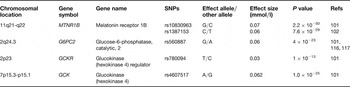
Large-scale genome-wide studies have also identified four genetic loci – GCK (glucokinase), GCKR (glucokinase regulator), G6PC2 (glucose-6-phosphatase catalytic unit 2) and MTNR1B (melatonin receptor 1B) – that are associated with traits related to type 2 diabetes (Table 4). Two genome-wide association studies independently reported previously unknown genetic loci to be unequivocally associated with fasting glucose concentrations. The first study showed that variants in the gene encoding MTNR1B were consistently associated with fasting glucose across all ten genome-wide association studies (N = 36 610) of the MAGIC (Meta-analyses of Glucose and Insulin-related Traits) Consortium (Ref. Reference Prokopenko101). The same variant was also associated with an increased risk of type 2 diabetes [OR = 1.09 (1.05–1.12), per additional risk allele, P = 3.3 x 10⁻⁷]. This study also identified association of variants in G6PC2 and GCK genes with fasting glucose. The second genome-wide association study, in 2151 nondiabetic French individuals, identified another variant near MTNR1B that was in linkage disequilibrium (r2 = 0.70) with the variant identified in the first study (Ref. Reference Bouatia-Naji102). This study also observed cumulative effects of the MTNR1B, G6PC2, GCK and GCKR loci, showing that those carrying six or more high-risk alleles showed a mean 0.36 mmol/l increase in fasting plasma glucose compared with individuals with no or with one risk allele. A recent study has shown that the association of the MTNR1B variant with type 2 diabetes could be due to the impairment of early insulin response to both oral and intravenous glucose and with faster deterioration of insulin secretion over time (Ref. Reference Lyssenko103). Although GCKR was shown to be associated with fasting glucose, it was first identified as being associated with higher triglycerides in the DGI genome-wide scans (Ref. Reference Saxena75).
Confirmed loci for fasting plasma glucose identified through genome-wide association studies

In summary, so far 18 loci for type 2 diabetes and four loci for fasting glucose have been identified through genome-wide association scans.
Genetic prediction of obesity and type 2 diabetes
In view of identifying individuals at high risk for obesity and diabetes, data on the combined influence of all established loci will be needed. Although there have been a substantial number of genetic susceptibility loci identified so far, the prospects for individual prediction, at this stage, seem limited.
The predictive value of eight validated obesity-susceptibility loci (TMEM18, KCTD15, SH2B1, MTCH2, NEGR1, GNPDA2, FTO and MC4R) on obesity risk was investigated in 14 409 men and women of the population-based EPIC-Norfolk cohort (Ref. Reference Willer54). For each individual, a genetic predisposition score was calculated by summing up the number of BMI-increasing alleles. When combined, the eight variants explained less than 1% of the variance in BMI and had very limited power in predicting the risk of obesity (Ref. Reference Willer54). The eight variants contributed only 2–3% to the prediction of obesity independent of age and sex. A study in 20 431 individuals from the EPIC-Norfolk cohort showed that 12 obesity variants explained 0.9% of BMI variation with an area under the curve of 0.574 for prediction of obesity (Ref. Reference Li55) (Fig. 3). Similar results were observed in four studies that examined the cumulative effects of previously established susceptibility loci for type 2 diabetes (Refs Reference Van Hoek104, Reference Meigs105, Reference Lyssenko106, Reference Lango107). These studies found that the genetic variants contributed only 1–2% to the prediction of type 2 diabetes beyond classical clinical characteristics.
Thus, the predictive value of the currently identified susceptibility loci is too low to be clinically useful, despite overwhelming significances and repeated replications. As more variants are identified, tests with better predictive value may become available and could potentially become a valuable tool for clinical practice.
Gene–lifestyle interactions in obesity and type 2 diabetes
Susceptibility to common diseases such as obesity and diabetes is determined by genetic as well as lifestyle factors. Evidence of gene–lifestyle interaction (Box 3) in the development of obesity and type 2 diabetes was first provided by descriptive epidemiological studies such as migration studies that compare the risk of disease between genetically related populations who have different lifestyles. This is best illustrated by the comparison of the risk of obesity and type 2 diabetes between Pima Indians living in the ‘obesogenic’ environment of Arizona (where 69% are obese and 55% have type 2 diabetes) and those living in the ‘restrictive’ environment of the remote Mexican Sierra Madre Mountains (13% of whom are obese with only 6% having type 2 diabetes) (Refs Reference Ravussin108, Reference Esparza109). These findings show that, despite a similar genetic predisposition, different lifestyles result in different prevalences of obesity and type 2 diabetes. White Americans living in a similar obesogenic environment but who have a different genetic background are much less susceptible to developing obesity (~32%) or type 2 diabetes (~8%) compared with the Pima Indians living in Arizona.
Box 3. Gene–environment interaction
The concept of ‘gene–environment interaction’ has different meanings to different people, and the interpretation depends on the type of research with which an individual is involved. A biologist might interpret gene–environment interaction at the molecular or cellular level as the direct (such as nutrients) or indirect (such as physical-activity-induced release of nitric oxide) effect of an environmental factor on the genome. A public health epidemiologist interprets gene–environment interaction at the population level as the differential response to an environmental factor (e.g. diet, physical activity, and smoking) on disease risk is dependent on an individual's genotype. We focus on the epidemiological definition of gene–environment interaction from both a public health as well as a genetic perspective.
The genetic perspective starts from a main-effect hypothesis that tests for association between a genetic variant and a disease or trait [e.g. whether a genotype is associated with obesity or body mass index (BMI)]. Next, the interaction hypothesis tests whether the genotype–disease association is different across different levels of environmental exposure (e.g. whether the genotype–BMI association is different in individuals who are physically active compared with individuals who are physically inactive). The gene–environment interaction would be statistically significant if the slopes of the two associations (physically active versus physically inactive) differ significantly from each other.
The public health perspective first questions the association between an environmental factor and disease or trait (e.g. whether a high-fat diet is associated with diabetes or lipid levels). Subsequently, the interaction hypothesis tests whether carriers of a certain genotype are more susceptible for the influence that the environment has on disease than noncarriers (e.g. whether the detrimental effects of high-fat diet on diabetes are more pronounced in the carriers of a specific allele than the noncarriers). Again, the gene–environment interaction will be statistically significant if the slopes of the two associations differ significantly from each other.
Besides descriptive epidemiological studies, genetic association studies have also identified gene–lifestyle interactions, as can be seen for the TCF7L2 and FTO genes. Gene–environment interaction studies in European populations have shown that the association between the FTO gene and BMI is attenuated by physical activity levels (Refs Reference Rampersaud110, Reference Allison11, Reference Vimaleswaran112). In the Old Order Amish population (N = 704), increased physical activity was found to be associated with lower BMI, but only in individuals homozygous for a FTO risk allele (e.g. rs1861868) and no such association was observed in the carriers of the protective allele (Ref. Reference Rampersaud110). Similar findings were observed in two other large population-based studies in Caucasians (Refs Reference Andreasen111, Reference Vimaleswaran112).
In the Diabetes Prevention Program, the effect of the TCF7L2 risk allele on the progression towards type 2 diabetes was found to be abolished in the lifestyle intervention group, but evident in the placebo control group (Ref. Reference Florez113). This suggests interaction between common variants in the TCF7L2 gene and lifestyle in the risk of progression to type 2 diabetes. Although the TCF7L2–intervention interaction in the Diabetes Prevention Program was not statistically significant, corroborating results from the Finnish Diabetes Prevention Study (Ref. Reference Wang114) provide further evidence of attenuation of the TCF7L2 susceptibility on diabetes risk by diet and exercise.
Gene–environment interaction studies can hold important public health messages: individuals might be genetically susceptible to develop disease, but this does not mean that they are destined to become diseased; changes in lifestyle can overcome genetic susceptibility, as illustrated by the FTO and physical activity example (Refs Reference Rampersaud110, Reference Andreasen111, Reference Vimaleswaran112) or the TCF7L2 and lifestyle-intervention studies (Refs Reference Florez113, Reference Wang114).
Future directions
The next steps towards the discovery of more susceptibility loci will involve various strategies. The first strategy will involve the initiation of a fourth wave of genome-wide association studies to further increase the sample size of the initial discovery stage, which will further improve the power to identify undetected variants for obesity and diabetes with even smaller effect sizes. The second strategy will involve the use of more-accurate measures of adiposity, besides using BMI as the only measure of adiposity, which might further improve power. Similarly, for type 2 diabetes, genome-wide association studies for fasting glucose, fasting insulin levels, HbA1C and other intermediary phenotypes for type 2 diabetes such as insulin resistance and impaired glucose tolerance will be performed to identify novel diabetes susceptibility loci. The third strategy will involve investigation of other sources of genetic variations such as copy number variants, epigenetics and rare variants in relation to predisposition to obesity and diabetes. The fourth strategy will involve resequencing and fine mapping in a step towards characterising functional variants. Finally, the established susceptibility loci will be followed up in molecular and physiological studies to determine the mechanisms through which these loci confer the disease susceptibility.
Conclusions
Dissecting the genetic architecture of complex diseases such as obesity and type 2 diabetes is a rather challenging task. Significant advances have been made in the past few years, in particular through genome-wide association studies, with the discovery of 19 genetic loci for obesity and 18 loci for type 2 diabetes. This recent progress may eventually provide valuable insights into pathophysiological mechanisms and pathways that underlie the disease development, and hence gives us the hope for genetic risk profiling and therapeutic intervention. Implementation of these approaches in mainstream healthcare, however, remains some way off in the future as we still need to explore much more about the causal variants and their functional significance in relation to obesity and type 2 diabetes.
Acknowledgements and funding
The authors thank the reviewers for their helpful and valuable comments.