Introduction
Disturbed sleep is common among family caregivers of older adults with a memory disorder. Findings indicate that family caregivers of individuals with dementia report worse overall sleep quality than non-caregivers of a similar age (Wilcox and King, Reference Wilcox and King1999), as well as shorter, less efficient, and more fragmented sleep than their non-caregiving peers (Rowe et al., Reference Rowe, McCrae, Campbell, Benito and Cheng2008). In addition, studies that have measured sleep by polysomnography have found that older caregivers of individuals with moderate or severe dementia sleep for a shorter duration than older non-caregivers (McKibbin et al., Reference McKibbin2005), and that the sleep of dementia family caregivers is comparable to that of non-caregivers of the same age reporting mild or moderate sleep disturbance (Castro et al., Reference Castro, Lee, Bliwise, Urizar, Woodward and King2009).
The caregiving role is often physically demanding, and to maintain caregivers’ ability to provide care it is important to identify modifiable risk factors for decline in their physical functioning. Preliminary findings indicate that poor sleep might be one of these risk factors. Self-reported poor sleep in older adults has been linked to impairment in physical functioning, as measured by the Medical Outcomes Study Short Form 36 (SF-36), and impairment in activities of daily living (ADLs), instrumental ADLs (IADLs) and ambulation (Ware and Sherbourne, Reference Ware and Sherbourne1992; Foley et al., Reference Foley, Monjan, Brown, Simonsick, Wallace and Blazer1995; Newman et al., Reference Newman, Enright, Manolio, Haponik and Wahl1997; Byles et al., Reference Byles, Mishra, Harris and Nair2003; Motivala et al., Reference Motivala, Levin, Oxman and Irwin2006). In addition, recent studies using actigraphy – an objective method of estimating sleep by recording movement (Ancoli-Israel et al., Reference Ancoli-Israel, Cole, Alessi, Chambers, Moorcroft and Pollak2003) – have found that poor sleep is associated with impaired IADLs and worse objectively measured neuromuscular performance (e.g. gait speed) in the general population of community-dwelling older adults (Goldman et al., Reference Goldman2007; Dam et al., Reference Dam, Ewing, Ancoli-Israel, Ensrud, Redline and Stone2008).
Given that many caregivers are older, and that sleep disturbance is common among caregivers, these links between poor sleep and poorer functioning in older adults could have important implications for the growing population of caregivers. Nonetheless, little is known about the association between sleep disturbance and physical function in family caregivers of older individuals with cognitive impairment. A recent study by Creese et al. (Reference Creese, Bédard, Brazil and Chambers2008) found a modest, non-significant association between worse self-reported sleep quality and the Physical Health component of the SF-12 in this population (Ware et al., Reference Ware, Kosinski and Keller1996). Although studies of caregivers of older adults with memory problems have been published that included both actigraphic measurement of sleep and a measure of physical functioning (McCurry et al., Reference McCurry, Vitiello, Gibbons, Logsdon and Teri2006; Reference McCurry, Pike, Vitiello, Logsdon and Teri2008), we are not aware of studies that have explicitly examined the association between these measures in caregivers.
In the present cross-sectional study, we investigated the association between sleep parameters, measured objectively by wrist actigraphy, and self-reported physical functioning on the SF-36 in family caregivers of older individuals with memory problems. We predicted that worse actigraphic sleep in caregivers would be associated with greater impairment of their self-reported physical functioning, and that this association would remain after adjustment for age, depressive symptoms, and self-rated health.
Methods
This study was conducted using data from a clinical trial registered in the ClinicalTrials.gov Registry (ClinicalTrials.gov Identifier: NCT00946530).
Participants
The participants comprised 45 caregivers enrolled in a randomized controlled trial of bright light treatment for sleep/wake disturbances in patients with memory disturbances. Caregivers were included if they were living in the home of the memory-impaired individual and were willing to participate in the protocol. Exclusion criteria for caregivers were a history of mania or an eye condition that precluded bright light exposure. The data reported here were collected at the baseline phase of the randomized trial.
Predictors
Caregivers wore actigraphs on their non-dominant wrists (Octagonal Basic actigraph with light sensor, Ambulatory Monitoring, Inc., Ardsley, NY) for at least three consecutive 24-hour periods. We derived sleep parameters using Action 4 software (Ambulatory Monitoring, Inc.) and we selected two key nocturnal sleep parameters as predictors for this study: total sleep time (TST; total time asleep from time into bed until time out of bed) and wake after sleep onset (WASO; mean time awake after initial sleep onset). During the period in which they collected actigraphic data, caregivers recorded their times into and out-of-bed, nap times, and intervals during which actigraphs were removed, in a brief sleep log.
Outcome
We measured physical functioning with the Physical Functioning subscale of the Medical Outcomes Study Short Form 36 (SF-36), a self-report measure of emotional and physical health-related quality of life (Ware and Sherbourne, Reference Ware and Sherbourne1992). The Physical Functioning subscale contains ten items that measure the difficulty respondents have with moderate and vigorous activities – lifting/carrying groceries, climbing stairs, bending/stooping/kneeling, walking various distances, and bathing/dressing – on a three-point Likert-type scale (1 = yes, a lot; 2 = yes, a little; 3 = no, not at all). Based on instructions, responses were summed and recoded; higher scores indicate better functioning (possible range = 0–100) (Saris-Baglama et al., Reference Saris-Baglama, Dewey, Chisolm, Kosinski, Bjorner and Ware2004).
Other measures
Caregivers provided demographic information, and completed the Beck Depression Inventory-II (BDI-II), a 21-item questionnaire measuring depressive symptoms (Beck et al., Reference Beck, Steer and Brown1996). Self-rated health was measured by item 1 of the SF-36 on a five-point scale (excellent = 1, poor = 5). Caregivers and patients also completed the Mini-mental State Examination (MMSE), a 30-item screen for cognitive impairment (Folstein et al., Reference Folstein, Folstein and McHugh1975).
Analyses
To determine the association between actigraphic sleep parameters and physical functioning, we conducted two unadjusted linear regression analyses, each with actigraphic TST or WASO as the predictor, and the SF-36 Physical Functioning subscale as the outcome. To prevent confounding by age, self-rated health and depression, we repeated analyses, adjusting for these variables. We added a quadratic term age2 (i.e. age squared) to multivariate models to transform the association between caregiver age and the Physical Functioning subscale from non-linear to linear.
Results
Participant characteristics
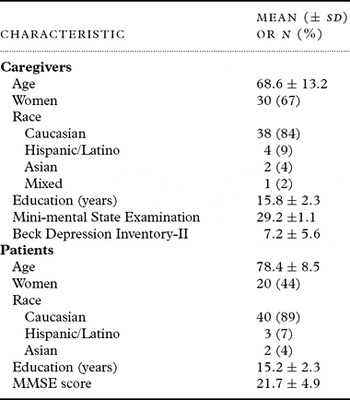
Of the 45 caregivers, 30 (67%) were women (Table 1). A total of 38 (84%) were Caucasian, four (9%) were Hispanic or Latino, two (4%) were Asian, and one (2%) reported mixed race. The caregivers had a mean age ± standard deviation (SD) of 68.6 ± 13.2 years, and 15.8 ± 2.3 years of education. Of the 45 patients, 25 (56%) were men; 40 (89%) were Caucasian, two (4%) were Asian and three (7%) were Hispanic or Latino. They had a mean age of 78.4 ± 8.5 years, 15.2 ± 2.3 years of education, and a mean MMSE score of 21.7 ± 4.9 (range = 10 to 28).
Participant characteristics (N = 45)
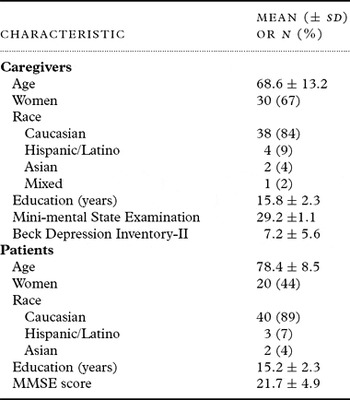
MMSE = Mini-mental State Examination
Caregivers had a mean MMSE score of 29.2 ± 1.1. Their mean SF-36 Physical Functioning score was 74.6 ± 22.5; scores ranged from 20 to 100. Their mean BDI-II score was 7.2 ± 5.6, indicating a low mean level of depression in this sample. Caregivers completed a mean of 6.5 ± 0.8 (range = 4 to 7) days of actigraphy, and completed a mean of 6.5 ± 0.8 sleep logs (out of 7; range = 4 to 7). Caregivers’ mean TST was 378.5 ± 87.2 min, and their mean WASO was 87.5 ± 72.6 min.
Total sleep time and physical function
In unadjusted regression analyses, each 30-minute increase in caregivers’ TST was associated with a 2.5-point increase in their Physical Functioning scores (unstandardized beta coefficient (B) = 2.5, 95% confidence interval (CI) 0.2, 4.7, adjusted R 2 = 0.08) (Table 2). After adjustment for caregiver age, age2, self-rated health, and BDI-II score, each 30-minute increase in TST was still associated with a statistically significant 2.2-point increase on the Physical Functioning subscale (B = 2.2, 95% CI 1.0, 3.4, adjusted R 2 = 0.75).
Associations between sleep parameters and Physical Functioning subscale (N = 45)

*Adjusted for age, age2, self-rated health, and Beck Depression Inventory-II score; B = unstandardized regression coefficient; CI = confidence interval.
Wake time and physical function
In unadjusted analyses, each 10 minute increase in WASO was associated with a 1.2-point decrease on the Physical Functioning subscale (B = −1.2, 95% CI −2.1, −0.4, adjusted R 2 = 0.14). After adjustment, this association decreased such that every 10 minute increase in WASO was accompanied by a 0.5 point decrease on the Physical Function subscale; this association was no longer statistically significant (B = −0.5, 95% CI −1.1, 0.1, adjusted R 2 = 0.69).
Discussion
In the present study, we found that shorter total sleep time was associated with poorer self-reported physical function in family caregivers of individuals with memory impairment, and that this association was independent of caregiver age, self-rated health, and depressive symptoms. We also observed an association between greater wake after sleep onset and physical function, but this decreased in magnitude and was no longer significant after adjustment for the same potential confounders. The general pattern of our findings is consistent with those from other studies of older adults that used self-report sleep measures and various measures of functioning (Foley et al., Reference Foley, Monjan, Brown, Simonsick, Wallace and Blazer1995; Newman et al., Reference Newman, Enright, Manolio, Haponik and Wahl1997; Byles et al., Reference Byles, Mishra, Harris and Nair2003; Motivala et al., Reference Motivala, Levin, Oxman and Irwin2006). Our results are also similar to those of Creese et al. (Reference Creese, Bédard, Brazil and Chambers2008), who found a trend-level association between caregivers’ self-reported sleep and a more general measure of physical health, the Physical Component Summary of the SF-12. The present study extends prior research on the association between sleep and function in caregivers by using an objective measure – actigraphy – to estimate caregivers’ sleep.
Various mechanisms could underlie the association between poor sleep and poor physical functioning in caregivers. Short sleep duration has been linked to hypertension and diabetes in community-dwelling older adults (Gottlieb et al., Reference Gottlieb2005; Reference Gottlieb2006), and sleep fragmentation is associated with increased markers of inflammation and coagulation in dementia family caregivers (von Kanel et al., Reference von Kanel2006). Because hypertension, diabetes and elevated coagulatory and inflammatory responses have themselves been linked to disability (Cohen et al., Reference Cohen, Harris and Pieper2003; Bourdel-Marchasson et al., Reference Bourdel-Marchasson, Helmer, Fagot-Campagna, Dehail and Joseph2007; Newman et al., Reference Newman2009), these variables might mediate the association between disturbed sleep and functional impairment. In addition, caregivers who are more stressed and often sleep-deprived are less likely to engage in basic health behaviors (e.g. healthy diet, exercise) (Schulz et al., Reference Schulz, Newsom, Mittelmark, Burton, Hirsch and Jackson1997; Son et al., Reference Son, Erno, Shea, Femia, Zarit and Stephens2007), which may contribute to the worsening of their health and level of physical function.
Limitations of this study include its cross-sectional design, which prevents us from drawing conclusions about the direction of a potential causal link between sleep and functional impairment. In addition, to reduce caregiver burden, we used a brief sleep log, rather than a full sleep diary. Although this resulted in a high rate of adherence to our protocol, as indicated by an average of 6.5 completed sleep logs per caregiver, the brief log did not require participants to report the amount of time spent awake after sleep onset or their total sleep time. This precluded us from identifying discrepancies between self-reported sleep and sleep parameters from actigraphy. Further, the small sample size may have limited statistical power to detect smaller effects in one of our multivariate models. Finally, although multiple subscales can be derived from the SF-36, the present study focused specifically on the SF-36 Physical Functioning subscale as an outcome. Further hypothesis-driven research is needed to determine the extent to which poor sleep is linked to other domains of functioning and health-related quality of life in family caregivers.
Despite these limitations, the present investigation is, to our knowledge, the first to provide evidence for an association between objectively measured sleep and self-reported physical functioning in family caregivers of patients with memory disorders. Additional studies of sleep and function in caregivers are needed that use a broader range of outcome measures, including performance-based functional measures (e.g. grip strength, gait speed). Further, prospective studies are needed to investigate the extent to which both subjectively and actigraphically measured caregiver and patient sleep predict nursing home placement. Evidence of a longitudinal association between nocturnal sleep and physical functioning in family caregivers would raise the possibility that interventions to improve caregivers’ sleep might have a positive impact on their functional status. Improved functioning might support caregivers’ ability to provide ongoing care, and perhaps delay institutionalization of older adults with memory problems.
Conflict of interest declaration
Adam Spira is a member of the scientific advisory board of MDCI Automation. He received honoraria while serving as a clinical editor for the International Journal of Sleep and Wakefulness—Primary Care, which provides continuing medical education materials through pharmaceutical industry support. Sonia Ancoli-Israel has consulted for Ferring Pharmaceuticals Inc., GlaxoSmithKline, Orphagen Pharmaceuticals, Pfizer, Respironics, sanofi-aventis, Sepracor, Inc., Schering-Plough, Teva and received grants from NIH, Sepracor, Inc., and Litebook, Inc.
Description of authors’ roles
Adam P. Spira developed the research question, and was involved in study design, data collection and analysis, and manuscript preparation. Leah Friedman was involved in formulating the research question, designing and carrying out the study, and in manuscript preparation. Sherry A. Beaudreau assisted with manuscript preparation. Sonia Ancoli-Israel was involved in study design, data analysis, and manuscript preparation. Beatriz Hernandez assisted with data analysis and manuscript preparation. Javaid Sheikh helped design and carry out the parent study that yielded these data, and assisted with manuscript preparation. Jerome Yesavage helped write and carry out the grant application that funded this research, and assisted with manuscript preparation.
Acknowledgment
This research was supported by National Institute on Aging Grants R01AG021134 and R01AG008415, and by the Medical Research Service of the Veterans Affairs Palo Alto Health Care System and the Department of Veterans Affairs Sierra-Pacific Mental Illness Research, Education, and Clinical Center (MIRECC). Some results from this study were presented as a poster at the 3rd International Congress on Brain and Behaviour (November 2007, Thessalonica, Greece). We thank Ellen Kim and Deryl Wicks for their assistance with collection, entry and cleaning of data.