Introduction
Firefighters regularly undertake emergency responses in hot environments wearing personal protective clothing (PPC) and self-contained breathing apparatus (SCBA) weighing in excess of 20 kg.Reference Keene, Brearley, Bowen and Walker 1 , Reference Barr, Gregson and Reilly 2 The physical nature of this work, when combined with high ambient temperatures, results in increased core body temperatures, potentially leading to life-threatening heat stroke.Reference Walker, Driller, Argus, Cooke and Rattray 3 , Reference Cheung, Petersen and McLellan 4 High core body temperatures, resulting from work in the heat, can also lead to premature fatigue, cognitive decline, and changes to inflammatory and coagulation factors.Reference Cheung, McLellan and Tenaglia 5 – Reference Walker, Driller, Brearley, Argus and Rattray 9
Emergency Medical Services (EMS) may be tasked in a preventative and/or treatment capacity at fire scenes to mitigate the risk of firefighter heat stroke during, and directly following, fire suppression activities. Exertional heat stroke has been defined clinically as a core temperature above 40°C with central nervous system dysfunction.Reference Wright-Beatty, McLellan, Larose, Sigal, Boulay and Kenny 10 To assist in appropriate identification and management of heat stroke and other heat conditions, a practical and valid measure of core body temperature should be available at the fire scene. Various measurement sites and methods have been used to estimate core body temperature in laboratory and clinical settings. However, measurement tools such as rectal probes are particularly invasive in-dwelling devices, which have limited application to field settings. Ingestible thermometers provide valid and reliable measurement of gastrointestinal temperature (TGI), and have been shown to be a reliable surrogate of core body temperature.Reference Zeller, Novack, Barski, Jotkowitz and Almog 11 , Reference Casa, Becker and Ganio 12 Ingestion of thermometers must occur more than six hours prior to use, thus limiting their practicality as a tool for emergency response.Reference Smith, Petruzzello and Goldstein 8
Infrared temperature measurement of the tympanic membrane (TTym) is used widely by EMS as a surrogate measure of core body temperature. The units are cost-effective, simple to use, and have been reported to measure core body temperature accurately in some clinical settings.Reference Gant, Atkinson and Williams 13 , Reference Amoateng-Adjepong, Del Mundo and Manthous 14 However, the accuracy of TTym as a measure of core body temperature has been questioned, particularly in field settings.Reference Zeller, Novack, Barski, Jotkowitz and Almog 11 , Reference Gant, Atkinson and Williams 13 , Reference Christensen and Boysen 15 , Reference Gagnon, Lemire, Jay and Kenny 16
This study aimed to examine the accuracy of TTym for core body temperature assessment, as used by EMS at emergency firefighting events, with reference to TGI, as measured by ingestible thermometers. By replicating the working conditions experienced by firefighters via a simulated structural firefighting event, this study further aimed to establish whether the current practice of using tympanic thermometry for firefighters working in a hot environment is appropriate.
Methods
Participants
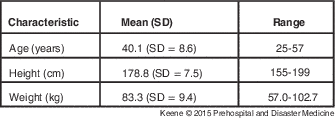
Forty-five (42 male, three female) professional urban firefighters from an Australian fire service volunteered to participate in the current study (Table 1). All participants were active operationally at the time of testing and represented all ranks within the fire service. Informed written consent from participants was obtained before testing, based on protocols approved by the University of Canberra Human Research Ethics Committee (Canberra, Australia).
Participant Characteristics (n=45)

Procedure
Qualified operational paramedics, employed by an Australian government ambulance service, undertook TTym and TGI measurement of participants. Baseline measurements (Time 1) were taken in an air-conditioned room (22°C-24°C) located adjacent to a purpose-built heat chamber with participants wearing boots, socks, pants, and a cotton t-shirt. To mitigate the possible confounding effects of dehydration, participants’ hydration status was evaluated prior to heat testing by a portable refractometer (Atago 3464 UG-a; Atago; Tokyo, Japan) with urine specific gravity less than 1.020 considered to be euhydrated.Reference Christensen and Boysen 15 Participants exceeding this value consumed 600 ml of water, provided in sealed bottles, before testing.
Following baseline measurement, participants completed two 20 minute work periods in the heat chamber set at 100°C (±5°C), as described previously.Reference Smith, Petruzzello and Goldstein 8 Participants completed one 14 meter circuit every 30 seconds carrying a plastic drum weighing approximately 20 kg. Participants wore structural PPC issued by the fire service and an open-circuit SCBA (Scott Safety Australia; Sydney, New South Wales, Australia). The protective equipment weighed approximately 22.0 kg. A 10 minute intermediate rest interval outside the heat chamber (13.5°C (SD=2.4)) separated the work periods. During the intermediate rest period, participants removed their SCBA, jacket, gloves and helmet, changed their SCBA cylinders, and consumed 600 ml of water, provided in sealed bottles. The timing protocols used in the current study have been reported as reflecting standard operating procedures for urban fire services at structural fires.Reference Ganio, Brown and Casa 17 , Reference Hostler, Bednez and Kerin 18
On completion of the second work period, participants removed their SCBA, jacket, gloves, and helmet, and walked to the air-conditioned room adjacent to the heat chamber where TTym and TGI were assessed (Time 2). Approximately five minutes elapsed between completion of the second work period and temperature measurement. The procedures were designed to replicate the process undertaken by firefighters and paramedics at a structure fire, with the exception that baseline measurements would normally not be taken at a real incident.
Measures
Gastrointestinal Temperature
Gastrointestinal temperature was monitored via an ingestible thermometer and radio receiver (HQ Inc; Florida, USA) consumed at least six hours prior to testing.Reference Kong, Beauchamp, Suyama and Hostler 19 To control for the possible effect of localized cooling from fluid ingestion, participants were excluded from analysis when baseline temperatures were ≤35.5°C or decreased by 2°C in any five minute period during testing.Reference Smith, Petruzzello and Goldstein 8 , Reference Hostler, Reis, Bednez, Kerin and Suyama 20
Tympanic Temperature Measurement
A single infrared thermometer (Braun ThermoScan IRT 4520; Kronberg, Germany) was used to measure participants’ TTym. Testing was conducted by qualified paramedics who were familiar with the use of this thermometer. One measurement per participant was undertaken at Time 1, and taken again at Time 2. Paramedics used the participant’s ear that was most convenient, and no attempt was made to control for which ear was used.
Statistical Analysis
Data were analyzed using RReference Brearley, Norton, Trewin and Mitchell 21 and are reported as mean (SD). The level of agreement between TTym and TGI was evaluated using procedures proposed by Bland and Altman. 22 , Reference Bland and Altman 23 This method compares the mean of the two different measures against the difference between the measurements. From this, a 95% confidence interval (CI) is derived to determine the limits of agreement between the two methods. If the CI is narrower than a pre-determined cut-off, then the two measurements are said to be interchangeable. The cut-off is determined clinically based on what is being measured; for this study, a difference of less than 0.5°C was considered a clinically acceptable level of agreement.
Results
Gastrointestinal temperature measurement was unable to be obtained in two participants at Time 1 and an additional six participants at Time 2, resulting in 37 participants with complete measurements at both time points (Table 2). Gastrointestinal temperature was significantly higher at Time 2 than Time 1 (P<.001), as was TTym (P<.001; Table 2).
Summary Statistics for TGI and TTym at Time 1 and Time 2 (Complete Measurements at Both Time Points)

Abbreviations: TGI, gastrointestinal temperature measurement; TTym, tympanic membrane temperature measurement.
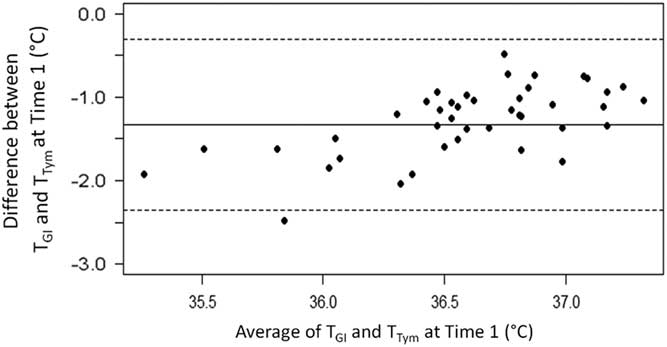
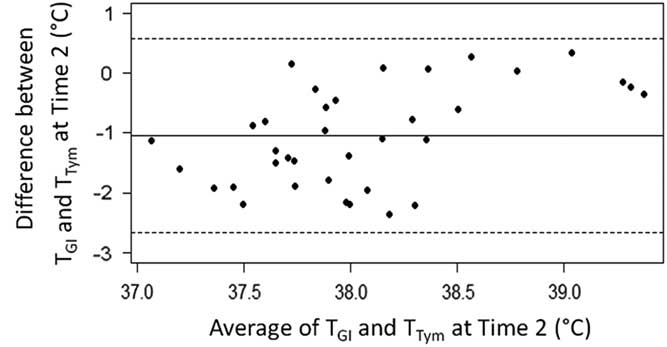
Levels of agreement initially were calculated separately for Time 1 and Time 2. At Time 1, the mean difference between TTym and TGI was −1.3°C (SD=0.5). The 95% CI for the difference was −2.3°C to −0.3°C (Figure 1). For Time 2, the mean difference was −1.0°C (SD=0.8); the 95% CI was −2.6°C to 0.6°C (Figure 2).
Levels of Agreement between TGI and TTym at Time 1. Solid Line is the Mean Difference; Dashed Lines Show the 95% CI. Abbreviations: TGI, gastrointestinal temperature measurement; TTym, tympanic membrane temperature measurement.

Levels of Agreement between TGI and TTym at Time 2. Solid Line is the Mean Difference; Dashed Lines Show the 95% CI. Abbreviations: TGI, gastrointestinal temperature measurement; TTym, tympanic membrane temperature measurement.

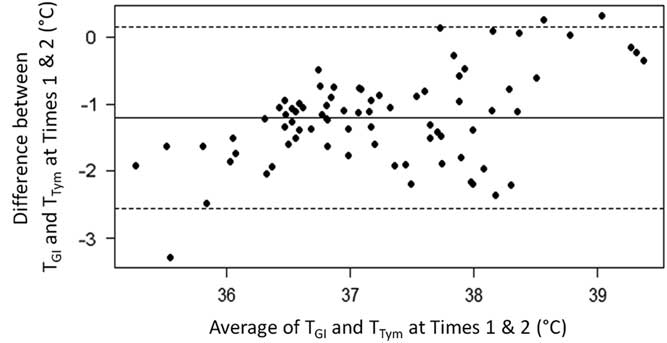
Levels of agreement were then calculated on the pooled data, regardless of time. Within subject variance was corrected for using the procedure outlined by Bland and Altman.Reference Bland and Altman 24 Using this method, the mean difference was −1.2°C (SD=0.7); the 95% CI was −2.5°C to 0.1°C (Figure 3).
Levels of Agreement between TGI and TTym Pooled Across Time 1 and Time 2. Solid Line is the Mean Difference; Dashed Lines Show the 95% CI. Abbreviations: TGI, gastrointestinal temperature measurement; TTym, tympanic membrane temperature measurement.

Discussion
The current study assessed the accuracy of an infrared tympanic thermometer commonly used by EMS as a surrogate measure of core body temperature in firefighters compared with TGI. The key finding of this study was that TTym showed poor agreement with TGI as the 95% confidence intervals were well outside the pre-determined cut-off of 0.5°C difference. In this setting, TTym can be expected to underestimate TGI by up to 2.6°C. Accurate assessment of temperatures in firefighters is critical in ensuring appropriate monitoring and treatment of heat-affected individuals in the field to minimize the risk of exertional heat stroke. As such, this discrepancy is too large to recommend TTym as a monitoring tool for use by EMS. If the error was reasonably constant, then a simple correction factor could be applied to TTym to improve validity. However, while TTym usually underestimated TGI, a small amount of overestimation was also possible.
In the current study, TTym was measured in a temperate environment (22°C-24°C) prior to, and following, the work task. Given the auditory canal’s exposure to the environment, it is intuitive to expect that the relatively mild, ambient conditions in the current study likely would impact upon temperature of the tympanum. Although the findings of this study may have been confounded by the temperate ambient conditions, when a similar exercise was undertaken in tropical conditions (mean ambient temperature 29.5°C), the mean discrepancy of −1.3°C between TTym and TGI during a simulated work task matched the findings of the current investigation.Reference Bland and Altman 25 Further, Prior and colleagues reported that tympanic thermometers failed to measure core body temperature accurately of firefighters wearing PPC while exercising in a hot (38°C) laboratory.Reference Brearley, Heaney and Norton 26 In that study, a mean bias of −1.3°C was reported for an infrared thermometer, approximating the results of both the current investigation and Brearley et al.,Reference Bland and Altman 25 despite the large discrepancy in ambient conditions between investigations.
Interestingly, the TTym error reported by Pryor was relatively constant throughout their 20 minute rest phase, despite decreasing body temperatures.Reference Brearley, Heaney and Norton 26 In contrast, Langridge et al.Reference Pryor, Seitz and Morley 27 reported increasing error during serial measurements at five minute intervals during a cooling protocol. It is currently unclear whether the active cooling strategies employed by that study contributed to the difference in temperature measurements.
Given the ubiquitous nature of tympanic thermometers in EMS, it is worth considering the origin of the measurement inaccuracy. DaanenReference Langridge, Ruzic, Larsen, Lord and Aisbett 28 made three dimensional models of the ear canal of healthy volunteers and compared these to tympanic thermometer accuracy, and it was found that visibility of the tympanic membrane was the most important factor in measurement accuracy. Further, it was reported that an inability to straighten the auditory canal to permit access to the tympanic membrane likely would measure auditory canal temperature, rather than that of the target tympanum, and result in an underestimation. The risk of measuring auditory canal temperature could be mitigated by combining the capabilities of an otoscope and a tympanic thermometer so that the operator could confirm visually accessibility of the tympanic membrane. However, this would lead to increased complexity and training requirements in using such a device.
Alternatively, insulating the auditory canal from the environment is likely to limit the temperature gradient drastically within the auditory canal,Reference Daanen 29 permitting improved measurement accuracy through use of a tympanic probe.Reference Muir, Bishop, Lomax and Green 30 While Pryor et al.Reference Brearley, Heaney and Norton 26 reported that tympanic probes were more erroneous than infrared tympanic monitors, the precise location of the probe was not detailed and the auditory canal was not insulated in that study. The primary limitation of “plugging the ear” for TTym monitoring is the inhibition of aural communication, a significant problem for firefighters working in hazardous environments. A potential solution combines a radio earpiece with an infrared tympanic thermometer.Reference Sato, Kane, Soos, Gisolfi, Kondo and Sato 31 The radio earpiece could achieve auditory canal insulation and TTym measurement, while also permitting firefighter radio communication.
Limitations
A significant limitation of this study is that no participant achieved TGI greater than 39.5°C. The diagnosis of heat stroke requires a core body temperature greater than 40°C. While deliberately inducing body temperatures greater than 40°C is ethically dubious, this study cannot draw conclusions from the accuracy of TTym in a firefighter potentially suffering heat stroke. It is likely that the measurement error will remain as reported, or even larger, but this would be supposition at this time. An understanding of how body temperatures over 40°C affect measurement accuracy would be useful.
Conclusion
In this study of firefighters completing a simulated structural firefighting task, TTym showed poor agreement with TGI as the 95% confidence intervals were well outside the pre-determined cut-off of 0.5°C difference. In this setting, TTym is not a reliable measure of TGI.