Photocopied articles on antiquities, a cut-out magazine profile on David Walsh, exhibition invitations, wine lists, handwritten notes on the 2002 Moorilla Scholarship awardee, photographs, staff handouts, brochures, exhibition price lists, letters, a small catalogue that includes a prize sponsored by the Moorilla Museum of Antiquities, the first Mona invitation, more photocopied articles on scarabs, Egyptian mummies, the latest artwork acquisition, museum architecture…
Most museum libraries have these kinds of loose ephemera – ‘interesting stuff’, to quote the Museum of Old and New Art (Mona) library manager, Mary Lijnzaad.
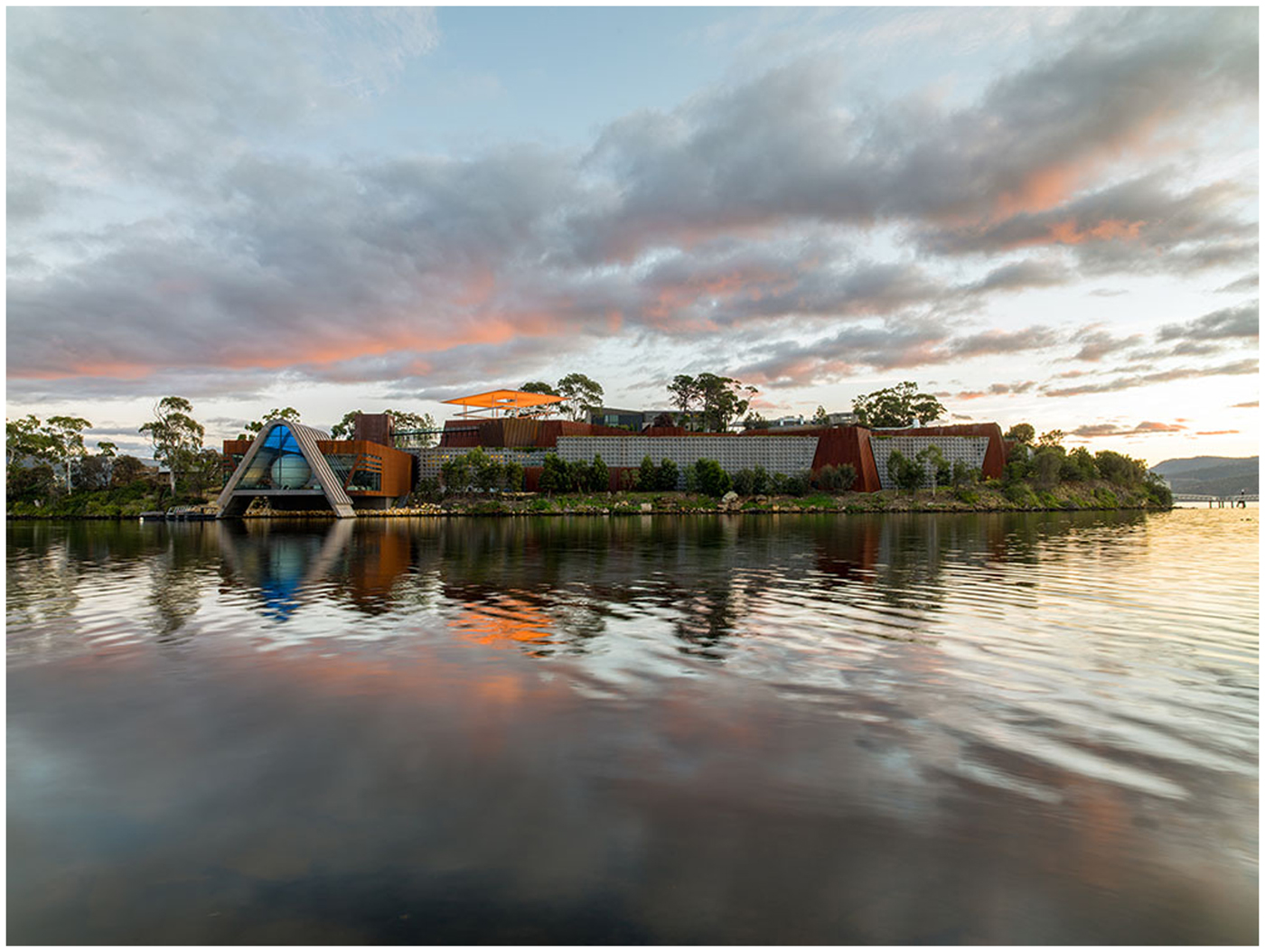
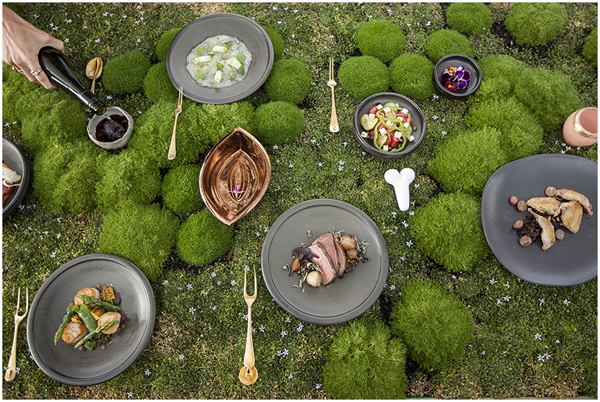
However, the Mona library is quite unique in the breadth of subjects it needs to cover. Opened in 2011 in the relatively small city of Hobart, Mona (fig. 1) is privately owned by locally-born professional gambler and polymath, David Walsh. The organisation started off as the Moorilla Museum of Antiquities and the Moorilla winery, and has since grown to be the Southern Hemisphere's largest private museum with a vast collection of contemporary art, antiquities, three vineyards, a brewery, hotel, three bars, a fine dining restaurant, (fig 2.) and a cafe. Mona runs multiple festivals, hosts concerts and markets, supports scientific research into heavy metal contamination in the Derwent River, and manages a large primary school kitchen garden scheme called 24 Carrots. Consequently, the library collection and accumulated ephemera covers a wide variety of subjects and reflects the evolving nature of the enterprise.
Mona at sunrise. Photo Credit: MONA/Jesse Hunniford. Image courtesy of the artist and MONA Museum of Old and New Art, Hobart, Tasmania, Australia

Living Table. Live moss covered table at The Source Restaurant. Photo Credit: MONA/Rémi Chauvin. Image Courtesy Mona, Museum of Old and New Art, Hobart, Tasmania, Australia

The Mona library has a significant space problem, and we are not alone. According to a recent white paper by ARLIS North America,Footnote 1 one of the greatest challenges facing art libraries today is the growing demand on space. This problem is compounded by the fact that visual art scholarship is notable for its continued use of print collections.Footnote 2
The library's internal resource sharing website, MoKnow, does not replace the vast number of print serials, artist monographs, or auction catalogues in our collection, but it does provide a solution to the storage of ephemera and provides easy online access to these important resources that might otherwise be forgotten or underutilised. The artist files – items like invitations, price lists, brochures, and photocopied articles on the collection's artists – once lived in a vertical file cabinet. Other documents relevant to the museum's collection and research (like articles on scarabs or yap stones) were filed away in cabinets, drawers, boxes or in some cases, piled on shelves. In other words, they were hard to access. Apart from the two original Mona library staff – library manager and former collections manager at the Moorilla Museum of Antiquities, Mary Lijnzaad, and former library assistant, Mel Knowles – the majority of staff didn't even know this material existed. The original MoKnow site was thus born as a solution to storage, or as Lijnzaad describes it, ‘a way of not having to store vast amounts of physical information’.
When Lijnzaad went looking for a solution, she was looking for an alternative to a server. It had to be free or low cost, easy to navigate and easy to search and retrieve information. The discovery of Google Sites was a lucky accident. Google Sites ticked all the boxes: it was simple to use with WYSIWYG editing, it allowed PDF attachments, unlimited pages, and privacy controls where individual users are granted access as either an owner, editor or limited viewer. I should note at this point that our ‘free’ access to this product is due to Mona's use of Google as our email service. There are many free or low-cost alternatives available, but for the purposes of this paper, I will use Google Sites as an example.
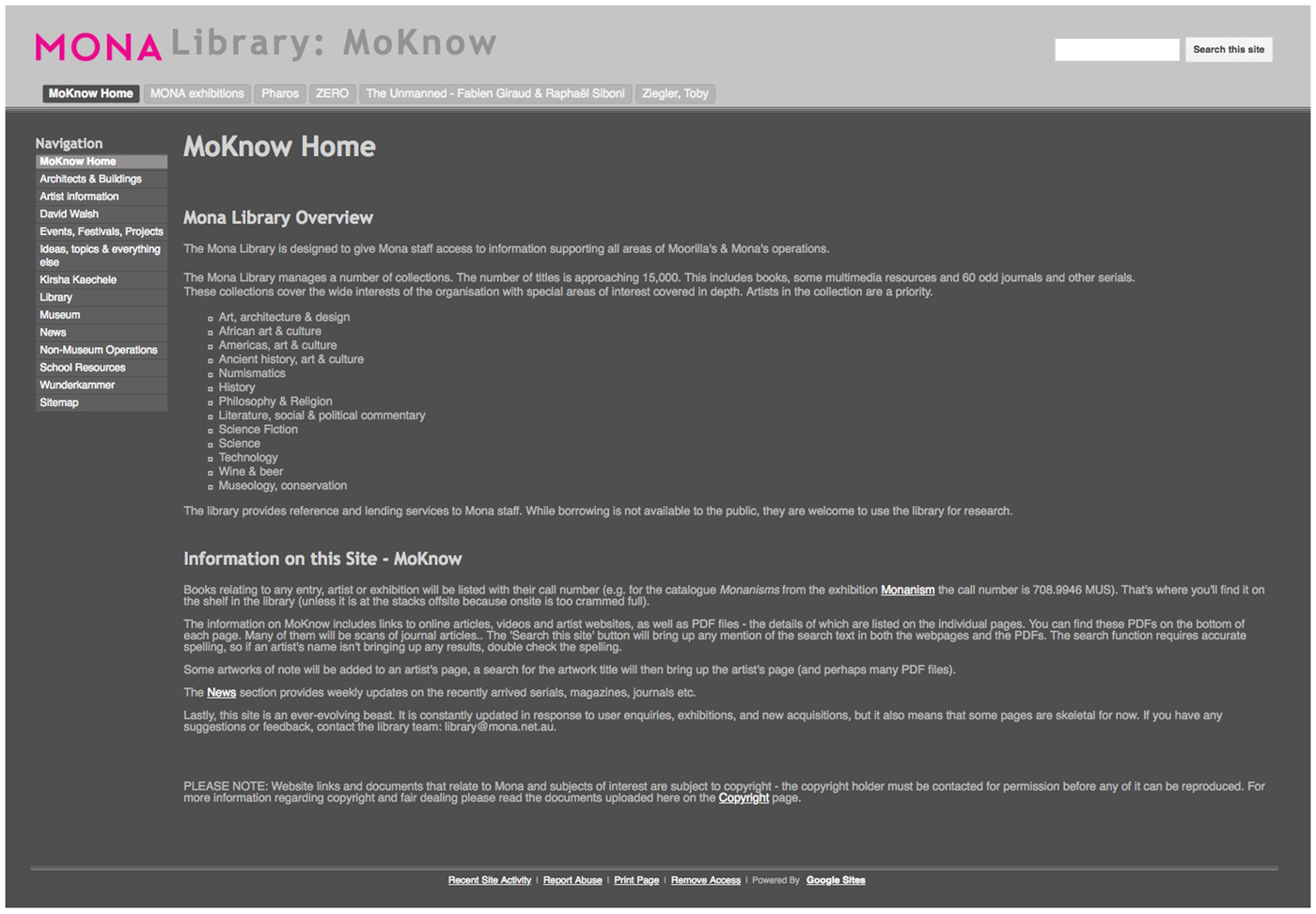
And so MoKnow (or as it was called at the time, ‘the library site’) was born. (fig. 3)
Home page, MoKnow. Screenshot. Image Courtesy Mona, Museum of Old and New Art, Hobart, Tasmania, Australia

The Evolution of MoKnow
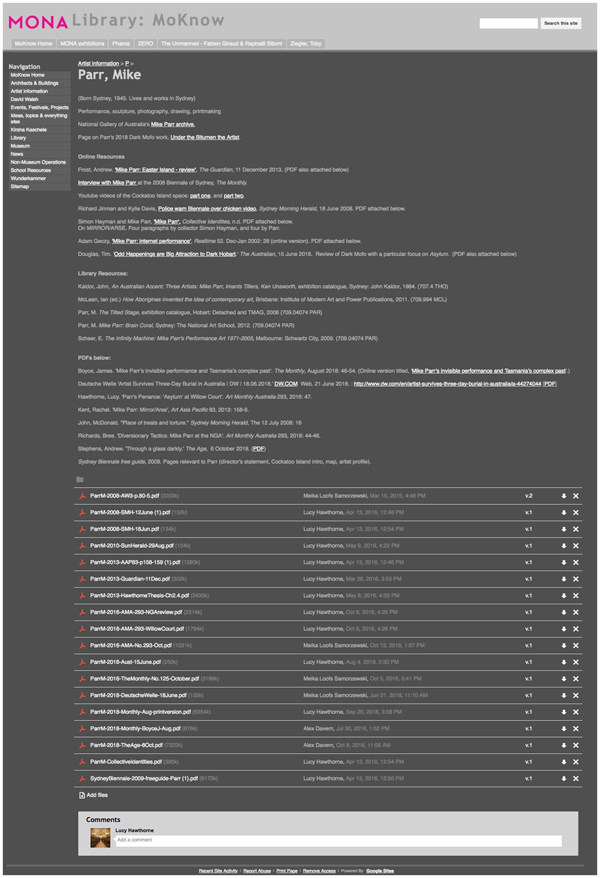
Initially, the site was used very much like a digital filing cabinet, accessed only by the then two library staff. The artist files in the vertical cabinets were gradually digitised and attached as PDFs to the individual artist pages. (fig. 4) Pages were also set up on the buildings’ architects, museum collection, and of course, David Walsh. When the library received a hardcopy journal with an article relevant to the collection, it would be scanned and uploaded to the relevant page as a PDF. Relevant books would be listed on each page along with their full bibliographic details and Dewey number.
Example artist page: Mike Parr, MoKnow. Screenshot. Image Courtesy Mona, Museum of Old and New Art, Hobart, Tasmania, Australia

As the site grew, so did its audience. Media staff and writers were given access, followed by interested museum front of house staff. Because front of house staff are usually the first contact for museum visitors wanting information on artists or artworks, the site became an informal educational tool in addition to its original role as a repository for information. MoKnow's success partly lies in the fact that the site is online and thus accessible not just in the library, but also in the home or elsewhere in the museum. Today, six years on, we have nearly 100 users in all areas of the organisation – from the museum curators and invigilators to the Moorilla winemakers.
As the function of the site expanded, so too did our use of the site as an online resource connected to the outside web. We started to list and link to online resources, and embed videos and annotated Google Maps. We also improved our site navigation and links between pages. A renaming competition was held and the ‘library site’ was changed to ‘MoKnow’ – a name that reflects not only its status as a repository of knowledge, but also the organisation's obsession with puns.
However, as user numbers increased – both in terms of audience and contributors (there are now five full-time library staff) – it became clear that years of haphazard updating by individuals with their own favourite reference styles had resulted in inconsistent file naming and bibliographic information. We created a MoKnow style guide, outlining file-naming protocols, page layout, and reference formats. We also did a major overhaul of the website, creating an ‘ideas’ section for ‘homeless’ ephemera organised into Dewey areas. Our top-level pages were changed to distinguish the museum and its collections from non-museum operations such as the wineries and brewery. The site is still a bit messy, but it is important to understand that it is a work-in-progress and always will be.
The information on MoKnow is responsive to the museum's needs and user enquiries. It also pre-empts the needs of our users, making it as easy as possible to find information on topics relevant to Mona, like our exhibitions, corporate history, or architecture. As mentioned earlier, MoKnow doesn't just link to digital resources – it also lists relevant physical resources, allowing staff to easily identify items they might want to borrow or browse within the library (we do not lend to the public, but staff have borrowing privileges). Because we do not yet have a library catalogue accessible to employees beyond back of house staff (such as curators, registrars, library staff, and exhibition designers), these reading lists are a targeted alternative. The site is an important time saver. By supplying users with quality and relevant resources – digital or otherwise – we can save staff time while providing them with up-to-date, relevant, and accurate information on artists, artworks, and/or conceptual concerns.
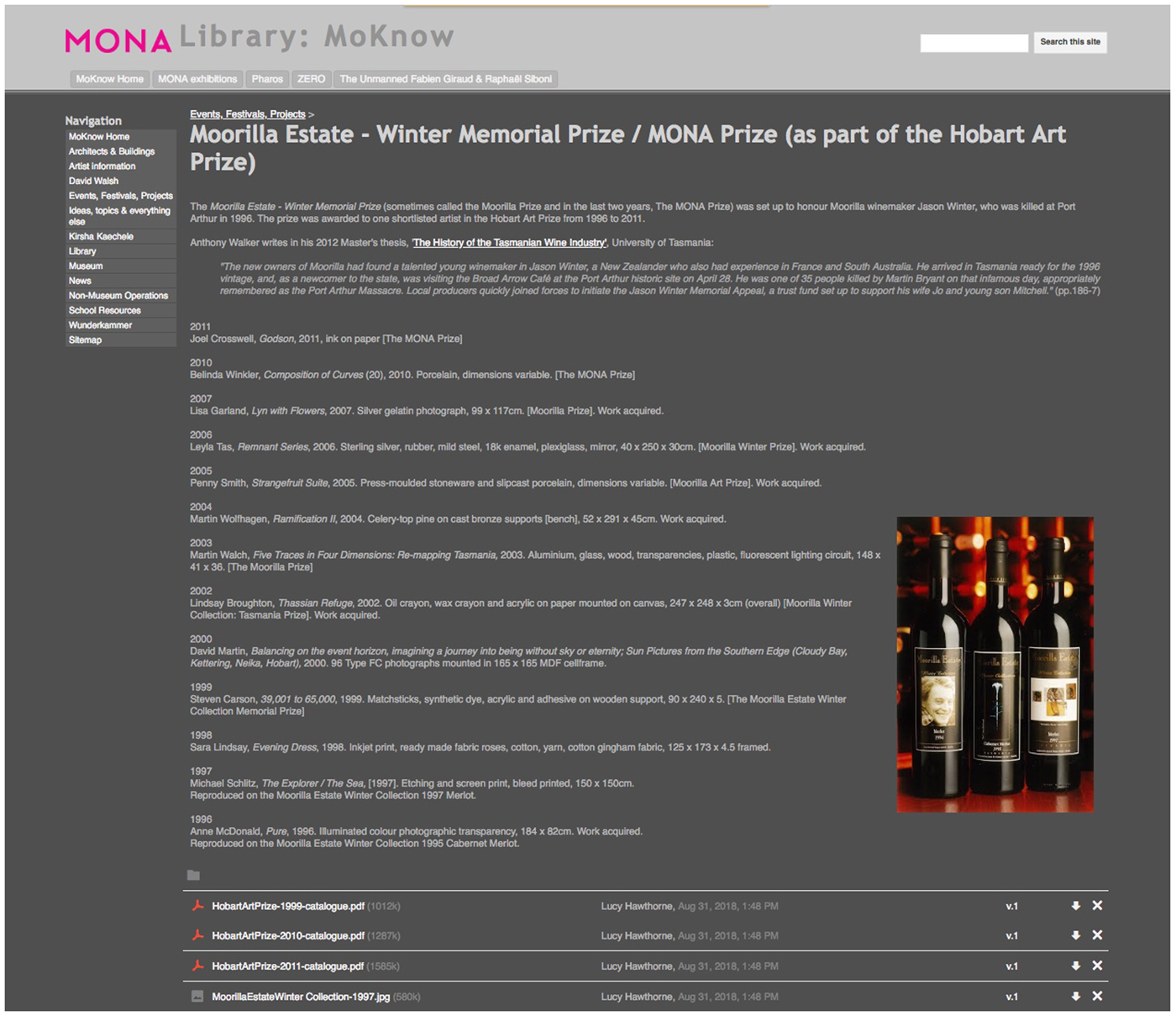
In addition to serving user demand, MoKnow also records important corporate memory of the pre-Mona museum era. Pages are still being created on pre-Mona events – information that's a significant part of our corporate history, but is not recorded anywhere else. Lijnzaad is one of the few staff members who worked in the original museum and knows about initiatives like the Winter Prize, for instance, the details of which I recently compiled from various sources and recorded on a dedicated page. (fig. 5) Until that point there was no written record of this memorial prize awarded to a Hobart Art Prize finalist between the years of 1996 and 2011. When the very personal prize was established, no one could have imagined that the tiny organisation would turn into such a massive and culturally significant institution.
Winter Prize page, MoKnow. Screenshot. Image Courtesy Mona, Museum of Old and New Art, Hobart, Tasmania, Australia

Other Applications
The compilation of exhibition information has become far more systematic in recent years. A separate site for each exhibition is established by library staff in the months or even years prior to its opening. For confidentiality reasons, the information is only imported to MoKnow once the exhibition is in the public domain. Unlike MoKnow, these sites are designed for short-term storage and information gathering. However, they also function as enduring records of the exhibition's development.
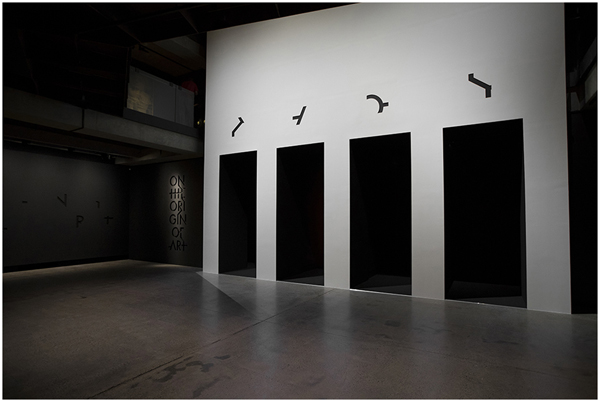
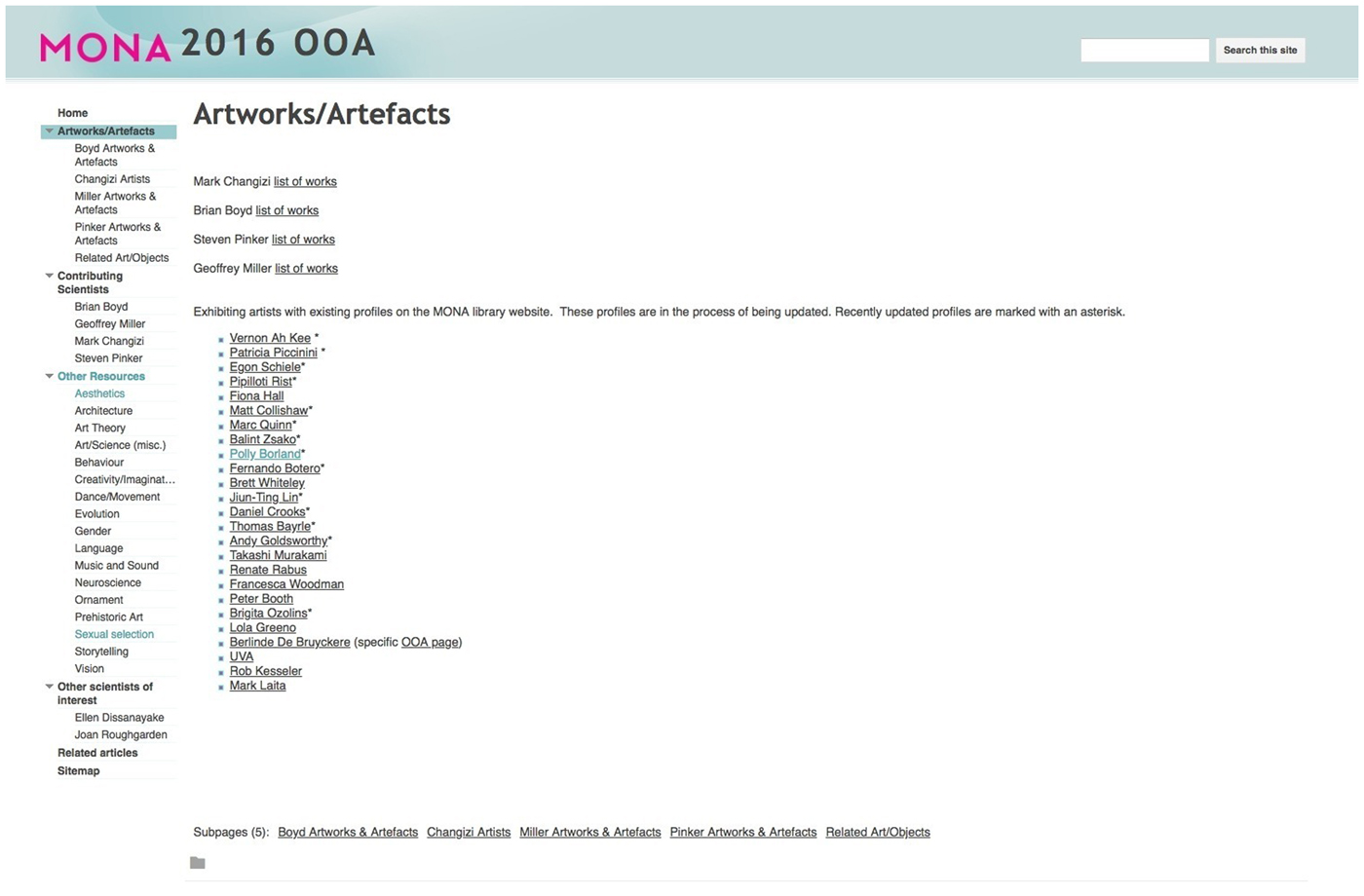
These temporary exhibition sites have a very different purpose and lifespan to MoKnow. The research site for our major 2016 exhibition, On the Origin of Art, (fig. 6) involved four external curators based in the USA and New Zealand (scientists Mark Changizi, Steven Pinker, Geoffrey Miller, and Brian Boyd), multiple internal curators, four sub-exhibitions, 185 artworks and cultural objects from more than 60 different lenders, and a 471 page catalogue. The ideas explored in the exhibition were complex and required a great deal of background research support. I was seconded two days a week for about eighteen months to research for this project, which I shared on a Google site established solely for this show. (fig. 7) The site was shared with the staff working in the library, curatorial, publications, and registration departments, many of whom subscribed to site changes so as to keep up with research as it developed. As artworks were confirmed, resources on the artwork and artist were presented on dedicated pages, making the information easy to retrieve. When the exhibition opened, much of the information related to the artworks and key themes was transferred to MoKnow as reference material for other museum staff. This reference material had particular value to front of house staff, who had the challenging job of answering visitor questions about the artworks and their relationship to the four scientists’ theories on art and human evolution. The site still exists as a record of the exhibition and has the potential to be used in the future – particularly as the theme is of enduring interest to the museum's owner. However, the site is no longer used as a working research tool.
Entrance foyer to the 2016 exhibition On the Origin of Art. Photo Credit: Mona/Rémi Chauvin. Image Courtesy Mona, Museum of Old and New Art, Hobart, Tasmania, Australia

On the Origin of Art research site. Screenshot. Image Courtesy Mona, Museum of Old and New Art, Hobart, Tasmania, Australia

Challenges
For short-term use like exhibition development, Google Sites is an excellent solution, providing users with the means to store, share and access information online in multiple formats. However, as a long-term storage solution, it has its flaws. MoKnow has grown to the point where we are reconsidering the appropriateness of a platform that is subject to changes that we have little control over. Google Sites, for instance, has brought in a new version, which has a cleaner structure, but at the time of writing the upgraded version does not store PDFs. At any point, Google could decide that all sites will be automatically converted to the new structure. Consequently, we are now considering moving MoKnow to a purpose-built site, although we will continue to use Google Sites for temporary exhibition development.
As a Google product, the platform is also at risk of censorship. China has long blocked all Google products, for instance, and between 2009 and 2014, the Turkish Government censored Google Sites in an overreaction to a single website that used the platform.Footnote 3 So far, Mona has not contracted any artists or curators living in Turkey or China who require access to the internal website, but that could always change.
The library's decision to start looking at purpose-built alternatives to Google Sites for MoKnow has been influenced by changes within Mona as a whole. Mona's recent adoption of the collection management system Vernon for its museum, archives and library collections, could link MoKnow to our future online catalogue. Mona has also established an organisation-wide intranet and social media platform, which again could be exploited and used to deliver MoKnow 2.0.
Another challenge is that of long-term preservation and copyright compliance. Due to the nature of online publishing, articles are often removed after a period and/or URLs are changed. MoKnow links to online articles, but if an article is important, say, an interview with one of the Mona curators, an article written by David Walsh, an exhibition review, or an essay on one of our artists, it is vital that we keep a copy for our records. However, there are copyright concerns when it comes to saving these articles and uploading them as PDFs to an internal site like MoKnow. This is an issue plaguing not just Mona, but all museum libraries. Australia's copyright laws simply haven't kept up with changing technologies and publishing trends.
In 2017, the Australian government passed an amendment to the Copyright Act of 1968, allowing libraries and museums to make multiple preservation copies (including electronic copies) of resources, as long as the institution owns a copy in its original form. These electronic copies can be shared with internal users and the public so long as reasonable steps are taken to ensure copyright is not breached.Footnote 4 It is a significant change and one that has allowed us to make digitised versions of articles available to staff. The majority of our PDF resources on MoKnow are scans of articles in our print journal collection, and are thus held in its original form. Users are provided with information on copyright laws and the site requires staff to log in, protecting the site from public access.
MoKnow is not designed to replace our print collection, but rather provide easy user access and preserve resources relevant to our larger art and antiquities collection. This might sound strange in an era where things are either digitised or considered ‘temporarily not-yet-digital’.Footnote 5 The notion that the internet has facilitated a ‘transition from owning to providing access’Footnote 6 is perhaps true of major public and academic institutions, but smaller libraries like Mona simply do not have the resources to subscribe to prohibitively expensive databases. Furthermore, print still reigns supreme in the field of visual art research and criticism. Prohibitive image reproduction costs, quality of digital images, the arts publishing landscape, the temporary nature of online arts-related information, and researcher preferences, means that many art journals are still published solely in print.Footnote 7 The Mona library's print journal collection is an integral part of the museum's collection as a whole, adding value to the objects held within.Footnote 8 MoKnow simply provides greater access to this information through digital surrogates.
The time and labour required to maintain a resource like MoKnow poses yet another challenge. Due to the sheer amount of information on the site and the time required to constantly update it, a lot of information is incomplete or yet to be even thought of. When we acquire a book or journal that mentions an artist in our collection, if the reference is not added to the artist's MoKnow page at the point of cataloguing, there is a risk it will not be added until a library staff member reviews that particular page. With around 560 individual artist pages on MoKnow so far, these reviews tend to be conducted as needed, rather than on a systematic basis. Preference is given to pages of artists who have upcoming shows at Mona or current work on display.
MoKnow will never be finished. Like our inaugural and still ongoing Monanisms exhibition, the site constantly evolving in terms of content and purpose, but for an initiative that was originally considered mere storage, MoKnow has turned out far more powerful than ever imagined.
This is an edited text of a paper originally presented at the 2018 ARLIS/ANZ Conference: Expanding Our Reach, National Portrait Gallery and National Gallery of Australia, Canberra, October 2018.