In the early stages of natural disasters, shelter along with water supply, sanitation, food, and health care form the core needs of affected populations. Providing shelter is urgent and lifesaving so as to limit exposure of affected populations to harsh weather conditions such as rain and high temperatures. Shelter also fosters privacy, dignity, and the personal safety of individuals and thereby community resilience.Reference Fernandes and Zaman 1
Typhoon Haiyan hit the central Philippines on November 8, 2013, and left a trail of destruction. It was the deadliest typhoon on record in the Philippines and resulted in the death of over 6000 people and the displacement of about 4 million inhabitants.Reference Barmania 2 Houses were partially or completely destroyed and numerous roofs were blown away. Given that the Philippines is an island community where fishing is the main revenue-generating activity, boats are essential for transport and livelihood; these were also extensively destroyed.
The emergency intervention of Médecins Sans Frontières (MSF) in East Samar Island in the Philippines, one of the most typhoon-affected areas, included the distribution of materials for reconstructing and repairing houses and boats as standardized kits to be shared between households. Chainsaws kits were also given out to facilitate removal of fallen trees and road clearing. A unique aspect of this intervention was the community engagement that was sought early, with the community and their leaders being empowered to lead the distribution of materials. In the present study, we aimed to answer, Was this approach effective and what lessons were learned? We assessed how the materials were distributed and used by the community, the community perception of the “usefulness” of the distributed materials, and the “acceptability” of the distribution process.
METHODS
Study Design and Inclusions
This was a cross-sectional survey involving a pretested semi-structured questionnaire. The survey was conducted in May 2014 by 3 trained interviewers who spoke the local language. It included all households who had received the reconstruction/repair materials and all community leaders.
Study Sites
The MSF response in Eastern Samar Island included an area called the Guiuan Inter-Local Health Zone with an estimated population of 82,000. It is composed of 5 municipalities; each is subdivided into administrative zones called barangays. The distribution of reconstruction/repair materials included 7 islands and part of the costal line in Guiuan.
Distribution of Reconstruction and Repair Materials
These were distributed between November and December 2013 targeting around 4000 households. Housing materials were distributed as standardized kits to be shared between 2 to 3 households according to the needs and degree of damage. The content included raw materials to build a house of 26 m2 surface area and some basic construction tools. Boat repair materials were given as a separate kit to build one boat (and equivalent to repair up to 15 boats) per barangay. One chainsaw kit was also given per barangay. The contents of the house, boat, and chainsaw kits are shown in Box 1.
Contents of House, Boat, and Chainsaw Kits
House reconstruction kit
▪ 26 pieces plywood 1.8 cm
▪ 12 pieces timber 2 x 4’’
▪ 12 pieces timber 2 x 6’’
▪ 12 pieces iron sheet
▪ 0.8 kg umbrella nails
▪ 10 kg nails 5’’
▪ 1 kg nails 1.5’’
▪ 1 saw
▪ 1 hammer
Boat repair kit
▪ 60 pieces marine plywood 4 mm
▪ 10 gallon marine epoxy A and B
▪ 30 kg bronze nails 1.5”
▪ 30 kg bronze nails 2”
Chainsaw kit
▪ Chainsaw (35 or 40 cm)
▪ 1 spark plug
▪ 1 spare chain
▪ 2 L oil
▪ 1 jerrican 20 liters
▪ 1 file for chainsaw 0.4
MSF delivered the kits to the community and discussed the distribution plan with the general community and community leaders. The distribution in the community was implemented by the community and led by community leaders represented by a community council. Two community representatives received training by MSF on the use of the chainsaw, and households were left to manage all technical aspects of reconstruction and repairs.
Definitions of Damage and Reconstruction/Repair
House status after the typhoon was classified as follows: no damage, partially damaged (repairable damage to the windows, foundations, ceilings inside building), major damage (repairable damage of the roofs but rendering segments of the building inhabitable), and totally damaged (irreparable). The status of boats after the typhoon was considered as “partially damaged” (repairable with an intact frame) and “totally damaged” (irreparable with a damaged frame). The status of houses and/or boats was observed during the interview as totally reconstructed (repaired roof, ceilings and walls with or without doors and windows), partially reconstructed (repaired roof or ceilings or walls with or without doors and windows), and not yet reconstructed.
Data and Statistical Analysis
Data entry and analysis was done by using EpiData software version 2.2 (EpiData Association, Odense, Denmark). Proportions for categorical variables were calculated. A thematic analysis using coding and categorization was used to report responses from interviews. Households were chosen in the community by using systematic random sampling. The sample size was fixed at 269 households on the assumption that 75% would use the materials for the intended purpose with 95% confidence and 5% precision.
Ethics
The study received ethics approval from the MSF Ethics Review Board, Geneva, Switzerland, and was approved by the municipality of Guiuan, East Samar Island.
RESULTS
Baseline Characteristics of Recipients
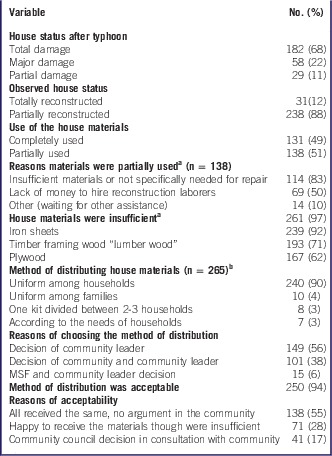
A total of 4000 households benefited from distribution of 1966 house reconstruction kits, 16 boat repair kits, and 17 chainsaws. Of 269 households interviewed, 61% had a fisherman as head of household. All households were affected by the typhoon with 68% incurring total damage (Table 1). In 12% of households, post-distribution housing repair was complete, whereas in the rest (88%) this was partial. Overall, 22% of households received other house reconstruction assistance besides that from MSF.
Utilization, Distribution, and Perception of House Reconstruction Materials After Typhoon Haiyan in Eastern Samar Island, Philippines (n=269)

a More than one response by the same recipient.
b Four households did not know about the method of distribution.
Utilization, Distribution, and Community Perception of House Reconstruction Materials
All households reported having used the house materials but 51% were only able to use the materials partially. Of all households, 97% said that the materials received were insufficient to complete reconstruction. What were particularly lacking were iron sheets for roofs (92%), followed by timber framing wood (71%).
The majority (94%) believed that the materials were uniformly distributed among households or families by community leaders. “We all received the same materials and started reconstructing our houses. Importantly, there was no argument in the community.” In only one barangay (3%) were the materials distributed according to the needs and level of damage.
In 56% the community leader made a decision alone, whereas the rest involved MSF and community members. All community leaders except one affirmed that they opted for uniform distribution between households: “We had to divide the house materials equally between households to avoid conflicts and arguments in the community, it was also more feasible.”
A few (10%) argued that “the materials were not sufficient and distribution should have been based on the needs and the degree of damage.” Despite the shortcomings, all community members perceived the distribution as being valuable.
Of 236 participants who suggested improving future distributions, 55% recommended providing sufficient iron sheets and 17% suggested that MSF should distribute the materials directly to the community.
Utilization, Distribution, and Community Perception of Boat Repair Materials
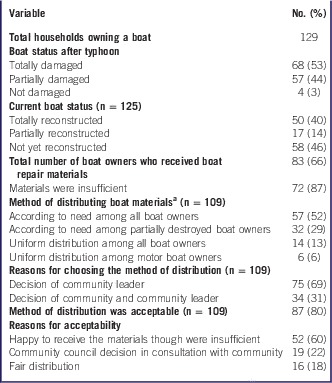
Of 129 households that owned a boat before the typhoon, 97% reported boat damage; 53% were totally damaged (Table 2). After distribution, it was found that most of these boats were not yet (46%) or only partially (14%) rebuilt. Of 125 affected boat owners, 66% had received MSF boat repair materials, but most (87%) said that they were insufficient to complete reconstruction.
Utilization, Distribution, and Perception of the Boat Repair Materials After Typhoon Haiyan in Eastern Samar Island, Philippines

a 16 recipients did not know about the method of distribution.
Among 125 boat owners, 87% knew about the distribution of boat repair kits. In all barangays, the distribution was decided by the community leaders. Of all, 80% accepted the distribution process although the materials were insufficient. Of 42 boat owners who did not receive materials, 69% accepted the distribution. One argued, “Our boat was totally damaged, the materials were insufficient to reconstruct totally damaged boats, so it was distributed among partially damaged ones, which was fair.”
Of 83 who received materials, 52 (62%) found them useful even if they were insufficient. Overall, 103 boat owners suggested providing sufficient amounts of materials in the future and to tailor this to individual needs.
Utilization and Community Perception of the Chainsaw Kit
Out of a total of 184 households interviewed, 76% knew about the availability of the chainsaw kit. Of these, 89% found it useful and 74% felt they were used fairly in the community. About half of households suggested providing bigger chainsaws; the same was affirmed by all community leaders. One community leader explained, “A bigger chainsaw would cut fallen big trees and slice coconut trees into coco-lumber which can be used to reconstruct our houses.”
DISCUSSION
This study documented the success and the problems of an emergency distribution of standardized house and boat reconstruction and repair kits through community engagement in an area struck by a typhoon. Overall, there was a good uptake of reconstruction materials, and the distribution process led by the community was well accepted and felt to be useful. However, variations in the type and degree of damage in households and boats compromised the utility of the content of the standardized kits.
A number of findings and lessons learned merit discussion. First, there was a lack of sufficient house materials: 9 of 10 households had damaged or blown-off roofs, the most vulnerable parts of houses to typhoons.Reference Alam and Collins 3 Use of “standardized kits” generally simplifies the initial procurement and distribution process and favors rapidity. However, since households were subjected to variable degrees of damage, use of kits resulted in some households ending up with more material than needed, while for others, this was insufficient to meet their needs or not specifically needed for repair. The kit was intended by MSF to be shared between 2 to 3 households based on needs, but the kits were divided evenly in the community based on the community leaders’ decisions in consultation with the community, which may explain the shortcomings. The even distribution was linked to the understandable logistical challenges faced by communities in distributing huge masses of materials and the need to avoid conflicts in the community. A possible way forward is to follow up the emergency distribution with a needs assessment and a tailored distribution.
Second, given the viable community governance system in the small villages on the islands, MSF decided to empower the community from the start and leave the distribution process to the local decision-makers, and this seems to have worked rather well. In particular, the distribution was accepted by the majority in the community and was perceived to be transparent and fair. Assessing local governance and decision-making capacity in the affected communities prior to embarking on distributions by MSF seems to have been worthwhile and reduced workload on MSF. Moreover, the significant community engagement and ownership during the whole distribution process is a successful example of community resilience in the aftermath of a devastating natural disaster.
Third, almost all of the boats were damaged by the typhoon, which had a catastrophic effect on the economy of such a fishing community. Moreover, 6 out of 10 boats were only partially or still not rebuilt at the time of survey. One of the reasons may have been the strict regulations on cutting trees needed for boat-frame construction. This suggests the need for alternative solutions to boat-building such as the use of fiberglass. 4
Fourth, it would have been beneficial if the chainsaws provided were larger to handle big trees and to slice fallen coconut trees, which could be used as supporting pillars in house reconstruction. Use of fallen coconut trees was adopted by the International Committee of the Red Cross after Typhoon Haiyan to build storm-resilient shelters in Samar Island and is laudable. 5
Finally, the public health consequences of natural disasters, particularly cyclones, are mostly due to loss of shelters and essential services (food, water, health care, and sanitation).Reference Keim 6 This is one of the first experiences whereby providing materials for shelter and boat repair, MSF actually embarked on a more holistic approach that went beyond helping communities cope with their health needs alone. Shelter is undeniably a basic and core need, and alleviating hardships related to the lack of shelter in the phase after a natural disaster would seem essential to enhance community resilience. There are also health-related dividends. Emergency relief organizations should thus take into consideration all these aspects in response to natural disasters.
In conclusion, this experience with emergency distribution of reconstruction and repair materials of houses and boats using community engagement was encouraging. The lessons learned can be taken on board to improve such future interventions.
Acknowledgments
We thank the MSF team and the survey team in Guiuan, East Samar Island, for their effort and support in conducting this evaluation. We are also grateful to the community and their leaders for engagement and support given to the study team. EA, MCF, and HG conceived the study. EA implemented the study and performed the data analysis. The first draft of the manuscript was written by EA and was critically reviewed by all co-authors. EA is the guarantor of the paper.
Funding
This study was funded by Médecins Sans Frontières–Operational Centre Brussels, Brussels, Belgium.