Introduction: miniature figurines
The ‘mother goddess’ of Çatalhöyük, the Venus of Willendorf and the Cycladic figurines are among some of the most famous, and contentious, ancient objects in the modern day. Though they differ widely in geographical and temporal origin, all are miniature human figurines, an exceptionally widespread form of visual culture in ancient societies that has excited huge interest in the archaeological literature, the art market and the popular imagination. Despite, or perhaps because of, their striking appeal, they have proven problematic to scholars who wish to write about them. Many derive from prehistoric societies, where the archaeologist must balance the attraction of the figurines’ considerable charm with their small number, a complete lack of written sources and, often, no clear archaeological context. Although what Douglass Bailey has termed ‘anecdotal’ interpretations of figurines (Bailey Reference Bailey and Insoll2017, 826–7), or interpretations often focused on their possible religious meaning, have generally now mostly been superseded (Gimbutas’ European goddess cult being the most famous and controversial example: Gimbutas Reference Gimbutas1982; Reference Gimbutas1989; Reference Gimbutas1991), the problem of interpretation has been a continuing preoccupation for studies of ancient figurines, one which has often proved ‘frustrating’ (Nakamura & Meskell Reference Nakamura and Meskell2009, 209). An ongoing fascination with meaning coupled with an often scanty dataset and challenging archaeological contexts have led scholars to develop highly theoretical treatments that are particularly prominent in the literature on prehistoric European figurines (e.g. Hamilton Reference Hamilton1996; Insoll Reference Insoll2017; Nanoglou Reference Nanoglou2005; Reference Nanoglou2008a,Reference Nanogloub; Reference Nanoglou2009; Talalay Reference Talalay1993; Ucko Reference Ucko1968) in which Meskell (Reference Meskell and Insoll2017, 17) notes that ‘it is in the study of prehistoric periods that much of the recent theoretical innovation [in figurine studies] has emerged’. Perhaps most influential among the more recent literature is Bailey's seminal monograph of Reference Bailey2005, in which he drew on frameworks of miniaturization and the human body from art history and cultural theory to posit a universal human reaction to certain visual and material aspects of the figurines. By disregarding the unknowable cultural context of the prehistoric figurines and instead analysing their formal qualities, he argued, ancient peoples’ reactions to the figurines’ formal qualities could be accessed through our own, modern-day experience of them. Thus, even if their original cultural significance remains unknowable, we are able to gain a better understanding of how the figurines worked on their ancient audience through the study of how they continue to affect us. His use of theories of miniaturization in particular continue to inspire much stimulating literature in archaeology that treats figurines from a wide variety of ancient cultures, including a 2015 World Archaeology special issue and a 2018 edited volume from Oxford University Press (e.g. Bailey Reference Bailey and Dent2014; Reference Bailey and Insoll2017; Danielsson Reference Danielsson, Alberti, Jones and Pollard2013; Foxhall Reference Foxhall2015; Langin-Hooper Reference Langin-Hooper2015; Martin & Langin-Hooper Reference Martin and Langin-Hooper2018; Stevenson Reference Stevenson and Insoll2017). Yet the potential problem still remains that there is an exceedingly large temporal and cultural gap between the reaction of a modern-day viewer to handling a small, sculpted human body and the theorized response of the ancient audience. Indeed, Bailey's argument utilized cross-cultural observation of a very wide variety of modern visual culture, some rather far from ancient figurines (his stimulating examples include, among others, Japanese bonsai, Disneyland's Main Street, built at 3/5 scale, and children's toys such as dolls). Despite the widespread use in archaeological literature of the idea of a universal human response to figurines, many remain cautious about such cross-cultural comparisons (Lesure Reference Lesure and Insoll2017, 42). This article seeks to support and further such stimulating studies on material approaches to figurines by examining a class of miniature, shabtis, that offers an immense record of 4000 years of use across several different cultures of a single type of figurine. Two thousand years of shabti use in ancient Egypt are illustrated by countless figurines from a clear archaeological context and numerous textual sources that allow us to trace the reactions of an ancient population to figurines; this record continues a further two millennia through to the present day with the use of shabtis by other ancient cultures, the accounts of early modern European travellers to Egypt, and reaction to shabtis in the modern West. Such a geographically and temporally broad record of response to one particular type of figurine, particularly when illustrated so extensively by textual evidence, offers empirical evidence to support the theoretical argument that human response to human figurines is governed in common ways by the visual and material aspects of the figurines, and not just by the cultural context of the viewer. Moreover, it demonstrates that the emotional response to figurines is an important part of their meaning, and should not be seen as secondary to their functional purpose.
Shabtis
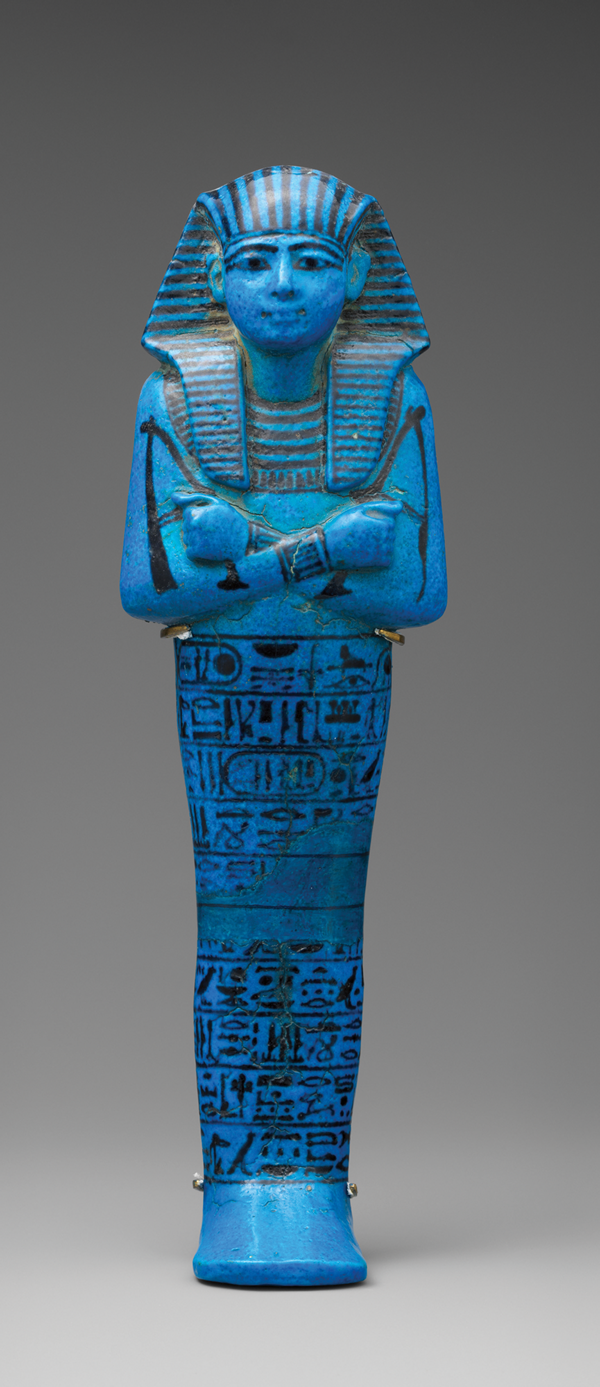
It is noticeable that Ancient Egypt rarely features among the growing literature on ancient miniatures, despite offering perhaps one of the most widely spread examples of ancient human figurines, that of the shabti, which, like all figurines, is particularly popular among collectors and ubiquitous on the art market. While prehistoric figurines retain an alluring air of mystery, however, shabtis are comparatively well understood. The text of the so-called ‘shabti spell’, chapter 6 from the Book of the Dead (Allen Reference Allen1974, 8) is often inscribed in various forms on the bodies of the figurines, and reveals their religious purpose. A standard example, taken from a faience shabti of King Seti I (1290–1279 bc; Fig. 1), can be translated as follows:
O shabti, if Seti is counted upon to do all the works that are to be done there in the realm of the dead as a man at his duties, ‘here I am!’ you shall say when you are counted upon at any time to serve there, to cultivate the fields, to irrigate the river banks, to ferry the sand of the west to the east and vice-versa, ‘here I am!’ you shall say. (Book of the Dead, chapter 6)
Faience shabti of King Seti I c. 1294–1279 bc (h. 30 cm). (Metropolitan Museum of Art, New York, 26.7.919.)

The text of the shabti spell is generally interpreted in the context of other Egyptian religious texts that describe the afterlife as very similar to life on earth, including all of its associated chores. The spell conveys that the owner of the shabti is able to call upon the shabti—quite literally—to perform on his behalf any work that the deceased may be required to do in the afterlife.
In addition to textual evidence, we also have a clear understanding of shabtis’ archaeological context, and a very large data set. Hundreds of thousands of shabti figurines have been excavated from secure burial contexts, underlining their integral place in Egyptian funerary belief and practice. The Egyptological literature therefore generally discusses shabtis in terms of their religious importance in Egyptian society and identifies them as one manifestation of Egyptian beliefs about the nature of the afterlife.
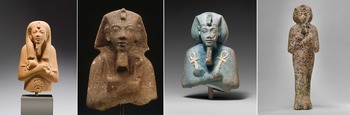
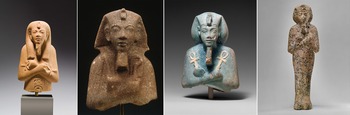
Shabtis are one of the most ubiquitous artefact types to survive from ancient Egypt. In use for approximately 2000 years, from about 2000 bc until the end of the Ptolemaic period in 31 bc, shabtis were one of the few object classes that appeared in both élite and not-so-élite burials, in the graves of both men and women, and often in large numbers (Tutankhamun, for example, owned 413, supplied with 1866 miniature agricultural implements: Reeves Reference Reeves1995, 136–9). The provision of shabtis for burials was such a pervasive cultural phenomenon that even Akhenaten, the ‘heretic king’ famous for his rejection of traditional Egyptian religion, was provided with them (Fig. 2). Shabtis could be manufactured from a variety of materials, but were most commonly made of faience, a non-clay glazed ceramic that was often manufactured in a bright blue colour (Nicholson & Shaw Reference Nicholson and Shaw2000, 177–94). They occur in a wide range of sizes from a couple of centimetres tall to more than half a metre, but average about 15 cm tall.
Shabtis of Akhenaten in various styles. Red and brown quartzite, faience and granite. (Metropolitan Museum of Art, New York, 47.57.2; 66.99.35; 66.99.37; 1982.50.)
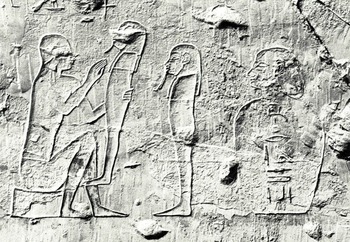
In the present day, shabtis are the foundation of both small and large Egyptian museum collections. The Fitzwilliam Museum in Cambridge has 473 examples listed on its online catalogue; the Louvre more than 7000. Given that only a small proportion of shabtis that were manufactured in ancient times will have survived to the modern day, the sheer number that still remain provide some idea of what an integral part of Egyptian visual culture shabtis must have been. Though ultimately they were buried along with their owner, the production of such a large number of figurines was a major undertaking in Egyptian society. Shabtis could be manufactured from faience, stone, wood or even wax; they were made not by specialist shabti makers, but rather by craftsmen in the workshops that specialized in each particular material (Whelan Reference Whelan2011, 10–12). The importance of these activities to daily life, regardless of the ultimate funerary nature of the product, is demonstrated through the discovery of a number of unfinished stone shabtis from a stone workshop at Amarna (Petrie Reference Petrie1894, 17–18, pl. XXXV), and the depiction of the shabti-making process in tomb scenes, notably in the 26th Dynasty tomb of Ibi (Fig. 3). Shabtis and their boxes are also shown in connection with workshop scenes in the tomb of Neferhotep (de Garis Davies Reference de Garis Davies1933, pls XXV–XXVI) and of Nebamun and Ipuki (de Garis Davies Reference de Garis Davies1925, pls XXIV–XXV). The large-scale production of shabtis, providing in some periods hundreds of shabtis for each moderately well equipped tomb, would therefore have involved a wide number of people and a huge investment of time. The ‘audience’ for shabtis would have encompassed many more parties than the gods or the deceased individual in the closed environment of the tomb. As shown by the tomb workshop scenes, many craftsmen in different types of workshops would have been involved with the manufacture of these objects, and since faience workshops were located in domestic settings (Nicholson & Shaw Reference Nicholson and Shaw2000, 187), they would have been visible to all sorts of people during their production: the purchaser would have chosen which shabtis to buy, perhaps exercising choice between the different designs or colours available, while the cult personnel would have prepared them for burial, sometimes with involved tactile processes including anointing and wrapping with linen (see further below), and placed them in the tomb. The activities involved in producing, purchasing and deploying shabtis therefore made these small objects a much more prominent part of the Egyptian visual landscape for the better part of two millennia than their eventual entombment would suggest.
Shabti making depicted in the Tomb of Ibi. (From Kuhlmann & Schenkel Reference Kuhlmann and Schenkel1983, tfl. 107a. © DAI Cairo.)

Given the prominence of shabtis in the archaeological record, the limited role they play in modern Egyptological scholarship is surprising. Shabtis are often treated as merely the material confirmation of Egyptian textual sources about the afterlife, or used in much the same way as ceramic evidence as a useful dating tool for the tombs from which they come. Stewart's comments in his volume on shabtis on the primacy of the figurines’ religious function over their aesthetic value reflect mainstream Egyptological attitudes: ‘A few [shabtis] are also superb works of art, although this aspect tended to be incidental to their main purpose, which had little to do with aesthetics’ (Stewart Reference Stewart1995, 8). Despite the overwhelming number of figurines in many museum collections and their popularity among the general public, such scholarly attitudes mean that there has only ever been one museum exhibition devoted to shabtis, held at the Louvre in 2003 (Bovot Reference Bovot2003). Shabtis these days, it seems, are often left to the domain of the art market, where collectors’ interest in the figurines as charming collectibles instead of as archaeological evidence makes scholars even less inclined to give shabtis serious attention.
I will argue that shabtis should be reconsidered within the broader framework of miniatures, and particularly miniature human figurines, for two reasons: firstly, that Egyptological interest in shabtis’ religious function has overlooked the importance of aesthetic response in both their original uses and their reception. Shabtis have proved to be hugely popular objects outside Egypt in both the ancient and the modern world, travelling widely to cultures in which they no longer retained their original religious purpose. The answer to shabtis’ cross-cultural popularity, therefore, must lie beyond religious explanations. Moreover, shabtis remained a ubiquitous part of Egyptian material culture for two millennia even while other items of burial equipment fell out of fashion, and over this time underwent numerous developments in style and use that are seemingly unrelated to their religious function. I will argue that the Egyptians shared our visual, tactile and emotional response to shabtis and saw them as more than just functional religious objects, exploiting their material qualities to increase their power as affective objects.
Shabtis in modern scholarship
In A.J. Spencer's popular volume Death in Ancient Egypt, barely two pages out of 242 are devoted to discussion of shabtis (Spencer Reference Spencer1982), despite the fact that they are the most numerous tomb object from ancient Egypt. In most scholarly treatments of Egyptian funerary religion, shabtis are presented as minor objects with little apparent importance among the wider tomb assemblage, simply described in terms of their religious function as ‘servants for the afterlife’. Christiane Ziegler of the Louvre damns them with distinctly faint praise as ‘témoignages modestes mais néanmoins passionnants des croyances pharaoniques [modest but nevertheless fascinating testaments of pharaonic beliefs]’ (Bovot Reference Bovot2003, 9).
In fact, academic studies that focus on shabtis are often conducted by scholars outside the Egyptological mainstream, most notably the series of descriptive catalogues of shabtis by Glenn Janes, an independent scholar, shabti enthusiast and collector who runs the website www.shabtis.com (e.g. Janes Reference Janes2010; Reference Janes2012; Janes & Bangbala Reference Janes and Bangbala2002). Shabtis’ popularity among collectors is a major factor in their inconspicuous position in Egyptological scholarship, and seems to diminish their worth as a serious subject of study in the eyes of many scholars. In a 1924 review of Speleers's monograph on shabtis, H.R. Hall, erstwhile curator at the British Museum, made the following dismissive observation: ‘They are quaint little people, the shawabti-folk, and a lover of Egyptian things could do worse than confine himself to collecting them. But, if he does, he must look out for good and interesting specimens, and eschew the cheap and common Saïte multitude’ (Hall Reference Hall1924, 178). Hall here personifies the shabtis, characterizing them almost as if they were a race of people (‘the shawabti-folk’), and stresses their diminutive stature, which seems for him to correspond to the size of their scholarly importance.
Although the functional, religious aspects of shabtis no longer have great relevance to a modern audience, their material qualities continue to inspire a particularly emotional response from a broad range of viewers. The responses of scholars, collectors and artists to shabtis demonstrate that modern viewers, whether consciously or not, are attracted to the miniaturized human form and small varieties in an otherwise homogeneous object class. Such emotion is a striking reaction to a supposedly functional object whose original religious purpose was lost more than 2000 years ago, and its cause may be explored by means of the now well-developed body of art-historical and cultural theory on miniatures.
Shabtis as miniatures
The power that miniatures exert over their audience has long been recognized in art history and cultural studies, and used to discuss the genre of painted ‘miniatures’ (e.g. Coombs Reference Coombs1998; Grootenboer Reference Grootenboer2012; Lloyd & Sloane Reference Lloyd and Sloane2008) as well as miniature objects and the phenomenon of miniaturism more generally (Mack Reference Mack2007; Stewart Reference Stewart1984). In recent years, the concept has also gained traction in archaeology to discuss figurines from numerous cultures. And indeed, the widespread use of miniature objects in many different cultures and time periods gives us some idea of the power that things of reduced scale exercise on their audience. Smallness, quite apart from diminishing an object's importance, can in fact enhance its power and efficacy. According to Bailey, miniatures are not intended as models; that is, as accurate but reduced-scale representations of reality. Rather, the essential essence of the ‘original’ has been simplified and distilled, to create an object intended to stimulate the imagination (Bailey Reference Bailey2005, 20).
The reduction in size works in many ways to increase miniatures’ significance. The tiny details of miniatures invite close looking. Because of their scale, miniatures must leave out certain details in their representation, forcing their audience to make inferences and thus compelling an active response from the viewer. These omissions invoke curiosity and make miniatures mysterious, implying that there are things about them we cannot know. In the case of human figurines, in presenting to the viewer a body like their own but with drastically reduced scale, the audience is made to feel enlarged and therefore secure, invoking pleasure in miniatures’ contemplation or handling. Miniatures also demand intimacy, since a viewer must pick them up to look at them. A miniature cannot be viewed from a distance, but must be handled and brought close to the face, again fostering an active relationship between miniature and viewer. The observations of the viewer are necessarily private, thanks to the extreme proximity between themselves and the figurine (Bailey Reference Bailey2005; Grootenboer Reference Grootenboer2012; Langin-Hooper Reference Langin-Hooper2015; Stewart Reference Stewart1984).
Shabtis are obviously miniatures, since they represent human figures much smaller than life size. Beyond this, though, the scale of shabtis relates to our bodies in a very particular way: they are hand-sized. In one example to quantify this observation, 80 per cent of the several hundred excavated shabti figurines at the New Kingdom cemetery at Aniba were found to measure between 9 and 15 cm (Olson Reference Olson1996, 207). The miniaturism of shabtis is therefore linked to a very particular scale that encourages their handling, reflecting the general rule of miniatures that they are scaled according to the human body that interacts with them (Mack Reference Mack2007, 53; Stewart Reference Stewart1984, 56). Indeed they were handled before their interment, often with extreme care: shabtis have been found in tombs wrapped in linen, sometimes in elaborate patterns that mirrored the mummification of human corpses, and anointed with incense (Riggs Reference Riggs2014, 37). Whether or not shabtis received such elaborate treatment, the bodily labour involved in transferring and properly arranging up to several hundred shabtis in the tomb would have been considerable.
Shabtis are often hand sized, of a form pleasing to handle with no sharp corners or edges, and simplified in detail to invite close looking. However, it is their miniature human form that has perhaps the most powerful effect on their audience. The German phenomenological philosopher Edmund Husserl recognized that the empathy of humans for other bodily forms is so strong that even sculpted bodies will evoke a feeling of affinity in human viewers (Risatti Reference Risatti2007, 119), while the important cultural significance of the body has been recognized to imbue the depiction of human bodies with emotive meanings (e.g. Bailey Reference Bailey2005, 139–42; Meskell Reference Meskell and Insoll2017, 18; Robb & Harris Reference Robb and Harris2013). In addition, the human form in miniature creates paradoxes that beguile the viewer (Bailey Reference Bailey2005, 135). Figurines appear human, but are much too small; their bodies are often simplified and thus ‘missing’ parts of a full-size body (in the case of the shabti, the details of the body are commonly concealed under the bandages of mummification). Like all human figurines, shabtis confound the distinction between objects and people, and in their position as funerary equipment, they are ‘this world’ objects whose sphere of influence is the ‘next world’. Indeed, this liminal status may well have been heightened by the faience material from which they were most often made, whose glimmering surface had divine associations (Friedman Reference Friedman1998, 15). Shabtis are inherently active in their meaning as agricultural workers, and yet static in their stiff, mummiform shape. Paradoxes such as these have the potential to evoke powerful emotions in the viewer, and even humour: think of Hall's ‘quaint shawabti-folk’.
According to art historians, then, interaction with miniature figures can create a powerful imaginary world for the viewer, but the theory of the universal appeal of figurines (and thus of shabtis) can also be supported by neuroscientific research on visual response, where the audience's experience of ‘miniature worlds’ is observed experimentally as well as experientially. Research by A.J. DeLong in the 1980s found that playing with miniature figures markedly affected subjects’ perceptions of time. The smaller the miniatures, the more the viewer's sense of time passing was distorted: a group playing with miniatures at 1/12 scale believed 30 minutes to have passed after only two minutes of play (Bailey Reference Bailey2005, 37–8; DeLong Reference DeLong1981; Reference DeLong1983).
The centrality of the three-dimensionality and manipulability of figurines on viewers’ experience of them, often discussed in art-historical theories of miniaturism (Zuckert Reference Zuckert2009), can also be experimentally confirmed through neuroscience's investigation of ‘mirror neurons’. When looking at a three-dimensional object that is of a size and shape to facilitate handling, exactly the same neurons are activated in the brain as when the object is in fact picked up (Freedberg & Gallese Reference Freedberg and Gallese2007). In other words, when we see an object that is scaled and shaped to fit in our hands—such as a shabti—our brains behave in exactly the same way as if we had actually handled it, inspiring the desire to reach out and touch. The shabti's three-dimensionality therefore exerts an important psychological effect on its audience, which is only magnified by the curiosity ignited through the inherent paradoxes of the miniature form.
It is clear that the idea of the universal appeal of shabtis and other figurines as material objects—as things that are appealing to humans, evoking curiosity and desire—must be taken seriously. Art-historical theories are supported by scientific observations that demonstrate the response to material aspects of human figurines is largely conditioned not by cultural factors, but by a common experience of the human body and its scale. Indeed, we will see that modern reactions to shabtis are concentrated on their miniature, personified nature. If such reactions are universal, we would also expect figurines to provoke these reactions in their ancient audience, as indeed Bailey has theorized; by taking advantage of the huge variety and number of data on shabtis, might it be possible actually to trace these reactions in the past?
Supporting theories of miniaturism with historical and archaeological data
In the absence of any satisfying understanding of the ancient meaning and uses of prehistoric European figurines, Bailey turned to frameworks of materiality to theorize how ancient populations might have interacted with them. This approach opened new perspectives from which a modern audience could view prehistoric objects, and was particularly successful at reinserting the importance of materiality into discussions of objects that had previously focused overwhelmingly on religious explanations. While Bailey's interpretations are persuasive, in prehistoric societies there is almost no evidence available to verify these theorized reactions, hampered both by lack of text and a small number of extant figurines. The Egyptian data set has here a major contribution to make in confirming the theories of archaeological figurine studies: we have for a single type of figurine both textual and archaeological evidence that records the interaction of humans with shabtis both in Egypt and elsewhere, and in time periods from c. 2000 bc through the Renaissance and up to the present day. Theories of miniaturism discussed above suggest the material properties of figurines inspire a universal response in viewers irrespective of culture, and I will argue that through the analysis of documents spanning more than 1500 years it can be demonstrated that reactions to shabtis in the past were indeed the same as modern responses, i.e. inspired by the visual and material form of the shabtis without regard to their religious function. The archaeological record in Egypt also supports this assertion: several aspects of shabtis’ stylistic development are more persuasively interpreted as attempts to maximize the affective power of the shabtis’ material form than as changes in Egyptian religious belief. A materially aware interpretation of ancient figurines is therefore not just a useful theory to be applied in cases where other forms of evidence are lacking, but can be shown through Egyptian evidence to be a vital part of human interaction with these miniature figures throughout history.
Shabtis in modern western culture
The British Museum curator H.R. Hall, quoted above, described shabtis in a way that emphasized their small size and personified nature. A similar reaction abounds amongst collectors and enthusiasts, though they interpret that reaction rather differently to scholars. In a comment on a Manchester Museum blog post by curator Campbell Price on the museum's shabti collection (Price Reference Price2012), collector Chris Simons writes:
I have a very small collection of shabtis … My favorite is ones from T.I.P [Third Intermediate Period] They are mostly dark blue with black writing on them, Each one has its own personality My favorite in the collection I have is small white shabti with the biggest smile (comment 1307 on Price Reference Price2012, posted 6.38 p.m., 19 May 2012)
As Mr Simons shows, shabtis are eminently collectible: in many ways they vary little amongst themselves, with most mummiform in shape, made of faience and small enough to hold in the hand. These similarities make them a very well defined group. But the small variations between them—the individual ‘personalities’ with which Mr Simons is so enamoured—encourage classification (the complex coding system to describe all possible attributes of shabtis developed in 1977 is used by many shabti catalogues, including those by Janes discussed above), and thus collection. The ability to sort shabtis based on small variations between them is key to their collectability, since ‘collection is classification lived, experienced in 3-D’ (Elsner & Cardinal Reference Elsner and Cardinal1994, 2).
The somewhat emotional response embodied by Simons’ ‘smile’ and Hall's ‘quaint little people’ is a reaction that many modern people have to shabtis, more so than to other Egyptian artefacts. This no doubt contributes to scholars’ discomfort regarding shabtis, given academia's more common approach of disinterested rationality. Since shabtis are objects scholars know to be functional religious tools, the realization that we are responding to their visual and material qualities can be rather disquieting, and indeed an academic response to ‘craft’ objects that favours their functional features over their visual appeal is common outside Egyptology as well (Risatti Reference Risatti2007, 119).
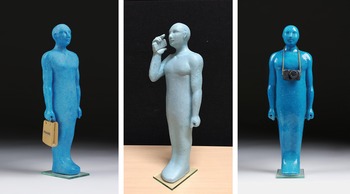
Yet much as scholars might like to dismiss emotional responses to shabtis as particular to a collector's zeal, in fact the affective power of these objects resonates far more broadly among the general public. Recently the Syrian artist Zahed Taj Eddin installed exhibitions of his faience ‘nu’ shabtis (a play on a variant name for the ancient figurines, ‘ushabtis’) at the Victoria & Albert Museum, the Petrie Museum and most recently the Manchester Museum in the UK (Fig. 4). The shabtis, all of similar size but of varying hues, are displayed in troupes, sometimes in neat ranks and sometimes more chaotic groupings, and occasionally scattered individually around the galleries, interacting with ancient Egyptian objects (as at the Petrie Museum). According to the artist, the nu shabtis have found themselves in the difficult situation of ‘hav[ing] awoken in the 21st century and found there is no afterlife, no god of the underworld, and no labours to perform. They are “liberated” and walk among us finding new things to do with their lives’ (Rosser-Owen Reference Rosser-Owen2015).
Zahed Taj Eddin, ‘nu’ shabtis. (V&A ME 17-2015; ME 19-2015; ME 21-2015. © Victoria and Albert Museum, London.)

But why would a Syrian artist find inspiration in this particular ancient Egyptian object type? Despite their different functional circumstances to their ancient counterparts, the success of these shabtis in an visual sense is much the same: they are miniature, of a size to be easily held in the hand, and they are multitudinous, with the pleasing repetition of a troupe broken up and made interesting by small variations in colour or attribute. Their human form encourages both the artist and the viewer to personify what are demonstrably inanimate figures, and Taj Eddin plays with the evocative power of the shape of the human body, placing his nu shabtis in mundane situations more commonly experienced by full-sized humans (holding a camera, mobile phone, or supermarket shopping bag). The viewer derives fascination and even humour from the fact that, paradoxically, small blue ceramic figures are acting as if they were ‘real’ people, while their reduced scale keeps the audience whose behaviour they are emulating resolutely excluded—notably, when the figurines stand within the locked display cases at the Victoria & Albert and Petrie Museums. The potential emotive power of the shabti's form is particularly evident in the Manchester exhibition, in which the shabtis (some wearing tiny orange life jackets) were used to respond to the human suffering of the European refugee crisis.Footnote 1
Early modern records of interaction with shabtis
Historical records demonstrate that a particular interest in shabtis among the broad variety of Egyptian material culture is by no means restricted to modern-day audiences, and many accounts by early travellers to Egypt pick out shabtis as worthy of note. Just as in the modern day, the miniaturism and personification of the shabtis were particularly important in shaping reactions to them. As early as 1583, explorer Mikołaj Radziwiłł described shabtis he observed in Egypt thus:
idola haec sunt ex argilla, caerulei vel violacei coloris, efficta … formam infantuli fasciolis circumligati, adiectis multis Aegyptiorum characteribus, exprimentia [these idols are made from clay, blue or violet in colour … imitating the form of a small child wrapped around with little bandages, with many Egyptian characters added] (Radziwiłł Reference Radziwiłł1601, 195)
While noting the shabtis’ possible variations in colour (caerulei vel violacei), he also describes them as ‘child-like’ (formam infantuli), and emphasizes their miniature nature with the use of a Latin diminutive form (infantuli).
In a strikingly similar vein, the Dutch painter Cornelis de Bruyn writes of a trip to Saqqara in the seventeenth century:
en welkers vlakke grond bezaayd is, met verdroogde gebeenten … en een menigte van kleyne Afgodetjes, van welke eenige van hout, andere van pleister, met groen gevernist, gemaakt … Ik moet alhier den Leezer waarschouwen … dat de Arabiers zederd wel ondervonden hebben, dat voor deze Afgoden beeldjes geld gemaakt kan warden, dat ze dezelven nu wel weten na Kairo te koop te brengen … hoewel ‘t ook waar is, dat ze niet zeer duur zyn. De Franken, wetende dat men in Europa, na die snuisteryen der Oudheid, begeerig is, koopen dezelve op, en verkoopenze daar na wederom aan andere. [[At Saqqara] the flat ground is strewn with dried out bones … and a host of tiny little idols, of which some are made of wood, others of plaster with green varnish … I must here warn the reader … that by now the Arabs have worked out that one can make money off these idols, that they manage to bring them to Cairo for sale … though it is true they are not expensive. The Franks, knowing that people in Europe are eager to have these antique knickknacks, buy them up and resell them later to others.] (de Bruyn Reference de Bruyn1698, 204)
Once again, the shabtis are described with a diminutive form, afgodetjes, and their personified nature is underlined with the description of their grouping as a menigte or ‘crowd’. The variety of materials of which they can be made is noted. A similar account appears in the printed catalogue of Leiden's Theatrum Anatomicum of 1706. A collection of shabtis is described as:
Dertien aegyptische kleine godenbeeldjes zoo van porcelein als van hout [Thirteen small little Egyptian statues of gods, made both of porcelain and of wood] (Schneider Reference Schneider1977, 2.7)
Describing them not only as small, kleine, but also with the diminutive form of the word ‘statue’ (beeldjes), serves doubly to emphasize the miniature nature of the objects, and again the variety within the object class is stressed.
De Bruyn mentions that even as early as the seventeenth century, enterprising Egyptians were taking advantage of the popularity of shabtis and selling them on the art market. The desirability of shabtis in early modern Europe is further demonstrated through the example of a mid seventeenth-century ad ‘shabti’ now in the collection of the Ashmolean Museum, the earliest ‘fake’ known (Whitehouse Reference Whitehouse1989). Shabtis were also among the first Egyptian objects donated to the University of Leiden collection by David le Leu de Wilhelm in 1619, and among the 160 Egyptian objects that were part of Sir Hans Sloane's founding collection of the British Museum in 1753 (Moser Reference Moser2006, 34–5). A further shabti (EA9183) was donated to the British Museum in 1756 by Pitt Lethieullier. As Moser notes, though the shabtis had no historic or artistic interest at this early period, they ‘possessed the features characteristic of the ‘ideal’ curiosity and thus were seen as having good display potential’ (Moser Reference Moser2006, 43).
The interest of these early travellers and collectors in shabtis does not come from an interest in their religious function, which was not understood before the decipherment of hieroglyphs in 1822 allowed the text of the shabti spell to be read. Rather, analysis of textual accounts shows that the appeal of shabtis seems to have derived from their small size (emphasized through the use of diminutive linguistic forms), their personified nature (they are called ‘little children’ or ‘little gods’) and the pleasing variety of colours and materials from which they were made.
Ancient records of interaction with shabtis
Outside Egypt, other cultures in the ancient world also felt shabtis’ charm. Shabtis were some of the most widely spread Egyptian objects in the ancient world and particularly throughout the Roman Empire, with examples found in Carthage, Britain, Tangiers, Belgium, Germany, France and Croatia, as well as both Etruscan and Roman Italy (e.g. Leclant Reference Leclant1955; Reference Leclant1970, 366; Ratié Reference Ratié1961; Tomorad Reference Tomorad2006). The figurines comprised both contemporaneous, locally made statuettes (‘pseudo-shabtis’) and Egyptian originals, looted from much earlier tombs, such as that of Necho II found at Carthage (Vercoutter Reference Vercoutter1955). While the demand for these figurines was clearly high enough for looters to undertake the effort of moving them long distances to their widely scattered destinations, their popularity cannot have been spurred by the original religious function of the figurines, since they were not used for their original purpose in their new cultural contexts. Although these shabtis were sometimes found in graves, there is no other evidence of Egyptian funerary belief accompanying them, and it is therefore likely that shabtis were no longer conceived of as servants to carry out work in the afterlife. The very wide area in which shabtis have been found demonstrates that their appeal in the ancient world was not unique to Egypt, but cross-cultural and not dependent on their original religious function.
The theoretical frameworks discussed above—that miniature figurines, through their scale and personification, provoke a universal response of beguilement in audiences irrespective of their cultural context—can therefore be supported through examination of historical and archaeological evidence concerning cross-cultural response to shabtis. Through the long afterlife of one particular type of figurine, we can see that from ancient times onwards shabtis travelled widely, their appeal apparently unrelated to their original religious function (which in many cases was unknown to the viewer). Moreover, textual documents that describe encounters with shabtis outside their original cultural context from the sixteenth century to the present day demonstrate that this appeal was based not on criteria specific to the receiving culture, but particularly on the size of the shabtis and their personified nature: in other words, by their material qualities as miniature human figures.
The ancient Egyptian response to shabtis
If the material properties of shabtis have acted so powerfully on audiences across time and space, it is a reasonable proposition that the Egyptians themselves would also have responded to the visual and tactile qualities of shabtis. The reactions of ancient peoples to their culture's figurines, however, have always been challenging to access, because of the lack of textual sources and the small number of examples of each type of figurine. Yet shabtis offer us not only a rich archaeological record of their use, but also numerous contemporaneous textual records through which we may trace Egyptians’ understanding of and reactions to them. I will here argue that Egyptian texts on shabtis strongly suggest that Egyptians did respond to the material properties of shabtis in the same manner as other, later groups of people. This response formed such an important part of Egyptians’ interactions with shabtis that certain stylistic developments in shabtis over time seem to have developed as a way to maximize the appealing visual qualities of these figurines.
The personification of shabtis
Throughout this paper we have seen that miniatures are capable of taking on their own private lives in the minds of their audience. There are several pieces of evidence that suggest that shabti figurines were also personified by the ancient Egyptians: not just in the obvious sense that shabtis were understood to represent workers in the afterlife, but also that the objects themselves were regarded as having personhood.
The first indication beyond their human shape that shabtis were regarded as being in some way ‘people’ is that they are able to communicate in the same way as humans. The opening of the shabti spell addresses them directly in the vocative with ‘O, shabti!’ (see above, Introduction). The shabtis are also able to speak: they both answer ‘here I am!’ in the shabti spell and speak directly to promise that they will ‘do everything’ that is assigned to their owner in the afterlife in the shabti decree of Neskhons (line 24; Černy Reference Černy1942). The personification of shabtis may be further traced textually in the interesting ink inscription that appears on the right side of an alabaster shabti for the king's scribe, Nehy (British Museum EA 8704). The text records the number of shabti statuettes made by the craftsman in a two-month period: ‘the first day of the season Peret, until the second month of the season Peret, final day, 44 men (s)’ (Birch Reference Birch1884, 54; Schneider Reference Schneider1977, 1.242). The shabtis are here personified not as ‘statues’ or even ‘shabtis’, but as ‘men’. The famous shabti receipt of Petekhons in the British Museum (EA 10800), one of two such documents to survive, paints a similar picture:
As Amun, the great god, endures, I have received from you the silver, (the price) of these 365 ushabtis and their 36 foremen, 401 in all, to my satisfaction…and I have received from you their (value in) refined silver, (namely the price) of the 401 ushabtis. (O ushabtis,) go quickly to work on behalf of Osiris for the beloved of the god, the wereb-priest Ihafy. Say ‘we are ready’ whenever he will summon you for the service of the day; I have received from him your silver. So he said in the presence of Bastet (?) --------, Ptah and Horus, the great one of the holy place; so he said speaking with his own mouth. (trans. Edwards Reference Edwards1971, 122)
The amulet maker Petekhons declares that he has received full payment for a troupe of 401 shabtis, and then addresses the shabtis directly, enjoining them to work hard on behalf of the deceased. The paradoxes of shabtis, as we have seen, often evoke humour in modern observers, and it may be possible to see a similar response here: the text is a sophisticated example of genre-switching, in which the receipt echoes the form of a legal decree, but instead of human witnesses the gods are said to be present to ensure the shabtis live up to their side of the bargain. The phrasing of the classic shabti spell is used, but includes at the end the addition of Petekhons’ financial incentive. The demonstrably inanimate shabti figures are thus imagined here as beings with free will, who can choose to work or not, and given legal personhood.
Artistic evidence supports the impression from the texts. Whereas early shabtis seem to have represented the deceased themselves directly and occurred only in small numbers in tombs (Aston Reference Aston1994, 21; Bourriau Reference Bourriau1988, 97–100), over time the number of shabtis in a single tomb increased. In the New Kingdom (1550–1070 bc), it became common that the figurines in a troupe of shabtis were divided into two groups: one much larger class shown carrying agricultural tools, and another smaller group in which the shabtis carried whips and staves (Černy Reference Černy1948; Milde Reference Milde and Wendrich2012, 5). In other words, the shabti troupe exhibited organization into socially stratified groups, in which the majority of worker shabtis were supervised by a smaller group of overseers. The idea that these afterlife workers would require some sort of supervision—presumably because, just like real workers, they would otherwise be inclined to shirk their responsibilities—also strongly suggests that the shabtis were conceived not just as magical tools, but as personified beings.
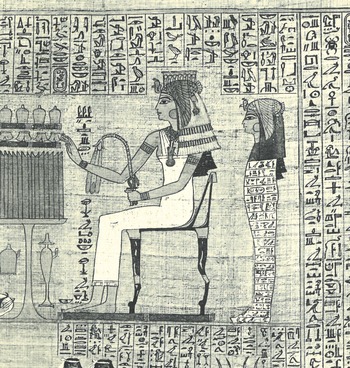
Shabtis’ occasional appearance in tomb art further supports the contention that Egyptians saw them in a different light to other tomb equipment. The shabtis are depicted not at a much smaller scale than the tomb owner (as in reality), but at the same size as the deceased, as shown in the vignette from Papyrus Maatkare (Fig. 5). The same equivalence of scale between shabti and person is seen on the shabti box of Mutemmeretes (Fig. 6), and even in the scene of shabti-making from the tomb of Ibi (Fig. 3). The depiction of shabtis as human-sized in art adds to the impression that the Egyptians conceived of them as personified beings with a particular significance rather than as inanimate tools, but is in striking contrast to their miniature, physical form. Why might the size of shabtis have differed so much between media? Their location in the tomb, their glittering faience material, and their wrappings that transformed them into sacred objects (both in the mummiform depictions and the literal bandaging of figurines in examples cited by Riggs Reference Riggs2014) all suggest that shabtis were potentially powerful bodies with divine characteristics: the reduction of size of the figurines into a form that could be handled, then, as opposed to their human-sized depiction in art, was a way in which the power of the shabtis and the liminality they embodied between this world and the next could be negotiated and directed by the tomb owner.
Queen Maatkare with shabti behind her. (Papyrus Maatkare. From Naville Reference Naville1912.)

Shabti box of Mutemmeretes. The shabti stands on the left. (Rijksmuseum van Oudheden, Leiden, AH 186.)

Smaller in size, and greater in number
A second trend in shabti development whose explanation may benefit from consideration of shabtis’ materiality is the increase in the number of shabtis per tomb in the late New Kingdom and Third Intermediate Period. As Petekhons’ decree tells us, the ideal number of shabtis rose from a handful to 401, although this exact number of figurines is very rarely found in tombs. In fact, in certain cases in the Third Intermediate Period, the number could be even higher, as is the case with the more than 1000 figurines found in the tomb of the 21st Dynasty king Psusennes I (Aubert & Aubert Reference Aubert and Aubert1974, 150–56). The increase in number of the shabtis at this time is often accompanied by a reduction in size of the figurines, which fell to under 10 cm tall on average and in the 25th Dynasty shrank to as little as 5 cm (Haarlem Reference Haarlem1986, 82ff.; Schneider Reference Schneider1977, 173).
What could explain this change in the practice of shabti provision? Some have linked the use of smaller shabtis to a scarcity of resources, theorizing that the poor quality of many of the statues (Aubert calls them ‘certainement pas de chefs-oeuvre [certainly not masterpieces]’) is a result of the instability of the politically decentralized Third Intermediate Period (Aubert & Aubert Reference Aubert and Aubert1974, 174; Stewart Reference Stewart1995). However, Shepenwepet II, God's Wife of Amun in the 25th Dynasty (712–657 bc), was furnished with both small, somewhat crude faience shabtis, only 8 cm tall, and also large stone examples with a very fine level of workmanship (Fig. 7). The existence of both types of shabti within a single tomb indicates that the change to smaller, less decorative shabtis cannot have been solely due to poor availability of materials and good craftsmanship.
Shabtis of Shepenwepet II from her tomb at Medinet Habu: (left) stone; (right) faience. (From Hölscher Reference Hölscher1954, pl. 21. Courtesy of the Oriental Institute of the University of Chicago.)

Most previous explanations of the shabtis’ numerical increase and shrinking size have tried to find a religious explanation for the phenomenon. Scholars have previously pointed to the fact that shabtis began to be referred to as ḥmw in the Third Intermediate Period, a term they translate as slave. The shabtis’ new status as ‘slaves’, they contend, encouraged the provision of a greater number of figurines that were carelessly made: Stewart argues that the increase in the number of shabtis ‘reflected a greater availability of migrant or captive labour [in the Third Intermediate Period], which affected the status of the figures, which came to be regarded as servants or slaves’ (Stewart Reference Stewart1995, 10). However, this is an unconvincing explanation for several reasons. Firstly, the word ḥmw is sometimes also used to describe shabtis during the New Kingdom, before the Third Intermediate Period, when the figurines were larger and of a higher artistic quality (Schneider Reference Schneider1977, 321). Secondly, ‘slave’ is a poor translation for ḥmw. The common Egyptian priestly title, Hmw-nTr, demonstrates the problems with such an interpretation: surely the (socially élite) priest is not a ‘slave’ of the god, but rather a ‘servant’, just as the text of the shabti spell suggests shabtis were viewed from the New Kingdom onwards.Footnote 2 Indeed, when a contract between two people resembling slavery is discussed in post-New Kingdom Egyptian texts, it is not the word ḥmw-ntr that is used, but rather bꜢk (Cruz-Uribe Reference Cruz-Uribe1982). Moreover, there is no other evidence that there was a shift in belief in the religious function of the figurines in the Third Intermediate Period. The shabti spell, when it could be inscribed on the smaller figurines, did not change in its essential meaning (Schneider Reference Schneider1977, 321–3).
A material approach, informed by the art-historical frameworks discussed above, suggests a more convincing explanation for the proliferation of small shabtis. We have seen that in making miniatures smaller, their affective power on the viewer is increased. The higher the level of miniaturization, the more concentrated the paradoxes offered by miniature human bodies: as the intriguing dissonance between their human form and tiny size is multiplied, the more appealing they become to viewers (shown by the increased power of the smallest miniatures in DeLong's study to affect their audience's perceptions). The effect of extreme smallness can be magnified by also multiplying the number of figurines, allowing the troupe of shabtis to take advantage of the pleasing visual effect of a collection in which the same form is repeated until the shabtis almost overwhelm the viewer with their multitude—a technique also utilized by many modern museum curators, who display their shabti collection in a visually arresting mass of repeated ranks of hundreds of figures. In the absence of any evidence for a change in religious belief surrounding shabtis in the Third Intermediate Period, then, the change to a greater number of smaller shabtis may be more convincingly interpreted as a technique to maximize the affective power of the miniature human form on its audience.
Diversity in uniformity
Another interesting and as yet unexplained feature in the use of shabtis, particularly those of the high élite, was for a single burial assemblage to be equipped with several different sizes, materials and styles of shabti. The pharaoh Seti I's burial assemblage is one example of this phenomenon, with shabtis of many different types of material and style featured among his total of several hundred figurines (Aubert & Aubert Reference Aubert and Aubert1974, 78–80). King Ramesses III and the God's Wives of Amun, buried in Thebes in the Third Intermediate Period, offer further examples of a variety of styles, materials and sizes in a single troupe (Aubert & Aubert Reference Aubert and Aubert1974, 116; Hölscher Reference Hölscher1954). The shabtis of King Akhenaten are perhaps the most interesting instance of this phenomenon (Fig. 2; Martin Reference Martin1974, 72–4). That Akhenaten owned shabtis at all is striking, given his religious revolution and his transformation of the traditional Egyptian conception of the afterlife in which shabtis functioned (Hornung Reference Hornung1999, 95ff.). These new religious beliefs are reflected in the fact that his large, fine shabtis do not bear the traditional shabti spell from the Book of the Dead and that they carry ankh-signs or the crook and flail, rather than agricultural implements. Nevertheless, his tomb was still supplied with a large variety of shabtis manufactured from various materials, wearing various headgear and carrying a variety of different equipment. The use of various styles within a shabti troupe does not correspond to functional differences between the shabtis; e.g. the distinction between worker and overseer shabtis. Rather, this phenomenon appears to have been used as a way to maximize the shabti's inherent material appeal through the intriguing visual effect of small differences between objects.
We have already discussed the power of shabtis as a collective, and as a collection of a multitude of similar objects, the pleasure of whose variability was often commented upon by early modern travellers. Viewing shabtis in large numbers magnifies the tension that the object class exhibits between sameness and difference. Jean-Luc Bovot comments on this ‘diversity in uniformity’: ‘de la diversité dans l'uniformité … au premier coup l’œil tous les chaouabtis se ressemblent … un examen plus rapproché révèle un monde insoupçonné de détails diversifiés, une incroyable variation dans les formes [concerning the diversity in uniformity … at first glance all the shabtis resemble each other … a closer look reveals an unexpected world of diversified details, an incredible variation of forms]’ (Bovot Reference Bovot2003, 24: emphasis mine). We return here to the attractive idea that every shabti, although superficially similar in appearance, has its own personality and thus uniqueness. Individuality is revealed in their miniature faces if only the viewer looks hard enough, a promise of intimacy that once again serves to attract the viewer. Through the use of different styles, scales and materials within a single troupe of shabtis, small variations within an otherwise homogeneous group of objects intrigue the eye of the audience by maximizing the effect of ‘diversity in uniformity’. The shabtis all perform the same task from a religious perspective, but their numbers overwhelm the senses, their multitude seemingly swelled by the use of various materials, styles and sizes.
Shabti boxes
Miniature figurines lead to the creation of separate, miniature worlds in the imagination of their audience, and art historians have often noted that miniatures require a frame through which the resultant microcosm can be contained: we might think of a doll's house (Stewart Reference Stewart1984, 61–3), or the carefully cultivated landscape of the bonsai tree's pot (Mack Reference Mack2007, 91). The frame becomes even more important when faced with a number of miniatures that belong together, a common occurrence because of miniatures’ collectability (Mack Reference Mack2007, 80–83). Elizabethan painted miniatures were often kept locked away in special cabinets in private rooms (Fumerton Reference Fumerton1991, 68), since the desire to organize and classify the collection lent a curatorial aspect to their keeping. The pleasurable intimacy of the relationship between miniature and viewer, fostered by proximity and touch, is enhanced by the necessary act of uncovering the miniatures in their container: having to lift a lid or open a door in order to access the miniatures within imbues a greater sense of mystery and therefore charm into the viewing process (Grootenboer Reference Grootenboer2012, 12).
Given the importance of shabtis’ miniaturism in audiences’ experience of them, it is not surprising that shabtis also required a frame in which they could be contained, especially as their number proliferated in the Third Intermediate Period. The most common way for a troupe of shabtis to be organized and confined was a ‘shabti box’, usually a rectilinear, covered vessel of wood or ceramic, often with internal dividers, in which the shabtis could be stored (Aston Reference Aston1994; Reference Aston2009, 364–74; Stewart Reference Stewart1995, 52–7).
What was the reason for keeping shabtis in shabti boxes? Of course, it keeps the shabtis neatly stored all in one place: but even a cursory glance at the excavation photographs from Tutankhamun's tomb, depicting the cornucopia of objects stacked higgledy-piggledy from floor to ceiling, shows that keeping things tidy was not otherwise a priority in the tomb environment. The decoration of these boxes offers few clues in the interpretation of their function. They do not bear texts specific to shabti boxes, and indeed shabti boxes are not mentioned in other texts about shabtis. Furthermore, the decorative schemes of the boxes are not specific to the religious purpose of shabtis, but instead reference general funerary themes: depictions of the Four Sons of Horus, gods who protected the organs of the deceased, are one common motif. It seems likely that shabti boxes did nothing to enhance the religious effectiveness of the shabtis themselves, but rather were decorated in ways that complemented the wider religious atmosphere of the tomb. The typical decoration of shabti boxes in the Third Intermediate Period supports this conclusion: such shabti boxes were not decorated with iconographic elements, but generally whitewashed and inscribed with the name, titles and genealogy of the deceased, and stereotypical offering formulae that also appeared on many other types of funerary object (Aston Reference Aston2009, 367, 369, 371). Other typical decorative motifs in the 25th Dynasty include two boats, one with mast raised and one with mast lowered, representing the traditional voyage of the deceased to the cult centre of Abydos (Aston Reference Aston2009, 371), and therefore again reflecting general funerary themes in place of specific beliefs about shabtis.
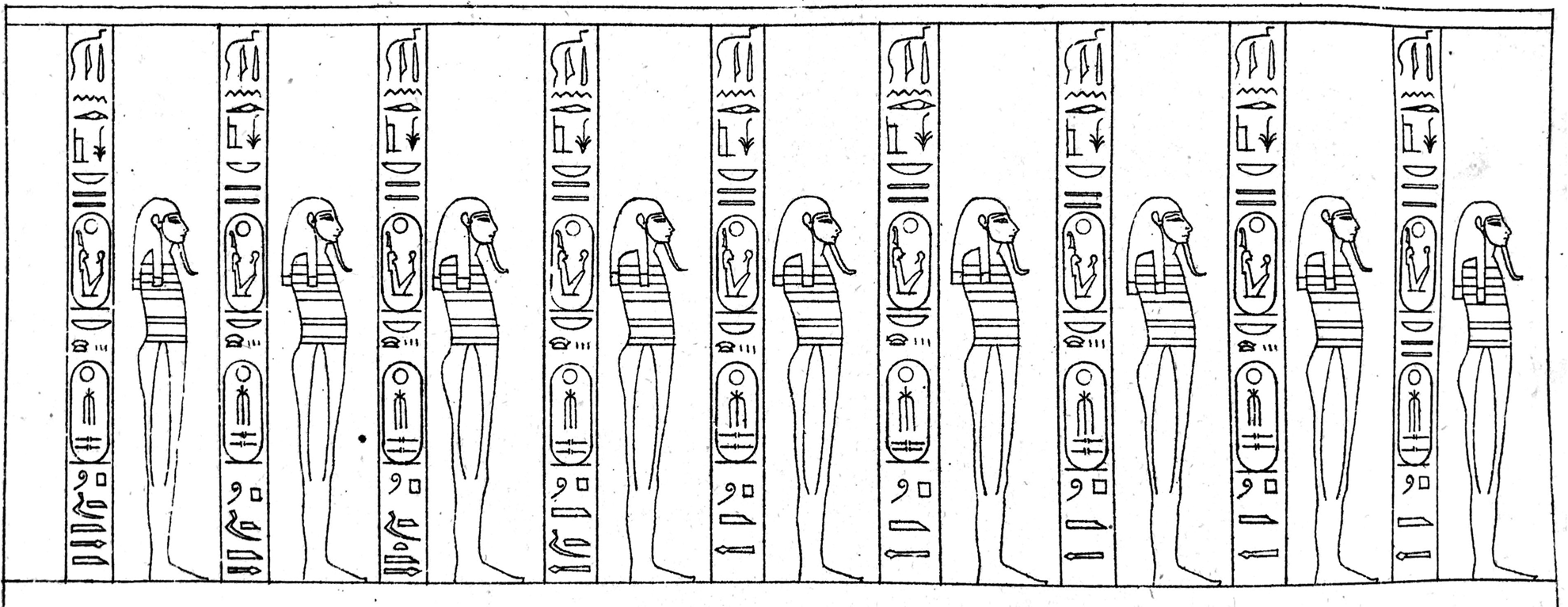
The idea that the shabti box was a way in which to define and contain the miniature world of the shabtis, rather than a religious tool, can be supported by observing the different ways in which this microcosm was created at different times in Egyptian history. On the grandest scale, Ramesses IV kept his shabtis not within boxes but in dedicated chambers within his tomb. The particularity of the purpose of these rooms was underlined by the decorative scheme, depicting 40 shabtis on the walls of the chambers, and the description of it as the ‘shabti-place’ in an ancient plan of the tomb now in the Turin Museum (Fig. 8; Carter & Gardiner Reference Carter and Gardiner1917, 140–41).
Detail of wall decoration from lateral chamber of tomb of Ramesses IV (KV 2) depicting shabtis. (From Lefébure Reference Lefébure1889, pl. XXXV.)

For most Egyptians, so grand a container as a whole room was not necessary, and a smaller receptacle could serve the purpose of separating the miniature world of the shabti from the normally scaled world of the viewer. The boundary of the shabti box also came in many forms, suggesting that the function of maintaining an appropriate, separate environment for the miniatures was more important than the form of the container itself. The oldest shabti boxes known come from the 18th Dynasty tomb of Yuya and Thuya, where they take the form of a chapel (Fig. 9). In the 19th Dynasty, conversely, terracotta urns with jackal-headed lids were sometimes used to contain the shabti figurines (Stewart Reference Stewart1995, 56–7). While these forms are all in a general way appropriate to the religious environment of a tomb, they do not have a particular significance for shabtis. The prevalence of miniaturized forms of architecture as shapes for boxes also once again suggests that the box acts as a microcosm in which the shabti's miniature world is contained. It should also be noted that these boxes were lidded, often in elaborate ways with the lid reflecting the shape of architectural elements (Aston Reference Aston1994, pls. 1–7): the shabtis’ microcosm was not only completely sealed, therefore, but a viewer was forced literally to uncover them in order to access them. The sense of intimacy already engendered by the shabtis’ miniature form was thus further enhanced.
Shabti box in the shape of a shrine from tomb of Yuya and Thuya (KV 46). (Metropolitan Museum of Art, New York, 30.8.59.)

Conclusions
Ancient figurines have inspired a large archaeological literature, in part because they are still so attractive to modern audiences. But the compelling theoretical insights that this literature has recently generated—in particular that visual and material aspects of the figurines produce a universal and powerful effect of beguilement in human audiences, no matter their cultural background—is difficult to prove with reference to ancient evidence, due to the generally small number of extant figurines and the lack of contextual and textual information to supplement the figurines themselves. Egyptian shabtis therefore provide an excellent dataset with which to investigate these theories further, as they offer an exceedingly large number of often well-provenienced figurines, and a rich textual and artistic record of ancient Egyptian interactions with the figurines. Moreover, shabtis are recorded as travelling widely across different cultures of the ancient world, and are also described in textual and archival sources of early modern-period Western explorers, while also remaining a prominent part of modern-day interactions with ancient Egypt in the West. It is clear that once outside of their original, Egyptian context, shabtis did not take their religious function with them—so why did they remain so popular in so many times and places? Examination of the wide variety of source material demonstrates that shabtis were valued by both the ancient Egyptians and other cultures, ancient and modern, for their material affect. Features such as miniaturism, personification and variety are repeatedly identified by numerous different audiences as fundamental factors in the shabtis’ charm, and can even be seen in the archaeological record to have been enhanced over time by Egyptian craftsmen. Shabtis, therefore, prove to be a very effective ‘real-life’ illustration of the theoretical insights of Bailey and others, demonstrating clearly through 4000 years of human–figurine interaction that reactions to figurines are conditioned not only by cultural factors, but also by their inherently appealing material characteristics. Far from an uninteresting if ubiquitous piece of tomb equipment, shabtis are personified objects with great emotive power, full of intriguing paradoxes.