Introduction
Insight into the daily life of older adults with psychiatric disabilities is extremely limited, especially from the individual's own perspective. This interview-based study focuses on the ways in which older adults with psychiatric disability experience different arenas of everyday life. The participants were adults over the age of 55. They all had some disability stemming from long-term mental illness, and a few also required assistance because of their age and physical ailments. They were all in receipt of support from formal medical and social services, and some also received support from their families (Nordström et al., Reference Nordström, Björkman, Skärsäter and Wjik2008).
Sweden is regarded as a universal welfare state in terms of its systems of benefits and services linked to the lifetime needs of its citizens (Esping-Andersen, Reference Esping-Andersen1990). The formal goals of the Swedish welfare system comprise universalism and extensive coverage. Sweden, like many other Western European countries, has undergone several reforms aimed at improving living conditions for individuals with different kinds of disabilities (Mansell and Eriksson, Reference Mansell and Eriksson1996; Markström, Reference Markström2003). The intentions of the reforms have been to support the opportunity for these individuals to live on equal terms with other citizens (Emerson and Hatton, Reference Emerson and Hatton1994; Nirje, Reference Nirje2003). Large psychiatric hospitals have closed and responsibility for housing and employment has been transferred from the healthcare system to municipal social services. The municipalities offer activities such as work training, supported housing, day-care centers, and household support (see Potter, Reference Potter1990; Hydén, Reference Hydén2005). Volunteer organizations also offer activities for particular target groups.
According to epidemiological studies, about 30 percent of older adults in Sweden suffer from mild or severe mental illness (Skoog, Reference Skoog2004). Older people with psychiatric disabilities may find it difficult to assert themselves in the competition for limited psychiatric resources, since their disabilities and even their age may make them unwilling to seek care (Olafsdottir and Marcusson, Reference Olafsdottir and Marcusson2001). Moreover, there is a tendency for medical and social service providers either to consider them simply as older adults, and thus offer them the same medical and social services as other older persons, or to view them as mentally ill and thus offer support adapted to younger adults with psychiatric disabilities. Only a very small percentage of older adults have access to psychiatric support specifically designed for older people (Larsson and Berger, Reference Larsson and Berger2007). However, other types of support, such as practical household help, day-care services and family support have been more successful (National Board of Health and Welfare, 2006).
It has been shown that individuals with psychiatric disability risk becoming isolated, as they spend most of their time alone in their homes (Bejerholm, Reference Bejerholm2007).The arenas in which people spend their time are important for their social relations as well as for the types of activity/occupation that are performed (Nordström et al., Reference Nordström, Björkman, Skärsäter and Wjik2008). Since little is known about this, the overall aim of this study is to describe and analyze the ways in which older adults with psychiatric disability experience places, social relations and activities in different arenas in their everyday lives.
The specific research questions were:
• Where do older adults with psychiatric disabilities spend their time?
• How do they experience these places?
• What social relations are connected with these places?
• What activities do these individuals engage in at these places?
Methods
Design
This study took a qualitative approach. It was conducted among 12 older adults (>55 years of age) with a psychiatric disability. It forms part of a larger multidisciplinary study including quantitative baseline mapping and questionnaires among individuals with a psychiatric disability in southern Sweden. The results of the baseline mapping and the questionnaires were presented were presented in an earlier paper (Nordström et al., Reference Nordström, Björkman, Skärsäter and Wjik2008).
Written informed consent to participate in the interviews was collected through the baseline questionnaires, and the respondents were then contacted by letter. A few days later they were phoned by the interviewer who obtained their verbal agreement and arranged a time and place for the interview. Most of the interviews were carried out in the respondents' homes.
The respondents were interviewed on two occasions in order to explore the experiences of the older adults' everyday life (Miles and Huberman, Reference Miles and Huberman1994). The first interview (n = 12), conducted between June and July 2006, was semi-structured. A thematic interview-guide, constructed by the authors, with pre-selected broad questions was used. The second interview (n = 7), conducted between May and July 2007, was an in-depth interview using a site-map inspired by the tradition of social network research (Tracy and Bell, Reference Tracy and Bell1994). The rationale of adapting two different interview techniques in two steps was to allow the respondents to supplement their experiences from the first interview with a deeper exploration of their everyday life in the second interview. The duration of the interviews was between half an hour and two hours. The interviews were tape-recorded and later transcribed verbatim.
The study adhered to the ethical guidelines of the Helsinki Declaration (WMA, 2000). Even though people with a psychiatric disability are often in a vulnerable and dependent situation, we find it important that older adults with psychiatric disabilities should be given the same opportunity as anyone else to participate in research studies if they are willing and able to do so (Belmont Report in Polit and Hungler, Reference Polit and Hungler1999). We also ensured that any signs of discomfort during the interviews were respected.
Study population
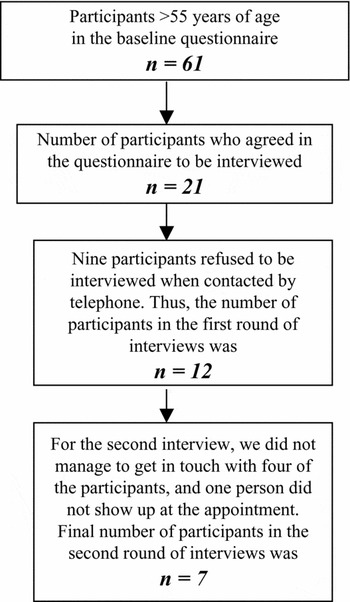
Figure 1 shows the number of older adults >55 years answering the baseline questionnaire, the number who agreed to be interviewed and the number who participated in the two different interviews. The reasons for refusing to participate in the interviews were not always stated but most often the person did not feel well enough to take part.
Schedule of how the study population was recruited.

Sensitizing concepts
The interview-guide used in the semi-structured interviews included the following themes: living conditions, everyday routines, social support and daily activities. The following in-depth interviews were guided by three open questions focusing on where, with whom and in what kind of activity/occupation the respondents were engaged. With the intention of doing justice to the unique and specific character of the respondent's experience, the study was guided by some sensitizing concepts (Blumer, Reference Blumer1954). These concepts were the means by which we sought guidance in approaching the empirical data.
Four types of arenas of everyday life may be distinguished: private, semi-private, semi-public, and public (Olsson et al., Reference Olsson, Sondén and Ohlander1997). These arenas contain different places connected with specific relationships and activities. The individual controls the private arena, and decides who is admitted and who is turned away. The semi-private arena is intended for, and open to, a limited or specific group of people (in this case, older adults with psychiatric disabilities.) In contrast, places in the public and semi-public arenas are accessible to anyone, though some are intended for paying guests while others offer unlimited access. In this study, we regard these latter two types of arena as one — the public arena.
In describing and analyzing social relations between people, the concept of the social network was applied. Size and variation are important aspects of the network structure (Mitchell, Reference Mitchell1969; Dunér, Reference Dunér2007). Size is concerned with the number of people, or groups of people, in a person's network. Variation is measured by the number of sectors in which the network members are located. Four different sectors are considered in the present study: family/kin, friends/workmates, neighbors/acquaintances and professionals/experts.
Relationships between people can be characterized as having either strong or weak ties (Granovetter, Reference Granovetter and Collins1983). Strong ties are close and intimate relationships with family members and close friends; these ties tend to be concentrated within smaller groups. Weak ties consist of nodding acquaintances, typically among neighbors or in the outer circles of an individual's connections. They may contribute to feelings of safety, security, and integration.
Everyday life is structured by routines and well-known modes of action depending on our understanding and interpretation of the situation (Berger and Luckman, Reference Berger and Luckman1966; Goffman, Reference Goffman1986). People engage in and experience activities as a part of everyday life. Activity has a number of aspects, such as the daily rhythm of activity and rest, the variety and range of occupations, meaningfulness, the routines and structure of everyday life, and initiative (Bejerholm, Reference Bejerholm2007).
Analysis
The analysis proceeded from open to focused coding in two steps (Emerson et al., Reference Emerson, Fretz and Shaw1995). The transcribed interviews were read through several times. In the first step, we took an empirically oriented approach, with the sensitizing concepts as a general point of reference. Three of the authors individually marked text relevant to the aim of the study. Condensed “meaning units” for each type of arena were brought together, and the meaning units were compared and discussed among the authors. Thereafter, a conceptual analysis of the sets according to place, relationships and activities was performed. The resulting themes were later illustrated with quotations. In the second step of the analysis, two of the authors identified themes that were common to the different arenas. We aimed to keep these themes on a more abstract level, guided by our sensitizing concepts. Discussions with a co-reviewer took place in each step of the analysis.
We emphasize that neither the sensitizing concepts nor the empirical themes should be regarded as mutually exclusive; they may overlap. The analysis was interwoven with other steps of the research process, as is characteristic of most qualitative research (for further discussion, see Miles and Huberman, Reference Miles and Huberman1994).
Results
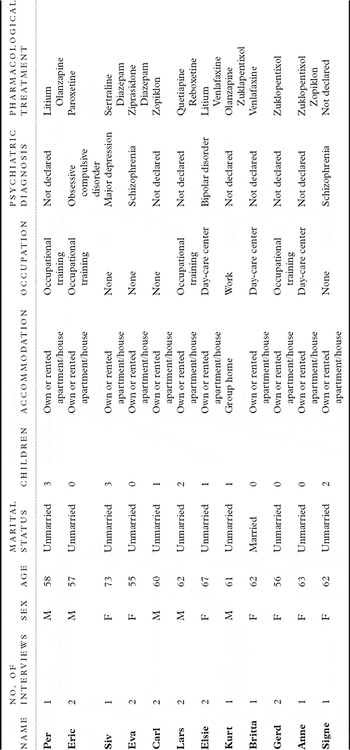
The 12 adults who participated in the study are listed in Table 1. They were all native Swedes, two of whom were receiving retirement benefits, while the rest were in receipt of disability pensions and all had received long-term support (more than three years) from formal psychiatric health care and the municipality's social services.
Background information of the 12 study respondents, collected from the baseline questionnaire

Proportion of time spent in the different arenas
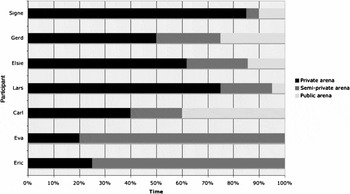
The results in this section derive from the second set of interviews (n = 7), in which the participants used a site-map to estimate the amount of time they spent in different places within the arenas. We first describe the places in each arena, and then present a figure which summarizes the participants' estimation of how they divided their time. The percentages in Figure 2 are based on the authors' interpretation of how the participants filled in the site-map; we do not claim that it is exact.
The participants' estimation of how they divided their time between different arenas. (Information on each participant can be found in Table 1.)

The respondents spent time in two different places in the private arena: their own homes and the homes of close family or friends. The semi-private arena consisted of places such as work training premises, day-care centers, associations, care settings, and the shared localities of group homes. The public arena included natural settings such as forests, beaches and parks, as well as urban places such as streets and squares, shops, concert halls, and restaurants and cafés.
The participants' estimates of the time they spent in the various arenas of daily life are shown in Figure 2. Most of the time spent in the private arena was spent in the participants' own homes. There was great variation in the time spent in the homes of others; some spent only a little time at the homes of others, most often the homes of their relatives, while others spent more time there than in their own homes. The time spent in the semi-private arena also varied a great deal. The respondents who spent least time in this arena were those who only visited a care setting, though on a regular basis. For the others, most time was spent in workplaces, day-care centers, or associations; there were no clear patterns in the amount of time spent in different types of places. It is noteworthy that two respondents stated that they did not spend any time at all in the public arena. Another of the interviewees said that he spent most of his time either at home or in the public arena, and that he could not make any distinction between the time spent in these arenas.
Experiences in the different arenas
In the following sections, we describe and analyze the results from both sets of interviews, in order to reveal the participants' experiences of places, social relations and activities in the different arenas.
The private arena
Peace and quiet, but also solitude and isolation
The respondents used ambivalent terms to describe how they perceived their own homes. Some said that the home produced a feeling of peace and quiet: “. . . you should enjoy being at home. [. . .] It's so nice and quiet” (Elsie). Others experienced liberation from their disability: “I don't notice that at home. Then I don't notice that I am ill. Like when I spend time with other people” (Eva).
However, others found it more difficult to settle down at home, and considered their parents' home to be their “real” home: “Home is Enekulle [the little village where his parents live] really. In other words, where my parents live. [. . .] It has been home, but it's starting to feel like this is home here [his own apartment]. Because at home Enekulle was a little too much my mother” (Erik). There was also an awareness of the significance of having a home of one's own; one of the participants said: “Since I became settled in this apartment, I'm happy here. And then I like to stay home a few evenings. [. . .] I thought that I should practice being at home a little” (Erik).
One respondent described a sense of ambivalence, with the home providing peace and quiet but also being a reminder of loneliness and isolation: “Peace and quiet, nice to have an apartment where you can go. I only feel poorly on weekends. [. . .] I don't have a balcony here. That's too bad. [. . .] It's good to go out and good to come home.” The same person also explained that the home made the loneliness more obvious: “Come home to whom? Home to whom? When I've been home a few hours I feel that it gets crowded” (Gerd).
Constraint and wear, but also support and security
Ambivalence was also present in the descriptions of the relationships that the respondents had in the private arena. Most participants spent time with their families, and the family was particularly important during periods when the participants did not feel well: “Then I only spend time with my family. [. . .] I need my relatives because it's good to have them to call. Just to get to talk a little with them.” The family was also important for routines in daily life — “She [sister] comes here once a week in any case. I only have her in our family.” — and for traditions relating to holidays and special occasions: “. . . and my aunt comes at Christmas and for my birthday” (Anne). Another participant described his dependence on his family's support as follows: “I have my sister. She's been with me for 22 years. [. . .] Because she kind of had to almost take over when I left my wife. She had to put up with me feeling sick . . . and then it was her” (Carl).
However, family relationships could also become complicated because of the illness: “My daughter was with me and it did not work out . . . it's too sensitive. And my daughter couldn't really say [. . .] When you are so close to someone you don't want that person to be ill” (Elsie). The participant quoted here had regular contact with her daughter which decreased as her grandchildren became older: “When I miss them I call and ask if I can visit” (Elsie). Other participants described more traumatic relationships with their children and grandchildren: “My oldest daughter lives down in Skåne. And there's been a split ever since she was 15 years old. She blames everything on her mother. [. . .] We have no contact at all. I have no contact with my grandchildren” (Anne).
Others emphasized the ties they had with their parents and the difficulties of living an independent life. One man said: “I've always been a little too close to my mother. [. . .] I'm almost 60 . . . Still, my mother has been my security. All my life. I've never stood on my own two feet. Unfortunately” (Per).
Several of the participants were seldom visited at home but still had regular telephone contact with their friends: “I call my aunt twice a day and I call my friends too. Yes, good lord, I use the phone a lot” (Anne).
Contact with social services and medical personnel was very important. Some participants developed more friend-like relationships with these personnel: “Sometimes I have people over for dinner. These are psychiatric nurses I've known for years, and the contact person comes, there are five or six of us” (Gerd).
Occupation and lack of initiative
The activities in which respondents were involved in their own homes included daily chores such as cooking, baking, and cleaning: “I like to cook and bake. Cooking food is probably the most fun, yes. But I think baking is fun too” (Britta). Many found that keeping themselves occupied helped the time to pass and was therefore meaningful: “If I didn't have my crossword puzzles I don't know what I'd do. [. . .] I subscribe to a weekly magazine” (Elsie).
Others highlighted physical activity as a way to stay busy: “It's like it keeps me company, I potter in the garden, then I have a cigarette and a cup of coffee. [. . .] And appreciate what I've done” (Siv).
For some, daily routines provided structure to a life which otherwise would have become rather passive: “. . . I put the coffee on then. [. . .] And I smoke. And I watch TV” (Gerd). Visits from care staff also broke up the daily routine: “Then the staff at eleven . . . an hour or so. Yes, I cook my own food” (Gerd). One participant described how he lost his desire to take the initiative in the activities of daily living, and saw it as a somewhat positive thing to get help with the daily chores: “It's good to have housing support [. . .] I don't have to do all the cleaning myself” (Lars). Inactivity and lack of initiative were recurrent themes in the participants' descriptions of their daily lives: “I work three days a week [half days]. If I'm not at work I usually just stay in bed and rest all day. [. . .] I don't feel like doing anything” (Lars).
The semi-private arena
Somewhere to go – because you want to or because you have to
Most, but not all, of the respondents had access to one or more places in the semi-private arena, where they could spend time in their everyday lives. Having access to such places meant having somewhere to go and being able to leave home for a while. One man said: “We formed a cooperative in 1993, where we ran a dining room [. . .] It's where I'm, it is where I'm happy” (Erik). Another respondent explained: “I spend a lot of time here at home. Except when I'm at Solhem, where I spend nine hours a week. Solhems Café, where I help to out and bake. [. . .] Tuesday, Wednesday, Thursday. Three hours each day” (Britta).
In some cases, the respondents had to spend a certain amount of their time in specific places, for example workplaces and day-care centers, as a prerequisite for receiving their economic allowance. For some, this also signified a feeling of security. One woman explained: “It was like a requirement, I just had to be somewhere. [. . .] I wanted there to be someone who kept an eye on me” (Elsie).
The respondents went to other places of their own free will, for example different associations where they were members: “Sometimes I'm at RSMH [Swedish Association for Social and Mental Health], tonight I'm going to RSMH. They have meetings on Monday evenings. [. . .] RSMH means something to me too” (Erik).
All of the respondents visited some kind of care setting, to collect their medicine and/or for treatment. For some, these settings were the only places they visited in the semi-private arena. These visits often occurred on a regular but not very frequent basis, for many not more often than once every three months. For the participants, the care settings contributed to structure, security in their everyday life and helped them to control of their illness. He takes care of my medicines [. . .]. He controls my breathing and my sleep (John).
Meeting other people
At various places in the semi-private arena, the respondents established social relations of different kinds; some deeper and others shallower. Some places catered for a fairly narrow target group, and hence only had a relatively limited number of visitors; for example, a day-care center or association aimed specifically at people with psychiatric disabilities. Other places were more open in character, and the visitors were more numerous. One woman described some of the differences: “There are more than 500 members in [PRO, the Swedish National Pensioners' Organization] so there are many different people. But at Myran [day-care center] there are only 15 to 20. [. . .] They are a little mentally ill, if I may say so, a little disabled. And at PRO there are just ordinary people” (Elsie).
Having access to these places meant having the chance to create relationships with others outside the family circle. Professionals, workmates and visitors all contributed to the everyday lives of the respondents. Some participants stressed the importance of the professionals whom they met in their work training and day-care centers. One woman spoke about the difference between the personnel and the visitors at her day-care centre: “Yes, they are the ones who . . . the personnel, both of them. They think I'm okay. They're both really great. But then there's no one. No, you can't talk to them [the visitors], because if you say something without being careful, before you know it someone is annoyed” (Elsie). On the other hand, the relationships with the professionals that the respondents encountered in care settings were often more shallow: “Once a quarter. Then I get to go see the district nurse. [. . .] It takes about fifteen minutes [the visit]. Yes, I feel it's more difficult to have contact with him [the doctor]” (Signe).
Sometimes the respondents met with the same people at many different places in the semi-private arena: “But I also see her at Kryddan and at RSMH and at my work” (Erik). This situation could lead to close relationships, with workmates or visitors becoming friends: “We can speak very openly with each other. [. . .] I have chosen to be myself with her. Since she accepts me the way I am . . .” (Erik). Sometimes, these friends were also invited into places in the private arena: “And then I invited them here [home] one evening” (Erik).
Even though some of the respondents mentioned no specific relationships of importance, they stressed the feeling of community and belonging that they felt at places in the semi-private arena: “You know many of them by appearance. And that's probably just as well” (Elsie). Being able to be together with others was also seen as a good thing: “And that's positive too. You get to go out and see others anyway” (Elsie).
However, social relationships were also sometimes connected with difficulties. During periods of feeling ill or bad, some of the participants only wanted to see close family members. Some spoke about having an ambivalent feeling when they tried to get on with people: “I get a little tense as soon as I am together with someone. I don't really know why” (Elsie).
Having something to do, or just existing
The time spent in the semi-private arena offered opportunities for daily intercourse with others as well as the chance to engage in different kinds of activities. These activities included work tasks such as sorting nails, taking care of a cafeteria, and ironing clothes, as well as leisure activities such as bingo and other games, needlework, religious activities, and cooking. The importance of doing things together with others was often stressed in the interviews, and was often seen as being more important than the tasks themselves: “Yes, it's also a pleasant time together. Sometimes we cook a little food. [. . .] Then we went out and barbecued hot dogs when it was possible” (Erik).
One man explained the value of activity: “I think that I feel better if I have a little structure and demands to meet. [. . .] It was meat soup or something, there were lots of things to cut, chop, and slice. It took quite a while. And I didn't think about that; I thought ‘wow, the time really flew by’.” (Per). One of the participants, who had worked for 15 years in a cooperative run by people with psychiatric disabilities explained what he was thinking when he decided to begin working there three days a week: “I thought that when I begin there I can't give my obsessive thoughts too much opportunity to run wild. [. . .] because then I can't take care of my job. [. . .] I actually succeeded with this, it is not the same way” (Erik). There was significance in taking charge of the illness via the daily routines provided by the work. One man explained how his everyday life was organized in the shared localities of his group home: “We help out [with cooking] once a week. Each meal. I have cooking duty tomorrow. [. . .] Spaghetti and meat sauce” (Kurt).
The places that were visited offered occasions to be active as well as passive. When the participants spoke about their workplaces, they often focused on the tasks performed there: “Yes, it's pretty good. We pack nails in boxes . . . And weigh the nails. [. . .] I pack screws in boxes . . . Different ones that go into the boxes” (Lars). Another participant also described the tasks at her workplace: “Yes, I wash and that kind of thing. Shirts, not all clothing, but shirts and skirts . . . The kind of thing that needs to be ironed” (Gerd). However, the day-care centers also offered activities that engaged the respondents: “Today we're going to have a gadget swapping day. [. . .] Some sit and do handicrafts, we have quizzes, and we have a snack at some point in the evening” (Erik) However, being active could also be extremely tiring: “I usually help out at the church, and I vacuumed ten couches. [. . .] And it was tough . . . because it takes me so much time” (Eva)
Some of the interviewees were more passive when they visited places in the semi-private arena: “I just sit and talk and socialize. And eat dinner with the other guys and girls” (Eva). However, being passive could simply be the first step when visiting a new place; one woman reflected on the possibility of being more active in the future: “PRO, you just sit there, I'm not active in any way. Maybe I can become more active some day” (Elsie).
The public arena
Longing to go somewhere and get out of the house
A typical practice was to use locations in the public arena as a means to get out of the house. One man emphasized the importance of getting out to the city: “The city means a lot to me. That's where I have my social life” (John). For others, excursions were important: “Yes, we go out and swim in summer. Some afternoon some time when the weather is hot” (Gerd).
While several participants expressed the desire to get out more, this was difficult because going out required the help of others: “I can't get over the ramp with the rollator. It's impossible to get over it. And that's why my home help helps me to get out. I can't get out by myself” (Signe). For others, it was difficult to get out to the specific places where they wanted to go, for both physical and mental reasons: “For example, going for a walk in the forest, I have a little . . . Yes, I'm not only mentally disabled, I also have a physical disability. So I can't walk much in the forest, but I would have liked to do it if I could” (Erik). There could be other obstacles as well: “I would love to spend time outdoors, amid nature, but I don't want to do it by myself. I'm so stupid that I would get lost” (Elsie).
Going to the city
Going into stores or cafés, or just being in the urban environment, meant a lot. The respondents seemed to use the city as a place for social interaction: “Before I got into that [treatment] home, I was there [in the city] every day. [. . .] That was my life. You go down and shop and you meet someone you know, that's how it is. [. . .] In town I might also meet some old relatives, and that kind of thing” (John).
For some, the visits to town were an opportunity to spend one-to-one time with their relatives: “So when I need to shop, she [her daughter] comes with me and carries things for me. Otherwise usually I'm the one that goes to her. Because there's so much to do there all the time. So she rarely has time to come and sit. That rarely happens. Usually we go out and do something” (Elsie). Another participant emphasized the importance of being able to be together with someone for a while: “The best part about the walks is to be able to get out a little and talk with someone [. . .] and she [housing support aid] usually comes with me for a walk once a week. And then we usually eat out too” (Lars).
Recreation and exercise
Many participants described how enjoyable it was to be able to spend time outdoors in the fresh air: “Yes, it's nice to be out, it really is. But it's nowhere special, just right around here. [. . .] I want to go at my own pace” (Elsie). A few had their own favorite places, where they would usually go: “Now the past few Sundays I've been to Hagaberget, a park” (Eva). Some even emphasized the importance of exercise: “I need to exercise. And I like taking walks, getting outside and walking” (Elsie).
Others mentioned how shopping could be both a necessity and a pastime: “Every Thursday I go on a round trip [to town]. I take out money and then I buy what I have to buy. It goes pretty well. I'm not afraid of people” (Gerd). Some even enjoyed spending time in cafés where other people were present, even if they had no contact with the other customers: “When I've been to work, first I go and buy medicine and then I go there [to the café]) and rest a while. Have a snack and read the newspaper and that sort of thing” (Erik).
Discussion
Freedom and constraint
The respondents perceived the home as a place over which they had control; somewhere that they could be themselves and where they did not have to be reminded of their illness (see Olsson et al., Reference Olsson, Sondén and Ohlander1997). Similar findings come from other studies focusing on the importance of the home for older people (Lawton, Reference Lawton1990; Perceval, Reference Perceval2002; Shenk et al., Reference Shenk, Kuwahara and Zablotsky2004). However, the respondents in this study also experienced the home as a place where they were forced to be, where it was hard for them to feel at home, and where they were reminded of their solitude. Even places such as work training centers, day-care centers and associations were perceived by some respondents as places where they were forced to go in order to receive the support they needed. Other respondents, on the other hand, actively wanted to go to these places in order to get out of the house and to have some kind of community, occupation and diversion. In a study of a community drop-in center, the potential significance of these centers for the provision of company and community to service users was revealed. The drop-in center meant different things to different service users; it could function as a place to meet others, to find a listening ear, to access advice and information, and to put some distance between their home environment (Conradson, Reference Conradson2003). Being outdoors in the fresh air, or spending time in various urban environments open to everyone, gave a feeling of freedom (see Olsson et al., Reference Olsson, Sondén and Ohlander1997). Spending time in these places was never something they were forced to do; rather, those respondents who could not get out on their own because of their disability felt their freedom was limited. The dependent situation of the respondents involved both constraint and freedom, because they were dependent on support and help in order to have access to a varied daily life and they had to submit to the caregivers' requirements for offering the desired support.
External and internal structure
Daily chores and traditions such as birthdays and Christmas celebrations create a sense of safety, security, structure and stability in daily life (Berger and Luckman, Reference Berger and Luckman1966). For many of the interviewees, household chores represented a way of creating order in a life that was otherwise described as passive and lacking in initiative and motivation. Even the household support provided by the staff was considered to contribute to maintaining everyday procedures, and these visits were also a welcome break from solitude. The activities of the respondents contributed to the division of their daily rhythm into both activity and rest, to varying the occupations they were engaged in, and to taking the initiative to varying extents. In a study of the everyday life of people with schizophrenia, the importance of activity in order to create routines and structure of everyday life was stressed and different levels of activity were found. The most passive group spent most of their time at home, while the most active group moved more freely between different environments (Bejerholm, Reference Bejerholm2007). The daily housework also helped several of the respondents in this study to create an identity and to be acknowledged in the same way as other people (see Goffman, Reference Goffman1986). Being in public places and blending in with others had the same significance for personal identity.
Meeting the same people, staff, and other visitors each time, being recognized by others, and recognizing the environment were factors that were meaningful to the respondents. These and similar aspects have been found to be typical of good environments for people with chronic medical conditions and have great significance for their well-being (Edvardsson et al., Reference Edvardsson, Sandman and Rasmussen2005). Having access to a variety of places, as most of the respondents did, meant a break in the time spent at home. Most interviewees visited some places on a regular basis, which was conducive to the structure of, and part of the routines of, their everyday lives. Access to these places offers opportunities of vital involvement, which facilitate the maintenance of psychosocial well-being in old age (Kivnik et al., Reference Kivnik, Stoffel and Hanlon2003). Daily routines and participation in different activities in different places not only created a structure in daily life for the respondents but they were also a way for them to maintain an inner structure, overcome their illness, and keep their symptoms in check (see Goffman, Reference Goffman1963). For persons with psychiatric disabilities, it has been shown that regular participation in daily occupational tasks increases both structure and interaction with others, which may lead to deceased dependence on care and support (Gahnström-Strandqvist et al., Reference Gahnström-Strandqvist, Liukko and Tham2003).
Relationships and support
In their homes, the respondents spent time together with their families. These relationships could be characterized as showing strong ties, with emotional closeness and exchange of support (see Granovetter, Reference Granovetter and Collins1983), but also as showing ambivalence, with conflicting emotions and difficulties. For people with a psychiatric disability, relationships with family and friends have often been damaged, something that may discriminate the character of their family relationships from older people in general (see Dunér, Reference Dunér2007). Many of the interviewees received formal support in their homes and established strong ties with some of the professionals. In the other places, relationships were established outside the family sector of the social network, thus affecting both its size and its variation. Some derived a feeling of security from having other people in these places who were waiting for them and controlled them. Relationships with workmates, visitors, professionals and friends were created to various extents, and could be characterized by both weak and strong ties (see Granovetter, Reference Granovetter and Collins1983). In some cases, these relationships were connected with difficulties and ambivalent feelings as well. This was also found in a study of care and rehabilitation for older people, where Martin et al. (Reference Martin, Nancarrow, Parker, Phelps and Regen2005) showed that the social processes between users, family members and staff could reinforce or contravene the therapeutic potential of a place. In the public places, the respondents interacted with close family and kin, and professionals, as well as with distant relatives, acquaintances and various familiar faces. Often, these people offered the support that was needed in order to be able to visit these places, or support with practical everyday chores, or just much appreciated company.
The respondents' reports made it clear that access to many places in different arenas also meant opportunities to establish a varying social network. The close relationships (strong ties) that were established were important in themselves, contributing to the respondents' well-being. The more shallow acquaintances (weaker ties), on the other hand, were important for the respondents' sense of integration and participation.
Conclusion
This study has its limitations. It is based on a rather small sample and relies primarily on analytical generalization, meaning that we strive to generalize the results to a broader theory and to findings of other research (Miles and Huberman, Reference Miles and Huberman1994). Some of the individuals who were invited to the study did not feel well enough to participate, and their experiences could differ from the experiences of the actual respondents. During the interviews, it became obvious that the respondents were not used to reflecting and talking about their everyday life and that their psychiatric disability in some cases had an impact on their ability to verbalize their experiences.
The older adults with a psychiatric disability interviewed in this study spent most of their time in their own homes. Those who had access to work training, day-care centers or association premises spent a lot of time there too; some even spent most of their time in such places. The time spent in various places in the public arena varied a great deal among the participants. The interviewees' experiences of these places were multifaceted and ambivalent. Places in all three different arenas were experienced both positively and negatively – as freedom, peacefulness, demand and control. It was the places themselves as well as the relationships and activities connected with them that contributed to these feelings.
The places in the private arena were primarily connected with close relationships within the family and kin sector of the social network. The semi-private arena offered opportunities to create relationships with others outside the family sector; places in this arena resulted in meetings with workmates, friends, acquaintances and professionals. In the public arena, the interviewees interacted with close family, professionals and other acquaintances. The respondents engaged in a variety of activities in the places of all three arenas. Some offered opportunities for activities such as cooking, ironing, sorting nails and taking walks; other activities were more restful, such as watching TV, sitting and talking, and reading the paper at a café.
For people with a psychiatric disability to have their own homes has been promoted as one of the most important sociopolitical objectives, and as a requirement for their being able to gain control over their lives and achieve participation in society. However, this study has shown that many other semi-private and public arenas are significant in daily life, though they are not as widely mentioned. Places, social relations and activities in all arenas of everyday life contribute positively to the identity, integration and community of older adults with psychiatric disabilities. Despite this, some of the respondents did not have access to places in all the arenas they wished to, whether because of their physical or psychiatric disabilities or because of their age. In conclusion, providing a varied range of services and support in diverse settings and making them accessible to persons of different ages and needs is an important challenge for welfare politics.
Conflict of interest
None.
Description of authors' roles
All authors participated in the design of the study, formulated the research questions and supervised the data collection. MN, AD and HW read the interviews and performed the coding and the analysis in step one. MN and AD carried out the second step of the analysis – the introduction, previous research, and theoretical basic premises, as well as the discussion and the conclusions. EO was helpful in drafting the manuscript. Discussions between the authors took place at every step of the analysis, and all authors approved the final manuscript.
Acknowledgments
The authors are particularly grateful to the respondents for sharing their experiences with us. This work was supported by grants from the Vårdal Institute, the Swedish Institute for Health Sciences, the Department of Social Work at Göteborg University, and the Institute of Health and Care Sciences at the Sahlgrenska Academy at Göteborg University.