Introduction
Among various pests that attack tea plants, the tea mosquito bug (TMB) Helopeltis theivora Waterhouse (Heteroptera: Miridae) is a major challenge to tea plantations in northeast India. In conventional plantations, organo-synthetic insecticides of different functional groups are routinely applied throughout the year to keep pest populations under control (Gurusubramanian et al., Reference Gurusubramanian, Rahman, Sarmah, Roy and Bora2008; Saha and Mukhopadhyay, Reference Saha and Mukhopadhyay2013). Heavy dependence and repeated use of endosulfan, quinalphos, deltamethrin and cypermethrin have rendered these pests less effective and sometimes even counterproductive (Saha and Mukhopadhyay, Reference Saha and Mukhopadhyay2013).
Potassium (K) is a highly mobile essential nutrient that affects most of the biochemical and physiological processes that influence plant growth and metabolism. K fertilizers have been widely reported to decrease insect infestation and disease incidence in many crops (Wang et al., Reference Wang, Zheng, Shen and Guo2013).
Perrenoud (Reference Perrenoud1990) reviewed 459 references and found that the use of K significantly decreased the incidence of insect and mite pest populations by 63%. Earlier studies have also reported that K could induce resistance in plants against TMB (Andrews, Reference Andrews1914, Reference Andrews1923; Aggarwal, Reference Aggarwal1985).
The purpose of the present study was to evaluate the effects of the foliar application of potassium chloride (KCl) and potassium sulphate (K2SO4) on infestation by TMB when mixed with certain conventional pesticides.
Materials and methods
In the present study, two field trials were conducted at Dikom Tea Estate (TE; latitude 27°2′80″, longitude 95°4′60″E) during May–June 2013 and at Borbhetta Experimental Station (ES; latitude 26°43′48.62″N, longitude 94°13′48.48″) during October–November 2013 to evaluate the bioefficacy of thiamethoxam (Actara® 25 WG; Syngenta, Pune, India) and bifenthrin (BRIGADE® 8 SC; GSP Crop Science Pvt Ltd, Ahmedabad, India) applied at the dosage recommended by the Tea Research Association and in combination with 2% KCl and mined K2SO4 against TMB. The trials were carried out in a randomized block design (RBD) with three replications per treatment. Plots containing 100 bushes were separated by two buffer rows. Infestation by TMB varied among the plots. Thus, after selection of the experimental plots, a pre-treatment count was taken from each plot. Two rounds of foliar spray (thiamethoxam 25 WG (dilution 1:4000) alone and in combination with 2% KCl and K2SO4; bifenthrin 8 SC (dilution 1:1600) alone and in combination with 2% KCl and K2SO4) were applied at 15-day intervals. A hand-operated, calibrated knapsack sprayer was used (hollow cone NMD 60 450 nozzle; droplet diameter 1.6 mm; droplet size 140 μm; discharge 450 ml/min at 40 psi pressure; distance between the nozzle and the target 30–45 cm) at 400 litres/ha. Pre- and post-treatment observations were made at weekly intervals for 4 weeks. The performance of each test substance against TMB was assessed by recording the number of infested and uninfested shoots in each treatment plot in the morning (09.00–10.00 h). The shoots were kept in muslin cloth bags and carried to the laboratory where the infested and uninfested leaves were counted. Infestation (I) and the percentage of reduction in infestation (RI) were calculated using the following formulae (Roy et al., Reference Roy, Mukhopadhyay and Gurusubramanian2010):
 $$I = \frac {Infested\,shoots/plot}{Total\,no.\,of\,shoots/plot}\times 100, $$
 $$RI = \frac {Pre\hyphen treatment\,infestation - Post\hyphen treatment\,infestation}{Pre\hyphen treatment\,infestation}\times 100. $$
Thus, the data obtained were subjected to the analysis of variance following a RBD, and critical difference (P= 0.05) and coefficient of variation (%) were calculated (Snedecor and Cochran, Reference Snedecor and Cochran1989).
The phytotoxic effects of applying the test substances were scored in the field trial at weekly intervals after spraying and continued for 4 weeks. The scales used for evaluating the symptoms were based on the type of change in the appearance of the leaves. If the tips or surfaces of the leaves showed injury marks or leaves were wilting, a phytotoxicity score of 20% was assigned to each symptom. If the symptoms were restricted to necrosis, vein clearing, epinasty or hyponasty, a phytotoxicity score of 10% was recorded for each symptom (Roy et al., Reference Roy, Mukhopadhyay and Gurusubramanian2010).
Weekly observations of the phytotoxic symptoms in each treatment plot and their corresponding scores were pooled and compared with those of the untreated control, following the method described by Roy et al. (Reference Roy, Mukhopadhyay and Gurusubramanian2010).
Results and Discussion
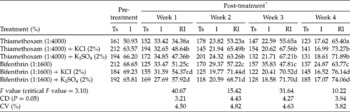
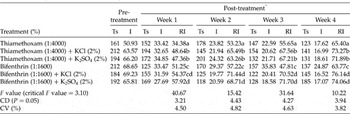
The bioactivity of the different treatments against TMB under field conditions during May–June 2013 at Dikom TE (Table 1) and during October–November 2013 at Borbhetta ES (Table 2) is summarized.
Effects of KCl and K2SO4 on the infestation of the tea mosquito bug (Helopeltis theivora) under the field conditions at Dikom Tea Estate during May–June 2013

Ts, total number of shoots; I, percentage of infestation; RI, percentage of reduction in infestation; CD, critical difference; CV, coefficient of variation.
Means within a column followed by the different letters were significantly different at P= 0.05 according to Tukey's multiple comparison test.
P< 0.000001.
+ Mean of three observations taken on the count of infested and uninfested plucked shoots.
Effects of KCl and K2SO4 on the infestation of the tea mosquito bug (Helopeltis theivora) under the field conditions at Borbhetta Experimental Station during October–November 2013

Ts, total number of shoots; I, percentage of infestation; RI, percentage of reduction in infestation; CD, critical difference; CV, coefficient of variation.
Means within a column followed by the different letters were significantly different at P= 0.05 according to Tukey's multiple comparison test.
P< 0.000001.
+ Mean of three observations taken on the count of infested and uninfested plucked shoots.
In the first field trial at Dikom TE, the application of thiamethoxam alone at the recommended dose led to a gradual reduction in infestation by TMB over a period of 4 weeks (20.66–54.82% in weeks 1 and 2; 32.86–72.66% in weeks 3 and 4). The spraying of bifenthrin (dilution 1:1600) also resulted in the reduction of TMB by 37.5–41.66% in weeks 1 and 2, and 60.48–70.50% in weeks 3 and 4 (Table 1). The application of thiamethoxam (dilution 1:4000)+KCl (2%) and K2SO4 (2%) caused a reduction in infestation by TMB by 44.56–70.31% (week 1), 45.11–72.16% (week 2), 57.50–91.33% (week 3) and 54.51–84.25% (week 4). When bifenthrin was applied with KCl (2%) and K2SO4 (2%), infestation by H. theivora was reduced by 13.28–68.23% (week 1), 22.58–51.65% (week 2), 53.34–78.71% (week 3) and 62.77–86.96% (week 4) (Table 1). Similar observations were also recorded at Borbhetta ES, where the combined treatments significantly reduced the infestation by TMB compared with the insecticides used alone (Table 2).
No phytotoxic symptoms were observed on the bushes up to 4 weeks after the treatments under field conditions.
The TMB control achieved by the combined treatments was statistically significant (P< 0.05) compared to that achieved by insecticides alone. Earlier studies by Andrews (Reference Andrews1914, Reference Andrews1923) indicated that tea plants in soil with a low available potash-to-available phosphoric acid ratio are less resistant to infestation by H. theivora than those with a high ratio. Thus, K salts in soil in which tea is grown have a negative correlation with H. theivora infestation. In addition, after the direct injection of potash, tea bushes heavily infested with H. theivora quickly became pest free and gave splendid flushes (Andrews, Reference Andrews1923). In a field trial with turf grasses, damage by Blissus leucopterus decreased slightly with increasing KCl rates (Pritchett and Horn, Reference Pritchett and Horn1966).
Decreases in fecundity and developmental rates of the green peach aphid Myzus persicae were highly correlated with increased levels of soluble K in leaf tissue (Van Emden, Reference Van Emden1966). Schuphan (Reference Schuphan1974) suggested that the higher foliar content of K in organically grown crops might be a key factor in determining lower damage by insects. In our experiments, foliar application consisted of K mixed with insecticides because foliar feeding of K required in low dosage is less expensive. The nutrient is absorbed by plants more rapidly than when applied to the soil; the danger of fixation and/or leaching is reduced; there is a quick plant response and deliverance from root uptake problems (McCall, Reference McCall1980; Snyder et al., Reference Snyder, Miley, Oosterhuis and Maples1991). However, the use of high concentrations of K includes the possibility of foliar burn, compatibility problems with some pesticides and low solubility of certain K salts, especially in cold water. In this experiment, no phytotoxic effects were observed when tea bushes were sprayed with thiamethoxam (dilution 1:4000) and bifenthrin (dilution 1:1600) in combination with 2% KCl and K2SO4 under the field conditions.
In addition, we conducted the physical compatibility test by following the method described by Petroff (Reference Petroff2008). After mixing, the solutions were allowed to stand overnight. There were no scum formation on the surface, clumping of mixtures and settling of solids at the bottom, and, therefore, the mixtures were considered to be physically compatible with each other.
K is an essential element for the functioning of multiple plant enzymes, and regulates the metabolite pattern of higher plants, ultimately by changing metabolite concentrations (Mengel and Kirkby, Reference Mengel and Kirkby2001; Marschner, Reference Marschner2012). In K-sufficient plants, the synthesis of high-molecular-weight compounds (such as proteins, starch and cellulose) was increased markedly, thereby decreasing the concentrations of low-molecular-weight compounds (such as soluble sugars, organic acids, amino acids and amides) in plant tissues. These compounds are responsible for the development of insect infestation, so plants with lower concentrations are less vulnerable to disease and pest attacks compared with K-sufficient plants (Marschner, Reference Marschner2012). In another study, Sarwar (Reference Sarwar2012) also concluded that reduced pest damage in plants with a higher K content can be attributed to the low levels of pest preference under sufficient nutrient concentrations, as well as the synthesis of defensive compounds in the cell sap leading to insect repellence. Prasad et al. (Reference Prasad, Singh and Singh2010) reported that adequate concentrations of K increased phenol concentrations that play a critical role in the resistance of plants to herbivores.
The present study suggested that thiamethoxam and bifenthrin at the recommended doses combined with 2% KCl or mined K2SO4 could be effectively used in the integrated pest management programme against H. theivora. Further studies are needed to obtain more insight into the relationship between K and insect infestation and the molecular mechanisms of K in the resistance of plants to biotic stress (insect pest), which may help to develop better integrated designs for pest control and better integrated fertility management designs.
Acknowledgements
The authors thank the Managers of Dikom Tea Estate and Borbhetta Experimental Station, Dr Ramesh Kr Baruah (Advisory Officer, I/C, Upper Assam) and Mr Biswajyoti Bordoloi (Assistant Advisory Officer) for providing assistance and support in conducting the field trial.