Introduction
Impulsivity may be defined as “a predisposition toward rapid, unplanned reactions to internal or external stimuli with diminished regard to the negative consequences of these reactions to the impulsive individual or to others.”Reference Chamberlain and Sahakian 1 , Reference Potenza 2 In contrast, compulsivity represents the performance of repetitive and functionally impairing overt or covert behavior without adaptive function, performed in a habitual or stereotyped fashion, either according to rigid rules or as a means of avoiding perceived negative consequences.Reference Chamberlain, Fineberg, Blackwell, Robbins and Sahakian 3 – 5 Impulsivity and compulsivity do not represent unitary phenomena; rather they represent useful conceptualizations that involve dissociable cognitive functions, which are mediated by neuroanatomically and neurochemically distinct components of cortico-subcortical circuitry. These constructs were historically viewed as diametrically opposed, with impulsivity being associated with risk-seeking and compulsivity with harm-avoidance. However, impulsivity and compulsivity have in common the profound feeling of “lack of control,” and are increasingly recognized to be linked by shared neuropsychological mechanisms involving dysfunctional inhibition of thoughts and behaviors.Reference Stein and Hollander 6
Impulsive and compulsive mechanisms are implicated in many psychiatric disorders. However, there exist certain disorders in which impulsive and/or compulsive behavior seems, at least on phenotypic grounds, to be the essential and most damaging constituent. These often highly heritable and disabling lifespan disorders include those characterized mainly (but not exclusively) by compulsive acts, such as the newly created Diagnostic and Statistical Manual of Mental Disorders, 5th edition (DSM-5) Obsessive-Compulsive and Related Disorders (OCRDs) cluster that comprises obsessive–compulsive disorder (OCD; which is considered the archetypal compulsive disorder), body dysmorphic disorder (BDD), and hoarding disorder. Trichotillomania and skin-picking disorder, also classified with the OCRDs, are defined by body-focused repetitive behaviors or grooming habits that can be considered as either impulsive or compulsive, depending on the nature of the symptoms expressed in individuals, whereas attention deficit hyperactivity disorder (ADHD) appears to be characterized primarily by motor impulsivity. Of great interest, the pathological behavior associated with disorders of substance addiction (SA) and “behavioral addiction,” such as pathological gambling (or gambling disorder in DSM-5 7 ), appears, over time, to change from reward-driven impulsive responding to habit-related compulsive responding.Reference Everitt and Robbins 8 – Reference Brewer and Potenza 10
Many of these disorders cluster together, either within the same individual (comorbidity) or within families, which implies the possibility of shared pathophysiological mechanisms.Reference Hollander, Kim, Khanna and Pallanti 11 , Reference Bienvenu, Samuels and Wuyek 12 Moreover, there is evidence of overlap in the treatment response across some disorders. For example, OCD and BDD typically respond to serotonin reuptake inhibitors (SRIs; clomipramine and selective SRIs, or SSRIs) and to SSRIs combined with antipsychotic agents,Reference Chamberlain, Blackwell, Fineberg, Robbins and Sahakian 13 as do the compulsions associated with autistic disorders.Reference Kolevzon, Mathewson and Hollander 14 However, unlike OCD, trichotillomania appears SSRI-unresponsive, and data from single randomized controlled trials suggest that monotherapy with olanzapine (an antipsychotic agent)Reference Van Ameringen, Mancini, Patterson, Bennett and Oakman 15 and n-acetyl cysteine (an amino acid compound) can be effective.Reference Grant, Odlaug and Kim 16 Antipsychotics represent first-line treatment for Tourette syndrome.Reference Weisman, Qureshi, Leckman, Scahill and Bloch 17 ADHD, on the other hand, responds to noradrenergic reuptake inhibitors as well as dopaminergic agents (eg, amphetamine), whereas substance-use and gambling disorders may share a therapeutic response to opiate antagonists.Reference Brewer, Worhunsky, Carroll, Rounsaville and Potenza 18
Traditionally, compulsive disorders such as OCD and impulsive disorders such as ADHD or addictions have been viewed at opposite ends of a single dimension; the repetitive compulsive acts that characterize OCD are designed to reduce or avoid harm and contrast with the reckless or reward-seeking behaviors that characterize impulsive disorders that invoke or disregard risk. However, the investigation of “endophenotypes” (intermediate phenotypes) that are thought to lie closer than the expressed behavior to the genetic and environmental origins of the disorders,Reference Gottesman and Gould 19 , Reference Chamberlain and Menzies 20 such as changes in cognitive performance, or structural and functional brain imaging abnormalities, increasingly suggests that rather than polar opposites, compulsivity and impulsivity may represent orthogonal factors that each contribute in varying degrees to the development of these disorders. A high level of comorbidity exists between impulsive and compulsive disorders across different cultures, and when these disorders occur together, they tend to be more severe.Reference Kashyap, Fontenelle and Miguel 21 Both impulsive and compulsive pathology may be underpinned by a shared tendency toward behavioral disinhibition, possibly resulting from failure in “top-down” cortical control of fronto-striatal brain circuits, or alternatively from over-activity within striatal neural circuitry.
The U.S. National Institute of Mental Health Strategic Plan calls for the development, for research purposes, of new ways of classifying psychopathology based on dimensions of observable behavior and neurobiological measures. 22 Its aim is to define basic dimensions of function to be studied across multiple units of analysis, from genes to neural circuits to behaviors, cutting across disorders as traditionally defined. The intention is to translate results from basic neurobiological and behavioral research to an improved integrative understanding of psychopathology and the development of new and/or optimally matched treatments for mental disorders. In line with this strategy, in this article we selectively review new developments in the investigation of the neurocognition of impulsivity and compulsivity in humans, in order to advance our understanding of the pathophysiology of impulsive and compulsive disorders. We focus on the following key questions:
-
1. Can we define the neuropsychological and associated neuroanatomical and neurochemical mechanisms that contribute to impulsive and compulsive responses in humans?
-
2. How do these mechanisms differentially contribute to impulsive disorders (eg, ADHD), compulsive disorders (eg, OCD), and addictive disorders (eg, substance-use and gambling disorders)?
-
3. Can we link genes with the neuropsychological changes that underpin impulsive and compulsive behaviors and disorders?
-
4. Does the presence of impulsivity or compulsivity have prognostic implications for treatment response?
-
5. What are the next steps for research?
Theoretical Models of Impulsivity and Compulsivity
Impulsivity and compulsivity are each multidimensional constructs. They involve disruption within a wide range of neural processes, including attention, perception, and coordination of motor or cognitive responses. These processes are thought to be underpinned by separate but intercommunicating “impulsive” and “compulsive” cortico-striatal neurocircuitry, with each circuit modulated by different neurotransmitters.Reference Brewer, Worhunsky, Carroll, Rounsaville and Potenza 18 , Reference Robbins 23
According to current neuroanatomical models, at least 2 striatal nodes (one impulsive and one compulsive) drive these behaviors, while 2 corresponding prefrontal nodes restrain them. Thus, the impulsive circuit may comprise a striatal component (ventral striatum/nucleus accumbens) that drives the impulsive behaviors, while a prefrontal component (anterior cingulate/ventromedial prefrontal cortex, VMPFC) exerts inhibitory control. Similarly, in the compulsive circuit, a striatal component (caudate nucleus/putamen) may drive compulsive behaviors, and a prefrontal component (orbitofrontal cortex, OFC) may exert inhibitory control. Other important areas for cortical control include the lateral PFC, especially on the right side, and increasingly (but mainly in social cognition or hyperbolic discounting choice procedures), the dorsolateral (DL)-PFC. Hyperactivity within the striatal components or abnormalities (presumably hypoactivity) in the prefrontal components may result in an increased automatic tendency for executing impulsive or compulsive behaviors, depending on the subcomponent that is affected. Current understanding suggests that OCD demonstrates over-activation (hyperactivity) during resting state, and symptom provocation and even error monitoring. However, there are many studies involving cognitive function that clearly indicate hypoactivation, ie, reduced activity in areas such as the DLPFC and OFC during executive functions.Reference van den Heuvel, Veltman and Groenewegen 24 – Reference Chamberlain, Menzies and Hampshire 27 In addition, overlap between these functional systems is likely to exist, so that what starts out as a problem in the impulsive circuit may end up as a problem in the compulsive circuit and vice versa, thereby contributing to an “impulsive–compulsive diathesis” model.Reference Brewer, Worhunsky, Carroll, Rounsaville and Potenza 18 , Reference Hollander and Wong 28 , Reference Goldstein and Volkow 29 In the same patient, deep brain stimulation of the nucleus accumbens may reduce compulsivity at certain voltages and elicit impulsivity at others,Reference Luigjes, Mantione and van den Brink 30 suggesting that under different contingencies, nodes within the same circuitry may direct both forms of behavior. Other prevailing influences on cortico-striatal activity, eg, diminished striatal activation to rewards during engagement in reward-related behaviors, may also contribute to seemingly impulsive or compulsive behaviors.Reference Fineberg, Robbins and Bullmore 31
Impulsivity: Neurocognitive Components and Role in Impulsive and Compulsive Disorders
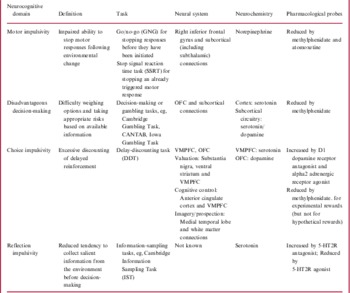
Data indicate that impulsivity may derive from several distinct neurocognitive mechanisms, each with separate neuroanatomical and neurochemical bases. Debate currently exists regarding the number and identity of domains into which impulsivity might fractionate, with 2 or more domains typically identified.Reference Potenza and de Wit 32 Proposed domains may include (i) a tendency to pre-potent motor disinhibition (motor impulsivity), (ii) a tendency towards decision-making deficits (decision-making impulsivity), (iii) difficulty in delaying gratification and choosing immediate small rewards despite negative long-term consequences (choice impulsivity), and (iv) insufficient information sampling before making a choice (reflection impulsivity). It should be noted that these represent working forms of impulsivity that are defined not clinically but rather on the basis of a number of cognitive tests, described below. Thus defined, different forms of impulsivity can co-occur within a given disorder, and may even overlap in terms of what is being measured. See Table 1.
Subdividing impulsivity: abbreviated summary of neurocognitive domains, tasks, and neural and neurochemical correlates

OFC = orbitofrontal cortex; VMPFC = ventromedial prefrontal cortex; CANTAB = Cambridge Neuropsychological Test Automated Battery.
Motor impulsivity
Motor impulsivity, also termed response or rapid-response impulsivity, refers to impairment in the ability to stop motoric responses following changes in environmental circumstances. This is typically operationalized in the laboratory using go/no-go (GNG) and stop-signal reaction time (SSRT) tasks.Reference Aron and Poldrack 33 , Reference Logan, Cowan and Davis 34
In GNG tasks, subjects perform motor responses to go cues but should refrain from responding when a no-go cue is presented. On SSRT tasks, subjects make motor responses to “go” cues (eg, directional arrows), but attempt to suppress responses when a stop signal occurs some period of time after presentation of the go cue. The chief distinction is that GNG involves stopping responses before they have been initiated, while SSRT involves termination at a later stage of the motor response. For the latter type of task, the period between the “go” and “stop” signal is varied using a tracking algorithm over the course of the task for each participant depending on performance. This enables calculation of the stop-signal reaction time, which is a measure of the internal time required to stop the already-triggered motor command.
Multiple tiers of evidence from functional magnetic resonance imaging (fMRI) findings, individuals with focal frontal lobe lesions, and animal research have demonstrated that response inhibition is sub-served by a neural network that encompasses the right inferior frontal gyrus (RIFG) and sub-cortical (including subthalamic) connections.Reference Potenza and de Wit 32 , Reference Rubia, Smith, Brammer and Taylor 35 Pharmacological manipulations in rats and in humans suggest that inhibitory control, as operationalized by the SSRT, falls under the neuromodulatory influence of the noradrenaline/norepinephrine system.Reference Chamberlain, Muller and Blackwell 36 – Reference Chamberlain and Robbins 38 In contrast, serotonin appears not to be centrally involved in this particular measure of impulsivity.Reference Rubia, Smith, Brammer and Taylor 35 , Reference Clarke, Walker and Crofts 39
Impaired response inhibition has been reported across many impulsive–compulsive disorders to different degrees. Motor impulsivity in the context of ADHD is perhaps the best-studied construct. Meta-analysis has indicated that people with ADHD, which may be considered the archetypal impulsive disorder, manifest impaired response inhibition with a medium–large effect size (Cohen's D = 0.64–0.89).Reference Boonstra, Oosterlaan, Sergeant and Buitelaar 40 , Reference Chamberlain, Robbins and Winder-Rhodes 41 This paradigm is useful in understanding treatment mechanisms for the disorder. Medications with demonstrable efficacy in treating the core impulsive symptoms of ADHD, such as methylphenidate (stimulant) and atomoxetine (selective noradrenaline reuptake inhibitor, SNRI), have been shown to improve response inhibition in ADHD patients following acute administration.Reference Rubia, Smith, Brammer and Taylor 35 , Reference Aron, Dowson, Sahakian and Robbins 42 , Reference Boonstra, Kooij, Oosterlaan, Sergeant and Buitelaar 43
In a study in healthy volunteers that combined pharmacological manipulation with functional MRI (pharmaco-fMRI), it was found that single-dose atomoxetine augmented right frontal brain activation during inhibitory control on the SSRT task, and that the extent of augmentation correlated with greater drug plasma levels.Reference Chamberlain, Hampshire and Muller 44 Using a flanker GNG task and a higher atomoxetine dose in pharmaco-fMRI, more failed inhibitions were observed in healthy volunteers after medication (single dose), along with drug-dependent increases in error-signaling in bilateral inferior frontal cortices and the pre-supplementary motor area (pre-SMA).Reference Graf, Abler and Freudenmann 45 More recent work has sought to explore the effects of methylphenidate and atomoxetine on inhibitory control during pharmaco-fMRI in ADHD itself. Cubillo etal found that both medications (single-doses) normalized left prefrontal cortex under-activation (observed versus controls), while similar right-sided effects were more pronounced for methylphenidate.Reference Cubillo, Smith and Barrett 46 Collectively, these data suggest that people with ADHD show motor impulsivity coupled with fronto-striatal dysfunction, both of which can be normalized, to some degree, with ADHD medication. However, considerably more work is needed to elucidate the precise mechanisms (eg, specific receptor subtypes involved), reasons for different responses across individuals, and brain effects with longer-term dosing.
Neurocognitive studies of response inhibition as measured by the SSRT and GNG tasks have also been performed in predominantly “compulsive” disorders such as OCD. Such investigations have frequently reported abnormalities in motor inhibition in OCDReference Chamberlain, Blackwell, Fineberg, Robbins and Sahakian 47 and possibly also in BDD.Reference Jefferies, Laws and Fineberg 48 Impaired response inhibition is shared by unaffected, first-degree relatives of OCD subjects.Reference Chamberlain, Fineberg and Menzies 49 In addition, the degree of impairment is significantly associated with reduced gray matter volume in the OFC and RIFG and increased gray matter volume in cingulate, parietal, and striatal regions.Reference Menzies, Achard and Chamberlain 50 Thus, structural variation in large-scale brain systems related to motor inhibitory control may mediate a component of the genetic risk for OCD and arguably represents a neurocognitive endophenotype of OCD-related response inhibition difficulties. Relative to comparison subjects, patients with OCD and their siblings additionally showed greater activation in the left pre-SMA during successful inhibition using the SSRT task,Reference de Wit, de Vries and van der Werf 51 as well as a state-dependent deficit in recruiting RIFG and right inferior parietal cortex, which may contribute to the inhibition deficit. Pre-SMA hyperactivity may therefore constitute another neurocognitive endophenotype of OCD that is possibly related to inefficient neural processing within the pre-SMA itself.
Impaired response inhibition on the SSRT task has been reported in other impulsive or compulsive disorders, including trichotillomania,Reference Chamberlain, Fineberg, Blackwell, Robbins and Sahakian 3 repetitive skin picking,Reference Odlaug, Chamberlain and Grant 52 and pathological gambling.Reference Verbruggen, Adams, Van't Wout, Stevens, McLaren and Chambers 53 However the neural basis of these deficits has yet to be clearly elicited in the majority of disorders. The SSRT deficit appears to be particularly pronounced in trichotillomania, with impairments similar to those seen in adults with ADHD when not taking their usual stimulant medication. In contrast, individuals with OCD show significantly less stop-signal impairment in direct comparison with those with trichotillomania.Reference Chamberlain, Fineberg, Blackwell, Robbins and Sahakian 3 It is, however, important to note that heterogeneity in the expression of SSRT deficits exists in these disorders, and some studies have not replicated the findings.Reference Lawrence, Luty, Bogdan, Sahakian and Clark 54 One possible explanation under active consideration is the existence of distinct subtypes of these disorders, each with a different neurocognitive profile.Reference Grant, Odlaug and Chamberlain 55 , Reference Odlaug, Chamberlain, Harvanko and Grant 56 Understanding cognitive heterogeneity in these disorders, for motor impulsivity, but also for all cognitive functions considered in this article, could be important in terms of enabling treatments that are tailored to individual patients.
Disadvantageous decision-making
Decision-making is typically quantified using gambling tasks such as the Cambridge Gamble Task (CGT), and the extent to which this represents a distinct domain of impulsivity has been debated. 57 The CGT fractionates different components of decision-making. As operationalized by this paradigm, impulsive decision-making is defined as (i) gambling an excessive proportion of one's points, (ii) disproportionately choosing the “risky” decision option (the option less likely to yield a win), or (iii) disproportionately “crashing out” and losing all one's points (going bankrupt). The Iowa Gambling Task (IGT), another decision making task, has yielded inconsistent results,Reference Cavedini, Riboldi and D'Annucci 58 , Reference Nielen, Veltman, de Jong, Mulder and den Boer 59 which could be a result of its potential sensitivity to additional cognitive processes such as reversal learning.Reference Fellows and Farah 60 In comparison with the IGT, the CGT quantifies decision-making under risk with explicit probabilities rather than ambiguity, and also more specifically examines decision-making as opposed to other confounding cognitive domains (since it minimizes demands for learning, working memory, and cognitive flexibility).Reference Nielen, Veltman, de Jong, Mulder and den Boer 59 , Reference Lawrence, Luty, Bogdan, Sahakian and Clark 61 Decision-making on the CGT and related tasks is mediated through orbitofrontal and related cortical circuitry under probable serotonergic modulation,Reference Rogers, Everitt and Baldacchino 62 and subcortical circuitry under joint dopaminergic, noradrenergic, and serotonergic control.Reference Zeeb, Robbins and Winstanley 63 , Reference Baarendse, Winstanley and Vanderschuren 64
Although OCD has been conceptualized as “a disorder of decision-making,”Reference Sachdev and Malhi 65 findings with the CGT and related tests have generally indicated intact decision-making in patients with OCD versus controls.Reference Cavedini, Riboldi and D'Annucci 58 , Reference Chamberlain, Fineberg and Blackwell 66 This finding is perhaps surprising given that the OFC is heavily implicated in the pathophysiology of the disorder. To some extent, an underlying decision-making deficit could have been masked by SSRIs, which many participants were taking in the above CGT studies, since there is reason to expect that these medications affect decision-making function. This issue is being explored further in medication-free OCD individuals. CGT decision-making was found to be intact in trichotillomania,Reference Sachdev and Malhi 65 while children with ADHD showed impulsive decision-making on the aspects of tasks that were normalized by methylphenidate treatment.Reference DeVito, Blackwell and Kent 67
Pathological gambling is another condition in which logically one would expect decision-making impairments to manifest, since the core features are highly suggestive of underlying difficulties in weighing options and taking appropriate risks based on the available environmental information. Consistent with this proposition, studies have identified disadvantageous decision-making not only in people with pathological gambling, but also in “at risk” individuals who currently do not meet clinical criteria.Reference Fellows and Farah 60 , Reference Odlaug, Chamberlain, Kim, Schreiber and Grant 68 Pathological gambling shows high comorbid expression with substance-use disorders and has been proposed as a useful model of “behavioral addiction” to explore the neurobiology underlying “addiction” without the potential confounding effects of repeated substance misuse on brain function. Supporting this proposition, disadvantageous decision-making occurs both in pathological gambling and in substance-use disorders (see below; Substance Addiction, Behavioral Addiction). Impaired CGT decision-making has also been found in people at elevated risk of suicidality.Reference Chamberlain, Del Campo and Dowson 37 , Reference Passetti, Clark and Davis 69
If we draw together findings related to disadvantageous decision-making, the emerging picture is of relatively spared decision-making in OCD and related grooming disorders (eg, trichotillomania), but of pronounced decision-making deficits in behavioral addiction (eg, pathological gambling) and substance addictions. These decision-making tendencies may predispose not only to these disorders but also to suicidality in some cases, with important clinical implications.
Choice impulsivity
Choice impulsivity (or “impulsive choice”) refers to the excessive discounting of delayed reinforcement.Reference Evenden and Ryan 70 While a measure of choice impulsivity is theoretically obtainable from some decision-making tasks, more usually it is obtained in studies via a stand-alone temporal discounting task that is specifically designed for this purpose. Participants are trained to select between small rewards that are given immediately and larger rewards that are given after a relative delay. The temporal discounting function quantifies the effect of delay on preference: the greater the discounting parameter, the greater the choice impulsivity.Reference Cardinal 71 In rats undertaking a delay-discounting task (DDT), real-time increases in serotonin efflux were observed in the medial prefrontal cortices while increases in 3,4-di-hydroxy-phenylocetic acid (DOPAC, a dopamine metabolite) were observed in the OFC, suggesting a double dissociation between serotonergic and dopaminergic modulation of impulsive decision-making within distinct areas of frontal cortex.Reference Winstanley, Theobald, Dalley, Cardinal and Robbins 72 Translational research indicates that pro-dopamine/noradrenaline stimulant medications generally reduce choice impulsivity, albeit not consistently.Reference Dalley and Roiser 73 , Reference Pattij and Vanderschuren 74 There is also evidence from rats that D1 dopamine receptor antagonism increases choice impulsivity, as does alpha-2 adrenergic receptor agonism,Reference van Gaalen, van Koten, Schoffelmeer and Vanderschuren 75 whereas changes in serotonin neurotransmission exert a complex influence on choice impulsivity, probably depending on the receptor type stimulated.Reference Dalley and Roiser 73 , Reference Baarendse and Vanderschuren 76 Moreover, recent studies in rats have also implicated glutamatergicReference Floresco, Tse and Ghods-Sharifi 77 – Reference Cottone, Iemolo and Narayan 79 and cannabinoidReference Wiskerke, Stoop, Schetters, Schoffelmeer and Pattij 80 , Reference Navarrete, Pérez-Ortiz and Manzanares 81 signaling in choice impulsivity.Reference Winstanley 82 It has been suggested that temporal discounting involves 3 distinct sets of neural regions: those involved in valuation (substantia nigra, ventral striatum, and VMPFC), cognitive control (anterior cingulate cortices and VMPFC), and imagery/prospection (medial temporal lobe).Reference Peters and Buchel 83 White matter tract connections between these implicated neural nodes are also likely to be important, since it has been shown that reduced white matter integrity within fronto-striatal tracts is associated with higher choice impulsivity in healthy volunteers.Reference Peper, Mandl and Braams 84
To the knowledge of the authors, delay discounting (choice impulsivity) has not yet been studied in OCD, trichotillomania, or pathological skin picking. Exaggerated choice impulsivity has been reported in several ADHD studies.Reference Rapport, Tucker, DuPaul, Merlo and Stoner 85 – Reference Tripp and Alsop 88 Methylphenidate reduces discounting of rewards in children with ADHD,Reference Shields, Hawk and Reynolds 89 but intriguingly, only for those rewards that are experiential (real money) rather than hypothetical. Increased impulsive choice has also consistently been observed in substance-addicted individuals, including those addicted to opiates, alcohol, tobacco, and psychostimulants.Reference Dalley, Everitt and Robbins 90 – Reference Perry and Carroll 92 These changes have been observed when money, substances, health, or freedom are used as rewards.Reference Bickel, Odum and Madden 93 – Reference Petry 96 Interestingly, these increased discounting rates are absent or less prominent in former addicts,Reference Perry and Carroll 92 , Reference Madden, Petry, Badger and Bickel 94 suggesting that increased discounting is either a consequence of prolonged substance abuse or a predictor of unsuccessful abstinence. There is evidence from animal studies to support both explanations (see below).
Reflection impulsivity
Reflection impulsivity refers to a reduced tendency toward collecting salient information from the external environment before making a decision.Reference Kagan 97 People who are “reflectively impulsive” tend to make choices rapidly rather than wait for more information germane to that decision to become available as time progresses. Reflection impulsivity is typically measured using information-sampling tasks such as the Cambridge Information Sampling Task (IST).Reference Clark, Robbins, Ersche and Sahakian 98 Research in rats found that reflection impulsivity was increased and reduced respectively by 5-HT2 receptor antagonism and agonism.Reference Evenden 99 In healthy human volunteers, transient reduction of brain serotonin using the tryptophan depletion technique selectively disinhibited the suppressive effects of small losses of information sampling behavior on the IST, such that subjects collected more information despite their being a cost to this.Reference Crockett, Clark, Smillie and Robbins 100 The neural substrates that mediate reflection impulsivity have yet to be delineated.
Elevated reflection impulsivity has been found in people with substance dependence, and also in those who previously used illicit substances.Reference Kagan 97 , Reference Clark, Roiser, Robbins and Sahakian 101 People with problem gambling (a clinical disorder that does not fulfill full criteria for pathological gambling, or putative prodromal form) showed increased reflection impulsivity compared to controls, as did alcohol-dependent individuals.Reference Fellows and Farah 60
There has been limited research using reflection impulsivity tasks in impulsive-compulsive disorders otherwise. Reflection impulsivity did not differ significantly between children with ADHD and healthy matched controls, nor was it affected by single-dose methylphenidate.Reference DeVito, Blackwell and Clark 102 Reflection impulsivity was also found to be intact in OCD and trichotillomania,Reference Sachdev and Malhi 65 and in pathological skin picking.Reference Snorrason, Smari and Olafsson 103
Compulsivity: Neurocognitive Components and Role in Impulsive and Compulsive Disorders
Compulsivity is, perhaps, less well-defined or well-investigated than impulsivity. Compulsive behavior is likely to result from alteration within a wide range of neural processes, including attention, perception, and coordination of motor or cognitive responses. Convergent evidence from translational studies of mental disorders characterized by high levels of behavioral compulsivity, such as OCD, implicates “behavioral disinhibition,” resulting from failures in “top-down” cortical control of fronto-striatal circuits, or alternatively from over-activity within striatal habit circuitry, as key neurocognitive mechanisms that underpin the repetitive performance of compulsive acts.Reference Fineberg, Potenza and Chamberlain 104 The diminished ability or tendency to restrain prepotent motor responses, as exhibited in studies of OCD patients using the SSRT taskReference Chamberlain, Fineberg, Blackwell, Robbins and Sahakian 3 (see above), raises the intriguing possibility that behavioral mechanisms that are usually considered to contribute toward impulsive behavior additionally contribute to disorders characterized by high levels of compulsivity and/or the tendencies to perform compulsive acts.
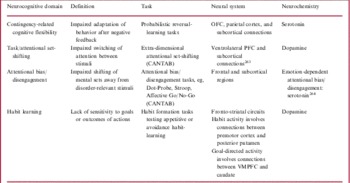
To date, neurocognitive measures of compulsivity have typically assessed the repetitive component of the construct with respect to the ability to flexibly (i) adapt behavior after negative feedback (eg, probabilistic reversal learning tasks) or (ii) switch attention between stimuli [eg, intra-dimensional/extra-dimensional (ID/ED) set-shifting task]. The diminished ability or willingness to disengage from repetitive acts or obsessive thoughts could be described as a persistence of a behavioral or mental set, or a diminished ability or willingness to shift sets. Perseveration of actions and thoughts could be conceptualized as reflecting cognitive inflexibility and representing a key neurocognitive process in compulsivity. Additionally, tasks that assess (iii) attentional bias or (iv) the formation of automatic stimulus-response behaviors (ie, habits) may contribute to compulsivity and so warrant consideration. See Table 2.
Subdividing compulsivity: abbreviated summary of neurocognitive domains, tasks, and neural and neurochemical correlates

OFC = orbitofrontal cortex; PFC = prefrontal cortex; VMPFC = ventromedial prefrontal cortex; CANTAB = Cambridge Neuropsychological Test Automated Battery.
Contingency-related cognitive flexibility
Exerting flexibility in learning and unlearning behavior, based on (probabilistic) contingencies (“probabilistic reversal-learning”), may be particularly relevant to the development of compulsive tendencies. Contingency-related flexibility is dependent on serotoninergic systemsReference Rubia, Smith, Brammer and Taylor 35 , Reference Clarke, Walker and Crofts 105 and has been linked to OFC function. OFC function contributes to the ability to use outcome expectancies in adapting future behavior,Reference Pickens, Saddoris and Setlow 106 , Reference Pickens, Saddoris, Gallagher and Holland 107 as does thalamic and striatal function.Reference Ghahremani, Monterosso, Jentsch, Bilder and Poldrack 108 – Reference Wrase, Kahnt and Schlagenhauf 110 Perseverating on a behavior that was once rewarded, but is later associated with negative consequences, may reflect a lack of flexibility in learning and result in rigid, maladaptive, or compulsive behavior. As such, (probabilistic) reversal-learning paradigms and tasks employing stimulus-response contingencies paired with changes in reward and loss schedules are relevant to investigate in relation to compulsivity.
Across species, reversal learning is impaired by lesions to the OFC but not the DLPFC.Reference Boulougouris, Dalley and Robbins 111 , Reference Hornak, O'Doherty and Bramham 112 Reduced activation of the OFC, lateral PFC, and parietal cortex is observed during reversal learning not only in patients with OCD but also in their unaffected, never-treated relatives.Reference Remijnse, Nielen and van Balkom 113 , Reference Figee, Wielaard, Mazaheri and Denys 114 Reversal-learning–related hypofunction, therefore, appears to be a candidate endophenotype for compulsivity that exists in people at increased genetic risk of OCD, even in the absence of chronic treatment or symptom confounders.
Task/attentional set-shifting
Task-shifting (also referred to as set-shifting or attention-switching) can be subdivided into rule-shifting and perception-shifting: whereas rule-shifting requires a change of goal-related information (a change of the task that should be performed), perception-shifting refers to reorienting of attention to different characteristics of the same stimuli.Reference Monsell 115 A “set” usually refers to the characteristic that is relevant in a given trial (for example “color” when the task is to define the color of a stimulus, and the appropriate stimulus-response mapping). Set-switching and task-switching are sometimes used interchangeably. Rule-switching is associated with a greater engagement of the DLPFC, whereas perception-shifting is associated with a greater recruitment of the parietal cortex.Reference Ravizza and Carter 116
The ID/ED shift task examines different components of attentional flexibility, including reversal learning, set formation and inhibition, and shifting of attention between stimulus dimensions (ED shifting).Reference Lawrence, Sahakian and Robbins 117 Studies have demonstrated that ED shifting is impaired in OCD but not in trichotillomania,Reference Chamberlain, Fineberg, Blackwell, Robbins and Sahakian 3 , Reference Watkins, Sahakian and Robertson 118 and additionally in the unaffected first-degree relatives of OCD subjects,Reference Jefferies, Laws and Fineberg 48 which implicates this aspect of cognitive inflexibility as an additional candidate endophenotype for OCD-related compulsivity. Moreover, ED shift impairment has been identified in patients with obsessive-compulsive spectrum disorders including obsessive-compulsive personality disorder,Reference Fineberg, Sharma, Sivakumaran, Sahakian and Chamberlain 119 schizo-OCD,Reference Patel, Laws and Padhi 120 and possibly BDD.Reference Chamberlain, Blackwell, Fineberg, Robbins and Sahakian 47
Attentional bias/disengagement
Another concept that may contribute to compulsive symptoms within disorders such as OCD and BDD involves attentional bias, ie, the degree to which an individual attends or avoids attending disorder-relevant stimuli. Attentional bias involves preferential attention toward disorder-relevant stimuli, and is evident in anxiety, mood, and addictive disorders.Reference Browning, Holmes and Harmer 121 , Reference Field and Cox 122 Attentional disengagement refers to the ability to disengage and shift attention away from disorder-relevant stimuli (eg, from disorder-relevant stimuli, relative to non-disorder–relevant stimuli).
Attentional disengagement difficulties may contribute to compulsive symptoms by inducing rigidity in the presence of disorder-relevant stimuli. Several neurocognitive studies have investigated the interfering effect of disorder-relevant material on task performance in OCD. For example, the presentation of OCD-related stimuli versus non-OCD–related stimuli results in increased difficulty in switching away from such stimuli in a stop-change paradigm in individuals with OCD.Reference Morein-Zamir, Fineberg, Robbins and Sahakian 123 The evidence concerning attentional bias toward OCD-related stimuli has been rather more varied and inconsistent,Reference Moritz, Fischer and Hottenrott 124 – Reference Kyrios and Iob 127 which has been taken as evidence to distinguish OCD from other anxiety disorders. It remains possible that a bias may only be present in patients with specific symptoms and not others.Reference Sizino da Victoria, Nascimento and Fontenelle 128 Patients with BDD may show a variety of disorder-relevant perceptual biases,Reference Clerkin and Teachman 129 including a tendency to poorly recognize fearful expressions on the Facial Expression of Emotion: Stimuli and Test,Reference Young, Perrett, Calder, Sprengelmeyer and Ekman 130 , Reference Jefferies, Laws and Fineberg 131 which implicates an influence of attentional bias on neurocognitive processing in this disorder as well.Reference Chamberlain, Blackwell, Fineberg, Robbins and Sahakian 47 Brain imaging studies in OCD suggest exaggerated symptom-specific frontal and subcortical activations to disorder-relevant stimuli in OCD patients,Reference Simon, Kaufmann, Musch, Kischkel and Kathmann 132 , Reference van den Heuvel, Veltman and Groenewegen 133 which may reflect a sustained effort to suppress strong responses to OCD triggers.Reference Jefferies, Laws and Fineberg 131
Habit learning
Repetitive performance of behaviors without apparent adaptive function may be characterized by not only a diminished ability to inhibit action, but also a lack of sensitivity to goals. In OCD, for example, many patients are fully aware that compulsive responses may have little to no relation to desirable outcomes, yet despite this knowledge, they continue to perform them. According to associative learning theories of instrumental behavior,Reference de Wit and Dickinson 134 , Reference Dickinson and Balleine 135 actions can be supported by 2 systems: a goal-directed system and a habitual system. When the goal-directed system functions, actions are performed to obtain desired goals or to avoid undesired events. After multiple repetitions, the habitual system begins to render behavior automatic,Reference Adams 136 – Reference Thorndike 138 allowing simple acts to be conducted without much effort. An imbalance between these systems is thought to contribute to OCD, whereby compulsivity is hypothesized to arise from a shift from goal-directed action to habit, rendering behavior insensitive to its outcome. In this way, habit formation may be a process that captures the ego-dystonic aspect of compulsivity, while also appealing to the previously described deficits in response inhibition observed in OCD.
The hypothesis that habits may substantially contribute to OCD developed from the observation that the fronto-striatal circuits that are affected in OCD also mediate the formation of normal habits in healthy individuals and rodents.Reference Graybiel and Rauch 139 Since then, several studies have tested this possibility and revealed a consistent pattern of dysfunction in OCD. The first such study examined the formation of appetitive habits, and observed that OCD patients show impairment in goal-directed learning, leading them to respond excessively to stimuli that are no longer associated with valuable outcomes.Reference Gillan, Papmeyer and Morein-Zamir 140 A subsequent study replicated this effect using a different paradigm, and found that economic decision-making that relies on action–outcome simulation is impaired in OCD patients.Reference Gillan, Morein-Zamir and Kaser 141 Another study tested whether OCD patients form habits in avoidance more readily than healthy control subjects. The authors found that this was the case and presented preliminary evidence to support the interesting possibility that rather than being driven by fear, the development of avoidance habits might actually induce irrational harm-related beliefs (obsessions) in some patients with OCD.Reference Gillan, Morein-Zamir and Urcelay 142
Although a direct neuroimaging investigation of excessive habit formation in OCD is still wanting, basic research in healthy individuals and experimental animals has implicated the fronto-striatal circuits in the balance between goal-directed action and habit.Reference Remijnse, Nielen and van Balkom 113 , Reference Balleine and O'Doherty 143 In a diffusion tensor imaging study, habitual action toward no-longer-rewarding outcomes was predicted according to the estimated white matter tract strength in the premotor cortex seeded from the posterior putamen (as well as by gray matter density in the posterior putamen determined with voxel-based morphometry). In contrast, flexible, goal-directed action was predicted by estimated tract strength in the ventromedial prefrontal cortex seeded from the caudate.Reference de Wit, Watson and Harsay 144 While the role of dopamine in human action control remains poorly understood, reducing dopamine function using acute dietary phenylalanine and tyrosine depletion has been shown to shift the balance of responding toward habitual control in females.Reference de Wit, Standing and Devito 145
Interestingly, habit formation is also thought to play a major role in drug addiction, as initially impulsive drug-seeking becomes compulsive with continued use.Reference Everitt and Robbins 8 An important avenue for future research will be to delineate the behavioral and neurobiological overlap between disruption in the habit system in disorders of appetitive compulsion such as drug addiction and disorders where avoidance compulsions are characteristic of the psychiatric phenotype, such as OCD.
How Far Do Impulsive and Compulsive Mechanisms Contribute to Disorders of Substance or Behavioral Addictions?
Substance addiction
Substance addiction may be defined as a chronic relapsing disorder characterized by diminished control over substance intake. 146 Almost by definition, the phenotype of substance addiction contains elements of impulsive and compulsive behavior. That is, the diminished ability or willingness to shift thoughts and behavior away from substance use and control urges to consume the substance, and the preference for the immediate reward (or, in some circumstances, reduction of distress) associated with substance intake over the, arguably larger, but delayed benefits associated with a non-addicted lifestyle, indicate that compulsive and impulsive traits, respectively, are inherent components of addiction.Reference Everitt and Robbins 8 , Reference Robbins, Gillan, Smith, de Wit and Ersche 9 , Reference De Wit 91 , Reference van den Heuvel, Veltman and Groenewegen 133 , Reference Dalley, Everitt and Robbins 147 – Reference Verdejo-García, Lawrence and Clark 153 Indeed, there is a wealth of evidence that shows impulse-control deficits and compulsive behaviors in humans with substance addictions. This has been demonstrated using tasks for impulsive action, such as GNG and SSRT tasks, impulsive choice in DDTs, and reflection impulsivity tasks, as well as self-report measures of impulsivity. Moreover, tasks that assess cognitive flexibility, such as set-shifting paradigms and probabilistic reversal-learning tasks, have also demonstrated impairments in individuals with substance addictions. 146 , Reference Dalley, Everitt and Robbins 147 , Reference Garavan and Stout 149 , Reference Rogers and Robbins 152 This begs the question of whether impulsive and compulsive behaviors represent vulnerability factors for addiction or are the consequence of prolonged excessive substance intake.
One way to address this issue is to perform prospective studies, or to compare addicted individuals with their non-addicted siblings. Importantly, studies in animals have provided evidence to indicate that there is a bidirectional relationship between impulsivity and addiction. Thus, high impulsivity on the 5-choice serial reaction time task (5-CSRTT; a rodent analogue of the continuous performance task) predicts sensitivity to the reinforcing properties of cocaine and nicotine, the progression to cocaine addiction–like behavior, and sensitivity to relapse after abstinence.Reference Belin, Mar, Dalley, Robbins and Everitt 154 – Reference Economidou, Pelloux, Robbins, Dalley and Everitt 157 Furthermore, high levels of impulsive choice in a DDT are associated with increased alcohol and cocaine self-administration, and higher persistence of nicotine- and cocaine-seeking,Reference Dalley, Fryer and Brichard 155 , Reference Broos, Diergaarde, Schoffelmeer, Pattij and De Vries 158 – Reference Poulos, Le and Parker 160 , but interestingly impulsive response on these scales was not a good predictor of increased heroin self-administration.Reference McNamara, Dalley, Robbins, Everitt and Belin 161 , Reference Schippers, Binnekade, Schoffelmeer, Pattij and De Vries 162 Conversely, several studies have shown that a period of drug self-administration enhances impulsive behavior in the 5-CSRTT or DDT.Reference Belin, Mar, Dalley, Robbins and Everitt 154 , Reference Economidou, Pelloux, Robbins, Dalley and Everitt 157 , Reference Poulos, Le and Parker 160 , Reference Dalley, Laane and Theobald 163 – Reference Winstanley, Bachtell and Theobald 166 Interestingly, the increases in impulsivity in the DDT after heroin self-administration seem to be transient,Reference McNamara, Dalley, Robbins, Everitt and Belin 161 which is consistent with studies in humans that show ameliorations in delay discounting in abstinent or former addicts.Reference Perry and Carroll 92 , Reference Madden, Petry, Badger and Bickel 94 The reduced impulsive choice in abstinent addicts could mean that increased discounting is the result of prolonged substance abuse, or that lower discounting rates represent a predictor for successful abstinence.Reference Yoon, Higgins and Heil 167 This latter suggestion is supported by the findings in animal studies that increased impulsivity in the DDT predicts slower extinction of self-administration and greater cue-induced reinstatement of extinguished responding.Reference Dalley, Fryer and Brichard 155 , Reference Economidou, Pelloux, Robbins, Dalley and Everitt 157 Together, these studies provide evidence for the notion that impulse-control deficits are a risk factor for addiction, although this seems to depend on the type of impulsivity and substance used. In addition, substance abuse itself may enhance impulsivity, especially impulsive choice.
Recent studies in humans have also shed light on the validity of impulsivity as a vulnerability marker for addiction. Siblings of psychostimulant-addicted individuals were found to display higher levels of impulsivity in the SSRTReference Ersche, Jones and Williams 168 , Reference Ersche, Turton and Chamberlain 169 and higher self-reported impulsivity than controls (albeit lower than their addicted siblings).Reference Ersche, Jones and Williams 168 , Reference Ersche, Turton, Pradhan, Bullmore and Robbins 170 These data suggest that motor impulsivity is a vulnerability factor for psychostimulant addiction, leading to the intriguing question as to what protects the impulsive, but non-addicted, individuals from substance-abuse problems. An important clue to this question is provided by studies that have shown increased sensation-seeking characteristics in recreational psychostimulant users as well as those with stimulant addiction, but not in their non-addicted siblings.Reference Ersche, Turton and Chamberlain 169 , Reference Ersche, Jones and Williams 171 Together, these studies suggest that the combination of increased impulsivity and increased sensation-seeking, but not just 1 of these 2 characteristics, confers a greatly enhanced risk for psychostimulant addiction. Prospective studies have also provided evidence for impulsive behavior as a possible risk factor for addiction. Impulsive choice in a DDT was found to predict smoking,Reference Audrain-McGovern, Rodriguez and Epstein 172 and lower SSRT performance predicted alcohol- and drug-related problems in adolescents.Reference Nigg, Wong and Martel 173 However, another study found SSRT performance not to predict the progression to heavy alcohol drinking in college students (in which performance on the Iowa Gambling Task did have predictive valueReference Goudriaan, Grekin and Sher 174 ).
Regarding compulsivity, attentional set-shifting (in a rodent analogue of the Wisconsin Card Sort Test) has been shown to be impaired in rats with a history of methamphetamine self-administration,Reference Parsegian, Glen, Lavin and See 175 and cocaine self-administration in rats and primates leads to reversal-learning deficits.Reference Calu, Stalnaker and Franz 176 , Reference Porter, Olsen and Gurnsey 177 Importantly, compulsive aspects of addiction have been found to occur in animals after prolonged substance self-administration.Reference Lesscher and Vanderschuren 178 , Reference Vanderschuren and Ahmed 179 That is, after prolonged cocaine and alcohol intake, rodents have been shown to display insensitivity to punishment and persistent substance-seeking.Reference Verdejo-García, Lawrence and Clark 153 , Reference Deroche-Gamonet, Belin and Piazza 180 – Reference Wolffgramm 186 Recent studies have suggested altered functioning in the prelimbic PFC, nucleus accumbens core, and dorsolateral striatum as well as reduced forebrain serotonin (in particular through 5-HT2C receptors) as underlying mechanisms of compulsive substance-seeking in rodents.Reference Hopf, Chang, Sparta, Bowers and Bonci 181 , Reference Bock, Shin and Kaplan 187 – Reference Pelloux, Dilleen, Economidou, Theobald and Everitt 191
Whether compulsivity is a cause or consequence of addictive behavior has not been investigated in great detail. The animal studies cited above suggest that compulsivity results from substance abuse, contributing to the development of addictive behavior, particularly in vulnerable individuals, such as those with impulse-control deficits.Reference Everitt and Robbins 192 , Reference Robbins, Gillan, Smith, de Wit and Ersche 193 However, reduced cognitive flexibility has also been shown to predict addictive behavior to some degree in prospective and sibling studies.Reference Ersche, Jones and Williams 168 , Reference Audrain-McGovern, Rodriguez and Epstein 172 In a resting-state fMRI study that directly compared OCD and stimulant-dependent individuals, reduced functional connectivity between the OFC and dorsal medial premotor cortex was observed in both patient groups, compared with healthy controls, and the degree of “OFC disconnection” correlated with ratings of clinical compulsivity,Reference Meunier, Ersche and Craig 194 which implicates functional OFC-disconnection as a possible endophenotype for compulsivity across diagnostic categories.
In summary, there is evidence to support the idea that impulse-control deficits represent a risk factor for substance addiction, and, conversely, that substance abuse induces or exacerbates impulsivity. Prolonged excessive substance use may lead to compulsive behavior, particularly in impulsive individuals.Reference Verdejo-García, Lawrence and Clark 153 , Reference Ersche, Turton and Chamberlain 169 , Reference Pelloux, Dilleen, Economidou, Theobald and Everitt 191 Whether compulsive traits also comprise a vulnerability factor for addiction remains to be thoroughly investigated. Importantly, studies into the relationship between impulsive and compulsive behavior on the one hand, and substance addiction on the other, need to consider the heterogeneities of the impulsivity and compulsivity constructs as well as the substances abused. There is likely to be specificity regarding the subtype of impulsivity/compulsivity that is related to addiction to certain substances.Reference Dalley, Everitt and Robbins 147 , Reference Verdejo-García, Lawrence and Clark 153 , Reference Poulos, Le and Parker 160 , Reference McNamara, Dalley, Robbins, Everitt and Belin 161
Behavioral addiction
Arguably the best-studied behavioral addiction is pathological gambling, a condition that was recently reclassified as an addiction and renamed as “gambling disorder” in DSM-5. 7 , Reference Potenza 195 Several theoretical models have been proposed to explain addictions and addiction vulnerability (eg, reward deficiency, impaired response inhibition and salience allocation, allostasis, misdirected motivationsReference Potenza 196 ), and most of these have applicability to gambling and substance-use disorders. Several studies have investigated reward processing in pathological gambling and have identified similarities with substance-use disorders. For example, using the monetary incentive delay task, individuals with pathological gambling were found to demonstrate relatively reduced ventral striatal activation in anticipation of monetary rewards,Reference Balodis, Kober and Worhunsky 197 , Reference Choi, Shin and Jung 198 —a finding similar to that observed in people with alcohol dependence.Reference Wrase, Schlagenhauf and Kienast 199 As in alcohol dependence, an inverse relationship between ventral striatal activation during reward anticipation and self-reported impulsivity was observed in both the pathological-gambling and alcohol-dependent groups,Reference Potenza 196 , Reference Beck, Schlagenhauf and Wustenberg 200 which suggests that this feature of blunted ventral striatal activation across behavioral- and substance-addiction groups relates similarly to impulsivity. These findings resonate with those from neurocognitive assessments of people with gambling and alcohol-use problems in which both groups demonstrated greater impulsivity, but the alcohol-dependent group additionally showed impairments on executive functioning that are thought to involve greater involvement of the DLPFC.Reference Lawrence, Luty, Bogdan, Sahakian and Clark 201
Preliminary findings suggest that these patterns might extend to other behavioral addictions. For example, binge-eating disorder, in part because of its association with poor impulse control, has been proposed to represent the eating disorder with the most similarities to addictions.Reference Gearhardt, White and Potenza 202 Obese individuals with binge-eating disorder, as compared to a body mass index–matched group without binge-eating disorder, show relatively diminished activation of the ventral striatum during reward anticipation,Reference Balodis, Kober and Worhunsky 203 which is a finding similar to those with alcohol dependence and pathological gambling.Reference Potenza 196 – Reference Choi, Shin and Jung 198 Furthermore, preliminary data suggest that among individuals with binge-eating disorder, the degree of activation of the ventral striatum relates importantly to clinically relevant measures such as treatment outcome.Reference Balodis, Grilo, Kober, Worhunsky, White, Stevens, Pearlson and Potenza 204 These findings highlight the importance of identifying clinically relevant subgroups of people with obesity and suggest the clinical relevance of impulsivity.Reference Ziauddeen, Farooqi and Fletcher 205 – Reference Ziauddeen, Farooqi and Fletcher 207 The extent to which these findings might extend to other behavioral addictions warrants direct examination.
Although dopamine function has been linked to reward processing in the striatum,Reference Zald, Boileau and El-Dearedy 208 differences have been observed in striatal dopamine function in behavioral and substance addictions. For example, diminished D2-like dopamine receptor availability in the striatum has been reported in stimulant dependence and obesity, which provides support for a relationship between the disorders.Reference Frascella, Potenza, Brown and Childress 209 However, several studies indicate a lack of differences in D2-like dopamine receptor availability in the striatum between individuals with pathological gambling and those without, although dopamine has been preliminarily associated with risk-taking and mood-related impulsivity in pathological gambling.Reference Leeman and Potenza 210 Furthermore, among individuals with Parkinson's disease, those with pathological gambling showed differences in ventral but not dorsal striatal availability of D2-like dopamine receptors, as well as differences in ventral striatal displacement of [C11]raclopride during performance of a decision-making (“gambling”) task, which suggests greater dopamine release in the group with pathological gambling.Reference Frascella, Potenza, Brown and Childress 209 These findings are similar to those in which individuals with dopamine dysregulation syndrome (taking more dopamine replacement therapy medications than prescribed, as if “addicted” to the medication) showed differences in ventral but not dorsal striatal D2-like dopamine receptor availability following levo-dopa administration.Reference Evans, Pavese and Lawrence 211 Thus, there seem to be both similarities and differences in the relationships between striatal dopamine function and behavioral and drug addictions.
Advances in Understanding the Genetics of Impulsive and Compulsive Behaviors and Disorders
Intensive efforts have been made to characterize the cerebral circuits that underpin cognitive traits and to define their genetic vulnerability, which would potentially lead to new effective treatments in psychiatry.Reference Millan, Agid and Brüne 212 The impulsivity trait is one of the most frequently studied traits in this regard. Impulsivity is at least moderately heritable in childrenReference Niv, Tuvblad, Raine, Wang and Baker 213 and in adults,Reference Coccaro, Bergeman and McClearn 214 , Reference Kendler, Aggen and Czajkowski 215 with a strong genetic continuity from mid- to late adolescence.Reference Millan, Agid and Brüne 212 A 45% heritability of self-rated impulsivity in adults is compatible with the 3 twin studies that have been performed on the topic.Reference Hur and Bouchard 216 – Reference Seroczynski, Bergeman and Coccaro 218 Compulsivity has been infrequently studied; to date the “compulsive” dimensions of OCD or obsessive-compulsive personality show little evidence of significant heritability.Reference Livesley, Jang and Vernon 219
No genome-wide association study (GWAS) has yet been performed on impulsivity. Candidate genes, or testing the “usual suspects” (ie, mainly the genes coding for serotoninReference Stoltenberg, Christ and Highland 220 or dopamineReference Gorwood, Le Strat and Ramoz 221 receptors and/or transporters), have been analyzed. The DRD2 A1-allele was associated with impulsive behaviors using a response inhibition testReference White, Morris, Lawford and Young 222 and a DDT.Reference Eisenberg, Mackillop and Modi 223 The A1 allele of the DRD2 gene may therefore relate to (1) heightened reinforcement sensitivity, (2) greater need for practice to overcome inherent reinforcement-related learning deficits (associated with fewer dopamine receptors in key brain reinforcement sites), or (3) reduced inhibitory control.Reference Rodriguez-Jimenez, Ãvila and Ponce 224 Interestingly, some dopamine genes were associated with impulsivity and one or more addictive disorders, including DRD4, DAT, MAOA, and COMT,Reference Gorwood, Le Strat and Ramoz 225 which showed that a bridge between quantitative impulsivity and qualitative psychiatric disorders can be proposed.Reference Robbins, Gillan, Smith, de Wit and Ersche 226 In a large study that was conducted in adolescents, allelic variation in rs36024, a single nucleotide polymorphism that is involved in encoding the norepinephrine transporter (NET), was significantly associated with extent of activation in the right frontal inhibitory network during successful response inhibition.Reference Whelan, Conrod and Poline 227 These findings accord well with the previously described pharmacological data, which linked norepinephrine with response inhibition and right frontal activation.Reference Rubia, Smith, Brammer and Taylor 35 , Reference Aron, Dowson, Sahakian and Robbins 42 , Reference Boonstra, Kooij, Oosterlaan, Sergeant and Buitelaar 43
Some of these genes had independent replication(s), and some even led to positive meta-analyses, but the effect size was limited (eg, the Taq1 A1 allele of the DRD2 gene increased the risk of impulsive traits or disorders by only 30%Reference Stoltenberg, Christ and Highland 220 ). The genes involved might therefore (1) have a role on specific characteristics of impulsivity, (2) may need to interact with environmental factors that are present only in subgroups of subjects to be deleterious (gene-by-environment interactions), (3) or may be numerous, with each mutation having an important impact but on a limited number of patients. Favoring this last hypothesis, 2 genes that may have a particularly strong relationship with impulsivity (MAO-A and 5-HT2B genes) share different characteristics.Reference Brunner, Nelen, Breakefield, Ropers and van Oost 228 , Reference Bevilacqua, Doly and Kaprio 229 The genetic polymorphisms detected in these 2 studies concern rare and severe mutations (stop codons), involve dopamine and/or serotonin, and were revealed in very small samples of patients with high impulsivity associated with criminal offenses.
Does the Presence of Impulsivity or Compulsivity Have Prognostic Implications for Treatment Response?
As indicated above, there is a growing body of literature that implicates neurocognitive impulsivity (assessed as poor response inhibition, steep temporal discounting, and possibly disadvantageous decision-making) in multiple neuropsychiatric disorders. Parallel to this, the clinical implications of increased impulsivity for treatment response or treatment drop-out have been studied in prospective studies. In addictive disorders, there is evidence that higher levels of impulsivity, specifically in the areas of reward-related and motor impulsivity, but also attentional-bias,Reference Streeter, Terhune and Whitfield 230 – Reference Waters, Shiffman and Sayette 233 result in earlier treatment drop-out, a higher likelihood of relapse into addictive behaviors/disorders, and/or exacerbation of substance-use–related problems. (For examples of motor impulsivity and reward-related impulsivity in substance-use disorders, see Nigg etal,Reference Nigg, Wong and Martel 173 Schmitz etal,Reference Schmitz, Mooney and Green 234 Bowden-Jones etal,Reference Bowden-Jones, McPhillips, Rogers, Hutton and Joyce 235 Passetti etal,Reference Passetti, Clark, Mehta, Joyce and King 236 and Krishnan-Sarin etal Reference Krishnan-Sarin, Reynolds and Duhig 237 ; for examples in problem/pathological gambling, see Goudriaan etal,Reference Goudriaan, Oosterlaan, de Beurs and van den Brink 238 Alvarez-Moya etal,Reference Alvarez-Moya, Ochoa and Jimenez-Murcia 239 Blanco etal,Reference Blanco, Potenza and Kim 240 and Grant etal.Reference Grant, Chamberlain, Odlaug, Potenza and Kim 241 )
Interestingly, the treatment setting may affect the influence that impulsivity has on treatment outcome: in a study that compared inpatient and outpatient treatment, impulsivity only influenced treatment outcome in the outpatient treatment setting.Reference Passetti, Clark and Davis 242 This suggests that having a protective environment surrounding impulsive patients (ie, in a residential treatment setting) may restrict the negative influence of impulsivity on treatment outcome. With regard to other disorders, such as OCD, there is mixed evidence with regard to the prognostic role of neurocognitive functions for treatment response. A study of 138 OCD patients indicated that most neurocognitive measures did not predict treatment response to cognitive behavioral treatment with or without additional pharmacotherapy, although trends were found for several measures relating to cognitive flexibility such as performance on an alternation test and perseveration errors on the Wisconsin Card Sort Test (WCST).Reference Moritz, Kloss and Jacobsen 243 A study of 63 pediatric OCD patients indicates that, on a broader level, diminished memory and executive functions may have a negative effect on treatment response to cognitive behavioral therapy and/or sertraline in children with OCD.Reference Flessner, Allgair and Garcia 244 Of interest, in a study that included tests on impulsivity (Stroop) and mental flexibility (perseverations on a verbal learning test), lower perseveration was associated with better response to cognitive behavioral therapy (CBT), but with worse response to fluoxetine, which implies that this form of mental flexibility may be a neurocognitive predictor of divergent outcome directions for CBT versus fluoxetine. Given the small sample size (a total of 38 patients across 2 treatment conditions), this finding needs to be replicated in further studies, although a neuroimaging study (see below) from the same research group indicates that responsivity to CBT versus fluoxetine is predicted by differential structural brain characteristics as well.Reference Hoexter, Dougherty and Shavitt 245
Neuroimaging data indicate that an important relationship exists between the neurocircuitry that underlies both reward impulsivity and attentional bias (cue reactivity) and treatment outcome in substance-use disorders. One of the first such studies investigating methamphetamine patients found that diminished frontal and cingulate cortex activity during a decision-making task was associated with a higher rate of relapse.Reference Paulus, Tapert and Schuckit 246 In an fMRI Stroop study, DLPFC activation was inversely associated with treatment retention, and VMPFC, striatal, and cingulate activation was positively associated with cocaine abstinence in cocaine-dependent subjects.Reference Brewer, Worhunsky, Carroll, Rounsaville and Potenza 18 An independent component analysis of the fMRI Stroop data from the same cocaine-dependent subjects identified 5 functionally integrated activations linked to Stroop performance, with the 2 circuits involving predominantly striatal and ventral PFC regions associated with cocaine abstinence measures.Reference Worhunsky, Stevens and Carroll 247 Preliminary findings in individuals with pathological gambling also link activations of these brain regions (VMPFC, ventral striatum) to treatment outcome.Reference Potenza, Balodis and Franco 248 Among treatment-seeking adolescent smokers who received behavioral therapies for smoking cessation, fMRI Stroop measures related to within-treatment urine cotinine (nicotine metabolite) levels, with greater activation in the inferior frontal gyrus, insula, thalamus, and anterior cingulate, were associated with greater reductions in cotinine levels during treatment.Reference Krishnan-Sarin, Balodis and Kober 249 A study in smokers indicated that both behavioral responses (attentional bias to smoking-related words in a Stroop task) and decreased functional MRI connectivity between the anterior insula and dorsal anterior cingulate cortex were associated with relapse.Reference Janes, Pizzagalli and Richardt 250 Neural responses in a gambling task indicate that reward impulsivity also relates to escalation of cannabis use.Reference Cousijn, Wiers and Ridderinkhof 251
In OCD, several small treatment studies have focused on the unraveling of the neurophysiological mechanisms of treatment response. For instance, a study in 10 OCD patients showed an increase in N-acetyl-aspartyl-glutamate in the pregenual anterior cingulate cortex (ACC) and a decrease in glutamate plus glutamine (Glx) in the anterior middle cingulate cortex after CBT.Reference O'Neill, Gorbis and Feusner 252 Structurally, smaller gray matter putamen in OCD, normalized in response to fluoxetine treatment compared to CBT treatment,Reference Hoexter, de Souza Duran and D'Alcante 253 and smaller lateral OFC was associated with responsivity to fluoxetine, whereas larger right medial prefrontal cortex was associated with better response to CBT.Reference Flessner, Allgair and Garcia 244 Functionally, higher insular responses in high-conflict trials in a Flanker task, diminished in response to CBT treatment in pediatric OCD patients,Reference Huyser, Veltman, Wolters, de Haan and Boer 254 and in another fMRI study, increased caudate activity on a cognitive flexibility taskReference Freyer, Klöppel and Tüscher 255 was present in treated OCD patients. Positron emission tomography (PET) studies showed increased glucose metabolism in the caudateReference Apostolova, Block and Buchert 256 and decreased thalamic glucose metabolism in combination with increased right ACC metabolismReference Saxena, Gorbis and O'Neill 257 to be associated with treatment response in OCD.
In addiction research, studies focusing on the neurophysiological mechanisms of treatment response are in their infancy.Reference Morgenstern, Naqvi, Debellis and Breiter 258 Currently, only 3 neuroimaging studiesReference Vollstädt-Klein, Loeber and Richter 259 – Reference Martinez, Carpenter and Liu 261 have focused on the neurobiological mechanisms of treatment in addiction, and only 1 of these studies included addictive behavior as an outcome measure.Reference Martinez, Carpenter and Liu 261 In this study, lower baseline dopamine (DA) transmission was associated with worse treatment outcome, but the studied form of treatment—contingency management within a community reinforcement approach—did not change DA transmission in the responders.Reference Martinez, Carpenter and Liu 261 In the 2 other studies that investigated neurophysiological mechanisms of action in substance dependence, one of the studies examined the effect of cue exposure training (CET) on changes in functional brain activations to alcohol cues.Reference Morgenstern, Naqvi, Debellis and Breiter 258 CET was associated with diminished cue reactivity in frontostriatal brain circuitry, but no clinical outcomes were reported. In the other study, DeVito etal Reference DeVito, Worhunsky and Carroll 260 investigated improvement on an (fMRI) Stroop task in 12 participants with an substance use disorder (SUD) by comparing treatment-as-usual to computer-assisted CBT combined with treatment as usual. The CBT-combined treatment resulted in better Stroop performance and lower frontal, ACC, and thalamic brain activation patterns in combination with decreased subthalamic nucleus (STN) activation compared to the healthy controls. Clearly, the topic of measuring neurophysiological mechanisms of behavior change in addictive disorders is in need of larger studies that include outcome measures relating to the relevant addictive disorder, in order to investigate how impulsivity and compulsivity interact and which role they play in the treatment effects of addiction.
In summary, there is evidence from neurocognitive and neuroimaging studies that specific aspects of impulsivity may contribute importantly to relapse in addictive disorders. In contrast, only a few studies have investigated the role of compulsivity for the course of neuropsychiatric disorders characterized by impulsive–compulsive characteristics, although existing data support roles for both impulsivity and compulsivity in treatment outcome (eg, see Alvarez-Moya etal Reference Alvarez-Moya, Ochoa and Jimenez-Murcia 239 and Blanco etal Reference Blanco, Potenza and Kim 240 ). For disorders that are more strongly associated with compulsivity, such as OCD, the few studies on the prognostic role of neurocognitive compulsivity in this disorder show mixed results. Neuroimaging studies that have investigated the neurophysiological mechanisms of both cognitive behavioral therapy and pharmacotherapy in OCD indicate that treatment effects are associated with metabolic and functional changes in the fronto-striatal brain circuitry. However, not all research results are consistently found across studies, and most of these studies were done in small (pilot) studies, which indicates the need for larger studies before translation of neurophysiological treatment mechanisms into treatment allocation in OCD can be made. Therefore, there is a clear need for studies on the prognostic value of compulsivity in addictive disorders, for studies on the prognostic value of both impulsivity and compulsivity for neuropsychiatric disorders like OCD, and for large-scale studies investigating the neurophysiological mechanisms of treatment response in addictive disorders and in OCD.
Next Steps for Research
Despite significant progress in our understanding of the constructs of impulsivity and compulsivity, their underlying psychobiology, and their contributions to various psychiatric disorders, much remains to be learned. Here we highlight a number of questions that seem particularly tractable using basic and clinical science methods.
First, there is a need to further clarify the operationalization of compulsivity and impulsivity. We have noted that a range of neuropsychological mechanisms contribute to both impulsive and compulsive responses. Nonetheless, as many of the relevant studies comprise work on patients with putative impulsive and compulsive psychiatric disorders, it is difficult to draw generalized conclusions about the relationship between transdiagnostic behaviors and underlying mechanisms. There is a literature on clinician-rated and self-reported impulsive and compulsive symptomatology, some of which is based on dimensional self-reported measures of behavioral tendencies, and some of which is based on categorical psychiatric disorders. Further work is needed, in order to provide validated clinical measures that can be used transdiagnostically.
Second, while many of the advances in this area have relied on translational approaches, much further application of both basic and clinical neuroscience methods is needed. At an imaging level, new tools are available for addressing the mechanisms of impulsivity and compulsivity and for comparing and contrasting impulsive and compulsive disorders; these include functional and structural connectivity methods, along with novel developments in radioligands that are designed to quantify receptor binding for specific neurotransmitter receptors and transporters.Reference Del Campo, Chamberlain, Sahakian and Robbins 262 At a molecular level, there is again a need to apply recently developed methodologies to understand the precise basis of impulsivity and compulsivity, and to determine relationships between mental disorders; these include genetic sequencing methods, advances in epigenetics, and methods in proteomics and metabolomics. Much of the focus in this area has been on monoamine neurotransmitters; this needs to extend to include work on other neurotransmitter systems, molecules involved in neuroplasticity, and other relevant molecular systems.
Third, much clinical work in this area has focused on cross-sectional studies. There is a real need for longitudinal work, ranging from work to examine the prevalence and course of impulsive and compulsive disorders in the community, to work to examine the way in which impulsive and compulsive symptoms evolve over time in the community. Such work may well benefit from integration with basic and clinical neuroscience methods, so that we understand, for example, changes in neurocircuitry and molecular signatures over time, and their correlations with neuropsychological features and clinical symptoms over time. Work focused on proximal mechanisms (eg, understanding the precise genes and environments that predispose one to compulsive and impulsive responses) should be supplemented by work that addresses distal/evolutionary mechanisms (and so provides insight into the possible adaptive value of such responses).
The recent technological advances in imaging, genetics, and other domains thus offer a unique opportunity to investigate and better understand core components of disorders characterized by impulsivity and compulsivity. Improved understanding has a significant likelihood of being translated into improved and possibly personalized approaches toward prevention, treatment, and policy for a range of currently costly psychiatric disorders.
Disclosures
Naomi A. Fineberg has the following disclosures: Servier, consultant, consulting fees, research support; Transcept, consultant, financial support to attend scientific meeting; ECNP, financial support to attend scientific meeting; BAP, financial support to attend scientific meeting; International Society for Addiction, activity: other, support to attend meeting; UK MRC, research, research grant; UK NHS NIHR, research, research grant. Samuel R. Chamberlain has the following disclosure: Cam Cog, consultant, consulting fees. Anna E. Goudriaan does not have anything to disclose. Dan J. Stein has the following disclosures: Lundbeck, advisor, Honoraria; Novartis, advisor, fee to institution; Servier, advisor, fee to institution; Bicodex, advisor, fee to institution. Louk J.M.J. Vanderschuren has the following disclosures: ZonMw, research support, research grant 91207006; ZonMwNIDA, research support, research grant 606060097211; NIDA, research support, research grant DA022628. Claire M. Gillan has the following disclosure: Medical Research Council, research, research support. Sameer Shekar has nothing to disclose. Philip A.P.M. Gorwood has the following disclosures: AstraZeneca, consultant/advisor, Honoraria; Bristol-Myers Squibb, consultant/advisor, Honoraria; Janssen, consultant/advisor, Honoraria; Lilly, research support, Honoraria; Lundbeck, consultant/advisor, Honoraria; Roche, consultant/advisor, Honoraria; Servier, consultant/advisor, Honoraria. Valerie Voon is a Wellcome Trust Fellow. Sharon Morein-Zamir does not have anything to disclose. Damiaan Denys does not have anything to disclose.
Barbara J. Sahakian has the following disclosures: Lundbeck, consultant/advisor, Honoraria/consulting fees; Janssen/J&J, research support, grants; Servier, consultant/advisor, consulting fees; Cambridge Cognition, consultant, consulting fees; PAION (previously CeNe5), consultant, consulting fees; Wellcome Trust, research support, research grant (89589/Z/09/Z); MRC, research support, research grant (G10000183); Wellcome Trust, research support, research grant (093875/Z/10/Z). F. Gerard Moeller has the following disclosures: Boehringer Ingelheim, consultant, travel grant; NIDA, research support, grant P50DA009262; NIDA, research support, grant P20DA024157. Trevor W. Robbins has the following disclosures: Cambridge Cognition, consulting, fees; Cambridge Cognition, CANTAB, Royalties for CANTAB; Lilly, consulting, consulting fees; Lundbeck, consulting, consulting fees; Shire, consulting, consulting fees; Teva, consulting, consulting fees; Chempartners, consulting, consulting fees; Lilly, research, research grants; Lundbeck, contract research, research grants; GSK, research, research grants. Marc N. Potenza has the following disclosures: Ironwood Pharmaceuticals, consultant, anticipated consulting fees; Lundbeck, consultant, anticipated consulting fees; Sands, consultant, consulting fees. Dr. Potenza also conducted research that was funded in part by NIH grants from NIDA (R01 DA 019039, R01 DA018647, P20 DA027844) and NIAAA (RL1 AA017539), the Connecticut State Department of Mental Health and Addictions Services, the Connecticut Mental Health Center, an unrestricted research gift from the Mohegan Sun casino, and the Yale Gambling Center of Research Excellence Award grant from the National Center for Responsible Gaming. The funding agencies did not provide input or comment on the content of the manuscript, and the content of the manuscript reflects the contributions and thoughts of the authors and not necessarily reflect the views of the funding agencies.