Analysis of medicine price data is a standard element of pharmaco-economic studies (Reference Drummond, Wilson, Kanavos, Ubel and Rovira1). Study objectives can include assessments of the cost-effectiveness of a new medicine, evaluations of policy measures (time-series analyses), comparisons of prices of the same molecules (originator versus generic, or biosimilar, medicines, cross-country comparisons of prices of single medicines or medicines of therapeutic groups and other groups (e.g., orphan medicines, medicines with high budget impact), analyses of different price components (e.g., distribution mark-ups and sales taxes as part of the final price), and assessments of the affordability of the medicines (from the perspective of patients, public payers, or procuring providers such as hospitals). Findings of such research allow policy makers to base their decisions on existing evidence; the decisions concern, among others, the price of a new medicine and its coverage in a publicly subsidized healthcare system (2;3). Experts working in or for public authorities need access to and an understanding of medicine prices when they assess a reimbursement dossier or set the medicine price in their country based on those of the other countries (application of the so-called external price referencing policy (4)).
Despite the importance of medicine price analyses, guidance of how to conduct them properly is limited. Few publications address methodological decisions for medicine price studies, and those available tend to focus on cross-country comparisons (Reference Andersson5–Reference Machado, O'Brodovich, Krahn and Einarson7). The issue of how to get access to medicine price data and how to assess their quality has, to the best knowledge of the authors, never been addressed in methodology papers and manuals. Solely the methodology jointly developed by the World Health Organization (WHO) and Health Action International (HAI) to measure availability and prices of medicines provides practical advice of how to source and survey price data. Still, while the WHO/HAI methodology manual (as of 2003 (Reference WHO8), updated version of 2008 (Reference WHO9)) offers guidance for conducting price surveys through on-site data collection in community pharmacies and other dispensing outlets, it does not address the appraisal of price data sources.
In high-income countries, with price regulation, medicine price lists, registers, and databases exist, but they differ in terms of content, set-up, usage, and accessibility. In some countries more than one medicine price data source is available. In the European Union (EU), for instance, the Council Directive 89/105/EEC (also referred to as Transparency Directive (10)) obliges Member States to publish the price data of price-regulated medicines. As a result, national price data provided by authorities are available in EU Member States, and they complement the databases of further (commercial) providers. Information about data sources for medicine prices globally, including a brief description of the frequency of update and the scope of content, has been made available by the WHO (11).
The choice of the data source, or sources, is a key methodological decision for any research as it has to be ensured that content and quality of data allow performing the intended work (e.g., research or the administrative task of setting a price). Selecting the most appropriate data source can be challenging. In the past, the authors have been approached by several researchers and policy makers for advice but, to their best knowledge, there is no established methodology to assess medicine price data sources. Thus, need for a methodology to support the selection of medicine price data sources in a more structured way was identified.
Against this backdrop, a framework that allows assessing data sources of medicine prices in terms of their feasibility for research was developed. The aim of this study is to present this framework (called Re-ADAPT framework) and to discuss the feasibility of its components based on lessons learned from applying them in a few case studies. Guidance for doing primary data collections (e.g., on-site surveys) in settings where no price data exist is not within the scope of this article; advice in this field is predominantly provided by the above-mentioned WHO/HAI methodology (Reference WHO9). The presented framework concerns the assessment and appraisal processes of data sources but it does not aim to present individual data sources given the existence of summaries of data sources, including the above-mentioned WHO overview (11) and a review of medicine price information mechanisms established by international organizations (Reference Hinsch, Kaddar and Schmitt12). For illustrative purposes, a few examples will be mentioned.
Methods
The development and testing of the Re-ADAPT framework was done in a multi-step process.
First, a targeted literature review was conducted by using PubMed and GoogleScholar as well as snowballing to identify peer-reviewed and gray literature related to the methodology of medicine price studies, in particular with regard to approaches for the selection and assessment of price data sources.
Second, a topology to describe dimensions of medicine price data sources and subsequently a catalogue of assessment criteria, accompanied by a checklist of practical questions (Re-ADAPT framework), were developed. For this purpose, some general elements identified in the literature review: for example, methodological issues of price comparisons, though not related to medicine price data sources, were used to inform the development of the topology and the Re-ADAPT framework. However, given lack of literature related to the assessment of data sources, the framework development was also based, to a large extent, on the authors’ long-term practical experience in performing price studies and providing guidance and trainings in this field. A working document presenting and discussing the elements of the framework was shared with peers for review, and their written comments were considered in updated versions of the Re-ADAPT framework.
Third, to test the framework, we developed four research questions (e.g., “cross-country comparison: analysis of the prices of 200 high-cost medicines in country D compared with the ones in countries A, B, and C” and “effect of the implementation of the national action plan for rare diseases in country B on the prices of orphan medicines in that country”) and proceeded to test the appropriateness of five fictional data sources for researching them. We created the fictional data sources based on characteristics from existing price sources; this allowed indicating more specificities of one data source (that, in reality, were observed with different sources) and keeping neutrality because this study does not aim to evaluate existing data sources. Nonetheless, the case studies were informed by real-world experiences that the authors have made or have been reported by colleagues. Finally, the countries used in the research questions are also fictional, but were chosen to incorporate characteristics of different health systems. More details on the methodology of the case studies are available in Supplementary Material 1.
Results
Literature Review
The review did not find any literature that provided advice on the selection of medicine price data sources.
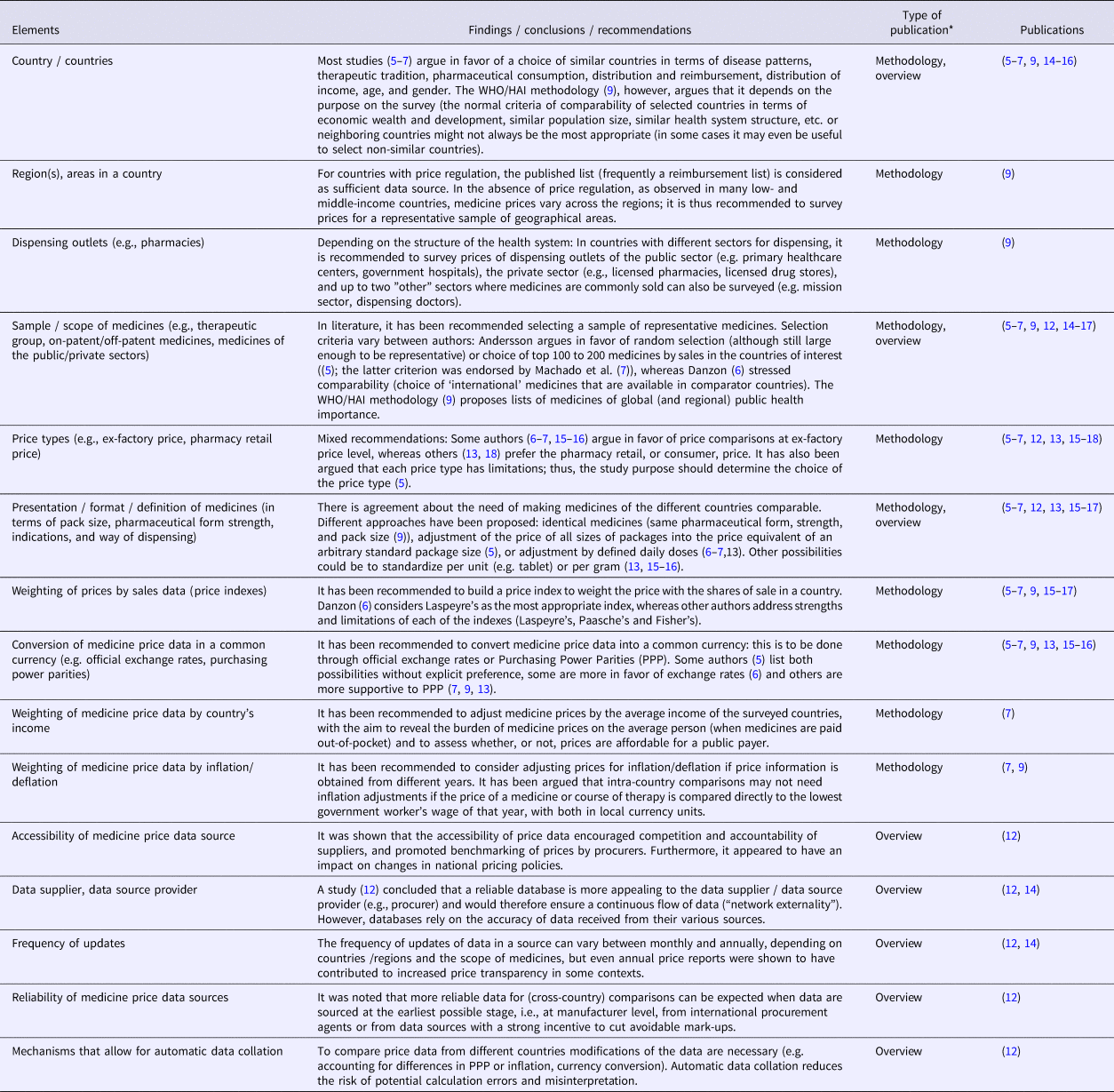
A few publications related to the methodology of medicine price comparisons were identified, and they mainly provided recommendations of how to do international comparisons of medicine prices. A frequently referenced methodology paper is the work of Andersson (Reference Andersson5) dating back to the early 1990s. Andersson defined six principles for price comparisons, such as the selection of similar countries, the choice of a representative sample and the conversion of medicine price data into a common currency. Further authors, some of them referring to Andersson's work (6;7), others not (Reference Walley, Folino-Gallo and Barry13), commented on the feasibility of these principles and proposed a revised methodology. While none of these publications offers any advice for selecting the most appropriate data source of medicine prices, they mention different methodological elements relevant for price studies, usually in the context of international price comparisons. Based on the findings of the literature review, Table 1 describes such elements that may also be relevant as assessment criteria of medicine price data sources. It also presents dimensions used in overviews of medicine price data sources to describe their characteristics.
Methodology Elements of Medicine Price Studies and Characteristics Used in Overviews of Medicine Price Data Sources Identified in Literature

Note. Type of publications indicates if the information relates to methodology papers and price studies that discussed methodological elements /‘methodology’) or to descriptive overviews of medicine price data sources (‘overview’). Findings, conclusions and recommendations are rather retrieved from methodology papers since overviews usually only list the data sources and/or identify elements to discuss the performance of data sources. Of the several publications by Danzon, only one was quoted; however, she also addressed these issues in further publications. The findings of the review of Panteli et al. (Reference Panteli, Arickx and Cleemput15) of methodological elements of medicine price comparisons was also made available in another publication (in German) of the same author (Reference Wagner and McCarthy17) that was not included since the same dimensions were discussed. The WHO/HAI manual (Reference WHO9) also provides a methodology on the measurement of availability and affordability of medicines; this was disregarded in the table.
HAI, Health Action International; PPP, purchasing power parity; WHO, World Health Organization.
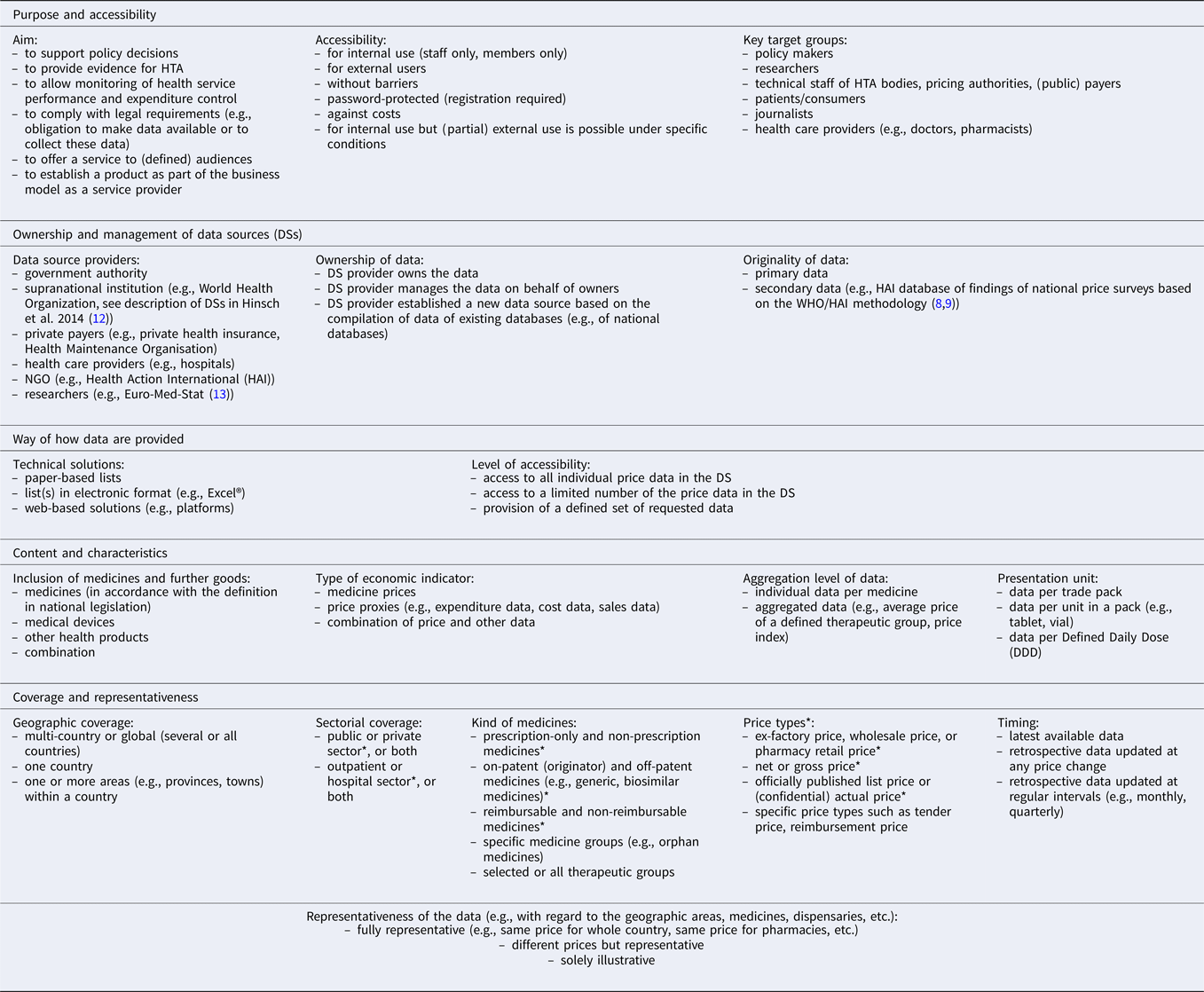
Topology of Medicine Price Data Sources
Data sources may be characterized by different dimensions, including their purpose and accessibility, ownership and management of data, characteristics and coverage. Table 2 provides a topology to describe data sources of medicine prices, including definitions of technical terms.
Topology of Dimensions of Medicine Price Data Sources

Note. Please note that for some categories (e.g., aim, target groups, data source providers) the lists are illustrative and not comprehensive. Some of the dimensions (e.g., sectorial coverage, kind of medicines) are overlapping (for instance, the prescription/non-prescription and reimbursement/non-reimbursement markets could also be classified under sectorial coverage). Definitions of some of the terms (marked with an * in the table): Public sector: provision of health care by the government; private sector: the totality of privately owned institutions and individuals providing health care, including private insurers. In low- and middle-income countries, this distinction is commonly applied. In the pharmaceutical system, medicines in the public sector are supplied and dispensed by government institutions, for free or against a co-payment, whereas medicines in the private sector are supplied and dispensed by private actors, these medicines are usually not price-regulated and have to be paid out-of-pocket by the patients. Outpatient sector: ambulatory; inpatient: hospital. Prescription-only medicines: medicines that can only be dispensed upon a medical prescription; non-prescription medicines: medicines which may be dispensed without a prescription. On-patent medicines: branded medicines protected by one or more patents (i.e., grants for a set period of time allowing the manufacturer the sole right to produce, use and sell these medicines; off-patent medicines: medicines not protected by a patent (e.g., after expiry of the patent). Reimbursable medicines: medicines which are eligible for reimbursement; non-reimbursable medicines: medicines which are not eligible for reimbursement (their costs are not covered by third party payers, but they have to be fully paid out-of-pocket by the patient). Price type: the level (e.g., the stage in the supply chain) at which the price of a medicine is set. Ex-factory price: the price at the level of industry, charged by a pharmaceutical manufacturer (synonym: manufacturer price); wholesale price: the price charged by wholesalers to the retailers such as community pharmacies (synonyms: pharmacy purchase price, pharmacy purchasing price); pharmacy retail price: the price charged by community pharmacies to the general public (part may be covered public payers). Net price: without taxes; gross price: with taxes. List price: the price that suppliers display as the price at which they are prepared to sell their product and/or regulated by legislation. A list price is quoted and/or indicated in a supplier's price list, in a catalogue, on an internet site, in advertisements, in a national price list/formulary or similar. A list price may differ from the actual transaction price; actual price: the price that is actually paid by the purchaser taking into account any granted discounts and/or rebates (synonym: real price, discounted price). Tender price: price achieved in a public procurement; reimbursement price: maximum amount paid by a third party payer.
Definitions are based on the Glossary of Pharmaceutical Terms of the WHO Collaborating Centre for Pharmaceutical Pricing and Reimbursement Policies (4).
DS(s), data source(s); HAI, Health Action International; HTA, health technology assessment; NGO, non-government organization; WHO, World Health Organization.
Re-ADAPT Framework to Assess Medicine Price Data Sources
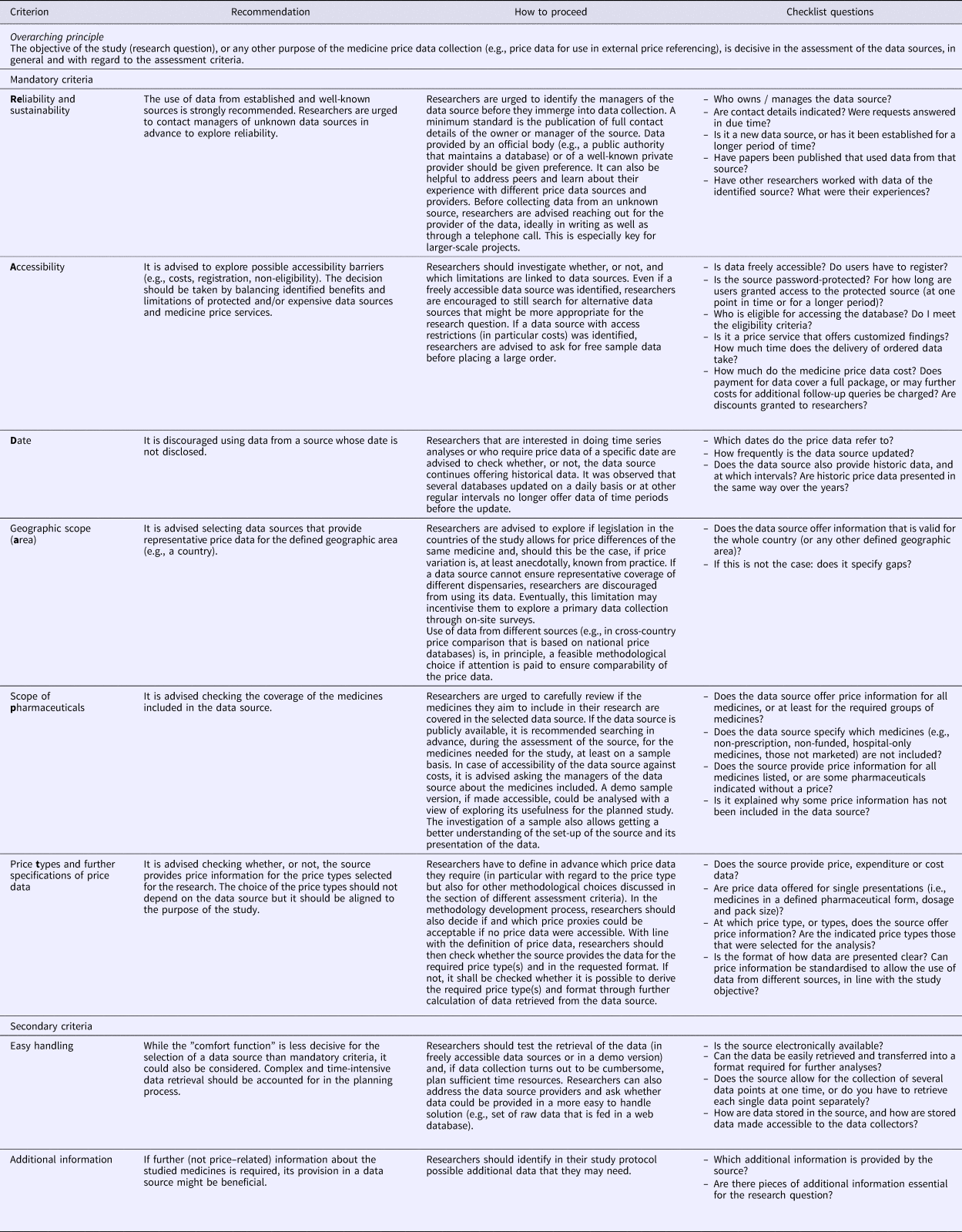
Considering the components of the above-presented topology, a framework to guide the assessment of medicine price data sources and the subsequent selection of the most appropriate data sources was developed. This framework proposes a total of eight prerequisites that a source of medicine price data should ideally comply with. Six of the identified criteria are considered key and were thus defined as mandatory, whereas the two secondary criteria should ideally be fulfilled but if they are lacking do not preclude carrying out the study. The importance of the underlying research question (or other aim of the medicine price data use, such as for pricing purposes) is an overarching mainstream principle that is relevant for each of the assessment criteria.
In accordance to the developed framework, an appropriate data source for intended use for medicines price studies should (i) be reliable (trustworthy) and sustainable; (ii) be accessible (at a cost that users can afford); (iii) provide medicine price information at the date(s) required; (iv) offer medicine price information for the defined area, or at least in a representative way; (v) include the pharmaceuticals required for the research; (vi) present data for the required price type(s), or for a price type that allows determining the required price type, and in the same or a comparable presentation (e.g., related to the pharmaceutical form, dosage and the dosage aggregation such as pack, units in a pack or defined daily doses); (vii) offer an easy and time-saving procedure to retrieve the data (secondary criterion), and (viii) present additional information (secondary criterion).
Table 3 presents the recommendations of this framework that is called Re-ADAPT based on the acronyms of the six mandatory criteria (reliability, accessibility, date, area, pharmaceutical presentation, price type). It provides practical advice to researchers of how to proceed in the assessment and selection process of medicine price data sources, and it offers a checklist of questions. The information presented in Table 3 is a summary of the Re-ADAPT framework. Further background information explaining why a price data source used in a pharmacoeconomic study should meet the proposed criteria (rationale) is presented in the full version of the Re-ADAPT framework accessible in the Supplementary Materials (Supplementary Material 2).
Re-ADAPT Framework for the Assessment of Medicine Price Data Sources (Key Principles)

Note. The full version of the Re-ADAPT framework, including a rationale of key considerations, is provided in the Supplementary Materials (Supplementary Material 1).
Case Studies
The feasibility of the developed Re-ADAPT framework was tested for four assumed research questions. A set of five fictitious data sources was assessed in terms of their compliance with the proposed criteria (detailed description of the case studies is provided in the Supplementary Material 1). For the limited number of scenarios, the multi-criteria assessment proved to be a feasible approach. At the same time, it was also shown that the relevance of the assessment criteria can differ depending on the research question. For instance, while it was important to know the date of the data in all the case studies, retrospective data were, not surprisingly, particularly important for a longitudinal study. In all four case studies, the criteria of reliability and accessibility were shown to be of uppermost importance, and, as a result, these two criteria could be defined as sine qua non conditions. While it is general knowledge that the study objective is of key importance for the methodological design of a pharmacoeconomic study, including a price study (Reference Busse, Panteli, Schaufler and Schröder16), the case studies confirmed that aim and purpose of a study also considerably impact the assessment of the data sources at the levels of the individual criteria. As a result of the testing, we adjusted the framework by adding the relevance of the objective of the research and data collection as an overarching principle.
Discussion
Need for Assessment Criteria Framework
The authors noted a lack of methodology guidance for medicine price surveys and analyses despite the relevance of this research area in pharmacoeconomics. A few available pieces of literature focused on methodological aspects of international price comparisons, such as the selection of an appropriate price type, the comparability of data and the application of price indices (5–7;15;16), or provided guidance for doing on-site surveys (WHO/HAI methodology (Reference WHO9), see also Table 1).
A framework for the selection of most appropriate price data sources is missing. Given the lack of explicit assessment criteria, some researchers were observed to not consider the selection of data sources as part of the methodology design of a study. In their search of price data sources, researchers were perceived to implicitly focus on the accessibility criterion while not sufficiently paying attention to further relevant aspects. The nonconsideration of assessment criteria and the lack of a systematic approach in the appraisal and choice of data sources can have considerable implications for the research. In international comparisons, comparability will be biased if price data of different types and as of different dates are considered, and availability limitations can result from variations in the scope of data provided by several sources. During the data collection phase, researchers could be confronted with the unpleasant experience of a discontinuation of access or gaps in required data of an initially promising data source.
Practical Implications
In the description of the Re-ADAPT framework (e.g., price types) in Table 3, it was stressed that the study objective is a key overarching principle. In fact, the objective and perspective of the study are guiding principles that importantly impact the final decision in favor of or against a data source. As also illustrated by the case studies, there are different pharmacoeconomic study types for which medicine prices are required.
One of the recurrent discussion points in the few pieces of literature on medicine price methodology concerns the choice of the price type in international price comparisons. Danzon and Kim (Reference Danzon and Kim6) and Machado et al. (Reference Machado, O'Brodovich, Krahn and Einarson7) argued in favor of ex-factory price comparisons as they considered other price types as possibly inaccurate. Other authors recommended using retail price data for analyses because these price types would represent the expenses incurred to the patient (18, an argument that is only valid in settings in which the final price is fully borne by the patient (e.g., in the private sector) but not in publicly funded benefits systems. Andersson (Reference Andersson5) argued that the purpose of a study should determine the choice of the price type, and the authors of the Re-ADAPT framework agree with this approach.
The Re-ADAPT framework is intended to support researchers in the preparation of price studies, and it lists different components that are considered to be helpful in the assessment process. However, the framework is not meant to be prescriptive, and there can be good reasons why researchers consider some of the Re-ADAPT framework elements less important in the context of their study, and/or decide to deviate from some of the suggestions made in the framework. There might be occasions in which nonconsideration of some of the assessment criteria of the Re-ADAPT framework is an appropriate and justified approach, but nonapplication of the assessment criteria should be done consciously.
In a cross-country comparison, for instance, retrieval of data from different national sources might be necessary (e.g., administrative data sources established by national pricing authorities), and, as a result, medicine prices relate to different points in time given timing differences in the data sources. If the study aims to inform about cross-country differences of selected medicines and the differences in the date of the price data between countries vary only in terms of a few months, this can be acceptable as a limitation. In some situations, however, even differences of a few months can have an impact (e.g., in the case of new medicines with staggered market entry in different countries, and thus unavailability of data in some databases; or in case of patent expiry in some but not all countries surveyed, with implications on the prices of the originator medicines), and data cannot be included in the study. In any case, variation of different years between medicine prices of national data sources can lead to misleading results due to price dynamics in the respective countries.
Although researchers may decide, for lack of alternative data sources, to use these price data, the results should be interpreted with caution and upon consideration of contextual information. While, in reality, researchers need to be pragmatic in some cases and may decide to attribute less importance to some of the proposed Re-ADAPT assessment criteria, overall recommendations should be taken into account. In this respect, it is particularly advised not to choose data sources for which information of key characteristics is missing.
Relevance of the Policy Framework
Knowledge of the pharmaceutical policy framework (especially those policies that are relevant for medicine prices) is a prerequisite for being able to comprehensively evaluate the data sources. This is of particular importance with regard to the assessment criteria of “geographic area”, “scope of pharmaceuticals” and “price type”. In this respect, researchers should know whether, or not, medicine prices are regulated in the country or countries of interest, and for which medicines (e.g., all pharmaceuticals, only medicines covered by reimbursement and/or subject to prescription) and at which price types (e.g., ex-factory, wholesale, or pharmacy retail prices).
As also confirmed in the application of the Re-ADAPT framework in the case studies, several reasons point to the necessity to combine the assessment of data sources with an analysis of the policy framework. First, it helps understand whether, or not, prices (or at least, officially published maximum prices) of selected medicines tend to be uniform across a country, or some other geographic area. Price regulation tends to contribute to a uniform price level across a geographic area (19), and homogenous prices are likely included in an administrative database. Second, the scope of price regulation allows providing a first idea of the possible scope of data sources. For instance, even in high-income countries with solidarity-based pharmaceutical coverage systems, price regulation is often limited to reimbursed and/or prescription-only medicines in the outpatient sector (20;21). Thus, in particular if there are indications for price competition between dispensing outlets such as pharmacies, it is less likely that prices of nonprescription medicines that patients purchase out-of-pocket are included in a price data source maintained by a social health insurance or a national health service. However, as shown in one of the case studies (data source 4), a data source addressed at patients purchasing medication might be available that offers price information for different dispensing outlets.
A mixture of data from different sources can be methodologically acceptable if comparability of price data is, in general, ensured, and if the different data sources comply, to a major extent, with the other assessment criteria. For cross-country comparisons, for instance, data of different national sources can usually be considered. In some cases, however, the identification and assessment of existing data sources can come to the conclusion that primary data collection is unavoidable. This preliminary conclusion was drawn, for instance, in the case study on discounts and further price-reducing arrangements in the hospital sector (research question 3).
Feasibility of the Framework and Limitations
Some dimensions to describe (topology) and to assess (framework) price data sources are overlapping and interlinked. As shown in the case studies, an assessment of the criteria of “geographic scope,” “scope of medicines,” and “price types” on a criterion-by-criterion basis can be challenging in some scenaria.
A limitation of the Re-ADAPT framework is that, given the lack of literature, it is, to a large extent, based on practical experience of the authors. In the development of this framework, it was aimed to minimize this limitation by asking experts in medicine prices to review as well as by testing the framework's feasibility in case studies. While the data sources we used in this context were fictional, their characteristics corresponded to those observed in real world practice. We considered the testing, as well as its documentation in Supplementary Material 1, as both an essential part of the development of the Re-ADAPT framework as well as a good demonstration of how evaluating a data source could work in practice.
We also acknowledge that in practice only very few data sources might be available and that, to move forward with the work, limitations have to be accepted. Still, we believe that there is value in assessing any medicine price data source before deciding to use it to ensure high quality of the research and to avoid a situation in which a study has to be discontinued due to lack of needed data in the defined format.
This study is not intended to be a critique of specific sources; thus, no existing data sources were assessed. Still, experience of existing data sources and the knowledge of their limitations fed the development of the Re-ADAPT framework.
Outlook and Conclusions
The identification and selection of the most appropriate data sources will remain a challenge. The framework intends to provide practical guidance. Additionally, it was aimed to raise awareness about the necessity to carefully select and analyze price data sources. Our vision is that researchers do no longer automatically use the source they identified first but that they invest time and capacity in this matter. The acronym Re-ADAPT as name for the framework is based on six assessment criteria that are considered essential. But “Re-ADAPT” also signals a call upon researchers and further users of price data to re-adapt a possible current practice of opting for easily accessible data without further investigation and to change to a critical review of data sources as systematic part of the methodology design of a price study.
Author ORCIDs
Sabine Vogler, 0000-0003-4853-4397
Supplementary material
The supplementary material for this article can be found at https://doi.org/10.1017/S0266462319000138.
Acknowledgments
First, we would like to thank colleagues in various institutions from all over the world that approached us in the course of the years and asked for advice on performing medicine price surveys and analyses. Some also shared with us their experiences with data of different sources. These discussions inspired us to develop the Re-ADAPT framework. In fact, this study would have never been produced without the requests of colleagues. Second, we highly appreciate the comments of colleagues on a working document of this framework that helped to develop it further. Comments were received from Gustavo Luís Meffe Andreoli, Ministry of Health, Brazil; Daniela Denisse Moye Holz, University Medical Center Groningen, University of Groningen, the Netherlands; Joan Rovira, University of Barcelona, Spain and Yared Santa Ana Tellez, University Utrecht, the Netherlands. Furthermore, we are grateful for the comments of the editors and anonymous reviewers to earlier versions of this article.