INTRODUCTION
Ingestion of excessive amounts of rumen degradable nitrogen (N) compounds increases urinary N losses, which in turn impacts negatively on the environment, decreases the efficiency of feed N use and may limit the metabolizable protein supply and performance of high productive ruminants (Rossi et al. Reference Rossi, Sampaio and Vieira2007). Tannins are plant polyphenols with the capacity to form complexes, mainly with proteins, reducing their degradation in the rumen (Makkar Reference Makkar2003) and thus show the potential to be used as a feed additive for ruminants. For example, Griffiths et al. (Reference Griffiths, Clark, Clark and Waghorn2013) reported decreased urinary N losses without effects on milk production in dairy cows grazing ryegrass pastures when supplemented with no more than 185 g/day of a tannin extract containing 601 g/kg of condensed tannins (CT), administered as an oral drench. However, Grainger et al. (Reference Grainger, Clarke, Auldist, Beauchemin, McGinn, Waghorn and Eckard2009) observed that a similar extract offered at a rate of 19 g/kg dry matter (DM) for dairy cows grazing a ryegrass pasture decreased urinary N excretion, but also reduced intake, organic matter (OM) digestibility and milk production. Moreover, Carulla et al. (Reference Carulla, Kreuzer, Machmüller and Hess2005) and Kozloski et al. (Reference Kozloski, Härter, Hentz, de Ávila, Orlandi and Stefanello2012) reported that supplementing the Acacia tannin extract at rates varying from 20 to 60 g/kg of diet DM for sheep fed ryegrass reduced urinary N excretion but also reduced OM digestibility.
All of the above studies, however, were conducted with animals fed forage-based diets without or with only small amounts of supplementary concentrate feedstuffs. Most OM in forages is fibrous carbohydrates and, since tannins reduce not only protein degradation but also carbohydrate degradation by rumen bacteria (Frutos et al. Reference Frutos, Hervás, Giráldez and Mantecón2004), the negative impact of tannins on rumen OM digestibility is not compensated by increased digestion in the lower gastrointestinal tract, decreasing total OM digestibility. In turn, assuming that most starch and true proteins flowing to the duodenum are digested in the lower gastrointestinal tract, it was hypothesized that supplementation of a tannin extract for animals fed diets containing medium to high levels of starch and true protein sources should improve the intestinal amino acid supply without a negative effect on OM digestibility.
Moreover, the productive response resulting from the increased amino acid supply in the small intestine is also dependent on amino acid profile. For example, positive responses, particularly from dairy cows, would be expected by improving the intestinal supply of Met and Tyr (Lapierre et al. Reference Lapierre, Lobley, Doepel, Raggio, Rulquin and Lemosquet2012). Soybean meal and canola meal are common ruminant feedstuffs showing ruminal degradability usually above 0·65 (Piepenbrink & Schingoethe Reference Piepenbrink and Schingoethe1998; NRC 2001; Valadares Filho et al. Reference Valadares Filho, Machado, Chizzotti, Amaral, Magalhães, Rocha Júnior and Capelle2010). The Met concentration in soybean meal is lower than in canola meal (NRC 2001) and Brito & Broderick (Reference Brito and Broderick2007) suggested that the true protein from canola meal provides better nutritional value than the true protein from soybean meal. Moreover, Piepenbrink & Schingoethe (Reference Piepenbrink and Schingoethe1998) reported that the amino acid profile in the undegraded fraction of canola meal was similar to that in the original feed. Thus, it should be expected that tannin extract supplementation could provide a better amino acid profile in the duodenum of animals given canola meal instead of soybean meal as a protein source.
The present study was conducted to evaluate the impact of the dietary inclusion of tannin extract from Acacia mearnsii on digestibility, ruminal fermentation, rumen microbial protein synthesis, N utilization and on duodenal flow of individual amino acids in steers fed maize silage plus concentrate containing either canola meal or soybean meal as protein source.
MATERIALS AND METHODS
Feedstuffs, animals, housing and experimental design
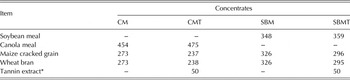
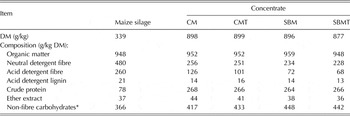
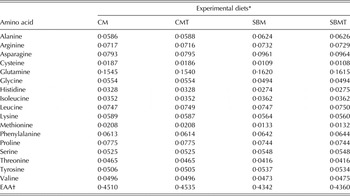
Research protocols followed the guidelines recommended by the Animal Care and Ethical Committee of the Universidade Federal de Santa Maria. Four Holstein steers (297 ± 56 kg of body weight (BW)) housed in metabolism pens were used in a 4 × 4 Latin Square experiment. The steers were fitted with a chronic rumen catheter (siliconized PVC, 35 cm length, 10 mm external diameter ×7 mm internal diameter) and a duodenal T-type cannula; the experiment started c. 30 days after surgery. The experimental diets consisted of maize silage plus concentrate, in proportions of 0·70:0·30 (DM basis) respectively, which were offered as a total mixed ration twice daily at 08·00 and 17·00 h. To prevent the effect of the level of feed intake on digestion processes, diets were offered at a restricted amount of 25 g DM/kg BW. Concentrate was formulated with either protein source (soybean meal or canola meal), and with or without the addition of 50 g/kg (i.e. 15 g/kg in total dietary DM) of A. mearnsii tannin extract (Weibull Black, Tanac S. A., Montenegro, Brazil). The extract was the same as that previously used by Kozloski et al. (Reference Kozloski, Härter, Hentz, de Ávila, Orlandi and Stefanello2012) and contained 694 g/kg DM of total tannins. Using a Sephadex LH-20 purified tannin extract as standard for the HCl–butanol analysis, the concentration of CT in this extract was reported to be c. 610 g/kg DM (Carulla et al. Reference Carulla, Kreuzer, Machmüller and Hess2005; Grainger et al. Reference Grainger, Clarke, Auldist, Beauchemin, McGinn, Waghorn and Eckard2009). The concentrate formulation is shown in Table 1. The chemical composition of forage and concentrates is shown in Table 2, and the amino acid profile of experimental diets is shown in Table 3. With the exception of the cracked maize grain, all other dietary components were reported to have protein with rumen degradability above 0·60 (Valadares Filho et al. Reference Valadares Filho, Machado, Chizzotti, Amaral, Magalhães, Rocha Júnior and Capelle2010). Steers had free access to water and to a mineral salt containing (g/kg): Ca: 165, P: 73, Na: 117, Mg: 15, Mn: 1·5, Zn: 3·0, Fe: 2·0, Cu: 0·65, Co: 0·025, I: 0·04, Se: 0·01, F: 0·74.
Formulation (g/kg) of the experimental concentrates

CM, canola meal; CMT, canola meal plus tannin; SBM, soybean meal; SBMT, soybean meal plus tannin.
* Acacia mearnsii tannin extract (Weibull Black, Tanac S. A., Montenegro, Brazil) containing 720 g/kg of total tannins.
Chemical composition of maize silage and concentrates
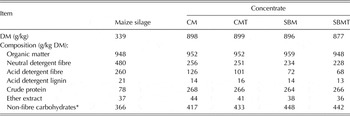
CM, canola meal; CMT, canola meal plus tannin; SBM, soybean meal; SBMT, soybean meal plus tannin; DM, dry matter.
* Organic matter–[(neutral detergent fibre−(neutral detergent insoluble N × 6·25)) + (total N × 6·25) + ether extract], all expressed as g/kg DM.
Amino acid profile (proportion of total amino acids) in experimental diets

* Maize silage (0·70) plus concentrate (0·30) containing canola meal (CM), canola meal plus tannin (CMT), soybean meal (SBM) or soybean meal plus tannin (SBMT). The formulation of experimental concentrates is shown in Table 1.
† Essential amino acids (arginine, histidine, isoleucine, leucine, lysine, methionine, phenylalanine, threonine and valine).
Experimental periods lasted for 15 days, with 10 days adaptation and 5 days collection period. Feed offered was weighed and sampled daily from days 11 to 15 of each experimental period. Total feed and Faeces were taken daily throughout the collection period and stored at −20 °C. At the end of each experimental period they were weighed and a sample (100 g/kg of wet weight from each steer) was collected. All samples were oven-dried at 55 °C for at least 72 h and ground through a 1 mm screen (Willey mill, Arthur H. Thomas, Philadelphia, PA) for subsequent chemical analysis. Urine was collected daily during the collection period, in buckets containing 500 ml of 3·6 N H2SO4. The volume of urine was measured and a sample of 10 ml was taken, diluted to 50 ml with distilled water and stored frozen (−20 °C) until analysis. From days 11 to 14 of experimental periods, duodenal digesta samples (200 ml) were collected at 2 h intervals over a 24 h period, composited within animal and period and stored frozen (−20 °C). For analysis, these samples were thawed, an aliquot of the supernatant (10 ml) was taken and stored at −20 °C and the remaining was dried in a forced-air oven (55 °C) and ground to pass through a 1 mm screen. On day 15 of each period, rumen fluid samples (approximately 100 ml) were collected at 0, 2, 4, 6, 8, 10, 12 and 18 h after the morning meal. These samples were filtered through a 50 μm nylon filter, the pH was immediately measured with a digital pH meter (Marte Ltda, MG, Brazil) and two aliquots (18 ml) of filtered fluid were removed. In one aliquot, 2 ml of 3·6 M sulphuric acid (H2SO4) and, in the other, 2 ml of 500 g/l TCA was added. Samples were centrifuged (4000 × g for 20 min) at room temperature and the supernatants collected and stored frozen at −20 °C. Pellets were discarded. The supernatant of TCA acidified samples were assumed to contain free amino acids and short chain peptides, whereas the pellet comprised protein and long-chain peptides (Greenberg & Shipe Reference Greenberg and Shipe1979).
Chemical analysis
Samples of feed, faeces, duodenal digesta, occasional refusals and urine were pooled on a 5-day basis for each animal and experimental period. Dry matter content was determined by oven drying at 110 °C for at least 16 h. Ash was determined by combustion at 600 °C for 3 h and OM by mass difference. Total N was assayed by the Kjeldahl method (Method 984·13; AOAC 1997). The neutral detergent fibre (NDF) analysis was based on the procedures described by Mertens (Reference Mertens2002) with use of heat-stable α-amylase and without sulphite, and the concentration of acid detergent fibre (ADF) was analysed according to Method 973·18 of AOAC (AOAC 1997) except that the samples were weighed in polyester filter bags (porosity of 16 μm) and treated with neutral or acid detergent in an autoclave at 110 °C for 40 min (Senger et al. Reference Senger, Kozloski, Sanchez, Mesquita, Alves and Castagnino2008). For sulphuric-acid lignin (ADL) analysis the bags containing residual ADF were treated with 12 M H2SO4 for 3 h (Method 973·18 of AOAC 1997). Analysis of neutral detergent insoluble N (NDIN) was performed according to Licitra et al. (Reference Licitra, Hernandez and Van Soest1996). Ether extract (EE) concentration was determined in a reflux system (Soxtherm 2000 S 306 M, Gerhardt; Königswinter, Germany) with ethyl ether at 180 °C for 2 h. The content of non-fibre carbohydrate (NFC) (g/kg) was calculated as: OM−[(NDF−(NDIN × 6·25)) + (N × 6·25) + EE], according to Van Soest et al. (Reference Van Soest, Robertson and Lewis1991).
Duodenal supernatant samples were analysed for ammonia N concentration following the procedures described by Weatherburn (Reference Weatherburn1967). Dried duodenal samples were analysed for purine base (PB) concentration according to Makkar & Becker (Reference Makkar and Becker1999). Rumen fluid samples acidified with H2SO4 were analysed for ammonia N (Weatherburn Reference Weatherburn1967) and reducing sugars (Dubois et al. Reference Dubois, Gilles, Hamilton, Rebers and Smith1956). The TCA-acidified rumen fluid samples were treated with 6 M hydrochloric acid (HCl) (2 ml of sample and 2 ml of 6 M HCl) at 110 °C for 24 h, neutralized by addition the 16 ml of 0·75 M sodium hydroxide, filtered and analysed for α-amino N. The analysis of α-amino N was also performed in dried duodenal samples. Approximately 0·1 g of dried duodenal samples were weighed into screw-cap tubes and treated with 2 ml of HCl 6 N at 110 °C for 24 h. After hydrolysis, 8 ml of 1·5 N sodium hydroxide (NaOH) was added to the tubes, the content diluted to 50 ml with distilled water and then filtered through a filter paper. The concentration of α-amino N in rumen fluid and duodenal filtrates was analysed using a non-automated colorimetric method adapted from Palmer & Peters (Reference Palmer and Peters1969) as described by Hentz et al. (Reference Hentz, Kozloski, Orlandi, Ávila, Castagnino, Stefanello and Pacheco2012). For individual amino acid analysis, feed and duodenal dried samples were hydrolysed with 6 N HCl solution containing 3 g/l of phenol during 24 h at 110 °C. Free amino acids were determined by reverse-phase high-performance liquid chromatography (HPLC: Agilent Model 1200 with column Pico Tag (Waters) of 3·9 × 300 mm, detector UV) at 254 nm following pre-column derivatization with phenylisothiocyanate. The α-aminobutyric acid was used as internal standard. Tryptophan was not included among detected amino acids.
Calculations
The apparent digestibility of feed fractions were calculated as follows: [intake (g/day)− faecal excretion (g/day)]/intake (g/day). The true digestibility of OM was estimated considering that neutral detergent soluble fractions of the Faeces are from endogenous origin and only the NDF fraction of Faeces originated from feed (Van Soest Reference Van Soest1994) as follows: [OM intake (g/day)−Faecal NDF (g/day)]/OM intake (g/day).The true digestibility of N compounds was estimated considering that neutral detergent soluble N of the Faeces are from endogenous origin and only the NDIN fraction of Faeces originated from feed (Van Soest Reference Van Soest1994) as follows: [N intake (g/day)−faecal NDIN (g/day)]/N intake (g/day). The amount (g/day) of retained N was calculated as: N intake (g/day)−faecal N (g/day)−urinary N (g/day).
Assuming that there is no significant disappearance of ADF or ADL at the lower gastrointestinal tract (Kozloski et al. Reference Kozloski, Stefanello, Mesquita, Alves, Ribeiro Filho, Almeida and Moraes Genro2014), and that ADF concentration in duodenal and faecal samples is higher than ADL, what reduces the impact of analytical variability on duodenal flow estimates, the duodenal flow of DM (g/day), and of its respective components, was estimated based on ADF concentration in duodenal digesta and faeces as follows: [Faecal DM (g/day) × Faecal ADF (g/kg of DM)]/duodenal ADF (g/kg of DM). The ruminal OM digestibility was calculated as follows: [OM intake (g/day)−duodenal OM (g/day)]/OM intake (g/day). The amount of microbial N flowing to the small intestine was estimated based on the amount of duodenal purines, assuming that the N content in purines is 0·49 and the ratio purine N: microbial N is 0·116 (Chen & Gomes Reference Chen and Gomes1992). The efficiency of microbial protein synthesis (EMPS, g microbial N/kg digested OM) was calculated as: microbial N (g/day)/rumen digestible OM (kg/day). Duodenal flow (g/day) of non-ammonia non-microbial N (NANMN) was calculated as: duodenal N (g/day)−[microbial N (g/day) + ammonia N (g/day)]. The ruminal degradability of dietary N compounds (RDN) was calculated without correction for N from endogenous origin as: 1−[NANMN (g/day)/N intake (g/day)].
Statistical analysis
Data was analysed using the MIXED procedures of SAS (2009) following the model: Y ijkl = μ + A i + Pj + PROTk + Tl + (PROT × T)kl + eijkl where Y is the dependent variable, μ is the overall mean, A is the random effect of the animal, P is the random effect of the period, PROT is the fixed effect of the protein source, T is the fixed effect of the tannin extract and ε is the residual error. Data derived from rumen samples collected at each sampling interval were analysed as repeated measurements using the PROC MIXED of SAS according to model: Y ijklm= μ + A i + P j + PROT k + T l + A(P × PROT × T)ijkl + Tpm + (PROT × T)kl+ (PROT × Tp)km+ (T × Tp)lm+ (PROT × T × Tp)klm + eijklm, where Tp is time and A(P × T) is the between unit random effect.
RESULTS
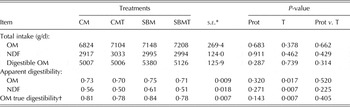
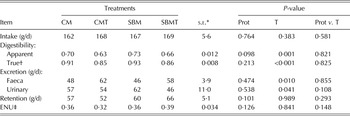
The intake of feed components was similar for all treatments (Table 4) and there was no effect of protein source for most variables. The apparent and true OM digestibilities, as well as NDF digestibility, were negatively affected by tannin extract inclusion (P < 0·05). The amount of N excreted in Faeces increased, whereas the apparent and true digestibility of N compounds, and the urinary N excretion decreased (P < 0·05) in tannin extract treatments (Table 5). The N retention and the efficiency of N utilization were not affected by treatment.
Intake and total digestibility of organic matter (OM) and neutral detergent fibre (NDF) in steers fed maize silage (0·70) plus concentrate (0·30) containing canola meal or soybean meal, with or without tannin extract inclusion

CM, canola meal; CMT, canola meal plus tannin; SBM, soybean meal; SBMT, soybean meal plus tannin. Prot, protein source; T, inclusion tannin extract; Prot v. T, interaction between protein source and tannin extract.
* Standard error of means, where n = 4 per treatment.
† [OM intake (g/day)−Faecal NDF (g/day)]/OM intake (g/day).
Nitrogen utilization by steers fed maize silage (0·70) plus concentrate (0·30) containing canola meal or soybean meal, with or without tannin extract inclusion

CM, canola meal; CMT, canola meal plus tannin; SBM, soybean meal; SBMT, soybean meal plus tannin. Prot, protein source; T, inclusion tannin extract; Prot v. T, interaction between protein source and tannin extract.
* Standard error of means, where n = 4 per treatment.
† [N intake (g/day)−Faecal neutral detergent insoluble N (g/day)]/N intake (g/day).
‡ Efficiency of N utilization by the animal (g of retained N/g of ingested N).
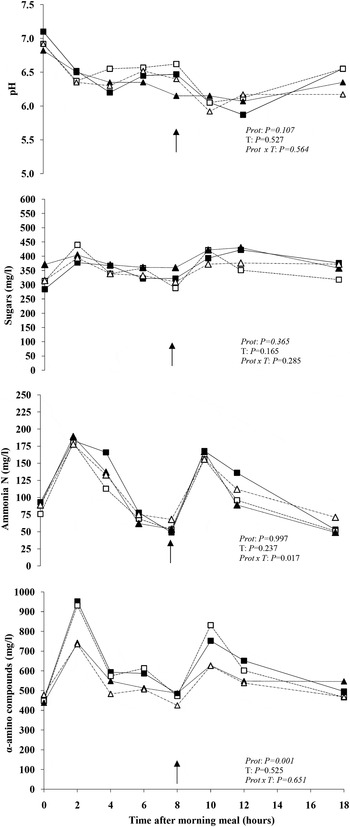
All rumen variables were affected by time (P < 0·05) in such a way that metabolite concentration in ruminal fluid showed the highest values 2 h after meals (Fig. 1). No treatment effect was observed for rumen pH or concentration of reducing sugars, and no time − × treatment interaction was detected for any variable. Steers given canola meal plus tannin extract showed lower concentrations of ammonia N in rumen fluid (P < 0·05). The concentration of α-amino compounds was not affected by tannin extract but was higher when canola meal was the protein source (P < 0·05).
Rumen fluid pH and concentration of reducing sugars, ammonia N and α-amino compounds in steers fed maize silage (0·70) plus concentrate (0·30) containing canola meal (□) or soybean meal (∆) without tannin extract inclusion, or canola meal (■) or soybean meal (▲) plus Acacia mearnsii tannin extract (15 g/kg diet dry matter).The arrows indicate the afternoon meal. Standard error of means were: pH = 0·14; Reducing sugars = 53·0; ammonia N = 12·8 and α-amino compounds = 30·7, were n = 32 per treatment for all variables.

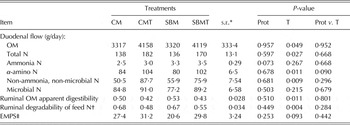
The duodenal flow of OM, total N, α-amino N and NANMN increased (P < 0·05) with tannin extract inclusion, whereas the duodenal flow of both ammonia N and microbial N, and the EMPS were not affected by treatment (Table 6). Tannin extract reduced the ruminal digestibility of both OM and dietary N compounds (P < 0·05).
Duodenal flux and ruminal digestibility of organic matter (OM) and N compounds in steers fed maize silage (0·70) plus concentrate (0·30) containing canola meal or soybean meal, with or without tannin extract inclusion

CM, canola meal; CMT, canola meal plus tannin; SBM, soybean meal; SBMT, soybean meal plus tannin. Prot, protein source; T, inclusion tannin extract; Prot v. T, interaction between protein source and tannin extract.
* Standard error of means, where n = 4 per treatment.
† 1 − [non-ammonia, non-microbial N (g/day)/ N intake (g/day)].
‡ Efficiency of rumen microbial protein synthesis (g of microbial N/kg of rumen degradable OM).
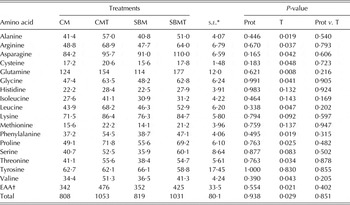
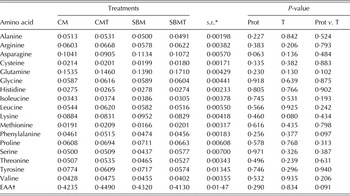
Tannin extract inclusion increased (P < 0·05) the amount of most individual amino acids flowing to the duodenum (Table 7). No significant effect of tannin extract was observed for duodenal flow of His, Ile, Met and Tyr. The amino acid profile (i.e. % of each amino acid in total amino acids) in duodenal digesta was not affected by treatment (Table 8).
Duodenal flux (g/d) of amino acids in steers fed maize silage (0·70) plus concentrate (0·30) containing canola meal or soybean meal, with or without tannin extract inclusion

CM, canola meal; CMT, canola meal plus tannin; SBM, soybean meal; SBMT, soybean meal plus tannin. Prot, protein source; T, inclusion tannin extract; Prot v. T, interaction between protein source and tannin extract.
* Standard error of means, where n = 4 per treatment.
† Essential amino acids (arginine, histidine, isoleucine, leucine, lysine, methionine, phenylalanine, threonine and valine).
Profile of amino acids (proportion of total amino acids) in duodenal digesta of steers fed maize silage (0·70) plus concentrate (0·30) containing canola meal or soybean meal, with or without tannin extract inclusion

CM, canola meal; CMT, canola meal plus tannin; SBM, soybean meal; SBMT, soybean meal plus tannin. Prot, protein source; T, inclusion tannin extract; Prot v. T, interaction between protein source and tannin extract.
* Standard error of means, where n = 4 per treatment.
† Essential amino acids (arginine, histidine, isoleucine, leucine, lysine, methionine, phenylalanine, threonine and valine).
DISCUSSION
Tannin extract inclusion at a rate of 15 g/kg diet DM consistently enhanced the duodenal flow of OM and NANMN and reduced the rumen OM and feed protein degradabilties, independently of whether the protein source was canola meal or soybean meal. However, the total apparent OM digestibility decreased, indicating that the extension of the OM digestion throughout the intestines did not compensate completely for the reduced digestion in the rumen. This negative effect, however, was not large enough to reduce the digestible OM intake by steers.
The concentrations of α-amino N in ruminal fluid were higher for canola meal than for soybean meal as the protein source. Assuming that the true protein content of the experimental diets was similar, this result indicates that the hydrolysis rate, catalysed by rumen bacteria proteases, was higher for proteins from canola meal than those from soybean meal. However, in contrast to the expected result (Jayanegara et al. Reference Jayanegara, Leiber and Kreuzer2012), most of the ruminal variable results did not clearly reflect the lower ruminal digestion of OM and N compounds in tannin extract treatments. For example, the ruminal concentrations of reducing sugars, reflecting carbohydrate degradation, and of α-amino N, reflecting true protein degradation, were not depressed by tannin extract. Moreover, the expected impact of the tannin extract on ammonia N concentration in ruminal fluid was observed only when canola meal was the protein source, but not soybean meal. These results indicate that the concentration of metabolites in rumen fluid is limited to infer on the quantitative digestion into the rumen. In fact, the concentration of a metabolite in ruminal fluid results from both opposite processes, i.e. production and disappearing through utilization by micro-organisms, absorption or outflow with digesta from rumen. Moreover, it is also affected by osmolarity and water volume in rumen, which are not constant throughout the day (Van Soest Reference Van Soest1994; Van Thang et al. Reference Van Thang, Sunagawa, Nagamine, Kishi and Ogura2012). Tannins have also been reported to change the metabolism of rumen bacteria improving the EMPS (Makkar Reference Makkar2003). In fact, although not statistically significant, there was a strong tendency to increased EMPS in tannin extract treatments in the present study.
Tannin extract also shifts the method of N excretion from urine to faeces, which is an effect reported consistently in the literature (Aufrère et al. Reference Aufrère, Dudilieu and Poncet2008; Theodoridou et al. Reference Theodoridou, Aufrère, Andueza, Pourrat, Le Morvan, Stringano, Mueller-Harvey and Baumont2010). This is positive from the environment point of view, since it contributes to reductions in nitrous oxide emissions from cattle manure (Misselbrook et al. Reference Misselbrook, Powell, Broderick and Grabber2005). However, this effect tended to be stronger when soybean meal was the protein source instead of canola meal. Moreover, surprisingly, the N retention by steers tended to be higher for soybean meal, mainly when tannin extract was included. Although the explanation for this discrepancy is not apparent, N retention is a consequence of several processes, including amino acid requirement, energy balance, amount and profile of absorbed amino acids and ammonia absorption, among others. In addition, based on experience and data from the literature, the urinary N excretion measured in short-term digestibility trials usually shows high residual error, compromising its precision and reliability. Older (Driedger & Hatfield Reference Driedger and Hatfield1972) and more recent studies (Carulla et al. Reference Carulla, Kreuzer, Machmüller and Hess2005) have both reported a positive impact of tannin extracts on N retention by sheep.
Regardless of whether it was measured as α-amino N or individual amino acids, and independent of the protein source, the duodenal flow of most amino acids strongly improved with tannin extract, increasing by c. 25% above the mean value observed in no-tannin treatments. Particularly relevant was the positive impact of tannin extract on the intestinal supply of essential amino acids, although no significant impact was observed for duodenal flow of Met and Tyr, which are limiting amino acids (Lapierre et al. Reference Lapierre, Lobley, Doepel, Raggio, Rulquin and Lemosquet2012). Moreover, in contrast to the expected result, the amino acid profile in duodenal digesta was similar for all treatments, despite the differences in dietary amino acid profile such as, for example, the higher Met concentration in diets containing canola meal than in those containing soybean meal. In fact, the duodenal flow of NANMN also included the endogenous N fraction, which might represent a considerable proportion of the duodenal N flow. For example, Marini et al. (Reference Marini, Fox and Murphy2008) reported that the free endogenous N represented 0·13 of the duodenal N flow in cattle, which would account for c. 0·30 of the NANMN fraction in the present study.
CONCLUSION
Regardless of whether the protein source was canola meal or soybean meal, the dietary inclusion of 15 g/kg DM of tannin extract from A. mearnsii improved amino acid supply, without affecting amino acid profile, to steers fed maize silage plus concentrate, with a minor significant impact on OM digestibility.
This study was funded by Conselho Nacional de Desenvolvimento Científico e Tecnológico (CNPq, Brasília, DF, Brazil).