INTRODUCTION
Life-history traits represent a suite of behavioural, anatomical and physiological attributes that influence reproduction and survival in organisms (Ricklefs and Wikelski, Reference Ricklefs and Wikelski2002). Based on the ideas of Fisher (Reference Fisher1930), variation in life-history traits is thought to reflect different allocation patterns of resources to competing life functions, especially body maintenance, growth and reproduction (Charnov, Reference Charnov1993; Ghalambor and Martin, Reference Ghalambor and Martin2001). Reproduction is influenced by the amount of energy from food that can be consumed and transformed into offspring (Kearny, Reference Kearny2012). Animals obtain energy from their environment in the form of food, and their reproductive output depends on internal processing of food stuffs and converting these materials into usable energy for reproductive propagules. The amount of energy that can be derived from a particular food depends on a variety of factors including the chemical composition of the food as well as the physiological machinery possessed by the organism directly involved in food processing (Lee and Houston, Reference Lee and Houston1993; Kam et al. Reference Kam, Khokhlova and Degen1997; Piersma and Drent, Reference Piersma and Drent2003; Johnston et al. Reference Johnston, Johnston and Richardson2005). The interplay between food composition and the physiological constraints of digestive machinery results, for example, in the well-known phenomenon of interspecific difference in digestibility of the same food (e.g. Choshniak and Yahav, Reference Choshniak and Yahav1987; see Degen, Reference Degen1997 for review). The reproductive results of this interplay are that (a) reproductive output varies among different species consuming the same food (Khokhlova et al. Reference Khokhlova, Fielden, Degen and Krasnov2012a) and (b) reproductive output of the same species varies depending on the food consumed (Lee and Heimpel, Reference Lee and Heimpel2008).
Mechanistically, variation in reproductive output may arise due to variation in energy expenditure per offspring produced. Energy-expensive offspring should be produced in smaller numbers than less costly offspring (Smith and Fretwell, Reference Smith and Fretwell1974). This idea has led to numerous studies that investigated a trade-off between the size and number of offspring under the assumption of an association between energy cost and the size of offspring (e.g. Parker and Begon, Reference Parker and Begon1986; Carriere and Roff, Reference Carriere and Roff1995; Czesak and Fox, Reference Czesak and Fox2003; Morrongiello et al. Reference Morrongiello, Bond, Crook and Wong2012). Studies that have attempted to assess the energy cost of offspring directly are rare (but see Doughty and Shine, Reference Doughty and Shine1997; Orrell et al. Reference Orrell, Congdon, Jenssen, Michener and Kunz2004).
In this study, we focused on the energy cost of egg production in two species of fleas (Insecta: Siphonaptera) when feeding on different host species. Adult fleas are obligatory haematophagous parasites being most diverse and abundant on small to medium species of mammals. Most parasite species, including fleas, vary in abundance (number of parasites per individual host) and/or prevalence (percentage of infested individuals) among different host species, being most numerous on the ‘principal host’ and less common on ‘auxiliary hosts’. This variation in abundance is a result of differential reproductive output of a parasite when feeding on different hosts. Recently, we demonstrated that fitness of fleas exploiting auxiliary hosts was lower than in fleas exploiting principal hosts (Khokhlova et al. Reference Khokhlova, Fielden, Degen and Krasnov2012a). We hypothesized that the proximate reasons behind this difference were that (a) the ability of fleas to transform food (i.e. host blood) into offspring depended on the source and composition of food (i.e. host species) and (b) blood taken from principal hosts was less costly to process, resulting in less energy expenditure per egg than when fed on blood from auxiliary hosts. To test these hypotheses, we investigated energy expenditure of egg production in two species of fleas (Parapulex chephrenis and Xenopsylla ramesis) when feeding on either principal or auxiliary hosts.
Both flea species in this study are common parasites of rodents in the central Negev Desert. Parapulex chephrenis is a host specialist found mainly on the Egyptian spiny mouse Acomys cahirinus, less often on the congeneric golden spiny mouse Acomys russatus and only occasionally on gerbils (Meriones crassus and Gerbillus dasyurus) (Krasnov et al. Reference Krasnov, Shenbrot, Medvedev, Vashchenok and Khokhlova1997, Reference Krasnov, Hastriter, Medvedev, Shenbrot, Khokhlova and Vashchenok1999). In contrast, X. ramesis is a host generalist that parasitizes a variety of rodents, with highest abundance on the gerbils Psammomys obesus and M. crassus, highest prevalence on M. crassus (Krasnov et al. Reference Krasnov, Shenbrot, Medvedev, Vashchenok and Khokhlova1997, Reference Krasnov, Hastriter, Medvedev, Shenbrot, Khokhlova and Vashchenok1999) and occurring rarely on A. cahirinus. Consequently, we predicted that the energy expended per egg produced by P. chephrenis would be lower when it feeds on A. cahirinus than on M. crassus, whereas the opposite would be true for X. ramesis. We also predicted that fleas fed on principal hosts would produce larger eggs and live longer after oviposition than fleas fed on auxiliary hosts because higher reproduction costs may compromise both offspring size (e.g. Khokhlova et al. Reference Khokhlova, Serobyan, Degen and Krasnov2010a) and survival of parents (e.g. Bell and Koufopanou, Reference Bell and Koufopanou1986; Cox et al. Reference Cox, Parker, Cheney, Liebl, Martin and Calsbeek2010).
MATERIALS AND METHODS
Fleas
We used fleas from our laboratory colonies started in 1999 from field-collected specimens either on M. crassus, P. obesus and G. dasyurus (X. ramesis) or A. cahirinus and A. russatus (P. chephrenis). Fleas were maintained on their natural hosts (X. ramesis was maintained on M. crassus and G. dasyurus and P. chephrenis on A. cahirinus and A. russatus). Further details on the breeding and maintenance of fleas can be found elsewhere (e.g. Krasnov et al. Reference Krasnov, Khokhlova, Oguzoglu and Burdelova2002, Reference Krasnov, Sarfati, Arakelyan, Khokhlova, Burdelova and Degen2003; Khokhlova et al. Reference Khokhlova, Serobyan, Krasnov and Degen2009a, Reference Khokhlova, Serobyan, Krasnov and Degenb, Reference Khokhlova, Serobyan, Degen and Krasnov2010a). All fleas used in the experiments were selected randomly from colonies. Fleas had not fed prior to experiments and were 24–48 h old (see Khokhlova et al. Reference Khokhlova, Fielden, Degen and Krasnov2012b).
Rodents
We used rodents from our laboratory colonies started from field-captured individuals in 1997–1999. Details on rodent maintenance can be found elsewhere (Krasnov et al. Reference Krasnov, Khokhlova, Oguzoglu and Burdelova2002, Reference Krasnov, Sarfati, Arakelyan, Khokhlova, Burdelova and Degen2003; Khokhlova et al. Reference Khokhlova, Serobyan, Krasnov and Degen2009a, Reference Khokhlova, Serobyan, Krasnov and Degen2009b, Reference Khokhlova, Serobyan, Degen and Krasnov2010a). In this study, we used adult males that were maintained individually for at least 1 month prior to experiments and had been previously exposed to flea parasitism 3–5 times. Each individual rodent was used for feeding a single group of fleas.
Experimental design and procedures
On day 0, rodents (14 A. cahirinus and 20 M. crassus) were placed in individual plastic cages (60 cm × 50 cm × 40 cm) with a bottom of 3–5 mm of clean sand covered by a wire mesh (5 mm × 5 mm) and 100 female and 50 male fleas (either P. chephrenis or X. ramesis) were released into the cage. Under these conditions, fleas start to oviposit no sooner than on the second day of their stay on a host (Khokhlova et al. Reference Khokhlova, Fielden, Degen and Krasnov2012a). On day 1, we collected fleas from rodents, examined them visually under a light microscope and randomly selected 10–15 female fleas in which 80% of the midgut was filled with blood (see details on the procedure of selection of engorged fleas in Khokhlova et al. Reference Khokhlova, Serobyan, Krasnov and Degen2009a). We weighed fleas (±0·01 mg, 290 SCS Precisa Balance, Precisa Instruments AG, Switzerland) and placed them in Petri dishes, which were maintained at 25 °C and 92% RH in temperature-controlled incubators (FOC225E, Velp Scientifica srl, Milano, Italy) for 24 h. The remaining fleas were returned to the cage of the same individual from which they were taken. On day 2, we checked fleas under a stereoscopic microscope, selected those that completed their digestion, re-weighed them and measured their CO2 production. On day 3, we again collected 10–15 engorged female fleas from each rodent. We weighed these fleas and measured their CO2 production (see below). Then, we again placed these fleas in Petri dishes and maintained them at 25 °C and 92% RH for 24 h. On day 4, we checked the Petri dishes for eggs. All groups of fleas produced eggs. We collected these eggs and recorded egg production as the number of eggs produced per female. If some fleas died between day 3 and day 4, we calculated egg production per flea as the total number of eggs divided by the average number of living fleas present. Then, fleas were collected, weighed and their CO2 production was measured. After respirometry measurements, we placed fleas in individual Eppendorf vials with perforated lids and bottoms covered by 2 mm sand and maintained at 25 °C and 92% RH. The vials were checked daily to record whether fleas were alive or dead. We confirmed mortality by examination under a light microscope.
Respirometry
Carbon dioxide (CO2) production was measured in female fleas using a flow-through respirometry system. Incurrent air was scrubbed of H2O and CO2 by drierite and ascarite columns, respectively, and pumped through a respirometer chamber made of Tygon tubing (6·5 mm internal diameter, 3 mL volume) at a flow rate of 50 ml min−1 (mass flow controller FC-260, Tylan, Rancho Dominquez, CA, USA). The CO2 content (ppm) of air exiting the respirometer chamber was measured with a CO2 analyser (model 6262, LI-COR, Lincoln, NE, USA) in conjunction with data-acquisition software (ExpeData, Sable Systems, Henderson, NV, USA) and was sampled every 2 s for 30 min. The temperature of the air inside the respirometer tubing was maintained at 25 °C by placing the chamber and preceding 6 m of incurrent tubing into a temperature-controlled water bath (model 1013S, Fisher Scientific, Pittsburgh, PA, USA). Baseline measurements, each lasting 5 min, were made before and after each recording to determine zero CO2 and to correct for any instrument drift. Fleas were measured in groups of 9–15 individuals since CO2 emission of an individual flea was only slightly above baseline levels. Fleas were weighed before and after measurements. Details of the protocol can be found elsewhere (Fielden et al. Reference Fielden, Krasnov, Khokhlova and Arakelyan2004; Krasnov et al. Reference Krasnov, Khokhlova, Burdelov and Fielden2004a; Sarfati et al. Reference Sarfati, Krasnov, Ghazaryan, Khokhlova, Fielden and Degen2005).
Estimating energy expenditure
We used CO2 production to estimate energy expenditure of fleas. To convert CO2 production into energy expenditure, we assumed a respiratory quotient of 0·8 and a conversion factor of 24·5 J mL−1 CO2 (Schmidt-Nielsen, Reference Schmidt-Nielsen1990; Lighton et al. Reference Lighton, Fielden and Rechav1993). We calculated the energy cost of egg production as follows. Fleas collected from rodents on day 1, completed their digestion of a blood meal or nearly so by day 2 (see also Krasnov et al. Reference Krasnov, Sarfati, Arakelyan, Khokhlova, Burdelova and Degen2003; Khokhlova et al. Reference Khokhlova, Serobyan, Krasnov and Degen2009a). The last stage of blood digestion in fleas is characterized by mechanical (release of the undigested remnants and final products) rather than physiological processes (Vashchenok, Reference Vashchenok1988). The eggs of these fleas had not been laid yet but rather only started to mature in the oviducts (Vashchenok, Reference Vashchenok1988). Consequently, we measured CO2 production for these fleas (collected on day 1 and measured on day 2) and considered this as an indicator of metabolic rate of an adult flea upon completion of digestion. We did not measure CO2 production of either newly emerged fleas or fleas on day 1 because physiological processes in fleas change dramatically immediately after the first blood meal , so that the responses of newly emerged and previously fed fleas differ (Fielden et al. Reference Fielden, Krasnov, Khokhlova and Arakelyan2004). Next, we measured CO2 production for fleas collected from rodents on day 3. These fleas had mature eggs in their oviducts that were subsequently laid on day 4. We used these two values to calculate the difference in the volume of emitted CO2 between fleas prior to egg maturation (e.g. on day 2) and fleas after egg maturation prior to oviposition (e.g. on day 3) for fleas fed on the same rodent individuals. This difference was considered as an indicator of energy expended for egg production by a flea. From this value and the known number of eggs produced per flea in a group of fleas taken from the same rodent, we calculated energy expenditure for production of one egg by a flea. On day 3, fleas likely spent some of their energy not only for egg maturation but also for digestion of blood. Digestion of blood taken from different hosts may entail different energy costs and, thus, differ in the same flea species when feeding on different host species (Sarfati et al. Reference Sarfati, Krasnov, Ghazaryan, Khokhlova, Fielden and Degen2005; Khokhlova et al. Reference Khokhlova, Fielden, Degen and Krasnov2012b). However, our earlier results demonstrated that P. chephrenis and X. ramesis spent similar amounts of energy while digesting blood from the two rodent species used in this study (see Fig. 3 in Khokhlova et al. Reference Khokhlova, Fielden, Degen and Krasnov2012b). Analyses of the difference in CO2 production per egg between fleas on day 3 (prior to oviposition) and day 4 (after digestion and oviposition) as an indicator of energy expended for egg production provided the same results.
Estimating egg number, egg size and time to endure starvation
The mean number of eggs produced per flea was calculated for each group of fleas collected from the same individual rodent. The mean mass of a flea egg was determined as follows. It was assumed that for fleas collected from rodents on day 1, the difference between initial body mass (on day 1; after a blood meal ) and final body mass (on day 2; after completion of digestion) was due to fecal output (FO), while for fleas collected from rodents on day 3, the difference between initial body mass on day 3 (during digestion and prior to oviposition) and final body mass on day 4 (after oviposition and upon completion of digestion) was due to both FO and the mass of produced eggs (FO+E). Subtraction of FO from (FO+E) equalled the total mass of eggs produced by all fleas, and the average mass of eggs was calculated. Finally, survival time of each flea from oviposition was taken as the number of days between day 4 and death of a flea.
Data analysis
The difference in energy cost per egg produced per flea relative to the host species was tested using ANCOVA, with average body mass of a flea on day 2 of the experiment (see rationale above) as a covariate. The mean number of eggs produced by a flea, mean mass of an egg and survival time of a flea after oviposition were analysed using one-way ANOVAs with host species as an independent variable. All analyses were done separately for P. chephrenis and X. ramesis. Prior to the analyses, the data were log+1-transformed. The figures present untransformed and unadjusted data.
RESULTS
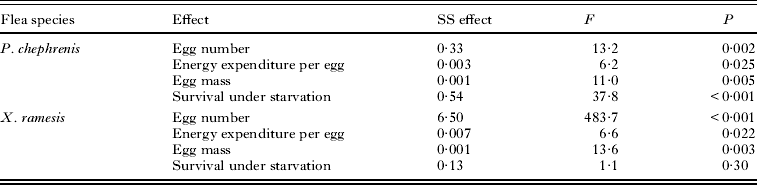
The number of eggs produced by a female flea differed significantly for both species of fleas when they fed on their principal and auxiliary hosts (Table 1). Both species of fleas produced significantly more eggs when fed on their principal hosts. Parapulex chephrenis produced an average of 1·06 ± 0·09 eggs per female after feeding on A. cahirinus, their principal host, and 0·56 ± 0·08 eggs per female after feeding on M. crassus, their auxiliary host, whereas X. ramesis produced 3·21 ± 0·15 and 0·20 ± 0·06 eggs per female when fed on M. crassus and A. cahirinus, their principal and auxiliary hosts, respectively.
Summary of ANOVAs and ANCOVAs (body mass of a flea as a covariate) of the effects of host species (Acomys cahirinus vs Meriones crassus) on the number of eggs produced per female, energy expended for production of one egg, mean mass of an egg and time of survival of fasting fleas after oviposition in Parapulex chephrenis and Xenopsylla ramesis. d.f. = 1,15 for the number of eggs, mean mass of an egg and survival under starvation (ANOVAs) and d.f. = 1,14 for energy expended for production of an egg (ANCOVAs)
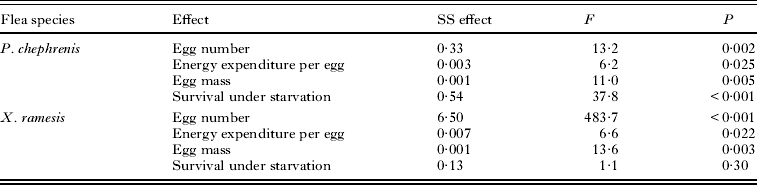
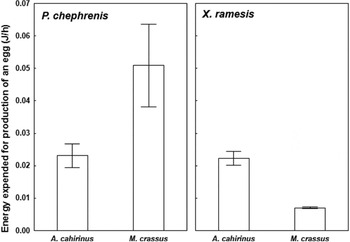
The effect of host species on energy expended for production of an egg was significant in both species of fleas (Table 1). Fleas expended less energy per egg produced when fed on their principal hosts (A. cahirinus for P. chephrenis and M. crassus for X. ramesis) than when fed on auxiliary hosts (M. crassus for P. chephrenis and A. cahirinus for X. ramesis) (Fig. 1).
Mass-independent (adjusted means ± s.e.) energy expenditure for production of one egg in Parapulex chephrenis and Xenopsylla ramesis fed on Acomys cahirinus or Meriones crassus. Acomys cahirinus is the principal host of P. chephrenis and the auxiliary host of X. ramesis. Meriones crassus is the principal host of X. ramesis and the auxiliary host of P. chephrenis.

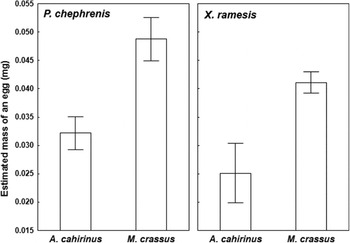
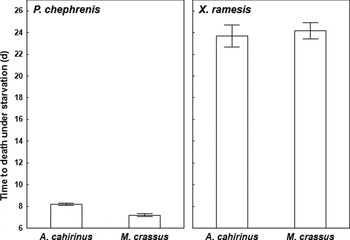
The mean egg size differed significantly between host species in both species of fleas. Xenopsylla ramesis produced significantly larger eggs after exploitation of a principal compared with an auxiliary host, whereas the opposite was true for P. chephrenis (Fig. 2). After oviposition, P. chephrenis that had been fed on the auxiliary hosts survived for a shorter time than those fed on the principal hosts (Table 1; Fig. 3), whereas in X. ramesis survival time was independent of host species (Table 1; Fig. 3).
Estimated (see text for explanations) mean mass of an egg produced by Parapulex chephrenis and Xenopsylla ramesis fed on Acomys cahirinus or Meriones crassus. Acomys cahirinus is the principal host of P. chephrenis and the auxiliary host of X. ramesis. Meriones crassus is the principal host of X. ramesis and the auxiliary host of P. chephrenis.

Time to death after oviposition of Parapulex chephrenis and Xenopsylla ramesis fed on Acomys cahirinus or Meriones crassus. Acomys cahirinus is the principal host of P. chephrenis and the auxiliary host of X. ramesis. Meriones crassus is the principal host of X. ramesis and the auxiliary host of P. chephrenis.

DISCUSSION
Our results support the hypothesis that converting nutrients in blood from the principal host into offspring was energetically less costly than when fleas processed blood from an auxiliary host. From a physiological perspective, translation of nutrients contained in host blood into offspring may be determined, at least in part, by the ability of a flea to synthesize triglyceride precursors (diglycerides) and transport them to the fat body where triglycerides are formed and stored in adipocytes which are characterized by the presence of numerous lipid droplets (Dean et al. Reference Dean, Collins, Locke, Kerkut and Gilbert1985; Canavoso et al. Reference Canavoso, Jouni, Karnas, Pennington and Wells2001; Arrese and Soulages, Reference Arrese and Soulages2010). These lipids are then utilized during egg production. In fact, the major part of the lipids in the insect oocytes has been shown to be transported to the ovaries from the maternal fat body (Ziegler and Ibrahim, Reference Ziegler and Ibrahim2001; Park et al. Reference Park, Attardo, Hansen and Raikhel2006; Ziegler and Van Antwerpen, Reference Ziegler and Van Antwerpen2006; Arrese and Soulages, Reference Arrese and Soulages2010). The amount and composition of lipids in the fat body of a flea may depend on the source of the blood meal , so that the energy cost of, for example, the transportation of lipids synthesized from a blood meal taken from a principal host may be lower than that of lipids synthesized from a blood meal taken from an auxiliary host.
From an ecological perspective, our study revealed a proximate cause for the higher fitness in parasites exploiting principal compared with auxiliary hosts (Harrington et al. Reference Harrington, Edman and Scott2001; Khokhlova et al. Reference Khokhlova, Fielden, Degen and Krasnov2012b). As a result, the abundance of a parasite is highest in one (the principal) host and lower among other (auxiliary) hosts (e.g. Krasnov et al. Reference Krasnov, Shenbrot, Khokhlova and Poulin2004b). However, higher egg production is not the only component of parasite fitness because the quality of eggs is also important. Higher fitness may be achieved if the majority of eggs survive and give rise to a new flea generation.
As we expected, the eggs produced by X. ramesis fed on the auxiliary host were, on average, smaller than eggs produced after feeding on the principal host. However, surprisingly and contrary to our expectations, eggs produced by P. chephrenis fed on the auxiliary host were larger than eggs produced by fleas fed on the principal host. This suggests that the two species of fleas have different reproductive strategies when they were forced to feed on an auxiliary host. Fleas feeding on an auxiliary host have higher energy costs per offspring. The strategy of X. ramesis exploiting A. cahirinus was to invest little energy into reproduction. They not only produced small eggs, but the number of these eggs was 15 times less than for X. ramesis exploiting M. crassus. In contrast, P. chephrenis compensated for the low number of eggs by their size. In other words, fleas forced to feed on M. crassus seemed to do ‘the best-of-a-bad job’ and invested heavily in reproduction in the current situation. As a result, their egg production on the auxiliary host was only half the number produced on the principal host.
Production of larger eggs may allow P. chephrenis feeding on the auxiliary host to increase the chances of offspring survival. Variation in egg size in insects has been reported (e.g. Harvey, Reference Harvey1983a, Reference Harvey1983b) and has been found to be regulated by a variety of factors including maternal age (e.g. Karlsson, Reference Karlsson1987) and maternal feeding (e.g. Murphy et al. Reference Murphy, Launer and Ehrlich1983). In our study, females were of approximately the same age and produced their first eggs. Consequently, the main reason for the difference in egg size in P. chephrenis fed on different hosts was the source of maternal food (host species). A larger size of eggs is usually associated with better performance of offspring (Torres-Vila and Rodríguez-Molina, Reference Torres-Vila and Rodríguez-Molina2002; Pöykkö and Mänttäri, Reference Pöykkö and Mänttäri2012; but see Wiklund and Persson, Reference Wiklund and Persson1983; Ruohomäki et al. Reference Ruohomäki, Hanhimäki and Haukioja1993). Interestingly, better performance of offspring hatched from larger eggs was attributed to absolute egg provisioning (i.e. higher mass) rather than relative egg provisioning (i.e. increased concentrations of nutrients) (Pöykkö and Mänttäri, Reference Pöykkö and Mänttäri2012). However, egg size is not the only factor affecting offspring performance; other factors include microclimate (e.g. Krasnov et al. Reference Krasnov, Khokhlova, Fielden and Burdelova2001) and larval density (e.g. Khokhlova et al. Reference Khokhlova, Hovhanyan, Degen and Krasnov2010b). Furthermore, the concentration of nutrients in an egg may not be important for some taxa (Pöykkö and Mänttäri, Reference Pöykkö and Mänttäri2012), but important to other taxa. Indeed, despite a difference in egg size in P. chephrenis in dependence of maternal host species, the viability of new imago from these eggs did not differ (Khokhlova et al., unpublished data).
The different reproductive strategies in the two flea species exploiting auxiliary hosts were reflected in their endurance to starvation. Post-reproductive survival of parents may be an indirect indicator of energy cost of reproduction (Cox et al. Reference Cox, Parker, Cheney, Liebl, Martin and Calsbeek2010). The shorter lifespan of P. chephrenis fed on M. crassus in comparison with conspecifics fed on A. cahirinus suggests that allocation of much energy into reproduction on the auxiliary host compromised post-oviposition survival. In other words, these fleas traded their future reproduction for their current reproduction. Similar survival of X. ramesis, independent of host species, suggests the absence of such a trade-off. The between-flea difference in strategies of reproduction on the auxiliary host can be explained, at least in part, by differences in their association with the host and their characteristic lifespan. Parapulex chephrenis are called ‘body’ or ‘fur’ fleas because they spend most (if not the entirety) of their lives on the body of the hosts on which they feed, mate and oviposit (Krasnov, Reference Krasnov2008). In contrast, X. ramesis are ‘nest’ fleas that stay on hosts only to accomplish a blood meal, while their mating and oviposition take place in the burrow or nest of their hosts (Krasnov, Reference Krasnov2008). The body of P. chephrenis is covered with sclerotinized bristles that anchor the flea within the host fur and resist the host's grooming, whereas X. ramesis has neither bristles nor ctenidia, and could be easily dislodged by a host. The pattern of host association may determine the number of host individuals used by a flea during its life, with P. chephrenis being likely restricted to a single host and X. ramesis exploiting multiple host individuals. In addition, X. ramesis live longer than P. chephrenis, all else being equal. Consequently, if a flea is forced to feed on the auxiliary host, it can be advantageous for X. ramesis to postpone reproduction until it will have an opportunity to attack a preferable host, while it is unlikely that P. chephrenis will have this opportunity. It thus may prefer to invest in immediate reproduction that will result in an, albeit low, but nonetheless positive fitness reward.
From an evolutionary perspective, the ability of parasites feeding on non-characteristic hosts to produce eggs which sometimes may be larger than eggs produced from feeding on principal hosts, may allow them to switch hosts and broaden or change their geographical distribution. First, if the auxiliary host remains the only food source for fleas across generations, they can develop adaptations allowing them to exploit this host successfully. In some cases, these adaptations to a new host may be accompanied by the loss of adaptations to exploit the original host (e.g. Arbiv et al. Reference Arbiv, Khokhlova, Ovadia, Novoplansky and Krasnov2012 for fleas). Second, this ability may represent the physiological basis of some evolutionary phenomena such as ecological fitting (Janzen, Reference Janzen1985; Brooks et al. Reference Brooks, León-Règagnon, McLennan and Zelmer2006) and co-evolutionary alternation (Thompson, Reference Thompson2005; Nuismer and Thompson, Reference Nuismer and Thompson2006). Ecological fitting acts when a parasite specializes on a particular resource that is widespread among many host species (which is the case for haematophagous arthropods) and it mainly tracks this resource rather than a host lineage per se (Brooks et al. Reference Brooks, León-Règagnon, McLennan and Zelmer2006). In other words, if the main requirement of a parasite is the resource itself rather than its ‘manifestation’ in nature (e.g. the principal host) and if this resource is shared by other host species, then a parasite tracking the resource may invade new geographical areas where the resource (e.g. blood), but not its original ‘manifestation’, is present. A process known as co-evolutionary alteration may result in repeated cycles of evolutionary change in parasite preferences for host species independent of their phylogenetic relatedness (Nuismer and Thompson, Reference Nuismer and Thompson2006).
In conclusion, our results suggested that one of the proximate causes for lower reproductive performance and subsequent lower abundance of fleas on auxiliary hosts is the higher energy cost of egg production. However, in some species, a lower offspring number can be compensated to some extent by their size, although this compensation may also compromise their future reproduction via decreased survival. In addition, reproductive strategy implied during exploitation of a low profitable (i.e. auxiliary) host may differ among flea species.
FINANCIAL SUPPORT
This study was supported by the United States-Israel Bi-National Science Foundation (grant number 2008142 to B.R.K., I.S.K. and L.J.F.). J.B.W. was funded by a grant from the National Science Foundation IBN-0212587. The experimental procedures complied with the laws of the State of Israel. This is publication no. 797 of the Mitrani Department of Desert Ecology.