As the ‘impact agenda’ becomes more important to the work we do as academics, we look increasingly to public history formats that are the most similar to our existing models of communication, such as giving public talks or writing blog posts.Footnote 1 The urban landscapes of towns and cities offer historians the opportunity to be more creative in our work beyond the academy, but equally present challenges. By reflecting on my experience of creating The Hull Blitz Trail, this article seeks to understand better the benefits and challenges of working beyond the academy in a project focused on a specific place. Public-facing urban history projects can be given more meaning if we as academics combine the histories we want to share with consideration of the city today. Using place can give our work greater relevance and help us achieve greater ‘impact’; equally, consideration of the urban present shapes the narratives of the urban past we are able to share.
The idea that place can be a powerful tool for public historians has, of course, been most influentially argued by Dolores Hayden. Reflecting on community projects in 1980s Los Angeles, Hayden suggested that ordinary urban landscapes – streets and sidewalks, buildings and alleyways, public squares and workplaces – are intimately tied to collective memory and cultural memory.Footnote 2 ‘Places trigger memories for insiders, who have a shared common past, and at the same time places often can represent shared pasts to outsiders who might be interested in knowing about them in the present.’Footnote 3 For Hayden, the cultural meanings of places for both individuals and the community are as critical as, and intimately tied to, social, material and spatial meanings, harnessing the power to connect historical urban narratives and contemporary life. Place, understood not just physically and socially, but also culturally, therefore needs to be ‘at the heart’ of urban public histories.Footnote 4 This article explores how The Hull Blitz Trail project utilized the power of place through the format of a heritage trail. Like Hayden, it uses ‘place’ rather than ‘space’ to emphasize the importance of considering the cultural urban landscape and the significance of working in a specific place – in this case Hull.
The subject of the Blitz is undoubtedly well known to audiences both within and outside academia. The scholarly attention paid by urban historians to the impact and aftermath of blitzes on Britain has been matched by continued popular interest in this period of British history among the public, and the central place of World War II in British cultural memory more broadly. Focus on the Blitz, particularly in the East End of London but also in provincial cities such as Coventry, remains a prominent theme in the heritage industry, manifesting in museums, monuments and popular literature.Footnote 5 However in comparison, the history of the Hull Blitz has been largely overlooked. This is not to say that the Blitz on Hull was insignificant, in fact, quite the contrary; between June 1940 and March 1945, more than 80 air raids brought destruction and devastation to the physical and social fabric of the Yorkshire port city.Footnote 6 Only 6,000 of the city's 93,000 homes escaped bomb damage, much of the city centre was damaged beyond repair, and at least half of Hull's population were made homeless at some point during the conflict.Footnote 7 It is not surprising then that World War II and its aftermath marked a critical period of urban transformation for the city. As David Atkinson has argued, ‘the devastation, re-planning and reconstruction of Hull since 1940 impacted upon the city, its cultures and its identities for decades afterwards’.Footnote 8
Some 75 years later, 2017 marked another period of transformation in Hull's history, albeit a rather different one, as Hull became UK City of Culture.Footnote 9 The city's status as UK City of Culture sparked a year-long explosion of arts, heritage and cultural events, as well as a longer programme of regeneration of many of the city's streets, major buildings and public spaces. This included, for example, Made in Hull, 11 commissions of sound and light installations projected throughout the city centre which attracted more than 340,000 visits over seven days, the reopening of the Ferens Art Gallery to host the Turner Prize 2017, and the Creative Communities Programme, which funded more than 60 independent community projects.Footnote 10 Public realm enhancements such as repaving, the addition of fountains and high-quality seating in public spaces rejuvenated areas such as Queen Victoria Square and Trinity Square into ‘informal and formal event spaces’.Footnote 11 Further cultural programmes were launched from the success of Hull's City of Culture status, such as the designation of the Old Town as a Historic England ‘Heritage Action Zone’ in March 2017. The scheme aims to ‘unlock untapped potential in areas that are rich in heritage, bringing places back to life to attract residents, tourists, businesses and investors’.Footnote 12 Overall, the UK City of Culture programme attracted more than five million visits and more than £3 billion investment since Hull was announced as its next designated location in 2013.Footnote 13
These two periods of urban transformation were brought together in 2017, when I launched The Hull Blitz Trail.Footnote 14 The heritage trail invites users to ‘walk the stories of Hull's wartime past’ and explore the experience and impact of World War II in the city ‘through the places and people that witnessed it’.Footnote 15 Over a self-guided circular route of Hull's city centre, users walk between 12 locations which each tell a part of Hull's Blitz narrative, covering themes such as evacuation, civil defence, air raid precaution, bomb damage and destruction, family life and the legacy of World War I. The route passes key heritage sites including Hull's Museums Quarter, and points users to public research resources such as the Hull History Centre and the Hull People's Memorial.Footnote 16 Its aim, primarily, was to stimulate interest in Hull's history among visitors and residents alike, but also to give users an insight into how the war had changed the urban landscape of Hull. With generous funding from the Leeds for Life Foundation Scheme at the University of Leeds, and support from the Hull History Centre, Hull People's Memorial and Hull City Council, the trail launched on 20 June 2017, 77 years to the day that the first bomb dropped on Hull. From the outset, the trail was free to use, available in print from tourist information points, museums, shops and community centres, and also downloadable from the official Hull UK City of Culture 2017 website.Footnote 17 To date, it has enjoyed more than 14,000 users.Footnote 18
This article reflects on the process of designing and creating The Hull Blitz Trail, and my experience as an academic taking their research beyond the academy. By thinking about how the trail brought together the urban past and urban present, it identifies strategies for delivering more meaningful, more engaging and ultimately more ‘impactful’ public-facing projects. I argue that place can be an important critical tool for urban historians who want to work beyond the traditional spaces of the university, but that doing urban history beyond the academy requires a careful negotiation of past and present, through the histories we want to share, the tools we have to share them and the places we want to share them in.
Place as a critical tool for urban historians
In recent years, place has become an increasingly important concept for those working outside of the academy, particularly in cultural and heritage industries, but also far beyond. Trails, tours and other forms of so-called ‘linear tourism’ have proliferated since the 1980s, with trails becoming a commonplace feature of travel and tourism on a global scale.Footnote 19 The concepts of both ‘placemaking’ and ‘place branding’ are becoming increasingly influential ideas used by local governments, business owners, urban planners and entrepreneurs, among others.Footnote 20 Proponents of these concepts have argued for their value in creating jobs, attracting businesses and visitors, supporting economic growth and regeneration and improving quality of life for local residents.Footnote 21 But place can also be a powerful tool for the historian. If urban historians are concerned primarily with the primacy of place, then places and spaces in cities today can provide a useful, and natural platform on which to communicate our research and collaborate with external partners. This first section of this article focuses on several ways that The Hull Blitz Trail used place and the impact of these.
When creating The Hull Blitz Trail, it was important to choose locations which had meaning in the present, both physically and symbolically, as well as in the past. Heritage trails of this type, self-led with the aid of a printed guide, are typically made up of a combination of text, images and locations. The text of the trail provides the story – the context, information and guidance for the user which is necessary to navigate and understand the trail. The locations provide the essential ‘nodes’ onto which the story can be attached, adding tangible and practical markers which the user navigates between. Images, usually photos but also often maps and illustrations, then provide the critical links between the past and present versions of these sites, helping the user to identify a location and imagine its past life. In the case of The Hull Blitz Trail, photographs of wartime Hull were used to illustrate how the sites looked during aerial bombardment, and included images of buildings destroyed and lost, streets that were heavily damaged, as well as ordinary people at work and play in the city. The locations chosen therefore acted as anchors for the stories I wanted to share, but also as bridges between the past and present which created space for historical empathy, imagination, emotional engagement and understanding.
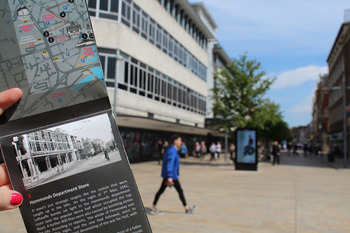
In the museum industry, several strategies are employed in the design of exhibits to provide users with links between the past and present that heighten engagement. This ‘mnemonic bridging’ takes many forms such as the display of artifacts, practices of imitation and emphasis on the same place through time.Footnote 22 The third stop, or node, on The Hull Blitz Trail, Hammonds Department Store, provides a good example of how the latter technique was effective in this project. During the Blitz, Hammonds Department Store was badly damaged in fires that were said to have engulfed the whole of Ferensway, a major Hull thoroughfare. The department store, and its glamourous top-floor dance hall were almost completely destroyed, leaving a shell of twisted iron (and also a ghost story) behind.Footnote 23 Crucially the site, despite the destruction wreaked upon it during the Blitz, remains strikingly similar in appearance today. Wartime photographs of the damaged building, held in the Hull History Centre, provided an almost identical vista of the store from Paragon Square, its front stretching down Jameson Street, today one of the city's main shopping streets (Figures 1 and 2). Therefore, the site provided substantial material from which to build a node on the trail which spoke to both the past and the present city. The identifiability of the site opened up space for users to compare its past and present lives, and thus more deeply imagine, engage with and understand Hull's experience of aerial bombardment. This act of comparing, in addition to inhabiting the place in which ‘the history happened’, helped to move the trail's content from an abstract narrative to one which the user could relate to, adding a sense of ‘realness’ and potential for historical empathy.
Jameson Street from Paragon Street, 1941. Source: Hull History Centre, C TSP.3.437.1. © Hull History Centre, Hull, reproduced with permission.

The Hull Blitz Trail compared with Jameson Street, 2018.

Yet to maximize the impact of using place in our work beyond the academy, we can look to locations with cultural significance as well as visual similarity. If place can be used to provide a ‘mnemonic bridge’ between the past and present, choosing places that users are already familiar with and have their own experiences of further reduces the sense of distance between history and audience. Hammonds Department Store was an institution in the city in the early 1930s and has remained so through the post-war period and to today, where it is now a busy department store and prominent building in Hull's city centre.Footnote 24 In the case of the Hammonds store, using a location which generations of Hull residents had their own memories of meant that users were more interested and more emotionally invested in the stories shared. Furthermore, using familiar locations which users had personal experience of allowed emphasis to be placed on the people who had lived through the Hull Blitz, not simply the buildings and streets which had witnessed it. Dolores Hayden argued that places can be ‘a more evocative source than any written records’ because of the material, social and imaginative attachments people develop to them.Footnote 25 Urban landscapes, she suggested, are ‘storehouses’ for social memories.Footnote 26 In The Hull Blitz Trail, if users were able to draw on their own experiences of a shopping centre, street or square, they were more able to imagine and engage with the experience of individuals and communities in wartime Britain.Footnote 27 While choosing sites with visual similarity, or identifiability, was an important strategy for prompting the imagination of users, choosing locations that were still important to the city today gave the content much greater meaning to those users who were residents of Hull and the surrounding areas. Thus by designing a trail that was incredibly personal to Hull today, not simply in the past, the project was able to have a much deeper and more meaningful ‘impact’.
Using place can therefore be a powerful tool for the historian in connecting the public to the past. But place was also used in The Hull Blitz Trail to communicate urban change and the legacies of World War II in Hull, rather than simply its history.Footnote 28 The fifth stop on The Hull Blitz Trail, the Albion Street Museum, is one such example. Hull's Royal Institution, and the Municipal Museum it housed, stood proudly on Albion Street (another major Hull thoroughfare) from the late nineteenth century until World War II.
Designed by leading architect Cuthbert Broderick and home to many thousands of rare and precious artifacts, the Institution and museum signified the importance of Hull as one of Britain's major port cities and cultural hubs in the early 1900s.Footnote 29 The Hull Blitz Trail tells of how ‘on the night of 24th June 1943, the museum took a direct hit. Firefighters were unable to save the building from the blaze that followed and the museum collapsed, thousands of its collections lost to the fire.’Footnote 30 It also shares the rather delightful story of a staff member of the museum who managed to recover his lost motorbike four decades later, when 1980s building works on the site recovered many of the museum's lost treasures. However, unlike other stops on the trail, the site today provides not the rebuilt remains of a grand museum but, instead, a car park.Footnote 31 The grandeur of the site's history stands in contrast with its rather unappealing modern function. Yet it remains one of the most popular points for users. The contrast between the past and present at the Albion Street Museum demonstrates to users how the legacy of the Hull Blitz is extensive, and can be found where it might be least expected. This stop illustrates the huge physical impact the aerial bombardment had on the built environment of the city, but also alludes to the urban transformation that has happened since.
Further points in the trail similarly aimed to tell the story of urban transformation, including the former site of the Hull Royal Infirmary, now a shopping district first outlined in post-war reconstruction plans, and the former warehouses and docklands along the river in Hull's Old Town which are today home to a busy area of pubs and restaurants.Footnote 32 Together, these places tell an urban history which is not simply concerned with the past, but one which has relevance and resonance in the city today. These stops functioned as striking visual signifiers of this change, again prompting imagination and engagement from trail users, but in very different ways to stops built on visual similarity such as Hammonds Department Store. One user's feedback made this clear: ‘[I enjoyed] comparing sites like Albion Street, where there's nothing left of the museum. I had no idea, that really brings home how much the city has changed since the blitz.’Footnote 33 Choosing content with contrast, as well as similarity, was therefore fundamental in opening up conversations about how the city has transformed over the past eight decades. Engagement with questions of historical change was shaped by the locations chosen, which prompted users to think not only about Hull's urban past, but also its urban present, and the space in between.
Successes, limits and challenges of working beyond the university
Thinking carefully about the wider form and design of urban history projects can also maximize the impact of historians’ work beyond the academy, by attracting larger and broader audiences to engage with academic research. In the case of heritage trails, this might be achieved through consideration of the timing of a project, careful planning of the route according to the present layout, use and accessibility of urban space, and taking into account the various motivations of potential users. On the other hand, considering the present so deeply in these ways does pose challenges to us as creators, and places limits on how we work.
In the case of The Hull Blitz Trail, the context in which the project was launched was critical to its success. Launching the trail during Hull's year as UK City of Culture 2017 meant that the trail reached a much greater audience, and as a result had greater ‘impact’, than would have been likely at another point in time.Footnote 34 As a major arts and culture programme spanning the entirety of 2017, Hull UK City of Culture attracted unprecedented numbers of visitors to the city centre, including tourists and locals alike. According to reports evaluating the programme, more than 75 per cent of City of Culture audiences were residents of Hull and the East Riding, with nine in ten residents engaging in at least one activity over the course of the year.Footnote 35 Furthermore, not only did the programme draw a much larger pool of potential users into the city centre looking for leisure activities, but its focus on exploring and celebrating Hull also stimulated interest in local urban history and culture in particular. Researchers found that around half of Hull 2017 commissions were ‘inspired’ by the city's heritage, and 65.6 per cent of residents reportedly ‘felt their knowledge of Hull's history or heritage had increased as a result of UK City of Culture’.Footnote 36 The combination of these two factors meant that a public history project which asked users to explore the city on foot was particularly appropriate and appealing. The programme thus provided a crucial platform for the project which undoubtedly contributed to the number of users the trail managed to attract, by increasing footfall in the city centre, and fostering a local appetite for a retelling of Hull's wartime story.
The design of the route itself was also carefully plotted to complement what was happening in Hull's urban space during 2017. In most public history projects, the elements of our academic research that we want to share typically need to be adapted or shaped to fit particular objectives and formats. Here, shaping the history of the Hull Blitz into a heritage trail meant forming 12 stops from a mass of potential material, and organizing these into a coherent narrative which, crucially, also worked as an engaging and practical walking route. With this in mind, the trail was designed as a circular route which covered most of the city centre to provide users, particularly visitors, with an overview of the modern urban landscape of Hull, as well as the area's history. Locations were chosen for their practical as well as historical purposes; for example, the trail started and ended in Queen Victoria Square, the geographical and cultural centre of the city. There were a number of reasons for this choice. Engaging photographs were available of the square in the midst of destruction in 1941 and during victory parades in 1945, offering an ideal site from which to introduce and conclude the trail's historical place-narrative. Today, the square is a popular public space, surrounded by attractive civic buildings including the City Hall and the award-winning Ferens Art Gallery, and is the location for countless events and activities. It was the hub of City of Culture 2017 activity and is also, conveniently, home to one of Hull's Tourist Information Centres where the trail was stocked. The choice of Queen Victoria Square as the start and end of The Hull Blitz Trail therefore carefully combined the site's history with its current purpose.
When adopting an approach which considers a city's urban past and present, thinking about the various functions that a trail can serve, and the differing motivations of its potential users, is also key. Scholars in heritage and tourism studies have noted the diverse range of roles that trails can play for users, which range from providing education and enjoyment to fitness and remembrance, as well as helping users to discover a new city, or at least new perspectives on it.Footnote 37 In self-guided tours in particular, users can ‘pick and mix’ the content they choose to engage with depending on their own motivations, taking divergent routes from node to node, skipping sections entirely or combining other elements of the urban environment into their experience – and research shows that they do.Footnote 38 The Hull Blitz Trail not only considered this, but actively encouraged it, guiding users along a route which took in the Hull History Centre, Museums Quarter, historic Old Town, shopping districts and the Ferens Art Gallery. At the Hull Minster, the trail text prompted users to step inside the church, a hub of cultural events in the regenerated Trinity Quarter, in search of a memorial stained-glass window. At the Hull History Centre, it suggested users make a visit to trace their own family histories of wartime Hull, after more than 91,000 Civil Defence records were catalogued and made available to the public.Footnote 39 The decision to launch a self-guided trail which took place in the city centre was therefore grounded in principles of flexibility, allowing users to combine the trail with other events and activities. The impact of considering the city's present in this way – particularly its Hull 2017 context – was that the trail was accessible and appealing to as wide an audience as possible. The trail benefited from the promotional opportunities of being launched in Hull's UK City of Culture year and in turn actively supported the cultural, social and economic regeneration happening in the city. Building these considerations into our projects at design level can ensure that our outputs are meaningful to users living in or visiting the city today.
However, while taking such an approach to The Hull Blitz Trail may have afforded the project many opportunities and successes, considering the present as well as the past in any public history project equally poses limits on the stories we are able to tell, as well as how we can tell them. At its simplest, using the form of a heritage trail places restrictions on the amount and type of material we can share with a given audience. The Hull Blitz Trail featured 12 nodes comprised of only 150 words and one image each. These nodes needed to be attached to locations that were physically accessible, identifiable and evenly spaced over a manageable distance. Choosing the content and shape of the trail therefore required a delicate balance between the historical content selected and the locations that were available and appropriate to anchor the content to. Urban space is dynamic, prone to transformation and regeneration, and while this was an important takeaway of the trail itself, working in an urban setting can make sharing particular histories especially challenging. The modern urban landscape of Hull's city centre, for example, offered little potential to tell personal stories of individuals living through the Blitz, with large amounts of residential space lost to redevelopment in the second half of the twentieth century. Instead, the surviving buildings of modern Hull, like many urban spaces, are more appropriate for exploring the physical effects of bombardment and civic responses to war. As a result, communicating stories of personal experience through place demanded creativity, with a node at the Central Fire Station exploring voluntarism through the story of one fire-watcher, Albert. Another node used the former site of air-raid shelters to discuss the impact of war on family life, describing the experiences of wartime housewife Harriet and her son Kenneth who lived in city centre terraces now long demolished. Moreover, in response to very small amount of content that could be included in the trail, the text encouraged users to follow up with their own research in Hull's museums, libraries and archives, and increased awareness of these resources by marking them out along the route. The trail was designed as an introduction to the history of wartime Hull which fostered audience participation, rather than as a comprehensive guide.
These issues draw attention to the power that academics hold when we take urban history beyond the academy, and the potential to influence particular narratives of the past. While working in the public spaces of cities may afford us access to wider audiences, the visibility of this type of public history can, as John Siblon points out, also create ‘spaces in which entangled personal and national histories are contested’.Footnote 40 In tourism studies, Nicola MacLeod has written about the specific influence that the design of trails has in this respect, which is undeniably important to consider: ‘As attractions which move visitors through space, organizing and unifying the built and intangible heritage through place-narrative, it is interesting to consider how trails might contribute to the processes inherent in the construction and experience of tourist space.’Footnote 41 Applying this idea to our academic projects, it is clear that creating a historic trail organizes the urban environment along particular lines, giving certain spaces and locations new physical and symbolic meanings. Each choice made on the shape and content of the trail directs and manages the audience experience, posing important questions of power that we need to consider as creators and co-creators.
The audiences themselves are not without agency, or their own ‘entrance narratives’, and the flexibility of the self-guided trail model allows for some democratization in how the particular narratives offered are experienced and interpreted. By walking a route of familiar places, the user brings their own memories, stories and experiences into dialogue with the historical themes raised. According to Dolores Hayden, this is ‘the key to the power of historic places’.Footnote 42 Public spaces can trigger memories, fostering a sense of shared ownership of a common past, while the public nature of the trail itself, taking place on the street rather than behind the often intimidating walls of a museum, archive or university, can act as an equalizer between the public and the academic as a perceived ‘gatekeeper’ of history.Footnote 43 As a format, trails can help public engagement projects to move away from linear and paternalistic transfers of knowledge and towards models of ‘making history’, even where the academic is not in direct conversation with their audience.Footnote 44
As directors of these projects, we can actively pursue this more collaborative approach to working with the public. In The Hull Blitz Trail, promotion on social media directly asked users to contribute their own stories of Hull's history, with dozens of individuals sharing stories through tweets, Facebook comments or via email. One elderly user, who had himself lived through the Hull Blitz as a child, chose to complete the trail with family on his ninetieth birthday, as a way of both reminiscing and sharing his own experiences with loved ones. Throughout the planning process meetings were held with community groups and history societies, as well as consultation with the public through social media, the feedback of which fed into the content that was eventually shared. This collaborative approach was powerful in encouraging a sense of shared ownership between all stakeholders, including the audience. Nonetheless, considering the present as well as the past in public history projects will continue to limit the stories that are told, and how they are told. Trails privilege certain sites and certain stories over others, and in following the route of a trail the audience accepts, to at least some degree, the interpretation offered by this route. This is not only the product of the curatorial choices made by the academic, but is also influenced by the physical and cultural landscape of modern urban space. Historians must recognize the power these issues hold to understand fully the impact of their public work.
Conclusion
Considering how the present shapes our narratives of the past is not unfamiliar to historians working within the academy. But working beyond traditional university spaces does require historians to confront many new types of work and develop many new skills. For historians’ work beyond the academy to be ‘impactful’, those directing projects need to forge new connections with stakeholders which might include those working in heritage and tourism industries, local government, education, arts, business or community groups. In the case of The Hull Blitz Trail, I worked closely with archivists at the Hull History Centre, volunteers at the Hull People's Memorial and other professionals working for Visit Hull and East Yorkshire and UK City of Culture. Each of the relationships built with these partners was vital to the success of the project. Ethical considerations of the past and present are necessary in any project, and working beyond the academy requires us to navigate new forms of project planning, risk management, legal logistics and networking beyond the usual circles. Academics often play the role not only of researcher, but also project manager and designer, social media director and public speaker, responsible for funding, finance and ‘impact’ analysis. The more comfortable we become in these new spaces, the more significant our work beyond the academy can be.
The Hull Blitz Trail is just one example of a project which used place to engage with audiences outside of the academy, one project among an increasingly vast and rich variety of work that academics are doing beyond the traditional spaces of the university. But reflecting on it can tell us important things about the benefits and challenges of this type of work. As urban historians, we are uniquely placed to utilize and reap the benefits of place in our work beyond the academy. In The Hull Blitz Trail, the medium of a heritage trail was used to engage new audiences, with carefully selected locations prompting comparison and contrast between historical and modern Hull, encouraging historical empathy, user engagement and opening up space for discussions about urban change. The contemporary city played a key role in determining how this aspect of urban history was taken beyond the academy. The project was deeply rooted in the cultural context of modern Hull through its timing to coincide with Hull UK City of Culture 2017, a route that was plotted to complement and support the city's physical and cultural landscape, and consideration of the various motivations of trail users. Each of these contributed to attracting larger and broader audiences to the project. Nonetheless, practical considerations of the city today pose significant restrictions on the stories we are able to tell, and how we tell them. ‘Doing’ urban history beyond the academy successfully and ‘impactfully’ means considering the present city as much as the past one, and requires a constant negotiation between the historical content we want to share, the tools we have to share it and the place we want to share it in.