A man is always a teller of tales, he lives surrounded by his stories and the stories of others, he sees everything that happens to him through them; and he tries to live his own life as if he were telling a story.
———Jean-Paul Sartre, Nausea, 39During a 2016 speech he gave on the one hundredth anniversary of the Ottoman victory against the British army in the First Battle of Kut, Turkey's President Tayyip Erdoğan said, “I reject the conception of history that places the beginning of the history of our centuries-old civilization in 1919” (Altun Reference Altun2016). He was referring to the launching of the Turkish War of Independence on 19 May 1919 by Mustafa Kemal, which is celebrated every year as one of Turkey's most significant national holidays. Two days later, a prominent journalist and outspoken representative of Ulusalcı nationalism, Bekir Coşkun, said “The President is forgetting that he owes his presidency to the process that started on 19 May 1919,” and reasserted that the history of Turkey “begins in 1919” (Reference Coşkun2016).
This exchange between Erdoğan and Coşkun exemplifies the politics of nationhood that has dominated the Turkish political scene since the turn of the millennium, which takes shape as a confrontation between two contending projects of nationhood. While Erdoğan's view represents the ruling AKP'sFootnote 1 notion of nationhood that claims Turkey as an Ottoman Islamic civilization (Çınar Reference Çınar2001), Coşkun's view represents the conception of the Turkish nation as primordially secular, ethnically Turkish, and fundamentally anti-imperialist, a view developed and propagated by a political movement called Ulusalcı nationalism that emerged around the time that the AKP was founded in 2001.Footnote 2 This conflict between the AKP's Islamist/Ottomanist conception of the Turkish nation and the secularist/anti-Ottomanist/anti-Western view of the Ulusalcı became the main political axis around which Turkey's recent political history has unfolded.
Since it came to power in 2002, and intensifying after its third term in office in 2011, the AKP has pursued an increasingly systematic, rigorous, and at times aggressive policy of Ottomanization and Islamization of Turkish society (Zencirci Reference Zencirci2014; Ongur Reference Ongur2015; Batuman Reference Batuman2014), as is evident in the more than tenfold rise in the number of Imam Hatip (Islamic Preacher) school students since 2002 (Eğitimsen 2016); the introduction of new Islamic courses and themes into school curricula; the strict regulation of the sale and use of alcohol in public spaces; and similar interventions. These have all been accompanied by Erdoğan's continual referral to Turkey as a civilization rooted in Islam and his persistent declaration of the AKP's devotion to raise a “pious generation.”Footnote 3 The conception of Turkey as an Ottoman-Islamic civilization has been the core of the AKP's political ideology and program since it came to power and it has increasingly dictated its policies and interventions to transform Turkish society toward its own version of Islamic values and norms.
Ulusalcı nationalism stood out as the AKP's main political adversary throughout its three terms in power, and defined itself as a secular nationalist and Kemalist movement that challenged the AKP's Islamism and close alliance with what they claimed were imperialist Western powers.Footnote 4 Ulusalcı nationalism first appeared on the Turkish scene around 2002 as a distinct movement that made a slight but significant departure from official Kemalist ideology. Politicians, intellectuals, writers, activists, retired military officials, artists, students, and different civil society associations started to identify themselves as “Ulusalcı” to refer to a particular political stance that is defined as primordially secularist, anti-imperialist, and against any form of Islamism, Ottomanism, or Islamic identities, as well as the European Union and the United States. Though Ulusalcı nationalists claim to be true Kemalists, their position departs from mainstream Kemalism. The latter has embraced modernization, Westernization, and secularism more as a cultural identity and a lifestyle than as a form of nationalism, and has always sought to establish Turkey as a close ally of the West that will eventually be part of Europe. While some Ulusalcı proponents were active under the social democrat, Kemalist CHP (Cumhuriyet Halk Partisi—Republican People's Party), the majority gathered around civil society organizations to form an autonomous political movement.Footnote 5
This paper examines the case of Ulusalcı nationalism and its use of nation-building techniques to establish and propagate its own version of Turkish nationhood. It explores the ways in which the politics of nationhood unfold around confrontations between rival nation-building projects, each of which generates its own version of national history built around different founding moments. We argue that the most significant technique the Ulusalcı nationalists use to redefine Turkish nationhood is to displace the founding moment from the official Kemalist moment marked by the founding of the Republic in 1923 and relocate it in the War of Independence fought against European powers between 1919 and 1922; thus, Coşkun's claim that Turkish history began with the start of the war.
Our larger goal is to draw attention to the centrality of the notion of the founding moment in the process of nation-building, the writing of national history, and the creation of national communities. We illustrate how the designation of a founding moment is not only an essential part of the nation-building process but also vital in the continual legitimation and conservation of the nation-state, its ideology, and its history. We discuss how national history is structured around a founding moment, which is established as a point in time when the nation is assumed to have acquired agency to become a sovereign entity capable of determining its own fate. The designation of a founding moment is a crucial part of nation-building not only because it serves as an anchor in time around which time is nationalized and structured along a linear path, but also in that it allows the nation to be located on this path as a single sovereign entity that has a uniform, continual existence throughout history.
We examine Ulusalcı nationalism through a narrative analysis of a record-breaking bestseller, the historical documentary novel Those Crazy Turks (Şu Çılgın Türkler), which became the bible of the Ulusalcı movement, and its author, the late Turgut Özakman, one of the movement's main spokespersons (Reference Özakman2005). We demonstrate that this new narration of Turkish nationhood displaces the founding moment by narrating national history around the War of Independence instead of the founding of the Republic, by framing the war as the moment when the Turkish nation acquired its sovereignty. Through the displacement of the founding moment, the Ulusalcı narration interpellates a new national subject that is primordially secular,Footnote 6 militaristically patriotic, and adamantly anti-Western. These are projected as the essential qualities that must be upheld and defended at all cost against Islamist, Ottomanist, and Western powers that are conspiring to bring Turkey down.
Another contribution of this study involves the adoption of a narrative-based approach to the study of nationalism by focusing on stories of nationhood as the main means through which national communities come into being. Though some key figures in the study of nationalism, such as Benedict Anderson or Homi Bhabha, have studied nationalism as narration, the generative function of narratives in nation-building processes have not been sufficiently theorized. Studies that focus on stories of nationhood circulating in the public and the political realms are scarce, and it is only recently that studies have begun to recognize the significance of narratives of nationhood and have started to introduce literary and narrative approaches to examine different aspects of nationalism (Morden Reference Morden2016; Khoury Reference Khoury2016). We adopt this approach here mainly because it allows for a more flexible and a context-specific way of studying nationhood by focusing on locally produced categories with which contending nation-building projects define themselves. We avoid popular categories conventionally used to study nationalism, such as civic or ethnic nationalism, which can obscure contextual specifics that are essential to unique forms of nation-building projects. Indeed, one of the most commonly debated issues regarding Turkish nationalism is whether it can be qualified as ethnic, civic, cultural, territorial, or a mixture of these (Yıldız Reference Yıldız2001; Bora Reference Bora2003; Özkırımlı Reference Özkırımlı and Kastoryano2013). Here we depart from this line of debate and propose to study nationalism instead as a field of contending stories that strive to define nationhood in different ways. We examine how these stories produce different national subjects by marking them with categories of culture, territory, religion, ethnicity, or, as in the case of Ulusalcı nationalism, the more specific category of primordial secularism.
STORIES OF NATIONHOOD AND THE FOUNDING MOMENT
Charles Taylor notes that “we grasp our lives in a narrative,” which allows us to sustain a sense of self that has continuity in time (Reference Taylor1992: 47). Among the many stories we tell to constitute our reality and situate ourselves in time, the most prominent ones are stories of nationhood, which act as a general frame within which other stories are subsumed. Tales of nationhood are used the world over to shape and justify all sorts of choices and practices that form one's reality, ranging from voting preferences and political actions to choices about who to marry, where to live, and what school to send the children to, and seemingly trivial things like what music to listen to, sports team to follow, or car to buy. As Bhabha observes, “The scraps, patches, and rags of daily life must be repeatedly turned into the signs of a national culture, while the very act of the narrative performance interpellates a growing circle of national subjects” (Reference Bhabha and Bhabha1993: 297). Stories assign national meaning to ordinary and arbitrary objects and practices, and quotidian choices, bringing them together into a meaningful, coherent, collective national narrative that converts ordinary individuals into members of the nation by addressing them as national subjects and assigning to them particular roles and identities in the grand narrative of the nation.
Through narration, the nation works itself into the imagination, and adapting Sartre's words, people come to “[see] everything that happens to [them]” through the collective story of the nation (Reference Sartre, Alexander and Howard2007: 39). Stories of nationhood are publicized through novels, films, television, and newspapers, and more recently video games and the Internet. These media are laden with national icons, symbols, and codes that concertedly educate individuals not only on the norms and standards of the life, culture, language, and preferences of a typical member of the nation, but also on how to become worthy citizens, what to value and prioritize to be part of the national community, and the boundaries of exclusion and inclusion. When the imagination is nationalized in this way, it leads people to think, speak, act, and even dress on behalf of the nation and assume that everyone else is doing the same. Nationally circulating stories constitute the nation and its members on a daily basis.Footnote 7
The constitutive power of stories is emphasized in Judith Butler's account of the construction of sex and gender. She argues that the marking of a body by the category of sex is not only a classificatory inscription, but also, and more importantly, a constitutive intervention. “There is no body prior to its marking,” Butler writes, indicating that it is not possible to talk about the body outside of the category of sex (Reference Butler1993: 98). Just as narratives of sex and gender mark the body into being, stories of nationhood mark the nation into existence. What categories of sex and gender are for the body, categories of ethnicity, religion, culture, territory, or historicity are for the nation, and to adapt Butler's insight, there is no nation prior to its marking by these categories, especially ethnicity.
Stories of nationhood not only interpellate the nation into existence, they also reify it by inserting it in time. The story of a nation is always narrated as if it is a single being that moves through time and has a continuous, uninterrupted, unwavering existence through history, regardless of the incommensurable changes in the actual number, origins, and the ethnic, cultural, or religious affiliations of the people that constitute it.
The narrative location of the nation in history is achieved by the designation of a point of origin, or a founding moment, at which it came into being. This founding moment is not necessarily the beginning of the nation before which it had no existence, but it is the point at which the nation is assumed to have come into awareness of itself as a sovereign entity capable of making choices for itself. From the founding moment, the nation can assume agency and a voice to declare itself independent and sovereign. From the moment of its founding, the nation is deemed capable of deciding the norms and principles by which it will live, codifying these in a constitution, and setting the conditions of inclusion and exclusion into its collective body. But since the nation is an imaginary subject, so too, is its voice and agency. Hence, it falls upon a group of elites, and later the state, to assume the authority to act, speak, and make decisions on the nation's behalf. The legitimacy of the claim to become the voice of the nation is based upon the effectiveness of the established regime of representation and the state's claim to represent the nation. The state seeks to legitimize its claim through elections or some other system of delegating authority.
The designation of a founding moment, therefore, is arguably the most important discursive technology with which a nation-state is formed. Through it, the nation acquires a singular, monolithic, and continuous subjectivity vested with sovereignty and agency, which is claimed by the founding state that emerges and legitimizes its authority as the nation's sole representative.
Given their vitally constitutive role in the formation and continued legitimation of the nation-state, founding moments must be continuously reproduced and kept alive in public memory. Yael Zerubavel suggests that this is accomplished through a variety of commemorative rituals, including “the celebration of a communal festival, the reading of a tale, the participation in a memorial service, or the observance of a holiday,” all of which concertedly “contribute to the formation of a master commemorative narrative that structures collective memory” (Reference Zerubavel1997: 5–6, her emphasis). The sustenance of the founding moment in public memory by such a master narrative reifies the nation and legitimizes the state in everyday life.
Founding moments also offer a resolution to what Homi Bhabha refers to as the “double-time” of the nation: “The nation's people must be thought in double-time,” where they are narrated both as “historical ‘objects’ of a nationalist pedagogy,” and also as “the ‘subjects’ of a process of signification” whereby the nation emerges as the agent and author of its own history (Reference Bhabha and Bhabha1993: 297). For Bhabha, this double-time of the nation as both ancient and new creates the conceptual space within which the nation is written into being.
In the double-writing of the nation, the effect of ancientness is achieved by the projection of the nation into a distant past through the writing of official national histories, various commemorative practices, and the construction of national memory. Achieving the effect of novelty involves a very different kind of intervention, especially since the claimed ancientness of the nation needs to be preserved. Such a sense of novelty is produced by the projection of the nation as acquiring agency in the creation of its own history. This kind of agency is ensured by a declaration of independence and sovereignty, which allows the nation to be imagined as having existed for a long time, but as having “awakened” to its sovereign existence only recently. This intervention in both time and the subjectivity of the nation is marked by a founding moment at which the nation is declared into being as a sovereign entity.
In this way, founding moments serve to make the “double-time” of the nation possible by creating a conceptual space within which it can exist as both ancient and new. Founding moments do this by authorizing the founding elite with the power to declare the nation into being, thereby establishing the nation as new and modern by virtue of its newly acquired, self-declared autonomy. As Alev Çınar notes, the inscription of a founding moment serves to establish the state as the sole representative of the “national subject vested with the ability (agency) to intervene and inscribe the nation into time” (Reference Çınar2001: 368). The founding moment's function of resolving the ambivalence of the double-time of the nation is evident, for example, in Lyn Spillman's comparison of the American and the Australian founding moments. Spillman points out that founding moments serve not only to legitimize the unity and continuity of the nation—its ancientness—but also to grant citizenship and agency to those who participate in the collective celebration of the founding moment (Reference Spillman1997: 71–73).
Official Turkish national history has designated as the founding moment 29 October 1923, the date on which the new republic was declared by the Grand National Assembly led by Mustafa Kemal Atatürk. This date is celebrated as the most important moment of Turkish national history, when the Turkish parliament assumed the voice of the nation and declared its sovereignty. At the end of The Outline of Turkish History, the first and main book on official Turkish national history, the founding moment is summarized as follows:
The sons of Osman [the Ottoman Dynasty] had long lost the ability and the honor to rule the Turkish nation. During the Armistice, the Turkish nation encountered the worst devastation that it had ever faced in its history, which is as old as the history of the whole world. [… But] knowing the heroism of the Turkish nation on battlefields, and the hardships it was facing and its needs, Mustafa Kemal took on the leadership of the nation and initiated an opposition in Anatolia (1919). The Turkish nation did not hesitate to come together under the banner of Mustafa Kemal and initiate the struggle for independence. […] Mustafa Kemal, who saved the Turks from the sons of Osman and the worthless Caliphate, formed the Republic (29 October 1923). The Gazi [Mustafa Kemal], who was elected as the president of the Republic, engaged the Turkish nation on a path of true advancement and progress (Türk Tarihi Heyeti 1996 [1930]: 466–67).
This short but significant passage not only narrates the nation into sovereign existence, but also nationalizes and structures time along a linear path beginning at the founding moment. The double-time of the nation is also clearly visible here, since the Turkish nation is marked simultaneously as an historical object that is “as old as the history of the whole world” and an autonomous subject that emerges as the agent of its own fate. It is both an object and a subject, both ancient and modern.
POLITICS OF NATIONHOOD
In the vast body of literature on nationalism, perhaps the most understudied topic is the politics of nationhood. Terms like politics of nationhood or nationalism are often employed to mean how the political elite or the state is involved in the nation-building process. Since further theorizing or conceptual exploration of the notion of politics is seldom offered, the term tends to become conceptually void and analytically useless. Yet, in the study of nationalism, the politics of nationhood has significance far beyond the state's involvement in the nation-building process. Nation-building is not only always political, but also it stands as one of the core elements of politics in general. Politics is not only about governance, distribution of power, and political action—it is also, and maybe more importantly, about the ways in which contending nationalisms, expressed as rival stories of nationhood, compete to come to power and establish their own version of nationhood as the dominant one.
If the nation is understood as ultimately the product of storytelling, then the politics of nationhood involves the production, dissemination, contestation, and negotiation of different stories of nationhood, and the resulting clashes and struggles for power between rival movements and projects. In any given context, there are always contending stories of nationhood, which produce different national subjects by placing differential emphasis on one or more categories of nationhood such as ethnicity, religion, culture, or territory. Therefore, the politics of nationhood is about rivalrous, contending nationalist projects struggling to produce, disseminate, and promote their version of the national story, to undermine, discredit, or destroy their rivals, and to institutionalize their version of the national subject and history in public memory.
All of these movements and projects, most of which organize into political parties, eventually seek to come to power or influence those in power. That is because only via the state apparatus and its resources can a particular nationalist project insert its version of the nation in history, establish its version of the national subject, rewrite and implement a new commemorative narrative, and restructure time around its own version of the founding moment.
But even when the particular national story of a political movement is institutionalized firmly and pervasively, it is always surrounded by alternatives and rivals. The establishment, institutionalization, and normalization of a particular narrative are ongoing and political processes precisely because the official narrative is always surrounded by contending projects. The politics of nationhood is about ongoing efforts to sustain the status of the dominant narrative as the founding ideology, as well as the continuous struggles among contending projects to replace it. Rogers Smith writes, “The politics of people-making, then, involves continual, partisan, conflictual, often invidious, and always exclusionary processes centered on stories and force” (Reference Smith2003: 56). One key aspect of the politics of nationhood is the struggle among contending national projects that claim different founding moments so as to empower different kinds of national subjects. This is best illustrated by J. J. Ellis when he points out that in the making of American nationhood there were two competing conceptualizations of the nation that rested upon two different founding moments: independence in 1776, and the adoption of the U.S. Constitution in 1787 (Reference Ellis2000: 9). Ellis' account suggests that these two moments correspond to two contending narratives of the nation. The first relates to the Revolutionary era, which focused on attempts to form and define a sense of nationhood with reference to the breaking or continuation of historical, cultural, or political connections with colonial Britain. The second corresponds to the Early Republic period, when the constitutive elements of American nationhood came to be based on a completely different set of priorities including rights and liberties, abolitionism, or individualism versus nationalism. Ellis notes that the political contention over these two narrations emanating from the two founding moments have not only shaped the ideological disputes at the time, but “historians have essentially been fighting the same battles, over and over again” since then as well (Reference Ellis2000: 14). Whether it is an ideological battle among political leaders in the form of federalism versus anti-federalism, a dispute among historians over the significance and centrality of the Revolutionary era as opposed to the Early Republic period, or a political contention between the supporters of the Confederation and the Unionists, the politics of nationhood seems to have unfolded around these two competing national narratives that establish and justify themselves by ascribing different meanings and significance to the two founding moments and the stories that they engender. The United States has the oldest written constitution in the world and has successfully institutionalized the Unionist national story, yet to this day the Confederate national story remains an influential competitor. Even though Ellis believes that it is possible to reach “a genuinely historical perspective on the revolutionary generation” (Reference Ellis2000: 15), it seems that the politics of nationhood unfolds as a never-ending process of selective rewriting and ongoing re-narration of historical events and different founding moments, which are appropriated by different groups and movements for their own current political and ideological purposes.
A study on the politics of nationhood in Turkey would explore competing notions of the Turkish nation that are the products of substantially different national histories, and that produce different commemorative narratives built around different founding moments, and that interpellate different national subjects.Footnote 8 Turkey's three main political parties each celebrate different notions of nationhood founded in different moments in history. The ruling AKP promotes the Turkish nation as an essentially Ottoman-Islamic subject and locates its founding moment at 29 May 1453 as the conquest of Istanbul, which is celebrated every year as the “Conquest Day” with massive festivals and demonstrations (Çınar Reference Çınar2001; White Reference White2013). The MHP (Milliyetçi Hareket Partisi—Nationalist Action Party) instead defines the Turkish nation according to its ethnic origins in the Turkic tribes of Central Asia. The MHP sets the real founding moment as the 1071 Battle of Manzikert (Malazgirt) that was fought between the Seljuq Turks and the Byzantine Empire and, as the party's leader observed, allowed the Turks “to imprint the stamp of the nation on Anatolia” (Bahçeli Reference Bahçeli2013). Having been founded by Mustafa Kemal himself, the CHP's version of Turkish nationhood is the closest to official Kemalist nationalism that celebrates the founding moment as 29 October 1923, when Turkey's Grand National Assembly declared the Republic into being.
Among these competing projects of nationhood, Ulusalcı nationalism stands out for being a political movement that was not organized around a political party. Instead, it was initiated by various secularist civil society associations as a reaction against the rising power of Islam in politics. As the AKP came to power in 2002 with a majority government, various secularist circles sought to take a political stance and rally against what they feared was an Islamic threat rising under the AKP's rule. While some of these groups were associated with the mainstream Kemalist CHP, most chose to gather around independent civil society associations and autonomous organizations that formed the Ulusalcı movement, such as the Association of Atatürkist Thought (ADD, Atatürkçü Düşünce Derneği), Support for Modern Life Association (ÇYDD, Çağdaş Yaşamı Destekleme Derneği), or the Women of the Republic Association (CKD, Cumhuriyet Kadınları Derneği).
Ulusalcı nationalists claim to be adamant Kemalists, but the primordially secularist and anti-Western/anti-imperialist features they attribute to Turkish nationhood differ from the official Kemalist national ideology. First, while mainstream Kemalism takes secularism as a cultural identity and lifestyle adopted as part of Turkey's modernization project in the nineteenth century (Göle Reference Göle2000: 111; Cizre and Çınar Reference Cizre and Çınar2003: 310; Navaro-Yashin Reference Navaro-Yashin1998: 85). Ulusalcı nationalism mobilizes secularism as the defining element of Turkish ethnic identity. They invoke it as a primordial quality of the Turks that existed long before Islam was imposed on them by outside forces. They declare Islam to be alien to Turkishness, something brought by the Arabs that Turks subsequently tamed and secularized (Saltık Reference Saltık2004).
A second difference is that Ulusalcı nationalism focuses exclusively on the anti-imperialist, anti-Western, and militaristic aspects of Kemalism. It dismisses the civilian elements that came to dominate after the founding of the Republic, when the new state under Atatürk's leadership embraced Westernization as a key axiom of official ideology and sought to form close alliances with European powers. It was the Kemalist secular elite that sought to establish Turkey as part of Western civilization and fully supported its accession process to become a full member in the European Union (Çınar Reference Çınar2010: 98).
The Ulusalcı reframing of Turkey's national ideology as primordially secularist and anti-Western, we argue, is achieved by displacing the founding moment of the new state from the officially recognized date of 29 October 1923 to the War of Independence period (1919–1922) and especially to the war's victorious finale on 30 August 1922. By rebranding their current endeavor as another, renewed war of independence against Western imperialists and their in-house proxies, Ulusalcı nationalists endeavor to protect the nation from what they perceive as two vital threats: Western imperialism (including the EU) that imperils Turkey's hard-earned sovereignty and independence, and political Islam that threatens to destroy secularism, which they see as the essence of the nation.
The difference between the Ulusalcı founding moment in 1919–1922 and the official Kemalist moment in 1923 signifies the difference between Mustafa Kemal, a soldier and army commander fighting an anti-imperialist war, and Atatürk, the civilian leader and president of the new republic that draws its legitimacy from the consent of the people. The latter represents a version of Kemalism that seeks to transform Turkey into a modern country that is part of the “civilized” West through a rigorous program of modernization. This program includes the building of a parliamentary republic, the writing of a new constitution, and other political, economic, and social reforms. The former represents the Ulusalcı version of Kemalism that prioritizes the significance of military power over civilian authority as the source of legitimacy for the sovereignty of a nation, rallies the nation behind Mustafa Kemal as a military commander rather than as a civilian leader, and gives utmost priority to resisting and fighting the imperialist intentions of Western powers and defending the country at all costs.
It has been suggested that Ulusalcı nationalism is no different than official Kemalist ideology (e.g., Kösebalaban Reference Kösebalaban2005) and, ironically, both AKP supporters and their Ulusalcı opponents employ this claim to justify their respective ideological positions. The Ulusalcı nationalists claim to be the true successors of Kemalism so as to justify and highlight the significance of their movement as the only true defender of Turkey's founding national ideals and interests. AKP proponents also recognize the Ulusalcı movement as the true successor of Kemalism, which they projected as the oppressive force that violated Turkey's “national and cultural sovereignty through a process of Westernization” and secularism, and continues to do so through the Ulusalcı (ibid.: 34). The AKP uses this claim to establish itself as the truly patriotic and legitimate political force that will protect and promote Turkey's national and cultural sovereignty, and to justify its regulatory and restrictive interventions to suppress not only the Ulusalcı movement, but any opposition or challenge to the AKP government. In fact, the AKP portrayed all nonaligned rallies, such as the massive Gezi Park protests that took place across the country in 2013, as a conspiracy against the government by Ulusalcı followers together with Turkey's enemies (Akbay Reference Akbay2013).Footnote 9
THE EMERGENCE OF ULUSALCI NATIONALISM IN HISTORICAL PERSPECTIVE
The Turkish words “ulusalcı” and “ulusalcılık” mean nationalist and nationalism, respectively. However, the common word for nationalism is milliyetçilik, from Ottoman Turkish, in which the root word millet was used to mean a religious community and later came to be used to mean “nation.” “Ulusalcı” comes from the root word “ulus,” which also means nation, but was reinvented as “purely Turkish” by the Turkish Language Association, which was founded in 1932 by Atatürk with the mission to purify Turkish from Arabic and Persian influences. While the word ulus subsequently became popular and was used interchangeably with millet to mean “nation,” its derivatives such as ulusalcı or ulusalcılık never replaced milliyetçi and milliyetçilik. The choice of this newly invented word is significant for three reasons. First, the term ulusalcı allows the proponents of the movement to avoid marking themselves as milliyetçi, which has Turkic/ethnic connotations, and hence lets them differentiate themselves from right-wing nationalists who adhere to ethnic definitions of nationhood. Second, since “ulusalcı” is derived from ulus, which was invented as part of Kemalist modernization and secularization reforms, it gives a nod to Kemalism and thereby highlights loyalty to Atatürk's legacy. Third, the use of a “purely Turkish” word implies a rejection of the Ottoman word millet, and therefore expresses an opposition to both Ottoman and Islam and underscores the Ulusalcı movement's secularist aspect.
The bourgeoning academic literature on Ulusalcı nationalism is inclined to establish a linear line of historical development and trace its intellectual roots back to the leftist trend within Kemalism, starting with the 1930s Kadro movement, the 1960s Yön Movement, and, later, to the works of the socialist-Kemalist poet and writer Atilla İlhan, whose views shaped the development of this nationalism (Gürpınar Reference Gürpınar2013a; Aktürk Reference Aktürk2015). Although the basic presumptions of this left-wing nationalist trend are also found in earlier interpretations of Kemalism, they have remained confined within an elite circle of intellectuals and have not translated into mass mobilization of any unique political movement. While this perspective was formerly referred to as Ulusal Sol (National Left) (İlhan Reference İlhan2005), the current common usage of Ulusalcılık instead implies a shift in this formation. The most important difference between the Ulusal Sol of the 1960s and the Ulusalcı movement of the 2000s is that the former was the product of the Cold War era and focused on reasserting the anti-imperialist component of Kemalism in opposition to the Turkish state's official alignment with anti-communist Western powers. It had no issue with Islamism. In contrast, the very raison d'etre of the Ulusalcı movement is to counter political Islam.
The Ulusalcı movement has its roots in the early 1990s, when the Islamist Refah Partisi (RP, Welfare Party), started to expand its support base.Footnote 10 While the RP was an electorally insignificant right-wing political party in the 1980s, it tripled its electoral support base in less than ten years. Its success during the 1994 local elections, when it won the mayoralties in most of Turkey's major cities, included the placement of Recep Tayyip Erdoğan as Istanbul's mayor. Its ascendancy to power in 1996 shocked and panicked secularists, who saw this Islamist victory as an alarming new threat that would carry Turkey toward an Islamist revolution of the Iranian kind. In this process, which resulted in the 1997 ousting of the RP-led coalition government, the military unprecedentedly undertook a massive campaign, including a series of meetings, which directly appealed to civilian urban sectors such as the media, academia, business, and civil societal organizations to mobilize against the rising “Islamist threat” (Cizre and Çınar Reference Cizre and Çınar2003: 322). Secularists saw the RP's 1994 electoral victory as such a serious threat that several new secular grassroots organizations and civil society associations emerged, such as ÇYDD or CKD, which targeted all their campaigning to resist and protest political Islam's rising influence. Secularist voluntary groups came together to raise money for and publish local newspapers and journals, thereby establishing the grassroots organizational base of the Ulusalcı movement (Çınar Reference Çınar2005: 19–20).
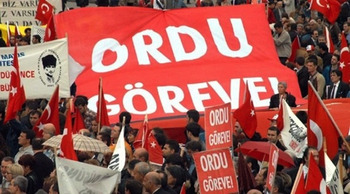
This initiative, which started as a civilian resistance against the rising influence of Islamism in the early 1990s, later developed into an active, fully established civil society movement that adopted secularism as its defining element. By the early 2000s, it took on still more pronounced features when it began to rally around secularism as a national cause, and evoke it as the core element of national identity that unified the Turkish nation and had to be upheld against Islamism at all cost. This sacralization of the principle of secularism implied that its protection had to be the nation's highest priority, even if that meant suspending democracy. This is when proponents and spokespersons of Ulusalcı nationalism began hinting at the possibility, or even necessity, of a military intervention against the rising influence of Islamism in Turkey. In some meetings organized by Ulusalcı associations placards began to appear that read, “The Military to Duty” or “Atatürk's Army Will Defeat the Sharia.” (Image 1)Footnote 11 For the Ulusalcı, if the wellbeing of the nation was at stake, this justified a military coup and the suspension of democratic rights and freedoms (Kınalı Reference Kınalı2008).
“Military to Duty” placard at the 25 October 2003 Ankara Tandoğan Republic Meeting; http://www.diken.com.tr/11-yil-ordu-goreve-mansetini-atan-turk-solu-caglayanda-zaman-nobetinde/ (used courtesy of DHA News Agency).

Despite its high militarist tone, this newly emerging secularist trend maintained a pro-EU stance until the late 1990s, with a claim that the country had to be kept on in its Western track as a measure against any deviation toward Islam. However, especially after the declaration of Turkey's EU Accession Partnership on 8 March 2001, the implications of EU membership began to be scrutinized more critically, including within Ulusalcı circles. The liberalization reforms that the EU imposes as a condition for accession, such as balanced civil-military relations, granting rights to ethnic and religious minorities, expansion of political freedoms, and similar measures were increasingly seen as infringing upon Turkey's sovereignty and imposing unacceptable limits on the military's ability to check the rising influence of political Islam and Kurdish nationalism.
Ironically, the Kemalist pro-Western position was at this time adopted by the AKP, which opposed not the West itself, but the Kemalist Westernization project, on the grounds that it alienated the nation from its true culture rooted in Islam. The AKP favored amiable relations with the West and championed the EU and its democratic ideals as a safe haven to survive the hostile secular environment and avoid the fate of its predecessor, the RP, which the Constitutional Court had shut down in 1998 for being a hub of anti-secular activities.Footnote 12
Perhaps the key turning point in the evolution of the Ulusalcı movement from being a loosely organized secularist trend into a full-fledged political movement, with an increasingly defined network of civil society associations, was when the AKP won the 2002 general elections overwhelmingly and came to power. This victory not only meant that Turkey would experience its first Islam-based political party in power as a single-party government, but also that the AKP, with its parliamentary majority, could change the constitution and introduce elements of Islamic law into Turkey's constitutional system. Soon after the AKP took power, formerly antagonistic groups began joining together within civil society associations that rallied around what some refer to as “isolationist nationalism,” which is a view that saw Western imperialism as threatening Turkey's national interests (Uslu Reference Uslu2008: 75).
Among the first of these unusual alliances was a demonstration on 23 February 2003 against the Annan Plan, which proposed the unification of the Turkish and Greek communities on Cyprus. The novelty of the demonstration lay in its unprecedented and unexpected alliance between the left and the right, including former left-wing nationalist members of the Workers' Party (İşçi Partisi) and ultranationalist supporters of the right-wing MHP. Together they chanted slogans against “Western imperialism” (Berkan Reference Berkan2004). This spontaneous union later adopted a more formal cast as “The Red Apple Alliance” (Kızıl Elma Koalisyonu), a name that signified allegiance to the unity of the Turkish nation.Footnote 13 This alliance was based on the claim, “Turkey, the last country belonging to the Turks, is under threat and that the country will be broken up and colonized by imperial powers and their domestic collaborators” (Dönmez Reference Dönmez2008: 552). Several new associations announced themselves as members of this alliance, including the National Forces Association (Kuvvai Milliye Derneği) and the Union of Patriot Forces (Vatansever Kuvvetler Güç Birliği). All these names reference the National Forces (Kuvayı Milliye) of the Turkish War of Independence, unofficial para-military groups that mobilized in the war against Western powers after World War I. These associations were prone to acts of violence, and now appeared under the premise of freeing the country from Western imperialism and the AKP's political Islam. The alliance later expanded to include members of Turkey's main social democrat party, the CHP, and the right-wing nationalist MHP. They came to be recognized as one of the first of the similar alliances that made up the broad base of the Ulusalcı movement (Berkan Reference Berkan2005).
What the national media started to refer to as “the Ulusalcı front” (Ulusalcı cephe) in 2000–2001 turned, after the AKP came to power, into a loose but tangible conglomeration of actors and groups. They varied in stance and style, but all shared the same basic premise of Ulusalcı nationalism, that Turkish national sovereignty is threatened by both the EU and the Islamism of the AKP government (Uslu Reference Uslu2008: 73). The Ulusalcı movement had several proponents from within the CHP, the MHP, and the Workers' Party, and included civil societal organizations such as the ADD, ÇYDD, Great Union of Jurists (Büyük Hukukçular Birliği), and the League of Turkish Youth (Türkiye Gençlik Birliği, TGB), as well as newspapers (Cumhuriyet, Aydınlık, Yeniçağ), magazines (Türk Solu, İleri), and television channels (BRT, Ulusal Kanal). Beside the weight of prominent intellectuals and journalists such as Atilla İlhan, Erol Manisalı, and İlhan Selçuk, it also included bestselling authors such as Turgut Özakman, Soner Yalçın, Yılmaz Özdil, and Hulki Cevizoğlu. We want to highlight here the emergence of Ulusalcı nationalism as a unique political movement at this time, when diverse groups mobilized around a common ideological position. Their goal was to influence political decisions and shape political outcomes either by organizing as part of, or as, new political parties, or by mobilizing public opinion toward political change. Like any other political movement, the Ulusalcı are not monolithic, and they do not think exactly alike on all of its principles. While some emphasize the movement's anti-imperialist/anti-Western stance as its most important defining mark, others prioritize secularism, and some are less supportive of the military's role in defending Kemalism. That said, the common attributes discussed here mark the Ulusalcı as a distinct political movement.
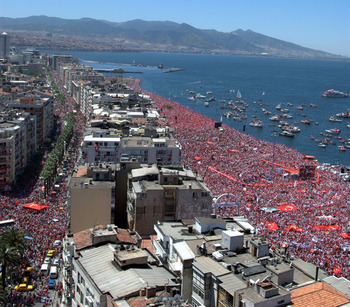
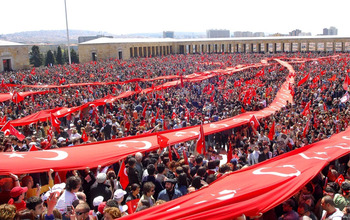
Ulusalcılık served as a national narrative that was equally embraced by the active and retired higher echelons of the civil-military bureaucracy and the secular urban middle classes. Its popularity peaked with the Republic Rallies (Cumhuriyet Mitingleri), a series of peaceful, yet strident and massively attended demonstrations in 2007 to protest the AKP government (Image 2). Under the slogan “Lay claim to your republic” (“Cumhuriyetine sahip çık”), the rallies were an expression of public alarm at the AKP's attempt to replace the presidency, which Ulusalcı nationalists saw as the last bastion of the secularist establishment, with one of the founding leaders of the Party, Abdullah Gül. These rallies, initiated by the ADD and later attended by nearly six hundred NGOs, began in Ankara on 14 April 2007, when over three hundred thousand people marched to Anıtkabir, the Mauseloum of Atatürk. Throughout April and May of 2007, Turkey witnessed similar massive demonstrations, all convened as “Republic Rallies,” with over 1.5 million participants in all (Image 3).Footnote 14 These were among the largest organized public gatherings ever convened in Turkey, and were widely perceived as constituting an unprecedented event.
Izmir Republic Meeting, 14 May 2007, one of the most populated protest meetings in Turkish history; http://fotogaleri.hurriyet.com.tr/galeridetay/23939/2/21/izmir-ikinci-cumhuriyet-mitingi (used courtesy of DHA News Agency).

Protect Your Republic protest at Anıtkabir, 14 April 2007. Photo by Selahattin Sonmez; https://commons.wikimedia.org/wiki/File:Protect_Your_Republic_Protest_-_6_(2007-04-14).jpg.

This massive mobilization did not fully translate into votes in the 2007 general elections, but the Republic Rallies demonstrated that the secular, anti-Western nationalism of the Ulusalcı had gained widespread appeal. Jenny White writes that this “Kemalist nationalist backlash … has been given oxygen and credibility by an impressive array of actual and perceived threats and insults to the nation” (Reference White2013: 51). These include the widespread Eurosceptic conviction that the accession process was going nowhere due to a European reluctance, if not hypocrisy.Footnote 15 Perceived interventions into national politics and violations of Turkish sovereignty included international pressures to settle the Armenian and Cyprus disputes, numerous proceedings in the European Court of Human Rights against Turkey, and increasing pressures on Turkey to adopt European political standards and norms. To bolster their arguments, Ulusalcı writers pointed to the escalating terror of Kurdish irredentism since 2004, the U.S. invasion of Iraq and its tolerance of the Kurdish administration in northern Iraq, and what has been referred to as the “sack incident,” when U.S. troops deported Turkish soldiers from Sulaymaniyah, in northern Iraq, with sacks over their heads (Yılmaz Reference Yılmaz2011: 186). Amidst this political turmoil, nationalism continued to resonate and conspiracy theories concerning the West and particularly the United States found fertile ground. The Ulusalcı proposition that Turks were heroic defenders of their country against the Western imperialists and their proxies (Islamists, Kurds, non-Muslim minorities) became a conspiratorial master narrative, which had two effects: First, this narrative proved an effective political toolkit with which to simplify and give meaning to the complicated landscape of national and international politics (Gürpınar Reference Gürpınar2013b: 412). Second, because many felt insecure and humiliated by the concessions Turkey had given for its accession to the EU, there was a healing effect in the recurrent emphasis on the Turkish victory in the War of Independence against European powers. The rebranding of the glorious past helped to restore national pride, as was demonstrated by the tremendous success of Turgut Özakman's bestseller, Those Crazy Turks.
DISPLACING THE FOUNDING MOMENT: THOSE CRAZY TURKS
While Atilla İlhan appears as the intellectual pioneer of Ulusalcı nationalism, the lion's share of its popularization must be credited to Turgut Özakman and the publication of his non-fiction novel Those Crazy Turks, in 2005. This novel's immense popularity marked the transformation of Ulusalcı nationalism from an idea into an outright political front that proposed a distinct nationalist project and national identity for Turkey (Özdalga Reference Özdalga2009; Yanık Reference Yanık2008). Those Crazy Turks in its 748 pages narrates the last years of the Turkish War of Independence, between 1921 and 1922, and it soon broke sales records in Turkish publication history. In just two years it reached one million in sales, with another million in estimated pirate copies. By January 2017, it had appeared in 425 editions.
The popularity of Those Crazy Turks was exceptional. Several civil society associations, universities, and the army purchased the book in bulk and handed it out for free (Aşık Reference Aşık2005). Charity organizations and private donors launched campaigns to have the book donated in the thousands to various schools and libraries around the country. The opposition party (CHP) suggested the book be included as the official history textbook in the curricula of primary and secondary schools, and some schools on their own initiative added it as a supplement to their main textbook.Footnote 16
Those Crazy Turks is a didactic novel, with forty-five pages of endnotes that provide references to original documents. It presents a loosely fictionalized compilation of historical anecdotes in chronological order. A few fictitious characters, like Nesrin the nurse and Captain Faruk, were added for dramatic effect and to smooth out the flow of events. Apart from the love affair between those two characters, the main sentiment found throughout the novel is the self-sacrifice and national devotion that made possible the “Turkish miracle”—the defeat of the Allied powers against incredible odds. In the book's opening scene, the Ottoman Sultan gives an honorary dinner for the British Navy Admiral Poe in 1914 on the eve of World War I, and a few months later the British War Minister Lord Kitchener announces that the British “will fight until Turkey is destroyed” (Özakman Reference Özakman2005: 14). This gives away the novel's main focus: the assault by the Western imperialists and their treacherous local collaborators that resulted in the humiliating Ottoman defeat in World War I. A running theme throughout is the slavish cooperation of the Ottoman government residing in Istanbul with the leaders of the Allied forces at the same time as the Turkish nation was making a heroic defense against them in Anatolia. The contrast between the treachery of the Ottoman rulers and the selfless patriotism of the unnamed national heroes is summarized as follows: “Destitute Anatolia was continuously pumping blood and lives to five different fronts. So much so that toward the end of the four-year war, every young person who weighed more than 45 kilos was sent to the front. […] Finally, the government had to admit defeat and called for a truce. After a rapid decline, starting in the seventeenth century, the Ottoman Empire had finally become a trivial colony and transformed into a garish masquerade empire (ibid.: 15).”
In his narration of events Özakman occasionally inserts his own voice and references the present so as to remind readers that what happened in the past is now being repeated. This intervention reaches its peak in the final pages, where he directly warns Turkish youth against present-day Islamists who are spreading lies about the War of Independence and Atatürk: “Dear Young Ones! The War of Independence is one of the most legitimate, most moral, most just, and most sacred wars in the world. Be proud of your ancestors who brought imperialism and its pawns to heel, and who succeeded in establishing a brand new, modern state out of wreckage. Do not let the honor of your martyred and veteran ancestors be tainted by a bunch of liars” (ibid.: 688).
In many ways, the Ulusalcı version of Kemalism expressed in the book closely resembles the official version that has been established as the founding ideology of the Turkish state. Common themes include: the emphasis on the bravery and honor of the Turkish nation before and during the War of Independence; the veneration of Mustafa Kemal as the wise and courageous leader of the war; the heroic selflessness of ordinary Turks; the devotion to independence at all costs; the devout adherence to territorial and national unity; and the projection of religion as a source of backwardness. In fact, the book emphasizes the need to reinstate Kemalism and its history, which is claimed to be under siege from the historical revisionism of both liberals and Islamists against the Kemalist order (see Gürpınar Reference Gürpınar2013b: 418).
In his attempt to conserve the Kemalist episteme, Özakman acknowledges the clash between the two competing narratives of nationhood when he says, “Today Turkish youths believe in two histories that are different from one another. One of these is the real history that makes us all proud, which this novel takes as a basis and is based on sound, authentic documents…. The other is the fake history that is full of lies, which was made up by those who have been trying to bring the Republic down” (Reference Özakman2005: 687). This passage is a perfect example of a politics of nationhood that acknowledges competing stories that promote their own versions of national history, but claims that the only true, authentic story of Turkish nationhood is that told by the book. Özakman blames the Islamists for propagating a fake history; they have been, and still are, trying to bring down the Turkish Republic, just like their Ottoman predecessors tried to put down the national struggle for independence.
In its claim to demonstrate “true Kemalism,” the historical narrative presented in Those Crazy Turks does depart from the official version in a slight but significant way. What the book presents as a factual rewriting of Turkish national history is in fact a reframing of Kemalism as an anti-imperialist ideology that strives for independence. It relocates the founding moment in the War of Independence, and particularly in its victorious conclusion in 1922, as the moment when the people of Turkey became a sovereign nation. As a nonfiction novel, the book delves into every detail surrounding the war, including the movement of the troops, correspondence and meetings among the leaders of the Allied powers, maps and plans of the Greek and the Turkish armies, and many other details of day-to-day developments. It concludes with the resignation of Prime Minister Lloyd George from his office, which is presented as the ultimate moment of the defeat of the imperialist powers and the victory of the Turkish nation. After a 680-page narration of the war, culminating in victory in 1922, the official founding moment—the formation of the Republic in 1923—is mentioned only in a single line in the one-page conclusion (ibid.: 681).
Another attempt to authenticate the claim that Those Crazy Turks presents the one and only true story of Kemalism is Özakman's account of his own experience with the War of Independence, which apparently became his main inspiration for writing the book. In the Preface, he recounts a 1948 tour he took with a group of friends, a ten-day trip on foot from Polatlı, Ankara to Dumlupınar, the same route the Turkish army took on its way to its 30 August victory. Özakman's group arrived on the site of that victory on 29 August, slept on the ground that night akin to the soldiers who did the same twenty-six years before, and welcomed the tens of thousands who arrived there from surrounding towns and villages to commemorate the triumph (ibid.: 7). Özakman's recounting of this experience not only invites the reader to become part of the patriotic spirit of the war, but also serves to authenticate his authority to write and speak on behalf of the nation's unnamed heroes as if he had participated in the war himself.
The book culminates in the 30 August victory, narrated as the climax of not only the war but the whole history of the Turkish nation, as if the nation's current existence would not have been possible without it. To further authenticate this date as the ultimate founding moment, Özakman quotes the writer and close acquaintance of Mustafa Kemal, Falih Rıfkı Atay, who grants the event an almost sacred, existential role: “If we have established an independent state and become free citizens, if we are walking straight as honorable people, if we were able to rescue our home country from the clutches of the West and our mentality from the clutches of the East, if we are looking at these seas [that surround us] as ours, if we are feeling the warmth of a mother's embrace in this land, and maybe even if we are breathing, we owe all of this, everything, to the 30 August victory” (in ibid.: 645).
Because founding moments are maintained not only with historical narratives, but also with commemorative practices, it is important to note that the book's rise to popularity was accompanied by a tremendous rise in the number of the events, and their participants, commemorating important moments of the War of Independence, such as 19 May, when Atatürk landed in Samsun to initiate the war, 30 August celebrated as the Victory Day, and similar dates. In 2005, the March of Victory (Zafer Yürüyüşü) was invented as a new tradition that annually replicates the Turkish soldiers' march from Şuhut to Kocatepe, Afyonkarahisar on the night of 25 August 1922, and thereby commemorates the beginning of the war's final battle (“The Great Offensive”).Footnote 17 Likewise, the battlefronts, ordinary stretches of land until 2005, were turned into participatory museums that serve as sites of national pilgrimage where participants are initiated into citizenship by sharing in the war experience.Footnote 18
The narrative displacement of the founding moment from 1923 to the 1919–1922 period serves multiple functions toward establishing the Ulusalcı as a distinct nationalist movement, and constructing a new Turkish national subject as anti-Western and primordially secular. First, it allows Turkish national history to be recast in terms of its military power fueled by patriotism and anti-imperialist nationalism, rather than the civilian reforms toward modernization and Westernization stressed by the official conception of national history. Second, it creates a sense of national unity by designating the European imperialist powers as the common enemy and main threat to the nation. Third, it serves to defame Islam and Ottomanism by framing the Ottoman state and the Islamic Ulama, which collaborated with those European powers during the war, as traitors who threaten the nation's wellbeing. Fourth, it depicts the present-day Islamists and the AKP government as the direct continuation of the Ottoman state and an equally treacherous power that the Turkish nation must protect itself from at all cost. And finally, it presents secularism as the primordial characteristic of the Turkish nation, and its most crucial weapon for protecting itself against the destructive advances of Islamism and Ottomanism.
Having authenticated himself as a legitimate spokesperson of the Turkish nation, Özakman says, “This is our essential struggle. We are not only battling imperialism, we are also battling the traitor Istanbul government and its extensions” (ibid.: 213). In the book, Western powers are consistently referred to as “imperialists” and the Ottoman government in Istanbul is portrayed as a devious traitor that did everything in its power to collaborate with the enemy and undermine the independence movement. The consequent framing of the war as against the European imperialists and their Islamist collaborators gives way to a conspiratorial interpretation of politics and a permanent sense of insecurity, which is utilized to create a need for national unity against a common enemy that continues to threaten the nation's wellbeing and sovereignty. The effects of the restructuring of national history around a new founding moment can be summed up under the two constitutive pillars of Ulusalcı nationalism: anti-Westernism and primordial secularism. In the Ulusalcı imagination, the War of Independence, fought against the European imperialists on the outside and their Islamist collaborators on the inside, is still being waged today by the Ulusalcı to defend the nation against the imperialist EU internationally and the AKP regime domestically.
THE EUROPEAN “WHITE CANNIBALS”: SECULARIST ANTI-IMPERIALISM AND ANTI-WESTERNISM
A crucial aspect of the relocation of the founding moment is that it presents the war, rather than the formation of the Republic, as the key moment of Turkish national history, and the fight against European powers as the worthiest cause around which the Turkish nation unified. For the Ulusalcı, Turks can preserve their sovereignty and independence only if they unite against Western powers, vilified by Those Crazy Turks as the worst common enemy, which will ruthlessly exploit every opportunity to bring Turkey down.
Özakman in both his book and interviews uses the words “West” and “imperialists/imperialism” interchangeably. While he invites the reader to respect the science and arts of the West, he warns against their “selfish, dark, and imperialist side,” which he attempts to capture in the phrase “the white cannibals” (ibid.: 127). According to him, even if the West appears to have become more amiable since World War II, this is an appearance only and, in truth, “they are the same as they were one thousand years, five hundred years ago. We should never forget how selfish politicians and diplomats that represent the West are” (quoted in Konuralp Reference Konuralp2005). He warns his readers that “these people are civilized toward themselves but barbaric toward others” (Özakman Reference Özakman2005: 127).
After the publication of the book several other public figures emerged with similar claims, asserting that Kemalism is essentially Ulusalcı and anti-imperialist, and that the Kemalist motto “Full Independence!” really means that Turkey should close all doors to the EU and the United States internationally, and suppress political Islam and Kurdish nationalism domestically. These views were widely repeated on banners flown and slogans chanted during the Republic Rallies in 2007. Some prominent Ulusalcı figures—like Tuncer Kılıç, the longest serving Turkish general in NATO representing the Turkish military, and the former secretary general of the National Security Council—have rejected existing alliances with the EU and the United States and proposed that Turkey leave NATO and initiate what has been called the “Eurasia” project, to seek new regional alliances with the Russian Federation and Iran (Oğuzlu Reference Oğuzlu2010–2011: 670).
The isolationist stance toward the EU and the United States the Ulusalcı movement has adopted in international politics is accompanied by an exclusionary nationalism in domestic politics. This finds expression in a reluctance to acknowledge or even an outright rejection of the Kurdish issue, let alone recognizing the rights of Kurds as an ethnic minority. This position, which brings the Ulusalcı ideologically closer to the ethnic nationalism of the right-wing nationalist MHP, is articulated in Those Crazy Turks as an unquestioned assertion that the national community in Turkey consists only of Turks. The book mentions the Kurds only a few times, and always as an external force that either fought against Turkish forces (2005: 82) or were targeted by the enemy to mobilize against the Turks (ibid.: 143, 693). The war is depicted as a black-and-white struggle of good against evil, in which Turks always appear as courageous, innocent, and honorable heroes, Europeans as cruel imperialists, and the Kurds and Arabs as sinister traitors.
The shifting of the founding moment from 1923 to 1922 was accompanied in the Ulusalcı imagination by the replacement of the 1923 Lausanne Treaty—the founding treaty of the new Turkish Republic—with the Treaty of Sèvres, signed on 10 August 1920. Sèvres, signed by the Allied powers and the Ottoman Empire after the First World War, envisaged the empire being divided up among the European powers and the formation of an independent Armenian state and an autonomous Kurdistan. After the victory in the war, the Lausanne Treaty replaced Sèvres, and it has been celebrated ever since as the crucial international agreement that established Turkey as a sovereign new state in the international community. Although the Treaty of Sèvres was never enacted, both official sources and the media have portrayed it as the supreme insult to the sovereignty of the Turkish nation and proof of the devious imperialist schemes of European colonial powers. It has haunted Turkey as a persistent, paranoid memory, sometimes labeled the “Sèvres Syndrome,” grounded in the fear that Western powers have never given up their imperialistic aims regarding Turkey and still intend to divide and control the country (Şener Reference Şener2014).
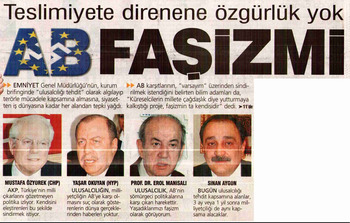
Unsurprisingly, the Ulusalcı revived the Sèvres Syndrome in their attempts to frame the EU as a mere continuation of the same imperialism that attempted to colonize Turkey after World War I. Ulusalcı nationalists began pointing fingers at the EU, saying that Turkey now faces the same threat that it did just before the War of Independence and that its sovereignty and wellbeing are at stake. This claim was strengthened when the EU challenged what was perceived to be Turkey's national interests by aligning with parties and countries engaged in international disputes against Turkey, for example in debates over the Cyprus and Armenian issues,Footnote 19 and by supporting political empowerment of Kurdish minority groups. The EU accession reform package was perceived as displaying the AKP government's servitude to EU's demands and labeled an extension of “EU fascism” (Bozkurt Reference Bozkurt2008). Erol Manisalı, head of the Europe and Middle East Studies Research Center of Istanbul University and a leading Ulusalcı spokesperson, wrote, “Ulusalcı nationalism is a movement that resists the EU's colonizing policies. What we are experiencing now [under the AKP government] is fascism” (Reference Manisalı2008) (Image 4). This same rationale perceives the Kurds as American proxies and the Kurdish irredentist movement as a foreign-supported plot to weaken and divide Turkey (Uslu Reference Uslu2008: 86).
“AB FAŞİZMİ” [EU Fascism], Yeniçağ, 31 Mar. 2008; http://www.mustafaozyurek.com/wp/_docs/0101-2733.jpg (This website is no longer active. The corresponding report can be found at: http://www.yenicaggazetesi.com.tr/ab-fasizmi-6117h.htm.) (used courtesy of Yeniçağ).

PRIMORDIAL SECULARISM OF THE “CRAZY TURK”
In Those Crazy Turks Özakman provides an insistently secular narrative of the Turkish War of Independence, where Islamic sentiments are invisible when not associated with reactionaries or treason. In the hands of Ulusalcı nationalists, secularism takes on a decidedly different meaning than in mainstream Kemalism, which upholds secularism as a necessary part of modernization that requires Turkey to detach itself from Islam and align with Europe. In contrast, the Ulusalcı claim that Turks were secular from the start, and that it was Islam that was imposed on them by outside forces, namely Arabs. It thereby ascribes to secularism a primordial role as the true core characteristic of Turkishness.
In this re-composition of Kemalism, which Toni Alaranta formulates as a shift from “universal secular-humanism to extreme nationalism,” secularism is more than a pillar of Turkish Enlightenment or an emancipation project (Reference Alaranta2014). In Ulusalcı rhetoric, secularism is a primordial quality that restores the Turkish nation to its original essence. According to the Ulusalcı writer İklil Kurban, “the Turkish nation was in fact secular” prior to the massive conversion to Islam around the eighth century, and to this secularism they owed their political and scientific successes in that period (Reference Kurban2009). From the Ulusalcı perspective, secularization reforms during the early Republican period (1923–1938) were not part of Westernization, but instead returned the nation to its Turkish roots by reinstating a national identity corroded by the influence of Islam. Moreover, Turks are claimed to be so naturally and primordially secular that they secularized Islam itself. Referring to Alevism that developed in Anatolia over the centuries, as opposed to the orthodox Islam of the Ottoman state,Footnote 20 Ulusalcı writers claim that Turks have “domesticated/tamed the Shariah of the [Arab] desert” (Saltık Reference Saltık2004; Erdemir Reference Erdemir2005: 938–39).
The employment of a political principle such as secularism as the primordial essence of a national identity is quite unusual because, by definition, the notion of a political principle involves intellectual debate and theorizing, and therefore is contingent upon historical, political, and cultural context. This is in direct contradiction with the notion of “primordialism” that asserts a natural, fixed, ahistorical, ethnic, and an almost sacred attribute that is rooted in biological or territorial factors. While secular modernity is supposed to appeal to reason and the “disenchantment of the world” in the Weberian sense, in Ulusalcı nationalism secularism mutates into a primordial element of nationhood and leads to the re-enchantment of the world.
The primordialist secularism of the Ulusalcı movement also allows the conflict with Islamism to be framed as a national struggle. Once secularism is established as a primordial quality of the Turkish nation, then Islamists can be condemned not only for being anti-modern, but more importantly for going against the very essence of the nation—for being outsiders and foreigners. This allows the Ulusalcı nationalists to open a new front in their war against Islamism, where Islamists are blamed not only for collaborating with the enemy (the EU), and thereby acting against Turkish sovereignty just as their Ottoman predecessors did, but also for being non- or even anti-Turkish. Özakman's book often associates Islam with Arabs and talks about Islamic garb and appearance as “Arab-like,” thereby framing Islam as an alien attribute that is an essential feature of another ethnic community and unbecoming of the Turk (Reference Özakman2005: 544). Another highly popular and adamantly Ulusalcı writer, Ergün Poyraz, attacked the AKP for pursuing policies that a genuinely Turkish party would never consider, because, he asserted, the AKP is an essentially “Arab Kurdish party that is a descendant of the army of the Caliphate” (Reference Poyraz2007: 5). The attempt to defame the AKP as an “Arab-Kurdish” party is a rhetorical tactic that taps into nationalist sentiments so as to depict Islamists as an ethnically foreign group with no patriotic concern for Turkey's national interests. This again establishes Turkishness as an essentially secular identity.
In this context, secularism is evoked as a valuable nationalist principle set against political Islam in general, and against the AKP government in particular, which is, like the Ottoman Dynasty during the War of Independence, seen to be “selling out” the Turkish nation to the Western powers in their efforts to make Turkey a member of the EU. In Those Crazy Turks we find stories and anecdotes of people carrying out gruesome atrocities in the name of Islam against the soldiers of the national struggle. Özakman refers to those who “attempt to use religion for their own personal benefits” as “ignorant, treacherous bigots” (Reference Özakman2005: 694). He draws parallels between the betrayal of the nation by fanatical Islamists and the current AKP government when he writes, “Conservative, reactionary, anti-revolutionary ideas and parties that emerged later” are a continuation of the group of “small-minded intellectuals, collaborators, traitors, fanatics, and bigots who had no conception of independence and lacked any sense of patriotism” and who collaborated with the enemy during the war (ibid.: 692).
CONCLUSION
As we have argued, the politics of nationhood involves the generation, institutionalization, and contestation of founding moments by contending political movements that produce, spread, and promote their versions of the national story, and strive to gain power to institutionalize their own version of the national subject and national history as a hegemonic national project.
We have examined the emergence of the Ulusalcı movement at the same time that the ruling AKP came to power in 2002 to scrutinize the Ulusalcı narration of the Turkish nation through an analysis of the record-breaking bestseller documentary novel Those Crazy Turks. The book narrates Turkish nationhood as primordially secular, defined against the Ottomanist and Islamist ideology of the ruling AKP, and as adamantly anti-Western. It contrasts this to mainstream Kemalism, which idealizes the national subject as modern, Westernized, and culturally secular. We have argued that this reframing of Kemalism and the creation of a new national subject is achieved by displacing the founding moment from the officially recognized date marking the declaration of the republic in 1923 to the War of Independence period of 1919–1922. Ulusalcı nationalists claim that the Turkish nation was secular from the beginning, long before Islam emerged. They ascribe a sacred status to secularism itself and treat it as the primordial bond that binds together the Turkish nation. They see Islamists as an alien power that is conspiring with the West, including the United States and the EU, against Turkey's sovereignty and wellbeing.
In an unexpected turn of events, in 2008 the AKP government initiated a series of investigations, lawsuits, and arrests against various Ulusalcı organizations and prominent figures, as well as retired and active-duty officers of the army. They began to be questioned and tried for alleged criminal activities, including plots to stage a military coup around a clandestine network named Ergenekon. The AKP no doubt benefited, in that the Ergenekon trials diminished the Ulusalcı opposition's organizational capacity and seriously limited the tutelary role of the military in Turkish politics. However, after the Gezi Park protests in 2013 both the AKP and the status of the Ulusalcı movement changed, along with much else in Turkey. A rift appeared between Turkey's two main Islamic camps—the AKP and the Gülen movement—which culminated in a failed coup attempt on 15 July 2016. During this period, the AKP declared the Gülen movement to be its main adversary, labeled it a terrorist organization, and began building unexpected alliances with Ulusalcı circles in its fight against it.
In 2014, the Ergenekon affair came largely undone after the Constitutional Court overruled the verdicts on the grounds that the trials had been unfair. Many Ulusalcı figures, including several military officers, police commissioners, judges, and prosecutors who had been imprisoned were not only released but placed back in key positions in the military, the legal system, and the bureaucracy to help the AKP fight the Gülen organization (Gürcan Reference Gürcan2016). During this time, the CHP started to negotiate its alignment with the Ulusalcı, and most of the leaders of the Ulusalcı clique within the CHP resigned.Footnote 21
In the midst of these shifting alignments, not only did the Ulusalcı perspective remain a powerful influence on various secularist groups, but its anti-Western nationalism gained popularity beyond secularist circles and was endorsed by others, including some AKP supporters and eventually the government itself. Erdoğan gradually drifted away from his pro-EU stance after he subdued the military and judiciary and further consolidated his political power around an increasingly anti-Western, nationalist agenda (Taş Reference Taş2015: 781). Accompanying this shift in the AKP's ideological composition, Erdoğan employed the Ulusalcı conspiracy-driven rhetoric that portrayed Turkey as being in a liberation war against the imperialist West and its internal collaborators. Today, although the organizational and mobilizational influence of Ulusalcı nationalism is less powerful that it was a decade ago, its discursive premises continue to shape political debates and inform political alignments in Turkey.