I. INTRODUCTION
Encapsulation of drugs is a fast expanding field in the pharmaceutical industry today,Reference Kinam1 which allows a controlled drug release to obtain an effective and efficient administration of drugs. The supports used for this process can be polymers, hydrogels, liposomes, or inorganic materials. After the pioneering work of Vallet-Regi et al.,Reference Vallet-Regi, Ramila del Real and Perez-Pariente2 the most popular supports among inorganic materials are mesoporous silica such as MCM-41 and SBA-15Reference Vinu, Dhanshri Sawant, Ariga, Hossain, Halligudi, Hartmann and Nomura3; however, titanium oxide can also be used, and its biocompatibility has been proved.Reference López, Ortiz-Islas, Manjarrez, Reynoso, Sepulveda and González4 On MCM-41, Vallet-Regi et al. reported that the most important factor controlling the release of ibuprofen was the method used to load the drug into the solid and later pointed out the importance of the pore size of the carrier as well as the drug-surface interaction.Reference Horcajada, Ramila, Ferey and Vallet-Regi5, Reference Cabañas, Peña, Román and Vallet-Regí6
In general, different microencapsulation methods have been reported, those that can be grouped in the following categories: chemical-physical, physical-mechanical, and chemical methods.Reference Benitas7 A conventional chemical method of synthesis of titanium oxide is by sol-gel processing, which produces a hydrophilic surface to modify the interactions with the drug and also to improve its biocompatibility. Moreover, sol-gel methods enable to control particle size and pore-size distribution, which are expected to be important in the case of diffusional limitations on drug release. From a technical perspective, controlled drug delivery implies the ability to control the distribution of therapeutic agent both in space and time. In other words, controlled drug delivery includes both control of drug rate release and the delivery of the drug to a specific organ or location in the body.Reference Patravale, Date and Kulkarni8
The encapsulation of fluoxetine commercially known as Prozac, is a 3-phenoxy-3-phenylpropylamine hydrochloride, was carried out by the sol-gel method using as a precursor titanium tetrabutoxide. This drug has been widely prescribed and used all over the world in patients with obsessive–compulsive behavior, depression, mood, and anxiety disorders. This material was tested as reservoirs for controlled fluoxetine drug release.Reference González9
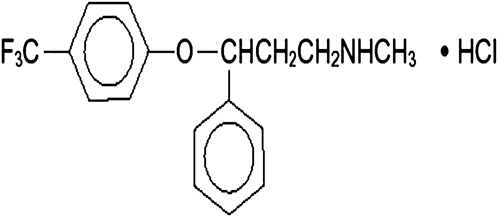
The aim of this work is to analyze the interactions between fluoxetine (Fx) (Fig. 1) and the matrix of a hydroxylated titanium oxide (xerogel). For this purpose, Fourier transform infrared (FTIR) spectroscopy, N2 adsorption, x-ray diffraction, and theoretical calculations were developed of synthesized nanostructured Fx/TiO2 system.
Chemical formula of fluoxetine.

II. EXPERIMENTAL METHODS
A. Synthesis
Encapsulation was made in a single-step sol-gel procedure. The synthesis of TiO2 with the drug was carried out adding 108 mL of water, 20 mL ethanol, and 60 mg of fluoxetine to a three-necked flask under constant stirring at room temperature. Then, 87 mL of titanium tetrabutoxide was added drop by drop during a 4-h period, the solution was refluxed and rotoevaporated at 30 °C during 24 h. Finally, the samples were dried at 30 °C during 1 week under vacuum. Also, for comparison the synthesis of pure TiO2 was carried out with the same experimental conditions.
B. FTIR spectroscopy
Infrared spectra were collected with a FTIR-BRUKER Vector 33 (Bruker Biospin Corporation, Billerica, MA). The sample (5 mg) and KBr (195 mg) were ground together in an agate mortar until a well-dispersed mixture was obtained; FTIR spectra were register in the wave number region between 500 and 4000 cm−1.
C. Morphology
Morphology of the nanostructured materials was analyzed by scanning electron microscopy (SEM JEOL-5600 LV, JEOL Ltd., Tokyo, Japan). Samples were coated by sputtering with a layer of gold of approximately 20 nm using an EMS 550 sputter coater (Electron Microscopy Sciences, Hatfield, PA).
D. N2 adsorption
Specific surface areas and pore size were obtained using a Micromeritics ASAP-2010 instrument (Micromeritics, Norcross, GA) at 77K. Samples previously dried during 3 h at 383 K and further evacuated at 473 K. Areas were calculated using the BET (Brunauer-Emmett-Teller) method, and the diameter pore average was determined using the Barrett, Joyner, and Halenda (BJH) method.Reference Barret, Joyner and Halenda10
E. X-ray diffraction
Diffractograms were recorded in a x-ray diffractomer (Siemens D5000), with a Bragg–Brentano geometry with a Cu Kα monochromator (λ = 1.5416 Å). The samples were ground and analyzed at 25 mA and 35 kV with a step size of 2° and a step time of 1 min within the range of 10° < 2θ < 60°.
F. Computational details
The theoretical calculations have been carried out with Gaussian 03 package programs within the density functional theory formalism.11 Geometry optimizations have been performed, without any symmetry constraint, using the Becke’s three-parameter hybrid functionalReference Becke12 with the LYP correlation functional, which includes both local and nonlocal terms (B3LYP) and LanL2DZ basis set. When using LanL2DZ, the Dunning/Huzinaga valence double-zeta D95V basis set is used for elements in the first row of the periodic table, and Los Alamos effective core potentialReference Dunning, Hay and Schaefer13 (ECP) for Na–Bi. Frequency calculations were carried out for all the studied systems at the same level of theory, and the minima character of the modeled structure was identified by the number of imaginary frequencies (NIMAG = 0). Thermodynamic corrections at 298.15 K were included for the calculation of the relative energies.
The condensed Fukui functionsReference Fukui14 have been obtained at the optimized geometry of fluoxetine using PW91 and double numerical plus d-functions (DND) basis set with DMOL3 codeReference Delley15, Reference Delley16 through the Material Studio user interface. Since we are interested in the interaction of fluoxetine with terminal H atoms in hydroxylated titanium, we have focused our attention on the electrophilic Fukui function, fk −, which measures the changes in the electron density when the molecule donates electrons. These functions are computed using the finite difference approximationReference Yang and Mortier17 as

where qk represent the atomic-centered charges, obtained from Hirshfeld partitioning scheme,Reference Hirshfeld18 and N is the number of electrons.
III. RESULTS AND DISCUSSION
A. Synthesis of fluoxetine–TiO2 nanostructured system
The encapsulation efficiency of fluoxetine in TiO2 was around 95% and 56%, respectively, since it depends on the molar ratios of tetrabutoxide/water,Reference Gonzalez and Rieumont19 1/24, and tetrabutoxide/alcohol, 1/8.
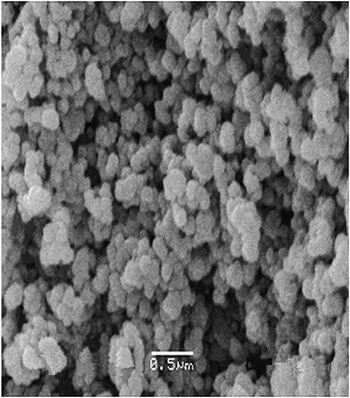
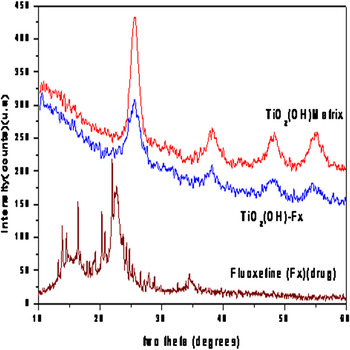
SEM micrograph of the nanostructured (TiO2(OH)/Fx) system is shown in Fig. 2. Spheroidal particles are below 500 nm with different sizes, also the formation of agglomerates between particles can be observed. It is known that TiO2 can present three crystalline phases: anatase, rutile, and brookite; however, the x-ray diffractogram (Fig. 3) shows only the formation of anatase (2θ, 25.2°) indicating that the encapsulation of fluoxetine does not modify the hydroxylated titanium oxide lattice. Therefore, the drug does not disturb the nucleation process and remains mainly at the surface.
Scanning electron micrographs of the nanostructured materials containing fluoxetine and hydroxylated titanium oxide matrix (TiO2(OH)/Fx).

X-ray diffraction pattern of TiO2(OH) matrix, fluoxetine (Fx) drug, and the nanostructured materials (TiO2(OH)/Fx).

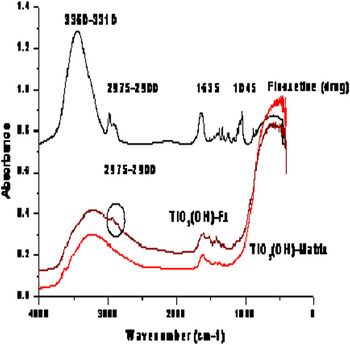
FTIR spectra of pure hydroxylated titanium matrix, the drug, and the nanostructured (TiO2(OH)/Fx) system are shown in Fig. 4. Fluoxetine spectrum presents a broad band corresponding to the secondary amine groups at 3310–3360 cm−1 and to chains and rings C–H vibrations together with vibrational modes detected at 2900–2975 cm−1of CH2, CH groups. In the same way, the band at 1635 cm−1 can be attributed to the bending N–H and stretching C–F modes at 1045 cm−1.
FTIR spectrum of the nanostructured materials TiO2(OH)/Fx, fluoxetine (Fx) drug, and the TiO2(OH) matrix.

The hydroxylated titanium oxide matrix presented a broad band at high wave number, 2906–3617 cm−1, assigned to the presence of OH from the water adsorbed on the particles surface and to the structural OH.Reference Bezrodna and Puchkovska20, Reference Tchoul, Fillery, Koerner, Drummy, Oyerokun, Mirau, Durstock and Vaia21
The FTIR spectrum of (TiO2(OH)/Fx) system presented a broad band at 3000–3635 cm−1 assigned to OH from the water adsorbed to the xerogel surface, besides OH and structural NH that are not isolated but associated to each other. Also, smaller intensity bands associated to CH2, CH groups around 2900–2975 cm−Reference Kinam1 that belongs to fluoxetine. The appearance of the bands around 1000–400 cm−1 is characteristic of the formation of Ti–O–Ti network.Reference Poulios, Micropoulou, Panou and Kostopoulou22, Reference Balasubramanian, Kraemer, Reding, Skomski, Ducharme and Sellmyer23 This FTIR spectrum keeps some features of its components; however, it was difficult to detect any signal suggesting any drug–matrix interaction. This result could be related to the fact that this system is a multicomponent material.
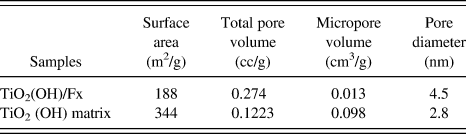
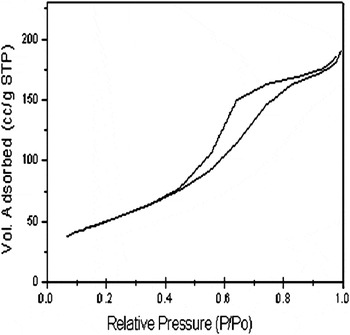
N2 isotherm for the titanium matrix containing the drug (Fig. 5) is of type IVReference Gomes, Fernanda and Gomes24 with a hysteresis loop of type H3Reference Brunnauer, Emmet and Teller25 is related to pores with different entrance sizes (Table I). Estimated microporosity is practically negligible and suggests an average size in the range of mesoporosity. The presence of the drug (Table I) seems to decrease effectively the specific surface area distributed over the matrix oxide surface. BET area values and pore diameter were calculated according to BJH methodReference Barret, Joyner and Halenda10 and confirm the mesoporosity of the obtained nanostructured materials, indicating that the pore diameter is around 4.5 nm for the (TiO2(OH)/Fx) system.
Specific surface area, pore volume, and pore diameter obtained by BET (Brunauer-Emmett-Teller) analysis.

Nitrogen isotherm of the nanostructured materials containing fluoxetine and hydroxylated titanium oxide matrix (TiO2(OH)/Fx).

B. Theoretical modeling
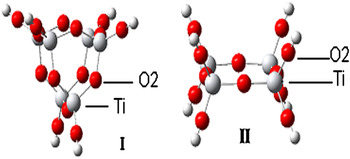
Two different clusters structures have been used to mimic the hydroxylated titanium matrix (Fig. 6). They correspond to six (I) and four (II) Ti atoms, all of them in tetrahedral configuration and connected via oxygen atoms. Model I is a Ti6O15H6 cluster constructed from truncated anatase (001) surface, while model II (Ti4O12H8) is not intended to resemble any of the titanium phases (anatase, rutile, brookite) but rather an amorphous phase. The average values for Ti–O(H) and Ti–O(Ti) bond distances were found to be 1.77 and 1.82 Å for model I and 1.78 and 1.81 Å for model II.
Optimized geometries of hydroxylated titanium models. Gray atoms: titanium; red atoms: oxygen.

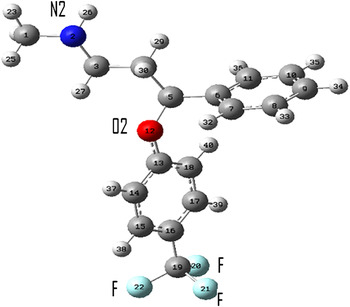
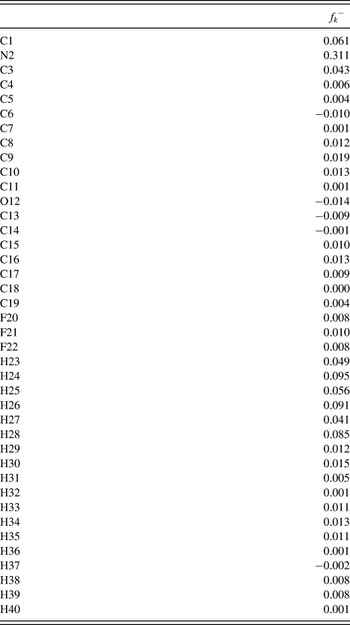
Previously to the modeling of fluoxetine–titanium interaction, it is important to determine which site is expected to have the strongest interaction on the drug. For that purpose, the electrophilic Fukui functions fk − were calculated for fluoxetine. The obtained values (Table II) show that H atoms in hydroxylated titanium are expected to interact mainly with the amino group in fluoxetine, which is the atom with the largest value of fk −. The meaning of the atom numbers in Table II has been explicitly shown in Fig. 7.
Atoms numbering for fluoxetine. Red atoms: oxygen; blue atoms: nitrogen; clear blue atoms: fluoxetine; gray atoms: carbon; clear gray atoms: hydrogen.

Electrophilic Fukui functions for fluoxetine.

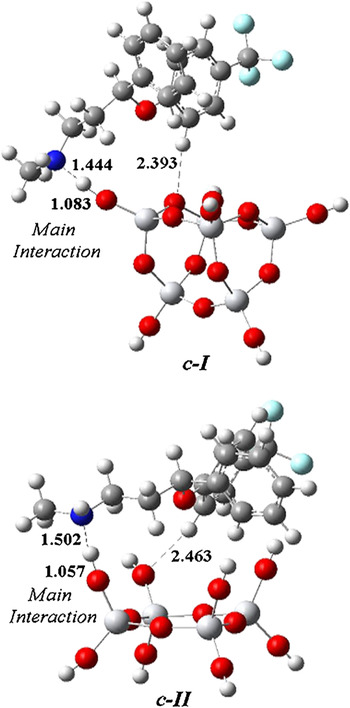
Based on the values of the electrophilic Fukui functions, two complex fluoxetine–titanium have been computed, involving titanium clusters I (c-I) and II (c-II), and both of them interacting with the amino group in fluoxetine. The optimized geometries of such complexes are shown in Fig. 8. The N…H distances were found to be 1.444 and 1.502 Å for c-I and c-II, respectively. The O–H distance for the hydroxyl group involved in the complex formation were found to increase by 0.18 and 0.16 Å, compared to titanium clusters. In addition to the interaction with the amino group, a secondary and weaker interaction was also found between the H atom in the phenyl rings and one of the O atoms in the titanium clusters.
Optimized geometries of fluoxetine–titanium complexes. Red atoms: oxygen, blue atoms: nitrogen, clear blue atoms: fluoxetine.

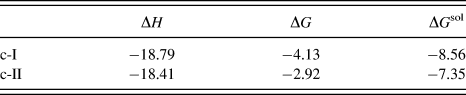
The energy associated with the formation of the fluoxetine–titanium complexes, in terms of enthalpies and Gibbs free energies, is reported in Table III. The first two columns correspond to ΔH and ΔG values in vacuum, using the standard state of 1 atm as calculated by the Gaussian program. However, since the actual process takes place in solution, the Gibbs free energies of reaction have been corrected to include the solvent cage effects. For that purpose, the reference state has been changed from 1 atm to 1 M, and the solvent cage effects have been included according to the corrections proposed by Okuno,Reference Okuno26 taking into account the free volume theory.Reference Watson, Beydoun and Amal27 These corrections are in good agreement with those independently obtainedReference Dzubiella and Hansen28 and have been successfully used by other authors.Reference Aguado, Pérez, Ugarte and Desviat29, Reference Galano30 The expression used to correct Gibbs free energy is

Enthalpies and Gibbs free energies of reaction (kcal/mol) for the complex formation.

where n represents the total of reactant moles. According to Eq. (2), the cage effect in solution causes a ΔG sol decrease value by 2.54 kcal/mol at 298 K for bimolecular reactions, with respect to ΔG gas. This lowering is expected since the cage effects of the solvent reduces the entropy loss associated with any addition reaction or transition state formation, in reactions with molecularity equal or larger than 2. Therefore, if the translational degrees of freedom in solution are treated as in the gas phase, the cost associated with their loss when two or more molecules form a complex system in solution is overestimated, and consequently these processes are kinetically overpenalized in solution leading to rate constants that are artificially underestimated.
As the values from Table III show, the formation of the complex is an exothermic and exergonic process, which justifies the anchorage of fluoxetine on the titanium surface, leading to stable adducts formation. As discussed above, the presence of a solvent increases the energy associated to the complex formation. It seems interesting to notice that the enthalpies and Gibbs free energies of reaction are of similar magnitude for the two different clusters of titanium that have been modeled. This finding suggests that the fluoxetine–titanium complex is expected to be formed, regardless of the local structure of the titanium particles. In addition, the values of ΔH and ΔG are large enough to overcome any inaccuracy inherent to the performed calculations, and accordingly it seems reasonable to claim that the hypothesis that fluoxetine can form stable adducts with hydroxylated titanium, through its amino group has been corroborated.
IV. CONCLUSIONS
The parameters of the process and synthesis used with this sol-gel method allowed us to obtain nanostructured materials containing fluoxetine. The drug does not interfere in the process of formation of the titanium oxide matrix but decreases the nitrogen adsorption of the surface of the material. The drug–matrix interaction was difficult to analyze by infrared spectroscopy; however, theoretical modeling suggests that fluoxetine can form stable adducts with hydroxylated titanium oxide matrix through its amino group forming a fluoxetine–titanium complex, regardless of the local structure of TiO2.
ACKNOWLEDGMENTS
The author thanks the Red of Macrouniversidad, Autonomous Metropolitan University (UAM), National Institute of Neurology and Neurosurgery (INNN), México and Foncicyt project No. 96095 for financial support and also to M.S. D. Aguilar for the technical support.