


This article attempts to fill a scholarly void by addressing one of the most momentous institutional changes of the Progressive Era in the United States—the decision by some state legislatures to devolve broad lawmaking powers to citizens. In 1898, South Dakota voters became the first in any American state to approve a constitutional amendment granting citizens the power of the initiative.Footnote 1 By 1918, voters in twenty states had followed suit, adopting similar direct democracy mechanisms at the polls. However, before citizens could amend their state constitutions to grant themselves a direct role in the lawmaking process, they were largely at the mercy of their state legislatures to refer a measure to the ballot giving them that opportunity.Footnote 2 The embrace of the initiative by voters at the polls, then, poses an important question to scholars of institutional development and legislative behavior: Why did some state legislatures choose to devolve institutional power by delegating to citizens the power of the initiative, while others did not? In our examination of the macrolevel conditions that precipitated one of the most momentous delegations of institutional power by state legislatures, we find that political conditions, most notably, interparty legislative competition, as well as party organizational strength and the presence of third parties, are crucial to any understanding of why some legislatures willingly acceded power to citizens.
In explaining why some American states adopted direct democracy reforms during the Progressive Era, this article has broad theoretical implications for scholarship on legislative behavior, institutional change, and the development of the American state. We begin by briefly addressing some concerns with the historiography of the Progressive Era, temporality, and case selection in regard to the question of the adoption of the initiative in the American states. We then offer a theory of interparty legislative competition to help explain why legislatures might delegate institutional power to citizens. In many respects, our analysis challenges the dominant historical narrative of why the plebiscitary process was adopted in some American states a century ago, as we argue that the initiative was not the by-product of an endogenous, uniquely western political culture or particular set socioeconomic conditions, as other scholars have suggested (Goebel Reference Goebel2002; Magleby Reference Magleby1984; Persily Reference Persily1997; Price Reference Price1975; Schmidt Reference Schmidt1989).Footnote 3 Although today the initiative is employed with great frequency in states west of the Mississippi, we argue that the mechanism of direct democracy was not the consequence of a regional brand of populism. Rather, once the dynamics of interparty legislative competition and other political considerations are accounted for, we find that lawmakers in the West were no more likely than those in other states to cede to citizens the institution of direct democracy. After detailing our empirical findings, we conclude by discussing how our macrolevel analysis of the adoption of the initiative raises some methodological questions about the conduct of historical research, as well as informs the scholarly debate over institution building during the Progressive Era in the American states.
Empirically, our findings are grounded in an original data set that we compiled from primary and secondary sources from the Populist and Progressive eras. We use an Event History Analysis (EHA) hazard model to test alternative hypotheses for why and when some state legislatures decided to refer the initiative to the ballot. In fleshing out the historical record, we examine an array of factors that may have conditioned the decision of some state legislatures to surrender their agenda-setting and policy-making authority to the citizenry. Our longitudinal, cross-state, macrolevel analysis suggests that, all else equal, political factors are the most powerful predictors for the legislative decision to devolve power. Although some of our empirical findings comport with the conventional story told by historians of why the initiative was adopted in some states, our emphasis on interparty competition in state legislatures is novel, providing new insights into why and when legislatures might be willing to divest themselves of their institutional power.
ADOPTING DIRECT DEMOCRACY: TEMPORALITY AND CASE SELECTION CONCERNS
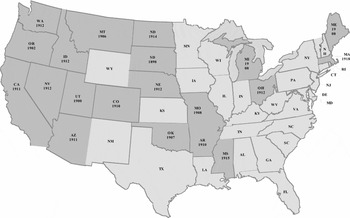
Although much of the groundwork for the building of the new American state at the national level was laid during the Progressive Era (Carpenter Reference Carpenter2001; Kolko Reference Kolko1963; Link and McCormick Reference Link and McCormick1983; McDonagh Reference McDonagh1992; Sklar Reference Sklar1998; Skocpol Reference Skocpol1992; Skowronek Reference Skowronek1982; Wiebe Reference Wiebe1967), with few exceptions (Hays Reference Hays1964; Huthmarcher Reference Huthmarcher1962), little scholarly attention has focused on the seemingly contradictory devolution of institutional power to citizens at the subnational level that resulted from the adoption of direct democracy reforms. Most notably, scholars have yet to adequately explain why nearly half the state legislatures decided to divest themselves of their monopoly control over lawmaking during this era, a development that appears to run against the expansive tide of institutionalization that centralized and consolidated governing authorities. This countercurrent has escaped the scrutiny of scholars examining the origins of the administrative state and progressive politics at the subnational level during the period (Clemens Reference Clemens1997; Mattson Reference Mattson1998; Sanders Reference Sanders1999; Thelen Reference Thelen1969), as well as scholars examining the popular adoption of direct democracy reforms during the Progressive Era (Cain and Miller Reference Cain, Miller, Sabato, Larson and Ernst2001; Ellis Reference Ellis2002; Goebel Reference Goebel2002; Milkis and Tichenor Reference Milkis and Tichenor1994; Persily Reference Persily1997; Piott Reference Piott1992, Reference Piott2003; Schmidt Reference Schmidt1989; Smith and Tolbert Reference Smith and Tolbert2004; Spoonholtz Reference Spoonholtz1973; Tolbert Reference Tolbert2003). Because the initiative spread rapidly across much of the West in the early twentieth century (Figure 1), scholars have concluded that younger states with a strong history of populism and antimonopoly sentiments, more homogenous populations (e.g., fewer blacks or foreigners), more radical (but weaker) political parties, and stronger interest groups were the most likely to adopt the initiative.
State Adoption of the Initiative, 1898–1918

Although piquing our interest in the reasons why citizens in some states adopted direct democracy, these studies have limited explanatory power for two reasons. First, the question of why some voters adopted the initiative is temporally a second-order concern. Before citizens had the opportunity to approve or reject the power of the initiative at the polls, an amendment to the state constitution first had to be placed on the statewide ballot. In most states, the decision to refer such an amendment was left in the hands of the state legislature. Thus, analyses of the popular vote to adopt the initiative (Anderson Reference Anderson2005; Bowler and Donovan Reference Bowler and Donovan2006; Bowler, Donovan, and Lawrence Reference Bowler, Donovan and Lawrence2005; Bridges and Kousser Reference Bridges and Kousser2005) elide the question of why some state legislatures initially referred a constitutional amendment to the ballot allowing citizens the right to vote to adopt the initiative. In short, why did some legislatures seemingly act against their institutional self-interest by choosing to devolve power to citizens?
Second, as rich and detailed as they may be, historical case studies (Goebel Reference Goebel2002; Piott Reference Piott2003; Schmidt Reference Schmidt1989; Spoonholtz Reference Spoonholtz1973) of states that adopted the initiative during the Progressive Era suffer from an inherent bias in case selection that limits their generalizability, as they retell the story of the diffusion of the initiative by drawing exclusively on the experiences of those states that adopted the mechanism (Geddes Reference Geddes1990). With few exceptions, scholars have not investigated why constitutional amendments allowing citizens to vote on direct democracy were kept off the ballot in more than half of the states.Footnote 4 The history of why the initiative was not adopted in Alabama, Indiana, or Vermont, to note a few, has yet to be told, and there is no compelling explanation for why a state like Missouri, for example, adopted direct democracy reforms, while neighboring Kansas (a hotbed of populist sentiment) did not. Although it is a truism that the recounting of the past reflects the views of the victor and highlights triumphal events, attempts at explaining why a reform did not spread evenly across the states would seem to invite a more detailed consideration of the null cases. Accounting for the conditions that led to a state legislature's decision not to place a referendum on the ballot seems vital if we are to explain the spread of the initiative. For us, the key to explaining the timing and spread of the initiative across the American states is to examine the socioeconomic and political conditions in all states.
THE TIMING OF THE LEGISLATIVE REFERRAL OF THE INITIATIVE TO THE BALLOT
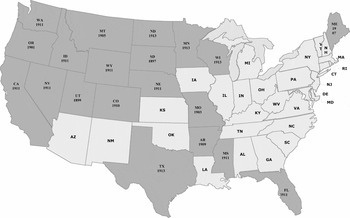
Figure 2 documents the first time a state legislature between 1897 and 1918 referred a constitutional amendment granting citizens the power of the initiative to the statewide ballot. Notably, the map highlights several states that are typically omitted from lists of direct democracy adopters. Texas, for example, is included among the 20 states, although in 1914 the statewide electorate rejected an amendment placed on the ballot by the state legislature the previous year that would have granted citizens the power of the initiative. Likewise, Minnesota is included in Figure 2. The Minnesota legislature referred a measure on the ballot in 1913, only to have it rejected at the polls the following year because the measure failed to attract a majority of all those who voted in the election, as was required by the state constitution (Schmidt Reference Schmidt1989, 18). Florida, which eventually adopted the initiative in 1968, is also included in Figure 2. In 1911, the state legislature approved by a wide margin a legislative referendum granting citizens the power of the initiative, but over the summer the governor conspired to keep the measure off the November ballot (Kerber Reference Kerber1994). Several legislatures, including those in Minnesota, Missouri, and Mississippi, referred direct democracy amendments to the ballot multiple times (Galbreath Reference Galbreath1912, 84–87; Schmidt Reference Schmidt1989, 16–17). For our purposes here, though, our inquiry is limited to the conditions that led to a state legislature's initial decision to devolve power to the citizenry.Footnote 5
Legislature's Determinative Vote to Refer Initiative to Ballot, 1897–1918

Although they are not highlighted in Figure 2, our analysis includes three states that adopted the initiative by means other than legislative referral. Citizens in Michigan (1908), Ohio (1912), and Massachusetts (1918) voted to adopt the initiative after delegates to their respective state constitutional conventions placed the reform mechanism on the statewide ballot. Although the legislatures in these states never placed a referendum on the ballot, we nevertheless include them in our study, because lawmakers could have referred a measure to the ballot prior to the action of the constitutional conventions. Our analysis excludes two states entirely—Oklahoma (1907) and Arizona (1911)—as they entered the Union with constitutions that incorporated the power of the initiative.Footnote 6 Legislative action in Oklahoma and Arizona was thus preempted by statehood; lawmakers were not afforded the opportunity to devolve power to citizens because the initiative was part of their original state constitutions. As such, the two cases offer no analytic leverage on the question of legislative devolution of power.
INTERPARTY LEGISLATIVE COMPETITION AND INSTITUTIONAL CHANGE
In explaining why some state lawmakers decided to refer to the statewide ballot an amendment providing for direct democracy, we suggest that legislative competition between the parties may have played a key role in the decision of lawmakers to devolve institutional power to citizens. Highlighting the importance of interparty legislative competition has a long-standing tradition in the study of subnational politics in the United States. Beginning with the seminal work of Key (Reference Key1949), there is broad scholarly agreement that competition between the two major parties in the American states has been instrumental in the passage of political reforms (Cnudde and McCrone Reference Cnudde and McCrone1969; Key Reference Key1956; Keyssar Reference Keyssar2002; Mayhew Reference Mayhew1986; Morehouse and Jewell Reference Morehouse and Jewell2004; Rosenson Reference Rosenson2005; Sharkansky and Hofferbert Reference Sharkansky and Hofferbert1969; Shefter Reference Shefter1994; Skocpol et al. Reference Skocpol1993; Ware Reference Ware2002).Footnote 7 As Key (Reference Key1956) observed, state governments produce different kinds of public policies, depending on the dynamics of party strength, organization, and interparty competition. In particular, heightened competition among parties may lead to public policies that are more representative of the desires of the whole population of a state, rather than just those of the ruling elites. For Key and others who have empirically tested this proposition (Alt and Lowry Reference Alt and Lowry1994; Barrilleux, Holbrook, and Langer Reference Barrilleux, Holbrook and Langer2002; Holbrook and Van Dunk Reference Holbrook and Van Dunk1993; Mayhew Reference Mayhew1986), low levels of party competition or the possibility of electoral defeat may inoculate majority party legislators from having to represent the median voter. Increased interparty competition, however, may force legislators to pay attention to the demands of their constituents.
In contrast to scholarship examining the development (and suppression) of minority rights in legislatures (Binder Reference Binder1997; Dion Reference Dion1997), our study focuses instead on the positive, proactive role that minority parties can play when it comes to institutional reform. Going beyond explanations of changes in public policy to the alteration of political institutions, we argue that as a majority party's control over the state legislature becomes attenuated, it may become easier for the minority party (and/or third parties) to induce majority party members to cater to the median voter, even if it means supporting institution-weakening reforms.Footnote 8 Of course, this begs another question of why any party, including minority and third parties, might support reforms—even with the goal of short-term political gain—that may conceivably weaken the political institution they seek to control. Because power in legislatures is not evenly distributed among legislators, but rather accrues to those in the majority party (Cox and McCubbins Reference Cox and McCubbins1993; Rhode Reference Rhode1991), we argue that members of minority parties may have a strong rationale for pursuing institution-weakening reforms. Insofar as a legislature can be construed as an instrument of the majority party, any weakening of the power of the legislature is simultaneously a weakening of the power of the majority party.Footnote 9 By attempting to dilute the institutional power of the legislature itself, in the short term, minority parties may be able to undercut some of the power of the majority party.
Minority parties, in fact, occasionally do pursue institution-weakening reforms (Scarrow Reference Scarrow1997). They are most likely to be successful in such attempts when there is popular support for such reforms.Footnote 10 As Theriault (Reference Theriault2005) shows, minority parties are sometimes able to score points by simultaneously attacking the majority party and the institution it controls, especially in times of intense electoral competition between the parties. Insofar as perceived political vulnerability persuades legislators to pay attention to preferences of the median voter, and assuming that electoral competition increases legislators' sense of vulnerability, then heightened interparty competition might simultaneously enhance the relative position minority parties while increasing the likelihood of members of the majority party to change their policy positions (Geddes Reference Geddes1991).
Not only might catering to the preferences of the median voter increase the willingness of the minority party to pursue institutional reforms, but also if the reforms are politically salient to the electorate, such support for institutional change may induce vulnerable members of the majority party to support the reforms of minority and third parties.Footnote 11 Indeed, as Key (Reference Key1949) observed more than a half-century ago, increased levels of electoral competition can force established parties and party leaders to become more attentive to popular opinion. Although their evaluations of median public opinion may or may not be accurate, parties—and especially minority parties—often attempt to adapt their positions such that they become more harmonious with what they perceive to be the public will, even if it diminishes their own institutional power. Recent cross-national research bolsters this proposition. Elites who are not part of a governing coalition are significantly more likely to support direct democracy, whereas those members of a winning party coalition “are significantly less supportive of expanding the scope of direct democracy in their nation” (Bowler, Donovan, and Karp Reference Bowler, Donovan and Karp2002, 747).
WHY DELEGATE? THE POPULIST DILEMMA FACING STATE LEGISLATURES
Understood as a particular instance of delegation of lawmaking authority, the initiative is not unique. Indeed, as Kiewiet and McCubbins (Reference Kiewiet and McCubbins1991) document, the devolution of institutional power by legislative bodies has occurred with some frequency—both internally to committees and externally to executive agencies. Typically, the association between lawmakers and bureaucrats is modeled as a principle–agent relationship (de Figueiredo Reference de Figueiredo2003). Delegation of power from legislators to bureaucracies, Lupia and McCubbins (Reference Lupia and McCubbins2000, 304) reason, is likely “a necessary component of modern democracy,” an inevitable response to increasing workloads and complexity. Although there is potential for dysfunction, the principle–agent relationship between legislators and bureaucrats is one that generally seems to work.
When it comes to the legislative delegation of power to citizens, however, lawmakers may have fewer reasons—if they have any at all—to expect that citizens will act as their agents. Indeed, by giving citizens a direct role in shaping public policy, legislators would seem to functionally abandon their monopolistic control over lawmaking. We have suggested that this is more likely to happen when interparty legislative competition is intense. However, given all that political scientists have learned about the attitudes, goals, and behavior of legislators, we should not accept this appearance at face value. The inclination of legislative bodies to delegate authority to citizens may be conditioned by legislators' primordial drive to win and retain office (Mayhew Reference Mayhew1974) or interest in obtaining personal and institutional power (Dodd Reference Dodd1977). Indeed, legislatures often tailor their institutions to facilitate these ends (Fiorina Reference Fiorina1989). Although legislators are in one sense the ostensible agents of their constituents, they can control the behavior of their principles (citizens), including setting “rules governing voter qualifications, campaign contributions, the form of the ballot, the role of the political parties, and virtually everything else they want to regulate” (Moe Reference Moe1990, 223). If and when legislators decide to delegate institutional power to citizens, we might reasonably assume that such a decision is not foisted unwittingly or unwillingly on them. Rather, we should assume that the decision to refer the initiative to a statewide ballot is based on legislators' beliefs that doing so will benefit their chances of reelection and/or retaining legislative power. Our argument, then, is that although the decision to cede lawmaking power to citizens may potentially have institution-weakening and destabilizing effects, it should be understood as an effort by legislators to either defend or increase their own personal and institutional power, especially in times of heightened interparty competition.
EVENT HISTORY ANALYSIS HAZARD MODEL: DATA AND METHOD
We use a discrete time EHA model to explain the timing of political and socioeconomic conditions that led to the referral of the initiative to citizens by state legislatures. EHA is well suited to isolate the conditions that led to the occurrence of an event at a particular time because it allows us to consider multiple types of events simultaneously (Berry and Berry Reference Berry and Berry1990; Box-Steffensmeier and Jones Reference Box-Steffensmeier and Jones2004; Hosmer and Lemeshow Reference Hosmer and Lemeshow1999). Specifically, it allows us to test our hypothesis that legislative party competition in a given year increased the likelihood that state lawmakers referred a measure to the ballot that year. Although we expect a state legislature to relinquish its institutional power because of increased legislative party competition, our model is able to control for other macrolevel conditions that may also impact the decision.
To answer the question why 20 state legislatures decided to devolve institutional power to citizens by granting them the initiative, we collected annual data from 1897 to 1918 for several time-varying covariates in 46 states. We used a number of historical and contemporaneous sources to document legislative action, including various issues of the Direct Legislation Record (later published in the periodical Equity), the official organ of the Direct Legislation League, as well as other histories of the period (Beard and Schultz Reference Beard and Shultz1912; Coker Reference Coker1916; Connors Reference Connors1917; Foxcroft Reference Foxcroft and Phelps1911; Galbreath Reference Galbreath1912; Garner Reference Garner1907; Goebel Reference Goebel2002; Haynes Reference Haynes1919; Kerber Reference Kerber1994; Kettleborough Reference Kettleborough1914; Lapp Reference Lapp1916; Phelps 1914; Piott Reference Piott2003; Schmidt Reference Schmidt1989; Wilcox Reference Wilcox1912).
Our data set begins in 1897, the year South Dakota's legislature became the first in the nation to place the initiative on the ballot via a legislative referendum. The data set has no “left-truncated” observations because no state legislature referred a referendum granting citizens the initiative prior to 1897. For reasons mentioned previously, Oklahoma and Arizona are excluded from the data set, but New Mexico enters it in 1912, the year it was granted statehood, as its constitution did not provide for the initiative.Footnote 12 Observations in the data set end in 1918, when Massachusetts voters adopted the initiative (Evans Reference Evans1918). For reasons yet to be fully explicated by scholars, but often explained away with a reference to World War I and the end of the Progressive Era (Goebel Reference Goebel2002; Hofstadter Reference Hofstadter1955), it would be more than 40 years before another state referred a measure to the ballot granting citizens the power of the initiative (Cronin Reference Cronin1989; Hamilton Reference Hamilton1970; Magleby Reference Magleby1984; Schmidt Reference Schmidt1989). It is conceivable, of course, that lawmakers in any of the other states could have referred an initiative question to the ballot after 1918.Footnote 13 Thus, observations for these states are right censored, that is, the full event history of these states is unobserved in the data set.
THE DEPENDENT VARIABLE AS AN EVENT
We are interested in estimating the probability that a state legislature decides to refer the initiative question to the voters at a particular point in time, conditional on its not having done so previously. The probability is, of course, unobserved (Berry and Berry Reference Berry and Berry1990). Rather, for each state and each year, we simply observe whether a legislature refers a constitutional amendment providing for an initiative to the citizens. The hazard rate, then, is the likelihood of the power of the initiative being referred to the ballot by a state legislature.Footnote 14 State legislatures that voted in a given year to place a referendum on the ballot are coded 1; those that did not are coded 0. Thus, prior to a state legislature's action, the dependent variable for every state in every year is coded 0. A state drops out of the data set the year following the legislative referendum (or in the case of Massachusetts, Michigan, and Ohio, the year that a constitutional convention placed a measure on the ballot) because the state legislature is no longer “at risk” of delegating institutional power.Footnote 15 Thus, the data set has a total of 789 observations clustered among the 46 states (or “subjects”). By assuming the distribution of the baseline hazard is not fixed, a Cox model is akin to a conditional logit model because it measures the relative impact of the covariates that may have influenced a legislature's decision to refer a measure, although unlike a conditional logit model, the Cox EHA model is duration dependent (Box-Steffensmeier and Jones Reference Box-Steffensmeier and Jones2004).Footnote 16
POSSIBLE EXPLANATIONS FOR LEGISLATIVE DEVOLUTION OF POWER
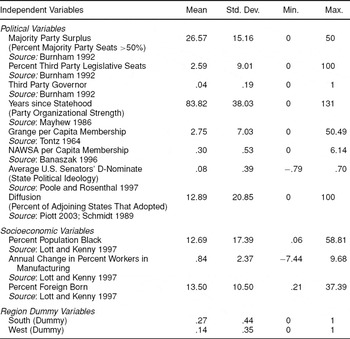
In testing our primary hypothesis concerning the impact of interparty competition on the likelihood of a legislature devolving institutional power, we control for several other macrolevel, time-varying political and socioeconomic covariates that scholars have identified as important factors shaping a state's adoption of the initiative. Appendix A provides descriptive statistics for each of the explanatory variables discussed here.
Political Pressures
Foremost among the various political pressures that may have led a state legislature to place a referendum on the ballot is interparty legislative competition. As a majority party's control over the state legislature becomes more tenuous, it may become easier for the minority party (and third parties) to convince members in the majority to cater to the median voter, even if doing so means supporting institution-weakening reforms. To test our interparty legislative competition hypothesis, we calculate the percentage of seats held by Republicans, Democrats, and third parties in both chambers of a legislature for each year of our study (Burnham Reference Burnham1992). Our covariate, which we refer to as majority party surplus, measures the percentage of seats in both chambers greater than 50% controlled by the majority party. On average, the majority party surplus was 22.5% among the 20 state legislatures that referred the initiative to the ballot in a given year; in contrast, of the remaining 769 data points in which a state legislature in a given year did not refer a measure to the ballot, the majority party surplus average was 26.7%. As such, as the percentage of a majority party's seats decreases (i.e., approaches 50%), we expect a legislature to be more likely to refer to the ballot a measure devolving institutional power.
The legislative referral of the initiative to the ballot in Montana is a case in point. Although first endorsed by mining unions in the 1890s as a means to apply pressure on a recalcitrant state legislature, the push for a referendum became politically viable following a struggle over mineral rights between mine operators. After a protracted political battle, which included the creation of the Anti-Monopoly Party, two of Montana's copper barons stopped production, leaving several thousand mine workers unemployed, angry, and politicized. Fearing retribution of unionized mine workers, all of the state's political parties endorsed the initiative in the run-up to the 1904 elections. The following year, a highly factionalized legislature (an internally divided Republican Party controlled both chambers, but with narrow margins) voted to refer to the ballot an amendment to the state constitution granting citizens the power of the initiative. In 1906, voters overwhelmingly approved the referendum (Piott Reference Piott2003, 51–60).
A second measure of interparty legislative competition is the presence of third parties in a state legislature. Historians have documented how third parties at the turn of the twentieth century were instrumental in a range of reforms besides direct democracy (Argersinger Reference Argersinger1980; Ware Reference Ware2002). Between 1896 and 1920, the national platform of nearly every third party (including the Populists, Silver Republicans, Silver Democrats, Progressives, and Socialists) officially endorsed or upheld most of the tenets of direct democracy (Piott Reference Piott2003).Footnote 17 We measure third party strength by the share of seats held by third parties in a given year in both chambers of a state legislature,Footnote 18 expecting that state legislatures with higher percentages of minor parties will be more likely to support an institutional reform that might coincidentally weaken the major parties.
In addition to lawmakers, several scholars have argued that some governors helped push through direct democracy reforms (Allswang Reference Allswang2000; Goebel Reference Goebel2002; Piott Reference Piott2003; Smith and Lubinski Reference Smith and Lubinski2002). Governors, for the most part,Footnote 19 had a limited formal role in placing referendums on the ballot, but several publicly supported direct democracy reforms. Although third party governors often supported the initiative, many Republican and Democratic governors did so as well.Footnote 20 For example, Democrats George Donaghey of Arkansas, John Shafroth of Colorado, and James H. Hawley of Idaho spearheaded direct democracy efforts in their states, as did Republicans George Hunt of Arizona, Hiram Johnson of California, and John Burke of North Dakota (Allswang Reference Allswang2000; Goebel Reference Goebel2002; Piott Reference Piott2003; Smith and Lubinski Reference Smith and Lubinski2002). In California, Governor Johnson, in 1910, led the charge within his own party against the “stand-pat” Republicans, campaigning on a direct democracy platform and advocating the reform in his 1911 state of the state address (Allswang Reference Allswang2000). To test whether third party governors were instrumental in the legislative referral of the initiative, we use a dummy (indicator) variable, coded 1 if the governor belongs to a third party and 0 otherwise. Although we expect legislatures in states with a third party governor to be more likely to place a referendum on the ballot than those states with a Republican or a Democratic governor, we would not be surprised if the statistical relationship was weak.Footnote 21
It is also possible that some state legislatures were more open to the devolution of institutional powers to citizens because state political parties were organizationally weak. As Mayhew (Reference Mayhew1986, 204–6) shows, states that achieved statehood more recently had less entrenched traditional political party systems than more established states because the “historical antecedents of the pattern of traditional [party] organization” predated the 1820s. Arguing that “local patterns of ‘traditional party organization’ go back to the turn of the century and before,” Mayhew (Reference Mayhew1986, 8–9) suggests that traditional party organizations are “durable” and are useful in understanding both institutional and policy changes in the American states. Specifically with regard to the adoption of direct democracy, Price (Reference Price1975, 248) contends that the initiative spread most rapidly across western states “because the political institutions and channels for doing things were not as firmly rooted in tradition” as they were in eastern states. We expect legislatures in newer states to be less circumscribed by the accretions of party tradition, and thus more likely to consider a major institutional change, such as devolving new powers to citizens. Following Mayhew (Reference Mayhew1986), we use the number of years since statehood as a proxy for party organizational strength, anticipating that younger states with less mature party organizations will be more likely to place a referendum on the ballot.
Several scholars have suggested that interest group pressure may have led some state legislatures to enact direct democracy reforms (Goebel Reference Goebel2002; Piott Reference Piott2003; Smith and Lubinski Reference Smith and Lubinski2002). As with other Progressive reforms, such as mothers' pensions and woman suffrage (Banaszak Reference Banaszak1996; Clemens Reference Clemens1997; McDonagh and Price Reference McDonagh and Price1985; Sanders Reference Sanders1999; Skocpol et al. Reference Skocpol1993; Wyman Reference Wyman1974), interest group pressure may have hastened the legislative approval of a referendum giving citizens the initiative. Gauging interest group strength, much less lobbying efforts for direct democracy reforms, is difficult,Footnote 22 but advocates in many states did assemble diverse coalitions to push for the reforms (Goebel Reference Goebel2002; Piott Reference Piott2003; Spoonholtz Reference Spoonholtz1973). To assess interest group strength, we use as proxies state-level membership data by year for two groups—the Grange (Tontz Reference Tontz1964) and the National American Woman Suffrage Association (NAWSA) (Banaszak Reference Banaszak1996)—both of which agitated for the adoption of direct democracy reforms. The Grange, known formally as the Patrons of Husbandry, was considered to be in many states “‘the mother of organizations,’ laying a foundation of organizing skills and activist networks for the associations that followed” (Clemens Reference Clemens1997, 156). Like other agrarian interests (e.g., the Farmer's Alliance), the Grange was a powerful advocate of direct democracy and other progressive reforms (Sanders Reference Sanders1999), and it had an especially strong presence in states west of the Mississippi (Crowley and Skocpol Reference Crowley and Skocpol2001). In contrast, NAWSA's singular mission was woman suffrage; the initiative was viewed by the organization as a purely instrumental means toward that end (Banaszak Reference Banaszak1996, 10). We expect legislatures in states with higher per capita membership in the two groups to be more responsive to their lobbying efforts, and thus more likely to place a referendum on the ballot.
The decision of some state legislatures to devolve institutional power to citizens may also have been influenced by the decisions of nearby states to adopt the process, as scholars of policy diffusion might hypothesize (Berry and Berry Reference Berry and Berry1990; Gray Reference Gray1973; Mooney Reference Mooney2001; Skocpol et al. Reference Skocpol1993). Direct democracy was by no means an alien concept to lawmakers during the Progressive Era. Talk of direct democracy abounded during the 1892, 1896, and 1912 presidential campaigns, and the initiative was a topic of intense conversation among lawmakers of all political persuasions across the United States (Piott Reference Piott2003). To test whether a legislature may have been persuaded by a neighboring state to place its own referendum on the ballot, we calculate the percentage of neighboring states that adopted the initiative for each year, generating a running average of these percentages for each state (Mooney Reference Mooney2001).Footnote 23 Although in a federalist system “proposals that might have been generated elsewhere” may have been “seized upon by regional politicians,” as Sanders (Reference Sanders1999, 3) suggests, the opposite may also have been true. Witnessing the deleterious effects of direct democracy in neighboring states may have dissuaded proximate state legislatures from following suit. We expect a state's proximity to neighboring states that had adopted the initiative to have a negligible impact on the likelihood of a legislature placing a referendum on its own statewide ballot.
Finally, it is possible that a state's broader political ideology may have affected a legislature's decision to devolve institutional power to citizens. Scholars often cite antimonopoly sentiments as a precursor to the adoption of the initiative (Cain and Miller Reference Cain, Miller, Sabato, Larson and Ernst2001; Goebel Reference Goebel2002; Ellis Reference Ellis2002; Piott Reference Piott1992; Reference Piott2003). Admittedly, there are many different ways to capture state political ideology, but most are not possible for the period under study. Drawing on data from Poole and Rosenthal (Reference Poole and Rosenthal1997), we create a measure of state political ideology by calculating the average D-NOMINATE score of a state's U.S. senators in a given year, which ranges from −1 (most liberal) to +1 (most conservative). All else equal, we expect that as a state's political ideology becomes more liberal, the likelihood of a state legislature placing a referendum on the ballot will increase.
Socioeconomic Pressures
Besides political factors, direct democracy scholars have suggested that states that adopted the initiative during the Progressive Era held in common several socioeconomic conditions.Footnote 24 Drawing on U.S. Census data (1890–1920), and following Lott and Kenny (Reference Lott and Kenny1999), we use a simple linear interpolation to provide yearly estimates of several socioeconomic variables. Most notably, scholars have argued that states that adopted the mechanism had predominantly homogenous white populations (Goebel Reference Goebel2002; Piott Reference Piott2003; Price Reference Price1975; Schmidt Reference Schmidt1989). The importance of race has been cited by several scholars for the peculiar timing and western geographic distribution of the states that adopted the initiative. In particular, some scholars have highlighted the reluctance of southern states to adopt the initiative due to what was known euphemistically at the time as the “Negro Question.”Footnote 25 Although some southern reformers were more enlightened than others, the forces of white supremacy were such that reforms intended to expand citizen participation were simply not politically feasible in parts of Dixie that were determined to keep the Democratic Party (and, by extension, state politics) “lily white” (Keyssar Reference Keyssar2002; Kousser Reference Kousser1974; Milkis and Tichenor Reference Milkis and Tichenor1994; Mowry Reference Mowry1940). Having successfully established white hegemony in the Democratic Party, Goebel (Reference Goebel2002, 97) argues that southern lawmakers simply saw no reason to experiment with “an untested device whose impact on the political situation could not be gauged.” Thus, because of white supremacist sentiments, we expect legislatures in states with higher black populations to be less likely to refer a ballot measure.
In addition to race, direct democracy scholars have argued that states with higher percentages of foreigners were less likely to adopt the initiative because lawmakers supposedly feared that recent immigrants would gain too much political influence via the plebiscitary mechanism (Goebel Reference Goebel2002; Huthmacher Reference Huthmarcher1962; Price Reference Price1975; Schmidt Reference Schmidt1989; Tolbert Reference Tolbert2003). Nativist sentiments may well have led some state lawmakers to oppose the adoption of the initiative because the process had the possibility of empowering otherwise marginalized immigrant groups. A counterargument, however, can also be made. Published in 1892, James W. Sullivan's influential book, Direct Legislation by the Citizenship through the Initiative and Referendum, provided a detailed account of the Swiss origins of the initiative and quickly became an essential reference for reformers across the United States (Goebel Reference Goebel2002, 32–34; Smith and Tolbert Reference Smith and Tolbert2004, 21–22). Because the institutional design recommended by reformers had a distinct European origin, many Old World émigrés—and the lawmakers who represented them—were likely familiar with direct democracy, and thus less receptive to nativist arguments. We expect legislatures in states with sizeable foreign-born populations to be no less likely to refer a measure to the voters.
Because direct democracy was first championed in the late nineteenth century by agrarian populists, scholars have suggested that states in the midst of industrialization were less likely to adopt the initiative (Clemens Reference Clemens1997; Goebel Reference Goebel2002; Piott Reference Piott2003; Price Reference Price1975; Schmidt Reference Schmidt1989; Tolbert Reference Tolbert2003).Footnote 26 Forged by agrarian frustrations and anxieties at the dawn of the industrial era, these scholars argue that reform efforts were built on rural anger against the monopolies controlled by railroads and other corporations and trusts. Following this logic, it is possible that legislators in industrializing states with growing manufacturing sectors may have been less likely to delegate authority to citizens via the initiative because the process might have enabled a forsaken and underrepresented ethnic urban working class to sidestep recalcitrant legislatures (Huthmacher Reference Huthmarcher1962, 321–341). We expect legislatures in states with a growing percentage of workers employed in manufacturing to be less likely to refer a measure to the ballot.Footnote 27
Finally, using two dummy variables, we consider regional variations in the decision of a legislature to devolve power to citizens. In an alternative specification of our model, we include dummy variables for the 10 western and 11 southern states in the data set. Along with others who note that “the theoretical rationale for the inclusion of the South dummy has never been clear” (Matsusaka Reference Matsusaka2004, 24), we are skeptical of the impact of the regional dummy variables. However, it is possible that in the variable years since statehood, our proxy measure for party organizational strength overestimates the strength of the Democratic Party in the South (Key Reference Key1949), so the inclusion of the dummy variables may compensate for this possible measurement error. Another possible measurement issue concerning the South is the fact that the nation's black population was heavily concentrated in southern states. Our decision to include these regional dummy variables is influenced by the pervasiveness of the argument that support for direct legislation via the initiative was a uniquely western phenomenon. For reasons discussed previously, we do not expect legislatures in western or southern states to be any more or less likely to refer an amendment to a statewide vote than states in the Northeast and Midwest, which are grouped together as the reference category.
FINDINGS
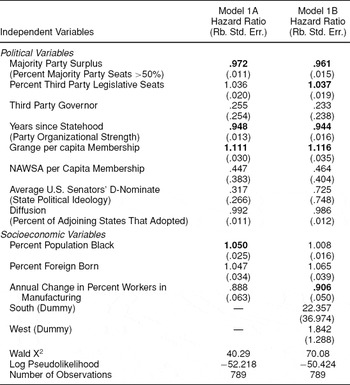
Table 1 provides EHA models explaining the legislative decision to refer a measure to the ballot giving citizens the opportunity to adopt the initiative. The estimated coefficients in each model are exponentiated and are expressed in the form of hazard ratios. The hazard rate represents the ratio of change in the hazard (legislative passage of the referendum) for a one-unit change in a corresponding covariate. For example, if a hazard ratio is equal to one, the predictor covariate has no effect. If the hazard ratio is less than one, say, 0.96, it means a one-unit increase in the explanatory variable decreases the likelihood of the hazard occurring by 4 percentage points. The two models control simultaneously for the theorized political and socioeconomic variables; the only difference is that Model 1B includes the two regional dummy variables while Model 1A does not.
EHA Models for Legislative Referral of Initiative

Note: Figures are estimated hazard ratios, robust standard errors clustered by state in parentheses to correct for heteroskedasticity. Breslow method used for ties. Number of subjects, 46; number of failures, 20. Bold indicates p < .05.
It is clear from Model 1A that majority party surplus was a key factor in a state legislature's decision not to devolve institutional power. For every one percentage point increase in majority party surplus, the likelihood of legislative referral, ceteris paribus, decreases by nearly three percentage points. In other words, if the majority party's share of seats drops from 61% to 51%, the likelihood of referral increases by roughly nearly 28 percentage points, all else equal. Our proxy for party organization strength indicates that for each additional year since a state's inception, the chance of a legislature placing a referendum on the ballot decreases considerably. This comports with Mayhew's (Reference Mayhew1986) account that newly admitted states had less institutionalized parties, and thus, their state legislatures may have been more willing to consider institutional changes. The share of legislative seats controlled by third parties is in the predicted direction, although it narrowly fails to reach statistical significance (p = .058). This null finding is likely due to the fact that third parties controlled, on average, less than 3% of all seats over the period covered in the data set.
We find mixed results in Model 1A for our expectation that interest group membership played a significant role in the decision of state legislatures to place referendums on the ballot, and no support for the third party governor or diffusion covariates. Per capita state membership in the Grange is significant and is positively related to the hazard. For every one-point increase in the per capita membership level, legislative support for referring a measure increases by 11 percentage points, indicating that as Grange membership increased, the pressure on legislatures to refer to voters an amendment allowing the initiative also increased. In contrast, the coefficient for per capita membership in NAWSA is less than one, but not statistically significant. This null finding may reflect the fact that NAWSA membership was strongest in New England and the Middle Atlantic states, and that the national organization targeted its financial resources in states where the legislatures were likely to adopt woman suffrage. Indeed, one of the reasons for the organization's successes was its ability to redistribute resources from areas where its membership was strong but its chances for victory slim, to areas where its membership was weaker but its chances for winning better (Clemens Reference Clemens1997, 89–90). Finally, it appears that a state's political ideology, as measured by the ideology of the state's sitting U.S. senators, had no discernable impact on the likelihood of a legislature delegating institutional power to citizens, indicating that a purely ideological explanation for the expansion of citizen lawmaking is perhaps unwarranted.
With regard to the socioeconomic macrolevel conditions, Model 1A reveals that only a state's racial composition is a significant predictor, holding other variables constant. Contrary to historical accounts, and our expectations, legislatures in states with sizable black populations were just as likely, if not more so, to refer the initiative to the ballot as other legislatures. A one-point increase in the percent of a state's black population actually increases the likelihood of a legislative referral by five percentage points. With respect to a state's foreign population, we find that lawmakers in states with sizeable foreign-born populations were no more or less willing to devolve institutional power to citizens, all else equal. Finally, we find that the change in the percentage of workers employed in manufacturing does not appear to significantly affect the likelihood of a state legislature deciding to refer an amendment to voters. These findings cast some doubt on the argument that racially and ethnically homogenous states and those experiencing rapid change in the manufacturing sector were more likely to adopt the initiative, and instead reinforce our main contention that legislatures devolving authority were responding to political pressures.
The findings of Model 1B, which include the two regional dummy covariates, bolster the findings of Model 1A. Most notably, the significance and substantive magnitude of majority party surplus and years since statehood covariates hold when the regional variables are added. State legislatures with lower majority party surpluses were more likely to place a referendum on the ballot. Although it is perhaps surprising that the West dummy variable fails to reach statistical significance, it is likely that any effects of the covariate are mitigated by the relative infancy of western states, as measured by years since statehood.Footnote 28 The South dummy variable is also not significant, indicating that the 11 former Confederate legislatures were no more or less likely than others to place a measure on the ballot when holding other variables constant.Footnote 29 With the regional dummy controls, we find that third party legislative strength is significant; for every additional percentage of legislative seats held by third parties, a state legislature was nearly 4 percentage points more likely to refer a measure to the ballot. We also find that when the regional variables are included, legislatures in states experiencing a rapid rise in the annual percentage of workers employed in manufacturing were less likely to refer a measure to the ballot, but that a state's percentage of black population was not a significant predictor.Footnote 30
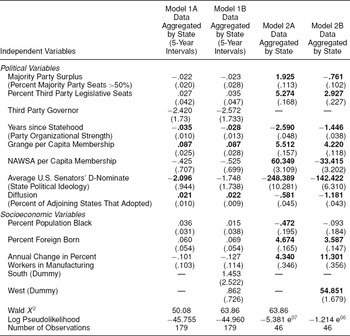
To check the robustness of our findings, we aggregated our EHA data set two different ways: first into five-year averages for each state, and second into a single observation for each state. For both new units of analysis, we calculate the mean values for each independent variable and create a new dummy dependent variable, coded 1 if a state legislature referred a measure to the ballot, and coded 0 if it did not at any time during the newly created unit of analysis. Appendix B provides the estimations of the resulting logit models, which predict the likelihood of a state legislature referring a referendum to the ballot. Although these alternative specifications may raise questions concerning the robustness of some of our causal variables—including the impact of majority party surplus—we think considerable caution should be exercised when interpreting them. Most notably, because we are principally interested in the longitudinal dynamics of state legislation, and not necessarily the cross-sectional differences among states, there is little theoretical justification for restricting the variance found in the dependent variable, which occurs when yearly data are aggregated over time. Logit models that use means of the covariates over multiple years do not precisely test our key hypothesis that greater interparty legislative competition in a given year increases the likelihood that state lawmakers will refer to citizens a measure devolving authority in that year.Footnote 31 Furthermore, there appears to be little methodological justification for aggregating the data as there is no indication that the yearly state-level data are “suspicious or perhaps measured poorly” (Gill Reference Gill2006, 334). Unlike the EHA hazard models, which are specifically designed to isolate the conditions that lead to the occurrence of an event at a particular time (Beck Reference Beck, Scarbrough and Tanenbaum1998; Berry and Berry Reference Berry and Berry1990; Box-Steffensmeier and Jones Reference Box-Steffensmeier and Jones2004; Hosmer and Lemeshow Reference Hosmer and Lemeshow1999), the aggregated logit models remove nearly all the temporal variation of the socioeconomic and political variables within the states by squeezing the overall number of observations.
DISCUSSION
Today, in 24 American states, the initiative is arguably the most important political institution available to citizens. The reason why some states adopted the initiative a century ago, though, remains largely shrouded in mystery. Our macrolevel historical analysis sheds some much needed light on why some state legislatures decided to devolve institutional power to citizens.
Although we are sensitive to concerns about possible endogeneity, our findings offer considerable support for a political, rather than a purely socioeconomic or regional, explanation for the genesis of direct democracy in the American states. In the midst of rapid national and subnational state building, we find the size of the majority party's surplus of seats and the relative youth of state political parties to be driving forces in the decision of state legislatures to devolve institutional power. Reinforcing Piott's (Reference Piott2003) historical study of the adoption of the initiative in 16 states, we show that interparty legislative competition was central to a legislature's decision to place a referendum on the ballot. Due to the legacy of gerrymandering and the fact that the partisan competition of state legislatures often did not reflect that of a state's population (David and Eisenberg Reference David and Eisenberg1961), we discount the possibility that our measure of majority party surplus is an endogenous by-product of a common set of socioeconomic conditions. This is not to say that socioeconomic factors were not important in a state legislature's consideration of devolving lawmaking authority to citizens, as is apparent with our findings that the percentage of African Americans living in a state and the change in the percentage of a state's workforce employed in the manufacturing sector had conditional effects. All else equal, though, we find little support for the claim that southern legislatures were more apprehensive toward the initiative than other state lawmaking bodies because of the mechanism's potential to mobilize African Americans. Indeed, the positive findings with regard to a state's black population in Model 1A and the null findings with regard to the South dummy variable in Model 1B seem to reflect the fact that the state legislatures of Arkansas, Florida, Mississippi, Missouri, and Texas all referred constitutional amendments to the voters, a part of the historical story that is rarely told.Footnote 32
Our findings also suggest that the decision of some legislatures to delegate power to citizens by way of the initiative was not the by-product of a unique western culture (Goebel Reference Goebel2002). As Model 1B reveals, we find scant support for one of the most pervasive claims today—that direct democracy was a western phenomenon and reflected a contagion of agrarian Populism (Bowler and Donovan Reference Bowler and Donovan2006; Bridges and Kousser Reference Bridges and Kousser2005; Price Reference Price1975). Although we do find that the membership density of the Grange in a state affected the legislature's decision to place a referendum on the ballot, there is little evidence that legislatures acted because neighboring states did so. Thus, it seems more than a mere coincidence that lawmakers in states with heightened interparty legislative competition today—Minnesota, New Jersey, New York, and Pennsylvania (Bibby and Holbrook Reference Holbrook and Van Dunk2004)—have introduced numerous bills calling for the adoption of the initiative (National Conference of State Legislatures 2007). A new wave of state legislatures granting citizens the power to adopt direct democracy mechanisms may yet be on the horizon.
Paralleling Ware's (Reference Ware2002) argument regarding the adoption of the direct primary during the same period and Theriault's (Reference Theriault2005) investigation of recent congressional reforms, our findings suggest that the initiative was not imposed unwillingly (or unwittingly) on state lawmakers. Rather, the fact that legislatures with greater interparty legislative competition were more apt to delegate power to citizens likely reflects the desire of the median legislator's desire to remain in office.Footnote 33 The willingness of minority parties to cede institutional power due to citizen demands may strengthen their standing vis-à-vis the majority party. “Minority parties are in constant search for the issue that will propel them into the majority,” Theriault (Reference Theriault2005, 134) concludes, because by “defending ‘the people’ against ‘the politicians,’ minority parities can ride populist politics to victory.”
Of course, for such a momentous shift in institutional power to succeed, there must be a level of political pressure sufficient to convince some members of the majority party to defect (Whittington and Carpenter Reference Whittington and Carpenter2003). Otherwise, the minority party qua minority party would not be able to pass legislation. As our analysis reveals, party organizational strength should not be underestimated in this regard. Legislatures in states with weaker party organizations were much likely to respond to statewide popular demands and relinquish institutional power to citizens. As with many of the institutional transformations at the national level that were orchestrated during the Progressive Era (Carpenter Reference Carpenter2001; James Reference James2000; Skowronek Reference Skowronek1982), we also find that reform-minded chief executives of all political stripes—not just those who ran on a third party label—were instrumental in the push for direct democracy in the American states. From an institutionalist perspective, then, it is perhaps obvious that some governors would have been favorable toward the initiative. Relatively speaking, the initiative diminishes the powers of the legislature vis-à-vis the executive branch.Footnote 34 One needs only to appreciate the recent strategic efforts of California Governor Arnold Schwarzenegger to use the initiative to advance his policy agenda, thereby circumventing an oppositional state legislature.
We would be remiss not to speculate that some lawmakers may have been willing to seemingly delegate power to citizens because they knew they could later reestablish their control over the initiative process (Gerber, Lupia, and McCubbins Reference Gerber, Lupia and McCubbins2004; Gerber, et al. Reference Gerber, Lupia, McCubbins and Kiewiet2001). As Piott (Reference Piott2003) documents, leaders of many state legislatures were optimistic that they would be able to control citizen lawmaking after it was adopted, thereby mitigating negative consequences that might arise in the delegation of power to citizens. Indeed, some legislatures were quite successful in their endeavors to inhibit the citizen initiative during the period. The legislatures of Utah and Idaho, for example, thwarted the use of the initiative for dozens of years after citizens adopted the mechanism, by refusing to pass enabling legislation (the approved constitutional amendments were not self-executing). Judson King (Reference King1913), the president of a national advocacy group in favor of direct democracy, The National Popular Government League, characterized the statewide initiative in both states as “worthless,” and the process in six other states (South Dakota, Montana, Oklahoma, Maine, Nebraska, Washington) as “defective.” Thus, while appearing to cede authority to citizens, several state legislatures were able to partially insulate and preserve their institutional powers.Footnote 35
Casting an eye toward the historiography of direct democracy in the United States, it is quite possible that some of our divergent findings reflect our macrolevel examination of the socioeconomic and political conditions prevalent in all states, when compared along side studies that only scrutinize states that adopted the initiative. By looking systematically over time and across all states, we are able to test several hypotheses for why some state legislatures decided to delegate power to citizens and others did not. Until recently, historians and political scientists have investigated the push for the initiative in piecemeal fashion, or they have plumbed the secondary question of why some states adopted the initiative. As such, the research design of these studies effectively disregards macrolevel political and socioeconomic conditions that were prevalent in states that did not adopt the initiative. By ignoring counterfactual conditions of “nonevents,” the impressions left by studies focusing exclusively on states that adopted the initiative may be inherently biased, with scholars advancing spurious assertions disguised as explanation (Megill Reference Megill1989). We leave it to historians and other political scientists to further unearth and recount the socioeconomic and political dynamics occurring within states that did not adopt the initiative during the period. But it is perhaps understandable that most scholars tend not to share Donald Rumsfeld's interest in probing “known unkowns” as well as “unknown unknowns” because it is much easier to document and explain “known knowns.” By ignoring null cases, however, scholars may be unintentionally ascribing unwarranted causality to some macrolevel conditions while overlooking others that may be crucially important.
Finally, by fleshing out the relative impact of several factors over time on the likelihood that a state legislature would “fail” to protect its institutional powers, we hope our study adds to the literature on institutional change (Dodd and Jillson Reference Dodd and Jillson1994; March and Olsen Reference March and Olsen1984; Orren and Skowronek Reference Orren and Skowronek2004; Steinmo, Thelen, and Longstreth Reference Steinmo, Thelen and Longstreth1992). A legislature's decision to place a referendum on the ballot granting citizens the opportunity to adopt the initiative is a momentous devolution of institutional power. Given that we generally assume legislators want to retain institutional power, our study may help isolate some of the socioeconomic and political conditions, most notably, interparty legislative competition, which at a given moment in history may impel legislators to act in a fashion that some may see as contrary to their institutional self-interest. It is our hope that scholars will continue to investigate and theorize about the conditions that induce legislative bodies to delegate authority to the citizenry beyond the arena of citizen lawmaking.
APPENDIX A
Data Description, Sources, and Descriptive Statistics

APPENDIX B
Aggregated Logit Models for Legislative Referral of Initiative

Note: Unstandardized logistic regression coefficients with robust standard errors in parentheses to correct for heteroskedasticity. Probabilities based on two-tailed tests. For Models 1A and 1B, standard errors adjusted by clustering cases by state. In Models 2A and 2B, the third party governor variable is dropped due to “quasicomplete separation” because the covariate perfectly predicts some, but not all, of the observations (Zorn Reference Zorn2005, 157), and in Model 2B, the South dummy variable is dropped due to multicollinearity. Bold indicates p < .05.



Comments
No Comments have been published for this article.