Children face a daunting set of cognitive tasks in their early years. At the same time they are learning words for entities in their environment, they are also learning a tremendous amount about these entities, and about the categories to which they belong (Waxman & Lidz, Reference Waxman, Lidz, Kuhn and Siegler2006). In order to examine the intersection of language and the development of concepts, many researchers have used a word extension task. The basic task involves introducing a new word and looking to see how it is extended, with response choices that typically include a taxonomic choice and any of the following: thematic choice, shape choice, or distracter. The taxonomic choice is in the same taxonomic category as the target item (e.g. if the target is a baseball, the taxonomic choice might be a football). The shape choice has the same basic shape as the target, but is not from the same taxonomic category (e.g. an orange). Finally, the thematic choice is related to the target by association (e.g. a baseball bat).
Using this paradigm, Markman & Hutchinson (Reference Markman and Hutchinson1984) found that children have a bias to assume that novel words refer to taxonomic categories. This bias was in contrast to their performance on a non-word control task, in which they tended to choose thematically. However, a limitation of that work was that the taxonomically related choices were very similar in shape to the target. For example, one set of items included a blue jay as the standard object, with a duck as the taxonomic choice and a nest as the thematic choice. It is therefore possible that words were directing children toward same-shape choices rather than taxonomically similar choices.
Imai, Gentner & Uchida (Reference Imai, Gentner and Uchida1994) conducted a word extension task that helped to distinguish taxonomic choices from shape choices. Children were taught a novel label for a standard item (e.g. a birthday cake) and were asked to select one of three picture choices: a taxonomic match (pie), a shape match (top hat) and a thematic match (birthday present). Preschool-aged children were asked to ‘find another’ example of the novel word from the choices in the Word condition. Results showed that children chose shape responses more than taxonomic responses, whereas adults chose taxonomic choices more often. This study supported the existence of a shape bias in children's word learning, and suggests important developmental changes over time.
There are at least two interpretations of the shape bias. On one view, shape per se is an important basis to young children's concepts and word extensions (e.g. Smith, Jones & Landau, Reference Smith, Jones and Landau1996). This position notes that count nouns tend to correlate with shape, and therefore children could develop a shape-based response from noting low-level associative correlations between linguistic and perceptual features in the input. This Attentional Learning Account (ALA) focuses more on the associative mechanisms, rather than representational concepts, that might influence children's attention to perceptual features in a word-learning task (Colunga & Smith, Reference Colunga and Smith2008; Samuelson, Reference Samuelson2002; Smith, Jones, Landau, Gershkoff-Stowe & Samuelson, Reference Samuelson2002). From another view, shape is important only as a correlate or cue to other, more conceptual features (Bloom, Reference Bloom2000; Booth & Waxman, Reference Booth and Waxman2002; Cimpian & Markman, Reference Cimpian and Markman2005; Diesendruck & Bloom, Reference Diesendruck and Bloom2003; Gentner & Namy, Reference Gentner and Namy1999). For example, members of a basic-level category tend to have a shared shape (Rosch, Mervis, Gray, Johnson & Boyes-Braem, Reference Rosch, Mervis, Gray, Johnson and Boyes-Braem1976), and thus shape may be a good first-order approximation to category membership (though category membership is not itself reducible to shape).
The present studies
The present studies were designed to provide further evidence regarding whether conceptual factors can influence children's and adults' word extensions. We examined these issues developmentally by varying the kinds of concepts preschool-aged children and college students were asked to consider. A word-extension task is inherently ambiguous, in that (real) words are of many different sorts, only some of which refer to kinds (Gelman & Kalish, Reference Gelman, Kalish, Kuhn and Siegler2006). Although most count nouns refer to richly structured categories (e.g. ‘a dog’, ‘a chair’; see Mervis & Rosch, Reference Mervis and Rosch1981), also known as ‘kinds’, count nouns may refer to other kinds of concepts as well, including shapes (e.g. ‘a square’, ‘a circle’), relationships (e.g. ‘a friend’, ‘a winner’) or temporary roles (e.g. ‘a passenger’, ‘a gift’), which would have less within-category similarity than ‘dog’ or ‘chair’. Furthermore, there are innumerable other, non-kind categories that one could consider (e.g. ‘red things’, ‘striped things’, ‘things to take on a camping trip’). Thus, a child who extends a novel label on the basis of shape or thematic relatedness may be doing so not because she fails to appreciate the importance of taxonomic features in classifying kinds, but rather because she fails to appreciate that the experimenter is asking for a kind-based extension on this task. Likewise, the finding that adults often extend novel labels on word-extension tasks to shape matches rather than taxonomic matches (e.g. Imai et al., Reference Imai, Gentner and Uchida1994) suggests that the task is open to multiple interpretations, based on the variety of categories available.
We therefore designed a study that would permit us to manipulate cues hypothesized to emphasize attention to kinds. Specifically, we manipulated four factors – generic noun phrases, internal property attributions, familiar kind labels and absence of a target photograph – each of which was theorized to emphasize kinds (vs. other sorts of categories). We predicted that children and adults would be more likely to select taxonomic choices when kinds were emphasized, though all of the factors would not be necessary to cue taxonomic choices for adults. If our hypotheses are supported, this would provide evidence that conceptual forces do influence word learning. Further, we conduct a ‘hard’ test of our hypotheses in that we provide superordinate, rather than basic level, taxonomic matches to our target items. Superordinate matches are known to be more difficult for young children (Golinkoff, Shuff-Bailey, Olguin & Ruan, Reference Golinkoff, Shuff-Bailey, Olguin and Ruan1995). Because we examine this more advanced categorical relationship, we have conducted this study with adults as well to provide information about the mature response to novel label extension. By examining this change in sensitivity to the factors, we will examine the developmental shift from a shape bias to a kind bias. Below we briefly review each dimension that we included.
Generic noun phrases
Generic noun phrases provide a universal means of directly referring to kinds of things (e.g. ‘bats’ in the statement ‘Bats fly at night’), and thus can be contrasted to statements referring to one or more individuals (e.g. ‘this bat’ in the statement ‘This bat flew last night’). Because of their link to kinds, generic statements provide information that is relatively central: enduring, timeless and inherent (as opposed to temporary, linked to a particular context and/or accidental) (Carlson & Pelletier, Reference Carlson and Pelletier1995; Prasada, Reference Prasada2000). Prior research indicates that children are sensitive to the distinction between generic and non-generic noun phrases on a range of tasks, including production in natural language (Gelman, Goetz, Sarnecka & Flukes, Reference Gelman, Goetz, Sarnecka and Flukes2008), comprehension (Gelman & Raman, Reference Gelman and Raman2003; Hollander, Gelman & Star, Reference Hollander, Gelman and Star2002) and inductive inferences (Gelman, Star & Flukes, Reference Gelman, Star and Flukes2002).
Internal property attributions
One of the primary functions of kinds is that they permit generalizations about relatively non-obvious features, such as internal parts (e.g. frogs have a three-chambered heart; birds have hollow bones). Other sorts of categories do not permit such inferences (e.g. circles; gifts). Prior research indicates that young children treat internal properties as particularly important to category membership (Gelman & Wellman, Reference Gelman and Wellman1991) and likely to be shared among category instances (Gelman & O'Reilly, Reference Gelman and O'Reilly1988). We therefore predicted that hearing an internal property attributed to an entity would encourage participants to interpret a novel label as kind-referring.
Familiar kind labels
As noted earlier, most familiar count nouns are kind-referring. Furthermore, a large body of research indicates that children treat familiar kind labels as capturing important, non-obvious features and generating category-based inferences (e.g. Gelman, Reference Gelman2003). Moreover, familiar labels (e.g. ‘a cow’) lead to more category-based inferences than novel labels (e.g. ‘a fep’; Davidson & Gelman, Reference Davidson and Gelman1990). We hypothesized that linking the novel label to a familiar kind-referring label (e.g. ‘This apple is a fep’ or ‘Apples are feps’) would serve to communicate that the novel label (‘fep’) also makes reference to a kind (‘apple’). The wording is potentially ambiguous regarding how ‘fep’ relates to ‘apple’ (e.g. ‘fep’ could be a synonym, a subordinate or a superordinate of ‘apple’). However, most typically this wording implies that the novel label is superordinate (e.g. one can say ‘Apples are fruits,’ but typically one would not say ‘Fruits are apples’).
Absence of target photograph
The final factor concerned whether or not a target photograph was available to children as they considered the task of extending a novel label. We predicted that looking at a photo would encourage participants to think about superficial perceptual features rather than kind membership, and similarly would encourage a focus on the item as an individual object rather than as a member of a larger kind. In both these respects, then, presenting the category verbally only (without a photo) was predicted to yield a greater focus on kinds.
STUDY 1: ADULTS
Examining adults' patterns in label extension will provide an important measure of the endpoint for children's reasoning. We predicted that adults would not exhibit a shape bias and would have higher taxonomic responses overall, which might lead to different sensitivity to our four kind-referring factors.
Adults have been found to privilege thematic categorization over taxonomic categorization when stimulus items have strong thematic relations (Lin & Murphy, Reference Lin and Murphy2001; Murphy, Reference Murphy2001); however, in this labeling context, past research shows that adults tend to provide more taxonomic and fewer shape responses than children. Adults generally find taxonomic relations more salient than children do – particularly at the superordinate level (Imai et al., Reference Imai, Gentner and Uchida1994; Markman & Callanan, Reference Markman, Callanan and Sternberg1983). We therefore predicted that adults would be less influenced by the factors under consideration here, because they would readily look beyond shape similarity and access superordinate-level taxonomic categories even in the absence of cues that highlight such relations. Adults' sensitivity to taxonomic relations is predicted to be robust even in the presence of a target photo, and even with non-generic language and only novel labels. Thus, we hypothesize that those factors that provide a general emphasis on taxonomic relations or away from shape relations will not exert any significant effects. In short, adults are predicted not to need these reminders.
In contrast, we predicted that internal property attributions might yield effects even for adults. This factor goes beyond simply reminding participants about taxonomic links, instead serving to indicate important new information about the novel word – that it is the sort of category for which non-obvious features can be predicated. For example, such a condition rules out a purely shape-based label (e.g. ‘a square’) which captures no internal commonalities. For this factor, then, we expect effects on taxonomic and shape responses even for adults.
METHOD
Participants
One hundred and twenty-five college undergraduates participated in this study, with 17 in the Baseline condition and 18 in each of the six remaining conditions (M age=19·5 years; 62 females, 63 males). Adults were college students at a Midwestern US university. All participants received partial course credit for taking part in the study. In addition, 17 undergraduates participated in pretesting of the stimulus materials (see below).
Stimuli
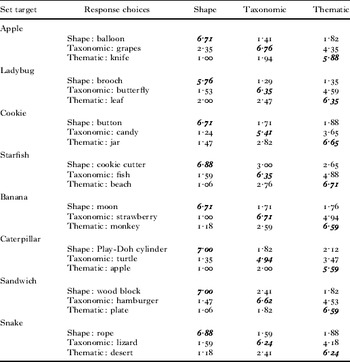
There were eight sets of color photographs of objects and animals that were familiar to children. Each set included four pictures: a target (e.g. apple) and three picture choices that matched the target according to taxonomic similarity (e.g. grapes), shape similarity (e.g. balloon) and thematic relatedness (e.g. knife). All item sets are listed in Table 1. Novel words were used to label the target items (fep, tepin, blick, dorn, skibble, gogi, zav, kevta) and provide property information in the conditions in which a non-obvious property was predicated (bants, screds, plogs, vorzyds, yancis, bactras, febbits, bleens).
Stimuli sets for Studies 1 and 2, with adult ratings for intended and non-intended matches on shape similarity, taxonomic category and thematic relatedness

note: Bold italics represent the scores that were predicted to be the highest.
To select and validate the stimuli, we obtained adult ratings (N=17) of eighteen stimulus sets. Participants rated how well each target item matched the corresponding picture choices according to taxonomic similarity (‘How much are items A and B the same kind of thing?’), shape similarity (‘How similar in shape are items A and B?’) and thematic relatedness (‘How related are items A and B?’), all rated on a scale of 1–7. We selected the eight sets for which the intended match was consistently rated more highly than the non-matches. Ratings information and stimulus sets are shown in Table 1.
Design
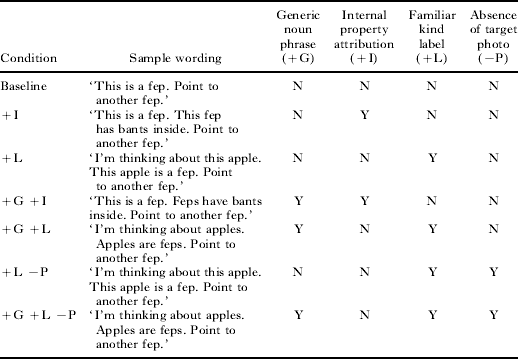
Table 2 lists all seven between-subjects conditions included in Studies 1 and 2. As can be seen, we have adopted a shorthand to refer to the conditions, by listing each of the relevant factors that were included for that condition (e.g. +G +I refers to the condition that included generic noun phrases and internal property attributions).
Study design
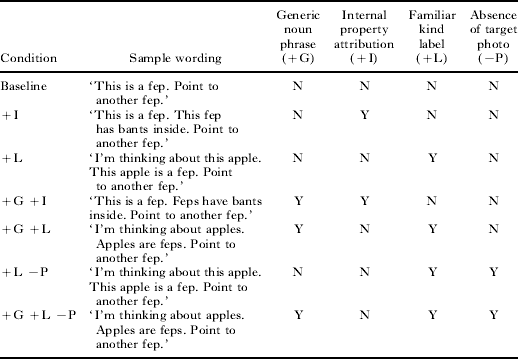
The baseline condition was conducted to replicate findings from previous studies; it was conducted with a target photo present, and no other conceptual information (generic language, property attribution or familiar kind labels) provided. Although we were interested in four distinct factors (generic noun phrases (+G), internal property attributions (+I), familiar kinds labels (+L) and absence of target photo (−P)), there were three constraints that made a full factorial design (sixteen conditions) unfeasible. First, whenever target photos were not present, it was required that a familiar kind label was present (otherwise, the participant would have no idea what the target picture referred to). This excluded four of the potential conditions (+G +I −P, +G −P, +I −P and −P). Second, we judged that the wording would be too long and complex if a given condition included both a familiar kind label and an internal property attribution. This excluded four of the potential conditions (+G +I +L −P, +G +I +L, +I +L −P and +I +L). Finally, inclusion of generic wording required either an internal property attribution or a familiar kind label, as it is not possible to refer to a generic category without one or the other of these factors. This excluded one more of the potential conditions (+G), as well as one of the conditions that was already excluded above (+G −P). As a result of these three exclusion criteria, nine conditions were excluded, leaving only seven remaining conditions (see Table 2 for the design and wording).
The influence of each factor on adults' taxonomic, shape and thematic choices was examined through multiple linear regressions on the full dataset. The presence (1) or absence (0) of each factor was coded for each participant according to the condition he or she was in, as outlined in Table 2, allowing us to examine the influence of the four factors individually for each response type.
Procedure
Adults were randomly assigned to one of the seven labeling conditions. The wording for each of the conditions is presented in Table 2. For those conditions that included a target picture, the target picture was provided with the three picture choices. Two of the conditions did not include a target picture (+L −P and +G +L −P). Adults received the task in written form, with booklets of the picture sets. Adults were tested in groups. They were told that the stimuli were also being used with children, and that even though the words were unfamiliar, they should answer to the best of their ability. They were also given the option to explain their responses; however, few participants did so. The order of the eight stimulus sets was randomized across participants, and the left-to-right ordering of the three picture choices was counterbalanced within and across participants.
RESULTS
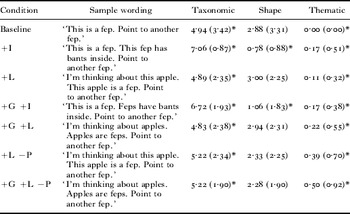
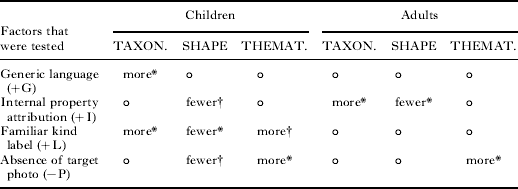
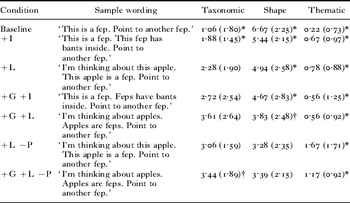
Responses were coded as shape, taxonomic or thematic for each of the eight item sets. For each participant, the number of choices of each type was summed, with scores ranging from 0–8. These response choices are not independent of one another and were therefore analyzed separately (see Table 3, which includes comparisons to chance). Table 4 provides an overview of the response patterns for all the analyses.
Study 1: Adults' mean number of taxonomic, shape and thematic responses per condition (SDs in parentheses)

note:* one-sample t-test, comparison to chance (2·67), p<0·05.
Overview of significant results, Studies 1 and 2
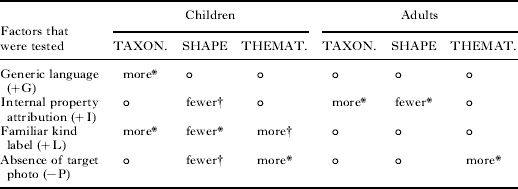
note:* p<0·05; † p<0·10; ‘more’ indicates that the presence of the target factor resulted in significantly more responses of the type indicated in the column heading, as compared to absence of that factor; ‘fewer’ indicates that the presence of the target factor resulted in significantly fewer responses of the type indicated in the column heading, as compared to absence of that factor; ‘0’ indicates that the target factor had no significant effect, as compared to absence of that factor.
Effects of factors on taxonomic responses
We conducted a multiple linear regression to analyze the relationship between the four factors and adults' taxonomic responses. The overall model was significant (R 2=0·132, p<0·01). The internal property factor was the only significant positive predictor of adults' taxonomic choices, increasing their choices based on kind, as predicted (β=0·385, p<0·01).
Effects of factors on shape responses
We conducted a multiple linear regression to analyze the relationship between the four factors and adults' shape responses. The overall model was significant (R 2=0·135, p<0·01). The internal property factor negatively predicted adults' shape responses, decreasing their choices based on perceptual similarity, as predicted (β=–0·393, p<0·01).
Effects of factors on thematic responses
We conducted a multiple linear regression to analyze the relationship between the four factors and adults' thematic responses. The overall model was significant (R 2=0·075, p=0·05). The presence of a target picture negatively predicted adults' thematic choices (β=–0·223, p<0·05). Thus, the absence of a target picture increased adults' responses based on thematic associations.
DISCUSSION
The primary result from Study 1 was that for adults, attributing an internal property to a novel category significantly predicted increased taxonomic matches and decreased shape matches. Adults did not show any sensitivity to the factors of generic language or familiar kind labels. However, the absence of a target photograph resulted in increased thematic responses. This may be because without the anchor of the target photo, adults make more thematic associations.
Thus, as predicted, adults demonstrated a mature response to label extension in that they did not require reminders or non-verbal cues in order to respond taxonomically in a word extension task. Indeed, providing such reminders (in the form of generic language, familiar kind labels or absence of target pictures) affected neither taxonomic nor shape responses for adults. However, when provided with information that specifically emphasized the non-obvious commonalities shared by category members, and that correspondingly ruled out a superficial response, adults did show an increase in taxonomic responses and a decrease in shape responses.
STUDY 2: CHILDREN
In Study 2, we were interested in examining developmental changes, by looking at how children would respond to the same testing conditions as in Study 1 with adults. Developmental changes may occur in how novel labels are extended and how these kind-referring factors affect how children interpret categories. For each target factor, we predicted that taxonomic responses would increase, and shape and thematic responses would decrease.
METHOD
Participants
One hundred and twenty-six children participated in the main study (M age=4 ; 5, range 3 ; 6 to 5 ; 0 ; 68 girls, 58 boys), 18 per study condition. Mean ages across the conditions ranged from 4 ; 2 to 4 ; 7. The sample was recruited from a university town in the Midwestern US and was primarily White. In addition, 12 elementary-school children participated in validation of the test stimuli (see below).
Stimuli
We obtained taxonomic, shape and thematic match judgments for the eight stimulus sets from elementary school-aged children (N=12, M age=7 ; 7) in order to confirm that children have the same understanding of the items' relationships as adults. For taxonomic matches, children were shown each of the eight stimulus sets and, in reference to the target item, heard, ‘This is a food/animal. Point to another food/animal’. For shape matches, children were shown each stimulus set and heard, ‘Point to another one that is the same shape as this one’. Finally, for the thematic matches, children were shown each stimulus set and heard, ‘Point to where you would find this in the real world/Point to what you would find this with in the real world’. Performance was 100% correct, 100% and 88·5% correct on the taxonomic, shape and thematic matches, respectively. All cells were much greater than would be expected by chance (all ps <0·001). Thus, we were able to proceed with the study with children.
Procedure
Children were randomly assigned to one of the seven labeling conditions and were tested individually. All conditions began with the child being introduced to a puppet, Zorg, who would tell the children some things in puppet language and ask some questions. The wording for each of the conditions is presented in Table 2. For those conditions that included a target picture, the target picture was laid out simultaneously with the three picture choices. Two of the conditions did not include a picture (+L −P and +G +L −P). For the +L −P condition, Zorg was looking at (and labeling) a picture on a clipboard which the child could not see; the three picture choices were laid out on the table when the novel label was introduced. For the +G +L −P condition, Zorg simply introduced the novel label while the three picture choices were laid out on the table. The order of the 8 stimulus sets was randomized across participants, and the left-to-right ordering of the three picture choices was counterbalanced within and across participants.
RESULTS
Below, we first compared overall effects of age (child vs. adult) on participants' responses. We then examined the child data using the same analyses as we had conducted in Study 1. Table 4 provides an overview of the response patterns for all the analyses.
Effects of age
In contrast to the adults in Study 1, the child participants in Study 2 consistently selected the shape choices most often, followed by the taxonomic choices, with the thematic choices again the least frequent (see Table 5, which includes comparisons to chance). We also conducted a set of independent sample t-tests to examine age differences in each response. As predicted, preschoolers provided significantly fewer taxonomic responses and significantly more shape or thematic responses than adults (all ps <0·001).
Study 2: Children's mean number of taxonomic, shape and thematic responses per condition (SDs in parentheses)

note:* one-sample t-test, comparison to chance (2·67), p<0·05, † one-sample t-test, comparison to chance (2·67), p<0·10.
Effects of factors on taxonomic responses
We conducted a multiple linear regression to analyze the relationship between the four factors and children's taxonomic responses. The overall model was significant (R 2=0·149, p=0·001). The presence of generic language positively predicted children's taxonomic responses (β=0·198, p<0·05), and the presence of familiar labels positively predicted children's taxonomic responses (β=0·340, p<0·05). Thus, generic language and familiar kind labels affected children's taxonomic choices in the predicted direction, increasing their choices based on taxonomic kind.
Effects of factors on shape responses
We conducted a multiple linear regression to analyze the relationship between the four factors and children's shape responses. The overall model was significant (R 2=0·180, p<0·001). The presence of familiar labels negatively predicted children's shape responses (β=–0·378, p<0·01). The absence of a target picture showed a trend as a negative predictor of shape responses (β=0·184, p=0·06). The factor of internal property attribution also showed a trend as a negative predictor of shape choices (β=–0·229, p=0·07). Thus, familiar labels affected children's shape choices in the predicted direction, decreasing their choices based on perceptual similarity. Internal property attribution and absence of a target picture, though non-significant, also affected shape choices in the predicted directions.
Effects of factors on thematic responses
We conducted a multiple linear regression to analyze the relationship between the four factors and children's thematic responses. The overall model was significant (R 2=0·141, p=0·001). As in Study 1, the presence of a target picture negatively predicted children's thematic choices (β=–0·293, p<0·01) and the presence of familiar labels showed a trend as a predictor of thematic choices (β=0·250, p=0·08).
DISCUSSION
In this study, we examined how four factors, each predicted to provide conceptual information and emphasize kinds, affected preschool children's novel label extensions. We predicted that the factors would lead to more taxonomic responses and fewer shape and thematic responses. Consistent with these predictions, each of the four factors resulted in either an increase in taxonomic responses or a decrease in shape responses, thereby demonstrating that young children's word extensions are sensitive to cues regarding the kind of concept under consideration. Specifically, familiar kind labels resulted in increased taxonomic responses and decreased shape responses; generic language resulted in increased taxonomic responses; and internal property attribution and absence of a target photo were marginally predictive of decreased shape responses.
As in Study 1 with the adults, the absence of a target photo (and marginally the presence of familiar kind labels) resulted in increased (rather than decreased) thematic responses in children. These results may have been a corollary of the decrease in shape responses in these conditions. However, each factor may also facilitate thematic responding in its own right. The absence of a photo may more easily permit someone to imagine the object participating in some sort of thematic event. For example, a photo of a cat sleeping does not call to mind the thematic activity of playing with yarn, but the word ‘cat’ spoken aloud (without a photo) permits one to consider the cat engaged in any activity (including sleeping or playing with yarn). Similarly, the use of a familiar kind label (e.g. ‘cat’ vs. ‘kevta) may more readily prime thematic associations (e.g. ‘cats play with yarn’). The (+L −P) condition had the highest level of thematic responses, suggesting that the combined effect of these factors may have been particularly powerful.
Although to this point we have considered the commonalities among the factors (in their predicted and obtained effects), it is worth noting their methodological and conceptual differences. Generic reference to a kind implies that a category is stable and has inductive potential. Familiar kind labels encourage children to build off of their experience with labels, which usually refer to kind categories, so that they should extend the novel label more taxonomically. Both generic reference and familiar kind labels are expressed in the noun phrase. In contrast, the novel internal property is expressed in the predicate, and implies that the category has a deeper basis than perceptual similarity alone. Finally, absence of a photograph of the target item decreases the salience of the perceptual cues, thus permitting children to focus on less obvious relations. This factor, in contrast to the other three, is non-linguistic.
It is also notable that these effects seem to be intensified when the factors were combined (in the two- and three-factor conditions), as shown in Table 3. However, even with three factors combined, children's taxonomic responses are only marginally greater than chance. So there is still a strong pull toward the use of shape at the preschool age. The factors examined in this study produce relative shifts in performance (toward taxonomic, away from shape), but not an absolute change. To erase the shape bias, one would presumably need to add in other factors (see, for example, those studied by Cimpian & Markman, Reference Cimpian and Markman2005).
From Study 2, we conclude that preschool children are sensitive to various kind-referring factors and take them into account when extending novel labels. Thus, when cues are available to suggest that a novel word is kind-referring, children are less likely to extend the word on the basis of shape and more likely to extend it on the basis of taxonomic relatedness than when such cues are not available.
GENERAL DISCUSSION
We presented four-year-olds and adults with a word-learning task in which they heard a novel label (e.g. ‘This is a fep’) applied to a familiar object (e.g. an apple), and were asked to extend that label to other instances that matched the target on taxonomic relatedness (e.g. grapes), shape relatedness (e.g. balloon) or thematic relatedness (e.g. knife). We varied what information was provided to participants, in addition to the novel label. The key manipulations were: (a) generic statements provided about the new word (e.g. ‘Feps …’); (b) internal property attributions (e.g. ‘… has bants inside’); (c) familiar kind labels (e.g. ‘This apple is a fep’); and (d) absence of a target photo. What all four of these factors have in common is that they emphasize that the novel label refers to a kind, and does not refer simply to superficial perceptual commonalities.
We found that children are sensitive to all four factors when extending a novel label. These factors serve to draw children's attention away from shape and/or toward other category relationships, particularly taxonomic kinds (and, to a lesser extent, thematic relations). Preschoolers extended a novel label taxonomically (e.g. from an apple to grapes) more often in two of the enhanced conditions than otherwise. Likewise, they extended a novel label based on shape (e.g. from an apple to a balloon) less often in three of the enhanced conditions than otherwise. In contrast, adults showed sensitivity only to the attribution of internal properties. We speculate that adults' lack of sensitivity to the other three factors in their taxonomic/shape responding reflects the fact that adults did not require them in order to access superordinate-level taxonomic categories. Thus, one important developmental difference is the greater ease with which superordinate categories are accessed by adults.
There are also overarching developmental patterns in terms of children's and adults' responses. As past work has found (Imai et al. Reference Imai, Gentner and Uchida1994), children provided mostly shape responses on the task, whereas adults provided mostly taxonomic responses on the task. One reason for children's high rate of shape response may be that shape is highly predictive of basic-level category membership, so it is a very useful heuristic for children to use. Furthermore, because our study used the relatively difficult superordinate level of taxonomic matches, this reduced children's selection of the taxonomic choices, and correspondingly increased their need to rely on something else. Adults in our Baseline condition responded similarly to those in Imai et al.'s (Reference Imai, Gentner and Uchida1994) Word condition, providing taxonomic responses about 60% of the time and shape about 35% of the time. Thus, despite adults' overall preference for taxonomic responses, shape remains a strong cue to novel label extension, unless participants are provided with compelling information regarding taxonomic category membership, such as internal properties shared among category instances. Nonetheless, adults' ‘taxonomic bias’ was stronger than children's ‘shape bias’ (as adults provided taxonomic responses above chance in every condition, whereas children provided shape responses above chance in only four of the seven conditions).
This finding also relates to the cognitive flexibility that children show toward the label extension task, relative to adults. Others have found that adults prefer to sort consistently, not creating taxonomic and thematic groups out of the same stimulus set (Murphy, Reference Murphy2001). Adults may also demonstrate less flexibility in our task in that they have a stronger ‘taxonomic bias’. Children, on the other hand, maintain multiple types of representations, of which taxonomic ones become privileged by adulthood.
The kind-referring factors that we chose to investigate were intended to be ecologically valid, that is, phrases or conditions which children would encounter in everyday word learning. Previous research has shown that mothers do use generic noun phrases with their young children in typical tasks such as playing and book-reading (Gelman, Coley, Rosengren, Hartman & Pappas, Reference Gelman, Coley, Rosengren, Hartman and Pappas1998; Gelman et al., Reference Gelman, Goetz, Sarnecka and Flukes2008). Similarly, the other factors, including using a familiar label in conjunction with a novel label, providing information about the insides of a novel category (e.g., an animal) and not having a picture of the target novel item readily available, all seem likely to occur in everyday conversations. We therefore expect that children's performance on these tasks mirrors the type of reasoning they might engage in when similar cues are available (or unavailable) in normal situations.
The findings regarding generics are intriguing, and provide the first demonstration that this subtle variation in linguistic form can influence the type of category that children consider. This finding is consistent with linguistic analyses regarding the stability and depth of generic concepts (Prasada, Reference Prasada2000), as well as recent demonstrations that children are sensitive to generic language in their semantic interpretation and recall (Gelman & Raman, Reference Gelman and Raman2003; Reference Gelman and Raman2007; Hollander et al., Reference Hollander, Gelman and Star2002). Likewise, the finding that familiar labels encourage more taxonomic responding is consistent with prior work suggesting that familiar labels are particularly apt to encourage taxonomic inferences (Davidson & Gelman, Reference Davidson and Gelman1990; Gelman & Markman, Reference Gelman and Markman1986).
We cannot be certain from the present data exactly why hearing an internal property increased taxonomic responding. It may be that predicating any property of a novel word would signal that the word captures a cluster of properties and therefore is not simply a shape label. One cannot meaningfully attribute a property to a shape category (e.g. circle), whereas one can easily attribute a property to a taxonomic category (e.g. coin). For example, when pointing to a copper coin, one can say ‘This is a coin’, or ‘This is a circle’, or ‘This coin has copper inside’, but it seems odd to say, ‘This circle has copper inside’. In contrast, it may be that the type of property used in these studies accounted for the results obtained. In the +I conditions, we expressed internal parts, which imply that a property is inherent to the category in question (see Gelman (Reference Gelman2003) for the importance of internal parts in children's concepts). This property is likely to be a relatively strong cue for an essential, principled connection. Thus, perhaps the content of this property contributed to the relatively higher rate of taxonomic responding. In future research, varying the type of property information could provide information regarding how property and form are linked in cuing taxonomic relationships.
Finally, the absence of a target photo tended to decrease shape responses for children, as predicted. However, there is reason to suspect that photos may encourage more of a taxonomic response than other kinds of representations, such as objects. Gelman, Chesnick & Waxman (Reference Gelman, Chesnick and Waxman2005) found that parents provide more kind-referring information about two-dimensional pictures of objects than about three-dimensional, real-world objects. Thus, it would be interesting to further examine how the format of the target stimuli affects children's label extensions.
The category domains may also play a role in how children interpret novel labels. Six of the eight target items were natural kinds (animals or fruit), which may elicit a stronger taxonomic interpretation than artifacts. In particular, adults may use their knowledge of the world to infer that internal properties are particularly likely to indicate category membership for natural kinds (Gelman, Reference Gelman2003). It would be interesting to vary systematically the domain of items, to compare natural kinds and artifacts. Further, the test stimuli varied somewhat in the relative strength of the shape, taxonomic and thematic matches (see Table 1). Although all of the sets met our criteria for inclusion, in future research it would be important to examine how these ratings relate to the degree of shape bias which children show with any given stimulus set.
With regard to the level of the taxonomic choices presented in these studies, we provided a stronger test of the influence of these factors on category understanding by using superordinate-level matches rather than basic-level matches for the novel categories. Children categorize objects much more easily at the basic level than at the superordinate level (Cimpian & Markman, Reference Cimpian and Markman2005; Mervis & Rosch, Reference Mervis and Rosch1981). Moreover, familiar noun labels and generic noun phrases appear to be more common at the basic level (Gelman et al., Reference Gelman, Coley, Rosengren, Hartman and Pappas1998). Therefore, the effects of these factors might be stronger when using basic-level categories. The use of basic-level categories would also likely help children overcome the shape bias (Golinkoff et al., Reference Golinkoff, Shuff-Bailey, Olguin and Ruan1995), which remains robust in our data even with multiple conceptually rich cues available.
In sum, the present studies demonstrate that a variety of cues regarding the kind-referring status of a category can influence children's interpretations of new words. We also found that internal property information plays a role in adults' judgments. The current studies thus further support the position that children and adults take conceptual information into account when extending novel words. While the studies should not be interpreted as evidence against an attentional learning account, as these studies were not designed to pit the two theoretical positions against one another, they do underscore the role that conceptual information plays in children's developing category knowledge. It is certainly possible, even likely in our view, that children make use of both conceptual and attentional learning information when interpreting and extending novel words (Waxman & Gelman, Reference Waxman and Gelman2009). In future work it will be interesting to explore the nuances of these understandings across development.