Introduction
Palliative care is an approach that aims to improve the quality of life of patients and families facing life-threatening illnesses through the prevention and relief of suffering by means of early identification and impeccable assessment and treatment of pain and other problems, whether physical, psychosocial, or spiritual (World Health Organization, 2005). Approaching spirituality and spiritual care is therefore essential to ensuring that care is focused on patients and their quality of life (Sepúlveda et al., Reference Sepúlveda, Marlin and Yoshida2002).
Owing to medical advances over the past several decades, many diseases that were once considered “death sentences” have become chronic conditions that require long-term intervention and care management (Richardson, Reference Richardson2014). Also, technological advances have made end-of-life care more complex by spurring widespread debate on the appropriateness of care procedures delivered to the patient, increasing attention to issues associated with bioethics (Goldim Reference Goldim2007, Reference Goldim2009), religious and spiritual needs of patients and their families at different stages of illness.
The concepts of spirituality and religion are not interchangeable or synonymous. Religion often refers to an organized system of faith, beliefs, practices, rituals, and language that characterizes a community, usually based on the belief in a divine being (Koenig, Reference Koenig2011). Spirituality, however, has been defined as “the dynamic dimension of human life that relates to the way persons (individual and community) experience, express and/or seek meaning, purpose and transcendence, and the way they connect to the moment, to self, to others, to nature, to the significant, and/or the sacred” (Puchalski et al., Reference Puchalski, Vitillo and Hull2014).
Healthcare professionals acknowledge that meeting spiritual needs is an important part of palliative care, yet they state that they do not feel prepared to identify and include them in the decision-making process (Balboni et al., Reference Balboni, Sullivan and Enzinger2014). The main barriers to the adoption of an approach that integrates spiritual care provision into palliative care provision include lack of staff training in addressing spiritual needs as part of daily care routines, work overload, communication difficulties, ethical concerns and dilemmas, embarrassment from differences in personal beliefs between healthcare professionals and patients, and difficulty in identifying when patients want to talk about their religious beliefs and spiritual values (Balboni et al., Reference Balboni, Sullivan and Enzinger2014; Best et al., Reference Best, Butow and Olver2016a, Reference Best, Butow and Olver2016b). These barriers can be overcome by adequately educating healthcare workers involved in the delivery of palliative care.
Many studies support the need to provide an educational foundation for healthcare professionals on how to assess and address the spiritual needs of patients and their families (Balboni et al., Reference Balboni, Sullivan and Enzinger2014; Baldacchino, Reference Baldacchino2008, Reference Baldacchino2011, Reference Baldacchino2015; Kelly, Reference Kelly, Cobb, Puchalski and Rumbold2012; Lucchetti et al., Reference Lucchetti, Oliveira and Koenig2013; Paal et al., Reference Paal, Roser and Frick2014). Spiritual care training may also result in a more holistic approach to patient care; this general effect, in turn, may result in improved patient quality of life (Yang et al., Reference Yang, Tan and Cheung2017). Overall, studies indicate the need to develop and enhance spiritual care content in health curricula (Balboni et al., Reference Balboni, Fitchett and Handzo2017; Baldacchino, Reference Baldacchino2015; Cobb et al., Reference Cobb, Puchalski and Rumbold2012; Kelly et al., Reference Kelly, Cobb, Puchalski and Rumbold2012; Lucchetti et al., Reference Lucchetti, Lucchetti and Puchalski2012; Paal et al., Reference Paal, Roser and Frick2014); however, there are differences in the methods and level of teaching in spirituality and health within the different health-related professions and in different countries, creating a theoretical base that supports new research (Baldacchino, Reference Baldacchino2008, Reference Baldacchino2011, Reference Baldacchino2015; Barnett & Fortin, Reference Barnett and Fortin2006; Bell et al., Reference Bell, Harbinson and Toman2010; Bentur & Resnizky, Reference Bentur and Resnizky2010; Cobb et al., Reference Cobb, Puchalski and Rumbold2012; Elhardt et al., Reference Elhardt, Riedner and Paal2013; Kelly et al., Reference Kelly, Cobb, Puchalski and Rumbold2012; Lucchetti et al., Reference Lucchetti, Lucchetti and Puchalski2012; Paal et al., Reference Paal, Roser and Frick2014; van Leeuwen et al., Reference van Leeuwen, Tiesinga and Middel2008).
Research in the field of spirituality and palliative care is at a critical and important juncture, with major limitations in the current body of knowledge of education processes at the intersection of spirituality and palliative care. The main gaps include a paucity of evidence-based spiritual care training curricula and the lack of standardized methods to assess spiritual care competences (Balboni et al., Reference Balboni, Fitchett and Handzo2017). The aim of this study was therefore to evaluate the effectiveness of a continuing education activity for healthcare professionals on spirituality and spiritual care for patients/families in palliative care at a public hospital in southern Brazil.
Methods
Design and participants
We conducted an intervention study using a quantitative pre- and posttest design (Campbell & Stanley, Reference Campbell and Stanley1963) in a convenience sample of 52 healthcare professionals from the Hospital de Clínicas de Porto Alegre (HCPA), a public teaching hospital in southern Brazil. The sample size was calculated to detect a difference of 0.8 points in the scores of the Brazilian version of the Spiritual Care Competence Scale (SCCS), with a 90% power, 5% significance level, and a pre- and posttest SD of 1.98 and 1.45, respectively, based on the study by van Leeuwen et al. (Reference van Leeuwen, Tiesinga and Middel2008).
Healthcare workers from HCPA were invited by e-mail, by posters announcing the activity, and during team meetings to participate in the study. Eligible participants were all healthcare professionals aged 18 years or older working with patients in palliative care who had more than one year of experience in palliative care provision. Professionals not available at the time of recruitment for the study and those not agreeing to participate or refusing consent were excluded.
Written informed consent was obtained from all participants before their inclusion in the study. The study was conducted in accordance with the Declaration of Helsinki and was approved by the HCPA Research Ethics Committee (protocol number 12-0456).
Procedures
Baseline data were collected using a questionnaire for sociodemographic data and the SCCS-Brazilian version (Dezorzi et al., Reference Dezorzi, Raymundo and Goldim2018). At the end of the continuing education activity, each participant completed the SCCS-Brazilian version again for assessment of the effectiveness of the intervention. The questionnaires were returned without names to ensure anonymity. A numerical code was generated for the respondents so that we could match their pre- and postintervention questionnaires.
The SCCS-Brazilian version contains 27 items scored on a 5-point Likert scale, ranging from completely disagree (1) to completely agree (5), for self-assessment of spiritual care competences. It consists of six dimensions: assessment and implementation of spiritual care, professionalization and improving the quality of spiritual care, personal support and patient counseling, referral to professionals, attitude toward patients’ spirituality, and communication. The total score ranges from 27 to 135, with higher scores indicating higher levels of perceived competences (van Leeuwen et al., Reference van Leeuwen, Tiesinga and Middel2009; van Leeuwen & Akkerman, Reference van Leeuwen and Akkerman2015). The SCCS-Brazilian version is a valid and reliable measure of spiritual care competencies, with good internal consistency, high reliability (total Cronbach's alpha of 0.92 and mean inter-item correlation of 0.29), and stability (test-retest with no statistically significant difference and intraclass correlation coefficient ranging from 0.67 to 0.84) (Dezorzi et al., Reference Dezorzi, Raymundo and Goldim2018). This instrument has psychometric measures similar to those of the original version (van Leeuwen et al., Reference van Leeuwen, Tiesinga and Middel2009).
Structure and content of the continuing education activity
The continuing education activity for healthcare professionals was developed by the authors based on a comprehensive literature review, research on spirituality in palliative care, the authors’ experience in oncology palliative care, and bioethics in clinical practice. The activity was titled “Spirituality and spiritual care for patients/families in palliative care: Reflections and proposals” and was conducted by a member of the HCPA Center for Interdisciplinary Health and Spirituality Studies.
The purpose of this activity was to help healthcare providers develop the competencies required to identify and meet the spiritual care needs of patients/families in palliative care. By the end of the activity, through both teaching and learning, the participants should be able to:
■ Define palliative care, religion, spirituality, and spiritual care;
■ Assess the religious and spiritual needs of the patient/family during palliative care;
■ Identify spiritual distress during illness;
■ Identify and deal with negative religious coping;
■ Identify the effects of spiritual well-being and positive religious coping on the quality of life of patients/families;
■ Integrate religious and spiritual needs into palliative care;
■ Use e-books to support actions during daily care.
Multiple teaching methods were used for the continuing education intervention. Based on the recognition of the importance of using accessible tools to support educational actions on spirituality in the care of patients/families and given the unavailability of guides in Portuguese, we developed e-books for access on smartphones and tablets (Dezorzi et al., Reference Dezorzi, Raymundo and Goldim2016a, Reference Dezorzi, Raymundo and Goldim2016b). Briefly, the purpose of the e-books was to provide healthcare professionals with pedagogical materials that can be quickly accessed during daily care routines. The first e-book focuses on the conceptual basis of spirituality and religion. It also provides tools to help healthcare professionals assess the spiritual history of patients/families and integrate spiritual and religious needs into the care plan. The second e-book, “Religions and creeds in Brazil: A short guide for healthcare professionals,” is based on models such as the “A dictionary of patients’ spiritual and cultural values for health care professionals” and the “Spiritual care: A multi-faith resource for healthcare staff,” both freely available online. For quick access, information on the main religions and creeds in Brazil, according to data from the 2010 census of the Brazilian Institute of Geography and Statistics (IBGE, 2010), is presented in a concise and objective manner. The guide provides information on belief/value systems, daily practices/symbols, diet and eating/fasting habits, dressing/hygiene habits, pregnancy and birth customs, death customs, and health-related beliefs and practices. Such information is essential for the shared decision-making in care planning, focusing on patient autonomy and respect for the patient's beliefs.
The continuing education activity was conducted over two weekly meetings of two hours each. Each teaching session was supported by an animated PowerPoint presentation. The content of the e-books was also used to guide the expository/dialog meetings with an interdisciplinary approach. At the end of the activity, all participants received the links to the e-books, freely available on smartphone and tablet applications. The theoretical references used in the development of the continuing education activity were sent to the participants by e-mail. During the continuing education activity, participants could write down their suggestions on how to improve and integrate the activity into the institutional palliative care program.
Data analysis
Continuous variables were expressed as mean and SD if normally distributed or as median and interquartile range (25th–75th percentile) if asymmetrically distributed. Categorical variables were expressed as counts and percentages. Student's t test was used to compare the mean scores according to spiritual and religious beliefs. Pre- and postintervention continuous variables were compared using Student's t test for paired samples. Intervention effect sizes were calculated using Cohen's d (Cohen, Reference Cohen1988), with values <0.5 indicating a small effect size, 0.5–0.8 indicating a medium effect size, and >0.8 indicating a large effect size. Spearman correlation coefficients were calculated to assess the association between nonparametric variables. All statistical analyses were performed using SPSS, version 21.0 (SPSS Inc., Chicago, IL), at a significance level of 5%.
Results
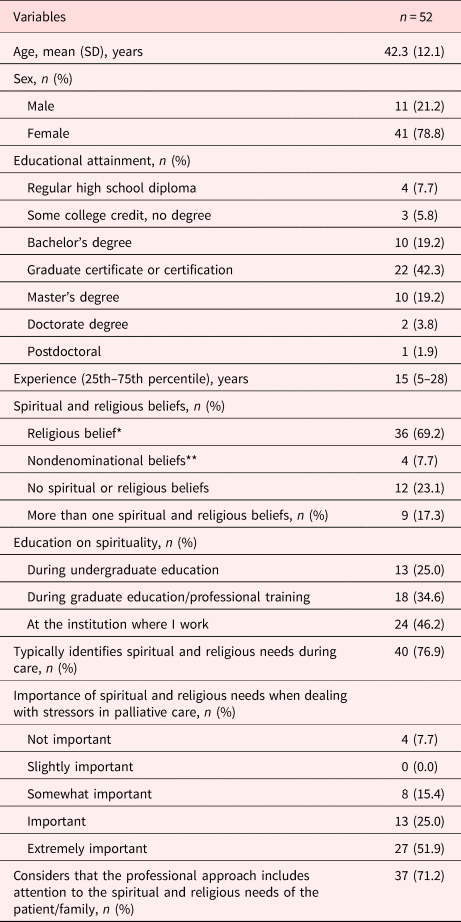
Of the 52 participants who attended the first meeting, 42 also attended the second meeting and completed the activity. The mean age of the participants was 42.3 (SD = 12.1) years, and 78.8% (n = 41) were women. Regarding educational attainment, most respondents had completed a graduate certificate or certification (42.3%) or a master's degree (19.2%). The median length of professional experience was 15 (interquartile range, 5–28) years. Overall, 76.9% (n = 40) of the participants reported having spiritual and religious beliefs, whereas 17.3% (n = 9) reported having more than one belief at the same time (Table 1).
Characteristics of healthcare professionals participating in the study

*Catholic (62.5%), Spiritist (30%), Buddhist (5%), Evangelical (5%), Umbanda (2.5%).
**Higher/cosmic forces (7.5%), self-awareness (5%), doing good for others (5%), spiritual life philosophy (2.5%), agnostic (2.5%).
Only 25.0% (n = 13) of the participants had learned about spirituality and spiritual care provision during undergraduate education, and 46.2% (n = 24) reported participating in spirituality-related programs at the workplace. During daily care, 76.9% (n = 40) reported that they usually identify the spiritual and religious needs of their patients in palliative care, whereas 71.2% (n = 37) considered that their professional approach included attention to the spiritual needs of the patient/family. Furthermore, healthcare professionals considered their spiritual and religious needs were important (25.0%; n = 13) or extremely important (51.9%; n = 27) when dealing with stressors during palliative care (Table 1).
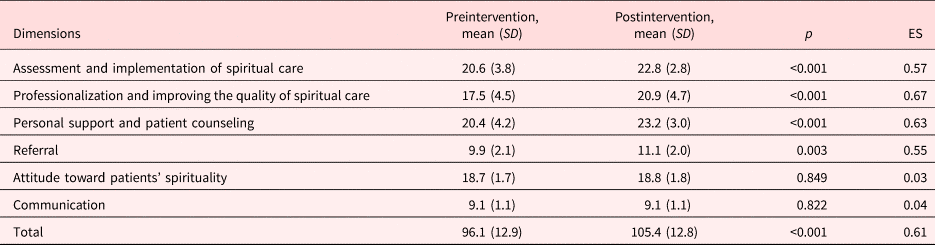
When the pre- and postintervention SCCS-Brazilian version scores were compared, significant differences were observed in the following dimensions: assessment and implementation of spiritual care, professionalization and improving the quality of spiritual care, personal support and patient counseling (p < 0.001), and referral (p = 0.003). There was also a significant difference in the total SCCS-Brazilian version score before and after intervention (p < 0.001). The dimensions “attitude toward patients’ spirituality” and “communication” showed no significant differences before and after the intervention (Table 2).
Comparison of pre- and postintervention scores obtained by the healthcare professionals who completed the continuing education activity

ES, effect size.
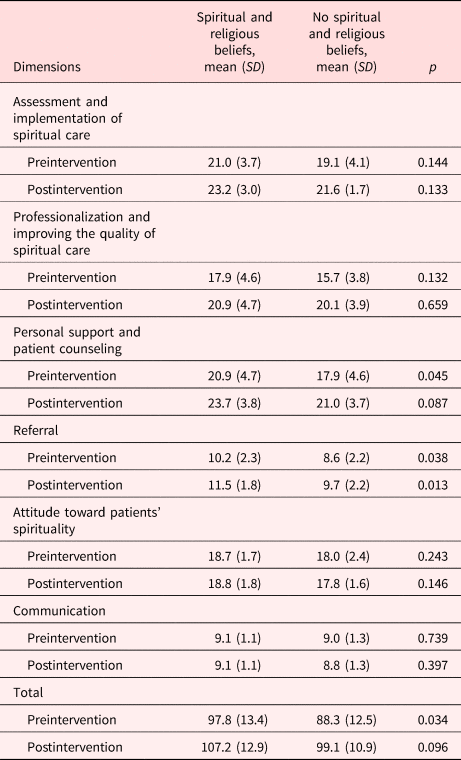
As shown in Table 3, the total score (p = 0.034) and the mean scores for spiritual and religious beliefs in the dimensions “personal support and patient counseling” (p = 0.045) and “referral” (p = 0.038) showed significant differences during the preintervention period, but only the “referral” dimension remained significant after intervention.
Association with spiritual and religious beliefs

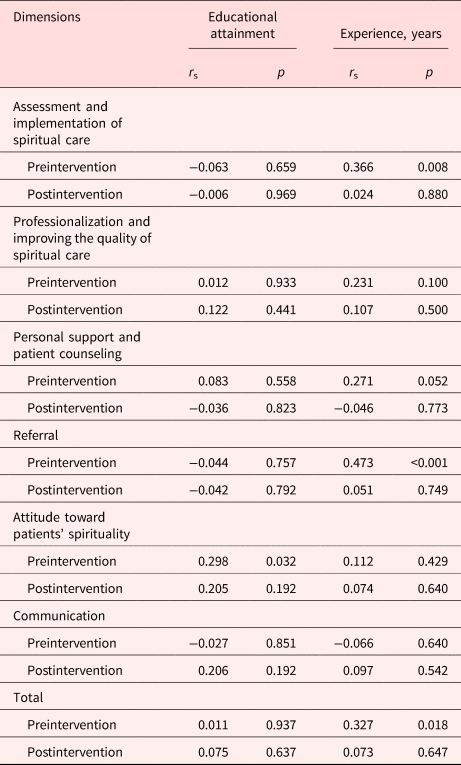
As shown in Table 4, there was a statistically significant positive association between educational attainment and the dimension “attitude toward patients’ spirituality” (p = 0.032) before intervention, but this association was not maintained after intervention (p = 0.192). As for years of experience, there was a significant positive association with “assessment and implementation of spiritual care” (p = 0.008), “referral” (p < 0.001), and total score (p = 0.018), but these associations were not maintained after intervention.
Association between educational attainment and years of experience

r s, Spearman correlation coefficient.
Discussion
According to the present results, 76.9% of the participants had spiritual and religious beliefs, and 17.3% had more than one belief at the same time. These data are not commonly reported in other studies, which may be explained by Brazilian cultural aspects. In a study analyzing religious syncretism in a nationally representative sample of the Brazilian population, however, 10.4% of adults reported adhering to more than one religion (Moreira-Almeida et al. Reference Moreira-Almeida, Pinsky and Zaleski2010). Furthermore, our data showed that 21% of the participants had no spiritual and religious beliefs. A multicenter study involving 12 Brazilian medical schools and 5,950 medical students showed that, regarding religious beliefs, 66.1% had a religious affiliation and 18.2% attended religious services frequently (Lucchetti et al., Reference Lucchetti, Oliveira and Koenig2013). These results are different from those found in the general Brazilian population, in which 95% have a religious affiliation and 37% frequently attend religious services (Moreira-Almeida et al., Reference Moreira-Almeida, Pinsky and Zaleski2010).
Healthcare professionals participating in this study recalled a few instances of learning about spirituality during their undergraduate studies. Even when working with patients/families in palliative care, only 46.2% of them had previously participated in educational or scientific events about spirituality in care. A study of physicians with special training in palliative care showed that more than one-half of the sample had previously received training or education in spiritual care, but only one-third had pursued further education on this topic in the previous two years. Among those seeking further information, the most common sources were spirituality seminars and reading about the topic (Best et al., Reference Best, Butow and Olver2016b). The paucity of knowledge on this subject is also illustrated by a survey-based study of 339 physicians and nurses caring for patients with advanced cancer, in which only 12% of nurses and 14% of physicians reported receiving specific spiritual care training (Balboni et al., Reference Balboni, Sullivan and Amobi2013). Similarly, a study involving nursing students and professors pointed to a lack of information on spirituality and suggested that courses on this subject should be included in the curricula (Tomasso et al., Reference Tomasso, Beltrame and Lucchetti2011).
Another important finding of our study was that, even though participants were poorly prepared as undergraduates and at the workplace to provide spiritual care, they were able to identify and meet the spiritual and religious needs of patients in palliative care (Table 1). These results are consistent with those of a previous study showing that most healthcare professionals would like to provide spiritual care to terminally ill patients (nurses = 74%, physicians = 60%); however, 39% of nurses and 41% of physicians reported delivering spiritual care less frequently than desired (Balboni et al., Reference Balboni, Sullivan and Enzinger2014).
In the same vein, the Multinational Association of Supportive Care in Cancer surveyed its members to determine their approach to spiritual care in caring for terminally ill patients. Of 271 respondents, 88 (33%) reported that they provide spiritual care most of the time; however, 33.6% reported that they seldom provide adequate spiritual care and 25.8% do not feel they can provide it adequately. Furthermore, 80 respondents (29.5%) claimed to have some kind of training or education regarding spiritual care (Ramondetta et al., Reference Ramondetta, Sun and Surbone2013). A study involving members of the Australian and New Zealand Palliative Medicine Society showed that 54% of respondents thought they were seldom or never able to adequately provide spiritual care, and only 5% felt they could always provide it. These findings suggest that, although healthcare providers working primarily with patients in palliative care attributed a high level of importance to spiritual care, their ability to care for cancer patients in this regard remains a problem independently of context (Best et al., Reference Best, Butow and Olver2016b).
The dimensions “attitude toward patients’ spirituality” and “communication” did not differ significantly before and after the intervention. This may be attributed to a preintervention self-evaluation at the highest levels scores, that is, the participants felt they performed well in these dimensions previously. The educational intervention therefore produced no significant changes in these dimensions of care.
The results of our continuing education activity suggest that the intervention was effective in developing the competences needed by healthcare providers to address and meet the spiritual needs of patients/families in palliative care. This was evident from the improved total SCCS-Brazilian version scores (p < 0.001) after participation in the continuing education activity. Based on the results, the statistically significant differences that existed before the intervention between professionals with spiritual and religious beliefs, different levels of education, and more professional experience disappeared after the intervention (Tables 3 and 4). Our data also demonstrate that the proposed continuing education activity is an effective strategy to minimize gaps in this area during traditional graduation/education programs and indicate that the path followed is in accordance with the 2009 Spiritual Care Consensus Conference recommendations to advance the delivery of spiritual care in the palliative care setting (Puchalski et al., Reference Puchalski, Ferrell and Virani2009).
Strengths and limitations of the study
This study provides evidence of the importance of including topics such as spirituality and spiritual care in palliative care programs through continuing education activities in healthcare institutions. Based on the present results, however, it is not possible to conclusively determine that the improvements obtained after the educational intervention resulted in an approach that can effectively identify and address the spiritual and religious needs of patients/families in palliative care. Further studies are still required to determine the effect of this intervention on the provision of spiritual care and quality of life of patients/families in palliative care. In addition, because our findings are based on a small sample from a single center, these data cannot be generalized to other populations. Future research with a control group, a large sample, and other active methods of continuing education will be needed.
Conclusion
After comparing pre- and postintervention periods, results show that a continuing education activity with support materials for daily use can contribute to the development of competences that help healthcare professionals identify and meet spiritual and religious needs in palliative care. This study provides some evidence that may be useful to health educators in designing interventions to address spirituality and spiritual care, underscoring the need to include these themes into curricular bases and continuing education programs for palliative care within healthcare organizations.
Acknowledgments
This study was funded by the Research and Event Promotion Fund of the Hospital de Clínicas de Porto Alegre (FIPE/HCPA).
Conflicts of interest
The authors declare no potential conflicts of interest with respect to the research, authorship, and/or publication of this article.