I. INTRODUCTION
Ti2AlC, one of the ternary layered compounds Mn+1AXn, also called MAX phases, where M is an early transition metal, A is mostly IIIA and IVA-group element, and X is either C and/or N, has been widely investigated due to its remarkable properties of both metals and ceramics, such as good electrical and thermal conductivity, low density, ready machinability, excellent thermal shock resistance, and high temperature oxidation resistance.Reference Barsoum1–Reference Bai, He, Li, Zhu and Zhang6 Such unique properties make it possible to use Ti2AlC in structural components for high-temperature applications and as oxidation-resistant coatings on alloy surfaces. However, compared with traditional binary carbide ceramics, Ti2AlC has low hardness and strength, which limit its wide applications in structural components. Thus, an improvement in the hardness and strength of Ti2AlC is desirable to overcome this drawback and widen its applications.
Previous theoretical and experimental work revealed that substitutions at the M, A, or X sites of MAX phases are all feasible to increase the hardness and strength of Ti2AlC.Reference Salama, El-Raghy and Barsoum7–Reference Meng, Zhou and Wang12 For example, Wang et al.Reference Wang and Zhou11 predicted that solid solution strengthening may be operative for MxM′2−xAlC (M and M′ = Ti, V, and Cr) solid solutions as the valence electron concentration is in the range 8.4–8.6. Meng et al.Reference Meng, Zhou and Wang12 used solid solution treatment to tune the properties of Ti2AlC, and the Vickers hardness, flexural strength, and shear strength were enhanced by 29%, 36%, and 45%, respectively, for the (Ti0.8,V0.2)2AlC solid solution.
In recent years, incorporation of a second phase has become another effective way to reinforce the mechanical properties of MAX phases.Reference Luo, Li, Chen, Wang, Li and Pan13–Reference Chen and Zhou17 On account of its high hardness, high modulus, excellent chemical stability, and compatible thermal expansion coefficient, Al2O3 has been considered as an effective reinforcement for the MAX carbides, like Ti3SiC2Reference Luo, Li, Chen, Wang, Li and Pan13,Reference Wang, Jin and Miyamoto14 and Ti3AlC2.Reference Chen, Liu, Bao and Zhou15–Reference Chen and Zhou17 The Ti3AlC2/Al2O3 composite has been fabricated by an in situ hot pressing/solid–liquid reaction process using Ti, Al, graphite, and Al2O3 powders as starting materials.Reference Chen, Liu, Bao and Zhou15–Reference Chen and Zhou17 In comparison to monolithic Ti3AlC2, the Ti3AlC2/Al2O3 composites substantially improved in hardness, toughness, compressive strength, and flexural strength.Reference Chen and Zhou17 Moreover, the addition of Al2O3 into the Ti3AlC2 matrix was shown to enhance its friction behavior and wear resistance.Reference Wu, Chen, Liu, Bao and Zhou18
However, the effect of the combination of solid solution with Mo and incorporation of a second phase Al2O3 on the mechanical properties of Ti2AlC has not been reported until now. Moreover, the reactive synthesis combined with the Al-based thermite reaction represents an in situ approach to produce Al2O3-reinforced composites with interpenetrating microstructures.Reference Merzhanov19,Reference Yeh, Kuo and Chu20 Chen et al.Reference Chen, Li and Zhou16 obtained Ti3AlC2/TiC–Al2O3 composites by in situ synthesis in the mode of thermal explosion from a compacted pellet composed of 3TiO2–5Al–2C. Recently, Yeh et al.Reference Yeh, Kuo and Chu20 successfully prepared the Ti3AlC2/Al2O3 and Ti2AlC/Al2O3 composites through in situ synthesis involving the thermite reaction of Al with TiO2. However, the microstructure is loose because of the thermal explosion reaction between Ti and C. Moreover, the mechanical properties were not measured.
There is a reportReference Yeh and Shen21 that uses some Mo as an active additive in reinforcements for the Al matrix composites. However, there is less report about addition of Mo as an additive on the microstructure and properties of Ti2AlC-based composite. Thus, the purpose of this paper is to modify the microstructure and mechanical properties of Ti2AlC by a combination of solid solution and incorporation of a second reinforcement using the in situ reactive hot pressing method in Ti, Al, TiC, and MoO3. The effect of MoO3 content in the starting materials on the mechanical properties was also investigated in detail.
II. EXPERIMENTAL
For the synthesis of (Ti,Mo)2AlC/Al2O3 in situ composites by reactive hot pressing, powders of Ti (200 mesh, 99.5% purity), Al (200 mesh, 99.5% purity), TiC (200 mesh, 98.0% purity), and MoO3 (200 mesh, 99.5% purity) were used as starting constituents. The powders were weighed with compositions according to reaction formula (1), and mass fraction of Al2O3 in the composites is 0%, 5%, 10%, and 20%, respectively. The detailed component of the samples is listed in Table I.
 $$(1 - 2{\rm{X}}){\rm{Ti}} + (4{\rm{X}} + 1){\rm{ Al}} + {\rm{TiC}} + 2{\rm{XMoO}}_3 \to ({\rm{Ti}}_{1 - {\rm{X}}} {\rm{Mo}}_{\rm{X}} )_2 {\rm{AlC}} + 2{\rm{XAl}}_{\rm{2}} {\rm{O}}_{\rm{3}} \quad .$$
Component of the samples.

After being ball milled in ethanol for 1 h, the powders were dried for several hours. Then the powder mixtures were compacted uniaxially at 10 MPa in a graphite mold precoated with BN. The compacted samples were hot pressed in vacuum (∼10−2 Pa) according to the following heating process: room temperature to 500 °C for 1 h, 500–900 °C for 1 h, 900–1350 °C for 1.5 h and retain the temperature for 2 h under a pressure of 15 MPa, and cooled down to ambient temperature in the furnace. The surface layers of the samples were machined to remove contaminants prior to characterization.
Phase compositions of the obtained samples were identified by x-ray diffraction [XRD, D/max-2200 PC X, Rigaku, Cu target, Kα radiation (40 KV and 30 mA)], at a scanning step of 0.02° and a scanning rate of 1° per minute. Powders for XRD were smashed from the bulk samples, and then ground in an agate mortar. To examine the change in lattice parameters of Ti2AlC on addition of MoO3, the complete profile of the powder diffraction pattern was refined using the Rietveld method using the DBWS code in the Cerius2 computational program for materials research (Molecular Simulation Inc., USA). The intensity is represented by
 $$I_{\rm Rietveld} (2{\rm{\theta }}) = b(2{\rm{\theta }}) + s\mathop\sum\limits_K {L_K \left| {F_K } \right|} ^2 \phi (2{\rm{\theta }}_i - 2{\rm{\theta }}_K )P_K A_K \!\quad ,$$
where b(2θ) is the background intensity, s is a scale factor, L K contains the Lorentz polarization and multiplicity factors,  $\phi$ is the profile function, P K is the preferred orientation function, A K is the absorption factor, and F K is the structure factor. The subscript K represents Miller indices for the Bragg reflections.
The microstructures were observed by scanning electron microscopy (SEM, JEOL JSM-6700F, Japan) equipped with energy dispersive spectroscopy (EDS). Densities of the composites were measured by the Archimedes method. The Vickers hardness was obtained at a load of 10 N with a dwell time of 15 s. The compressive tests were conducted using specimens with a dimension of 4 × 4 × 8 mm3. The height of the specimen is vertical to the direction of hot pressing. The load plates were of high alloy steel. The crosshead speed of 0.05 mm/min was used in compressive testing. Three-point bending test was used to measure the flexural strength and fracture toughness at room temperature, by the PT-1036PC material tester (Perfect Instrument Co. Ltd, Taiwan, China) with a loading span of 20 mm at a crosshead speed of 0.5 and 0.05 mm/min, respectively. The size of specimens for flexural strength and fracture toughness testing is 4 × 4 × 30 mm3. The fracture toughness was measured by the single-edge notch beam method. The notch with the size of 2 mm length and 0.15 mm width was made by electrical discharge method. The changes of load and deflection with time were automatically recorded by the data acquisition program. At least five samples were measured for each kind of test.
III. RESULTS AND DISCUSSION
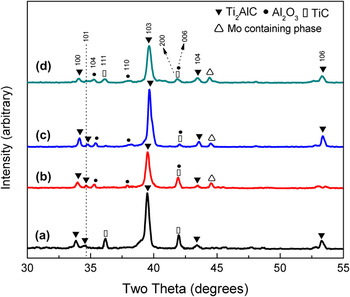
The XRD diffraction patterns of the Ti2AlC monolithic and (Ti,Mo)2AlC/Al2O3 in situ composites obtained by the hot pressing at 1350 °C for 2 h are shown in Fig. 1. As revealed in Fig. 1(a), Ti2AlC is identified as the dominant phase and TiC the secondary phase in the product constituents from the starting powders of Ti–Al–TiC. This is consistent with the phase relationship in the Ti–Al–C ternary phase diagram.Reference Pietzka and Schuster22 The presence of the TiC phase in the final product has also been obtained in the synthesis of Ti2AlC in the previous work,Reference Yeh and Shen21,Reference Yeh and Shen23 which reveals that the high reaction temperature and short reaction time among the exothermal reactant Ti–Al–C are unfavorable for the formation of single phase Ti2AlC.
XRD patterns of (Ti,Mo)2AlC/Al2O3 in situ composites hot pressed at 1350 °C for 2 h (a) 0% Al2O3, (b) 5 wt% Al2O3, (c) 10 wt% Al2O3, and (d) 20 wt% Al2O3.

When the thermite reaction of Al with MoO3 is involved in the Ti–Al–TiC system, in situ formation of Al2O3 along with Ti2AlC is confirmed in Figs. 1(b)–1(d). Moreover the minor content of Mo–Al intermetallics is detected in all products, which will be further discussed in the following texts. The TiC phase is reduced when Al2O3 content is below 10 wt%, indicating an improvement in the evolution of Ti2AlC. According to the previous studies,Reference Yeh, Kuo and Chu20 a reduction of TiC in the Ti2AlC/Al2O3 in situ composites could be attributed to the lower reaction temperature and the prolonged reaction time caused by the incorporation of the thermite reaction. As indicated by the XRD peak intensity, the relative content of TiC to Ti2AlC is increased again when the Al2O3 content was increased to 20 wt%, which may be due to the hindering effect of too much of in situ formed Al2O3 on the sintered product.
As shown in Fig. 1, although the dominant phase in all resulting samples is Ti2AlC indexed by the JCPD card no. 29-0095, it should be noted that the major reflection peaks evidently shift to large angles with the increment of MoO3 content in the initial constituents, which is attributed to the decrease of lattice parameters, due to the displacement of Ti by Mo formed by thermite reaction of Al and MoO3. The main reactions among Ti, Al, TiC, and MoO3 can be expressed as the following reactions:
 $${\rm{Ti}} + {\rm{Al}} \to {\rm{TiAl}}\quad {\rm{,}}$$
 $${\rm{TiAl}} + {\rm{TiC}} \to {\rm{Ti}}_{\rm{2}} {\rm{AlC}}\quad {\rm{,}}$$
 $${\rm{4Al + 2MoO}}_{\rm{3}} \to {\rm{2Mo + 2Al}}_{\rm{2}} {\rm{O}}_{\rm{3}} \quad ,$$
 $${\rm{2Mo}} + {\rm{Ti}}_{\rm{2}} {\rm{AlC}} \to {\rm{(Ti,Mo)}}_{\rm{2}} {\rm{AlC}}\quad {\rm{.}}$$
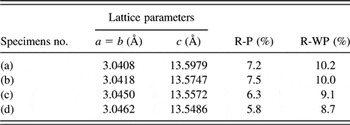
To quantitatively describe the change in the lattice parameters that resulted from the solid solution, Rietveld refinement of the diffraction patterns was performed using Ti2AlC as the structure mode. The calculated parameters, the reliability factors, i.e., R-P and R-WP values, are shown in Table II. The lattice constant a increase linearly, and the lattice constant c decreases linearly more significantly. The variation of the lattice parameters is mainly ascribed to strengthening or weakening of the electronic bond in the a and c directions because Ti and Mo possess similar atomic radii of 1.32 Å and 1.3 Å, and the latter has one more valence electron. This is consistent with the previous theoretic analysis by ab initio calculations,Reference Sun, Music, Ahuja, Li and Schneider24,Reference Musica, Sun, Voevodinc and Schneidera25 which reveals that the transition metal Mo in Mo2AlC has a strong coupling chemical bonding between the MoC layers and Al layers, whereas the Ti in Ti2AlC possesses a weak coupling due to the difference in valence electron population of the transition metal. These results may have implications for the understanding of the decrease in the c value with the replacement of Ti by Mo.
Calculated lattice parameters for Ti2AlC and (Ti,Mo)2AlC/Al2O3 composites.

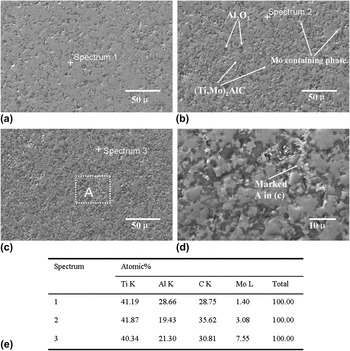
The SEM micrographs and EDS analysis of the polished (Ti,Mo)2AlC/Al2O3 in situ composite samples with different Al2O3 contents are shown in Fig. 2. The EDS results reveal that the matrix phase (light gray) is (Ti,Mo)2AlC, and (not shown here for brevity) the fine granular grains with dark color are in situ-formed Al2O3 particles, the white one is the Mo–Al intermetallics (with mole ratio of Mo:Al≈1:1). The magnified image of the Mo–Al intermetallics in Fig. 2(d) shows a dendritic morphology. The formation of Mo–Al intermetallics indicates that the excess Mo, that resulted from thermite reaction of Al and MoO3, reacts with Al melting. The previous workReference Wu, Yang, Xue and Sun26 reported that the MoAl5 phase would form when Mo addition was over 1.0 wt% in Al/TiC composites. The Al2O3 particles disperse uniformly throughout the material when its content is below 10 wt%. But when the Al2O3 content exceeds 10 wt%, e.g., in (Ti,Mo)2AlC/20 wt% Al2O3, agglomeration of the Al2O3 particles is observed to be serious, as shown in Fig. 2(c).
SEM images and EDS analysis taken from polished surfaces of (Ti,Mo)2AlC/Al2O3 in situ composites with different Al2O3 contents (a) 5 wt%, (b) 10 wt%, (c) 20 wt%, (d) magnified image of the typical area marked as A, and (e) matrix atomic ratio of samples. The light gray phase is (Ti,Mo)2AlC matrix, white phase is Mo containing dendritic phase, and the dark phase is Al2O3.

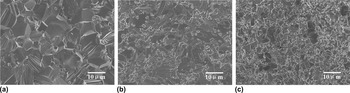
The SEM micrographs illustrated in Fig. 3 show typical fracture surfaces of the synthesized monolithic Ti2AlC and (Ti,Mo)2AlC/Al2O3 in situ composites sintered at 1350 °C for 2 h. As displayed in Fig. 3(a), the pure Ti2AlC sample shows predominantly elongated grain and uniform size with an average value of more than 10 μm in diameter and 5 μm in thickness, and the plate-like grains of Ti2AlC are closely packed into a laminated configuration, which is characteristic of the layered ternary carbide MAX.Reference Lin, Zhuo, Zhou, Li and Wang4 With increasing the amount of the in situ formed Al2O3 particles, the matrix grains vary from elongated morphology to equiaxed shape, and the size and the aspect ratio of the matrix evidently decreased, as presented in Figs. 3(b) and 3(c). The 13.81 wt% MoO3 addition [10 wt% Al2O3, Fig. 3(c)] developed a finer matrix structure with an average grain size of about only 5 μm, significant refinement of Al2O3 particles and more uniform distribution of Al2O3 particles in the matrix. Such microstructural evolution can be understood if it is postulated that the Al2O3 grains inhibit grain growth and the grain-boundary mobility. Moreover, Li et al.Reference Li, Liu, Zhang and Rong27 suggested that Mo could improve the wettability between ceramic phase and metallic phase due to the formation of a surrounding structure with rich Mo element, which prevents ceramic particles from aggregating. As a result, the size of Al2O3 particles reduced obviously with an average diameter of about 0.5 μm [Fig. 3(b)]. However, when the MoO3 content exceeds 13.81 wt%, the size of Al2O3 particles is increased again, and the agglomeration of the Al2O3 grains is also obviously observed.
Images of fracture surface of the monolithic Ti2AlC and (Ti,Mo)2AlC/Al2O3 samples. (a) 0% Al2O3, (b) 10 wt% Al2O3, and (c) 20 wt% Al2O3.

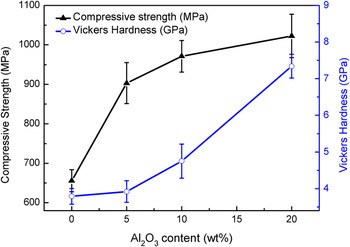
The measured density of (Ti,Mo)2AlC/Al2O3 composites increases gradually with increasing the Al2O3 content. For one hand, it is attributed to the substitution of Ti by relatively heavy Mo and the shrinkage in crystal structure in solid solutions. Another main reason is the formation of the Mo–Al phase, which has a higher density than those of Ti2AlC and Al2O3. Overall, the measured density of all samples used for mechanical tests is 98–99% of the theoretical density. The compressive strength and the Vickers hardness of the sintered samples with different Al2O3 contents are shown in Fig. 4. A significant increase in the hardness is observed with the increment of the in situ-formed Al2O3 content. The hardness increases from 3.79 GPa to a maximum of 7.34 GPa for the (Ti,Mo)2AlC/20 wt% Al2O3 composite, which is increased by 94% in comparison to that of the pure Ti2AlC (3.79 GPa). Similar to other MAX phases,Reference Hong, Mei and Zhou2,Reference Wang, Mei, Xiao and Zhou5 there is no crack initiated from the diagonals of the indent in all the composites. The indentation damage is confined to the vicinity of the indent. And the sliding, delamination, buckling, and breakup of the Ti2AlC grains are evidently observed in the vicinity of the indentations.
Compressive strength and Vickers hardness of (Ti,Mo)2AlC/Al2O3 composites with different contents of Al2O3.

The compressive strength increases from 655.57 to 1022.68 MPa with increasing Al2O3 content ranging from 0 to 20 wt%. It is interesting to note that in the compressive tests, the failure of the composites is noncatastrophic, except for the samples of (Ti,Mo)2AlC/20 wt% Al2O3 composites, which break into pieces upon failure. Products with Al2O3 content below 5 wt% [specimens (a) and (b)] exhibit obvious yield points between 700 and 900 MPa. The transition from elastic to plastic deformation is accompanied by a drop in the deformation resistance. Such an apparent discontinuous yielding indicates that dislocations play an important role during deformation.Reference Bohn, Klassen and Bormann28 When the in situ-formed Al2O3 content is over 10 wt%, although the fracture stress of the composites have been increased, there is no evident transition from elastic to plastic deformation to be observed.
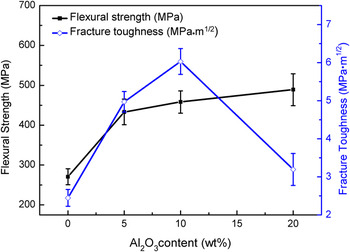
Figure 5 shows the effect of the in situ-formed Al2O3 content on the flexural strength and fracture toughness (KIC) of the composites. It can be seen that the flexural strength increases from 270.58 to 489.15 MPa as the mass content of Al2O3 increases linearly from 0 to 20 wt%. Although KIC increases first and reaches a maximum value of 6.03 MPa m1/2 at 10 wt% Al2O3 content, it then decreases dramatically to 3.20 MPa m1/2. The details of the mechanical properties of the as-fabricated (Ti,Mo)2AlC/10 wt% Al2O3 in situ composite are shown in Table III. For comparison, the mechanical properties of the monolithic Ti2AlC and its composites are also included. It can be seen that the fracture toughness of the monolithic Ti2AlC in this work is much lower than that in the previous work.Reference Meng, Zhou and Wang12 From the polished and fracture surface micrographs of the as synthesized Ti2AlC (Figs. 2 and 3), some residual porosity exists due to the low external pressure of 15 MPa, which accounts for the strength reduction of the composites. However, compared with the monolithic Ti2AlC, Ti2AlC solid solution, and other Ti2AlC-based composites, the mechanical behaviors of the investigated (Ti,Mo)2AlC/Al2O3 in situ composites are modified evidently due to a combination of several kinds of strengthening effects. First, the intrinsic properties of the Ti2AlC matrix are reinforced by the solid solution of Mo. Second, the responsible aspect is the refinement of the matrix that resulted from the inhibiting effect of the second small Al2O3 particles and bonding nature between such a reinforcement and the matrix due to the in situ reactions. In general, it has been demonstrated that grain refinement often improves mechanical properties. Third, modification of the homogeneity of dispersing distribution of both the matrix and the reinforcement phases by the in situ-formed Mo is also effective for improving the mechanical properties of the present composites.
Flexural strength and fracture toughness of samples.

Summary of typical properties of the as-prepared (Ti,Mo)2AlC/10 wt% Al2O3 in situ composite, together with those from previous works for comparison.

When the in situ-formed Al2O3 content exceeds 10 wt%, the Al2O3 grains agglomerate seriously, which could be responsible for the decreases in KIC of the (Ti,Mo)2AlC/Al2O3 composites. In addition, large amount of dendritic MoAl phase forms. Previous workReference Wu, Yang, Xue and Sun26 indicates that this phase is brittle, which would also lead to a decrease in KIC. Figure 3(c) shows that the card-frame structure is affected because of the decrease in the size and the aspect ratio of the matrix structure, which may be another reason for the decrease in KIC. In conclusion, this study has shown the improvement of the mechanical properties, including hardness, flexural strength, and fracture toughness of Ti2AlC material with addition of MoO3 in the Ti, Al, and TiC system, and the optimized in situ-formed Al2O3 content is about 10 wt%.
IV. CONCLUSIONS
Dense (Ti,Mo)2AlC/Al2O3 in situ composites were synthesized from Ti/Al/TiC/MoO3 by hot-press-assisted reactive synthesis under a uniaxial pressure of 15 MPa in vacuum at 1350 °C for 2 h. The matrix grain size was evidently refined with an increase in the amount of in situ formed Al2O3. The introduction of 10 wt% Al2O3 content evidently raises the hardness, flexural strength, and toughness of the composites by 25%, 69%, and 146%, respectively. However, the fracture toughness of (Ti,Mo)2AlC/20 wt% Al2O3 composites decreases due to Al2O3 agglomeration. The investigation shows the possibility of increasing the mechanical properties of Ti2AlC by synthesizing (Ti,Mo)2AlC/Al2O3 in situ composites.
ACKNOWLEDGMENTS
This work was supported by the National Foundation of Natural Science, China (Grant Nos. 51272145 and 51171096), the Natural Foundation of Shaanxi Province, China (Grant No. 2010JM6014), and the Graduate Innovation Fund of Shaanxi University of Science and Technology.