Introduction
Sheep production in the EU is now market driven rather than subsidy driven as a consequence of decoupling of farm subsidies from production. Sheep producers have a number of options for increasing margins from the enterprise including increasing lamb carcass output per hectare through improved efficiencies (Keady and Hanrahan, Reference Keady and Hanrahan2006) or extended (deferred, winter) grazing that necessitates a reduction in stocking rate (Keady et al., 2008) and production costs. Whilst winter conditions in Ireland are relatively mild and wet, daily grass dry matter (DM) growth declines to less than 5 kg/ha for a prolonged period. Consequently, on sheep farms in the lowlands, ewes may be either housed and offered predominantly grass silage, or confined outdoors on a small area of the holding and grazed to allow herbage to accumulate for the following grazing season. Previous studies at this centre have shown that extended grazing of ewes in mid-pregnancy (Flanagan, 2003; Keady et al., Reference Keady, Hanrahan and Flanagan2007a), late pregnancy (Keady et al., Reference Keady, Hanrahan and Flanagan2007a) or throughout pregnancy (Keady et al., Reference Keady, Hanrahan and Flanagan2007a and 2008) increased lamb birth and weaning weights relative to progeny from ewes housed unshorn. Keady et al. (Reference Keady, Hanrahan and Flanagan2007a) also observed that ewes shorn at housing and offered grass silage indoors produced progeny with similar birth and weaning weights as ewes that were extended grazed throughout pregnancy probably due to reduced heat stress associated with the removal of the fleece in mid-pregnancy and the outdoor environment, respectively. Whilst increasing lamb birth weight is one of the advantages of extended grazing ewes throughout pregnancy, a major disadvantage is the reduced stock-carrying capacity (by 3.7 ewes/ha) of a system based on extended grazing during winter (Keady et al., 2008). Keady and Hanrahan (Reference Keady and Hanrahan2007c) reported that extended grazing increased, margin per ewe but decreased margin per hectare, which is the major factor affecting farm income due to the reduced stock-carrying capacity.
Silage feed value is determined by its intake characteristics and digestibility. Crop yield is a major factor affecting the costs of silage production (Keady et al., 2002a) and the feed value declines as crop yield increases (Keady et al., Reference Keady, Mayne and Fitzpatrick2000). Steen et al. (Reference Steen, Gordon, Dawson, Park, Mayne, Agnew, Kilpatrick and Porter1998) concluded that digestibility and the protein and fibre fractions are the major factors affecting silage DM intake. Furthermore, Patterson et al. (Reference Patterson, Yan, Gordon and Kilpatrick1998) and Keady et al. (2002b) reported that increasing silage DM concentration by wilting pre-ensiling increased forage intake. Silage chop length has a major impact on silage intake by sheep (Dulphy and Dermarquilly, Reference Dulphy and Dermarquilly1972; Fitzgerald, Reference Fitzgerald1996). Increasing silage digestibility has been shown to increase the performance of beef cattle (Steen, Reference Steen1987; Keady et al., Reference Keady, Lively, Kilpatrick and Moss2007b), dairy cows (Gordon, Reference Gordon1980; Keady et al., Reference Keady, Mayne, Fitzpatrick and Marsden1999) and finishing lambs (Fitzgerald, Reference Fitzgerald1987).
The aims of the current study were to: (1) evaluate the effects of herbage allowance during extended grazing in mid-pregnancy when followed by a high herbage allowance in late pregnancy on ewe and subsequent progeny performance, (2) evaluate shearing at the time of housing and the feed value of grass silage offered whilst housed and their interactions on ewe and subsequent progeny performance, (3) compare the feed value of extended-grazed herbage relative to grass silage, and (4) compare the effects of extended grazing on ewe and subsequent lamb performance with those due to shearing ewes at housing.
Material and methods
Animals and management
One hundred and twenty crossbred ewes (Belclare × Scottish Blackface or Chamoise × Scottish Blackface; sixty 1.5-year-old animals and sixty 2.5-year-old animals; mean initial liveweight 67.6 kg (s.d. 6.04), mean initial condition score 3.7 (s.d. 0.25)) were allocated at random, balanced with respect to breed and age, to one of six treatments for the period from 19 December (day 63 of pregnancy) until lambing in mid-March. The ewes had been synchronised using progesterone-impregnated sponges and were joined with rams (on 14 October) prior to the expected date (17 October) of the subsequent estrus. Ewes that held to the service at this estrus were used. The six treatments were as follows: two silage feed values (low and medium) offered during mid- and late pregnancy (from day 67 to lambing) × two shearing treatments for housed ewes (shorn and unshorn) and two extended-grazed pasture allowances (1.0 and 1.8 kg DM/ewe daily) offered during mid-pregnancy (days 63 to 107) followed by a common herbage allowance during the last 6 weeks of pregnancy. The housed ewes were in four slatted pens per treatment with five animals per pen, and grass silage was offered once daily in sufficient quantities to allow a refusal of 50 to 100 g/kg offered.
The herbage allowance treatments were rotated within the paddock once weekly, from 19 December to 1 February, to avoid any confounding between location in the paddock and treatment effects. From 1 February to lambing in mid-March, the low and high herbage allowance ewes were grazed as one flock and offered the same daily herbage DM allowance of 1.5, 1.6, 2.0, 2.0 and 2.0 kg per ewe during weeks 6, 5, 4, 3 and 2 prior to parturition, respectively. The ewes were then moved to lambing paddocks and the stocking density was reduced on 7 March for lambing on 14 March.
Each ewe received 23.4 kg of a pelleted concentrate during the last 6 weeks prior to lambing. Concentrate allowance per ewe was stepped up from 0.3 to 0.8 kg per day between weeks 6 and 1 prior to lambing. The concentrate consisted of 350, 350, 250, 25 and 25 g/kg barley, sugar beet pulp, soya bean meal, molasses and minerals plus vitamins, respectively. The concentrate was offered in one feed daily (at around 1000 h).
Housed ewes and their lambs were turned out to pasture within 3 days of lambing. All ewes rearing singles and twins received 0.5 kg of the prelambing concentrate/head daily for 2 weeks post turnout, due to grass scarcity, and were grazed in one flock in a rotational grazing system. Ewes rearing triplets were grazed as a separate flock and received a concentrate supplement (1 kg/day) for 5 weeks post lambing. Concentrate was offered to lambs reared as triplets, to a maximum of 300 g per lamb daily, until weaning. All lambs were weaned at 14 weeks.
Forages
Low and medium feed-value grass silages were ensiled from predominantly perennial ryegrass permanent pastures on 30 May (precision chopped) and 5 August (big baled), respectively. The herbage was mown using a mower conditioner (Kuhn FC 302G; Kuhn S.A., Severna, France). The precision-chop silage was harvested after a 36-h wilt using a trailed harvester (JF FCT 1050 harvester; JF-Stoll, Sondeborg, Denmark) and ensiled, untreated, in a walled trench silo. The bale silage was conserved as round bales (Claas Rollant 225; Claas, Harsewinkel, Germany), untreated, following a 30-h wilt. Immediately after baling, the bales were transported to the storage area and wrapped (McHale 991 Bale wrapper; Ballinrobe, Mayo, Ireland) using six layers of film and stacked three layers high.
Predominantly perennial ryegrass permanent pasture that had been harvested for silage on 6 September received fertiliser N (34 kg/ha) immediately and was grazed between 19 December and lambing in mid-March.
Measurements and calculations
Pre-grazing sward height was recorded using a rising plate meter (Ashgrove plate meter; Hamilton, New Zealand) twice weekly during extended grazing at 80 locations taken randomly across the area to be grazed the next day. Post-grazing sward heights were recorded twice weekly at 20 locations randomly chosen within each treatment area grazed the previous day. Pre-grazing herbage mass (above 2 cm) was determined twice weekly, until 6 weeks prior to lambing and weekly until lambing, by cutting four randomly selected strips (3.2 m × 0.65 m) within the area to be grazed, using a reciprocating finger bar mower (Agria; Moeckmuehl, Germany). Herbage harvested from each strip was weighed separately, and the length of each strip was recorded. A representative bulked sample of herbage was used to determine oven dried DM concentration after which dried samples were milled and analysed for crude protein (CP), ash, acid detergent fibre (ADF) and neutral detergent fibre (NDF). A further representative sample of the fresh herbage was used for the analysis of water-soluble carbohydrate (WSC). Pre-grazing herbage mass below 2 cm was determined by cutting two 1-m strips to the ground level using a hand-held clipper (Gardena; Ulm, Germany) within each strip harvested to 2 cm. All herbages were collected, washed to remove soil contamination, and oven dried at 100°C for 48 h. A representative dried sample was retained for the determination of ash concentration.
Herbage mass post grazing was determined by cutting two 1 m strips to ground level using a hand-held clipper, within each treatment area twice weekly until 6 weeks prior to lambing. The total sample was collected, washed to remove soil contamination and dried at 100°C for 48 h. A representative dried sample was retained for the determination of ash concentration.
Mean individual herbage DM intake was estimated twice weekly by the difference between pre- and post-grazing herbage mass to ground level divided by the number of ewes per treatment. Herbage utilisation was estimated as herbage consumed (pre-grazing yield minus post-grazing yield) expressed as a proportion of pre-grazing herbage yield.
Silages offered and refused were sampled daily for the determination of oven dried DM, and dried samples of offered silage were bulked weekly for the determination of ADF, NDF and ash. Further composite samples of offered silage were taken once weekly and analysed for alcohols, gross energy, CP, ammonia nitrogen (N), acetate, propionate, butyrate, valerate and lactate concentrations and pH. A representative sample of each silage was removed and frozen for the determination of apparent digestibilities and metabolisable energy (ME) concentration when offered at maintenance to male castrate sheep.
Silage DM was determined by oven drying at 85°C for 24 h. Alcohol-corrected toluene silage DM was determined as described by Porter and Murray (Reference Porter and Murray2001). Chemical composition of the herbage, silage, urine and faeces were determined as described by Keady et al. (Reference Keady, Mayne and Marsden1998 and Reference Keady, Mayne, Fitzpatrick and Marsden1999).
The silages were offered once daily in sufficient quantities to allow a refusal of 100 g/kg intake. Mean silage DM intake per head was determined on a weekly basis per pen of animals (four replications per treatment).
The apparent digestibilities and ME concentrations of the forages offered at maintenance level, were determined using four male castrate sheep per forage. The sheep were housed in digestibility crates designed to allow separate collection of urine and faeces. The digestibility study had a 22-day duration consisting of a 14-day pre-experimental period to allow the animals to adjust to the forages, a 6-day feed-in period and the daily collection of faeces and urine for a 6-day period with a 48-h interval between the first feed and first collection. Faecal and urine samples were taken daily for each animal in proportion to the total quantity produced. Sulphuric acid was placed in the urine collection vessels whilst toluene was added to the daily faecal sample for each animal to prevent degradation. The six faecal and urine samples for each animal were bulked and a composite sample was retained for analysis.
The silage for the apparent digestibility of the medium feed-value silage was removed from the silo midways through the feeding study as described by Keady et al. (Reference Keady, Mayne and Marsden1998). The silage for the apparent digestibility of the low feed-value silage was removed from two bales taken at random, thoroughly mixed, sealed in 5-kg bags and frozen until required for the digestibility study. The herbage for the digestibility study was obtained by mowing representative areas of the paddocks to approximately 1 cm (to avoid soil contamination) using a reciprocating finger bar mower. The herbage was thoroughly mixed, sealed in 5 kg bags and frozen until used in the digestibility study.
Ewe live weight and condition score (Russel et al., Reference Russel, Doney and Gunn1969) were recorded on two consecutive days prior to the study, two consecutive days at the end of the mid-pregnancy extended grazing treatment (day 107 of pregnancy), and at weeks 5, 10 and 14 post lambing. Ewe condition score was also assessed within 24 h of parturition. Lambing difficulty was assessed on a three-point scale: 1 = unassisted, 2 = slight intervention and 3 = major intervention. All lambs were tagged in each ear and weighed within 24 h of birth and were weighed again at 5, 10 and 14 (weaning) weeks of age. Lamb growth rate was calculated for the 0–5-, 5–10- and 10–14-week intervals and from birth to weaning.
Statistical analysis
Animal performance data were analysed as a completely randomised study using Proc GLM and Proc MIXED (Statistical Analysis Systems Institute, 2000). For all variables the model included fixed effects for treatment, ewe genotype and ewe age. Pre-experimental liveweight was used as a covariate for ewe liveweight. Pre-experimental condition score was used as a covariate for ewe condition score. For the analysis of lamb weights and growth rate, the model included sex and rearing type (number reared per ewe) as fixed effects and ewe identity as a random term. In the case of birth weight, rearing type was replaced by birth type.
The differences among the four indoor treatments were partitioned using orthogonal contrasts to evaluate the effects of shearing, silage feed value and their interaction. The contrast between the two herbage allowances was also evaluated. The performance of extended-grazed ewes was compared with the ewes that were housed and shorn. Because the contrasts were not all orthogonal, Bonferroni adjustment was used for evaluating the significance of all contrasts. Data on herbage intake were analysed using Proc GLM and the model had effects for herbage allowance and date, and the herbage allowance × date interaction was treated as the error term. As there was no true replication for herbage allowance effects, any significant differences should be treated with caution. In the case of silage intake, pen within treatment provided replication and these data were analysed using Proc MIXED with pen as a random term. The final model had fixed effects for ewe age (ewes were penned by age within treatments), shearing treatment, silage feed value and week and the following interaction terms: age × week, silage feed value × week. Shearing treatment × week and shearing treatment × silage feed value were omitted as these effects did not approach significance (P > 0.80 and > 0.35, respectively) in a preliminary analysis.
Results
The chemical composition of the forages is presented in Table 1. The silages differed with respect to DM and ME concentrations and fermentation characteristics. The grazed herbage had a higher CP concentration than the two silages and had a similar ME concentration to the low feed-value silage. The DM, CP, ash, NDF and ADF concentrations of the concentrate were 882 g/kg, 207 g/kg DM, 65 g/kg DM, 359 g/kg DM and 153 g/kg DM, respectively.
Chemical composition of the forages

DM=dry matter.
1Metabolisable energy concentration determined through sheep given forage at maintenance and by assuming a methane energy loss of 0.08 of gross energy intake, with urine energy determined directly.
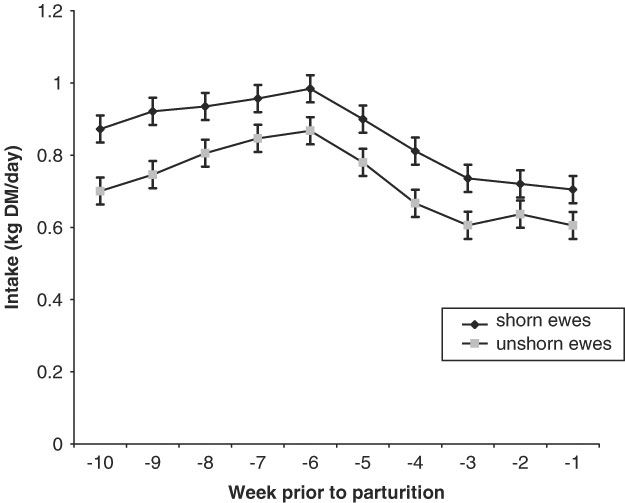
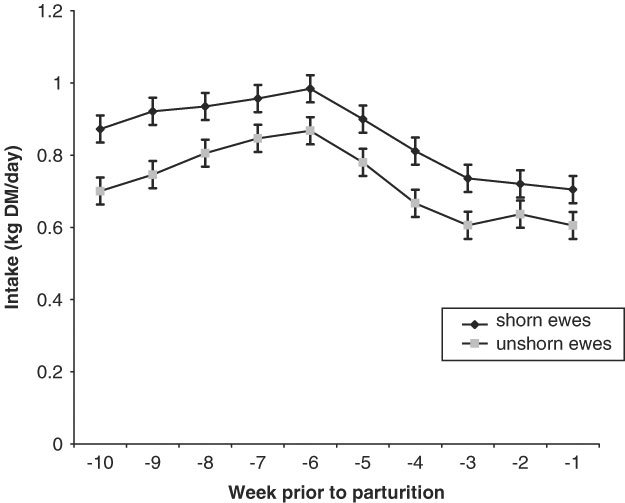
The effects of silage feed value and shearing treatment on silage intake are presented in Table 2. Shearing the ewes at housing increased (P < 0.05) silage DM intake. Silage feed value did not significantly affect silage DM intake. There was no significant shearing × week (Figure 1) or silage feed value × shearing interaction for silage DM intake.
Effects of silage feed value and shearing on silage dry matter intake (kg/day)

MFVS = medium feed value grass silage; LFVS = low feed value grass silage; SFV = silage feed value.
The effect of shearing on the silage dry matter intake of housed ewes in late pregnancy (kg/day) (vertical bars=s.e.).
The effects of herbage allowance on forage intake and utilisation during extended grazing from 19 December to 1 February are presented in Table 3. Increasing herbage allowance increased DM and OM intake (P < 0.05) but decreased DM and OM utilisation (P < 0.05).
Effect of herbage allowance for extended grazing on estimated herbage dry matter (DM) intake and utilization during mid-pregnancy (19 December to 1 February)

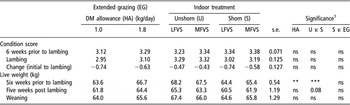
The effects of extended grazing, shearing indoors and silage feed value on ewe body condition and live weight are presented in Table 4. Increasing herbage allowance in mid-pregnancy increased ewe live weight (P < 0.01) at 6 weeks prior to lambing. Herbage allowance during mid-pregnancy did not significantly affect condition score at 6 weeks prior to lambing, at lambing or condition score change to lambing. Ewes shorn at housing were lighter at 6 weeks prior to lambing (P < 0.001) and tended to be lighter (P < 0.08) 5 weeks post lambing but had a similar condition score at lambing, condition score change to lambing and ewe weight at weaning relative to ewes housed unshorn. Ewe condition score and liveweight during the study were not significantly affected by silage feed value. Relative to ewes shorn at housing, extended grazing did not significantly affect condition score at 6 weeks prior to lambing, at lambing, condition score change to lambing or ewe liveweight at 6 weeks prior to lambing, 5 weeks post lambing or at weaning. There were no significant shearing treatment × silage feed value interactions for live weight or condition score.
Effects of herbage DM allowance for extended grazing, grass silage feed value and shearing on ewe condition score and liveweight

DM=dry matter; MFVS = medium feed value grass silage; LFVS = low feed value grass silage.
1There were no significant effects due to silage feed value, or shearing × silage feed value interactions.
Treatment had no significant effect on the incidence of lambing assistance; 86% of the ewes lambed without assistance. The effects of extended grazing, shearing treatment and silage feed value on litter size and number reared are presented in Table 5. There was no evidence for any effects of treatment on litter size or number reared. There were no significant (P > 0.05) shearing treatment × silage feed value interactions for litter size or number reared.
Effects of herbage DM allowance for extended grazing, grass silage feed value and shearing on litter size and number reared

DM=dry matter; MFVS = medium feed value grass silage; LFVS = low feed value grass silage.
1There were no significant effects due to shearing, herbage allowance, silage feed value or their interactions.
The effects of extended grazing, shearing treatment and silage feed value on lamb performance are presented in Table 6. Shearing ewes at housing increased lamb birth weight (P < 0.01) and tended to increase weaning weight (P = 0.07) and growth rate from birth to 5 weeks (P = 0.10) compared to ewes housed unshorn. Lambs from ewes that were extended grazed or housed shorn had similar birth and weaning weights and growth rate. Lamb birth and weaning weights or growth rate were not significantly altered by herbage allowance in mid-pregnancy or by silage feed. There were no significant shearing × silage feed value interactions for lamb birth or weaning weights or growth rate.
Effects of herbage dry matter (DM) allowance for extended grazing, grass silage feed value and shearing on lamb performance

MFVS = medium feed value grass silage; LFVS = low feed value grass silage.
1There were no significant effects due to herbage allowance or silage feed value or shearing × silage feed value interactions.
Discussion
One of the key objectives of the current study was to evaluate the feed value of extended-grazed herbage relative to grass silage. In the current study whilst the grass silages were offered ad libitum, the ewes on extended grazing in late pregnancy were offered a relatively high herbage allowance and supplemented with the same amount of concentrate as the housed ewes. The grass silages were harvested using different harvesting systems to vary the chop length, which has been identified as a major factor effecting silage intake by, and consequently feed value for, sheep (Dulphy and Dermarquilly, Reference Dulphy and Dermarquilly1972; Fitzgerald, Reference Fitzgerald1996). The grass silages offered in the present study were typical of grass silages produced in Ireland and the United Kingdom, based on their fermentation and feed-value characteristics (Keady, 2000). The herbage offered in the present study had similar CP, ash and estimated ME concentrations as autumn-saved pasture, comprising predominantly of perennial ryegrass, as reported by Flanagan (Reference Flanagan1994) and Keady et al. (Reference Keady, Hanrahan and Flanagan2007a and 2008). As there were no significant interactions between shearing treatment and grass silage feed value, only the main effects are discussed.
Effects of extended grazing
Utilisation rate is one of the major factors affecting the cost of the grass consumed by grazing livestock (Keady et al., 2002a). The herbage utilisation rate was lower than the utilisation rates reported by Keady and Hanrahan (2007a and 2007b) probably due to a different soil type and higher rainfall at the site where the present study was undertaken. In the current study, increasing herbage allowance increased the daily DM intake by 0.19 kg but the utilisation rate of the additional 0.8 kg herbage DM allocated was only 0.24. Carson et al. (2003) reported that increasing herbage allowance to ewes in late pregnancy from 1.3 to 2.6 kg DM/day reduced the utilisation rate of the additional 1.3 kg of herbage to only 0.13. Consequently, while increasing herbage allowance increases herbage intake, the higher the allowance, the greater the quantity of material that will remain unutilised, which has a negative impact on the efficiency of extended grazing systems.
The increased lamb birth weight due to grazing for the duration of pregnancy compared to ewes housed unshorn was similar to the response reported by Keady et al. (Reference Keady, Hanrahan and Flanagan2007a and 2008). Previous authors have reported that grazing during mid-pregnancy (Keady et al., Reference Keady, Hanrahan and Flanagan2007a), late (Carson et al., Reference Carson, Dawson, Irwin and Kilpatrick2004; Keady et al., Reference Keady, Hanrahan and Flanagan2007a) and throughout pregnancy (Keady et al., Reference Keady, Hanrahan and Flanagan2007a and 2008) increased lamb birth weight. The increased lamb birth weight is probably due to reduced heat stress, which has been shown to reduce lamb birth weight (Skelton and Huston, Reference Skelton and Huston1968; Alexander and Williams, Reference Alexander and Williams1971), and due to increased gestation length as Keady et al. (Reference Keady, Hanrahan and Flanagan2007a) reported that ewes’ extended grazed during pregnancy had a longer gestation. Furthermore, whilst the ewes on extended grazing had a lower ME intake, protein intake was probably higher, leading to a greater supply of true protein to the conceptus, especially during mid-pregnancy. Keady et al. (Reference Keady, Hanrahan and Flanagan2007a) reported that extended grazing ewes in mid-pregnancy (days 47 to 89) and then housing increased lamb birth weight by 0.35 of the increase observed from extended grazing throughout pregnancy and was probably due to the increased true protein intake. Keady (1991) reported from the summary of six studies that true protein accounts for 790 and 553 g/kg N, respectively, of herbage at ensiling and the resultant untreated silages. Also, Keady and Murphy (Reference Keady and Murphy1998) observed that silage increased protein degradation in the rumen and reduced microbial protein supply. Consequently, true protein intake may be more important than the ME intake in mid-pregnancy. Bell et al. (Reference Bell, Kennaugh, Battaglia and Meschia1989) reported that the efficiency of the intake of amino acid nitrogen by the foetus was greater in mid-lactation than late lactation. Lippert et al. (Reference Lippert, Milne and Russel1983) concluded that amino acid supply may be more important in alleviating the adverse effects of undernutrition of the ewe in mid-pregnancy on subsequent lamb birth weight relative to ME supply.
For ewes on the low and high herbage allowances and the housed shorn ewes, ME intake in mid-pregnancy was estimated to be 0.6, 0.9 and 1.2 of the maintenance required, respectively. The increased energy intake on the high herbage allowance was partitioned to body reserves, as indicated by higher condition score and liveweight, rather than to the conceptus as indicated by lamb birth weight. Robinson et al. (Reference Robinson, Sinclair and McEvoy1999) concluded that for ewes in good condition, that from 30 to 90 days of pregnancy, a mild degree of undernutrition (resulting in a steady loss of up to 0.5 of a condition score), as in the current study, enhanced the growth of the placenta. Furthermore, in late pregnancy the high herbage allowance, together with concentrate feeding, might have enabled increased foetal growth to compensate for the lower plane of nutrition of the ewes that were on the low herbage allowance in mid-pregnancy.
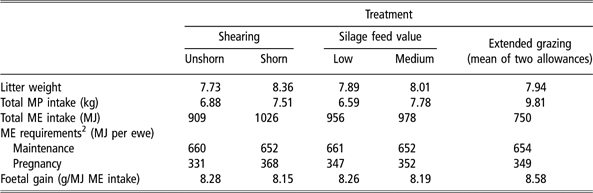
Whilst herbage intake was not determined during the last 6 weeks of gestation, herbage was allocated at predetermined allowances. Assuming, from grass intake determination in mid-pregnancy, that herbage allowances between 1 and 2 kg DM/ewe had a utilisation rate of 0.24 and that increasing concentrate feed level reduced herbage intake by 142 g DM per 1 kg concentrate intake (adapted from Carson et al., 2003), it is possible to estimate herbage intake for the duration of the study. Gross efficiency, calculated as foetal weight per 1 MJ of estimated ME intake, was greater for ewes on extended grazing (Table 7). However, it should be noted that ewes on extended grazing mobilised greater body reserves, which would contribute to both maintenance and foetal gain.
The effects of treatment on energy intake and availabilityFootnote 1

MP=metabolisable protein; ME=metabolisable energy.
1 Calculations based on Agriculture and Food Research Council (1993).
2 Day 63 of pregnancy to lambing.
Effects of winter shearing
The increased food intake due to winter shearing has been reported previously (Vipond et al., Reference Vipond, King and Inglis1987; Black and Chestnutt, Reference Black and Chestnutt1990a) and persisted until lambing, probably due to the removal of the fleece increasing heat production to maintain body temperature post shearing and a reduction in heat stress in late pregnancy. Kennedy (Reference Kennedy1985) reported that the food intake of cold-exposed sheep was increased proportionately by 0.13, which was attributed to an increased rate of eating and clearance of digesta from the rumen. Whilst temperature of the ewes in the current study was not recorded, it has been noted previously that shearing decreased the skin and rectal temperature (Vipond et al., Reference Vipond, King and Inglis1987). Skelton and Huston (Reference Skelton and Huston1968) reported a depression in food intake due to heat stress. Previously, Black and Chestnutt (Reference Black and Chestnutt1990b) reported reduced respiration rate whilst Keady et al. (Reference Keady, Hanrahan and Flanagan2007a) and Vipond et al. (Reference Vipond, King and Inglis1987) reported increased gestation length for shorn relative to unshorn ewes; both are indicative of reduced heat stress in late pregnancy.
The increase in lamb birth weight due to shearing at housing is similar to the results of Black and Chestnutt (Reference Black and Chestnutt1990b), Keady et al. (Reference Keady, Hanrahan and Flanagan2007a), Symonds et al. (Reference Symonds, Bryant and Lomax1986) and Vipond et al. (Reference Vipond, King and Inglis1987), but contrary to those of Black and Chestnutt (Reference Black and Chestnutt1990a) who reported no effect. The increased lamb birth weight recorded in the current study can be attributed to a reduction in heat stress as indicated by the increase in food intake and gestation length. Previously, Keady et al. (Reference Keady, Hanrahan and Flanagan2007a) and Vipond et al. (Reference Vipond, King and Inglis1987) reported increased gestation length due to shearing ewes at housing. Furthermore, the birth weights of lambs for the ewes shorn at housing and from ewes extended grazed were similar, indicating that reduced heat stress was responsible for the increased birth weight of lambs from the ewes shorn at housing. Keady et al. (Reference Keady, Hanrahan and Flanagan2007a) concluded that, using the equations of Koong et al. (Reference Koong, Garrett and Rattray1975) and Robinson et al. (Reference Robinson, McDonald, Fraser and Crofts1977) for foetal growth prior to birth, increasing gestation length from 145.8 to 147.5 days would account for proportionately 0.23 and 0.35, respectively, of the increased birth weight of the lambs from the shorn ewes. The increased forage intake (0.18), due to winter shearing, throughout the housing period was the equivalent of increased ME intake of 111 MJ. Whilst a large proportion of the increased intake immediately post shearing would be required for increased heat production, in later pregnancy the increased energy intake may have been partitioned towards foetal development. Gross efficiency, expressed as foetal gain per 1 MJ of ME, was similar for the unshorn and shorn ewes (Table 7), indicating that increased food intake accounted for a large proportion of the increased lamb birth weight due to winter shearing.
Effects of silage feed value
Steen et al. (Reference Steen, Gordon, Dawson, Park, Mayne, Agnew, Kilpatrick and Porter1998) concluded that digestibility, and the protein and fibre fractions are the major determinants of silage DM intake. However, silage intake by sheep is reduced significantly when chop length is increased (Dulphy and Dermarquilly, Reference Dulphy and Dermarquilly1972; Fitzgerald, Reference Fitzgerald1996). Increasing silage digestibility has been shown to increase the performance of beef cattle (Steen, Reference Steen1987; Keady et al., Reference Keady, Lively, Kilpatrick and Moss2007b), dairy cows (Gordon, Reference Gordon1980; Keady et al., Reference Keady, Mayne, Fitzpatrick and Marsden1999) and finishing lambs (Fitzgerald, Reference Fitzgerald1987). The absence of an effect of silage quality on animal performance in the current study is in line with the results of Black and Chestnutt (Reference Black and Chestnutt1990b) and is probably due to a combination of the following. Firstly, in big bales, whilst the particle length is long and the packing density low, there was visual evidence that the sheep were selecting the leaf and rejecting the stem, consequently increasing ME intake. With precision-chop silage, due to the shorter chop length and greater packing density within the silo, the opportunity for ewes to select is greatly reduced. Secondly, the medium feed-value silage was of moderate fermentation quality. Whilst fermentation parameters per se have little impact on the silage intake by beef cattle (Steen et al., Reference Steen, Gordon, Dawson, Park, Mayne, Agnew, Kilpatrick and Porter1998), they do impact the intake by sheep (Offer et al., Reference Offer, Percival, Dewhurst and Thomas1998). Thirdly, the quantity of concentrate supplement offered in late pregnancy, whilst moderate, may have masked any effect of silage feed value on lamb birth weight. Previous studies (Chestnutt and Kilpatrick, 1989), which yielded evidence of a response to silage feed value by pregnant ewes, involved lower levels of concentrate supplement than in the current study. Finally, the ewes were in good condition at the start of the study.
Ewes offered the low and medium feed-value grass silages produced lambs of similar weight at weaning. Based on lamb weaning weight, which includes the effects of birth weight and growth rate, 0.80 kg silage DM had the same feed value as allocating 1.8 kg herbage DM for extended grazing per ewe daily during mid- and late pregnancy (from day 63 to day 147 of pregnancy).
Lamb growth
Lamb growth rate from birth to weaning was in the upper range of previously published values for mid-season production systems. Further analysis of the relationship between lamb birth weight and weaning weight (using treatment means) yielded a significant linear relationship between lamb birth weight and weaning weight (**P < 0.01), which is described by the following equation:

where WW = weaning weight (kg) and BW = birth weight (kg)
Keady et al. (Reference Keady, Hanrahan and Flanagan2007a) reported a similar response in weaning weight (3.35 kg) for each 1 kg increase in birth weight. On well-managed pastures, lamb growth rate post weaning is approximately 1 kg per week. Consequently, in the current study lambs from ewes shorn indoors or from ewes on extended grazing would be expected to reach slaughter about 2 weeks earlier than lambs from ewes that were housed unshorn during the winter feeding period.
Conclusions
It is concluded that shearing ewes at housing increased lamb birth weight and subsequent growth rate due to increased silage intake, probably associated with cold stress immediately post shearing and reduced heat stress in late pregnancy. Based on differences in lamb weight at weaning, a daily intake of 0.8 kg of silage DM had the same feeding value as extended grazing herbage at a daily DM allowance of 1.8 kg per ewe daily during mid- and late pregnancy. Silage feed value and herbage allowance in mid-pregnancy did not alter lamb birth weight or subsequent growth rate. Increasing herbage allowance for extended grazing dramatically reduced the utilisation rate to 0.24 of the additional herbage allocated.