China saw rapid expansion in the area of land used for human settlements, industrial and mining sites from 1949 to 1996. According to Lin and Ho, this expansion of land for construction had taken place at the expense of agricultural and unused land, among which the loss of cultivated land (gengdi 耕地) was most acute. Based on an analysis of the 1996 nationwide land survey results, it was estimated that around 80 per cent of newly acquired land for construction was converted from cultivated land.Footnote 1 Much of this converted cultivated land was requisitioned from peasant collectives. Of the 2.26 million hectares of cultivated land converted to non-agricultural use from 1987 to 2001, it was estimated that 70 per cent or 1.58 million hectares was collectively owned land requisitioned by the government.Footnote 2 As of 2007, China's cultivated land per capita had fallen to 1.39 mu or 0.093 hectare, which is only a third of the world's average.Footnote 3
Some may contend that the extensive conversion of agricultural land for construction is hardly surprising given China's rapid urbanization since the late 1970s. In under a decade, urban population increased from in 215.7 million in 1982 to 314.4 million in 1990, then to nearly 470 million or 37 per cent of the entire population in 2000.Footnote 4 The demands of a growing population have fuelled the taking of agricultural land for urban development such as housing and other infrastructure.Footnote 5
Yet alongside this urban spatial expansion propelled by demographic changes, a different path of urbanization has been observed since the mid-1990s. Instead of being driven by the needs of a larger urban population, city expansion is motivated by land finance (tudi caizheng 土地财政), whereby local governments raise revenue and attract investment through land leasing and land development that necessitate the extensive conversion of agricultural land.Footnote 6 Lin, for instance, suggests that land sale or, more precisely, the leasing of land use rights, which constitutes 30 to 70 per cent of local revenue in many Chinese cities, has become a vital source of capital for urban development. “This new ‘land-centred urban politics’,” he argues, “has been correctly identified by many urban researchers as one of the most important driving-forces operating behind the spectacular expansion of cities, particularly large cities, and the upsurge in city-forming urbanization since the mid 1990s.”Footnote 7
In view of these two concomitant processes of urbanization in China, it may be argued that attributing the conversion of agricultural land to the demands of urbanization only tells part of the story. This study centres on the other part: the supply of agricultural land for conversion and what determines this supply. Since local officials are the key decision-makers empowered to manage and regulate the supply of land within the constraints of central policy, how they benefit from land use conversion is important to understanding the supply side of the story. The central role of local state agents in supplying land is further augmented in the context of China, where the state monopolizes the supply of agricultural land for users who intend to use it for non-agricultural purposes.Footnote 8
The main questions posed by this study are therefore as follows. What affects local governments' decisions in supplying agricultural land for conversion? And in what ways does the supply of agricultural land for conversion serve as an instrument for local officials to fulfil their objectives? This article argues that supplying agricultural land for non-agricultural use is a means through which local officials raise revenue and fulfil other career objectives. Fiscal recentralization since 1994 compels local governments to seek alternative revenue sources, and rural–urban land use conversion is a quick way to generate income. An expert sums up the attractiveness of urban land as an asset for governments and how public improvements boost land prices:
In countries where all urban land is owned by the public sector, land is by far the most valuable asset on the municipal balance sheet … Urban land values are created in part by public investment. They reflect the capitalized value of access to road networks, water supply, schools and other services made possible by municipal investment. It is economically appropriate therefore for municipalities to capture part of the land-value increment they create through their investment. There are various ways that increases in urban land value can be captured, but the sale of land or land rights has the advantage of producing revenue quickly and being easier to administer.Footnote 9
Besides generating revenue, local officials may use land to incentivize investments and promote industrialization. They may also expand the urban built-up area (jianchengqu 建成区) under their territorial jurisdiction and build infrastructure to expedite “urbanization.” Land development fuels GDP growth and conjures up highly visible political accomplishments: mega-scale construction projects labelled aptly as “political achievement projects” or “trophy projects” (zhengji gongcheng 政绩工程).Footnote 10 In short, supplying agricultural land for non-agricultural purposes effectively allows the government to “kill many birds with one stone.”
Through a case study of a county in Guangdong, this article also looks into how local governments' supply of agricultural land for non-agricultural use is influenced by local conditions, in particular the fiscal situation and the distribution and/or availability of land resources. The study draws on the empirical evidence gathered during my fieldwork in Sihui 四会, a county-level city in Guangdong province, and Xiamao town 下茆镇 in Sihui. It relies on the analysis of documents and data collected during my visits in 2007 aided by additional information supplied by local informants and secondary research through Chinese journals and the internet. In particular, the locality's land use master plan (tudi liyong zongti guihua 土地利用总体规划) offers a quick glance into how land is distributed by usage in Sihui and its township level units over 15 years from 1996 to 2010.Footnote 11 Under China's land management system, approval for converting land to non-agricultural use, granted annually in batches by the next higher level of government, is tied to the approval for a locality's land use plan. The amount of cultivated land to be conserved and converted has to adhere strictly to that determined in the land use master plan and the annual land use plan at various administrative levels.Footnote 12 However, because local governments often disregard or find ways to circumvent the prescribed quotas through illegal land use change, city planning and “quota-buying,” the land use quotas listed in the plan are verified against the actual situation where information from fieldwork and research is available.Footnote 13
What follows is a brief introduction of Sihui, its development, fiscal and land resources. The article then looks into how a government-engineered urban sprawl in Sihui's city district has generated revenue for the local coffers. This is followed by an analysis of how agricultural land was supplied at competitive prices for “development zones” beyond the city district to draw investors. The article concludes by addressing the implications of its findings to alternative explanations of land use conversion and the applicability of this study to other localities in China.
Sihui's Geography, Land and Fiscal Resources
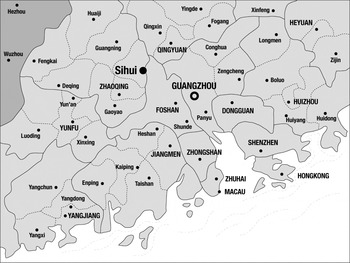
A county-level city in Zhaoqing 肇庆 prefecture, Sihui is situated on the north-western fringe of the Pearl River Delta (see Figure 1).Footnote 14 The western wing of the Pearl River Delta comprises five prefectural-level cities including Zhaoqing and takes up half the total area in the Delta. Although 62 per cent of the population of the Pearl River Delta reside in the western wing, it has registered a slower growth than the eastern wing, producing only 31.6 per cent of the region's GDP in 2002.Footnote 15
Sihui's Location in Guangdong

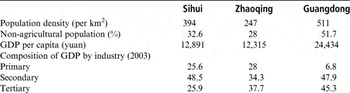
As of 2005, Sihui had a population of 430,058, of which agricultural population made up around 67 per cent and non-agricultural population 33 per cent. In 2005, net migration in Sihui was 2,404, with an outgoing migrant population of 8,717 and 11,121 incoming migrants. The county's GDP per capita was 12,891 yuan, about half that of Guangdong province but slightly higher than that of the entire Zhaoqing prefecture (see Table 1). Among Zhaoqing's county-level units that still have an agricultural population, Sihui is relatively industrialized. For instance, its GDP per capita was almost double that of neighbouring Guangning 广宁 in 2005; its industrial output was treble that of the latter.Footnote 16
Socio-economic Indicators of Sihui, Zhaoqing and Guangdong (2005 unless stated)

Sources: Yao Weiliang et al. (eds.), Sihui nianjian 2004 (Sihui Yearbook 2004), p. 232; Guangdong tongji nianjian 2009 (Guangdong Statistical Yearbook 2009), available at http://www.gdstats.gov.cn/tjnj/c4.htm, accessed 20 February 2010; Guangdong Provincial Bureau of Statistics (comp.), Guangdong tongji nianjian 2004 (Guangdong Statistical Yearbook 2004) (China Statistical Press, 2004), p. 84; Zhaoqing tongji nianjian 2006 (Zhaoqing Statistical Yearbook 2006), p. 90.
Of Sihui's total land area of 121,299 hectares, 89 per cent was agricultural whereas construction land and unused land took up around 8 per cent and 3 per cent respectively with a slight variation from 1996 to 2010.Footnote 17 The geographic landscape of Sihui is dominated by mountainous and hilly terrain. The northern and western regions, including the towns of Luoyuan 罗源, Weizheng 威整, Jianglin 江林, Huangtian 黄田 and Shigou 石狗, are mountainous while the towns in central Sihui – Xiamao, including Longwan 龙湾 which merged with it in 2003, and Longfu 龙甫– are situated on hilly terrain and the river basin. Only south-eastern Sihui is an alluvial plain through which the River Sui 绥江runs.
A large part of Sihui's land for construction thus falls within the south-eastern territory, which encompasses the city district spanning Dongcheng 东城, Chengzhong 城中, Zhenshan 贞山 and two other towns Dasha 大沙 and Xinjiang 新江. Together, the region takes up 20.4 per cent of the county's total land area and more than 40 per cent of its total land for construction. This contrasts with the mountainous northern and western regions, which take up half of the county's total land area and half of its agricultural land but less than a third of the total land for construction (see Appendix).
The Appendix shows a breakdown of Sihui's land use distribution by town and region. On paper, the county's land for construction increased modestly by around 700 hectares from 1996 to 2010. The gain is largely from the conversion of unused land which was reduced by around 600 hectares over the same period. Agricultural land declined slightly by 92 hectares. Comparing the regions, south-eastern Sihui registers a loss of agricultural land by 420 hectares and an increase in construction land by 535 hectares. In the central and eastern parts, the area of construction land actually fell by 136 hectares over these years.Footnote 18 In the mountainous northern and western regions, which have 50 per cent of the county's total unused land, construction land decreased slightly by less than one hectare whereas agricultural land expanded by 332 hectares, mostly from the conversion of unused land.
In today's Sihui, only one of the county's eight main development zones – the Wangtian 旺田 industrial zone in Huangtian town – is situated in the northern and western regions, where the mountainous terrain has contributed to lagging industrial development. Developing raw agricultural land on the mountains through the provision of electricity, water, roads and the levelling of sites (santong yiping 三通一平) is costly, a difficulty compounded by the county's perennial fiscal deficit. Since 1958, Sihui's expenditure has been greater than its revenue and it has had to rely on upper-level subsidies each year to achieve fiscal balance. From 1952 to 1985 the county received subsidies amounting to 75.34 million yuan from the prefecture and provincial governments,Footnote 19 and from 1986 to 1993 it received a total subsidy of 55.1 million yuan.Footnote 20 After the implementation of the revenue-sharing system in 1994, Sihui's finances remained heavily subsidized by the upper-level governments. The city received tax revenue returns (shuishou fanhuan 税收返还) from the central government of around 50 per cent of what it remitted. On top of the tax rebates, it also received varying amounts of subsidy from upper-level governments each year, such as 95.9 million yuan in 2000, and 130.4 million yuan in 2004.Footnote 21
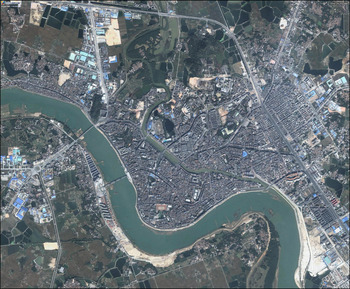
In the past decade, Sihui officials have exploited their limited land resources to build numerous development zones in the less mountainous regions and engineer an urban sprawl in the city district located on flat plain. In the process, they have oversupplied agricultural land for conversion in these relatively accessible areas and converted more agricultural land to non-agricultural uses than allowed by the county's land use plan. The stark contrast between the developed city district of Sihui and the surrounding agricultural land is reflected in the satellite image in Figure 2.
Satellite View of Sihui

To a certain extent, the government's supply of agricultural land has been driven by increased demand as traditional labour-intensive industries from the developed parts of the Pearl River Delta moved out of the region to make way for new industries from the late 1990s.Footnote 22 The diffusion and relocation of industries from nearby Foshan 佛山, Guangzhou and Dongguan 东莞 has sparked off the setting up of development zones in Sihui. In 1999, for instance, five industrial zones – in the towns of Dongcheng, Chengzhong, Xinjiang, Longfu and Nanjiang 南江 – were set up to “seize the historic opportunity of the Pearl River Delta's industrial adjustment.”Footnote 23 The pace of industrial relocation quickened in 2001 when the Guangdong provincial government encouraged the relocation of some industries in the Pearl River Delta to the less developed eastern, western and mountainous regions of the province to solve problems including labour shortage and land saturation.Footnote 24 In 2004, Zhaoqing was selected by the Guangdong government as the destination for foreign capital and the relocation of industries within the Pearl River Delta.Footnote 25
However, the conversion of agricultural land to accommodate relocating industries fails to account for the large areas of idle land that resulted. Urban sprawl in Sihui's city district has also outpaced the growth of its urban population. In other words, demand for non-agricultural land seems to have fallen short of its supply. The following sections seek an explanation for the incongruity by examining local officials' motivations in supplying and converting agricultural land for non-agricultural uses.
Sihui's City District: Government Engineered Urban Sprawl
In China, city building fever, commonly termed chengshi jingying 城市经营 or “city building as a business” by Chinese media and experts, is characterized by the inordinate expansion of a city through the extensive requisition of land for property development and infrastructure construction, financed through bank loans, land leasing, or the collection of ad hoc fees from enterprises and society.Footnote 26 Such city building fever has gripped Sihui since the late 1990s, when there was a sudden expansion in the floor space of buildings constructed, from 224,747 square metres in 1998 to 314,091 square metres in 1999. This increased further to 354,375 square metres in 2001.Footnote 27 Over the past decade, there were two sharp hikes in government investment in capital construction. From 1998 to 1999, it grew nearly tenfold from 1.09 million yuan to 10.67 million yuan, and it more than doubled from 2001 to 2003, reaching a high of 22.48 million yuan in 2003.Footnote 28
Urban building, including an expansion of the city district, was part of the Sihui government's ambition to attain a level of urbanization of over 70 per cent by around 2010, financed through bank loans, private investments and subsidies from upper-level government while expropriating and amassing land. In 2004, the government announced ambitious plans to expand the city district to beyond 48 square kilometres in five years, with an urban population and non-agricultural population of over half a million.Footnote 29
Given that the designated area of construction land in the city district spanning Dongcheng, Chengzhong and Zhenshan is supposed to be 24.75 square kilometres or 2,475 hectares by 2010 as drawn up in Sihui's land use plan, the government's plan means that it will exceed the quota for construction land by 100 per cent or more. Even if all 4.56 square kilometres of unused land in the city district is occupied for expansion from 2000 to 2010, the government will still have to take up another 20 square kilometres of agricultural land to meet its urbanization target. Furthermore, even if city expansion encroaches into the adjacent Xinjiang town, the town has a total quota of only 4.58 square kilometres of construction land and 1.22 square kilometres of unused land from 2000 to 2010 which the government may utilize (see Appendix).
Evidence suggests that the urban sprawl in Sihui was not predicated on urbanization in the sense of a shift from agricultural to non-agricultural activity. Since it was reclassified as a county-level city in 1993, growth in Sihui's non-agricultural population had been slow. In 1994 it had a non-agricultural population of 110,500. This grew slightly to 123,009 or 31 per cent of its total population in 2000. By 2005 it was 140,339 or 32.6 per cent of its total population.Footnote 30 On the other hand, the urban built-up area of Sihui expanded from 19.2 square kilometres in 2000 to 23.7 square kilometres in 2006, growing by 23.4 per cent.Footnote 31 With the enlargement of urban space from 1998 to 2004, population density in the city district of Dongcheng, Chengzhong and Zhenshan had also declined from 1,198 to 750 persons per square kilometre.Footnote 32 Moreover, the composition of Sihui's GDP by industry has not changed significantly. From 1996 to 2003, the percentage of GDP contributed by the primary industry declined by less than 7 per cent.Footnote 33
It may be argued that Sihui's recent urban sprawl was driven by the profit motive, in particular the revenue generated from the real estate industry. Local governments have an incentive to promote the real estate industry because most of the tax revenues related to property development are local taxes.Footnote 34 Moreover, large sums are raised through land speculation when officials collude with property developers to manipulate prices through hoarding land or properties.Footnote 35 The numerous fees accompanying land development further enhanced its profitability.Footnote 36 Although the arbitrary levying and collection of fees is illegal, a substantial part of the government's takings from land has been derived not from direct taxes but from ad hoc fees under various pretexts.Footnote 37 In 2002, for instance, the Sihui Land Bureau alone collected 5.27 million yuan of administrative fees.Footnote 38
Through city expansion and infrastructure building, the Sihui government benefited from higher land prices and revenues. Its key strategy was to relocate its cluster of government offices to the periphery of the city district to create another “prime district,” a tactic often employed by Chinese governments to push up land and property prices artificially.Footnote 39 The new government buildings sit on 230,000 square metres of land in the newly constructed Sihui People's Square, unprecedented in scale in Guangdong and about half the size of Tiananmen Square.Footnote 40 On one side is the 160,000 square metre Sihui International Jade Centre while across the square is the biggest shopping mall in Sihui, the Sihui Times Square, which is built on 60,000 square metres of land. Various high-end residential apartments and bungalows have also been built in the vicinity.Footnote 41 Under construction behind the government buildings, for instance, is a 161,831 square metre housing estate equipped with residential, business, education and sports facilities.Footnote 42
This government engineered, land-centred “urbanization” has created a property boom and driven up the prices of surrounding land and property. From 2004 to 2005, investment in real estate more than doubled in Sihui.Footnote 43 In 2004, its land conveyance takings were reported to be 93.4 million yuan, equivalent to 98.6 per cent of total revenue from government funds that year. This rose to 113.25 million yuan in 2005.Footnote 44 From 2005 to 2007, newly added residential floor space registered a growth of 75.5 per cent from 158,400 to 278,000 square metres. The price of commercial housing in February 2008 supposedly rose to 2,560 yuan per square metre, more than double that of five years earlier. According to local residents, prices could be as high as 4,200 yuan per square metre or more for top-end residential properties.Footnote 45
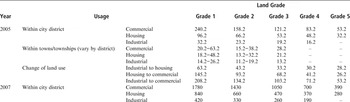
Benchmark land prices published by the county government also register significant increases. Although listed prices may not reflect all actual transacted prices because public authorities are known to exchange suppressed land prices for favours from private interests, they are nevertheless telling of broader trends and direction.Footnote 46 Within two years from 2005 to 2007, the government listed price of grade one land for commercial use in Sihui's city district had soared sevenfold from 240 yuan per square metre to 1,780 yuan per square metre; that of grade one land for residential use rose more than eightfold from 96 yuan to 840 yuan per square metre; while that of industrial land surged by 13 times from 32 yuan to 420 yuan per square metre. Prices of other grades of land within the city district also saw a close to tenfold increase or even more (see Table 2).Footnote 47 It had been estimated that land prices might rise to between 500,000 and one million yuan per mu, which will enable the government to recoup the millions invested into city building in the past years.Footnote 48
Published Rates of Land Conveyance Fee in Sihui (yuan per square metre)

Sources: Sifu document no. 51 (2005), “Sihui shi tudi churangjin zanxing biaozhun” (“Tentative standard rates of land conveyance fee in Sihui”); Sifu document no. 12 (2007), “Guanyu gongbu shishi xin jizhun dijia de tongzhi (“Notice to announce the implementation of new basic land prices”).
Actual prices of land for commercial and residential uses, at least for reported transactions, may also exceed the listed prices. In 2006, for instance, a tract of land of 17,081 square metres on the grounds of a resort hotel close to the Sihui People's Square was sold at 1,089 yuan per square metre through bidding to a Shunde 顺德 property developer.Footnote 49 Other highly lucrative land deals in 2007 include the auctioning of two parcels of land for commercial and residential use totalling 251,108 square metres, which were sold at 41 million and 354 million yuan respectively.Footnote 50 The parcel of land which was auctioned fetched a price of 3,774 yuan per square metre, far higher than the prices listed in Table 2.
Beyond the City District: Development Zone Fever and Idle Land
Alongside the property boom in the city of Sihui was the proliferation of development zones in townships and villages on the fringe of the city district and beyond. If the sale of land in the city district serves as a quick way to create a property boom that generates considerable revenue for local coffers, the supply of low-priced serviced land in less prime areas is an expedient means to attract industries.Footnote 51 One common strategy is to offer cheap agricultural land in the form of a development zone with services and infrastructure for industry.Footnote 52
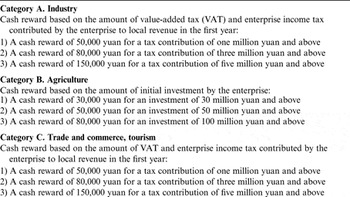
Back in 2004, Sihui had already implemented temporary preferential measures to attract investors to the city's then 11 development zones. Fifty-year land use rights were conveyed at no more than 60,000 yuan per mu or 90 yuan per square metre of land, inclusive of initial development costs incurred for connecting electricity and water, the construction of roads, and the administrative charges for the land use certificate. Land was also offered for rent at the lowest stipulated price in each industrial zone. There was even a further “discount” for investments exceeding 50 million yuan or projects with a short construction period. Various administrative charges, such as licence fees, the construction enterprise management fee, urban basic infrastructure fee, construction safety supervision fee and quality control fee were also waived.Footnote 53
In 2007 new measures were drawn up by Sihui's government. Industries and enterprises labelled as “high technology” might pay 50 per cent of the land conveyance fee as an initial sum and the balance by instalments over the next three years.Footnote 54 On top of the waiver of various administrative fees, enterprises that contributed tax amounting to five million yuan or above in a year were entitled to a cash reward of 50,000 yuan. In addition, there was a “progressive award” of 10,000 to 20,000 yuan for every million yuan of tax increment using the sum of tax paid in 2006 as the base amount.Footnote 55
The drive to lure investors through low-priced land was galvanized through enticing cadres with cash rewards, which were incidentally funded by the county's takings from land sales. As from 2007, the Sihui government had allocated 10 per cent of the net income from the conveyance of land in the county and all towns and townships every year as monetary incentives for drawing businesses and investments of above 10 million yuan to the county. The money was paid to a specialized account managed and dispensed by the county's finance bureau. Individuals were entitled to a lump sum of up to 15,000 yuan while a danwei was rewarded with 5,000 yuan for every one million US dollars of foreign capital it secured. An additional 20 per cent monetary reward was given to those who managed to fulfil 60 per cent of the year's investment quota by June, and a further 30 per cent was awarded for the full attainment of the quota by September.Footnote 56 These bonuses varied by sector and the amount of tax or investment contributed by the particular business (see Table 3). Towns and street offices that brought in new enterprises were further rewarded when the tax revenues collected from enterprises exceeded the requirement set by the county government.
Monetary Rewards for Attracting Businesses and Investment to Sihui

Sources: Sifu document no. 5 (2007), “Sihuishi zhaoshang yinzi jiangli zanxing banfa” (“Sihui city's tentative measures for rewarding the attraction of business and investment”)
The incentive structure had also been replicated at the township level. In 2005 Xiamao town, for instance, meted out additional rewards for the offices and villagers' committees under its supervision: 2 per cent of land proceeds were allotted to each individual who successfully brought in an investor to set up a factory in the town's industrial zone; for attracting an investor to set up a factory in other areas within Xiamao town, individuals would receive a one-off payment amounting to 10 per cent of the town's economic gains (excluding taxes) arising from the investment in that year; individuals who secured investments ranging from below 500,000 yuan to above one million yuan would be awarded a percentage of the government's economic gains, ranging from 4 to 10 per cent. To entice local cadres and officials further, cash rewards were meted out promptly within three days of the receipt of payment for land and other expenses.Footnote 57
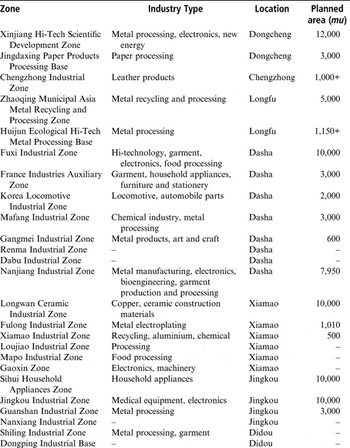
The conversion of agricultural land into development zones in Sihui gained pace from the early 2000s, coinciding with the countrywide zone fever.Footnote 58 After the Fuxi 富溪 Industrial Zone was set up in 2001, other towns in Sihui quickly followed suit, setting up Xinjiang, Dongcheng, Chengzhong, Zhenshan, Longfu and Fulong 福龙 industrial zones. Smaller zones also sprung up in other towns and villages.Footnote 59 As of 2002, Sihui city reportedly had 16 development zones with a total area exceeding 20 square kilometres.Footnote 60 This land area had already surpassed the 15.58 square kilometres allocated to industrial and mining sites in 2000 based on Sihui's land use plan.Footnote 61
During the 2003 moratorium on the approval for development zones, Sihui was ordered by the State Council's office to scrap seven industrial zones in Xiamao, Longfu, Longwan, Jianggu, Didou 地豆, Jingkou 迳口 and Dongcheng.Footnote 62 Despite the central government's measures and regulations to cut down the number of development zones, political leaders in Sihui continued to push openly for the construction of zones and claimed that the city's progress in this aspect was still “far from meeting the upper level's standards.”Footnote 63 As a result, new development zones have continued to spring up in Sihui in the past few years.
Table 4 lists the numerous zones undertaken by different levels of government in Sihui over the years till 2007.Footnote 64 Of those in 2007, the planned area of five of Sihui's most prominent industrial zones – Fuxi Industrial Zone, Nanjiang Industrial Zone, Longwan Ceramic Industrial Zone, Xinjiang Hi-Tech Scientific Development Zone and Zhaoqing Municipal Asia Metal Recycling and Processing Zone – was 44,950 mu or 2,997 hectares, 932 hectares more than the 2,065 hectares of land designated as stand-alone mining and industrial sites by the year 2010 as indicated in the county's land use plan.Footnote 65 By 2009, the total planned area of Sihui's eight major industrial zones, mostly located in the central region down to the south-eastern tip, has ballooned to 269.62 square kilometres or 26,962 hectares, exceeding the land area allocated to stand-alone mining and industrial sites by a staggering ten times and more than double the quota of construction land for the entire county.Footnote 66
Development Zones in Sihui till 2007

Sources: Fieldwork in Sihui, 2007; Sihui government website, http://www.gdsihui.gov.cn, accessed on various dates.
The existence of vast expanses of idle land, however, contravenes the claim that the development zones were created as a response to industrialization needs. Since development zones are usually financed through land-secured bank loans,Footnote 67 the enormous price difference between set-up costs and generated revenues is such a potent motivation for land requisition that it has become commonplace for local governments to expropriate farmland in anticipation of future demand.Footnote 68 This, coupled with an attractive cash stimulus for cadres, contributed to the proliferation of over-ambitious, ill-planned or ill-executed development zones, which in turn led to large areas of idle land, including land that is levelled but yet to be developed and land that is developed but underutilized.Footnote 69 Large areas lie idle often because the size of the developed area exceeds demand and there is inadequate investment. Some fail to draw investors because of their poor location. In other cases, investors who obtain land at low cost do not have sufficient financial power to develop the industrial zone. Lapses in the supervision and management of development zones after land is conveyed are also contributing factors as some governments are more interested in selling than developing land.Footnote 70
In Sihui, the total area of idle land was 163.6 hectares or 2,454.4 mu in 1997.Footnote 71 In 2000, under the regulations and guidelines in newly promulgated government documents such as the “Temporary Regulations on the Handling of Sihui City's Idle Land,” Sihui Land Bureau dealt with 108 cases of idle land. Construction on 242 mu of land was expedited and put into use; the land use rights of 1,045 mu of land were retracted; 2,216 mu of idle land were assigned to other usage and the deadline for construction on 34 mu of land was extended.Footnote 72 Yet in 2007, Sihui still had 22 cases or 1,120.67 mu of idle land. The culprits who left large areas of undeveloped land for the longest period were mainly manufacturing and metal processing plants located in development zones.Footnote 73 In addition, 3,000 mu of land in the Longwan Ceramic Industrial Zone located in Xiamao, which was found to be acquired illegally – the town authorities had “rented” land from villagers instead of going through proper requisition (yizu daizheng 以租代征) – was in limbo. According to a town official, part of this tract of land was converted back into cultivated land for the cultivation of corn but most was still lying idle as the construction of factories had halted and investments were rescinded.Footnote 74
Conclusion
In explaining what drives land use conversion in China, part of the story is that urbanization in the sense of a shift from agricultural to industrial activity is accountable for the expansion of Chinese cities at the expense of rural land. This article tells the other part of the story. It argues that China's urbanization is also a spatial expansion that may proceed independent of the demands of urban population growth or a sectoral shift. The engineers of this land-centred urban sprawl are the local states.
In Sihui, government officials had supplied agricultural land for two distinct purposes. In the prime city district which rests on flat terrain, local officials spurred an urban sprawl to capitalize on higher land and property prices; on the fringe of the city district and beyond, numerous development zones were conveyed or illegally leased to industries at competitive prices to promote industrialization. The scarcity of flat, developable land in Sihui and the high costs of developing land in the mountainous areas contributed to an oversupply of agricultural land for conversion in the south-eastern region, exceeding the quota set in the county's land use plan.
The hypothesis that land use conversion is driven by the demands of urbanization or industrialization, tested against the case of Sihui, is inadequate in two senses: first, growth in the county's urban population and industrial GDP had been outpaced by the expansion in urban space; and secondly, the supply of development zones had not been met by a corresponding demand, resulting in a considerable amount of idle land. Based on the findings of this study, therefore, a model to explain land use change has to take into consideration not just the demands of urbanization but also the government's motivations in supplying land, and how these interact with local conditions such as geography and the locality's fiscal capacity. The interplay of these variables gives rise to different land use patterns and trends.
One point to bear in mind when applying this explanatory model to other localities is that the relative impact of these variables on land use conversion differs from place to place. In the case of Sihui, the demands of urbanization appear to have played a less significant role in driving land use change than the government's motivations in supplying land. However, given Sihui's proximity to the more developed areas of the Pearl River Delta, the forces of urbanization would presumably have exerted a greater influence on the supply of agricultural land than for more rural areas in inland China. In contrast, it may be conjectured that the conversion of agricultural land in counties located within the prosperous eastern Pearl River Delta is driven by the demands of urbanization to a greater extent than in Sihui's case.
To further test the explanatory power of this proposed model, Sihui may be compared to other counties in Zhaoqing such as Guangning, Fengkai 封开 and Huaiji 怀集 that share similar characteristics in their development, level of urbanization, geography and fiscal situation.Footnote 75 If, for instance, the local government's supply of agricultural land for conversion differs substantially from one county to another, the study may then probe into the local incentive structures and motivations that drive officials to supply agricultural land to ascertain if these are the key determinants. Such a comparative study will contribute to a better understanding of the forces that drive the conversion of agricultural land in China.
Appendix: Sihui Land Use Distribution by Town and Region (hectares)

Notes:
Figures in parentheses indicate the area of a land type in each town/region as a percentage of the same land type in the entire county.
* Includes Xiamao, Longfu, Jingkou, Jiguangtang Farm and Danan Forest.
# Includes Dengcun, Didou, Huangtian, Jianggu, Jianglin, Luoyuan, Shigou and Weizheng.
Source:
Sihuishi guotu ziyuanju (Sihui City Land Resources Bureau), “Sihuishi tudi liyong zongti guihua tiaozheng shuoming” (“Explanation of adjustments in Sihui city's land use master plan”), April 2005.