Introduction
Competition for space, or spatial competition, is a very common feature in epibenthic communities (Buss, Reference Buss1979; Connolly and Muko, Reference Connolly and Muko2003; Jackson, Reference Jackson1977; Lauer and Spacie, Reference Lauer and Spacie2004; Márquez et al., Reference Márquez, Zea and López-Victoria2006; Paine, Reference Paine1984). As a result, one competitor outgrows another competitor entirely or partly. Overgrowth of some competitors may be lethal to their opponents, but some organisms are able to survive despite being reduced to a small size by the competitor. Many colonial and modular species are characterized by such properties (Ayling, Reference Ayling1983; Pansini and Pronzato, Reference Pansini, Pronzato and Rutzler1990; Rützler, Reference Rützler1970). Some authors believe that colonial and modular organisms have stronger competitive potential than solitary organisms (Jackson, Reference Jackson1977).
Sedentary animals are inevitably engaged in both interspecific competitive relationships and intraspecific competition (Dalby, Reference Dalby1995; Guiñez, Reference Guiñez2005; Hughes and Griffiths, Reference Hughes and Griffiths1988), because free space is usually a limiting factor in epibenthic communities developing on hard substrates (Konar and Iken, Reference Konar and Iken2005; Lauer and Spacie, Reference Lauer and Spacie2004; Myers, Reference Myers1990). Intraspecific competition, where organisms claim the same resources, is known to be more intense than interspecific competition (Adler et al., Reference Adler, Smull, Beard, Choi, Furniss, Kulmatiski and Veblen2018; Anderson and Whiteman, Reference Anderson and Whiteman2015; Barnes and Kuklinski, Reference Barnes and Kuklinski2005; Dhondt, Reference Dhondt1977; Zobel et al., Reference Zobel, Öpik, Moora and Pärtel2006). Intraspecific competition is a key factor controlling population dynamics and size-age structure (Bürger et al., Reference Bürger, Schneider and Willensdorfer2006; Kleunen et al., Reference Kleunen, Fischer and Schmid2001; Liess and Foit, Reference Liess and Foit2010; Schoener, Reference Schoener1973; Snell, Reference Snell1979). However, features and peculiarities of intraspecific competition in modular epibenthic organisms are still poorly understood (Barnes and Kuklinski, Reference Barnes and Kuklinski2005; Gappa, Reference Gappa1989; Karande and Swami, Reference Karande and Swami1988; Rossi and Snyder, Reference Rossi and Snyder2001). Competition reduces growth and regeneration rates, because an organism involved in competitive interactions expends energy that could be used for these primary processes (Singh and Thakur, Reference Singh and Thakur2015). However, in modular animals, there are mechanisms allowing them to avoid competition, in particular, by adjusting the shape during growth (Franco, Reference Franco1986). In general, size and shape are extremely important for modular epibenthic organisms, since they predetermine the degree of contact with neighbours and, consequently, the probability of any interactions (Meinig and Jackson, Reference Meinig and Jackson1979).
Sponges are important components of epifaunal communities. Encrusting sponges occupy large areas of primary substrate (Aerts, Reference Aerts1998; Russ, Reference Russ1982). Sponges often become winners in competition for space with other organisms such as corals, ascidians, molluscs, bryozoans, algae, and cnidarians (Gaino, Reference Gaino2005; Gastaldi et al., Reference Gastaldi, Firstater, Romero, Pereyra and Narvarte2020; González-Rivero et al., Reference González-Rivero, Ferrari, Schönberg and Mumby2012; Khalaman and Komendantov, Reference Khalaman and Komendantov2016; Lauer and Spacie, Reference Lauer and Spacie2004; Maughan and Barnes, Reference Maughan and Barnes2000a). The large success of some sponge species is preconditioned by their ability to produce toxic compounds that prevent other organisms from colonizing the substrate and/or fouling these sponges (de Voogd et al., Reference de Voogd, Becking, Hoeksema, Noor and van Soest2003; Porter and Targett, Reference Porter and Targett1988; Turon et al., Reference Turon, Becerro and Uriz1996) or serve as a defence mechanism against predators such as fish (Pawlik et al., Reference Pawlik, Chanas, Toonen and Fenical1995; Swearingen and Pawlik, Reference Swearingen and Pawlik1998) and cephalopods (Huysecom, Reference Huysecom1990; Proksch, Reference Proksch1994).
The widespread sponge Halichondria panicea (Pallas, 1766) was chosen for the study of intraspecific competition. This species is widely distributed in epibenthic communities formed on both natural and artificial substrates in the North Atlantic and Pacific (Barthel, Reference Barthel1986; Dijkstra et al., Reference Dijkstra, Sherman and Harris2007; Hoare and Peattie, Reference Hoare and Peattie1979; Khalaman and Komendantov, Reference Khalaman and Komendantov2011; Khodakovskaya, Reference Khodakovskaya2005; Knowlton and Highsmith, Reference Knowlton and Highsmith2000). It inhabits the Mediterranean Sea and the Indian Ocean (Erpenbeck, Reference Erpenbeck2004; Purushottama et al., Reference Purushottama, Venkateshvaran, Pani Prasad and Nalini2009), as well as New Zealand and Antarctica (Encyclopedia of Life, accessed 23 October 2023). Halichondria panicea is known to be characterized by high growth (Leichter and Witman, Reference Leichter and Witman1997; Thomassen and Riisgård, Reference Thomassen and Riisgård1995), resistance to epibiosis (Barthel and Wolfrath, Reference Barthel and Wolfrath1989), and high ecological flexibility, since it inhabits both sublittoral and littoral zones (Ereskovskii, Reference Ereskovskii1994; Knowlton and Highsmith, Reference Knowlton and Highsmith2000). It is also a species with toxic properties (Dyrynda, Reference Dyrynda1983; Khalaman et al., Reference Khalaman, Belyaeva and Flyachinskaya2008; Khalaman et al., Reference Khalaman, Sharov, Kholodkevich, Komendantov and Kuznetsova2017; Khalaman et al., Reference Khalaman, Korchagina and Komendantov2014), which are apparently provided by symbiotic bacteria (Althoff et al., Reference Althoff, Schütt, Steffen, Batel and Müller1998; Schneemann et al., Reference Schneemann, Nagel, Kajahn, Labes, Wiese and Imhoff2010).
Here, we hypothesize that the growth and spatial distribution of the sponge H. panicea depend on intraspecific competition. The following hypotheses have been tested: (1) neighbourhood with an isogeneic or allogeneic competitor affects the relative growth of H. panicea; (2) the relative growth of H. panicea depends on the size of the competitor; and (3) the presence of a competing conspecific individual influences the growth directions of H. panicea.
Materials and methods
Study site and material
The study was performed at the White Sea Biological Station of the Zoological Institute of the Russian Academy of Sciences (‘Kartesh’; 66°20.230′ N, 33°38.972′ E). Halichondria panicea specimens were collected from the fouling communities of artificial substrates (nylon ropes and stripes) in the Kruglaya and Krivozerskaya bights (Chupa Inlet, Kandalaksha Bay, the White Sea), located in the immediate vicinity of the Biological Station. The field experiment was conducted in the Kruglaya Bight. The experimental site had a system of horizontally stretched ropes near the water surface, and their buoyancy was provided by polyethylene floats. The ropes were anchored to the bottom, so they kept a stable position in the water column. Experimental plates were formed from a mesh stretched over polyethylene frames; the sponge explants were attached to the plates and were then placed into the water with no contact with the bottom, on a thin nylon 5-m halyard mounted to the polyethylene floats.
During the experiment, the environmental conditions changed depending on the season of the year. Water temperature varied from −1.2°C to +19.5°C. The average tidal current rate is about 2 cm/sec. Water salinity varied within 23–25 ppt, being a normal level for the White Sea (Berger et al., Reference Berger, Dahle, Galaktionov, Kosobokova, Naumov, Rat’kova, Savinov and Savinova2001).
Experimental design
Explants were prepared by an original technique. Halichondria panicea individuals of a size, which allowed obtaining the required number of fragments, were selected. The fragments obtained from one sponge individual were considered isogeneic, from different sponge individuals, allogeneic.
Two sorts of fragments (explants) were excised from one individual: small (2 × 2 cm) explants (one for the isogeneic experiment and two for the allogeneic experiment) and large (4 × 4 cm) explants (four fragments for the isogeneic experiment and five fragments for the allogeneic experiment).
Sponge explants were placed onto the plates in seven combinations: three combinations for the experiment with isogeneic explants and four ones with allogeneic explants (Figure 1).
Experiment design: (A) sponge explants of equal size; (B) sponge explant is larger in size than that of competitor; (С) sponge explant without competitor (control); (D) sponge explant is smaller in size than that of competitor.

The isogeneic explants were placed onto the plates by a particular scheme (Figure 1). Two combinations were set for experimental plates. In the first one, two isogeneic sponge fragments of equal size (4 × 4 cm) were attached 1 cm apart. In the second one, two isogeneic fragments of different sizes (4 × 4 cm and 2 × 2 cm) were fixed onto the plate at the same 1 cm distance from each other. Control plates had one 4 × 4 cm explant attached in the centre as for the experiment with isogenic and allogenic sponges. It was not possible to use the second control variant, 2 × 2 cm sponge fragments, because the size and shape of the sponges available to us limited the number of explants that could be obtained from one individual.
One experimental set-up comprised three plates in total, i.e., one plate of each type (control and two experimental combinations). Within the same set-up, all sponge fragments on the plates were isogeneic. However, explants in different set-ups were allogeneic with respect to each other because a different individual was used to equip each set-up. A total of 10 set-ups were prepared, so 10 different individuals of H. panicea were used accordingly.
Allogeneic sponge explants were placed onto the plates by different schemes (Figure 1). On the control plates, a single 4 × 4 cm explant was attached in the centre. Three combinations were developed for experimental plates: (1) two allogeneic sponge fragments of the same size (4 × 4 cm), one of which was isogeneic with respect to the control, were attached 1 cm apart; (2) a fragment isogeneic to the control (4 × 4 cm) and an allogeneic fragment (2 × 2 cm) were fixed in 1 cm distance from each other; (3) a small fragment (2 × 2 cm) isogeneic to the control explant and an allogeneic fragment (4 × 4 cm) were fixed on the experimental plates at a 1-cm distance from each other.
One set-up comprised four plates, one of each type (control and three experimental). A total of 10 set-ups were prepared.
Prior to the sponge placement onto the plates, the lines were drawn on the mesh with a black marker. The explants were attached to the plates exactly along these lines by sewing them to the mesh with nylon thread using two perpendicular stitches, without piercing the sponge. All plates with sponges attached to them were photographed before being submerged in water. The setting of the experiment took place on 14–17 June 2021.
Registration of the experiment results and data processing
Photorecording of experimental results was performed twice by a Panasonic DMC-FZ50 digital camera with a 10-megapixel/inch sensor on 30–31 August 2021 and on 11–13 July 2022. The presence/absence of contact between sponges was checked, and the area occupied by each individual was calculated from the resulting photographs using ImageJ software.
Since the strategy of many epibenthic organisms is to occupy as much substrate area as possible (Hall and Hughes, Reference Hall and Hughes1996; Jackson and Coates, Reference Jackson and Coates1986; Marfenin, Reference Marfenin1997), here we consider the area occupied by a sponge as its size and growth estimate. The competitive success of sponge explants has been evaluated by their relative growths, according to the equation:
 \begin{equation}D = \left( {{S_l} - {S_f}} \right)/{S_f,}\end{equation}
where D is the relative growth, Sl is the sponge area at the moment of measuring (2.5-month and 1-year periods), and Sf is the initial area of sponge (t = 0).
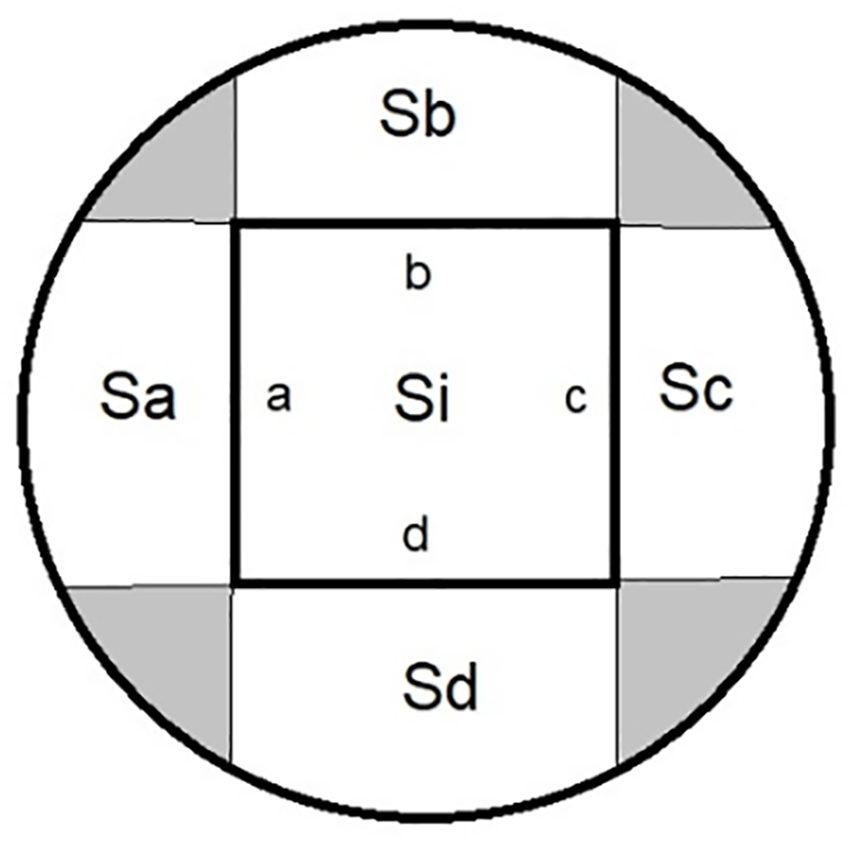
The directions of preferential growth of sponges were determined by comparing their growth toward the competitor and in other directions (Figure 2). The growth zones of the individual and the boundaries of the initial explant were always visually distinguishable. The lines previously drawn on the mesh cloth served as an additional reference marker.
Scheme of sponge measurements for determining the preferential direction of growth: Si is the initial area of the explant; a, b, c, and d are sides of the initial sponge fragment (explant); Sa, Sb, Sc, and Sd are the areas of growth to the corresponding directions.

The averaged linear growth of the sponge towards the competitor was calculated as follows:
 \begin{equation}{L_c} = \left( {{S_c}/c} \right)/\surd {S_i,}\end{equation}
where Sc is the area of sponge growth towards the competitor, c is the length of the sponge side facing the competitor, and Si is the initial area of the explant.
The weighted average growth in all other directions (Lbad) was calculated as follows:
 \begin{equation}{L_{bad}} = \left( {\left( {\left( {{S_b}/b + {S_a}/a + {S_d}} \right)} \right)/3} \right)/\surd {S_i,}\end{equation}
where a, b, and d are the sides of the original sponge explant not facing the competitor; Sa, Sb, and Sd are the areas of growth not facing the competitor; and Si is the initial area of the explant.
The influence of the competitor was assessed by comparing the growth areas of H. panicea individuals in experimental and control explants by one-way ANOVA in R, an extension of the paired-samples t-test for comparing the means of four levels (control, equal-size, larger, and smaller sizes) of a within-subjects variable. The dependent variable was the relative growth (standardized by initial sponge area), the variable specifying the sample identifier was the identifier number of a particular sponge (id), and the within-subjects factor or grouping variable was the size of the competitor (equal/larger/smaller-size experimental explant). In our experiment, the pairwise variants were the areas of sponge explants with a competitor of a certain size within the same genetic group (isogeneic or allogeneic). This approach allowed us to account for the influence of individual differences between individuals in growth on the experimental results.
Before performing the analysis, the data were tested for significant outliers, normality (by the Shapiro–Wilk normality test), and sphericity. The Holm–Bonferroni method was applied for post hoc comparison. Welch’s two-sample t-test was used to assess the significance of differences between means in the samples when analysing the effect of competitor on the sponge growth directions.
Results
Effects on sponge growth of the presence and size of an allogeneic competitor
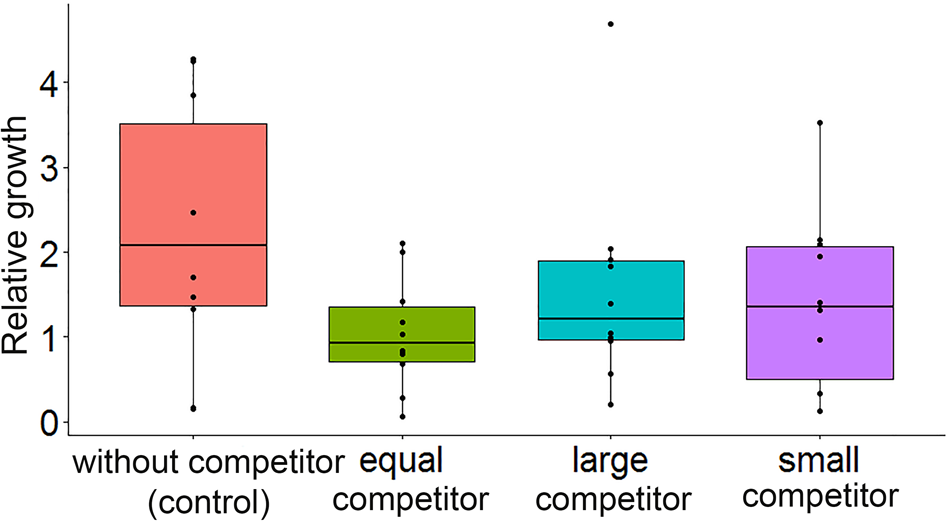
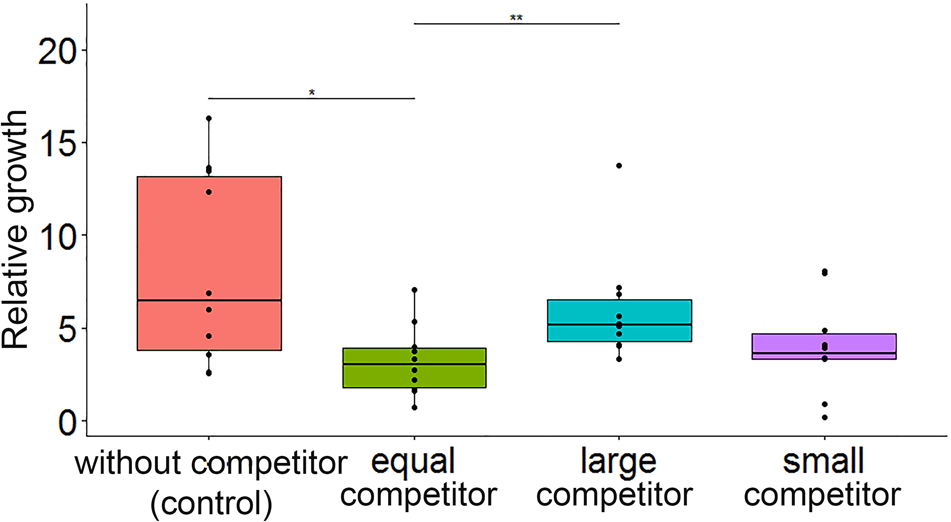
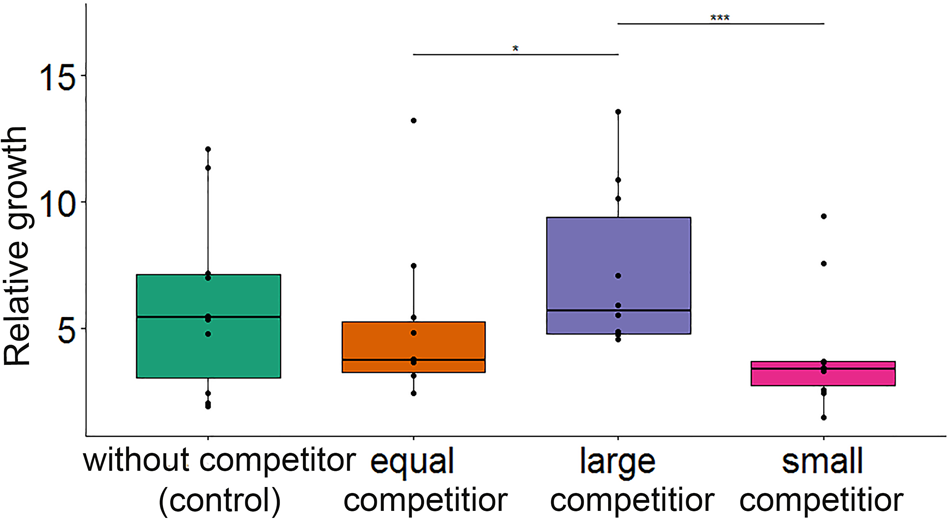
After 2.5 months of exposure, no significant effect of the allogeneic competitor and its size on the relative sponge growth was found (Table 1, Figure 3). However, 1 year after the experiment was launched, the influence of the allogeneic competitor was significant, manifested in the decrease in the relative growth of sponges neighbouring the allogeneic competitor (Table 1, Figure 4). According to pairwise comparison analysis, the relative growth of sponges located on the same plate with equal-size allogeneic competitors was lower than that of control individuals (p = 0.011) and of those co-inhabiting allogeneic individuals of a larger size (p = 0.006).
Relative growth of sponges on control plates (control) and on experimental plates with allogenic competitor of equal (equal), larger (large), and smaller (small) sizes, 2.5 months after the experiment was set up.

Relative growth of sponges on control plates (control) and on experimental plates with allogeneic competitor of equal (equal), larger (large), and smaller (small) sizes, 1 year after setting up the experiment.

Effect of the presence and size of allogeneic and isogeneic competitors on sponge growth after 2.5 months and 1 year the experiment has been started: ANOVA results

Effects of the presence and size of an isogeneic competitor on the sponge growth
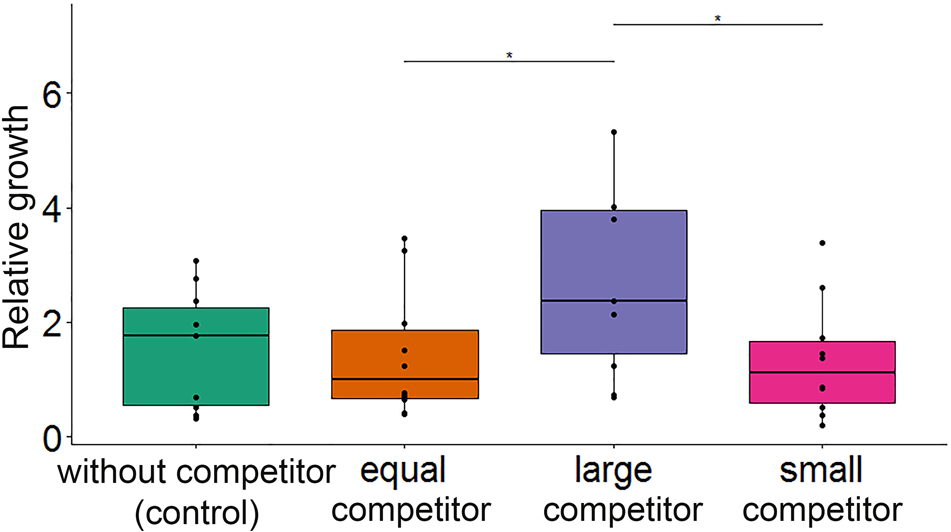
A significant influence of the isogeneic competitor and its size on the relative growth of sponges was recorded already in 2.5 months after the beginning of the experiment (Table 1; Figure 5). The relative growth of sponges neighbouring with the isogeneic competitor of larger size was higher than the relative growth of sponges growing together with the isogeneic competitor of equal size (p = 0.034) and smaller ones (p = 0.043). After 1-year of exposure, the effect of isogeneic competitor on the relative growth of sponges was also significant (Table 1; Figure 6). The relative growth of sponges living next to the isogeneic competitor of larger size was higher than that of neighbouring the isogeneic competitor of smaller (p = 0.0002) and equal size (p = 0.01).
Relative growth of sponges on control plates (control) and on experimental plates with isogenic competitor of equal (equal), larger (large), and smaller (small) sizes, 2.5 months after the experiment was set up.

Relative growth of sponges on control plates (control) and on experimental plates with isogeneic competitor of equal (equal), larger (large), and smaller (small) sizes, 1 year after setting up the experiment.

Influence of the competitor presence, its genetic nature, and size on the sponge growth direction
The direction of growth was analysed only for the data obtained after 3-month exposition, when not all pairs of competing sponges came into contact with each other and a contact duration was not enough to provoke the overgrowth of one individual by another. The latter was regularly observed in our other experiments of biofouling of artificial substrata. It should be noted also that it was not always possible to formalize the direction of sponge growth after 1 year of exposure due to the complex shape of the individuals. Therefore, we have restricted our dataset for this case accordingly.
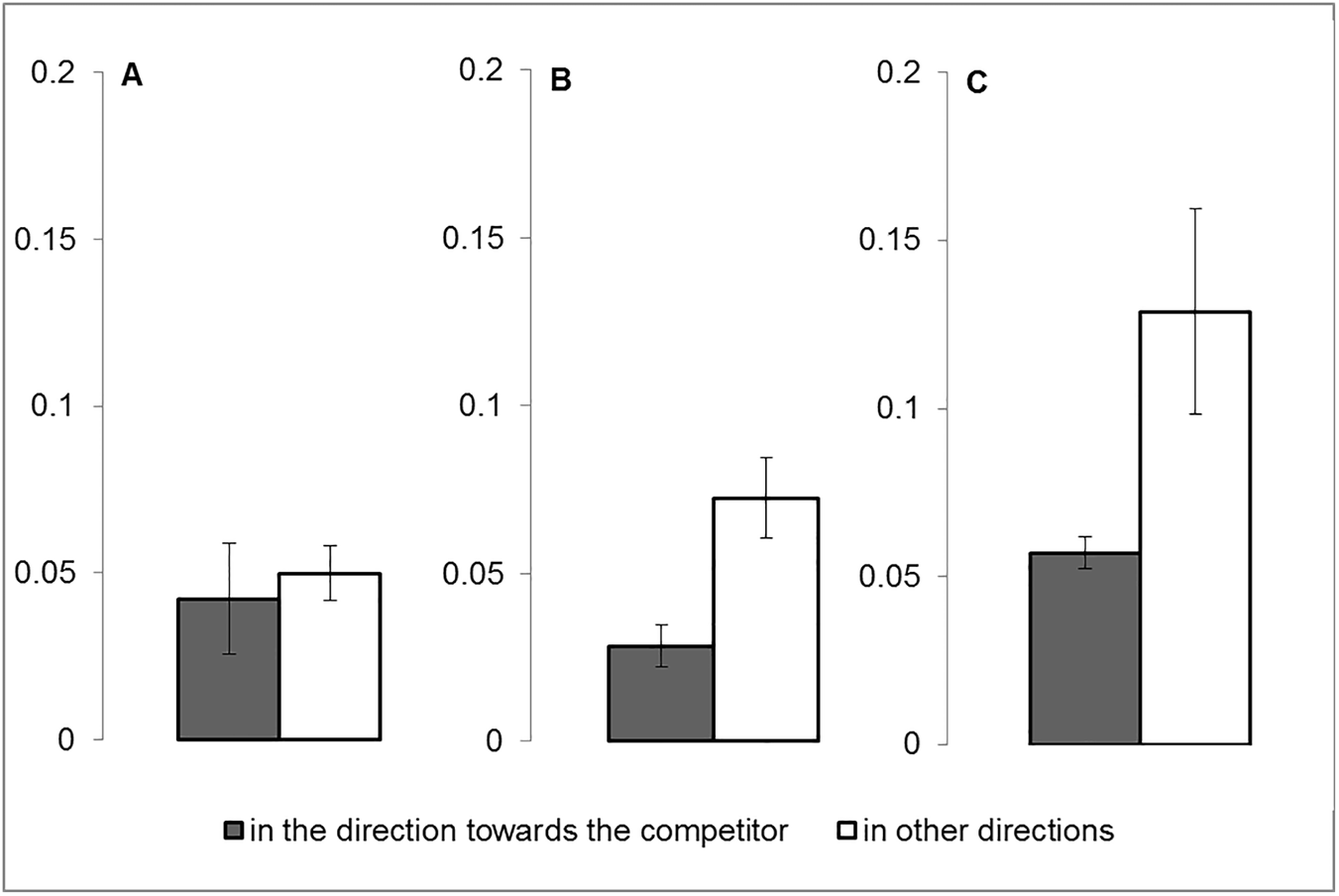
When the competing allogeneic sponge was the same size as the experimental sponge, the growth towards the competitor was not statistically different from that in the other directions (Table 2; Figure 7A). If the competitor was an allogeneic individual of either smaller or larger size, the growth of the experimental fragment was lower towards the competitor compared to growth in the other directions (Table 2; Figure 7B, C).
Relative growth of sponges in certain directions in the presence of an allogeneic competitor of different sizes: (A) equal size; (B) smaller size; and (C) larger size.

Mean relative growth of sponges in the presence of an allogeneic competitor

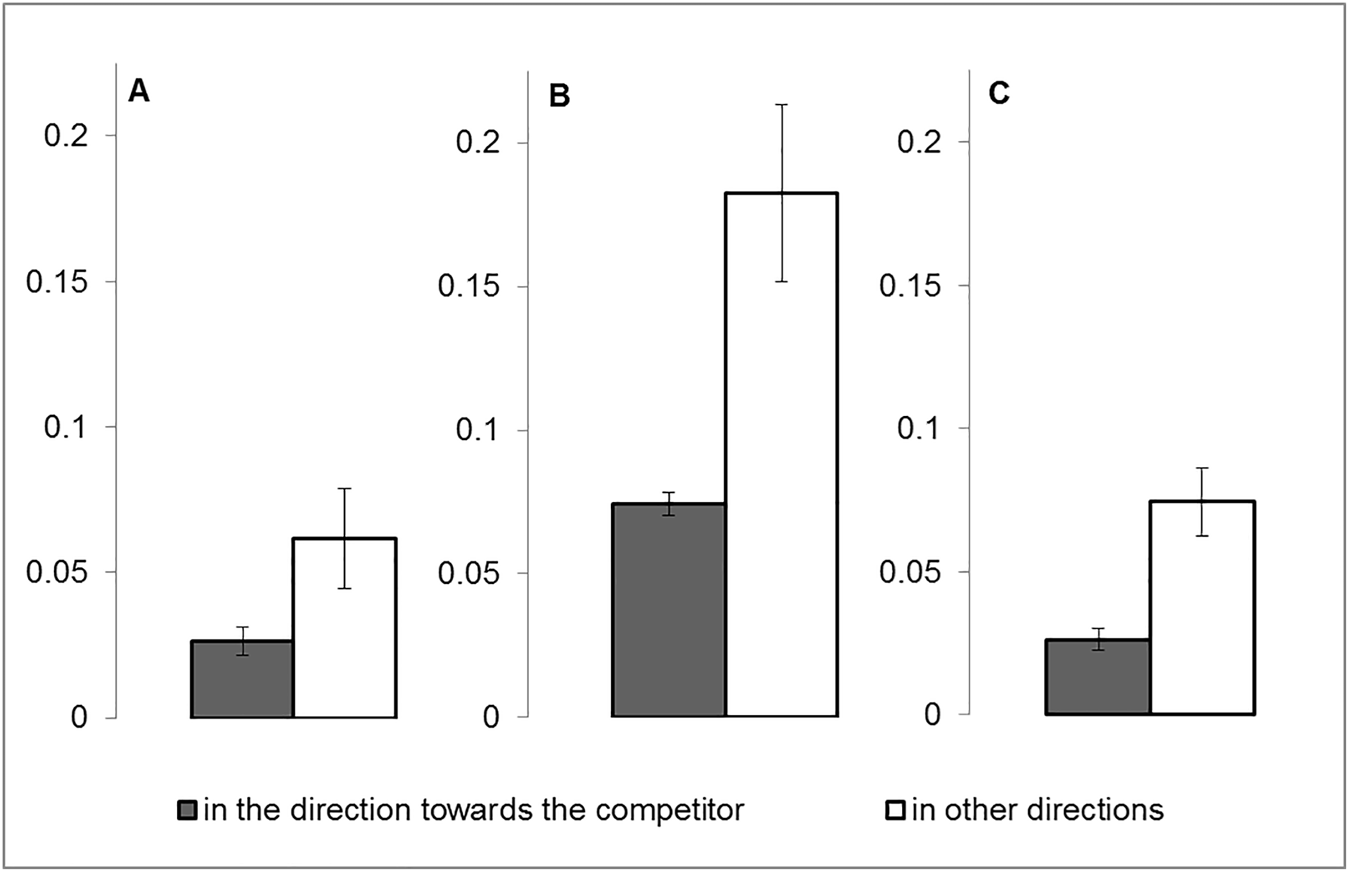
When the competing individuals were of equal size, growth toward the isogeneic competitor also tended to be smaller than in other directions, but the significance slightly exceeded 0.05 threshold (Table 3; Figure 8A). If the competitors were of different sizes, and a competitor was an isogeneic individual, growth towards the competitor was lower than in other directions (Table 3; Figure 8B, 8C).
Relative growth of sponges in certain directions in the presence of an isogeneic competitor of different sizes: (A) equal size; (B) smaller size; and (C) larger size.

Mean relative growth of sponges in the presence of an isogeneic competitor

Discussion
In this study, we specifically assessed the surface area occupied by experimental and control sponges, as free space is typically a limiting factor for epibenthic communities developing on hard substrates (Konar and Iken, Reference Konar and Iken2005; Lauer and Spacie, Reference Lauer and Spacie2004; Myers, Reference Myers1990). Different strategies of competition, depending on the size and shape of the organism, are implemented in modular animals, such as sponges (Becerro et al., Reference Becerro, Uriz and Turon1994). In some cases, it is advantageous for individuals to activate their defence mechanisms, such as the production of toxic substances and/or use of protective spines (Becerro et al., Reference Becerro, Turon and Uriz1995; Harvell, Reference Harvell1986), while in other cases another strategy is implemented, when they simply increase the growth rate (Barnes and Rothery, Reference Barnes and Rothery1996). In particular, the competitive advantage of mangrove sponge species over reef sponge species appears to be due to differences in growth rates (Wulff, Reference Wulff2005). However, there is a compromise between growth and the level of protection. It is indicated by faster growth and more frequent fouling of reef sponges by mangrove ones. However, the former tends to be more rapidly consumed by fish than reef sponges, which are better protected but have low growth rates. However, for bryozoans of the species Parasmittina delicatula, it has been shown that under conditions of competition for substrate, their growth rate is reduced due to overgrowth by modular organisms such as ascidians and sponges (Bone and Keough, Reference Bone and Keough2009).
It is known that when an organism is small, the cost of defence is much higher than the cost of growth (Barnes and Rothery, Reference Barnes and Rothery1996; Harvell, Reference Harvell1986; Wulff, Reference Wulff2005). For example, defence costs in small colonies of the bryozoan Membranipora membranacea result in greater growth retardation than in larger colonies (Harvell, Reference Harvell1986). In turn, small-size Crambe crambe sponges exhibit significantly less toxicity during competition than medium-size specimens do (Becerro et al., Reference Becerro, Turon and Uriz1995). Thus, the size of a sponge may determine its toxicity as well as its growth rate.
The results of our experiment allow us to consider that intraspecific competition in H. panicea certainly takes place, when the relative growth of competing individuals decreases, and the lowest values are found in sponges competing with an allogeneic neighbour of equal size. Probably, this response is a consequence of the activation of defence mechanisms rather than the use of active growth as a means of competitive struggle.
When the competitor is an isogeneic individual, the outcome of competition is fundamentally different. The presence of a larger isogeneic competitor has a noticeable effect on the sponge growth. It causes not suppression, but active growth of the individual. When equal-size and smaller isogeneic competitors are present, the sponge growth does not differ or even tends to be lower than in the control. These results indicate that the mechanisms of struggle against the competitor, which are clearly seen in the case of neighbouring with an allogeneic individual, are apparently absent in the presence of an isogeneic competitor. The observed effect of ‘excessive’ sponge growth when it coinhabits a plate with a larger isogeneic sponge may be explained by histocompatibility, which is a fusion into one organism when isogeneic individuals come into contact with each other and which is reported for the species of the same genus, H. japonica (Saito, Reference Saito2013). It should also be noted that the effect of the presence of both isogeneic and allogeneic individuals on the relative sponge growth was tracked as early as 2.5 months after the experiment had started; moreover, it intensified and became more pronounced 1 year later.
Size and shape are important to sponges (Sebens, Reference Sebens1986; Stocker, Reference Stocker1991) because they both precondition the degree of contact with neighbours and hence the likelihood of any interaction (Jackson, Reference Jackson, Rosen and Larwood1979a). Demand for resources and escape from competitors are achieved by shape adjusting in modular organisms (Franco, Reference Franco1986). Previous studies of growth patterns of benthic modular organisms have mainly focused on bryozoans (Jackson, Reference Jackson, Rosen and Larwood1979a), hydroids, and ascidians (Stocker, Reference Stocker1991). Modular encrusting organisms are known to utilize several ecological strategies (Connell and Keough, Reference Connell, Keough, Pickett and White1985; Turon, Reference Turon1990a; Turon and Becerro, Reference Turon and Becerro1992). Cohabitation with a strong spatial competitor may affect the direction of growth of the sponge – growth towards the spatial competitor may cease (Becerro et al., Reference Becerro, Uriz and Turon1994). A similar strategy has been reported for some bryozoans (Stebbing, Reference Stebbing1973). Growth redirection is considered to be one of the advantages of organisms with indeterminate growth compared to those with determinate growth, because it increases their chances of avoiding the negative effects of competition (Buss, Reference Buss1979).
When examining the growth directions of sponges, we have found a phenomenon that may be interpreted as an attempt to ‘avoid’ a contact with a competitor. When neighbouring a larger or smaller allogeneic individual, the relative growth towards the competitor was lower than in the other directions. However, when the competing allogeneic individuals were of the same size, we found no differences in growth directions. When studying the influence of competitors on sponge growth direction, it is worth paying attention to the dependence of sponge relative growth on competitor size. Sponges with a competitor of the same size have low relative growth, so we cannot detect differences in growth directions. However, where the relative growth is high, in sponges with a large or small competitor, the differences in growth in different directions that we found may be due to an obstacle that the sponge meets in its path. This obstacle is a competing individual that limits its growth in a certain direction, while in other directions the sponge’s growth seems unrestricted.
Another fact draws much attention. Overgrowing of other sedentary organisms is a very characteristic of H. panicea, which we have repeatedly observed in epibenthic and fouling communities of artificial substrata. However, in our experiment, we did not register any single case of overgrowth of one sponge by another. This may indicate that growth is redirected when sponges come into contact with each other. However, when neighbouring individuals did not reach direct contact with each other, growth towards the competitor was also lower than in all other directions. In turn, this may indicate that redirection of growth is due to some distant (probably, chemically based) communication (Franco, Reference Franco1986). Certainly, this hypothesis demands detailed studies, although some data testifying to this is given below.
When studying the relationships between isogeneic explants, the growth towards the competitor compared to that in other directions had the same pattern as for allogeneic explants, except for neighbouring isogeneic individuals of equal size, when the growth towards the competitor tended to be lower than in other directions, but differences were not statistically significant (p = 0.079). The growth of allogeneic and isogeneic explants prior to contact appears to follow the same patterns. As has been shown in some studies (Saito, Reference Saito2013; Shenk, Reference Shenk1991), ‘recognition’ of the individual (self/non-self) occurs at contact but not before.
Conclusions
Intraspecific competition exists between allogeneic individuals of H. panicea, which is manifested in a decrease in the growth of the competing individuals. At the same time, the size of competitors can determine the way you confront them. Following the main ‘task’ of a modular organism to occupy the maximum substrate area, it is more advantageous for H. panicea to increase both its size and the number of modules until there is free space on the substrate, rather than to enter into competition with another individual. Halichondria panicea individuals in the presence of a competitor at a distance of 1 cm from each other try to occupy as large an area of substrate as possible before direct contact with the competitor. ‘Self/non-self’ recognition seems to be possible only when individuals are in direct contact with each other. The fusion of isogeneic individuals apparently leads to an increase in the growth potential of the organism.
Data availability
The datasets analysed during the current study are available from the corresponding author upon reasonable request.
Author contributions
P.A.M.: conceptualization, investigation, formal analysis, writing – original draft; A.Y.K.: investigation; T.G.S.: conceptualization, investigation; and V.V.K.: conceptualization, investigation, project administration, funding acquisition, data curation, writing – review & editing.
Funding
The study was supported by the Russian Foundation for Basic Research (grant no. 20-54-15002 NCNI) and by the State Task no. 125012800889-2.
Competing interests
The authors declare none.