1. Introduction
Negative advertising is a major feature of many electoral landscapes, and ads targeting an opponent's policies, convictions, competence, and other perceived vulnerabilities are a familiar sight. High levels of scholarly interest have led to significant advances in our understanding of the dynamics and effects of negative advertising in recent decades. Political scientists have used numerous approaches to measure and estimate the level of negativity over time, to explain why candidates go negative, and to gauge the effect that negative exposure has at the voter level, and by extension, on the electoral system. However, fundamental issues about negative advertising remain to be fully addressed, such as how to measure negativity. Although debates over negativity tend be framed in conceptual terms, we suggest that there may be a methodological explanation for why they persist. For instance, when we talk of negativity do we understand it uniformly? Are our operationalizations the most appropriate ones? Are we measuring negativity in similar ways? The response in most cases is ‘no’, and the implications are damaging for attempts to further understand this campaign behaviour, as it hinders comparison across cases and over time and retards the testing and development of generalizable theories. To overcome the problem of methodological inconsistencies, particularly the issue of non-valid and non-reliable measures, we put forward in this article a new scale for measuring negative messages.
2. Measuring negative tone
Constructing a valid and reliable measure of negativity has proven problematic. Several scholars have questioned the utility of the concept of negativity altogether, arguing that negative advertising is a suspect category that ‘vexatiously subsume[s]’ several distinguishable attributes (Jerit, Reference Jerit2004: 565; Richardson, Reference Richardson2001: 776). Just as observers have been criticized for defining negativity as ‘anything they do not like about campaigns’ (West, Reference West2001: 64), political scientists have been criticized for failing to recognize that negativity is a ‘contestable, complex and multi-dimensional concept’ (Richardson, Reference Richardson2001: 776). In the substantial literature on negative advertising, political scientists have employed numerous approaches to defining and measuring negativity, without reaching consensus on the most appropriate. The various approaches can be arrayed on a continuum ranging from ‘minimalist’ to ‘maximalist’ conceptualizations. In this context, operationalizations range from the purely directional (i.e. minimalist), where ‘talking about the opponent’ is deemed to be negative (Lau and Pomper, Reference Lau and Pomper2002: 48),Footnote 1 to evaluative (i.e. maximalist) ones where negative messages are accounted for in specific terms relating to opponents’ political stance, character and history, or the form and language used in an ad. As we will demonstrate, the advantages and disadvantages of employing each of these types of operationalization when measuring the level of democracy, the source of this terminology, are similar to those obtained in selecting minimalist or maximalist measures of ad tone.
Arguably, the most prominent approach used in recent research is a directional, minimalist operationalization, which has the advantage of being unambiguous and easier to apply systematically across a large number of ads, comparatively across a large number of cases, and longitudinally across a number of campaigns. In some studies, directional definitions have been employed to count the number or share of negative messages contained in an ad (Damore, Reference Damore2002; Lau and Pomper, Reference Lau and Pomper2002; Sides et al., Reference Sides, Lipsitz and Grossman2010; Sigelman and Buell, Reference Sigelman and Buell2003; Sigelman and Shiraev, Reference Sigelman and Shiraev2002). In others, directional definitions have been used to typologize ads based on interpretations of the predominant tone (Druckman et al., Reference Druckman, Kifer and Parkin2010; Hale et al., Reference Hale, Fox and Farmer1996; Kahn and Kenney, Reference Kahn and Kenney1999; Polborn and Yi, Reference Polborn and Yi2004; Sellers, Reference Sellers1998). These approaches give rise to a dichotomous operationalization of tone, where a single ad can either be positive or negative. The problem here is twofold. First, although such an operationalization offers a clear way to differentiate between ads containing negative messages and those that do not, it does not provide a sensitive enough estimate of the degree of negativity. Thus, an ad with a low number of negative messages may more closely resemble an ad with a low number of positive messages than an ad with a high number of negative messages. Furthermore, this positive/negative dichotomy does not account for the important distinction between ‘legitimate’ attacks, where candidates compare their own positions and qualities with those of their opponents, and ‘illegitimate’ ones, focusing on less-substantive or personal matters (Jamieson et al., Reference Jamieson, Weldman, Sherr, Thurber, Nelson and Dulio2000: 46).
Maximalist approaches factor other attributes into their operationalizations, sometimes in concert with a directional definition. A major focus of earlier research centred on the distinction between image and issue ads (Finkel and Geer, Reference Finkel and Geer1998; Lau and Pomper, Reference Lau and Pomper2004), in large part driven by normative concerns that ‘voting choices based on policy concerns are superior to decisions based on party loyalty or candidate image’ (Carmines and Stimson, Reference Carmines and Stimson1989: 79). Other studies differentiate between negative messages on policy, traits, and values (Geer, Reference Geer2006; Walter and Vliegenthart, Reference Walter and Vliegenthart2010). A growing number of studies add another layer to their operationalization of negativity by accounting for both the direction of a message and the type of language used to convey it. These studies commonly focus on the ‘civility’ of language used in campaign ads (Brooks and Geer, Reference Brooks and Geer2007; Sigelman and Park, Reference Sigelman and Park2007; Fridkin and Kenney, Reference Fridkin and Kenney2008), the inclusion and purpose of emotional cues (Brader, Reference Brader2005), the type of arguments employed (Johnston and Kaid, Reference Johnston and Kaid2002), or attempt to identify the function of an ad (Benoit, Reference Benoit1999). Clearly, both approaches may create problems. Minimalist operationalizations result in a significant loss of information, for, as Lawton and Freedman point out, negative messages can range from important substantive attacks on a candidate's voting record to more trivial claims about her driving record (2001: 4). Moreover, since much research on negative advertising is ultimately motivated by a concern for voter-level effects, it is important to note that ‘citizens differentiate between negative ads in meaningful and consistent ways’ (Fridkin and Kenney, Reference Fridkin and Kenney2008: 694). In maximalist operationalizations, where tone is manifest in discrete qualities that require judgements about the perceived legitimacy, fairness, or civility of a message (Brooks and Geer, Reference Brooks and Geer2007; Jamieson et al., Reference Jamieson, Weldman, Sherr, Thurber, Nelson and Dulio2000; Kahn and Kenney, Reference Kahn and Kenney1999; Sigelman and Park, Reference Sigelman and Park2007), measures are highly context-dependent, and require subjective and thus potentially non-reliable judgements.
Drawing on research on the ways in which voters process the information they are exposed to (e.g. Zaller, Reference Zaller1992), some scholars have differentiated between political messages based on whether they attempt to generate cognitive or affective responses in voters (e.g. Brader, Reference Brader2005). Although this division is very useful in many areas of political communication research, in the case of negative advertising it is insufficiently precise. This is because in campaign advertising there is an apparent overlap between cognitive and affective types of messages, and the differentiation does not therefore provide a sharp enough analytic framework. However, drawing on the logic of these studies we argue that distinguishing between messages that are more specific, more prone to being supported with evidence, more likely to be based on logical argument and typically relate to narrower and more concrete concerns (which we refer to as ‘claims’) and messages that are comparatively vague, abstract, and relate deep-seated concerns, (which we identify as ‘appeals’) is a useful advance (cf. Geer, Reference Geer2006).
Few studies have attempted to develop a reliable scale that validly measures negative tone in campaign ads (Lau and Pomper, Reference Lau and Pomper2002: 49; Lau and Rovner, Reference Lau and Rovner2009: 289/90) or distinguishes between different types of message in this, or other, ways. Furthermore, scales that do exist have not been constructed using appropriate scaling methods, and are thus of questionable reliability. The implications of this problem are not confined to methodology, since non-reliable scales have been employed in multiple studies as measures of negative tone, and these analyses quite often reach substantially different conclusions in terms of the factors that predict negativity, the strengths of the associations and even their directions. One should note that different operationalizations, whether based on reliable or non-reliable scaling, are often significantly correlated with one another. This correlation however, does not denote interchangeability, as we will later demonstrate.
3. Data and methods
In this paper, we focus on negative advertising in the context of Taiwanese presidential and mayoral elections. The growing number of nations holding competitive elections has increased observed instances of negative campaign advertising, to the extent that ‘going negative is now a global phenomenon’ (Sigelman and Shiraev, Reference Sigelman and Shiraev2002: 45). However, the literature on negative advertising is still dominated by research conducted in the US (Lau et al., Reference Lau, Sigelman and Rovner2007), effectively limiting our understanding of it to a single, albeit extremely important, case. Evaluating the findings reported in the literature in another, non-US context will help validate the models employed to predict this behaviour, and will give us leverage over the question of their generalizability. The characteristics of the Taiwanese electoral system further allow us to test additional explanatory variables that vary less substantially in American electoral contexts. For instance, in Taiwan, TV and newspaper ads account for a more even share of campaign budgets (Schafferer, Reference Schafferer2006), parties have more distinct recent institutional trajectories (Rigger, Reference Rigger2001), and the task of endorsing ads is more evenly shared between parties and candidates (Sullivan and Sapir, Reference Sullivan and Sapir2012).
Taiwan is a recently consolidated democracy where free and fair elections have been held for all levels of public office since 1996. Transition from one-party rule began in 1987 and was a predominantly peaceful process in which a series of ‘elite settlements’ culminated in the first direct election for the presidency in 1996 (Lin and Chu, Reference Lin and Chu2001). Democratization has had a fundamental effect on the campaign environment in Taiwan, i.e. the political and media contexts in which campaigns take place. As a result of these changes and the adaptive behaviour of parties and candidates, campaigning in Taiwan has evolved from a clientelistic mobilization battle supplemented by small-scale traditional practices, to an enterprise that shares many elements in common with campaigns in the US (Sullivan, Reference Sullivan2008). Negative advertising has been observed in abundance in most Taiwanese election campaigns since 1996 (Sullivan and Sapir, Reference Sullivan and Sapir2012).
Our data collection covers four presidential campaigns (1996, 2000, 2004, and 2008) and three Taipei mayoral elections (1998, 2002, and 2006). Presidential campaigns generate the highest levels of media coverage, campaign spending, election activities, volume of advertising, and voter turnout. Although a subnational election, the position of Taipei Mayor is an important one, given that Taipei is the capital city and the political and economic center. Indicative of its importance, the Taipei Mayorship served as a springboard for the incumbent president, Ma Ying-jeou, and his predecessor, Chen Shui-bian. Campaign dynamics are similar to those of presidential campaigns, with electoral formulae, campaign regulations, and the media environment essentially the same in both elections. In both cases, winners are elected by simple majority with no run-off, and the two major parties (i.e. the Kuomintang (KMT) and the Democratic Progressive Party (DPP)) are the dominant players in both elections (Jacobs, Reference Jacobs2012; Mattlin, Reference Mattlin2011).
Our sample includes 406 unique ads (i.e. excluding duplicates),Footnote 2 of which 172 (42%) were TV spots provided by a commercial media agency in Taiwan,Footnote 3 and 234 (58%) were newspaper ads collected from three major Chinese language dailies (i.e. Liberty Times (Ziyou Shibao 自由時報), China Times (Zhongguo Shibao 中國時報), and United Daily News (Lianhebao 聯合報)). The ads were collected for candidates from each of the two major parties in Taiwan, i.e. the KMT and DPP. These two parties have dominated virtually every election held since democratization, and only their candidates have held the presidency and the position of Taipei Mayor. The data collection was restricted to official advertisements paid for by the party or the candidates. Unofficial ads paid for by support and interest groups, which accounted for roughly 10% of all campaign ads in the period under investigation (Sullivan, Reference Sullivan2008), were excluded from the analysis. This decision was informed by our objective to examine the campaign behavior of candidates and not supporters, over whom they do not exercise direct control. The timeframe for the data collection was the official campaign period as stipulated by the Central Election Commission.Footnote 4
To generate data we conducted a manual content analysis using a codebook based on existing content dictionaries (e.g. Fell, Reference Fell2005; Geer, Reference Geer2006), literature review, and a pilot study of a sample of ads (see Appendix I for details).Footnote 5 Following much recent research (e.g. Druckman et al., Reference Druckman, Kifer and Parkin2010), we treat the discrete messages contained in an ad as the unit of coding. Any ad can therefore contain multiple positive and negative messages, which were classified into one of four, maximalist, types: (1) ‘issues’ records claims related to substantive policy positions, proposals, or performance claims; (2) ‘traits’ records references to leadership qualities, competence, integrity, compassion etc.; (3) ‘values’ records both narrow ideological appeals, such as those related to Taiwan identity and more general values such as prosperity, harmony, and progress, and (4) ‘strategy’ captures appeals to turnout, appeals to vote for the sponsor or against an opponent, and commentary on the business of the campaign, such as the other candidates’ ‘dirty tricks’.Footnote 6 These four categories were able to capture the vast majority of messages contained in the ads. After classifying the discrete messages in the ads into our four categories, we recorded whether each message focused on the candidate or his opponent, or his opponent's party. The former were recorded as positive messages within each of the four categories and the latter as negative ones. The next step was to calculate the net number of negative messages by subtracting the total positive messages from the total negative ones.
Since the objective of this study is to develop a valid measure of negativity, and since there are numerous minimalist and maximalist strategies to operationalizing negativity, we employ two validation strategies. For the minimalist measures, we test whether the scales used in the literature are reliable and yield adequate indices. For the maximalist measures, we model each measure by employing salient predictors reported in the literature and compare their coefficients. Thus, the analysis in this article proceeds in two stages. First, we scale new measures of negativity by employing a factor analysis and loading different types of negative messages reliably (cf. Rummel, Reference Rummel1967). Specifically, we use Principal Component Analysis (PCA) and employ Varimax orthogonal transformations (Kaiser, Reference Kaiser1958) to transform a set of correlated types of messages into a set of multiple, uncorrelated principal components. These components will later be used separately as the dependent variables in our models. Similar approaches to assess the unidimensionality of aggregated scales by means of rotated solution have been employed by numerous scholars (e.g. Jackman and Miller, Reference Jackman and Miller1996, Gregg and Banks, Reference Gregg and Banks1965; Easton and Dennis, Reference Easton and Dennis1967; Lijphart, Reference Lijphart1999; Ray, Reference Ray1999; Klingenmann et al., Reference Klingemann, Volkens, Bara, Budge and McDonald2006). In the subsequent analyses, we employ multivariate OLS regressions to model the two types of negativity scaled in the first analysis, and compare these findings to the results from models where we use alternative, minimalist and maximalist, operationalizations of negativity applied in other studies as dependent variables. This comparison will serve in highlighting the discrepancies between the results in different studies, and in assessing the robustness of the predictors employed in these models.
4. Scaling negative messages: negative claims and negative appeals
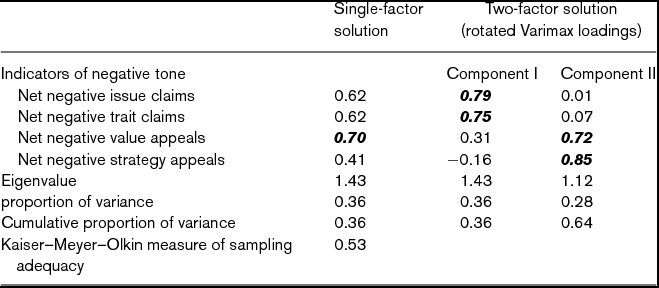
We first apply PCA to the four measures of negative messages in our campaign ads to assess whether these are indeed different aspects of the same phenomenon, and should thus be loaded into a unidimensional scale of negativity.Footnote 7Table 1 reports the estimates obtained from this analysis. The Kaiser–Meyer–Olkin (KMO) measure of sampling adequacy compares the magnitudes of the observed correlation coefficients to the magnitudes of the partial correlation coefficients. Since the KMO test yields a sufficiently high value, we proceed with the analysis.Footnote 8 The left margin in Table 1 lists all four types of negative message employed solely or jointly in the literature as measures of negativity. The estimates shown in this column are generated by assuming a unidimensional solution, and correspond closely with proponents of aggregating all types of message together. Looking at this column, we note that only one type of negative message, namely value appeals, has a loading of greater than 0.7, while two others (issue and trait claims) reach loadings of 0.6. The fourth one, strategic appeals, has a less satisfactory loading of 0.4. These loadings fall below 0.7, indicating that this is not a reliable unidimensional scale. Less than 36% of the variance is accounted for by this supposedly unidimensional factor. Therefore, further rotation is required.
Principal component analyses of indicators of negative tone in campaign ads broadcast on Taiwanese TV and in newspaper outlets during the presidential campaigns of 1996, 2000, 2004, and 2008, and the Taipei mayoral campaigns of 1998, 2002, and 2006 (n = 406; italicized loadings ≥ 0.70)

Note: cell entries represent factor loading.
As the estimates in the remaining columns in Table 1 show, this single factor solution does not constitute a reasonable representation of most of the information contained in these four types of campaign message. When we move to a PCA-based solution on the customary Eigenvalue cut-off point of 1 and rotate this solution, the results suggest a two-factor solution, with two components reproducing almost two thirds of the variance. Issue and trait claims load well on the first component (0.79 and 0.75 respectively), while value appeals are non-robustly associated. Strategic appeals have an even weaker negative loading.Footnote 9 These two variables however, have high loadings on the second component (0.72 and 0.85 respectively), whereas issue and trait claims have statistically no degree of relationship (0.01 and 0.07 respectively).
This analysis shows that the major scaling approach used in the literature, i.e. the minimalist directional approach, leads to the construction of non-reliable scales of negativity. Although it may be convenient to aggregate various measures into a scale to be used in statistical analyses (Putnam et al., Reference Putnam, Leonardi and Nanetti1993; cf. Jackman and Miller, Reference Jackman and Miller1996), doing so with different types of negative messages yields non-reliable indicators. The use of such a scale could lead to biased inferences in studying negativity in campaigning, and we suggest that some of the inconsistencies in the literature on the correlates of negative campaigning may be a function of poor scaling. To make more strongly grounded inferences, we suggest that scholars should distinguish between a construct comprising issue and trait claims on the one hand, and a construct that is based on value and strategy appeals on the other.
These findings help us determine the differences between the four types of negative messages discussed above. Consistent with the PCA results reported earlier, we find virtually orthogonal relations between negative claims and negative appeals. This finding supports the conceptual differentiation of negative claims (providing voters with information on issues and traits), and negative appeals (containing ideological and strategic content). Although issue and trait claims obviously differ in their focus, negative claims overall are often characterized by their conveyance of concrete, complementary information that potentially forms the basis of an accountability mechanism (Geer, Reference Geer2006). Similarly, although value and strategic appeals do not focus on the same phenomena, negative appeals convey messages that are intended to appeal to voters’ values and stimulate their emotions.
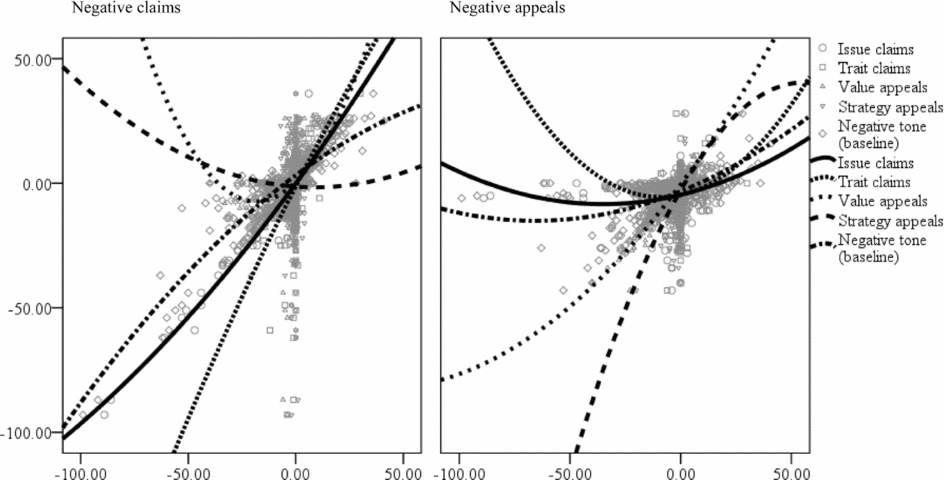
Having identified these two components, we next assess their association with different measures of negativity discussed in the literature. Figure 1 shows these associations using fit lines accounting for each of the two scales against negative issue claims, negative trait claims, negative value appeals, negative strategy appeals and the aggregated unidimensional measure of negativity. The left side of the figure shows that the negative claims component is significantly associated with negative issue claims, negative trait claims and the baseline negative tone scale (with R2 quadratic values of 0.91, 0.29, and 0.81 respectively). On the other hand, no associations were found with the two types of appeals (R2 was 0.06 for negative value appeals and less than 0.01 for negative strategy appeals). Similar findings are evident in the right side of the figure, where the negative appeals component is significantly associated with negative value appeals, negative strategic appeals, and the baseline (with R2 of 0.86, 0.36, and 0.40 respectively), and not with the two types of negative claims (R2 lower than 0.05 for both). Weak associations were found between the four different maximalist measures of negativity at the basis of these components. Issue and trait claims and value and strategy appeals were internally correlated at 0.25. Both claims are correlated significantly with value appeals (0.17 and 0.15 respectively), but not with strategy appeals. The correlations between the aggregated baseline negative scale and the four types of messages are better, with issue claims, trait claims, and value appeals reaching high Pearson's R values (0.84, 0.50, and 0.59 respectively), while strategy appeals associated with this so-called negative tone measurement are at 0.26.
Associations between minimalist and maximalist measures of negativity and the two principal components (total number of negative claims and total number of negative appeals), in unique campaign ads broadcast on Taiwanese TV and in newspaper outlets during the presidential campaigns of 1996, 2000, 2004, and 2008, and the Taipei mayoral campaigns of 1998, 2002, and 2006 (n = 406)
Note: Axes represent number of negative appeals.
The finding that there are significant correlations between the different measures of negativity may be interpreted as an indication that all of these scales measure roughly the same latent trait. Since the correlations are so strong, was the effort to develop new scales necessary? The short answer is that it was, since these correlations do not indicate cross-measure interchangeability, but rather a general consistency in the distributions of the measures. Put differently, various latent traits may be associated with one another while being conceptually independent. For instance, the level of democracy in political systems and the level of their economic development are highly correlated (Diamond, Reference Diamond and Hadinus1995), but measure distinct phenomena and are therefore not interchangeable. In order to assess the differences between the alternative measures of negativity in a systematic way, we next model the seven types of negative measure (i.e. the aggregated minimalist baseline, four types of maximalist measures of negativity, and the two new scales retrieved from the PCA) with explanatory variables reported in the literature as being associated with negativity. If some or all of these different measures were indeed interchangeable, we should expect their coefficient scores and significance to be consistent across models. On the other hand, if the following analysis yields different results based on each measure, we will have established that they are not identical and should not be treated as such.
5. Modelling negativity
Having created these reliable scales, the next step is to model the various types of negativity discussed above, and to compare the model results with those reported in the existing literature. The scales we have identified for negative claims and negative appeals require validation, and modelling them with theoretically salient predictors of negativity is an effective way to achieve that. In the following multivariate analysis, we employ eight salient predictors of negativity identified in the literature. Numerous studies have found that one of the strongest predictors of negativity is the level of competitiveness, leading to the widely accepted notion that trailing candidates are more likely to go negative than those leading in the polls (Buell and Sigelman, Reference Buell and Sigelman2008; Druckman et al., Reference Druckman, Kifer and Parkin2010; Lau and Pomper, Reference Lau and Pomper2004; Haynes and Rhine, Reference Haynes and Rhine1998; Theilmann and Wilhite, Reference Theilmann and Wilhite1998; Sigelman and Shiraev, Reference Sigelman and Shiraev2002; Skaperdas and Gofman, Reference Skaperdas and Grofman1995). Another persistent finding is that there are significant differences in the campaign behaviour of incumbents and challengers. While incumbents argue in favour of continuing the status quo by promoting their own performance, challengers have to establish a case for changing the status quo. An effective way to do this is to target an incumbent's performance and record (Geer, Reference Geer2006). Additionally, since an election candidate may not be standing for re-election, but may have been nominated by the party in power, we also control for ads endorsed by the party in power and the opposition (Buell and Sigelman, Reference Buell and Sigelman2008).
Party identity has been controlled for in several studies in the US, with the propensity for Democrat and Republican candidates to go negative varying across elections (Buell and Sigelman, Reference Buell and Sigelman2008; Petersen and Djupe, Reference Petersen and Djupe2005; Sellers, Reference Sellers1998). A further identity-based variable that we control for is the endorser or sponsor of an ad. In the US, ads are primarily sponsored by candidates running semi-autonomous campaigns with little interference by the party, but in Taiwan parties are more involved in sponsoring campaign ads and have greater influence on campaign content. When a party sponsors an ad it can afford to focus more on attacking the other side without compromising increasing familiarity with voters through running positive ads. Candidates may also benefit from delegating the task of attacking to the party (or, analogously, their running mates), allowing them some latitude in the case of a backlash from voters (Sigelman and Buell, Reference Sigelman and Buell2003).
Another predictor of negativity is the type or level of office that candidates are competing for, with observed differences in the strength of the associations with negativity (Druckman et al., Reference Druckman, Kifer and Parkin2010; Lau and Pomper, Reference Lau and Pomper2004). It is therefore useful to control for the type of election, particularly in cases like the current investigation where we utilize ads from both national and subnational electoral arenas. Damore (Reference Damore2002) argues that the timing of an attack in relation to Election Day is associated with the propensity to go negative, and presents findings that show candidates are more likely to run more negative ads the closer the election. Finally, since the range of media available to candidates is increasingly broad it is reasonable to expect that the tone and content of ads placed in different media may vary (Walter and Vliegenthart, Reference Walter and Vliegenthart2010). Due to the different advantages in terms of cost, reach, the type and amount of material that can be presented by each media type, parties and candidates appear to conceive their TV and newspaper ads as having distinct roles within their own campaigns (Elemlund-Praeksater, Reference Elemlund-Praeksater2010). Recent research reports significant differences between ads in various media in Europe, where TV is not the dominant venue for campaign advertising that it is in the US (Elemlund-Praeksater, Reference Elemlund-Praeksater2010; Walter and Vliegenthart, Reference Walter and Vliegenthart2010).
6. Results
In the analysis, we employ seven dependent variables pertaining to measurements of negativity in campaign ads: four maximalist scales measuring the net number of negative messages in the four message categories discussed above, one aggregated (and, as we have shown, non-reliable) scale of the total net negative tone in each of the ads, and the claim and appeal scales identified by the PCA. In our sample, we find that for issues, about one third of the ads contain more positive claims than negative claims, resulting in a net score lower than zero. Another third have a neutral net tone, where the number of positive and negative messages is equal, including cases where they are both zero. Eleven percent of the ads contain ten or more positive issue claims, while 9% contain ten or more negative ones. In terms of traits, one quarter of ads contain a net positive number of claims, while over half contain a neutral net number. For values, 61% of the ads contain a net positive number of appeals, while one third are neutral or offsetting. Over 12% of the ads contain ten or more positive value appeals, while less than 1% contain seven or more negative appeals. In terms of strategic appeals, a little under half the sample contains a net number of positive appeals, while another 42% contain a neutral net number, leaving one in ten ads with a net number of negative strategic appeals.
Following Geer (Reference Geer2006), we aggregate the different types of message into a (non-reliable) unidimensional negative tone scale, which serves a purpose here solely as a baseline. In this aggregated measure, over 60% of the ads contain a positive net tone, only 2% contain a neutral net tone, and the remainder have a net negative tone. Moving to the proposed claims and appeals scales, we note that the distributions are substantially different from the baseline. For claims, 42% of the ads contain a positive net number of messages, 19% a neutral or offsetting number, and 38% negative. Some 16% of ads in the sample contain ten or more positive claims, while one tenth of the ads contain ten or more negative claims. In terms of appeals, 70% of the ads contain a net number of positive messages, 18% offsetting, and only 12% negative. Footnote 10
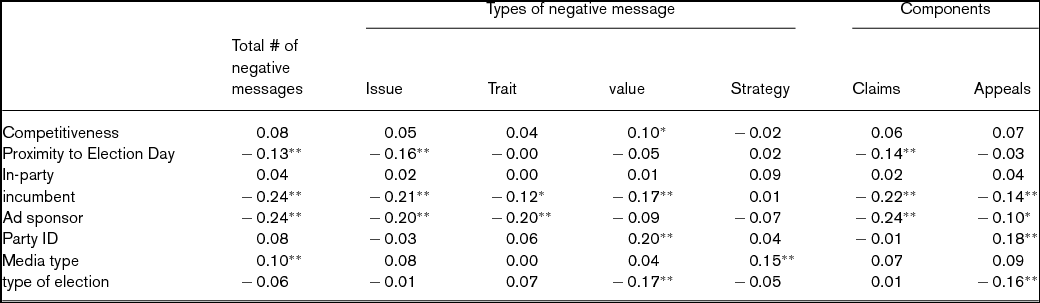
The first step in modelling the correlates of different types of negativity is to examine the bivariate associations between each of the model predictors and each of the outcomes, shown in Table 2. The explanatory variables employed in these models provide information about characteristics of the ads themselves, and therefore pertain to the same unit of measurement as the outcome variables, namely campaign ads. The table contains seven columns. The first column shows associations with the total number of net negative messages. These results should not be considered salient as this model merely replicates previous findings using the same non-reliable scale used in other investigations. The next four columns show the associations between the explanatory variables and the four discrete types of negative message.
Associations between predictors of negativity and seven measures of negative tone in unique campaign ads broadcast on Taiwanese TV and in newspaper outlets during the presidential campaigns of 1996, 2000, 2004, and 2008, and the Taipei mayoral campaigns of 1998, 2002, and 2006 (n = 406)
Notes: * p < 0.05, ** p < 0.01.
Cell entries represent Pearson's correlation coefficients.
Incumbency and ad sponsorship exhibited similar associations with two types of negative messages, namely issues and traits, and while incumbency displayed similar trends for value appeals, ad sponsorship was insignificantly associated with it. Competitiveness was associated with negative value appeals, with an increase in this type of appeal in highly competitive elections. The proximity of the publication of an ad to Election Day, which was significantly associated in the baseline model, was only associated with negative issue claims. Media type, which was also significant in the baseline model, was only associated with negative strategy appeals. The type of election proved significantly associated with negative value appeals, which were more prevalent in Mayoral campaigns. Comparing the two types of negative claims, proximity to Election Day was significantly associated with negative issue claims but not trait claims. Similarly, comparing the two types of negative appeal, party identity, and the type of election were only associated with negative value appeals, while media type was only associated with negative strategic appeals. The last two columns in Table 2 show the associations between the predictors and the components, negative claims and negative appeals. Here too, incumbency and ad sponsorship were robustly correlated with both components, while proximity to Election Day was only associated with the former and party identity and election type were only associated with the latter. The bivariate analysis establishes that these predictors (with the exception of party status) are associated with at least one measure of negativity.
The next step is to estimate the associations for each of the predictors controlling for all explanatory variables simultaneously. This multivariate analysis serves two purposes. First, comparing the coefficient scores across the measures of negativity provides a sharper perspective of these associations, the robustness of the predictors, and the differences between the results for negative tone, as operationalized in other studies, types of negative message, and negative claims and negative appeals. Second, it enables us to validate the salient findings in the literature, namely the predictive power of the explanatory variables in the models.
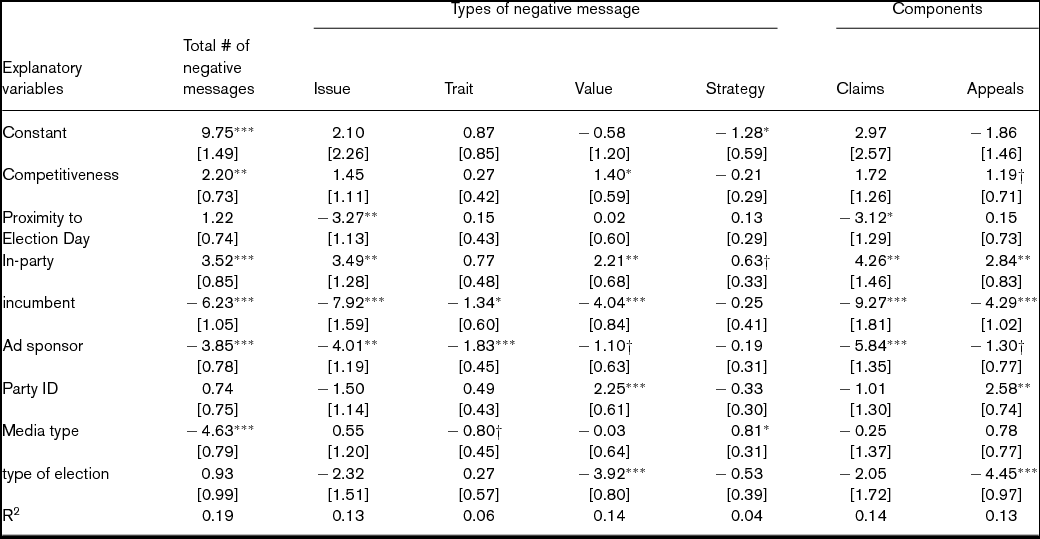
Table 3 shows the OLS results for the same seven outcome variables. The last row in Table 3 reports the proportion of the total explained variance in each of the models. The R2 values are not very impressive, indicating that the model predictors contribute modestly to predicting the different types of negativity. Moreover, it shows that further research is required to improve the results. However, the major objective of this analysis is not fitting models to predict the outcome, but rather to compare the findings across the different operationalizations of negativity.
OLS regression models on seven measures of negative tone in unique campaign ads broadcast on Taiwanese TV and in newspaper outlets during the presidential campaigns of 1996, 2000, 2004, and 2008, and the Taipei mayoral campaigns of 1998, 2002, and 2006 (n = 406)
Notes: * p < 0.05, ** p < 0.01, *** p < 0.001, † 0.05 <p<0.10.
Cell entries represent B coefficients and [standard errors].
Three explanatory variables, party status, incumbency,Footnote 11 and sponsorship, are robust predictors of all measures of negativity, bar strategic appeals. Three other variables, namely proximity, party identity, and election type, are significant predictors of at least one type of negative messages and one of the components. Looking at the baseline model, we note that five variables are significantly associated with this non-reliable measure of negative tone when controlling for everything else. Three of the four variables that were significantly associated in the bivariate analysis are also significant predictors of the outcome in the multivariate model, the exception being media type. Media type was positively associated with the outcome in the bivariate analysis, but after controlling for the other explanatory variables, the association changes direction and is negatively associated with it (i.e. newspaper ads are more likely to be negative.) Party status, which was insignificantly associated with negative tone, or any other measure, in the bivariate analysis, is robustly associated with six out of seven measures reported in Table 3. Moving to the four types of negative message, we note several interesting findings. First, although significantly associated with all other measures of negativity, party status is an insignificant predictor of negative trait claims. The timing of publication, an insignificant predictor in the baseline model, is a significant predictor of negative issue claims. Similarly, party identity and election type, insignificant predictors in the baseline model, are significant predictors of negative value appeals. One explanatory variable, i.e. media type, which is a significant predictor in the baseline model, only predicts negative strategy appeals. This finding is the first of several inconsistencies we observe in the case of negative strategy appeals. For instance, three otherwise robust explanatory variables, party status, incumbency, and ad sponsor, are insignificant predictors of strategic appeals.
Looking at the final two columns, showing the results for the two new and reliable scales we developed earlier, we note several findings. The three robust explanatory variables that predicted both the baseline and the different types of negative message are similarly significant, but the magnitude of the coefficients is much greater for claims than for appeals. Parties in power are more likely than opposition parties to include negative claims and negative appeals in their ads, although incumbent officials are less likely to. Incumbency status, for both parties and candidates, better explains the tendency to make negative claims than negative appeals. Ads sponsored by the party are more likely to include negative claims and negative appeals (although borderline significance was attained for the latter) than ads sponsored by the candidates.
Proximity, which was insignificant in the baseline model, but significant for issues in the message models, is a significant predictor of the negative claims scale, but not appeals. Although existing theory suggests that the closer we are to Election Day, the greater the propensity to go negative, controlling for all explanatory variables using a reliable scale suggests the opposite. One way to interpret this result is the recognition that claims are more campaign specific than appeals, and thus the timing of an ad's publication is more relevant here. The length of campaigns in Taiwan is relatively short, certainly much shorter than US presidential campaigns, and thus our measure of proximity is effectively ‘close to the election’ and ‘even closer to the election’. For this reason, we interpret the results for this variable cautiously. Election type and party identity, insignificant in the baseline and only significant for values, are both significant predictors of the negative appeals scale. Ads that ran in mayoral elections contain substantially more negative appeals than ads in presidential campaigns, although there were insignificant differences in the level of negative claims. In addition, ads endorsed by the KMT contain more negative appeals than DPP ads. The DPP has a stronger and clearer ideological orientation (Lin, Reference Lin2005) thus providing abundant material for the KMT to attack on this dimension. Media type and competitiveness, which were significant predictors in the baseline model and value appeals, are not significant for claims or appeals (if we discard the borderline-significance in the negative appeals model).
7. Conclusions
In this article, we examined one of the major components of the electoral landscape, namely negative advertising. We started by scaling various types of negative message and found that employing a minimalist or a maximalist operationalization is problematic, as some of these messages (but not all), scale on two independent indices. The findings show that there are substantial differences between negative claims and negative appeals and we argue that these differences should be accounted for analyses of negative advertising. We subsequently modelled the salient predictors of negativity found in prior studies on seven different measures of negativity, in order to establish their robustness. Out of the eight explanatory variables we tested, three predicted all types of negativity robustly, while others achieved different results based on the operationalization of the outcome variables. Models based on these predictors account for a low proportion of the explained variance and clearly require further development.
For many years, political scientists have tried to explain why some campaign ads contain more negative messages than others and to identify the determinants of this form of campaign behaviour. There have been many attempts to answer this question employing numerous methodologies to measure negativity, ranging from minimalist, purely directional operationalizations, to maximalist evaluative ones. We demonstrate in this article that there is a high correlation between these different types of measure, however this does not mean that alternative measurements are all measuring the same latent trait and are therefore interchangeable. There are two serious implications of this finding. First, sub-optimal operationalizations that compromise reliability limit the robustness and generalizability of the findings on campaign behaviour in general and negative advertising in particular. Second, the plurality of operationalizations not only affects reliability, but in some cases jeopardizes construct validity, with meaningful consequences for findings on campaign behaviour which use measures of negativity as a dependent variable. This is manifest in the inconsistent findings in the three major strands of campaign advertising research, namely attempts to estimate the level of negative advertising across campaigns, to gauge voter level exposure effects and to explain campaign strategies. Considering the inconsistencies which result from employing highly correlated, although different, measures of negativity, researchers should select their measures cautiously and explain the theoretical basis for preferring one measure over another in terms other than expediency or personal taste. In addition, researchers should explain why they choose not to use alternative indices of negativity. Finally, they should validate their findings and be able to account for why their findings would be different when using another measure of negativity.
About the authors
Eliyahu V. Sapir is a Lecturer in the Department of Political Science at Maastricht University, The Netherlands. His research focuses on the quality of democracy, comparative democratization, electoral politics, political methodology, complex data linking, text analysis, and data visualization.
Jonathan Sullivan is Associate Professor in the School of Contemporary Chinese Studies, University of Nottingham. He researches political communications in various Chinese contexts.
Tim Veen is a visiting fellow at the Centre for the Study of European Governance, University of Nottingham
Appendix I: Codebook
The codebook is designed hierarchically. There are four appeal categories: issues, traits, values, and strategy, which are divided into the broad domains shown and more specific sub-domains not shown. A content dictionary was developed with hundreds of mutually exclusive individual indicators, i.e. words and phrases, for each sub-domain. The issue category is divided into eight policy domains, which are further disaggregated into specific policy sectors. For instance, the domain ‘cross-Strait relations’ includes management of relations with China, security and defence issues related to China, transportation and other links, efforts at diplomacy, positions on the issue of independence and unification, references to negotiations and relations with the US relevant to Taiwan/China relations (e.g. weapons sales or the Taiwan Relations Act) etc. Issue claims are further separated into general valence statements, specific policy proposals, and policy performance. The traits category records mentions of the personal characteristics of the candidates, divided into references to leadership qualities, competence, integrity, and compassion. References to a candidate's lineage and associations, for instance connections to democracy activists, the ‘old regime’, or criminals, were also recorded. An important distinction is made between trait claims and a candidate's policy performance. A claim such as ‘my opponent is corrupt’ would be coded as a negative trait, whereas ‘my opponent has let corruption flourish during his time as mayor’ refers to candidate performance on the issue of corruption. The operational distinction between issues and value/ideology appeals is that the latter contain no reference to specific policy actions. To illustrate the distinction, ‘democracy is freedom for the people’ would be coded as a value appeal, whereas ‘constitutional reform is necessary to improve the working of our democratic institutions’ would be coded as a general statement on the issue of democratic reform. Similarly, ‘resuming dialogue with China increases the chance of peace in the Strait’ would be coded as a general issue statement on cross-Straits relations. Conversely, ‘we love peace’ would be coded as a value, although it may implicitly refer to improving relations with China. The strategy category records an array of claims related to the business of the election and the campaign itself. Strategic appeals include mobilizing for rallies, encouraging supporters to mobilize friends and family, publicizing campaign events, appealing for votes, encouraging voter turnout, emphasizing the importance of the election, commenting on the state of the race, and estimating the chances of winning or losing. Mentions of bad campaign practices are also recorded in this category.