Introduction
Cretaceous-aged vertebrates from Arizona, including dinosaurs, are rare. Despite the paucity of data, early reports (e.g., Miller, Reference Miller1964) recognized two main Cretaceous faunas in the state: one ‘middle’ Cretaceous (?Aptian-?Cenomanian) and one Late Cretaceous (Campanian) in age, a distinction that still holds today (see Lucas and Heckert, Reference Lucas and Heckert2005). Whereas known Late Cretaceous diversity is high, known ‘middle’ Cretaceous diversity is low, with only a few fragmentarily represented dinosaur taxa, including nodosaurids, sauropods, iguanodontians, dromaeosaurids, and large theropod dinosaurs (‘carnosaurs,’ Miller, Reference Miller1964; Galton and Jensen, 1989; McCord and Gillette, Reference McCord and Gillette2005; Lucas and Heckert, Reference Lucas and Heckert2005). Most of these remains are taxonomically ambiguous, housed in private collections, or only substantiated by brief mention in the literature (e.g., Ratkevitch, Reference Ratkevitch1997a; Hodnett, Reference Hodnett2003; Lucas and Heckert, Reference Lucas and Heckert2005). Fragmentary sauropod remains are known from at least three published localities (Ratkevitch, Reference Ratkevitch1998; McCord and Gillette, Reference McCord and Gillette2005). Among dinosaur remains, only the sauropod Sonorasaurus is known from somewhat complete material, including about one-third of a partially articulated skeleton.
The holotype and only known specimen of Sonorasaurus thompsoni was discovered by Dr. Richard Thompson of Tucson, Arizona in the fall of 1994 in the Whetstone Mountains of southeastern Arizona (Fig. 1). It was collected from 1995 to 1999 by crews from the Arizona-Sonora Desert Museum. Earliest reports (e.g., Thayer and Ratkevitch, Reference Thayer and Ratkevitch1995; Ratkevitch, Reference Ratkevitch1997a, Reference Ratkevitchb) informally used the name ‘Sonorasaurus’ for the dinosaur from this site, originally tentatively identifying it as a sauropod (Thayer and Ratkevitch, Reference Thayer and Ratkevitch1995) or hadrosaur (E. Colbert personal communication in Hill and Ratkevitch, Reference Hill and Ratkevitch1996). The discovery of Sonorasaurus generated significant attention because of the purported presence of a skull (Ratkevitch, Reference Ratkevitch1997a:fig. 2), which was later shown to be a crushed dorsal vertebra (Curtice, Reference Curtice2000). Later, the holotype specimen, ASDM 500, was described and identified as a new genus and species along with identification as a brachiosaurid sauropod (Ratkevitch, Reference Ratkevitch1998). At the time of its original description, ASDM 500 was the most complete ‘middle’ Cretaceous North American sauropod specimen (Ratkevitch, Reference Ratkevitch1998).
Locality information for Sonorasaurus thompsoni: (1) Location of Sonorasaurus thompsoni (black star) and other Aptian–Cenomanian sauropod body fossil sites (gray stars) in the western United States (modified from D’Emic, Reference D’Emic2013; D’Emic and Foster, in press); (2) Simplified geologic map of southeastern Arizona showing pre-Quaternary exposures (inside of solid black lines), extent of Cretaceous sedimentary rocks (gray shaded areas), and location of fossil site (black star) (modified from Inman, Reference Inman1987).

The formal description of Sonorasaurus was followed up by further anatomical (Curtice, Reference Curtice2000), geological (Scarborough, Reference Scarborough2000), and phylogenetic (e.g., Royo-Torres, Reference Royo-Torres2009; D’Emic, Reference D’Emic2012; Mannion et al., Reference Mannion, Upchurch, Barnes and Mateus2013) studies. Wilson (Reference Wilson2002) recognized Sonorasaurus to be a member of the clade uniting Jobaria plus Neosauropoda, whereas Upchurch et al. (Reference Upchurch, Barrett and Dodson2004) considered it to be a nomen dubium. Curtice (Reference Curtice2000:87) described strong similarity between Sonorasaurus and Brachiosaurus (then including Giraffatitan brancai as Brachiosaurus brancai; see Taylor, Reference Taylor2009; D’Emic, Reference D’Emic2012), stating that the “only character differentiating Sonorasaurus from Brachiosaurus is its temporal location.” Later cladistic and comparative studies have varied in their support for brachiosaurid affinities for Sonorasaurus. For example, Sonorasaurus was found to lie outside Brachiosauridae in one of the analyses presented by Royo-Torres (Reference Royo-Torres2009); instead it was hypothesized to be a member of ‘Laurasiformes’ along with other taxa traditionally considered to be brachiosaurids, including Cedarosaurus and Venenosaurus (D’Emic, Reference D’Emic2012). In contrast to the results of Royo-Torres (Reference Royo-Torres2009), D’Emic (Reference D’Emic2012) identified Sonorasaurus as a brachiosaurid but noted that further study was necessary to firmly establish its affinities. Mannion et al. (Reference Mannion, Upchurch, Barnes and Mateus2013) resolved Sonorasaurus in a variety of positions within Titanosauriformes, including within Brachiosauridae or various clades within Somphospondyli depending on how the data were analyzed. In none of these analyses was the recovered phylogenetic position of Sonorasaurus strongly supported. The labile phylogenetic position of Sonorasaurus among various studies suggests that any hypothesis of relationship based on currently published data is weak. This is likely because these hypotheses have been based on little information, because the original description (i.e., the data used by most researchers) only figured some of the bones of the holotype. This prompted our redescription of the osteology of Sonorasaurus along with a reconsideration of its phylogenetic affinities, as presented below.
Sonorasaurus is also important because of its potentially young geological age, possibly representing the last sauropod taxon before the ‘sauropod hiatus,’ the ca. Cenomanian-Campanian absence of the clade from the North American record (see D’Emic and Foreman, Reference D’Emic and Foreman2012 and references therein). Based on regional correlations and assumptions about sedimentation rates, Ratkevitch (Reference Ratkevitch1997a:213) suggested that “the Turney Ranch Formation should overlap the Lower/Upper (Albian/Cenomanian) Cretaceous boundary” and placed its bounds between 110 and 76 Ma. Later, Ratkevitch (Reference Ratkevitch1998) and Scarborough (Reference Scarborough2000) narrowed Sonorasaurus’ hypothesized age range to closer to the Early-Late Cretaceous boundary, with the latter author favoring a late Albian (105–100 Ma) age. Mannion and Upchurch (Reference Mannion and Upchurch2011:532) followed these authors, stating that Sonorasaurus was “late Albian–early Cenomanian” in age, using it as one piece of evidence to discount the reality of the “sauropod hiatus” in North America as an artefact of poor sampling. Mannion and Upchurch (Reference Mannion and Upchurch2011) suggested that the sauropod hiatus was an artifact of the paleoenvironmental preferences of pre- and post-hiatus sauropods and differential preservation of certain paleoenvironments (i.e., ‘inland’ versus ‘coastal’) during the hiatus. Sonorasaurus also represents one of the last purported brachiosaurid sauropods worldwide, highlighting the need to establish its geologic age with more certainty.
Like its geologic age, the published understanding of the paleoenvironment of Sonorasaurus is ambiguous—for example, Ratkevitch (Reference Ratkevitch1998:79) described the Turney Ranch Formation as “fluvial and possibly estuarine…”. Perhaps due to this uncertainty, Sonorasaurus and its paleoenvironment were not included in the numerical analyses of sauropod environmental preferences by Mannion and Upchurch (Reference Mannion and Upchurch2011:supplemental information), despite its importance as one of or the youngest sauropods before their disappearance from the North American record.
We revisited the Sonorasaurus holotype quarry and surrounding exposures of the Turney Ranch Formation in 2013 and 2014 with five goals. First, we re-opened the holotype quarry in an effort to find more material. The quarry has been tectonically uplifted into an essentially vertical position, and Ratkevitch (Reference Ratkevitch1998:79) noted that: “Further skeletal elements are predicted to be contained in the downstream (now vertically down) unexcavated portion of the sandstone ridge.” Second, we prospected the surrounding exposures for more vertebrate remains. Third, we obtained geological data to evaluate previous interpretations of the depositional environment of the quarry as well as sedimentological data to establish the paleoenvironment in which Sonorasaurus lived. Fourth, we assessed the plant macroflora of the Turney Ranch Formation as a complement to our paleoenvironmental data. Fifth, we obtained detrital zircon samples from the quarry and a nearby mudstone for the purposes of precisely dating the age of Sonorasaurus.
Institutional Abbreviations
ASDM, Arizona-Sonora Desert Museum, Tucson, USA; DMNH, Denver Museum of Natural History, Denver, USA; FMNH PR, Field Museum of Natural History, Chicago, USA; NMST-PV, National Science Museum, Tokyo, Japan; YPM, Yale Peabody Museum, New Haven, USA; MCF-PHV, Museo Municipal Carmen Funes, Plaza Huincul, Argentina; MCS, Museo Cinco Saltos, Cipoletti, Argentina. USNM, National Museum of Natural History, Smithsonian Institution, Washington, D.C., USA.
Geology of the Turney Ranch Formation
Below we present new lithologic descriptions of the strata within the Turney Ranch Formation, the first stable isotope records from the Whetstone Mountains exposures of the formation, and radiometric dates from detrital zircons sampled from the holotype Sonorasaurus quarry. The Turney Ranch Formation, underlain by the fluviodeltaic-to-braided fluvial Shellenberger Canyon Formation and overlain by Quaternary pediment gravels, contains alternating river and floodplain deposits that are about a kilometer in thickness (Fig. 2). Short stratigraphic sections were trenched and measured through sedimentary successions and corrected for local dip of strata using a Jacob’s staff. In order to gain insights into the paleoenvironment of Sonorasaurus, pedogenic carbonate nodules were obtained from the B-horizons of paleosols at five locations for stable carbon and oxygen isotope analysis. Carbonate nodules were also obtained from a conglomeratic layer (interpreted as flood deposit), which also hosts petrified tree remains. The exact stratigraphic position of each stable isotope sample was not determined, but all sample sites are approximately from within the 200 m below and 200 m above the Sonorasaurus site. In all cases pedogenic carbonate nodules were cut and polished and their micritic cores sampled with a dental drill. Spar was also sampled at two localities for comparison to micrite values. δ18O and δ13C values were obtained using a Thermo Finnigan DeltaPLUS XP Continuous Flow Stable Isotope Ratio Mass Spectrometer housed at the University of Wyoming Stable Isotope Facility. Prior to introduction to the mass spectrometer, carbonate powders were roasted at 200°C for 1.5 hours and reacted with anhydrous phosphoric acid at ~25°C. Isotope values were normalized to internal and external standards (VPDB and NBS-19), and reported VPDB in standard per mil notation. Precision is better than 0.1‰ for both δ18O and δ13C values.
Generalized stratigraphic section and interpretations of depositional setting in the study area in the southwestern Whetstone Mountains. Approximate stratigraphic position of Sonorasaurus thompsoni and detrital zircon sample marked with black star. Sand bodies are shown schematically, in reality each is about 2–10 meters thick and spaced at roughly regular 5–10 meter intervals within the Turney Ranch Formation. Pedogenic carbonates were obtained from strata within ~200 meters above and below fossil site. Information for the Turney Ranch based on personal observation (BZF) and Archibald (Reference Archibald1987).
For radiometric dating, two fine-grained mudstones with a minor silt and fine sand component within the otherwise sandstone-dominated fluvial deposit within the holotypic quarry were sampled. Such fine-grained beds are more likely to preserve ash fall zircons in greater abundance (Trujillo and Chamberlain, Reference Trujillo and Chamberlain2013). Sample preparation followed standard techniques of physical disaggregation into individual grains followed by water table, magnetic, and heavy liquids separations (Gehrels et al., 2008). Zircons were analyzed at the University of Arizona’s LaserChron facility using a laser-ablation multi-collector inductively coupled plasma mass spectrometer with a measurement error of 1%–2% (2-sigma level). Euhedral grains that appeared clear in scanning electron microscope images were specifically targeted for age determinations, as these tend to be the youngest grains (Gehrels, Reference Gehrels2012). A total of 136 age determinations were made of unknown samples and 59 from in-house standards (Fig. 3.1). We applied a discordance filter of 15% to the age determinations yielding 132 dates. Recovered U/Pb ages range from 129.2±9.9 (2σ) to 2105.9±4.9 (2σ) Ma with peaks in the frequency distributions at ~167 Ma, 227 Ma, ~1407 Ma and ~1675 Ma (Fig. 3.2; Supplemental Data 1). Phanerozoic ages (<310 Ma) show additional young peaks at ~136 and 151 Ma (Fig. 3.3). As mentioned above, the weighted mean average of the five youngest grains is 136.3±4.1 (2σ) (Fig. 3.3–3.4), but we regard this age as too old to represent the Sonorasaurus holotype quarry based on other geological and biostratigraphic evidence (see above).
Detrital zircon U-Pb data. 1, and 2, Pb*/U Concordia plots for the two detrital zircon samples from the Turney Ranch Formation in and near the Sonorasaurus holotype quarry. Gray circles represent 2-sigma uncertainty for each age determination on a single grain and black dots concordant ages between the two isotope decay systems. Grains whose ages were greater than 15% discordant were eliminated from further study; 2, Normalized probability spectra for all detrital zircon U/Pb age determinations and peaks identified; 3, normalized probability spectra for detrital zircon U/Pb ages for the Phanerozoic only. Note that mostly euhedral grains were targeted during analysis (i.e., grain selection was non-random), and peak height should not be interpreted as indicative of provenance signatures; 4, Youngest ages obtained from single grain analyses for the two sediment samples at the fossil site. Vertical grey brackets are uncertainty on single grain analyses and black line denotes weighted mean of the single grain analyses. Bold text provides average and represents a maximum depositional age for the site.
Sedimentology of the Turney Ranch Formation
In the Whetstone Mountains the Turney Ranch Formation varies from 900 to 1420 m thick and is composed of repetitive successions of fluvial and overbank deposits (Archibald, Reference Archibald1987). In outcrop fluvial units form regularly spaced ridges with floodplain units occupying low-lying area in between (Fig. 4.1). Fluvial sand-bodies are typically 2–10 m thick and can extend laterally for well over a kilometer (Archibald, Reference Archibald1982; this study). The base of these fluvial sand-bodies is commonly a sharp scour surface while the top can be sharp to gradational (Archibald, Reference Archibald1982; this study; Fig. 4.2, 4.3). Internally they are composed of a basal coarse- to medium-grained sandstone with siltstone rip-up clasts, rounded carbonate nodules, and chert pebbles (Archibald, Reference Archibald1982; this study). Grain-size fines up-section within the sand-bodies to medium- and fine-grained sandstones and large scale trough-bedding transitions to ripple cross lamination (Archibald, Reference Archibald1982; this study). Planar cross-bedding, climbing ripples, and planar laminations with parting lineations are also common (Archibald, Reference Archibald1982; this study). Archibald (Reference Archibald1982; Reference Archibald1987) identified a ‘mega-ripple’ sedimentary structure with amplitudes up to 0.5 m and wavelength greater than 1 m within the Turney Ranch Formation. We also observed multiple examples of these sigmoidal, repetitive structures (sometimes with ripple cross laminations and dune stratification on the inclined foresets) that are up to 1.5 m thick, but more commonly 1.0–1.3 m thick (Fig. 4.3). Archibald (Reference Archibald1982) attributes this facies to large-scale bedform migration, however, we view them as more consistent with deposition on point and mid-channel bars within a river channel (Mohrig et al., Reference Mohrig, Heller, Paola and Lyons2000). Additionally, some sand-bodies are completely devoid of primary sedimentary structure and are instead intensely bioturbated. Sub-vertical and sub-horizontal burrows (Fig. 4.4, 4.5) are ubiquitous in these sandstones and are typically a few millimeters wide and <5 cm long; some are reminiscent of marine trace fossils Skolithus and Planolites (possibly suggested as such by Archibald, Reference Archibald1982; Reference Archibald1987) but are not definitively identifiable as such.
(1) Outcrop exposure of ridge-forming fluvial sand bodies (photograph looking to the southeast). Sand bodies appear to be regularly spaced and are typically 2–10 meters thick and each can extend laterally over a kilometer. Dip is to the south in this photograph; (2) Typical outcrop exposure of fluvial sandstone showing subtle bar clinoforms down and to the right; (3) Exposure of carbonate-bearing soil succession overlain by a thick fluvial sand-body. Here pedogenic carbonates form two hardpan layers (two rugose ledges beneath capping sandstone), Jacob’s staff is 1.5 meters tall; (4, 5) burrows in sandstone layers in the Turney Ranch Formation; scale bars equal 5 cm.
These fluvial sand-bodies are overlain and underlain by mudstone and siltstone units that represent floodplain or overbank deposition. Gray, green, maroon, and red mudstones and siltstones represent floodplain low-lying areas, ephemeral ponds, and well-drained soils (Archibald, Reference Archibald1982; this study). Ephemeral pond deposits are uncommon, but are characterized by green gray claystones containing carbonaceous matter, laminations, gastropod shell fragments and are overlain by purple mottled siltstones occasionally with pedogenic carbonate nodules. Red and maroon mottled siltstones contain weak ped structures and varying degrees of pedogenic carbonate development, from isolated nodules a few millimeters in diameter to thick hardpan layers several decimeters thick (Figs. 4, 5). One other significant facies occurs within the floodplain sequences, thin (<0.4 m), but laterally extensive (several hundred meters) coarse-grained sandstones to conglomerates with abundant carbonate nodules. Typically, these deposits contain a basal unit of crude cross-bedding followed by a zone rich in carbonate and chert pebbles followed by a ripple laminated fine- to medium-grained sandstone. These beds host the most concentrated zones of petrified wood fragments and logs in the Turney Ranch Formation and are interpreted as large, destructive breach or splay deposits from fluvial channels.
Representative exposure of floodplain and fluvial deposits within the Turney Ranch Formation; (1) Photograph of outcrop within modern ravine; (2) Designation of stratigraphic units and general interpretation (Jacob’s staff is 1.5 meters tall); (3) stratigraphic section through the outcrop. Numbers on stratigraphic section correspond to units mentioned in the text.
A detailed stratigraphic section through a representative overbank–fluvial transition is shown in Figure 5. From bottom to top, units 1 and 2 are grey green siltstone and mudstone with grayish red (10R 4/2) and dark yellowish orange (10YR 6/6) mottles, weak burrow structures, blocky ped structures, and carbonate nodules that range in diameters from 1 mm to 3 cm. These units represent B-horizons within a paleosol sequence. Unit 3 is a massive, pale greenish yellow (10Y 8/2) fine-grained sandstone with a significant silt component that likely represents an illuviated A-horizon within the paleosol. Unit 4 fines upwards from a grayish yellow green (5GY 7/2) medium-grained sandstone to a siltstone. The basal contact is sharp with siltstone rip-up clasts and there is a transition from multiple trough cross-bed sets to ripple cross-lamination, to fine laminations up-section coincident with grain-size changes (Fig. 5). The very top is weakly mottled dark yellowish orange (10YR 6/6). Unit 5 if a medium- to fine-grained sandstone with a sharp lower contact and is composed of a set of repetitive sigmoidal clinoforms dipping down and to the left in the photograph (Fig. 5). Ripples and cross-beds up to 8 cm thick are present on the foresets of these clinoforms. This is interpreted as a bar deposit and its thickness (1.3 m) roughly approximates the flow depth for the river (Mohrig et al., Reference Mohrig, Heller, Paola and Lyons2000). Units 6 and 7 represent another paleosol and Unit 8 an additional fluvial deposit with bar clinoforms.
Isotopic Results
Fig. 6 presents stable isotope results from the pedogenic carbonate nodules sampled in this study. δ18O values range from −4.9‰ (VPDB) to −9.7‰ with a median of −7.0‰ and a mean of −7.1‰ for micrite samples. Spar δ18O values range from −8.2‰ to −9.2‰. δ13C values range from −5.5‰ (VPDB) to −7.9‰ with a median of −6.4‰ and a mean of −6.7‰ for micrite values. Spar δ13C values range from −6.0‰ to −6.2‰. Two of the carbonate nodules derived from the conglomeratic layer that hosts petrified wood fragments display δ18O and δ13C values similar to in situ nodules derived from soil horizons (grey circles in Fig. 6). A third displays a lower δ18O value but similar δ13C value to soil hosted nodules (Fig. 6).
Bivariate plot of stable isotope values from pedogenic carbonate nodules. Black and white circles denote in situ pedogenic carbonate nodules whereas grey circles identify nodules recovered from the conglomeratic unit that hosts abundant petrified wood.
Flora of the Turney Ranch Formation
To understand the plant communities surrounding Sonorasaurus in its paleoenvironment, we undertook macro- and microfossil floral investigations of the Turney Ranch Formation. Fragments of silicified wood commonly occur as float throughout the formation. Palynological samples from grayish red mudstone samples were barren, and we did not find identifiable plant adpression fossils. Large, silicified prostrate trunks are preserved in fluvial gravel or sandstone channel-fill and sheet flow deposits that are bound by mudstone and siltstone units (Fig. 7). The largest trunk observed was ~0.63 m in diameter. None of the specimens examined for this study show basal flare; some preserved knots indicating branching.
Conifer woods from the Turney Ranch Formation. (1 & 2) examples of large silicified tree trunks in the Turney Ranch Formation near the Sonorasaurus quarry; (3–6) thin sections of USNM 629458; (3) transverse section without growth interruptions, showing polygonal outline of the trachieds; (4) tangential section showing short (up to 12 cells high) uniserate rays and rare locally biserate rays (at arrow); (5) radial longitudinal section showing tracheids with closely spaced, uniseriate, circular bordered pits on the radial wall of a tracheid (at arrow); (6) radial longitudinal section showing the cross-field pitting with 2–5 oculipores visible per cross-field; note four pits in the crossfield at arrowhead.
We prepared standard thin sections in radial longitudinal (RLS), tangential longitudinal (TLS) and transverse orientations (XS) from six specimens (USNM 629458–629463) that appeared to show good anatomical preservation. All seven are anatomically indistinguishable and likely represent a single taxon. We examined the thin sections using a Nikon 80i Eclipse digital binocular transmitted light microscope and a photographed them with a Nikon DXM 1200F camera. All the specimens and thin sections are curated in the Department of Paleobiology, National Museum of Natural History, Smithsonian Institution. Anatomical measurements were made from the images using the program ImageJ (Rasband, Reference Rasband1997) and following the recommendations of the IAWA for softwood identification (IAWA committee, 2004).
The transverse sections revealed that the secondary xylem consists of homoxylous pycnoxylic wood (Fig. 7.3). Although some hand specimens appear to have growth rings, when viewed under the microscope they are indistinct. Resin canals are absent, and axial parenchyma is rare or absent. The tracheids are medium to small, rectangular to polygonal, and arranged in radial files. They range from 24.3–51.8 μm in tangential diameter measured from middle lamella to middle lamella. The mean tangential diameter of the tracheids is 41.8 μm, standard deviation is 7.5 μm (n=25). In TLS, uniserate (rarely locally biseriate) rays 1–14 cells high (n=5) are separated by ~4 files of tracheids (Fig. 7.4). The ray cells are procumbent and elliptic in tangential section (15.1 μm across by 23.4 μm high). They have smooth and thin cell walls (Fig. 7.4). Ray density is ~5.0 raysmm−1. In RLS, uniseriate, closely spaced to contiguous circular bordered pits with circular apertures (abietinean pits) are visible on the radial walls of the tracheids (Fig. 7.5). Pit diameter is 19–20 μm, and aperture diameter is 3.7–10.1 μm; scalloped tori, torus extensions, and notched borders were not observed. Pits in the cross-field are poorly preserved oculipores with either elliptic or oval apertures. 1–6 oculipores per cross field, usually in two rows (Fig. 7.6). The ratio of aperture length to pit border diameter is undetermined.
Following the key to Mesozoic conifer wood types provided by Philippe and Bamford, (Reference Philippe and Bamford2008) this wood should be classified as a Group C Mesozoic conifer wood, either Taxodioxylon Hartig or Cupressinoxylon Göppert. Species in these genera share pycnoxylic wood with abietinean pitting and primarily uniserate rays, but they can usually be distinguished by the cross-field pitting. Although there are some fossil woods that combine the characteristic features of these two genera (Falcon-Lang, Reference Falcon-Lang2003), Taxodioxylon is characterized by oculipores in the cross-field in which the pit aperture is oval to elliptic and larger than the pit border, whereas Cupressinoxylon is characterized by oculipores in which the pit aperture is elliptical and as long as or shorter than the diameter of the pit border (Philippe and Bamford, Reference Philippe and Bamford2008). Based on the presence cross-field pits without a visible elongate aperture, we tentatively assign the specimens described here to Cupressinoxylon. The fossil wood described here was most likely produced by trees in the family Cupressaceae or possibly Cheirolepidiaceae. The trees grew up to at least 32.0 m tall based on Niklas’ (Reference Niklas1994) allometric scaling relationship for woody trees (log10 H=1.59+0.39 log10 D−0.18(log10 D)2) where D is stem diameter above the basal flare, and H is tree height.
Other dinosaur specimens from the Bisbee Group
The dinosaurs of the Bisbee Group were reviewed by Lucas and Heckert (Reference Lucas and Heckert2005) and McCord and Gillette (Reference McCord and Gillette2005), who noted the presence of Sonorasaurus, fish, turtles, crocodilians, nodosaurids, a claw referred to cf. Deinonychus, a tooth referred to cf. Acrocanthosaurus, and ornithopod femora that closely resemble that of Tenontosaurus (see also Galton and Jensen, Reference Galton and Jensen1979). Previous to these reviews, Miller (Reference Miller1964:378) reported (via personal communication) the presence of a stegosaur “of probable Lower Cretaceous age” from southern Arizona, but no other details are known about this report. Only a few other taxonomically informative dinosaur specimens exist from the Bisbee Group; we describe these below and offer new information about the tooth referred to cf. Acrocanthosaurus (ASDM 300).
Sauropod dorsal ribs
We re-opened the holotype quarry of Sonorasaurus in 2014, but no additional elements were found. However, two partial dorsal ribs were collected from a site 0.6 km distant and ca. 125 m stratigraphically above the Sonorasaurus quarry. One rib (ASDM 857, incorrectly given as ASDM 807 by Ratkevitch [Reference Ratkevitch1998]; Supplemental Data 2) was found before Sonorasaurus’ discovery (R. Thompson, personal communication, 2014) and was mentioned by Ratkevitch (Reference Ratkevitch1998:72, 80). It is 142 cm long as preserved, but it is not complete proximally or distally. Its proximal end bears what might be a pneumatic foramen or fossa (Supplemental Data 2), but this is difficult to assess due to damage. Its cross section near its mid-length is plank-like, measuring about 7.0 cm by 2.2 cm. This plank-like morphology indicates that this rib pertains to a titanosauriform (Wilson, Reference Wilson2002). At the same site, we collected a ca. 30-cm long fragment of a dorsal rib (ASDM 2070). It has essentially the same cross sectional measurement as ASDM 857 (8 cm by 2.5 cm), which tapers distally such that it cannot be a broken distal fragment of that rib. Based on its cross section, ASDM 2070 also pertains to a titanosauriform. It is likely that these two ribs pertained to a single individual based on their proximity and similar size and preservation.
Sauropod maxilla
Part of a sauropod maxilla (ASDM 2069; Supplemental Data 3) was discovered at the same site as the two dorsal ribs (ASDM 857, 2070). Unfortunately, only the ca. 1 mm thick lateral skin of bone bounding six alveoli was present, and most of the bone could not be collected. A badly crushed, single tooth root measuring about 8 mm in diameter was present in the maxilla.
Theropod femur
Part of a proximal theropod femur shaft (ASDM 2111; Supplemental Data 4) was found approximately 300 m from the Sonorasaurus quarry in a reddish sandstone layer just superjacent to one of the black pebble petrified wood–bearing conglomerate layers. The bone preserves the fourth trochanter, but lacks other processes including the femoral head. Its preserved length is 34 cm and its circumference at its preserved distal end is approximately 25.5 cm.
Theropod tooth
In describing the bones of Sonorasaurus, Ratkevitch (Reference Ratkevitch1997a:215) reported the presence of a large theropod dinosaur tooth (ASDM 330; Fig. 8) that was stated to “match bite marks on the radius and ulna of our skeleton” and tentatively referred this tooth to Acrocanthosaurus (Ratkevitch, Reference Ratkevitch1997a:fig. 7; see also Scarborough, Reference Scarborough2000:fig. 5; McCord and Gillette, Reference McCord and Gillette2005: Table 2). This tooth was further prepared in 2013 by MDD, making its cross–sectional shape visible and clarifying the shape of its margin. The tooth is at least 5.9 cm long as preserved (=‘crown height’ of Smith et al., Reference Smith, Vann and Dodson2005; versus the ‘apical length,’ which was greater than 5.6 cm long), and its preserved base measures 2.9 cm mesiodistally by 1.2 cm labiolingually. Denticles are visible and their density can be measured on the apical part of the distal margin (density=2 denticles/mm), about the mid-height of the distal margin (2.8 denticles/mm), and mid-height of the mesial margin (3.4 denticles/mm) (Fig. 8). Denticle densities in these regions in Acrocanthosaurus average 2.7, 2.9, and 2.7 denticles/mm, respectively (Smith et al., Reference Smith, Vann and Dodson2005), so only the mid-height of the distal margin is similar in this regard. The presence or absence of enamel wrinkles, which are present in Acrocanthosaurus (D’Emic et al., 2012; Hendrickx et al., Reference Hendrickx, Mateus and Araújo2015), cannot be assessed. The lateral profile of the tooth when viewed lingually or labially is weakly sigmoid in outline with a concave basal and convex apical portion, which was suggested to be diagnostic of Carcharodontosaurinae (Hendrickx et al., Reference Hendrickx, Mateus and Araújo2015). Based on this feature, the denticle density, and overall proportions, we refer this tooth to Carcharodontosaurinae.
Carcharodontosaurinae indet., theropod dinosaur tooth (ASDM 330) from the mid-Cretaceous Turney Ranch Formation of Arizona, USA. Abbreviations: den=denticles.
Shellenberger Canyon material
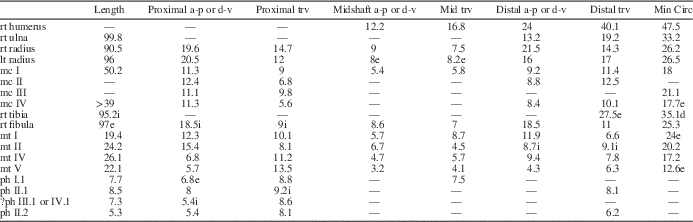
Schafroth (Reference Schafroth1968) reported the presence of dinosaur bones in the Shellenberger Canyon Formation of the Bisbee Group, but no further information was given. A sauropod fibula and sternal plate were reported from the Shellenberger Canyon Formation (McCord and Gillette, Reference McCord and Gillette2005), which is subjacent to the Turney Ranch Formation (Ratkevitch, Reference Ratkevitch1998). The sternal plate is incomplete, so not much can be gleaned from its anatomy. The fibula is similar in robustness to that of Sonorasaurus, with a robustness index (average of anteroposterior dimension of proximal + midshaft + distal ends/length; Wilson and Upchurch, Reference Wilson and Upchurch2003) of 0.17 in the former versus approximately 0.16 in the latter (Table 2). Its lower-level affinities are uncertain.
In sum, the presence of a basally branching titanosauriform (Sonorasaurus), cf. Tenontosaurus, and a carcharodontosaurine theropod (similar to Acrocanthosaurus) suggests that the dinosaur fauna of the Turney Ranch Formation was similar to that of other middle Cretaceous North American faunas (see D’Emic and Foreman, Reference D’Emic and Foreman2012, and references therein). We cannot support nor refute the identification of nodosaurids nor Deinonychus in the fauna (McCord and Gillette, Reference McCord and Gillette2005), although those taxa would strengthen the apparent faunal similarity based on the limited data at hand.
Systematic paleontology
Sauropoda Marsh, Reference Marsh1878
Macronaria Wilson and Sereno, Reference Wilson and Sereno1998
Titanosauriformes Salgado, Coria, and Calvo Reference Salgado, Coria and Calvo1997
Family Brachiosauridae Riggs, Reference Riggs1903
Genus Sonorasaurus Ratkevitch, Reference Ratkevitch1998
Sonorasaurus thompsoni Ratkevitch, Reference Ratkevitch1998
Dorsal vertebrae of Sonorasaurus thompsoni (ASDM 500) from the mid- Cretaceous Turney Ranch Formation of Arizona, USA: Two dorsal vertebrae in (1) right lateral view that are cemented together taphonomically; (2) partial dorsal vertebral centrum in posterior view; (3) same in anterior view; (4) dorsal vertebral neural arch in posterior view; (5) same in right lateral view; (6) same in dorsal view. Abbreviations: acpl=anterior centroparapophyseal lamina; cam=camera; hypa=hypantrum; hypo=hyposphene; pcdl=posterior centrodiapophyseal lamina; pcpl=posterior centroparapophyseal lamina; podl=postzygodiapophyseal lamina; posdf, postzygapophyseal spinodiapophyseal fossa; spol=spinopostzygapophyseal lamina.
Select holotypic caudal vertebrae of Sonorasaurus thompsoni (ASDM 500) from the mid-Cretaceous Turney Ranch Formation of Arizona, USA. From left to right, the vertebrate are shown in right lateral, posterior, left lateral, anterior, dorsal, and ventral views. Specimen numbers are as follows: (1) ASDM 500–6; (2) ASDM 500–294; (3) ASDM 500–9; (4) ASDM 500–38 & –297; (5) ASDM 500–296; (6) ASDM 500–10. Abbreviations: oc=over–prepared chevron facet; apparent fossa is not real; ri=rib fragment that was taphonomically affixed to this caudal vertebra; sh=‘shoulder’, ridge between zygapophyses; trv=transverse process.
Parts of the cross sections of the blade of the holotypic scapula of Sonorasaurus thompsoni (ASDM 500) from the mid-Cretaceous Turney Ranch Formation of Arizona, USA.
Right holotypic humerus of Sonorasaurus thompsoni (ASDM 500) from the mid-Cretaceous Turney Ranch Formation of Arizona, USA: (1) anterior; (2) posterior; (3) distal views, with cross section of shaft shown between (A) and (B). Abbreviations: div=divided radial condyle; trp=posteriorly projecting triangular process.
Comparison of distal humerus shape in various neosauropods. Bones are scaled to the same transverse width and are oriented with their anterior faces towards the top of the page. Note the posterior projection of the ulnar condyle (highlighted by the thin horizontal line that runs along the posterior part of the opposite condyle) in Sonorasaurus and deeply nested titanosaurs. Specimen numbers for depicted humeri are: Apatosaurus, NMST–PV 20375 (drawn from Upchurch et al., Reference Upchurch, Barrett and Dodson2004b); Camarasaurus, YPM 1901 (drawn from Ostrom and McIntosh, Reference Ostrom and McIntosh1966); Sonorasaurus, ASDM 500; Ligabuesaurus, MCF–PHV 233; Rapetosaurus (FMNH PR 2209; reversed and drawn from Curry Rogers, 2009); Neuquensaurus, MCS–8.
Right holotypic ulna of Sonorasaurus thompsoni (ASDM 500) from the mid-Cretaceous Turney Ranch Formation of Arizona, USA: (1) proximal; (2) distal; (3) medial; (4) posterior; (5) lateral views. Abbreviations: ol=olecranon process; ri=ridge for ligamentous attachment to radius.
Right holotypic radius of Sonorasaurus thompsoni (ASDM 500) from the ‘middle’ Cretaceous Turney Ranch Formation of Arizona, USA: (1) proximal; (2) medial; (3) anterior; (4) lateral; (5) posterior; (6) distal views, with cross sections along the shaft depicted next to (2 and 3).
Right holotypic metacarpals of Sonorasaurus thompsoni (ASDM 500) from the mid-Cretaceous Turney Ranch Formation of Arizona, USA. Photographs taken by MDD in 2010. Abbreviations: bo=boss.
Holotype
Each fragment of the holotype received its own catalog number, so in several instances, multiple numbers signify the same assembled element. All bones of the holotype fall under the number ASDM 500, the remains of a single individual composed of 5 posterior dorsal vertebrae (ASDM 500-4, -12, -52, -104 [two conjoined vertebrae]), ten mid-posterior caudal vertebrae (ASDM 500-6, -7, -8, -9, -297/299, -10, -296, -300, -302, -11 [in relative order within the vertebral series]), several (ca. 30) fragments of dorsal ribs (ASDM 500), fragments of one or both scapular blades (ASDM 500-370, -36), a partial right humerus (ASDM 500-45, -323, -483, -479, -54), a right ulna (ASDM 500-58, -23, -24, -25), left and right radii (right: ASDM 500-1, left: ASDM 500-33, -49, 496), right metacarpals I (ASDM 500-316, -317, -495), II (ASDM 500-491, -493), III (ASDM 500-290, -298), and IV (ASDM 500-251, -490, -315), a fragmentary left ilium (ASDM 500-30, -371, -372, -373, -379), the pubic peduncle of the right ilium (ASDM 500-480, -586), a right tibia (ASDM 500-2), a right fibula (ASDM 500-3), right metatarsals I (ASDM 500-287), II (ASDM 500-284, -285), IV (ASDM 500-282), and V (ASDM 500-278), right phalanx I. 1 (ASDM 500-283), right phalanx ?II.1 (ASDM 500-288), right phalanx ?II.2 (ASDM 500-279), right phalanx ?III.1 or ?IV.1 (ASDM 500-286), two right fragmentary manual or pedal unguals (ASDM 500-509, -289), and many fragments.
A quarry map of the site is presented in Ratkevitch (Reference Ratkevitch1997b). No available photographs confirm the exact placement of the bones depicted on this map, but it is certain that all bones of ASDM 500 came from a single quarry and many were found in contact with one another (R. Thompson, personal communication, 2014). The humerus on the quarry map listed by Ratkevitch (1997) is likely the tibia, which is located adjacent to the fibula, whereas the bone labeled “femur” is the humerus. Like the tibia and fibula, one radius and ulna are depicted in near-articulation, and the other radius is depicted near the metacarpals. The metacarpals and phalanges are depicted near the tibia and fibula, some caudal vertebrae are depicted in articulation, and some rib shafts are depicted as parallel to one another. Thus, if this quarry map is accurate, then this individual was somewhat articulated upon burial. There are also several dozen unidentifiable fragments from the site. Ratkevitch (Reference Ratkevitch1998) attributed chevrons, a pubis and ischium, cervical vertebrae, and gastroliths to the holotype of Sonorasaurus, but these could not be recognized in the ASDM collections (aside from the polished stones labeled as gastroliths) and are excluded from the holotype here. Furthermore, there is no anatomical basis to confirm nor deny referral of a large dorsal rib (ASDM 807) to Sonorasaurus thompsoni made by Ratkevitch (Reference Ratkevitch1998). Although it was stated to come from “the same horizon” (Ratkevitch, Reference Ratkevitch1998:72), it comes from about 0.6 km away in a different stratum of the Turney Ranch Formation (R. Thompson, personal communication, 2014).
Diagnosis
Sonorasaurus thompsoni is nested within Brachiosauridae based on very elongate forearm long bones (as a local autapomorphy of a subset of brachiosaurids; see Discussion below) and distally beveled metatarsal IV (D’Emic, Reference D’Emic2012; see Cladistic analysis below). Autapomorphic features are (1) the extreme posterior development of the ulnar condyle of the humerus into a triangular process and (2) a funnel-shaped but gracile metatarsal V (proximal breadth/length=0.6).
Occurrence
Sonorasaurus thompsoni was found in the Turney Ranch Formation of the Bisbee Group, in Mattie Canyon near the Whetstone Mountains, southern Arizona, USA. In an effort to constrain maximum depositional age for the Sonorasaurus holotype, detrital zircons were separated from two sedimentary beds within the holotype quarry (the “clay-ash beds” and bed “2” adjacent to the bone bearing bed [“3”] of Scarborough, Reference Scarborough2000:fig. 2; both of which are within approximately 1 m of the holotype in a stratigraphic sense). For details on our radiometric dating methods and results, see “Geology of the Turney Ranch Formation” below, as well as Figure 2 and Supplemental Data 1. The weighted mean average, with a Gaussian distribution of the reported age uncertainty, of the five youngest grains is 136.3±4.1 (2σ) (Fig. 3.4). The pooling of the youngest population of grains minimizes the uncertainty based on single ablated grains and is the most robust means to estimate of the maximum depositional age (Dickinson and Gehrels, Reference Gehrels and Dickinson2009).
The ~136 Ma estimate for the maximum depositional age of the Sonorasaurus quarry appears to be too old based on stratigraphic correlations of Cretaceous strata in southeastern Arizona, and it is likely that our samples simply failed to capture any younger volcanic grains that may have been in the fluvial system at the time. The Turney Ranch Formation was regarded as Albian-Cenomanian by Ratkevitch (Reference Ratkevitch1998) and Scarbourough (Reference Scarborough2000) on the basis a K/Ar minimum age of about 98 Ma. Dickinson and Lawton (2001) correlated the Mural Limestone in the Mule Mountains with the estuarine strata of the middle portion of the Shellenberger Canyon Formation in the Whetstone Mountains (Fig. 2). This represents the maximum extent of the Aptian-Albian (ca. 112 Ma) transgression in the area, and makes the overlying Shellenberger Canyon and Turney Ranch Formations in the Whetstone Mountains and the Cintura Formation in the Mule Mountains younger than this transgression. Dickinson et al. (Reference Dickinson, Lawton and Gehrels2009) reported U/Pb ages from the Cintura Formation of northern Sonora, Mexico, which is possibly coeval to the Turney Ranch Formation or to the upper part of the underlying Shellenberger Canyon Formation (Ratkevitch, Reference Ratkevitch1998; McCord and Gillette, Reference McCord and Gillette2005; Lucas and Heckert, Reference Lucas and Heckert2005). These ages (108 and 111 Ma) were from detrital zircons thought to be derived from coeval volcanism to the west (Dickinson et al., Reference Dickinson, Lawton and Gehrels2009), suggesting a maximum age of Albian for the Cintura Formation. Thus, the Turney Ranch Formation is likely younger than ~110 Ma. Furthermore, while our non-random grain selection prohibits quantitative provenance analysis of the Turney Ranch Formation, the observed peaks younger than 285 Ma and peaks at 1407 Ma and 1675 Ma are consistent with a sediment source from Upper to Middle Jurassic San Rafael Group eroded in the highlands to the north and west. This is similar to the Cintura Formation (Dickinson et al., Reference Dickinson, Lawton and Gehrels2009) and suggests the Turney Ranch Formation represents the continuation of the nonmarine depositional system that initiated after the Aptian-Albian transgression. Moreover, this age framework is in general agreement with late Albian-early Cenomanian age estimates for the Cintura Formation based on fossil bivalves (Scott, Reference Scott2007; Scott et al., Reference Scott, Molineux, Löser and Mancini2007; González-León et al., Reference González-León, Scott, Löser, Lawton, Robert and Valencia2008). In sum, radiometric dates bracket the age of Sonorasaurus between ca. 98 and ca. 110 Ma; biostratigraphic evidence suggests that it lived sometime just before or after the Albian-Cenomanian boundary.
Description
The following description uses the nomenclature for vertebral laminae and fossae proposed by Wilson (Reference Wilson1999, Reference Wilson2012) and Wilson et al. (Reference Wilson, D’Emic, Ikejiri, Moacdieh and Whitlock2011), respectively. Traditional, ‘Romerian’ terminology is used (Wilson, Reference Wilson2006).
General remarks and taphonomy of the quarry
Sonorasaurus thompsoni was found within an isolated, lenticular sandstone unit in the lower portion of an 8.5-m thick succession of fluvially deposited beds (Scarborough, Reference Scarborough2000). The fluvial succession is underlain and overlain by thick overbank deposits dominated by red paleosols. The fluvial succession itself is composed of laminated and cross-bedded sandstones containing rounded green claystone clasts and plant debris interbedded with green to maroon mudstone lenses (sampled for detrital zircons) (Scarborough, Reference Scarborough2000). Scarborough (Reference Scarborough2000) argues this succession represents deposition along a meander bend and successive scour and fill events. We agree, but note that the scour surfaces (i.e., sandstones with mudstone rip-up clasts) likely represent channel reoccupation of the area after a local avulsion or lateral migration of the channel away from the area. Ratkevitch (Reference Ratkevitch1997b) depicts a roughly bimodal (approximately N-S and E-W) orientation for the bones in the quarry, but neither the methods used to create the map nor pictures of the quarry are available. It appears that the fossils did not exhibit a uniform orientation. Many of the long bones are broken into two or more pieces, and processes of the vertebrae are almost invariably broken off. Broken surfaces are not sharp, indicating that breakage occurred before or during deposition. We found no clear examples of desiccation flaking of the bone, insect traces, puncture marks, tooth drags, or other diagnostic features of significant scavenging on the remains (contra Ratkevitch, Reference Ratkevitch1998). Overall, the variable orientation of the fossils, particularly long elements, presence of vegetation debris, and the lack of evidence of scavenging on the bone suggest relatively rapid burial after death and moderate transport that broke many of the bones.
Dorsal vertebrae
All of the dorsal vertebrae are fragmentary and come from the posterior part of the series based on the absence of parapophyses on the centrum or near the neurocentral junction. All are missing most of their neural arches and parts of their centra (Fig. 9), but are preserved enough to show that neurocentral junctions were fused. Of the many dorsal vertebral fragments recovered at the Sonorasaurus quarry, parts of two are still articulated (ASDM 500-104). The dorsal vertebrae are somewhat deformed, and only one preserves its entire posterior centrum (Fig. 9.2, 9.3), which is deeply concave and measures about 27 cm×21 cm. Centrum length is not preserved in any dorsal vertebra, but likely would have been in the range of 25–30 cm based on what is preserved.
The centra are excavated by large lateral pneumatic fossae and foramina (pleurocoels) that ramify into 2–5 cm diameter chambers but do not permeate the entire centrum or neural arch (Fig. 9). This type of pneumaticity represents the camerate to semicamellate condition (sensu Wedel, 2003). The neural arch is set anteriorly on a very elongate centrum—about one-third of the vertebral length occurs posterior to the base of the centropostzygapophyseal lamina (cpol). This condition resembles that of the middle dorsal vertebrae of Brachiosaurus (Fig. 9, Riggs, Reference Riggs1903) and Giraffatitan (Janensch Reference Janensch1950), in contrast to the more symmetrically placed neural arches of Camarasaurus (Osborn and Mook, Reference Osborn and Mook1921), Cedarosaurus (Tidwell et al., Reference Tidwell, Carpenter and Brooks1999), Tastavinsaurus (Canudo et al., Reference Canudo, R. Royo-Torres and Cuenca-Bescós2008), Ligabuesaurus (MDD personal observation, 2010) and Sauroposeidon (D’Emic and Foreman, Reference D’Emic and Foreman2012). Several well-developed laminae connect the centra to their neural arches, including a centroprezygapophyseal lamina (cprl), a posterior centroparapophyseal lamina (pcpl), a posterior centrodiapophyseal lamina (pcdl) that is bifurcated ventrally, and a centropostzygapophyseal lamina (cpol). Tall, deep centroprezygapophyseal (cprf) and centropostzygapophyseal (cpof) fossae excavate the areas above the neural canal. Some of the posterior dorsal vertebrae (e.g., ASDM 500-52, -104) preserve well-developed, subtriangular hyposphenes and corresponding hypantra below the zygapophyses.
Caudal vertebrae
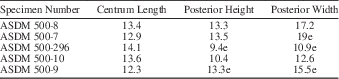
Ten anterior-middle caudal vertebrae (Fig. 10) were recovered from the Sonorasaurus quarry. All neural arches, centra, and transverse processes are fused. No tubercles are associated with the presumed line of fusion between the transverse process and neural arch, unlike the condition in some derived titanosaurs (e.g., Mendozasaurus, Baurutitan, Huabeisaurus; see D’Emic et al., Reference D’Emic, Mannion, Upchurch, Benson, Pang and Cheng2013 for discussion). All centra are wider than tall (Table 1) and lack internal pneumaticity or fossae or foramina on their lateral and ventral faces. There are no ventrolateral ridges connecting anterior and posterior chevron facets as in some titanosauriforms (e.g., Huabeisaurus, D’Emic et al., Reference D’Emic, Mannion, Upchurch, Benson, Pang and Cheng2013). Chevron facets have been over-prepared (i.e., mechanically removed during preparation, exposing interior bone) in several vertebrae, so their height relative to the rest of the vertebra is unknown (Fig. 10). Centra are relatively constant in length throughout the series (Table 1). The anteriormost preserved centrum in the series (ASDM 500-6) has damaged anterior and posterior faces. Centra of other vertebrae that are more anteriorly positioned in the series have anteriorly concave and posteriorly flat faces (e.g., ASDM 500-7, -8, -294), as in many non-lithostrotian sauropods (D’Emic, Reference D’Emic2013). Centra of vertebrae that are more posteriorly positioned in the series have equally concave anterior and posterior faces (e.g., ASDM 500-10). Transverse processes of more anterior caudal vertebrae are blade–like and curve posteriorly to project past the posterior margin of the centrum, whereas transverse processes of more posterior caudal vertebrae are simple tubercles (Fig. 10.6). The postzygapophyses are anteroposteriorly elongate and project abruptly from of the neural spine posteriorly along with posterior reduction of the SPOL, a feature interpreted as an autapomorphy of Lusotitan (Mannion et al., Reference Mannion, Upchurch, Barnes and Mateus2013) that is present in Cedarosaurus, Giraffatitan, and several other sauropods as well. The prezygapophyses and neural spine are incomplete or missing in all of the caudal vertebrae, but a shallow ridge and fossa are present anterior to the postzygapophyses on two of the better preserved-vertebrae (ASDM 500-10, -296). This ridge and fossa were described as an autapomorphy of Lusotitan by Mannion et al. (Reference Mannion, Upchurch, Barnes and Mateus2013), but this feature has a broader distribution among sauropods (see below).
Measurements of well-preserved caudal vertebrae of Sonorasaurus thompsoni from the middle Cretaceous of Arizona, USA
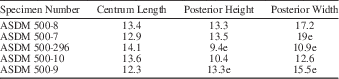
Measurements are in cm.
e, estimated measurement.
Scapula
A partially complete scapula was reported and figured by Thayer and Ratkevitch (Reference Thayer and Ratkevitch1995:fig. 6), but we could not find a bone matching that depicted in the field photograph, nor could we find more than two small fragments of the scapular blade. The two fragments indicate that the blade was broadly D-shaped in cross-section proximally and flatter distally (Fig. 11).
Humerus
The right humerus is missing most of its proximal end and its midshaft is damaged (Fig. 12). Based on comparisons with the humerus of Brachiosaurus and the 2:3 radius: humerus length ratio common in sauropods (MDD, personal observation), it would have been around 150 cm long when complete (Table 2). Near its midshaft the humerus measures 16.8 cm transversely by 12.2 cm anteroposteriorly, with a circumference of approximately 47.5 cm. The humerus is elongate (estimated midshaft circumference/estimated total L =0.32). The lateral margin of the humerus is nearly straight, whereas the medial margin is bowed. The deltopectoral crest is incomplete and slightly curves medially. The proximolateral corner of the bone and the presence of a raised attachment site in the deltopectoral fossa for the supracoracoideus cannot be assessed due to damage. No ridges or tubercles are present on the posterolateral face of the bone, unlike the condition observed in most titanosaurs (Upchurch et al., Reference Upchurch, Barrett and Dodson2004; Wilson et al., Reference Wilson, D’Emic, Curry Rogers, Mohabey and Sen2009).
Measurements of limb bones of Sonorasaurus thompsoni from the middle Cretaceous of Arizona, USA
Measurements are in centimeters.
a-p, anteroposterior; d-v, dorsoventral; d, distorted measurement; e, estimated measurement; i, incomplete; lt, left; Min Circ, minimum circumference; mc, metacarpal; mt, metatarsal; rt, right; rv, travel.
The distal end of the humerus was misidentified as that of a femur by Ratkevitch (Reference Ratkevitch1998) and the distal metaphyseal circumference of the humerus was cited as the midshaft circumference of the femur in Benson et al. (Reference Benson, Campione, Carrano, Mannion, Sullivan, Upchurch and Evans2014). It has a well-developed, divided radial condyle that projects anteriorly from the bone. The ulnar condyle is muted anteriorly, but forms a sharp, slightly acute angle posteriorly. The ulnar condyle is especially developed into a triangular process that projects very far posteriorly when compared with most other sauropods, which is interpreted as an autapomorphy of Sonorasaurus convergently acquired in derived titanosaurs (Figs. 13, 8). The distal articular condyles are undivided when viewed in anteroposterior views (Fig. 13.1, 8), restricted to the distal face of the bone, and have a coarse crenulated texture indicative of a cartilaginous covering. There is a deep supracondylar fossa on the posterior face of the distal end of the humerus as in many other sauropods (Fig. 13.2).
Ulna
A right ulna is preserved in four segments that roughly articulate with one another and is mostly complete, only missing its anteromedial arm proximally (Fig. 14). The ulna is elongate with a slightly raised olecranon process and a slightly posteriorly expanded distal end. The cross-sectional shape of the ulna varies along its length; near the proximal end, it is a ‘pinched’ triangle, with fossae on the anterior, posteromedial, and posterolateral faces, though these fossae are exaggerated by crushing (Fig. 14). More distally, these fossae shallow and the cross-section becomes subtriangular. A well-developed ridge for ligamentous attachment to the radius is present obliquely along the anterior face of the bone. The distal end of the ulna is D-shaped, with a gentle concavity anteriorly for reception of the radius, a pointed lateral edge, and a gently rounded medial edge.
Radius
Both left and right radii were recovered from the Sonorasaurus quarry; the right (Fig. 15) is better preserved. The left radius appears to be slightly longer than the right (ca. 96 cm versus 90.2), though this seems to be an artifact of crushing and too much reconstruction along the shaft of the left radius. The other dimensions of the left and right radii are nearly identical (Table 2). The radius is very gracile with relatively unexpanded proximal and distal ends. The proximal end is D–shaped as in other sauropods, with an anterior pointed end, flat medial face, and rounded lateral face. Each radius bears a sharp ridge that extends obliquely along its length and a parallel, rounder ridge that extends for only part of its midshaft (Fig. 10); these ridges mark the ligaments for attachment of, and bound the articulation site for, the ulna (Borsuk–Bialynicka, Reference Borsuk-Bialynicka1977). The midshaft of the radius is oval and about 1.2 times broader than wide. The distal end of the radius is orthogonal to the long axis of the bone, unlike the condition in deeply nested titanosaurs (Wilson, Reference Wilson2002). The distal end is roughly oval in shape, with a small embayment on the posteromedial margin (accentuated by damage), as in most sauropods (e.g., Camarasaurus, Ostrom and McIntosh, Reference Ostrom and McIntosh1966).
Manus
Four metacarpals were recovered from the Sonorasaurus quarry (Fig. 16); they are identified as metacarpals I, II, III, and IV based on comparisons with other sauropods (e.g., Camarasaurus, Giraffatitan, Venenosaurus). Only metacarpal I is complete; the other metacarpals are missing parts of their shafts, and metacarpal III is missing its distal end. The ratio of metacarpal I to the length of the shorter radius is 0.55 (Table 2; this ratio is 0.52 when the longer radius’ length is used), which is towards at the high end of the range known for sauropods (Mannion and Otero, 2012). When articulated, the metacarpals form a tight arc proximally. Herein we will describe the metacarpals oriented vertically as if the colonnade were unfurled, such that the exterior–facing part of each metacarpal will be called anterior, and the interior–facing part (the palmar surface) will be called posterior.
Metacarpal I is elongate (length/midshaft breadth =9.0; Table 2) with a straight medial border and curved lateral border (Fig. 16). The proximal end is D-shaped, with subequal anteroposterior and transverse dimensions, unlike the transversely compressed proximal end of metacarpal I in Venenosaurus (Fig. 17). The midshaft is rounded in cross section and bears a flat boss about two-thirds of the way up the shaft on its posterior side, as in the metacarpals of many sauropods (e.g., Camarasaurus, Ostrom and McIntosh, Reference Ostrom and McIntosh1966; Venenosaurus, Fig. 17). Distally, metacarpal I is subrectangular, undivided, and its articular face is orthogonal to the long axis of the bone. The posterior side of the distal end is weakly divided into medial and lateral condyles. Metacarpal II does not appear to be as gracile as metacarpal I (Table 2). Its proximal end forms an elongate triangle, whereas its distal end is subrectangular with two posteriorly projecting condyles (Fig. 16). As in other sauropods, the medial condyle (i.e., that facing metacarpal I) is better developed. The proximal and distal ends are subequal in area to those of metacarpal I. Little is preserved of metacarpal III; its proximal end is teardrop-shaped with a flat anterior face and pointed posterior face. Metacarpal IV is strongly damaged proximally. It tapers towards a narrow midshaft, and widens distally. As in the other metacarpals, the distal end has weakly divided condyles posteriorly, but is undivided distally (Fig. 16).
Metacarpals of Venenosaurus (DMNH 40932) from the Early Cretaceous Cedar Mountain Formation of Utah. Photographs taken by MDD in 2010. Abbreviations: bo=boss; ri=ridge.
Ilium
The left ilium is preserved as several fragments (ASDM 500-30, -371, -372, -373, -379; (Fig. 18) that do not fit together with complete precision. The preacetabular process flares laterally and is strongly expanded anterodorsally. All that is preserved of the right ilium is a 34 cm–long segment of the pubic peduncle, whose distal end measures an estimated 21 cm transversely (ca. 18 cm preserved) by 10 cm anteroposteriorly. Though the medial face is not completely preserved, it is clear that Sonorasaurus possessed the titanosauriform condition, in which the iliac peduncle is anteroposteriorly narrow and transversely broad (D’Emic, Reference D’Emic2012). Considering the left and right ilia together indicates that the pubic peduncle was very tall, resembling that of Giraffatitan (Janensch, Reference Janensch1961:pl. 198; Fig. 18). None of the many broken surfaces of the ilium reveal pneumaticity.
Holotypic ilia of Sonorasaurus thompsoni (ASDM 500) from the mid-Cretaceous Turney Ranch Formation of Arizona, USA: (1) partial left ilium in lateral view; (2) pubic peduncle of right ilium in lateral view; (3) same in anterior view; (4) same in posterior view; (5) same in distal view.
Tibia
The right tibia is poorly preserved and is missing much of its proximal and distal ends (Fig. 19). It measures at least 95.5 cm long, and its midshaft is D-shaped and measures 13.8 cm × 8.0 cm, with a circumference of 34.8 cm. Its distal end is expanded transversely relative to its midshaft, but this may be an artefact of crushing of the latter. Little else can be said about its morphology due to damage.
Holotypic right tibia of Sonorasaurus thompsoni (ASDM 500) from the mid-Cretaceous Turney Ranch Formation of Arizona, USA: (1) lateral; (2) medial; (3) anterior views, with schematic cross section depicted between (2) and (3).
Fibula
The right fibula is nearly complete, subequal in length to the radius and about four times the length of the central metatarsals (Table 2). The shaft is straight with a D-shaped cross section, and the proximal and distal ends are orthogonal to the shaft in mediolateral views (Fig. 20). The proximal half of the fibula expands gently on its anterior side but does not bear a well-developed anterior crest as in some titanosauriforms (e.g., Erketu, Euhelopus, Neuquensaurus, Wilson and Upchurch, Reference Wilson and Upchurch2009). The proximal end has a shallow medial fossa. Just above the midshaft, the lateral end bears a muscle scar composed of two bulbous ridges as in most sauropods (e.g., Camarasaurus, Ostrom and McIntosh, Reference Ostrom and McIntosh1966; Giraffatitan, Janensch, Reference Janensch1961, Neuquensaurus, Salgado et al., Reference Salgado, Apesteguía and Heredia2005). The distal end is beveled slightly upwards laterally and it expands abruptly as a dorsoventrally thick shelf in the medial direction (Fig. 20). The distal end of the fibula is parallelogram-shaped in distal view.
Holotypic right fibula of Sonorasaurus thompsoni (ASDM 500) from the mid- Cretaceous Turney Ranch Formation of Arizona, USA: (1) lateral; (2) posterior; (3) medial; (4) anterior; (5) proximal; (6) distal views, with cross section depicted between (1) and (2). Abbreviations: lip=medially projecting lip; ltr=lateral trochanter.
Pes
Four right metatarsals were recovered from the Sonorasaurus quarry (Fig. 21); they are identified as metatarsals I, II, IV, and V based on comparisons with other sauropods (e.g., Giraffatitan, Cedarosaurus, Gobititan). Eusauropod metatarsals are oriented subhorizontally (Wilson and Sereno, Reference Wilson and Sereno1998; Carrano, Reference Carrano2005) and will be described as such here. Metatarsal I is the shortest element, followed by metatarsal V; metatarsals II and IV are longer and subequal in length (Table 2). No collateral ligament pits or medial/lateral tubercles are present on the distal ends or shafts of the metatarsals.
Holotypic right metatarsals of Sonorasaurus thompsoni (ASDM 500) from the mid-Cretaceous Turney Ranch Formation of Arizona, USA.
Metatarsal I has a stout shaft with weakly flaring proximal and distal ends. The proximal end is D-shaped, pointed dorsally, and longer dorsoventrally than transversely. The proximal (astragalar) articular face is beveled about 30 degrees relative to the long axis of the bone in both transverse (downwards medially) and dorsoventral (downward ventrally) senses. The distal end is undivided distally but bears two subequally developed condyles posteriorly, and is strongly beveled upward medially. A posterolateral process is present, although it is weaker than that observed in some diplodocoids (McIntosh et al., Reference McIntosh, Coombs and Russell1992) or other sauropods such as Giraffatitan (D’Emic, Reference D’Emic2012). No tubercles are found on the medial and/or lateral face of metatarsal I, in contrast to the situation in Cedarosaurus and Venenosaurus. Metatarsal I of Sonorasaurus is more gracile than that bone in either of the two latter genera (Figs. 21–23).
Metatarsals of Cedarosaurus (DMNH 39045) from the Early Cretaceous Cedar Mountain Formation of Utah. Photographs taken by MDD in 2010. Abbreviation: tub=tubercle.
Metatarsals of Venenosaurus (DMNH 40932) from the Early Cretaceous Cedar Mountain Formation of Utah. Photographs taken by MDD in 2010. Abbreviation: tub=tubercle.
Metatarsal II is subrectangular in proximal view, with flat dorsal and medial faces and a curved lateral face for articulation with metatarsal III. A weak fossa is present on the ventral face of the proximal end as in some other sauropods (e.g., Ligabuesaurus, Gobititan; M.D.D. personal observation). The distal end of metatarsal II is beveled upward medially and is weakly divided. Metatarsal IV is more elongate than the other metatarsals. The proximal face is somewhat kidney-shaped, with a medial embayment as in some other titanosauriforms (D’Emic et al., Reference D’Emic, Williamson and Wilson2011). Its proximal margin is roughly orthogonal to the bone; in contrast, its distal end is strongly beveled upwards medially (ca. 20 degrees), unlike the condition in most sauropods, but similar to the condition in brachiosaurids (D’Emic, Reference D’Emic2012). The lateral margin of the shaft is nearly straight, whereas the medial margin is strongly curved. As in the other metatarsals (and metacarpals), the medial part of the distal end of the bone is more strongly developed than the lateral part. The dorsal face of the distal end is flat, whereas the ventral face is divided. Metatarsal V is funnel–shaped and dorsoventrally compressed as in other saurischians. Metatarsal V is autapomorphically elongate compared to other sauropods with the exception of Cedarosaurus, which has a rod-like (i.e., unexpanded) fifth metatarsal (D’Emic, Reference D’Emic2013). The proximal end forms a sharp angle across its face transversely in dorsoventral views, unlike the flat proximal ends of the other metatarsals. The area medial to this sharp bend represents a facet for articulation with metatarsal IV. The proximal end flares to over three times the midshaft breadth, whereas the distal end expands modestly to form a bulb. This is very different from the narrow proximal end of metatarsal V in Cedarosaurus (Fig. 21). The lateral curvature of metatarsal V is tighter than the medial curvature. On the dorsal face of the midshaft, a slight roughened area might indicate the insertion of a ligament or extensor tendon; this roughened area corresponds to a raised welt in some other sauropods (e.g., Gobititan).
Phalanges
Several phalanges were preserved in the holotypic quarry (Fig. 24); their disarticulation and poor preservation makes it difficult to identify them. The ungual phalangeal fragments are too poorly preserved to certainly tell if they belong to the manus or pes. The non-ungual phalanges likely belong to the pes based on the lack of distal flaring that would be present in manual phalanges, weak collateral ligament pits, and the overall proportions of the elements when compared with other sauropods (Fig. 24). The phalangeal formula is unknown.
Holotypic phalanges of Sonorasaurus thompsoni (ASDM 500) from the mid- Cretaceous Turney Ranch Formation of Arizona, USA: (1) dorsal; (2) ventral; (3) proximal; (4, 5) medial or lateral; (6) distal views. Depicted specimens from left to right are phalanx I.1 (ASDM 500–283), two proximal phalanges (ASDM 500–288, –286), and one more distal phalanx (ASDM 500–279). Two ungual phalanges are depicted in lateral or medial (7, 8) and dorsal (9, 10) views.
The non-ungual phalanges are broader transversely than they are dorsoventrally tall or proximodistally long (Table 2). Their proximal faces are gently cupped whereas their distal faces are convex and weakly divided into two condyles; this division is deeper ventrally. In proximal view the phalanges are D-shaped, with a flat ventral edge and a rounded dorsal edge whose apex is offset medially. The medial halves of the elements are more robust and have flat faces, whereas the lateral halves taper in dorsoventral and proximodistal senses. One phalanx (Fig. 24; ASDM 500-283) likely represents phalanx I.1 based on its fit with metatarsal I and comparisons with the referred pes of Cedarosaurus originally described by Gallup (1989; see D’Emic, Reference D’Emic2013 for description). This bone resembles the other non–ungual phalanges in its proximal profile, but distally it is subtriangular, with an upturned, laterally facing lip for articulation with the ungual phalanx, posteriorly divided condyles, and a tapering medial lip that is visible as a small tab in dorsal view. A small fossa on the lateral face of the bone is interpreted as a small collateral ligament pit (Fig. 24). A similar fossa is present on the lateral side of a more distal phalanx as well (ASDM 500-279).
Dorsal ribs
Many fragments of dorsal rib shafts are catalogued under ASDM 500, but none show the derived plank-like cross section of the anterior dorsal ribs of titanosauriforms (Wilson, Reference Wilson2002). The absence of this feature could be genuine or it could be the result of only middle-posterior ribs being preserved.
Growth and body size
Hill and Ratkevitch (Reference Hill and Ratkevitch1996) studied the bone histology of some fragments from the Sonorasaurus quarry; it is not certain which bones or regions of bones they analyzed. To standardize sampling against other studies (see Stein and Sander, Reference Stein and Sander2009), a core of the humerus was taken with a diamond–tipped drill bit from the midshaft of the posterior face 67 cm from the preserved proximal end and on the transverse midline of the bone. A thin section was prepared from the core according to the method of Stein and Sander (Reference Stein and Sander2009). The core reveals a section of primary fibrolamellar bone with predominantly circumferential vascularization (Fig. 25), as is common in sauropods (Sander, Reference Sander2000). Near the outer part of the core, vascularization tends to become more longitudinal, suggesting a decrease in apposition rate (Cubo et al., Reference Cubo, Le Roy, Martinez-Maza and Montes2012 and references therein). Primary vascular canals are small, with about half of their area filled with lamellar bone (Fig. 25); both of these features suggest relatively slow growth (Cubo et al., Reference Cubo, Le Roy, Martinez-Maza and Montes2012 and references therein). Secondary osteons are dense up to the about the last centimeter of the core, and a few are scattered to within half a centimeter of the edge of the bone. Eight lines of arrested growth (mostly double LAGs) are irregularly spaced within the outer ~11 mm of the cortex (Fig. 25), indicating highly variable growth if this core is representative of the entire cross section’s growth history. This represents histological ontogenetic stage (HOS) 11 of Klein and Sander (Reference Klein and Sander2008). HOS 11 in the brachiosaurid Giraffatitan indicates individuals that are about 75%–80% of the maximum known size for the species, which would suggest that Sonorasaurus was approaching adult size if these species shared similar growth histories. This body size can be estimated based on its humeral circumference: midshaft circumference of about 475 mm suggests a femoral circumference of 598 mm if Sonorasaurus was similarly proportioned to its close relative Giraffatitan. Using the equation provided by Campione and Evans (2012), the mass of this subadult individual of Sonorasaurus was nearly 17,000 kg, only slightly larger than that of the Cedarosaurus holotype (ca. 15,000 kg, Benson et al., Reference Benson, Campione, Carrano, Mannion, Sullivan, Upchurch and Evans2014) and about half that of the largest known individuals of Giraffatitan brancai (ca. 34,000 kg, Benson et al., Reference Benson, Campione, Carrano, Mannion, Sullivan, Upchurch and Evans2014).
Bone histology of the humerus of Sonorasaurus thompsoni (ASDM 500) from the mid-Cretaceous Turney Ranch Formation of Arizona, USA: (1, 2, 3) at right indicate detail of corresponding regions of section at left. Arrowheads denote lines of arrested growth; brackets and arrowheads denote multiple lines of arrested growth deposited within one year (i.e., double LAGs). Abbreviations: po=primary osteon; so=secondary osteon.
‘Gastroliths’
Thayer and Ratkevitch (Reference Thayer and Ratkevitch1995) and Ratkevitch (Reference Ratkevitch1998) reported the presence of several gastroliths from the holotype quarry of Sonorasaurus thompsoni. Thayer and Ratkevitch (Reference Thayer and Ratkevitch1995:74) gave five lines of evidence to support their identification of gastroliths: “(1) highly polished; (2) exotic types of rock for the region; (3) high in silica; (4) out of sedimentological context; 5) in formations known to contain fossils for gastroliths—using animals such as ornithopods and sauropods.” However, these lines of evidence are problematic, and the purported presence of gastroliths in general in sauropods has been challenged (Wings and Sander, Reference Wings and Sander2007). Regarding point (1), a polish similar to that seen on the ‘gastroliths’ of the Sonorasaurus quarry is not expected (Wings and Sander, Reference Wings and Sander2007). Regarding points (2) and (3), the Turney Ranch Formation contains abundant ‘gastroliths’ regardless of the presence of associated bone (MDD, BZF, NJ personal observation, 2014), as well as other ‘exotic’ clasts such as cobbles of Paleozoic limestone and pre-Phanerozoic reworked zircon crystals (Dickinson et al., Reference Dickinson, Lawton and Gehrels2009; see above/below). Regarding point (4), the ‘gastroliths’ attributed to Sonorasaurus were scattered around the quarry, and the quarry preserves some channel-lag deposits containing pebbles (Ratkevitch, Reference Ratkevitch1998; Scarborough, Reference Scarborough2000), so the sedimentological context speaks to an abiological origin for these clasts. Finally, point (5) is circular. Further evidence is required to substantiate the presence of gastroliths in Sonorasaurus.
Cladistic analysis
In order to understand the lower–level relationships of Sonorasaurus, we used the character-taxon matrix from a recent cladistic analysis designed to investigate the relationships of early titanosauriforms (D’Emic, Reference D’Emic2012). We chose to use the smaller matrix of D’Emic (Reference D’Emic2012) rather than the larger matrix of Mannion et al. (Reference Mannion, Upchurch, Barnes and Mateus2013) because the latter employs many interrelated characters. For example, Mannion et al. (Reference Mannion, Upchurch, Barnes and Mateus2013) separately coded the gracility of the humerus (character 42), radius (character 45), ulna (character 50), and first metacarpal (character 53). However, these are biologically related features in sauropods—sauropods with gracile forelimbs tend to have each long bone elongated, not just one segment (McIntosh, 1990). Likewise, characters 141 and 144 of Mannion et al. (Reference Mannion, Upchurch, Barnes and Mateus2013), which code the extent and style of pneumaticity in the dorsal vertebrae, are related. Other characters are also biologically related: Mannion et al. (Reference Mannion, Upchurch, Barnes and Mateus2013) separately coded variation in the cross sectional shape of the pubic peduncle of the ilium (C57) and the iliac peduncle of the pubis (C58), but since these structures directly articulate, their shapes should not be coded independently. A similar problem exists in coding the prominence of the olecranon process of the ulna (C233 of Mannion et al., Reference Mannion, Upchurch, Barnes and Mateus2013) separately from the depth of the supracondylar fossa on the posterior face of the distal humerus (C228 of Mannion et al., Reference Mannion, Upchurch, Barnes and Mateus2013), which receives the olecranon process. Similarly, characters C15, 16, 17, 21, 22, 25, 26, 28, 29, 30, and 31 deal with the proportions of vertebral centra; though this feature does display variation along the column, it does not vary independently as eleven characters. An argument could be made that all of these characters are independent if they do not display identical scorings, but subtle differences could be due to the vicissitudes of preservation or the delineation of states by a given researcher; their biological relatedness indicates that they should not be split (see Gingerich et al., Reference Gingerich, Franzen, Habersetzer, Hurum and Smith2010). The effect of oversplitting these characters gives them greater weight, biasing the analysis in favor of them. A full discussion of the effects of character atomization and appropriate matrix size is beyond the scope of this paper—for recent debates of this issue, see discussions surrounding pterosaurs (Nesbitt, Reference Nesbitt2011, Bennett, Reference Bennett2013), turtles (Gaffney and Jenkins, Reference Gaffney and Jenkins2010; Joyce and Sterli, Reference Joyce and Sterli2012), and primates (Williams et al., Reference Williams, Kay, Kirk and Ross2010; Gingerich et al., Reference Gingerich, Franzen, Habersetzer, Hurum and Smith2010).
We made modifications to the matrix of D’Emic (Reference D’Emic2012) for our analysis of Sonorasaurus. We added two OTUs, Sonorasaurus and Lusotitan, and we altered 15 character state scores for Europasaurus based on recently published material (Carballido and Sander, 2013; Marpmann et al., 2014). These include character 9 (1 to 0), characters 18, 30, 31, 33, 35, 36, 49, 53, 56, 57, 63 (? to 0), and characters 51 and 59 (? to 1). Three characters (Table 3) were added to the matrix of D’Emic (Reference D’Emic2012). First, a character was added to describe the posterior elongation of middle dorsal vertebral centra and consequent anterior displacement of the neural arch. In most sauropods, the middle dorsal vertebral centra are not much longer than the base of their respective neural arch (e.g., Shunosaurus) or they are 20%–30% longer, with the neural arch displaced somewhat anteriorly (e.g., Camarasaurus, Tehuelchesaurus, Neuquensaurus, MDD personal obsservation). In some middle dorsal vertebrae of Sonorasaurus and Giraffatitan, the neural arch occupies only about the anterior 50% of the centrum, representing a third, derived state. This multistate character was treated as unordered. The second new character describes the abrupt posterior projection of the postzygapophyses and related reduction in the spinopostzygapophyseal lamina (spol), which was regarded as an autapomorphy of Lusotitan by Mannion et al. (Reference Mannion, Upchurch, Barnes and Mateus2013) but has a wider distribution (e.g., Sonorasaurus, Giraffatitan, Europasaurus, M.D.D. personal observation). Third, a character was added to describe the anteroposterior ridge extending between the zygapophyses in middle caudal vertebrae; this character was also regarded as an autapomorphy of Lusotitan by Mannion et al. (Reference Mannion, Upchurch, Barnes and Mateus2013), but is present in other sauropods, for example Camarasaurus, Giraffatitan, and Sonorasaurus. Finally, an error was present in character 36 of D’Emic (Reference D’Emic2012); this character deals with the posterior centroparapophyseal lamina (pcpl), not the posterior centrodiapophyseal lamina (pcdl) as stated. All other protocols followed those outlined in D’Emic (Reference D’Emic2012), including the content of each OTU (e.g., the expanded hypodigm of Sauroposeidon based on material referred by D’Emic and Foreman, Reference D’Emic and Foreman2012 and D’Emic, Reference D’Emic2013). The nexus file is available as supplemental information (Supplemental Data 5).
Characters added to the matrix of D’Emic (Reference D’Emic2012)

Sixty equally parsimonious trees were recovered of treelength 214. A strict consensus of these trees is identical to that of D’Emic (Reference D’Emic2012) with the addition of Sonorasaurus and Lusotitan within the Brachiosauridae (Fig. 26). Sonorasaurus is positioned as the sister taxon of Giraffatitan, with this clade nested between Europasaurus and other brachiosaurids (Brachiosaurus altithorax, Abydosaurus, Cedarosaurus, Venenosaurus, and the newly added Lusotitan), which form a polytomy. The large amount of missing data for both Sonorasaurus and Lusotitan suggests that their lower-level (i.e., sister taxon) relationships should be treated with caution, and indeed, the decay (=Bremer) index of Brachiosauridae and included clades is only 1, in contrast to the value of 3 when Sonorasaurus and Lusotitan are not included in the analysis (see D’Emic, Reference D’Emic2012: table 7). Clades with a decay index greater than 1 include Euhelopodidae, Tehuelchesaurus + more deeply nested macronarians, and Chubutisaurus + more deeply nested somphospondylans (decay index=2), Macronaria, Titanosauriformes, and Somphospondyli (decay index=3), and Lithostrotia and Saltasauridae (decay index=5). Only one step is required to position Sonorasaurus as a more deeply nested brachiosaurid (or the sister taxon of any more deeply nested brachiosaurid), whereas two steps are required to position it as the sister taxon to Europasaurus or as the most basally branching brachiosaurid. Four steps are required to move Sonorasaurus outside Brachiosauridae, and 9 are required to position it as the sister taxon to the roughly contemporaneous North American taxon Sauroposeidon. Under DELTRAN, five synapomorphies support the monophyly of the Brachiosauridae (characters 5, 15, 40, 105, 121), 13 support the monophyly of brachiosaurids aside from Europasaurus (characters 2, 3, 4, 9, 10, 18, 36, 53, 56, 78, 81, 118, 112), one supports the monophyly of Giraffatitan and Sonorasaurus (character 120), and two support the five-way polytomy of deeply nested brachiosaurids (characters 79 and 93).
Cladistic hypothesis of relationships for Sonorasaurus thompsoni (ASDM 500) from the mid-Cretaceous Turney Ranch Formation of Arizona, USA.
Discussion
Phylogenetic relationships of Sonorasaurus
As perhaps one of the youngest sauropod taxa before the start of their Late Cretaceous North American hiatus, the phylogenetic relationships of Sonorasaurus are important for understanding the number of sauropod clades affected by their extirpation (D’Emic and Foreman, Reference D’Emic and Foreman2012). Anatomical information pertinent to the phylogenetic affinities of Sonorasaurus thompsoni is discussed below, based on the analysis presented herein and with the original author of each character cited. The dorsal vertebrae of Sonorasaurus do not display the sub-centimeter, pervasive pneumaticity that is characteristic of somphospondylan sauropods (Wilson and Sereno, Reference Wilson and Sereno1998), but instead have camerate to semicamellate pneumaticity (Wedel, 2003) as in basal titanosauriforms (e.g., Giraffatitan, Janensch, Reference Janensch1950). The dorsal vertebrae of Sonorasaurus also possess a hyposphene-hypantrum, suggesting affinities outside of deeply nested titanosaurs (Salgado et al., Reference Salgado, Coria and Calvo1997). Its caudal vertebrae are not procoelous, again suggesting affinities outside of derived titanosaurs. The limbs of Sonorasaurus are gracile, as in brachiosaurids (Janensch, Reference Janensch1961), some basal somphospondylans (Bonaparte et al., Reference Bonaparte, González Riga and Apesteguía2006, D’Emic, Reference D’Emic2012), and some titanosaurs (Gomani, Reference Gomani2005). The high metacarpal-to-radius ratio suggests affinities within Macronaria, and the undivided and orthogonally oriented distal end of metacarpal I (Wilson, Reference Wilson2002) and the anteroposteriorly compressed pubic peduncle of the ilium (D’Emic, Reference D’Emic2012) suggest placement within Titanosauriformes. The straight shaft and absence of an anterior crest on the proximal fibula suggest affinities outside or at the base of Somphospondyli (D’Emic, Reference D’Emic2012). Abruptly posteriorly expanded postzygapophyses are only found in Sonorasaurus, Giraffatitan, Europasaurus, Cedarosaurus, Lusotitan, and some specimens of Camarasaurus (this analysis). A ‘shoulder’ on the last several anterior caudal vertebrae (character 122) is found in Sonorasaurus, Giraffatitan, Lusotitan, Andesaurus, and some specimens of Camarasaurus, and is optimized in one part of the tree as a synapomorphy of brachiosaurids more deeply nested than Europasaurus (this analysis). The medial embayment of the proximal end of metatarsal IV suggests titanosauriform affinities (D’Emic, Reference D’Emic2012). The bevel of the distal end of metatarsal IV is a feature shared only with brachiosaurids (e.g., Abydosaurus, Giraffatitan; D’Emic, Reference D’Emic2012). Strongly posteriorly expanded middle dorsal vertebral centra are only found in Sonorasaurus, Giraffatitan, and Atlasaurus. The large amount of missing data present in Brachiosauridae and its disjunct anatomical pattern suggest caution in interpreting the lower-level relationships recovered within the clade. In other words, although Sonorasaurus can safely be regarded as a brachiosaurid, its lower-level affinities require additional data to firmly establish.
Interpretation of the paleoenvironment of Sonorasaurus
Our interpretation of the paleoenvironment of the Turney Ranch Formation is that of a well-drained, semi-arid alluvial plain subject to variable precipitation events. Previous studies (Archibald, Reference Archibald1982; Reference Archibald1987) argued for estuarine or coastal influence on deposition; however, we view this interpretation as problematic. First, no marine fossils have been recovered from the Turney Ranch Formation, nor have definitive marine trace fossils (Archibald, Reference Archibald1982; Reference Archibald1987). Indeed, there is a growing appreciation for the degree to which fully terrestrial strata can be significantly bioturbated (Hasiotis, Reference Hasiotis2002) and the presence of intense bioturbation in a localized area does not necessitate marine or estuarine conditions. Furthermore, previous reports of an Albian-Cenomanian marine interval at the top of the Turney Ranch Formation (Inman, Reference Inman1987; Dickinson et al., Reference Dickinson, Fiorillo, Hall, Monreal, Potochnik and Swift1989), transitional into the Fort Crittenden Formation are incorrect. Reassessment of the transition instead suggests a purely fluvial origin based on various sedimentary structures, internal scour surfaces, freshwater invertebrate fossils, and abundant pedogenic carbonate nodules (William R. Dickinson, personal communcation 2014). Upper plane bed laminations are a common occurrence within fully fluvial deposits and particularly common in fluvial systems subject to flashy, seasonal discharge (Fielding, Reference Fielding2006). Additionally, bar clinoforms do not display mud drapes on the foreset laminae (i.e., inclined heterolithic strata) commonly attributed to tidal influences on river flow patterns. The coarse-grained sandstone and conglomeratic units that entomb petrified logs combined with common scour-and-fill patterns within the fluvial systems (Archibald, Reference Archibald1982; this study) also support a flashy discharge regime for Turney Ranch fluvial systems. Ubiquitous development of pedogenic carbonate nodules and hardpan layers occur in modern environments where mean annual rainfall is less than 1.0 m/year and is variable (Cerling, Reference Cerling1984).
Furthermore, all stable isotope results are firmly consistent with terrestrial signals. The majority of δ18O values fall within the range of other pedogenic carbonates of the Early and Late Cretaceous (White et al., Reference White, González, Ludvigson and Poulson2001; Foreman et al., Reference Foreman, Fricke, Lohmann and Rogers2011). If we assume similar fractionation against 12C between soil organic matter and pedogenic carbonate (~15‰) as observed in modern soils (Cerling and Quade, Reference Cerling and Quade1993; Koch, Reference Koch1998), most Turney Ranch Formation δ13C values fall within the predicted range (−7‰ to −11‰ accounting for a difference in in the δ13C values between modern and mid-Cretaceous atmospheric CO2) if the landscape was dominated by C3 vegetation. Higher δ18O and δ13C values may indicate evaporation within the soil system and water stress to the plants (Cerling and Quade, Reference Cerling and Quade1993; Farquhar et al., Reference Farquhar, Ehleringer and Hubick1989) in the Turney Ranch Formation, consistent with a semi-arid climate.
Plant macrofossil evidence indicates that the broad floodplains of the Turney Ranch Fm. supported a taxodiaceous/cupressaceous (or possibly cheirolepidiaceous) evergreen woodland. Documented permineralized plant fossils from the Lower Cretaceous of southern Arizona so far consist only of conifer material. Stoyanow (Reference Stoyanow1949) mentioned specimens identified as Araucarioxylon from the Lower Cretaceous Lowell Formation in southern Arizona but provided no data on the features used to make that determination. All of the wood known from the Turney Ranch Formation is coniferous. In contrast, plant fossils from the Cedar Mountain Formation and the Dakota Formation (Albian-Cenomanian) in Utah and northern Arizona provide evidence of forested landscapes with a mix of conifers, small angiosperm trees, and tree ferns (Bailey, Reference Bailey1924; Andrews and Kern, Reference Andrews and Kern1947; Thayne et al., Reference Thayn, Tidwell and Stokes1983; Thayn et al., Reference Thayn, Tidwell and Stokes1985; Tidwell and Thayn, Reference Tidwell and Thayn1985). To the east, fusainized and silicified conifer wood from the Albian of Texas is clearly associated with the foliage and reproductive organs identified as Frenelopsis ramosissima (Axsmith and Jacobs, Reference Axsmith and Jacobs2005). The F. ramosissima wood is anatomically similar to the Turney Ranch wood in sharing abietinean pitting, mostly uniserate rays, indistinct/absent growth rings, and the absence of resin canals, but the tracheid and ray cells in the Turney Ranch wood are smaller, and the estimated tree height is taller for the Turney Ranch specimens. The low diversity of trees compared to assemblages from further north, if not due to sampling bias, probably reflects the ability of these southern trees to tolerate the periodic flooding that characterizes alluvial floodplain settings. The lack of growth rings in sampled wood seems to suggest that year-round conditions of temperature and water availability that were favorable to growth; however, even seasonally dry tropical forests can include both evergreen and deciduous species that do not produce distinct growth rings in the present (Worbes, Reference Worbes1999) and during the Cretaceous (Peralta-Medina and Falcon-Lang, Reference Peralta-Medina and Falcon-Lang2012). Despite the absence of growth rings in the wood, the small to medium diameter of the tracheids suggests the presence of drought resistance necessary to cope with a warm, variable climate (Wilson and Jackson, Reference Wilson and Jackson2006).
In sum, Turney Ranch Formation sedimentological, isotopic, and floral data together provide evidence for strong sub-annual variability in rainfall; there may have been one long dry season or several shorter dry periods spread throughout the year. In turn, these geological and floral data are congruent with the bone histology of Sonorasaurus, which indicates that its growth was generally more sporadic and slower than that of other sauropods (see above; Klein and Sander, Reference Klein and Sander2008). The holotype and only known specimen of Sonorasaurus died in an ‘inland’ environment in the categorization of Mannion and Upchurch (Reference Mannion and Upchurch2011); the full range of paleoenvironmental habitats inhabited by the species requires further discoveries to establish (D’Emic and Foreman, Reference D’Emic and Foreman2012).
Conclusions
Sonorasaurus, formerly one of the most enigmatic sauropods from the Cretaceous of North America, is herein shown to be taxonomically valid, one of the last sauropod taxa known before their Late Cretaceous North American hiatus, and one of the youngest members of the clade Brachiosauridae. Our investigation of its bone histology indicates that Sonorasaurus grew slowly and somewhat sporadically and likely only reached about half the adult body mass of the Late Jurassic brachiosaurids Giraffatitan or Brachiosaurus. This slow, irregular growth may have been related to its harsh environment. Our reinterpretation of the paleoenvironment of the Turney Ranch Formation that hosts the only known remains of Sonorasaurus based on new geologic and floral data suggests that it inhabited an inland, low relief evergreen woodland with highly variable precipitation. The presence of a brachiosaurid, an ornithopod similar to Tenontosaurus, and a carcharodontosaurine theropod suggests that the relative faunal homogeneity that characterized other Early Cretaceous North American basins to the north and east extended to southernmost Arizona as well.
Accessibility of supplemental data
Supplemental data deposited in Dryad data package: http://dx.doi.org/10.5061/dryad.51j0j
Acknowledgments
Thanks to R. Thompson for field assistance and information regarding the Sonorasaurus quarry and Bisbee Group in general. Thanks to D. Colodner, S. Norman, and C. Aslan (ASDM) for collections access, assistance, information, and hospitality at the ASDM. Thanks to M. Pecha at the University of Arizona LaserChron Center for assistance. J. Carballido (Museo Edigio Feruglio) kindly provided additional anatomical information about Europasaurus. Thanks to K. M. Melstrom (University of Utah) for field and collections assistance, B. Howes (Macalester College) for lab assistance, Jonathan Wingerath (Smithsonian Institution, NMNH) for assistance making thin sections of the silicified wood, C. Seiffert, S. Shurtleff, J. Latimer, A. Troidl, and T. Arce for assistance with permits, and R. Hill (New York Institute of Technology) and C. Rubin and S. Pongkitwitoon (Stony Brook University) for use of microscopy equipment. Thanks to W. R. Dickinson for discussions regarding the stratigraphy of the Turney Ranch and Cintura formations. Fieldwork was performed under permit numbers KE 29-1169191 and 2013-076ps. Thanks to reviewers M. Wedel and J. Fronimos and editor D. Varricchio for comments that improved the manuscript. Funding was provided by the Scott Turner Award of the University of Michigan and the National Geographic Foundation’s Committee for Research and Exploration (grant number 9252-13) to M.D.D.